
Life, 1924-08-14 · page 3 of 36
Life — August 14, 1924 — page 3: what you’re looking at
What you’re looking at
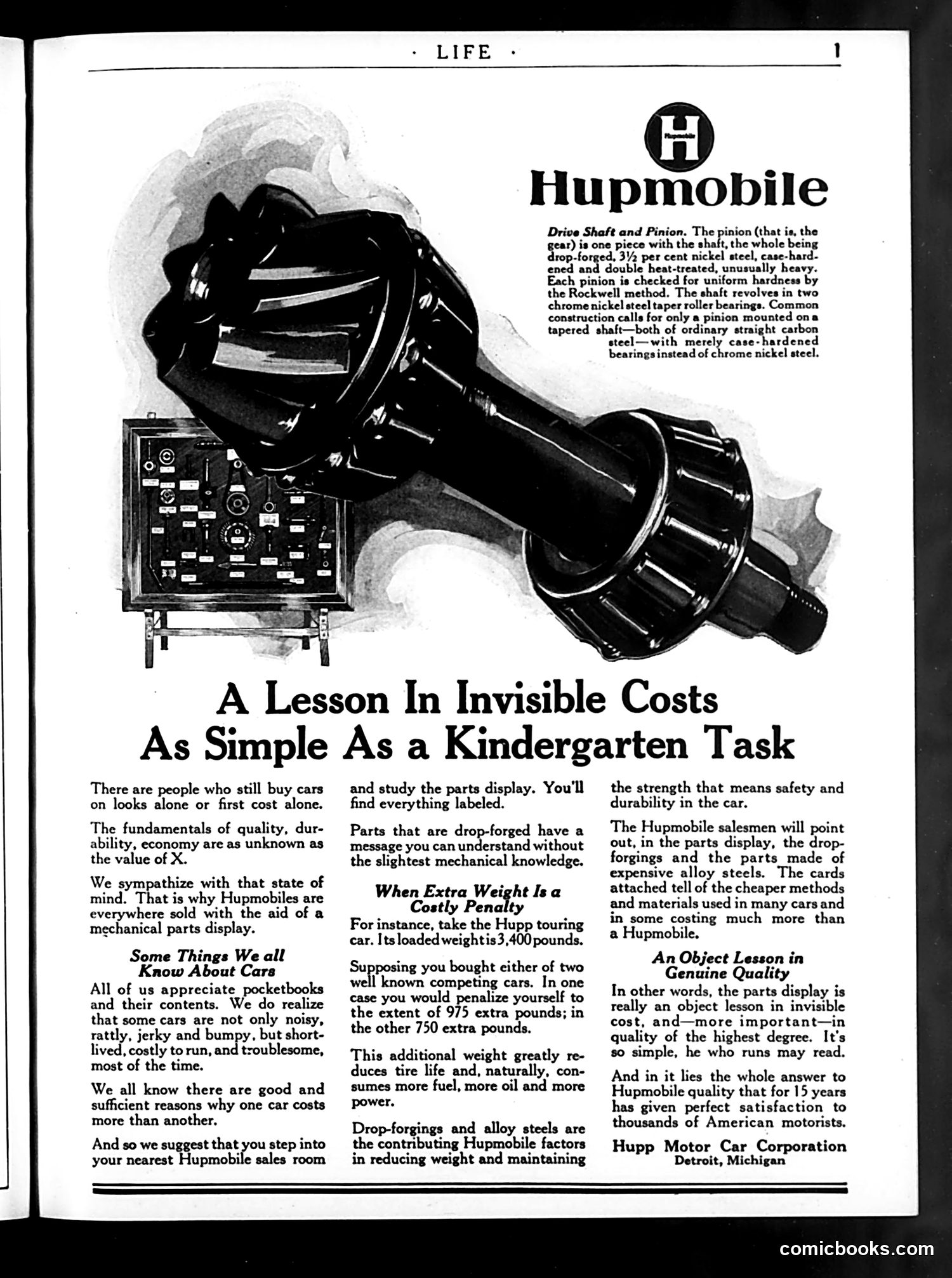
This is **not satire or political cartoon**, but rather a **straight automobile advertisement** from Life magazine's advertising pages. The Hupmobile company uses technical imagery—a large mechanical gear assembly and engine parts—to educate readers about manufacturing quality. The ad's central claim is that invisible engineering costs (materials, precision manufacturing, drop-forged steel components) justify the car's price, even if cheaper competitors exist. The headline ironically compares understanding automotive engineering to "a kindergarten task," suggesting that once buyers see the parts display explaining Hupmobile's superior construction, the quality justification becomes simple and obvious. This represents early 20th-century advertising strategy: educating consumers about mechanical specifications to justify premium pricing.
📄 Transcribed text from this page (OCR, searchable)
Machine-transcribed from the original scan — historical spelling and the odd misread are preserved.
Hupmobile Drive Shaft and Pinion. The pinion (that is, the ear) is one piece with the shaft, the whole being Soptorged. 314 per cent nickel steel, case-hard- ened and double heat-treated, unusually heavy. Each pinion is checked for uniform hardness by the Rockwell method. The shaft revolves in two chrome nickel steel taper roller bearings. Common construction calls for only a pinion mounted ona tapered shaft—both of ordinary straight carbon steel—with merely case-hardened bearings instead of chrome nickel steel. Costs A Lesson In Invisible As Simple As a Kindergarten Task There are people who still buy cars on looks alone or first cost alone. The fundamentals of quality, dur- ability, economy are as unknown as the value of X. We sympathize with that state of mind. That is why Hupmobiles are everywhere sold with the aid of a mechanical parts display. Some Things We all Know About Cars All of us appreciate pocketbooks and their contents. We do realize that some cars are not only noisy, rattly, jerky and bumpy, but short- lived, costly to run, and troublesome, most of the time. We all know there are good and sufficient reasons why one car costs more than another. And so we suggest that you step into your nearest Hupmobile sales room and study the parts display. You'll find everything labeled. Parts that are drop-forged have a message you can understand without the slightest mechanical knowledge. When Extra Weight Is a Costly Penalty For instance, take the Hupp touring car. Its loaded weightis 3,400 pounds. Supposing you bought either of two well known competing cars. In one case you would penalize yourself to the extent of 975 extra pounds; in the other 750 extra pounds. This additional weight greatly re- duces tire life and, naturally, con- sumes more fuel, more oil and more power. Drop-forgings and alloy steels are the contributing Hupmobile factors in reducing weight and maintaining the strength that means safety and durability in the car. The Hupmobile salesmen will point out, in the parts display, the drop- forgings and the parts made of expensive alloy steels. The cards attached tell of the cheaper methods and materials used in many cars and in some costing much more than a Hupmobile. An Object Lesson in Genuine Quality In other words, the parts display is really an object lesson in invisible cost, and—more important—in quality of the highest degree. It's so simple, he who runs may read. And in it lies the whole answer to Hupmobile quality that for 15 years has given perfect satisfaction to thousands of American motorists. Hupp Motor Car Corporation Detroit, Michigan comicbooks.com