
Life, 1924-08-14 · page 15 of 36
Life — August 14, 1924 — page 15: what you’re looking at
What you’re looking at
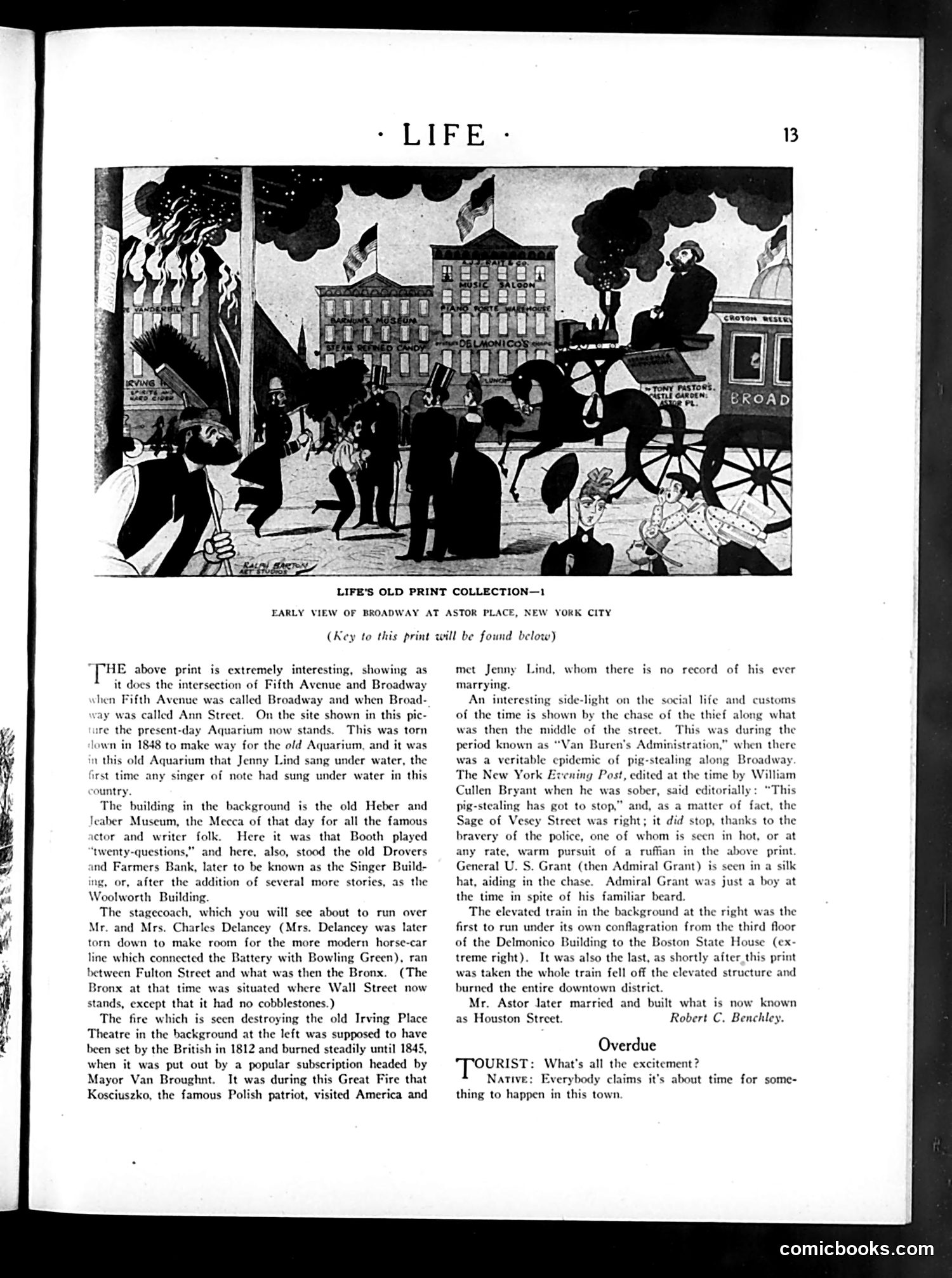
This page features "Life's Old Print Collection—1," showing an early 19th-century engraving of Broadway at Astor Place in New York City. The print depicts the intersection when Fifth Avenue was called "Broadway" and depicts the old Aquarium location. The accompanying text by Robert C. Benchley provides historical context: it identifies notable figures like Jenny Lind (a famous singer), General U.S. Grant, and references the Great Fire of 1812. The text discusses period details—pig-stealing along Broadway, the Heber and Jeaber Museum, and the elevated train at Delmonico Building. This isn't satirical commentary but rather historical documentation and explanation for modern readers, allowing them to understand the urban geography and social life of early New York City through an archival print.
📄 Transcribed text from this page (OCR, searchable)
Machine-transcribed from the original scan — historical spelling and the odd misread are preserved.
LIFE’S OLD PRINT COLLECTION: EARLY VIEW OF BROADWAY AT ASTOR PLACE, NEW YORK CITY (Key to this print will be found below) “THE above print is extremely interesting, showing as it does the intersection of Fifth Avenue and Broadway hen Fifth Avenue was called Broadway and when Broad- ay was called Ann Street. On the site shown in this pic- re the present-day Aquarium now stands. This was torn avn in 1848 to make way for the old Aquarium, and it was 1 this old Aquarium that Jenny Lind sang under water, the irst time any singer of note had sung under water in this country. The building in the background is the old Heber and caber Museum, the Mecca of that day for all the famous actor and writer folk. Here it was that Booth played “twenty-questions,” and here, also, stood the old Drovers ind Farmers Bank, later to be known as the Singer Build- ng, or, after the addition of several more stories, as the Woolworth Building. The stagecoa which you will see about to run over Mr. and Mrs. Charles Delancey (Mrs. Delancey was later torn down to make room for the more modern horse-car line which connected the Battery with Bowling Green), ran between Fulton Street and what was then the Bronx. (The Bronx at that time was situated where Wall Street now stands, except that it had no cobblestones.) The fire which is seen destroying the old Irving Place Theatre in the background at the left was supposed to have been set by the British in 1812 and burned steadily until 1845, when it was put out by a popular subscription headed by Mayor Van Broughnt. It was during this Great Fire that Kosciuszko, the famous Polish patriot, visited America and met Jenny Lind, whom there is no record of his ever marrying. An interesting side-light on the social life and customs of the time is shown by the chase of the thief along what was then the middle of the street. period known as “Van Buren's Administration,” when there was a veritable epidemic of stealing along Broadway The New York Evening Post, edited at the time by William Cullen Bryant when he was sober, said editorially: “This pig-stealing has got to stop,” and, as a matter of fact, the Sage of Vesey Street was right; it did stop, thanks to the bravery of the police, one of whom is scen in hot, or at any rate, warm pursuit of a ruffian in the above print. General U. S. Grant (then Admiral Grant) is seen in a silk hat, aiding in the chase. Admiral Grant was just a boy at the time in spite of his familiar beard. The elevated train in the background at the right was the first to run under its own conflagration from the third floor of the Delmonico Building to the Boston State House (ex- treme right). It was also the last, as shortly after this print was taken the whole train fell off the clevated structure and burned the entire downtown district. Mr. Astor later married and built what is 1 known as Houston Street. Robert C. Benchley. his was during the Overdue ‘OURIST: What's all the excitement? Native: Everybody claims it's about time for some- thing to happen in this town comicbooks.com