
Life, 1924-08-14 · page 26 of 36
Life — August 14, 1924 — page 26: what you’re looking at
What you’re looking at
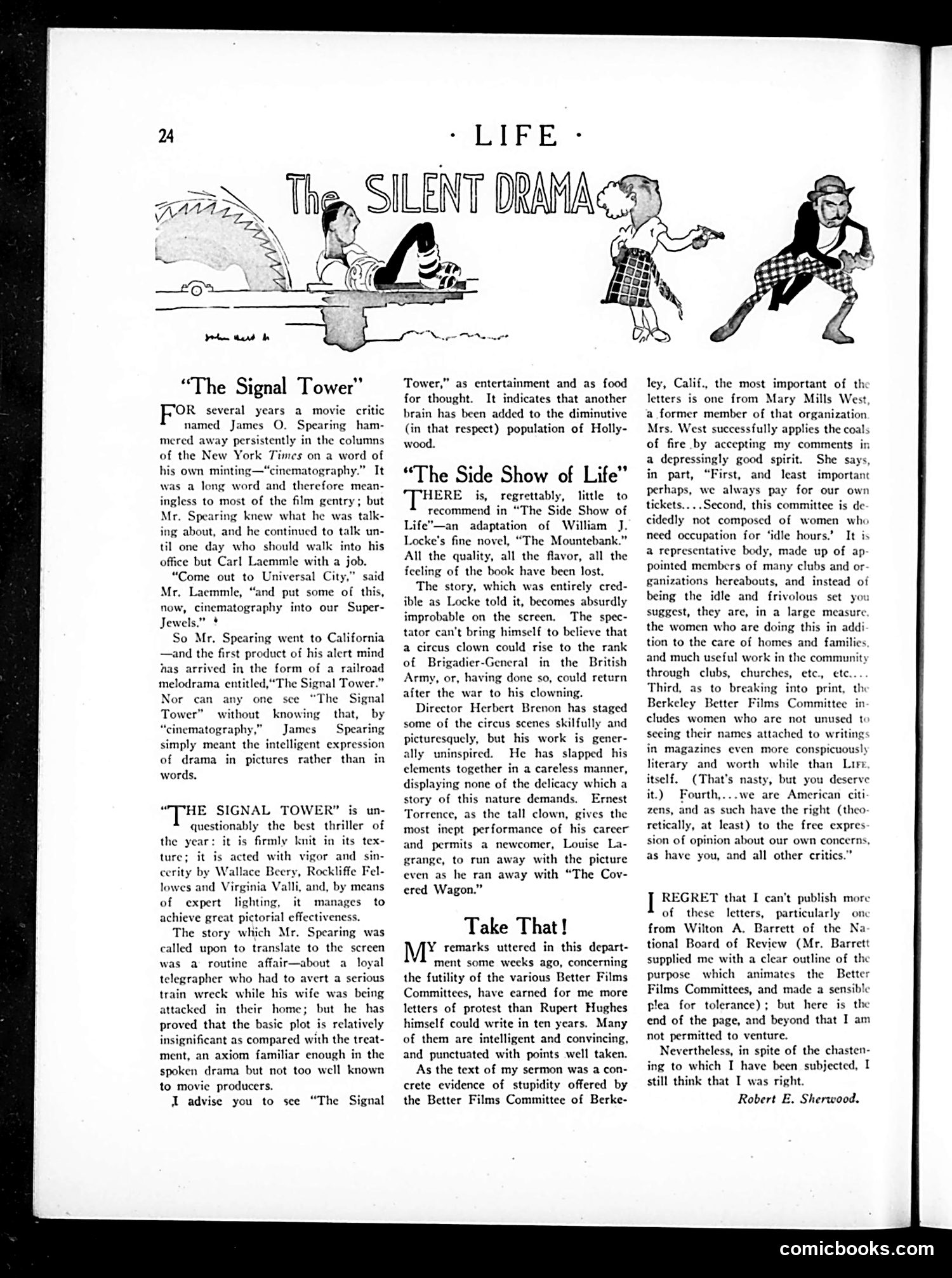
This page reviews three silent films and responds to criticism. **"The Signal Tower"** is praised as the year's best thriller, directed by critic James O. Spearing (hired by Carl Laemmle). The review celebrates Spearing's concept of "cinematography"—intelligent visual storytelling rather than mere plot. The film stars Wallace Beery and others in a routine railroad-melodrama plot (loyal telegrapher prevents train wreck during home attack), but Spearing's skilled treatment elevates it. **"The Side Show of Life,"** adapted from William J. Locke's novel, is criticized for losing the source material's quality. Director Herbert Brenon's careless staging makes the implausible plot (circus clown becomes British general) unbelievable. Ernest Torrence's poor performance is overshadowed by newcomer Louise Lagrange. **"Take That!"** addresses angry letters protesting the critic's earlier dismissal of Better Films Committees. Mary Mills West, a former committee member, responds graciously, defending the organization's work improving cinema standards.
📄 Transcribed text from this page (OCR, searchable)
Machine-transcribed from the original scan — historical spelling and the odd misread are preserved.
“The Signal Tower” For several years a movie critic named James O. Spearing ham- mered away persistently in the columns of the New York Times on a word of his own minting—“cinematography.” It was a long word and therefore mean- ingless to most of the film gentry; but Mr. Spearing knew what he was talk- ing about, and he continued to talk un- til one day who should walk into his office but Carl Laemmle with a job. “Come out to Universal City,” said Mr. Laemmle, “and put some of this, now, cinematography into our Super- Jewels.” * So Mr. Spearing went to California —and the first product of his alert mind has arrived in the form of a railroad melodrama entitled,“The Signal Tower.” Nor can any “The Signal Tower” without knowing that, by “cinematography,” James Spearing simply meant the intelligent expression of drama in pictures rather than in words. one sce “THE SIGNAL TOWER” is un- questionably the best thriller of the year: it is firmly knit in its tex- ture; it is acted with vigor and sin- cerity by Wallace Beery, Rockliffe Fel- lowes and Virginia Valli, and, by means of expert lighting, it manages to achieve great picto! effectiveness. The story which Mr, Spearing was called upon to translate to the screen was a routine affair—about a loyal telegrapher who had to avert a serious train wreck while his wife was being attacked in their home; but he has proved that the basic plot is relatively insignificant as compared with the treat- ment, an axiom familiar enough in the spoken drama but not too well known to movie producers. I advise you to sce “The Signal Tower,” as entertainment and as food for thought. It indicates that another brain has been added to the diminutive (in that respect) population of Holly- wood. “The Side Show of Life” HERE is, regrettably, little to recommend in “The Side Show of Life’"—an adaptation of William J. Locke's fine novel, “The Mountebank.” All the quality, all the flavor, all the feeling of the book have been lost. The story, which was entirely cred- ible as Locke told it, becomes absurdly improbable on the screen. The spec- tator can’t bring himself to believe that a circus clown could rise to the rank of Brigadier-General in the British Army, or, having done so, could return after the war to his clowning. Director Herbert Brenon has staged some of the circus scenes skilfully and picturesquely, but his work is gener- ally uninspired. He has slapped his elements together in a careless manner, displaying none of the delicacy which a story of this nature demands. Ernest Torrence, as the tall clown, gives the most inept performance of his career and permits a newcomer, Louise La- grange, to run away with the picture even as he ran away with “The Cov- ered Wagon.” Take That! MY remarks uttered in this depart- ment some weeks ago, concerning the futility of the various Better Films Committees, have earned for me more letters of protest than Rupert Hughes himself could write in ten years. Many of them are intelligent and convincing, and punctuated with points well taken. As the text of my sermon was a con- crete evidence of stupidity offered by the Better Films Committee of Berke- ley, Calif., the most important of the letters is one from Mary Mills West a former member of that organization. Mrs. West successfully applies the coals of fire by accepting my comments in a depressingly good spirit. She says, in part, “First, and least important perhaps, we always pay for our own tickets....Second, this committee is de cidedly not composed of women who need occupation for ‘idle hours.’ It is a representative body, made up of ap pointed members of many clubs and or- ganizations hereabouts, and instead of being the idle and frivolous set you suggest, they are, in a large measure. the women who are doing this in addi tion to the care of homes and families. and much useful work in the community through clubs, churches, etc., ete.. Third, as to breaking into print, the Berkeley Better Films Committee in cludes women who are not unused t seeing their names attached to writings in magazines even more conspicuously literary and worth while than Lire itself. (That's nasty, but you deserve it.) Fourth,...we are American citi zens, and as such have the right (theo retically, at least) to the free expres sion of opinion about our own concerns, as have you, and all other critics.” REGRET that I can't publish more of these letters, particularly one from Wilton A. Barrett of the Na tional Board of Review (Mr. Barrett supplied me with a clear outline of the purpose which animates the Better Films Committees, and made a sensible plea for tolerance); but here is the end of the page, and beyond that I am not permitted to venture. Nevertheless, in spite of the chasten- ing to which I have been subjected, I still think that I was right. Robert E. Sherwood. comicbooks.com