
Life, 1924-08-14 · page 16 of 36
Life — August 14, 1924 — page 16: what you’re looking at
What you’re looking at
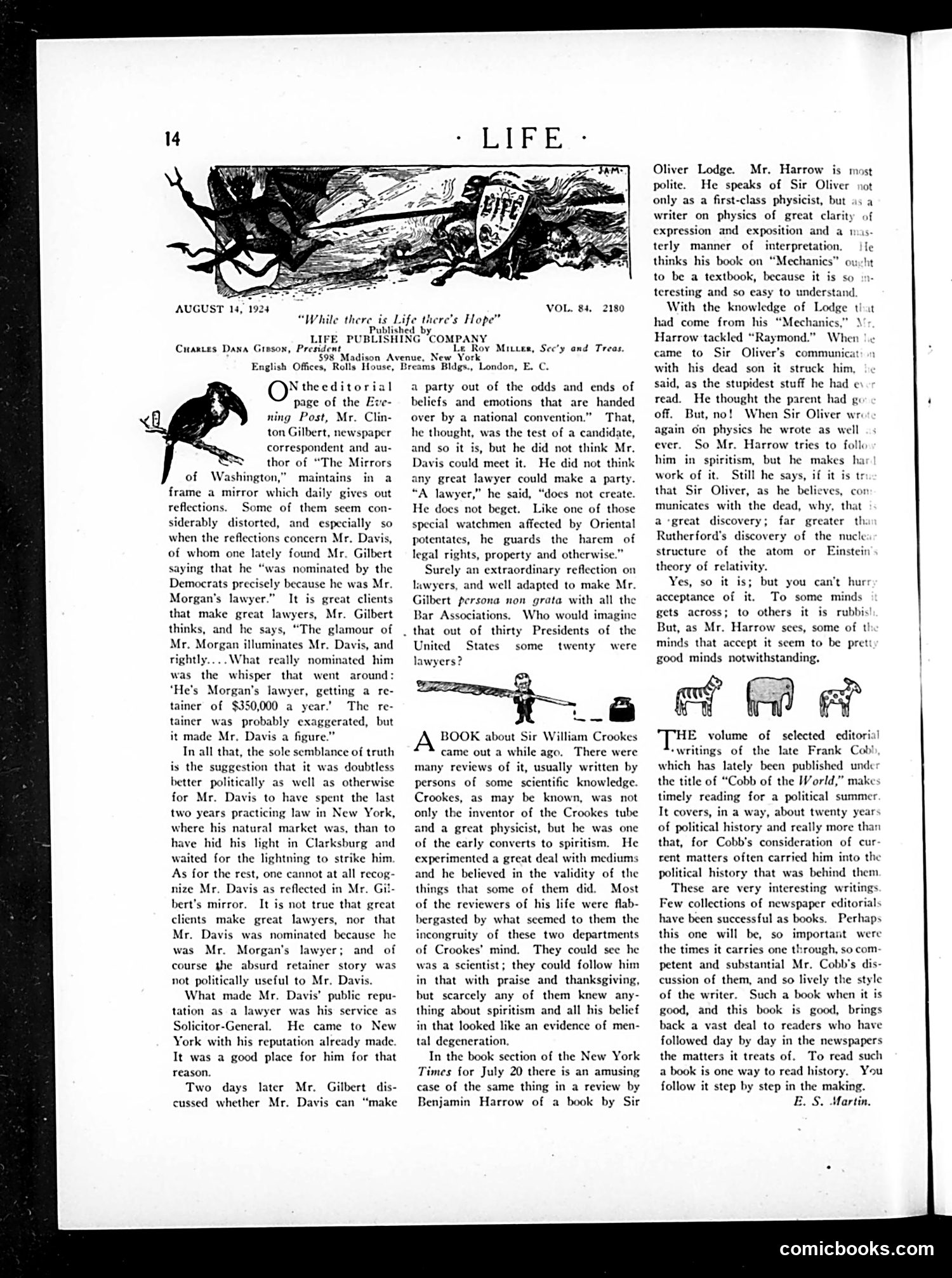
The page features a political cartoon titled **"While there is Life there's Hope"** depicting a figure labeled "LIFE" (the magazine itself) as a bird or phoenix-like creature emerging from or struggling with debris and obstacles. The accompanying text discusses a lawyer named **Mr. Davis** (likely John W. Davis, 1924 Democratic presidential candidate) and his nomination. The article critiques Davis's qualifications, noting he was nominated partly due to his connection to powerful clients like J.P. Morgan, rather than exceptional legal merit. The satire suggests Life magazine itself represents hope and resilience amid political and social challenges of the era. The piece questions whether mere client connections, rather than genuine ability, determine success in American law and politics—a commentary on corruption and privilege in the 1920s.
📄 Transcribed text from this page (OCR, searchable)
Machine-transcribed from the original scan — historical spelling and the odd misread are preserved.
AU “While there is Lif. VOL. 84, 2180 there's Hop Published by LIFE PUBLISHING COMPANY Cuantes Dana Grason, President, Le Roy Mites, Sec’y and Treas. $98 Madison Avenue, New York English Offices, Rolls House, Breams Bldgs., London, E. C. Ntheeditorial page of the E ning Post, Mr. Clin- ton Gilbert, newspaper correspondent and au- &S thor of “The Mirrors of Washington,” maintains in a frame a mirror which daily gives out reflections. Some of them seem con- siderably distorted, and especially so when the reflections concern Mr. Davis, of whom one lately found Mr. Gilbert ying that he “was nominated by the Democrats precisely because he was Mr. Morgan's lawyer.” It is great clients that make great lawyers, Mr. Gilbert thinks, and he says, “The glamour of Mr. Morgan illuminates Mr. Davis, and rightly....What really nominated him was the whisper that went around: ‘He's Morgan's lawyer, getting a re- tainer of $350,000 a year.’ The re- tainer was probably exaggerated, but it made Mr. Da a figure.” In all that, the sole semblance of truth is the suggestion that it was doubtless better politically as well as otherwise for Mr. Davis to have spent the last two years practicing law in New York, where his natural market was, than to have hid his light in Clarksburg and waited for the lightning to strike him. As for the rest, one cannot at all recog- nize Mr. Davis as reflected in Mr. Gil- bert’s mirror. It is not true that great clients ¢ great lawyers, nor that Mr. Davis was nominated because he was Mr. Morgan's lawyer; and of course the absurd retainer story was not politically useful to Mr, Davi What made Mr. Davis’ public repu- tation as a lawyer was his service as Solicitor-General. He came to New York with his reputation already made. It was a good place for him for that reason. Two days later Mr. Gilbert dis- cussed whether Mr. Davis can “make a party out of the odds and ends of beliefs and emotions that are handed over by a national convention.” That, he thought, was the test of a candidate, and so it is, but he did not think Mr. Davis could meet it. He did not think any great lawyer could make a party. “A lawyer,” he said, “does not crea He does not beget. Like one of those special watchmen affected by Oriental potentates, he guards the harem of legal rights, property and otherwis Surely an extraordinary reflection on lawyers, and well adapted to make Mr. Gilbert persona non grata with all the Bar Associations. Who would imagine . that out of thirty Presidents of the United lawyers? &, States some twenty were BOOK about Sir William Crookes came out a while ago. There were many reviews of it, usually written by persons of some scientific knowledge. Crookes, as may be known, was not only the inventor of the Crookes tube and a great physicist, but he was one of the carly converts to spiritism. He experimented a great deal with mediums and he believed in the validity of the things that some of them did. Most of the reviewers of his life were flab- bergasted by what scemed to them the incongruity of these two departments of Crookes’ mind. They could see he was a scientist; they could follow him in that with praise and thanksgiving, but scarcely any of them knew any- thing about spiritism and all his belief in that looked like an evidence of men- tal degeneration. In the book section of the New York Times for July 20 there is an amusing case of the same thing in a review by Benjamin Harrow of a book by Sir Oliver Lodge. Mr. Harrow is m polite. He speaks of Sir Oliver no: only as a first-class physicist, but writer on physics of great clarity of expression and exposition and a 1 terly manner of interpretation. thinks his book on “Mechanics” ou to be a textbook, because it is so teresting and so easy to understand. With the knowledge of Lodge tht had come from his “Mechanics, Harrow tackled “Raymond.” When came to Sir Oliver’s communicat with his dead son it struck him, said, as the stupidest stuff he had e read. He thought the parent had gx off. But, no! When Sir Oliver wr: again on physics he wrote as well ever. So Mr. Harrow tries to folk him in spiritism, but he mal ha work of it. Still he says, if it is tr that Sir Oliver, as he believes, con municates with the dead, why, that a-great discovery; far greater th Rutherford’s discovery of the nucle structure of the theory of relativity. Yes, so is; but you can’t hurr acceptance of it. To some minds gets across; to others it is rubbis But, as Mr. Harrow sees, some of t! minds that accept it seem to be pri good minds notwithstanding, atom or Einstein HE volume of selected editorial ritings of the late Frank Cob! which has lately been published unde the title of “Cobb of the World,” makes timely reading for a political summer It covers, in a way, about twenty years of political history and really more than that, for Cobb's consideration of cur rent matters often carried him into the political history that was behind them These are very interesting writings. Few collections of newspaper editorials have been successful as books. Perhaps this one will be, so important were the times it carries one through, so com- petent and substantial Mr. Cobb's dis- cussion of them, and so lively the style of the writer. Such a book when it is good, and this book is good, brings back a vast deal to readers who have followed day by day in the newspapers the matters it treats of. To read such a book is one way to read history, You follow it step by step in the making. 2. S. Martin. comicbooks.com