
A complete issue · 40 pages · 1924
Life — May 1, 1924
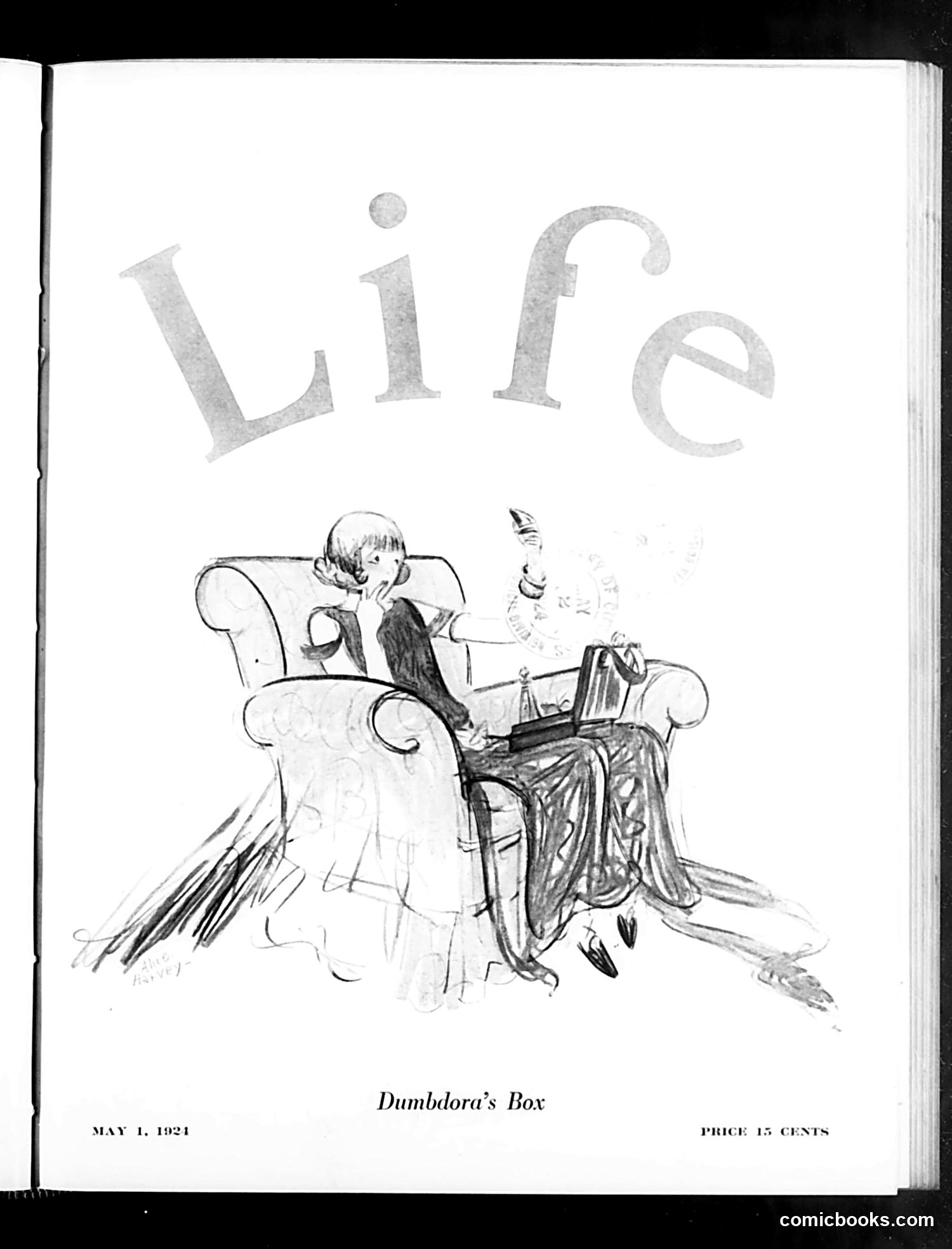
This satirical illustration depicts a figure lounging in an ornate chair, appearing to read or hold some kind of publication or document. The title "Dumblord's Box" suggests mockery of someone perceived as foolish or unintelligent—"dumb" combined with a title of nobility ("lord"). The 1924 date places this during the post-WWI era. Without clearer context identifying the specific figure, the cartoon appears to be political satire targeting either a public figure or a type of person (possibly a wealthy, lazy aristocrat or politician) that Life's readership would have recognized. The elaborate chair and leisurely pose suggest critique of privilege, indolence, or disconnection from everyday concerns.
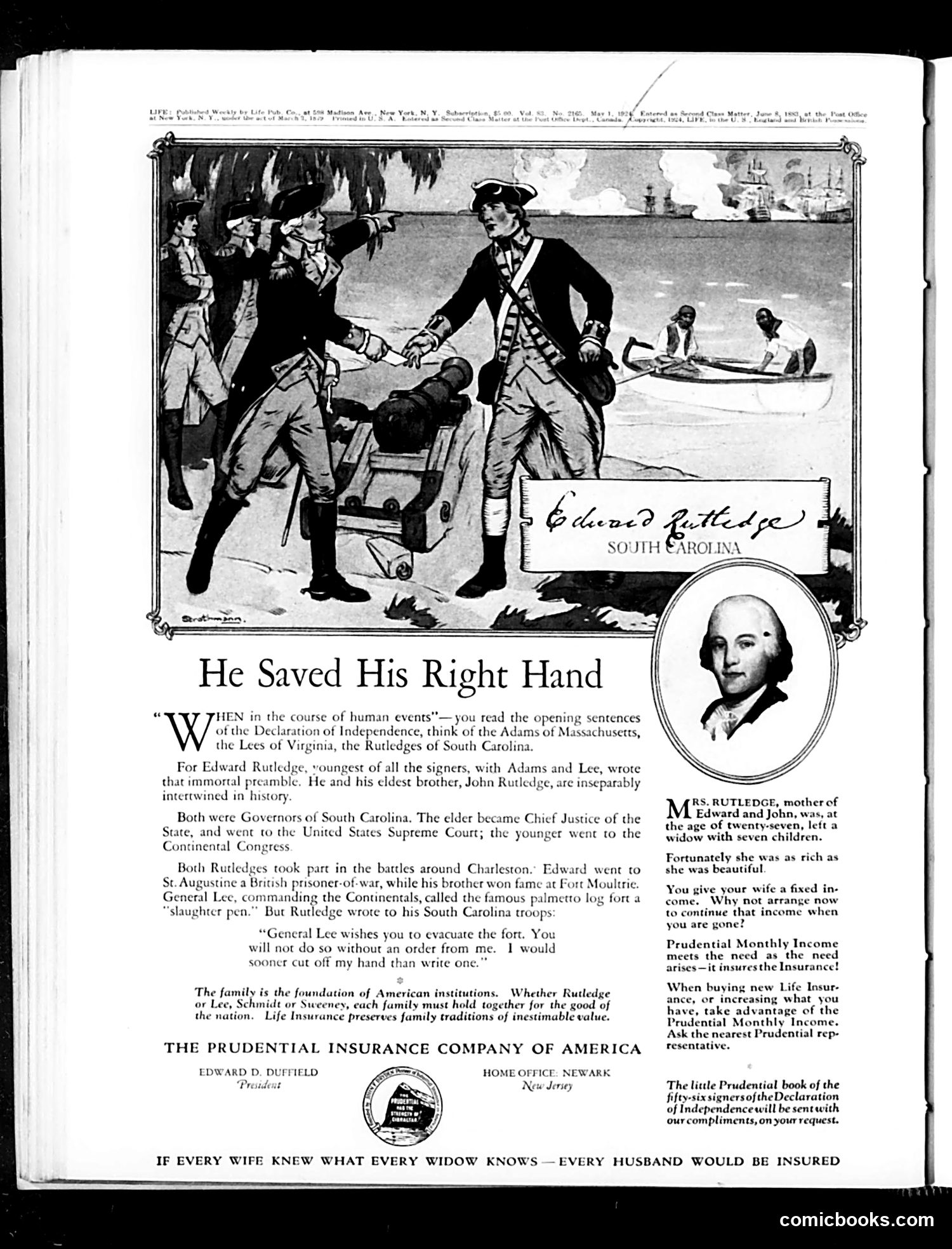
This is primarily a **Life magazine advertisement for Prudential Insurance**, using historical patriotism as marketing strategy. The illustrated scene depicts **Edward Rutledge**, identified as the "youngest" signer of the Declaration of Independence. The cartoon shows him losing his right hand in military service during the Revolutionary War, illustrating the tagline "He Saved His Right Hand." The biographical text emphasizes Rutledge's patriotic sacrifice and his prominent role as South Carolina Governor and Supreme Court Justice. His mother is featured in a portrait, described as "as rich as she was beautiful." **The satire/pitch**: By linking life insurance to patriotic legacy and family preservation, Prudential argues that protecting one's family financially is as important as military service. The closing slogan states: "If every wife knew what every widow knows—every husband would be insured."
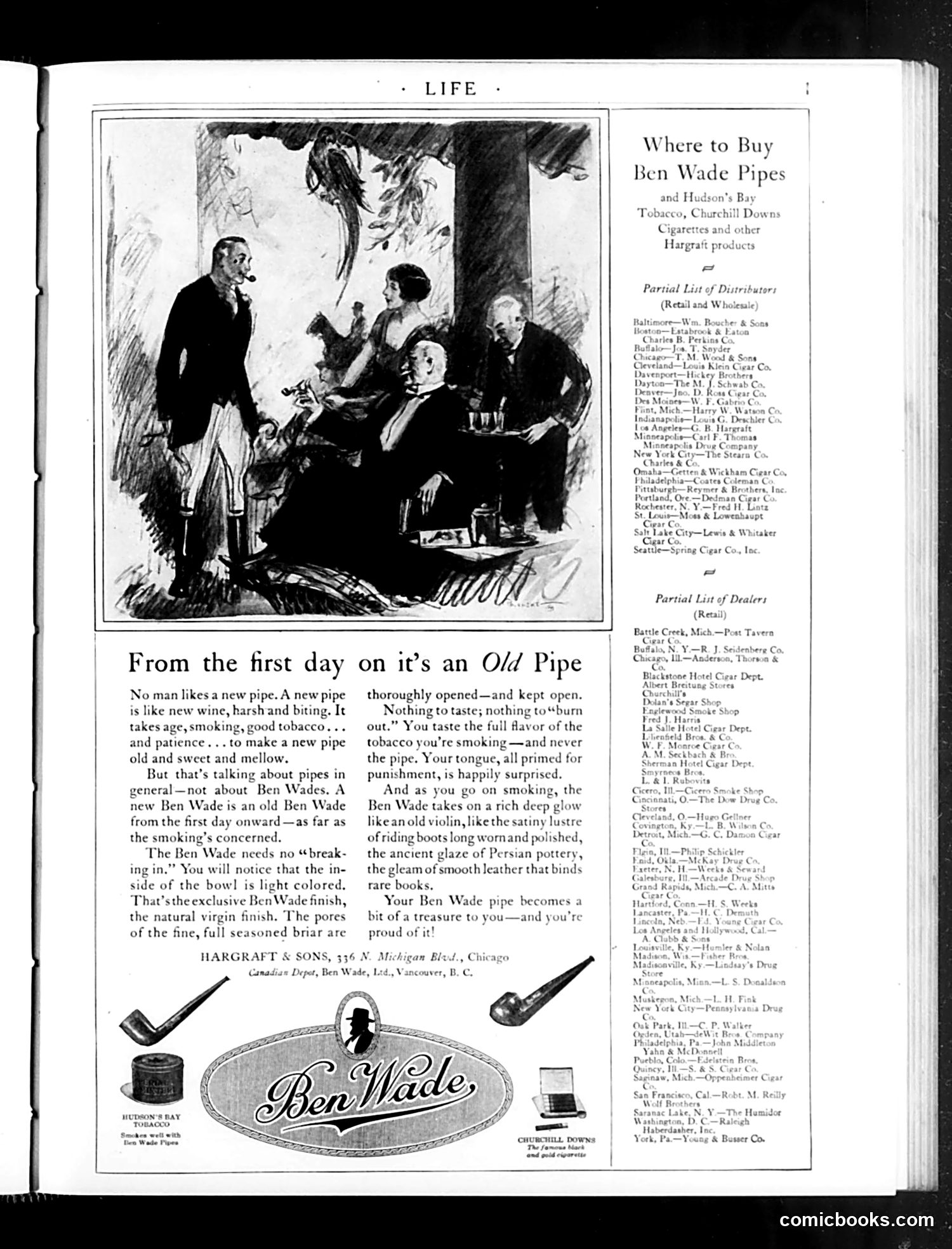
This page is **primarily advertising**, not satire or political commentary. The main illustration is a Ben Wade pipe advertisement, not a cartoon with political meaning. The sketch shows what appears to be a social gathering of gentlemen in a parlor or club setting, smoking pipes. The accompanying text is a sales pitch emphasizing that Ben Wade pipes improve with age and use—they need "breaking in" like fine wine, developing a "deep glow" and rich patina over time. The advertisement includes distributors and dealers lists across North America. The small pipe product images and Hudson's Bay Tobacco branding at bottom reinforce this is straightforward commercial messaging aimed at pipe-smoking consumers, not satirical commentary on contemporary events or figures.
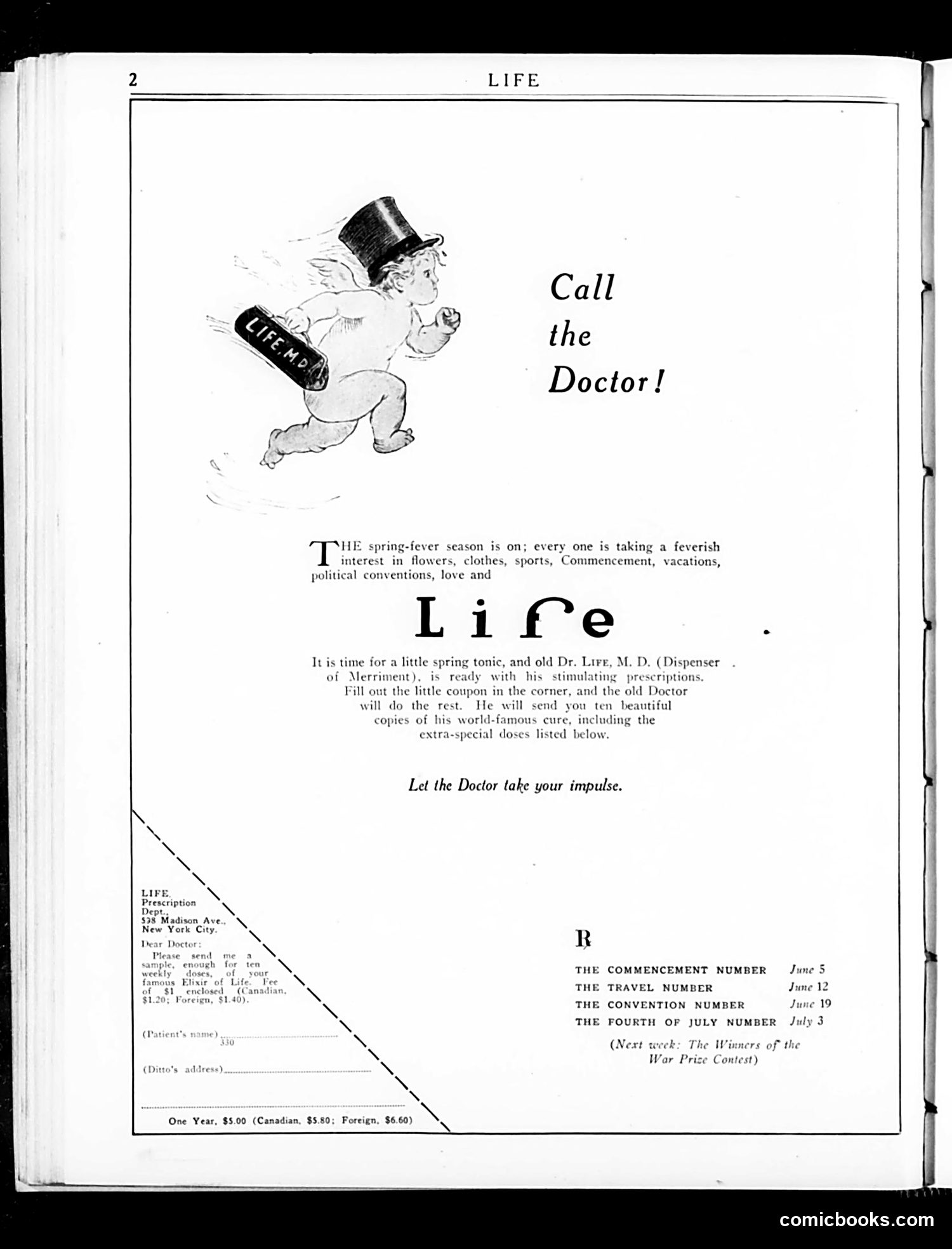
This is primarily a **Life magazine advertisement**, not political satire. It advertises "Life" brand patent medicine as a spring tonic. The cartoon shows a cherubic child in a top hat carrying a bottle labeled "LIFE MED" running energetically with text "Call the Doctor!" The ad plays on spring fever—a seasonal condition—to market Dr. Lire's stimulating tonic prescription. The humor is gentle wordplay: the magazine *Life* advertises "Life" brand medicine, positioning the product as a spring remedy for the season's "feverish interest" in various activities. The coupon offers free samples and "extra-special doses." This reflects early 20th-century patent medicine marketing, when such tonics were heavily advertised in magazines despite dubious efficacy. The advertisement occupies the entire page—there is no separate political cartoon here.
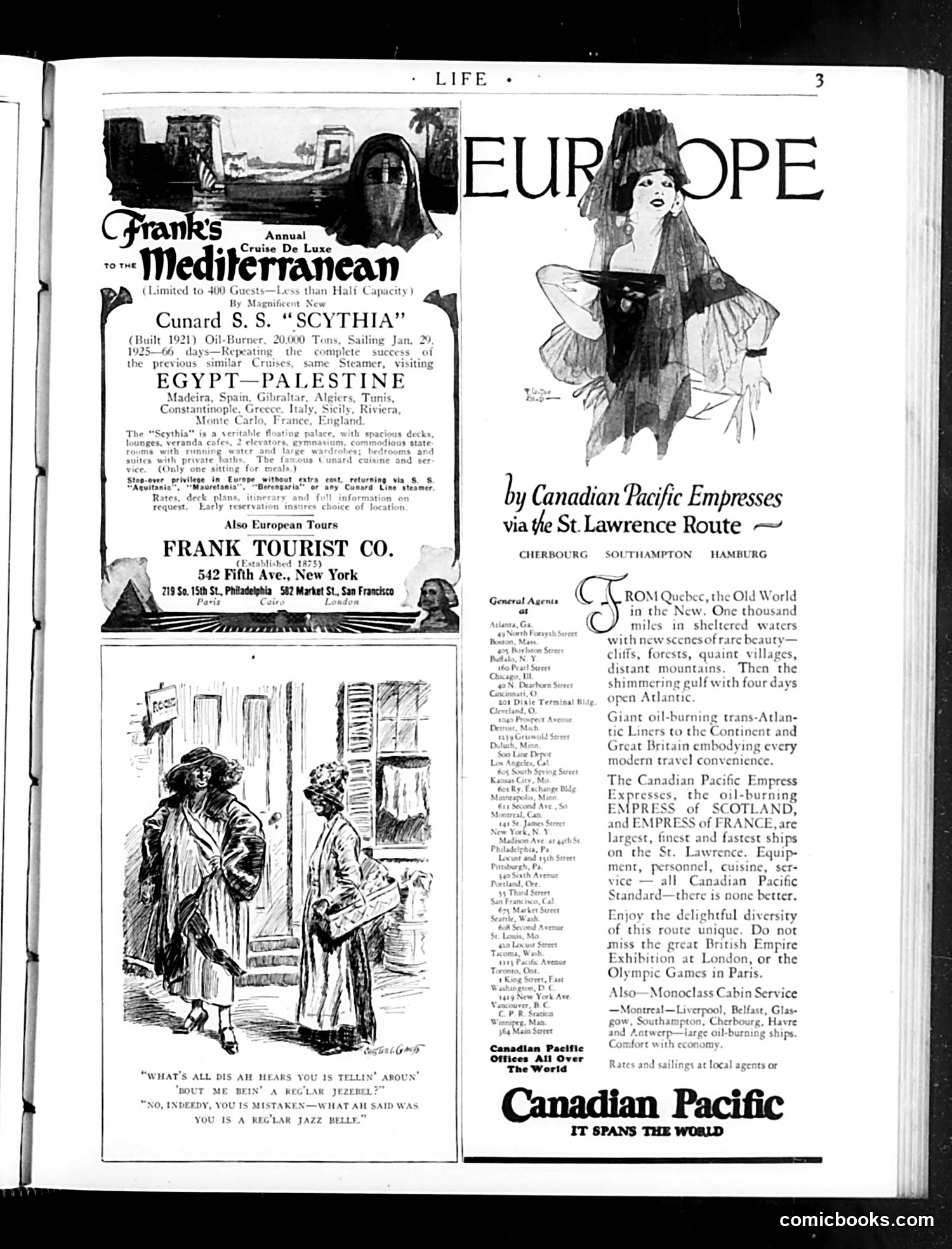
This page is primarily **advertising**, not political satire. The left side advertises Frank's Tourist Company's Mediterranean cruise on the Cunard S.S. *Scythia* (built 1921), offering tours to Egypt and Palestine with stops including Spain, Gibraltar, and the Riviera. The right side features a stylized illustration of a fashionable woman in 1920s attire (cloche hat, draped clothing) advertising Canadian Pacific Empress ocean liners traveling via the St. Lawrence Route to Europe. The tagline "IT SPANS THE WORLD" emphasizes the ship line's global reach. The small cartoon at bottom-left depicts two women in conversation about "jazz," reflecting contemporary 1920s cultural discussions about modern music and social customs—a period detail rather than political commentary. Both advertisements target affluent travelers seeking luxury transatlantic passage.
This is **not a cartoon or satirical content** — it's a **straightforward advertisement** for Phoenix Hosiery, a Milwaukee-based manufacturer. The ad celebrates a genuine business achievement: 300 million pairs of hosiery produced in ten years, enough to clothe every American's feet. It positions Phoenix as the market leader in "high-standard hosiery," emphasizing value, durability, and affordability. The page also announces a **naming contest** ($1,000 prize) for their new "Phoenix girl" product mascot, judged by Charles Dana Gibson (Life's publisher), Walter Dill Scott, and Glen Buck. This represents typical early 20th-century industrial advertising — celebrating American manufacturing capacity and brand reputation. There is no satire here; *Life* magazine accepted paid advertisements alongside its editorial content.
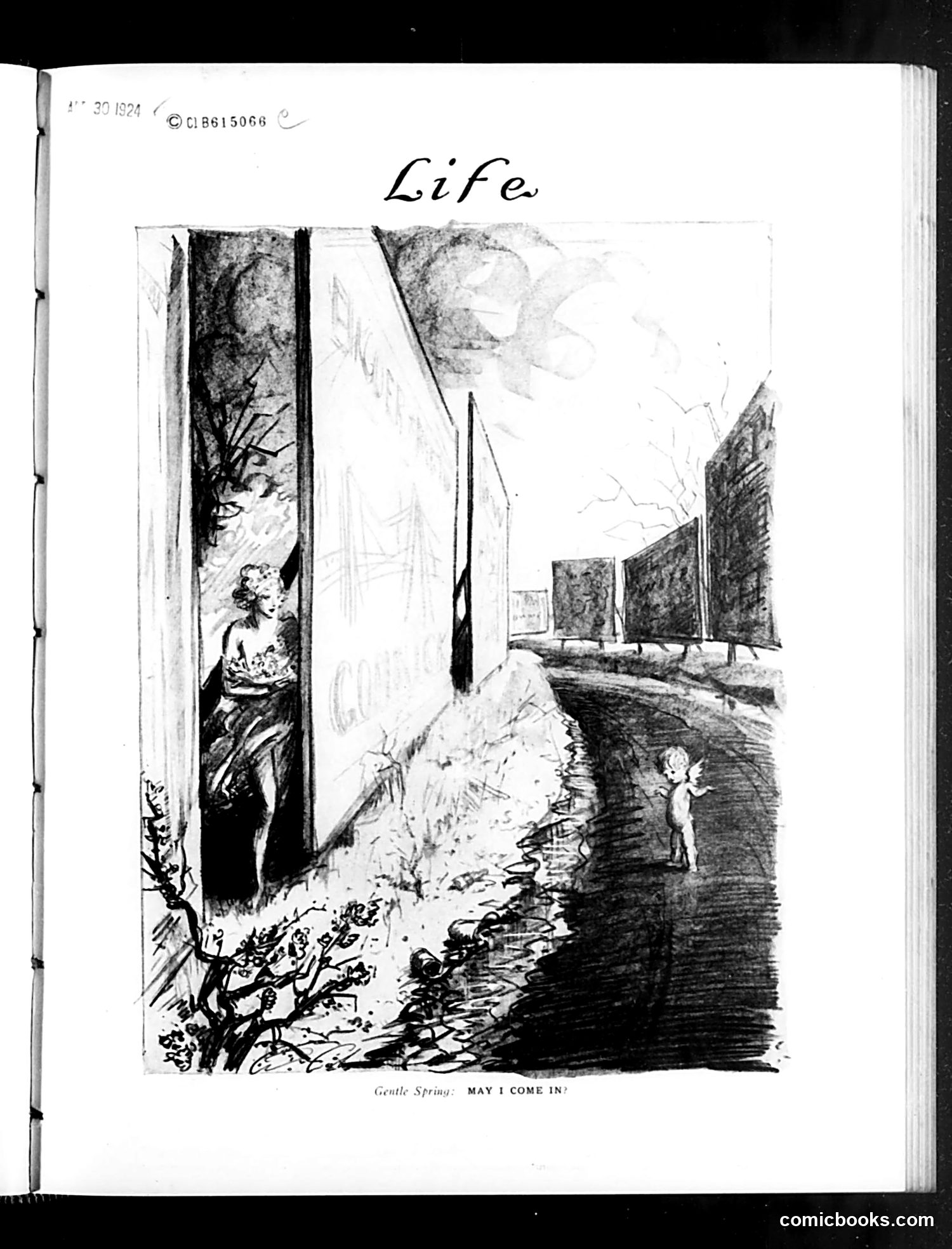
This page features a satirical cartoon titled "Gentle Spring - MAY I COME IN?" The illustration depicts spring personified as a young, delicate figure hesitantly approaching a doorway where winter—represented as a stern, bundled figure—still occupies the threshold. Behind spring, a coastal scene shows boats and what appears to be warmer weather beginning to emerge. The joke plays on the unpredictability of spring weather in temperate climates, where cold snaps frequently interrupt warming trends. Spring is literally asking permission to enter, suggesting winter's reluctance to fully depart. This was a relatable, timeless observation about seasonal transition that would have resonated with Life's contemporary readership, requiring no specific historical context beyond common experience.
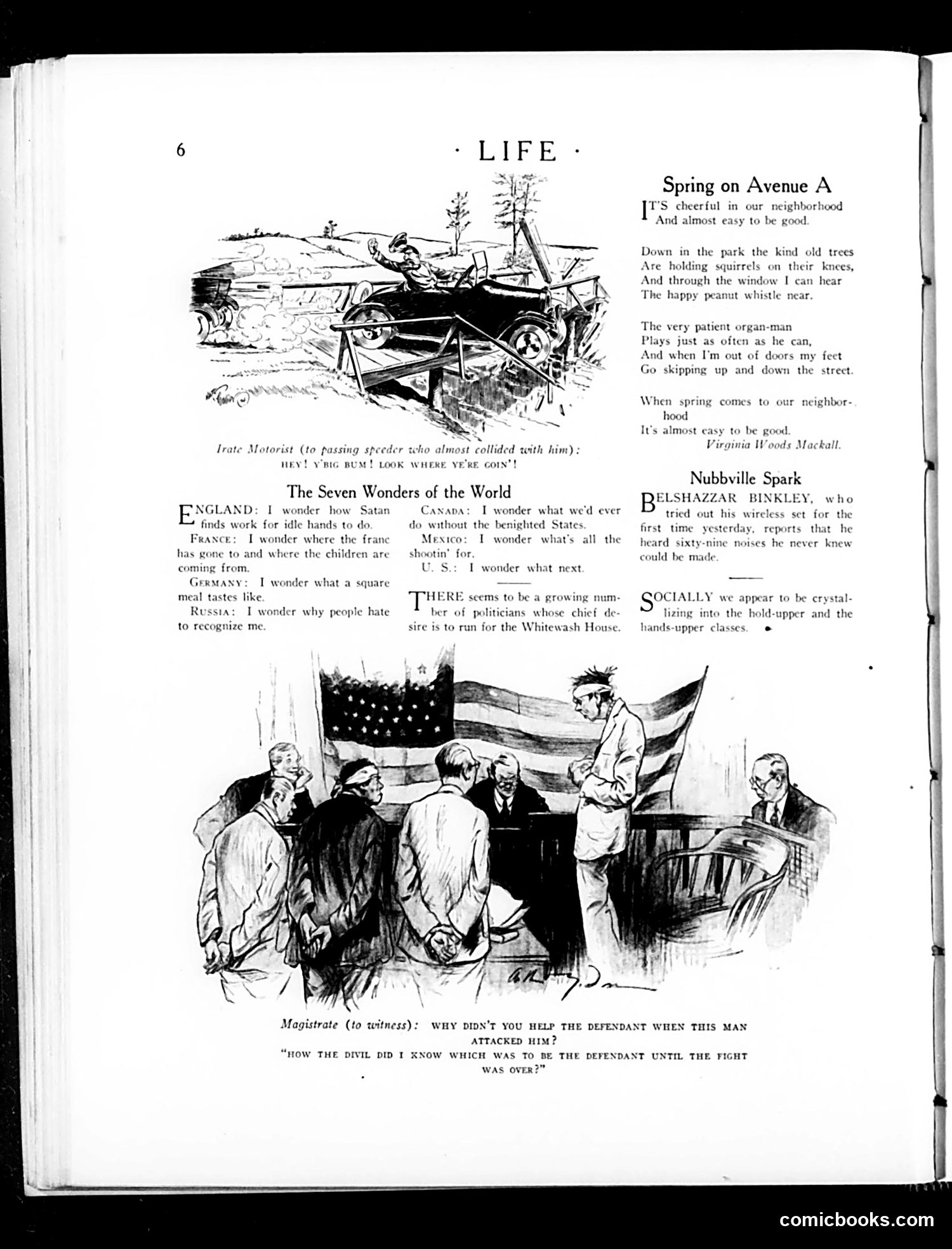
This page contains satirical humor typical of early 20th-century Life magazine. **Top section:** A poem "Spring on Avenue A" celebrates modest urban pleasures—trees, squirrels, street musicians—with gentle irony about finding contentment in ordinary city life. **Middle section:** "The Seven Wonders of the World" is a joke list where various countries express bewilderment: Satan wondering about idle hands, the Franc disappearing, square German meals, Russian recognition, and American uncertainty about "what's next." This satirizes national stereotypes and American anxiety about the future. **Bottom cartoon:** Shows a magistrate questioning why a witness didn't help during a fight, with the defendant's excuse that he couldn't identify the attacker until it ended. This lampoons courtroom logic and legal absurdity. The illustrations use sketchy, expressive linework characteristic of the period's editorial cartooning.
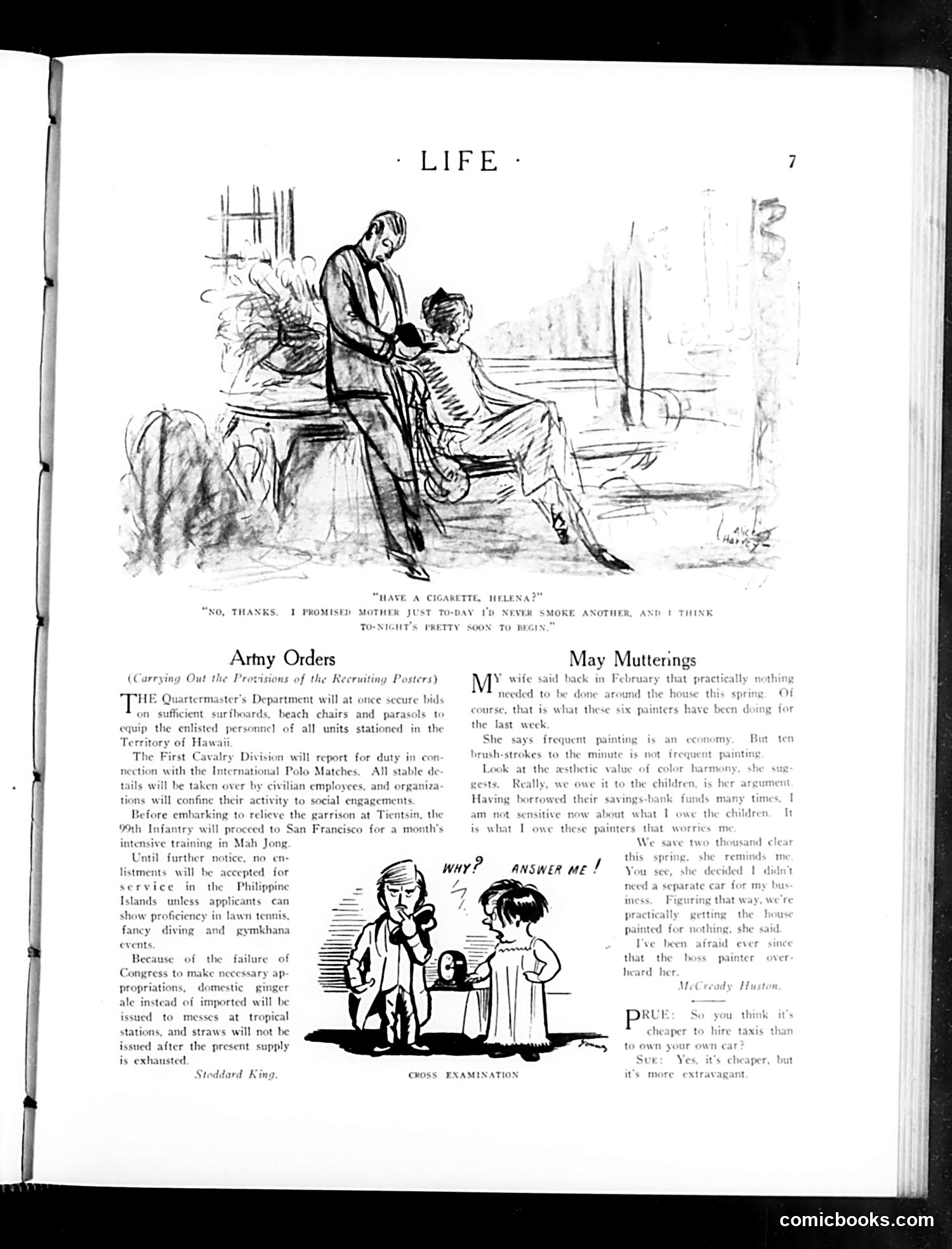
This page contains three distinct pieces: 1. **Top illustration**: A man offers a cigarette to a woman, who declines, saying she promised her mother never to smoke. The man suggests "to-night's pretty soon to begin"—implying he wants to corrupt her morality immediately. 2. **"Army Orders"** (left column): Military bureaucratic satire about securing supplies and managing troop movements, authored by Stoddard King. It mocks the inefficiency of military procurement and logistics during wartime. 3. **"May Mutterings"** (right): A domestic humor piece where the author's wife argues that frequent house painting is economical. The accompanying cartoon "Cross Examination" depicts a child questioning an adult about this logic. The page reflects early-20th-century social anxieties about morality, wartime administration, and domestic economics.
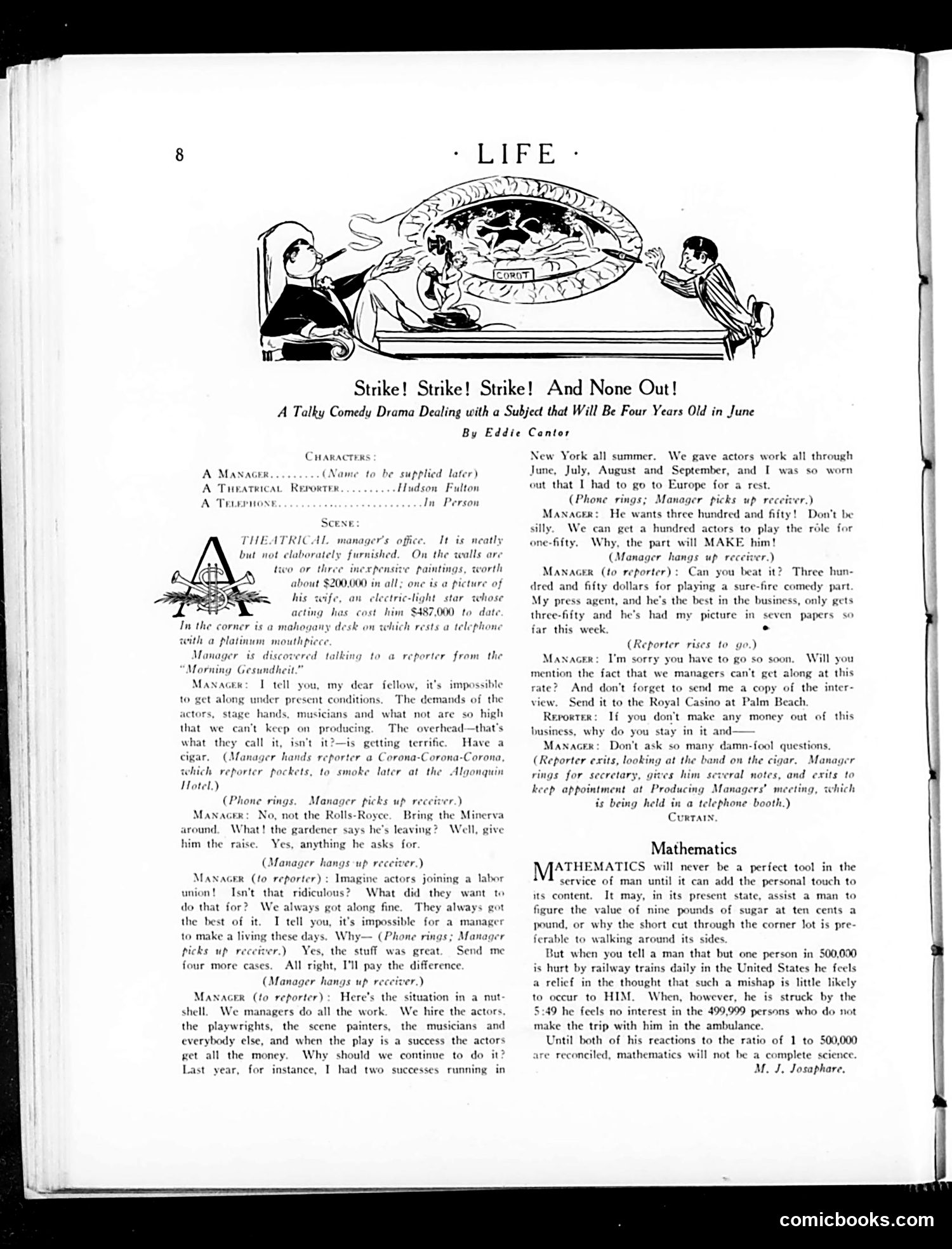
This page features a theatrical satire titled "Strike! Strike! Strike! And None Out!" by Eddie Cantor. The cartoon depicts a theatrical manager (left) and a reporter (right) discussing casting problems, with a baseball being used as visual metaphor for show business negotiations. The satire mocks the disconnect between theatrical managers and actors during labor disputes. The manager dismisses actors' demands for higher pay and better working conditions while claiming managers handle all the real work—hiring actors, playwrights, scene painters, and musicians. He argues actors receive all the money despite managers doing the labor. The baseball imagery suggests the "game" of theater management, where strikes and negotiations mirror sports terminology. The piece critiques management's self-serving arguments about their indispensability versus actors' actual value.
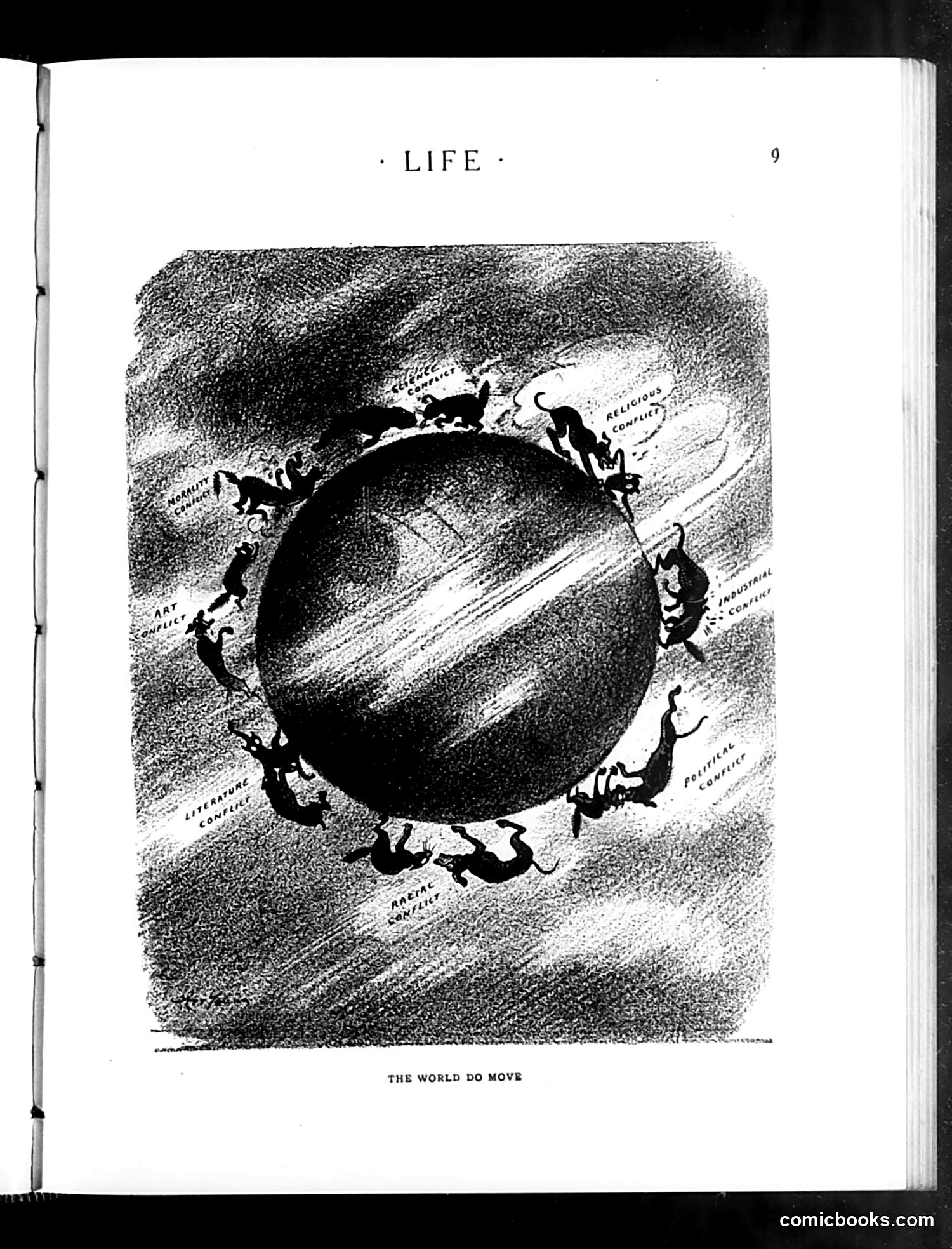
This satirical cartoon depicts a large globe being pushed uphill by multiple human figures, labeled with various social forces and ideologies. The visible labels include "LITERATURE," "COMPLEXITY," "IMMORALITY," "IRREVERENCE," and "PRIMEVAL CONFLICT"—representing progressive or modernist cultural movements of the early 20th century. The cartoon critiques how various contemporary social currents were collectively advancing societal change, depicted as a heavy burden being collectively moved. The title "The World Do Move" (employing intentionally awkward grammar) suggests ironic commentary on progress itself. This reflects Life magazine's satirical stance toward modernism, social upheaval, and cultural shifts of its era—presenting these forces as arduous, collaborative, and potentially destabilizing to traditional society.
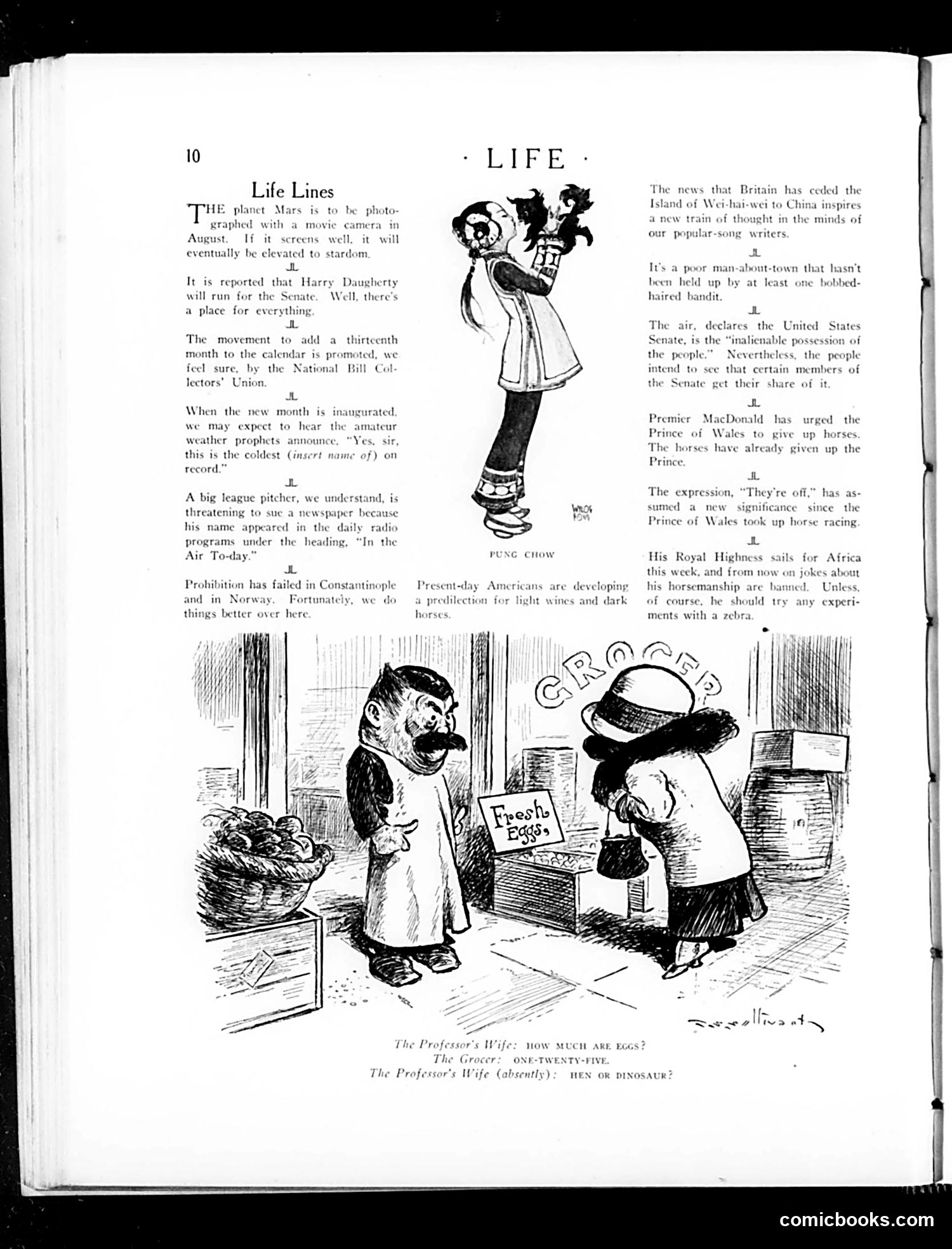
This page contains several short satirical "Life Lines" items and one cartoon. **The Cartoon:** The bottom illustration depicts a grocer and a well-dressed woman (the Professor's Wife) at a shop counter. She asks the price of eggs ("ONE-TWENTY-FIVE"), then incredulously replies "HEN OR DINOSAUR?" — suggesting eggs have become absurdly expensive, so costly they seem impossibly overpriced. **Context:** This appears to reference post-World War I inflation and food-price concerns in America. The joke equates current egg prices to prehistoric levels of absurdity — implying profiteering or economic dysfunction that makes basic commodities unaffordable for ordinary consumers. **Life Lines:** The brief items mock contemporary figures (Harry Daugherty, MacKenzie King) and social trends, including radio broadcasting and animal breeding experiments — typical satirical commentary on news and society of the period.
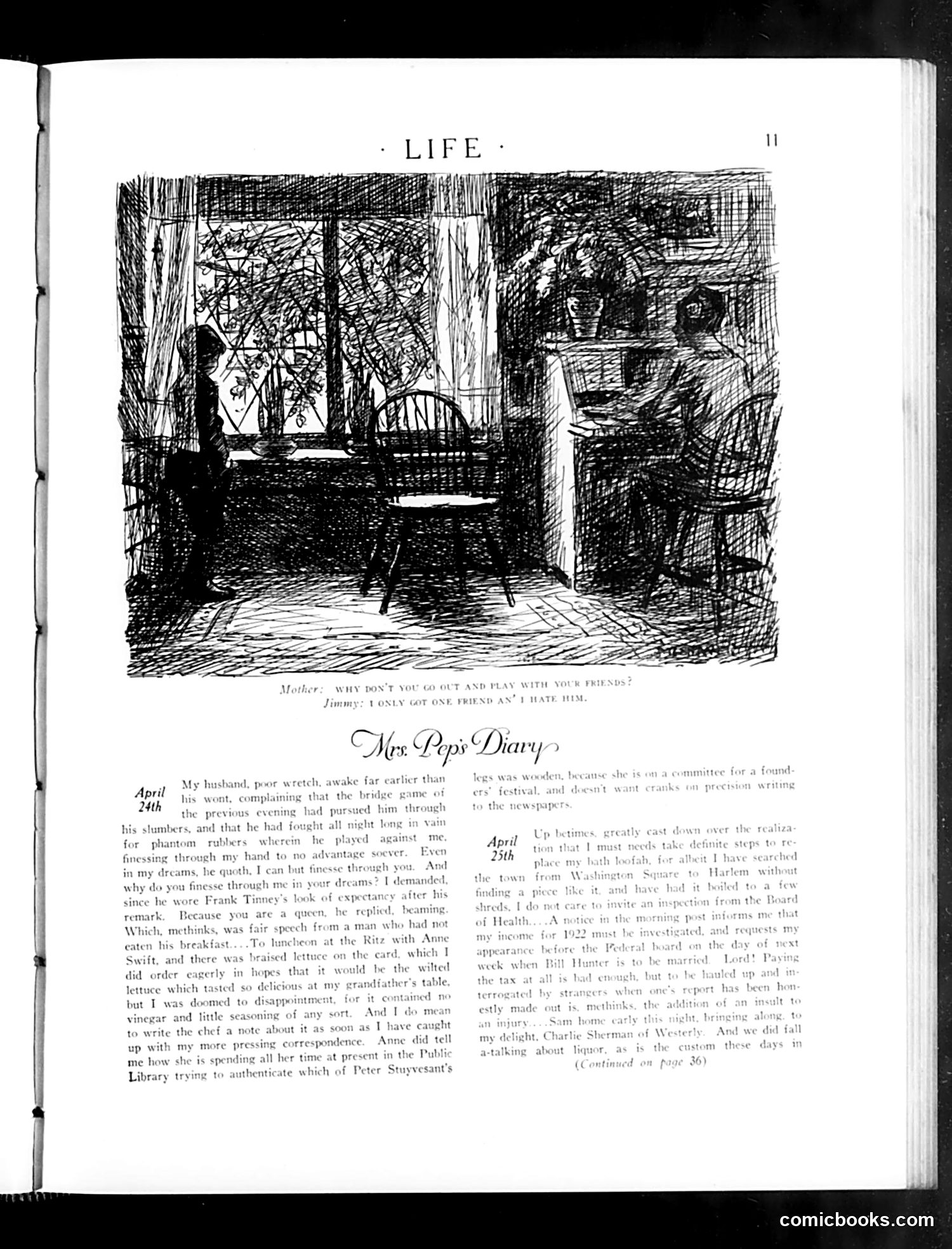
This page features "Mrs. Pep's Diary," a satirical advice column. The illustration shows a domestic interior scene with figures in an early 20th-century setting. The diary entry (dated April 25th) mocks upper-class social pretensions. Mrs. Pep discusses her husband's poor health, complains about a bridge game, and references various social anxieties—including needing to relocate from Washington Square to Harlem, tax troubles, and social scandals involving acquaintances like "Bill Hunter" and "Lord Passing." The satire targets wealthy New York society's obsession with status, gossip, and financial worries during what appears to be the 1920s (mentions of 1922 income tax). The "Mother and Jimmy" dialogue at the top, where Jimmy refuses to play with friends because he "hates" them, reinforces themes of social dysfunction masked by polite society.
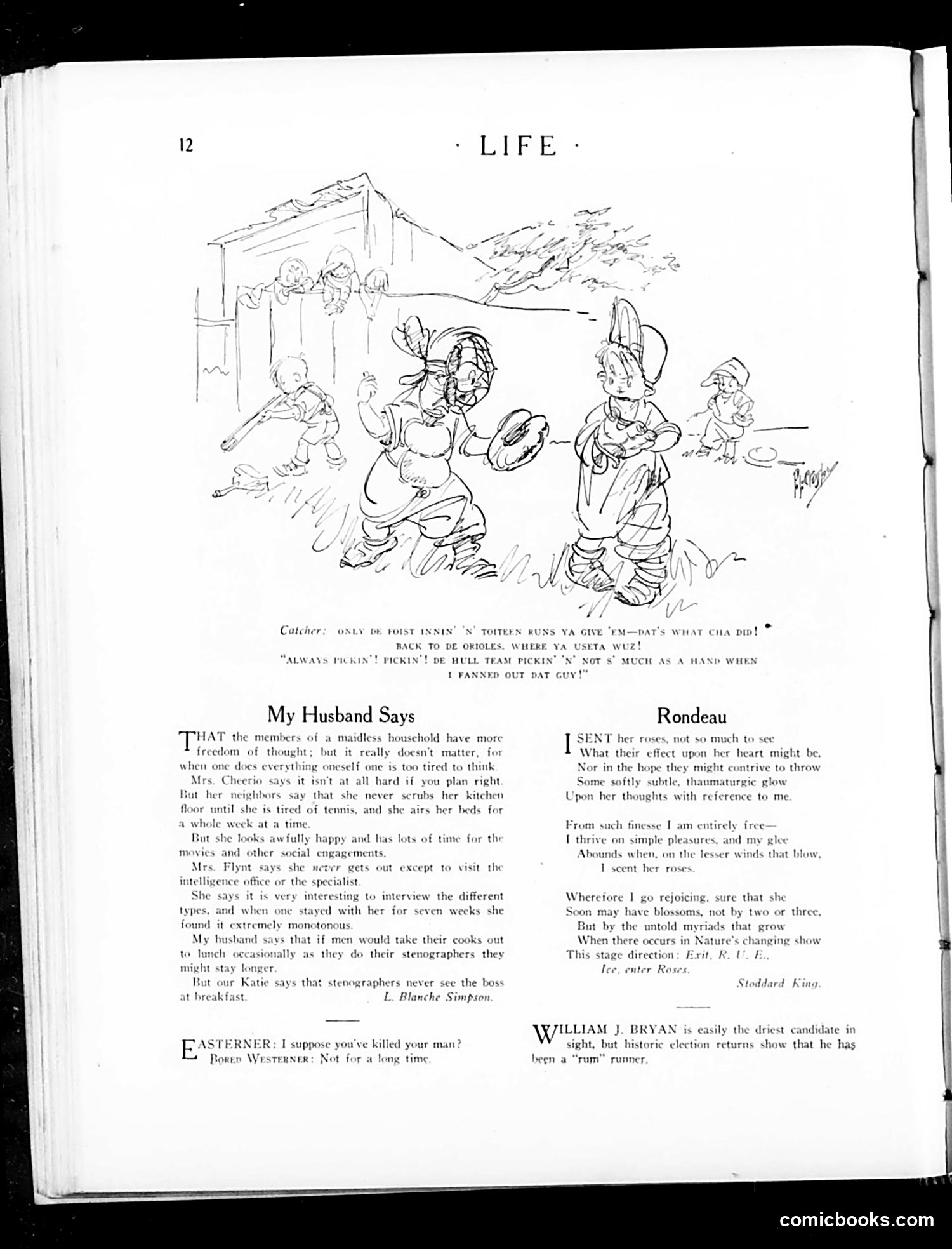
The top cartoon depicts a domestic scene with children playing baseball, satirizing urban tenement living conditions. The caption captures working-class dialect, mocking children's games in cramped spaces and their ignorance of proper baseball terminology ("innis" for innings, "totten" for totals). The text sections below include: - **"My Husband Says"**: Commentary on housework freedom and leisure time for wives in households without servants - **"Rondeau"** (poem by Stoddard King): A literary piece about roses sent without romantic intent - **"Easterner/Bonehead Westerner" joke**: A brief comedic exchange The overall page satirizes domestic life, class differences in leisure and household management, and regional American character stereotypes typical of early 20th-century Life magazine humor.
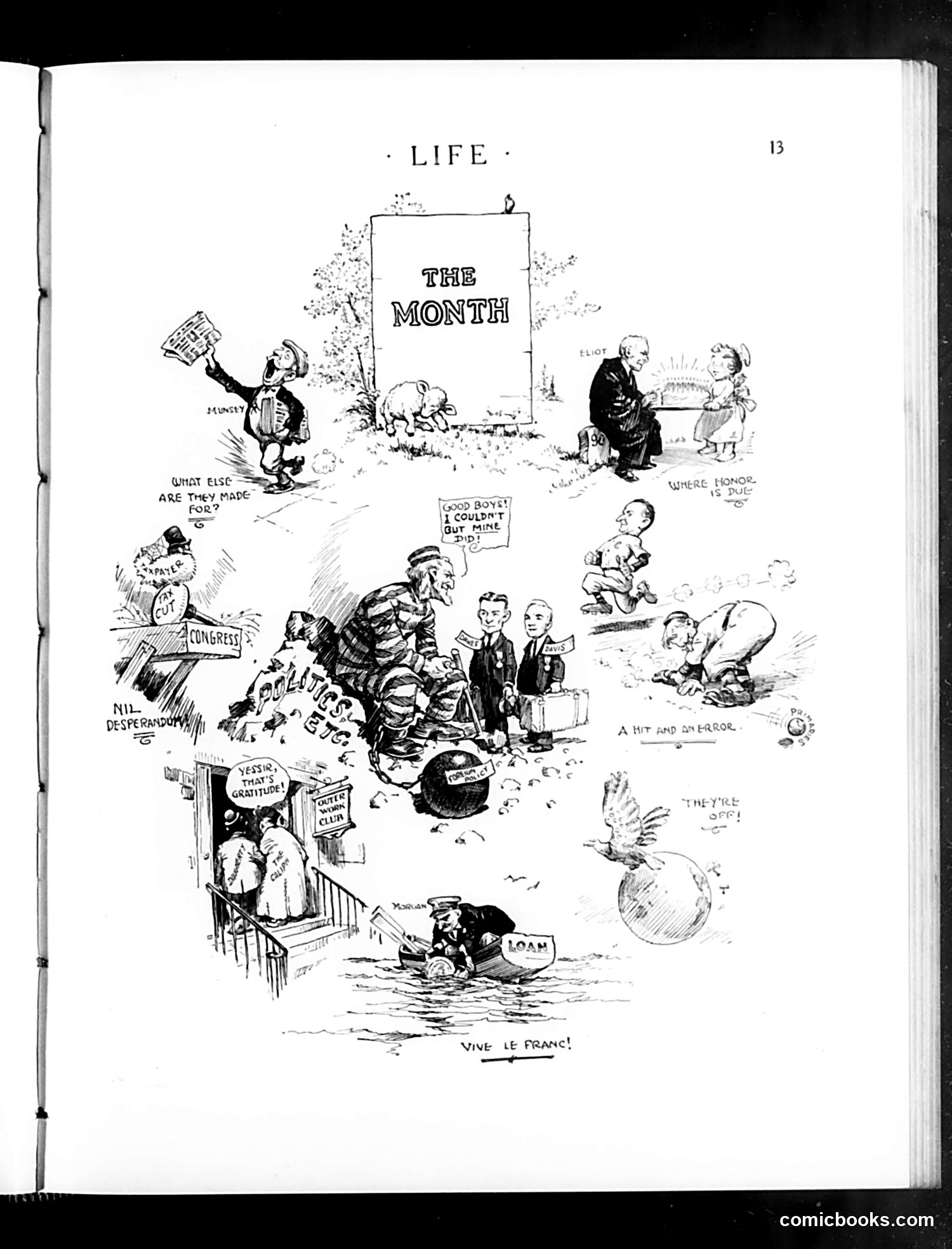
This is a satirical overview page depicting various political and social issues of its era. The central figure appears to be a large military or political authority wrapped in bandages (labeled "POLITICS"), surrounded by smaller scenes representing contemporary problems: - Upper left: "What else are they made for?" - depicts hungry/poor conditions - Center: Military/political corruption with uniformed figures and briefcases - Lower left: Congressional gridlock and governmental dysfunction - Bottom: "Vive le France!" with a drowning figure labeled "LOAN" - likely satirizing American financial aid to France - Various other vignettes addressing Congress, diplomatic relations, and economic troubles The overall message critiques government incompetence, corruption, military excess, and questionable foreign policy decisions of the period.
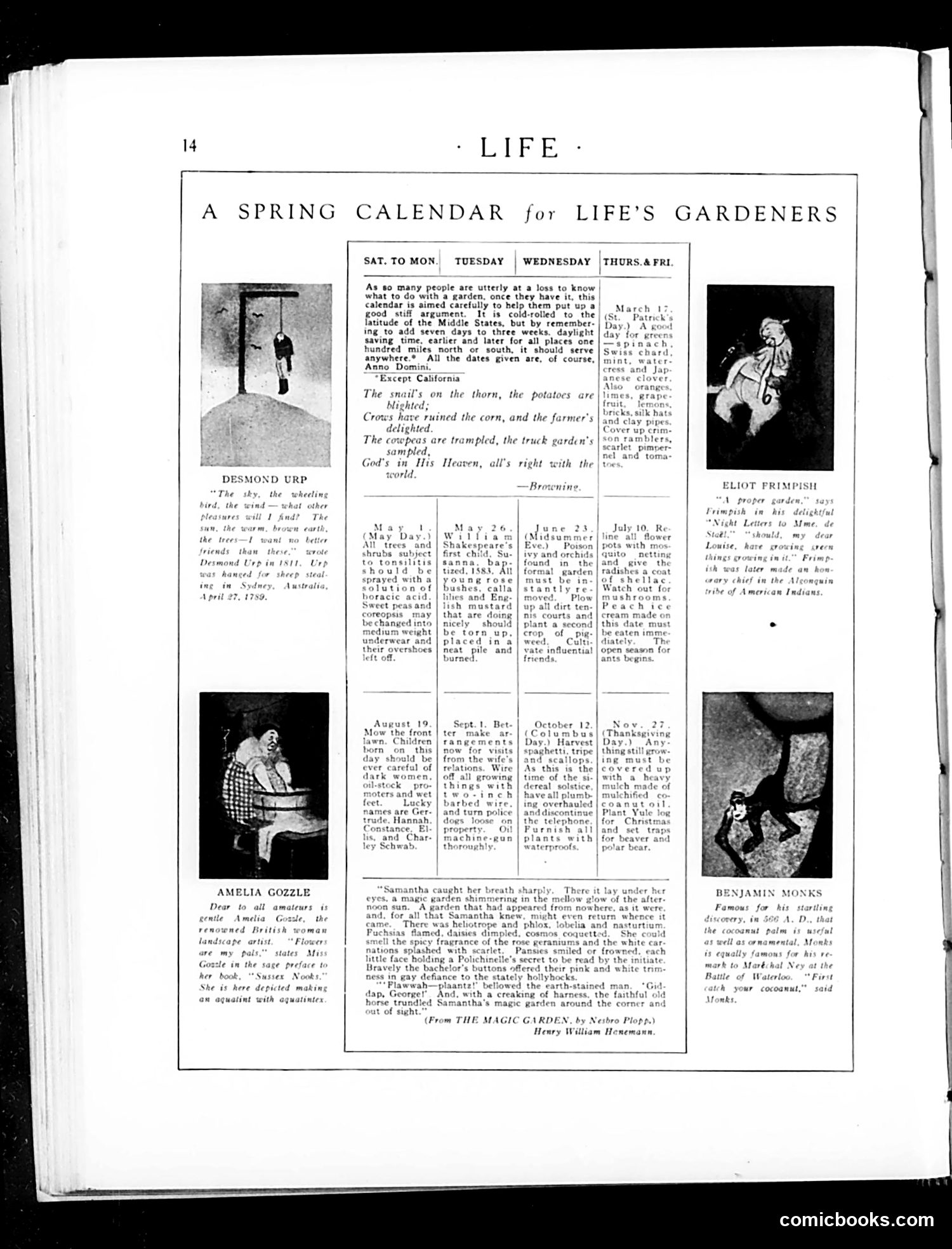
This page presents a gardening calendar styled as satirical literary and cultural commentary. The illustrations feature four named figures—Desmond Urp, Eliot Primpish, Amelia Gozzle, and Benjamin Moses—each paired with seasonal gardening advice and literary quotations. The satire appears to mock pretentious literary types through gardening metaphors. "Desmond Urp" references bird poetry; "Eliot Primpish" evokes T.S. Eliot's affected manner; the others represent stock characters of affected sophistication. The calendar jokes that even precious intellectuals must get their hands dirty with practical spring tasks—weeding, planting, pest control—deflating their pretensions through mundane horticultural reality.
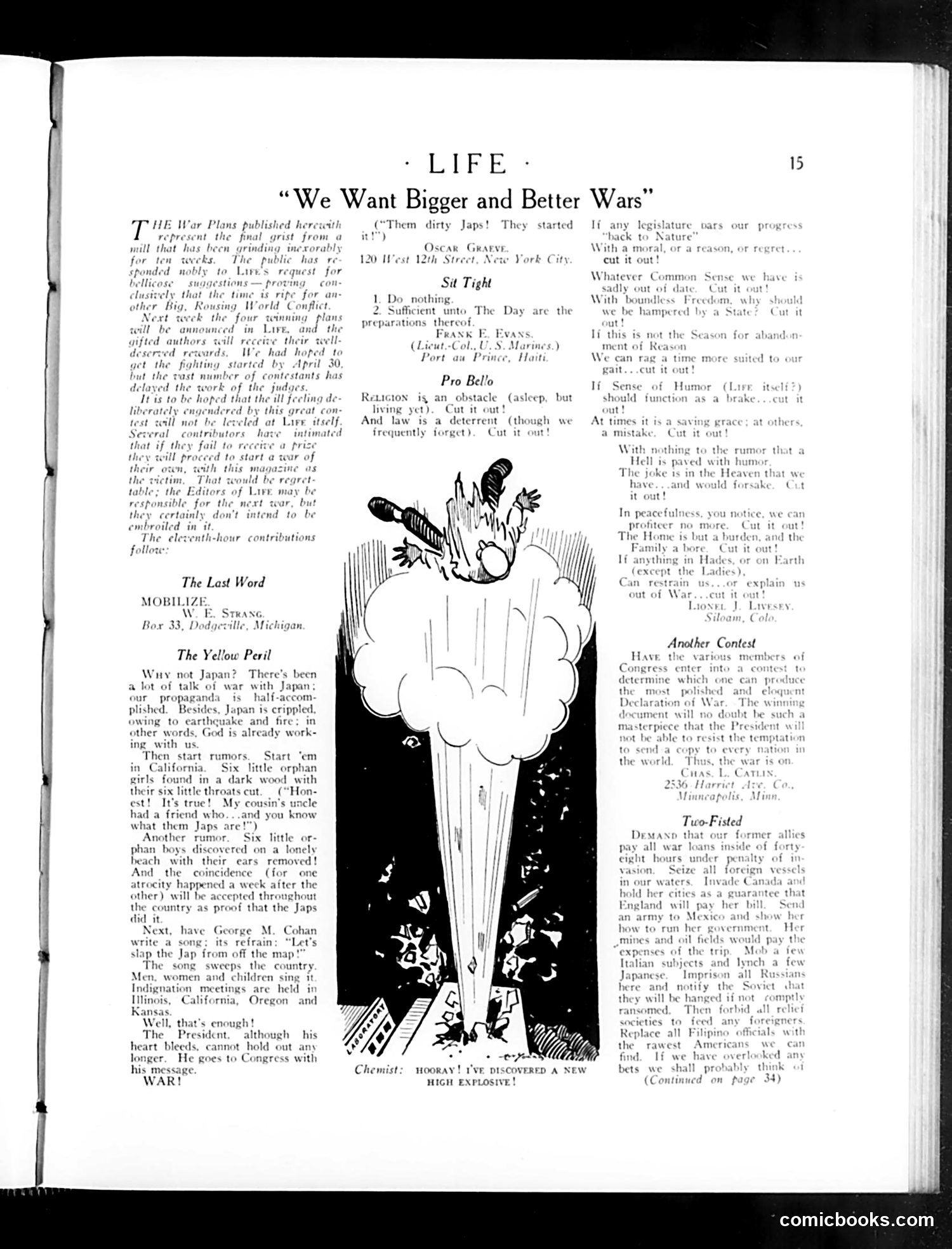
This Life magazine page satirizes American warmongering sentiment, likely from the World War I era. The central cartoon depicts an explosion labeled "CHEMIST: HOORAY! I'VE DISCOVERED A NEW HIGH EXPLOSIVE!" The satire targets multiple targets: pacifist sentiment ("Cut it out!"), government inefficiency, and particularly those advocating escalated military conflict. Various contributors submit increasingly absurd "war plans"—from Japan invasion schemes to demanding other nations pay war debts through military conquest. The cartoon's explosion symbolizes how calls for bigger wars spiral into destructive madness. The phrase "Cut it out!" (repeated throughout) mocks the futility of appeals for peace against those profiting from or romanticizing warfare. Life magazine uses dark humor to critique American interventionist impulses and the cheerleading for global conflict.
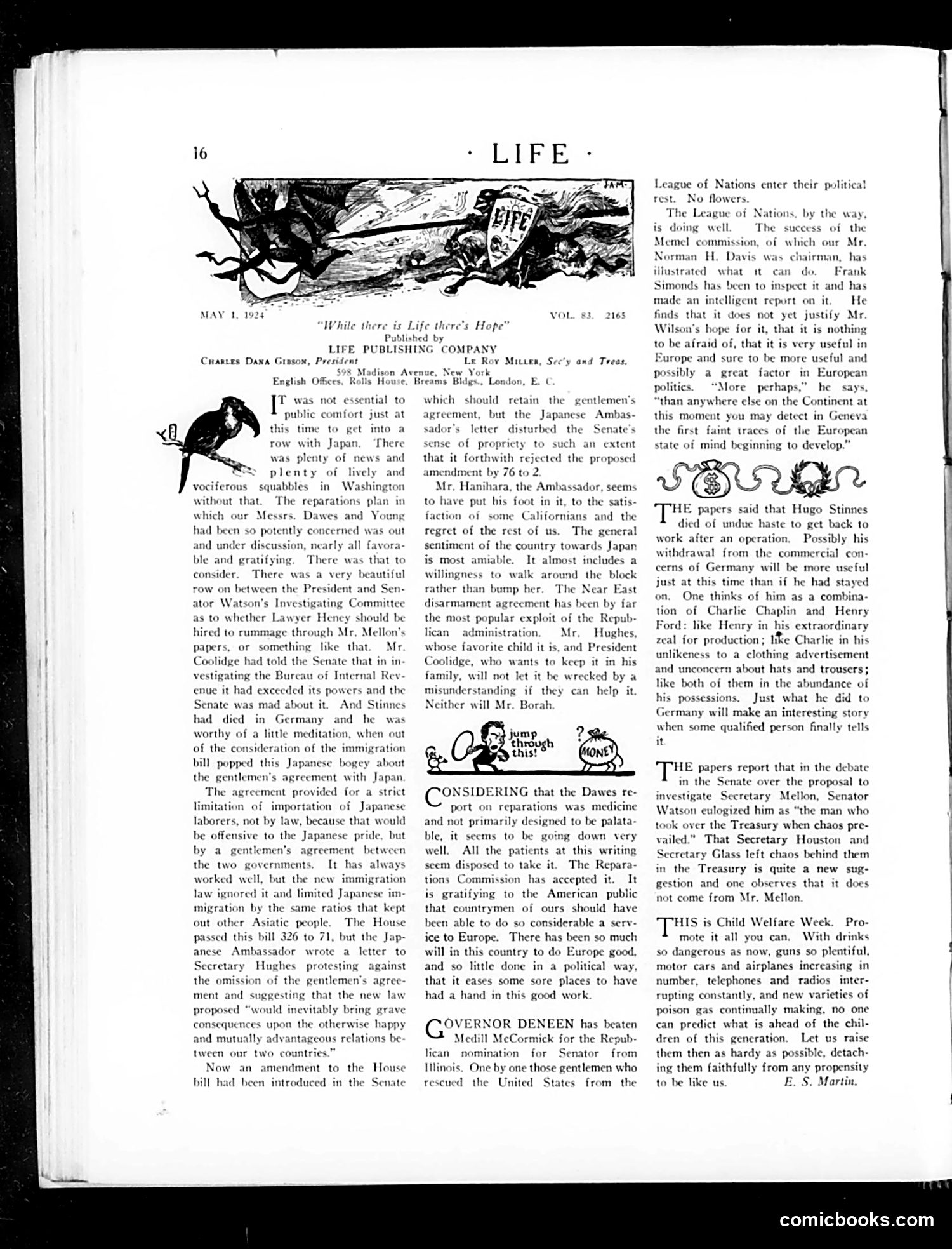
This page discusses several political controversies of 1924. The main cartoon (top left) appears to show a dead or dying figure labeled "Life," satirizing public exhaustion with constant political turmoil. The text critiques the Japanese immigration controversy: Japan's Ambassador Hanihara protested the new immigration law that violated the "gentlemen's agreement" limiting Japanese laborers. His letter offended the Senate so deeply they rejected a compromise amendment 76-2, satisfying California nativists but disappointing those favoring better U.S.-Japan relations. The page also mentions President Coolidge's handling of the Mellon investigation, noting he told the Senate it exceeded its authority—angering senators who had investigated Treasury corruption. Finally, it notes Governor Deneen's primary victory over Medill McCormick in Illinois, observing that one-by-one, the politicians who kept America out of the League of Nations are being defeated politically—their moment passing.
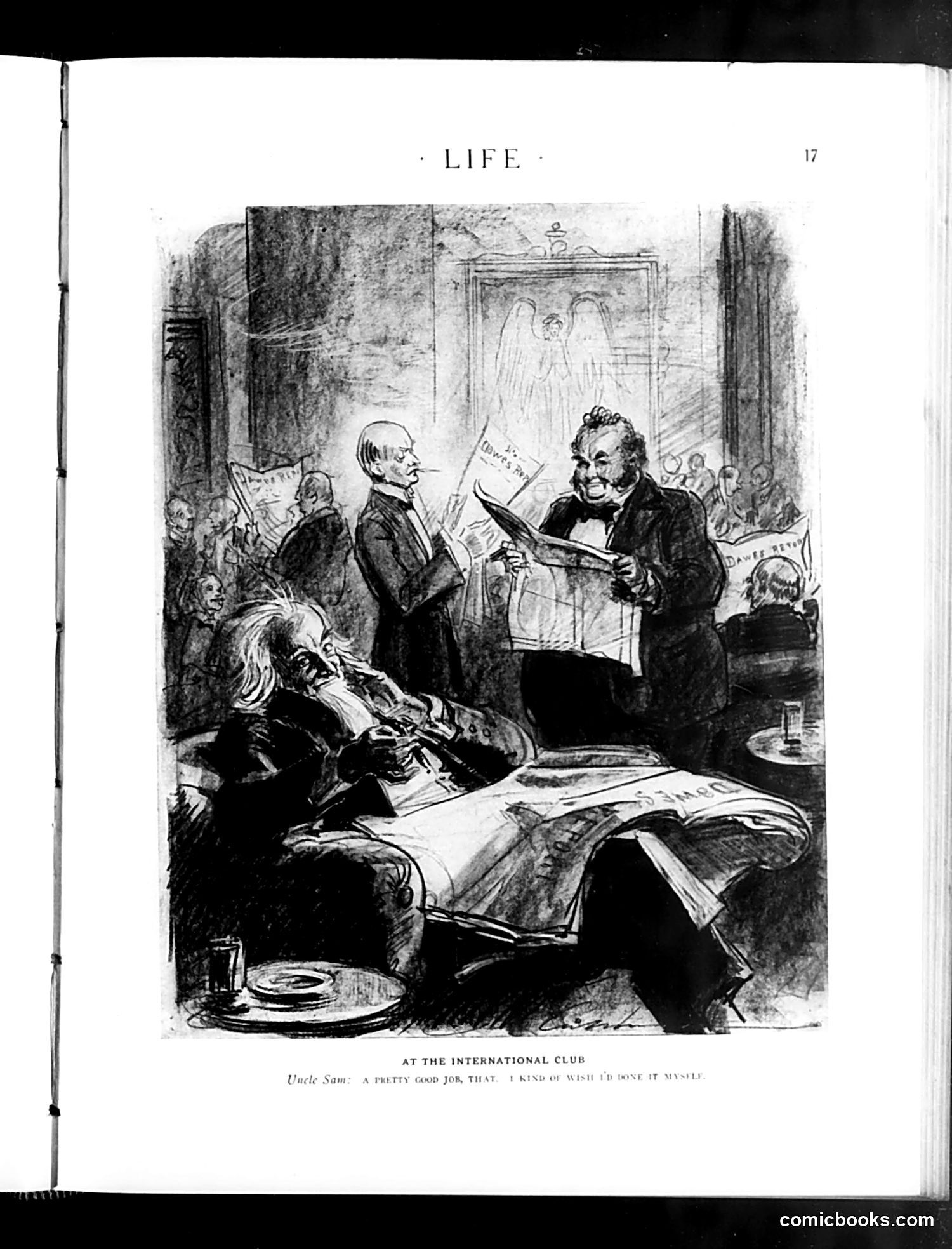
This satirical cartoon from *Life* magazine depicts a scene titled "At the International Club." The image shows what appears to be a formal gathering where Uncle Sam (identifiable by his characteristic appearance) is being addressed by several figures in formal dress. One man holds what looks like a document or proclamation, while others gesture and speak. The caption suggests Uncle Sam is being complimented on a "pretty good job," though he expresses a wish to have done it himself—likely satirizing American diplomatic or political efforts. The "International Club" setting suggests this concerns foreign relations or international affairs. Without the magazine's date visible, the specific historical context remains unclear, but the scene appears to mock American involvement in or reaction to international matters, possibly related to peacekeeping, governance, or treaty negotiations.
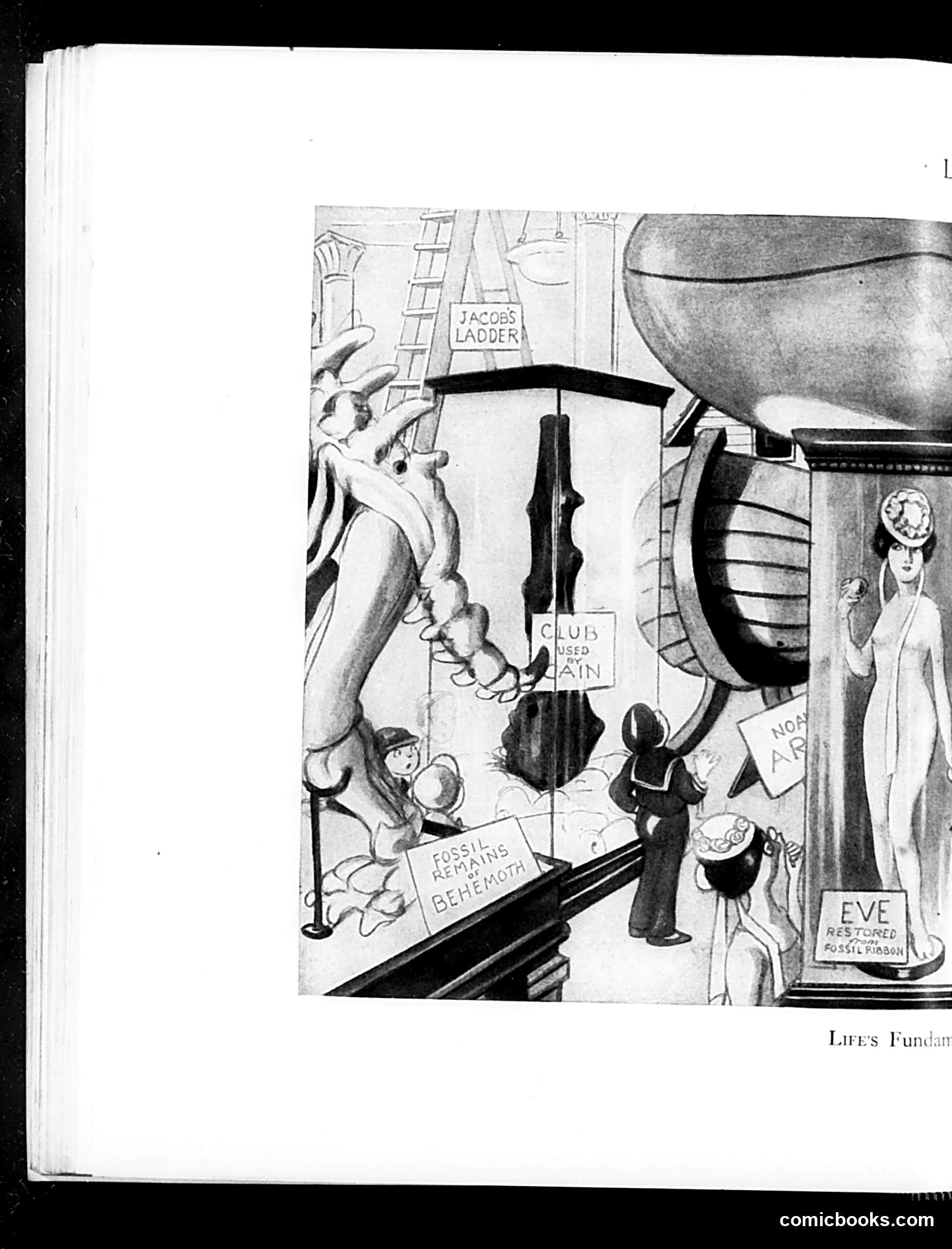
This appears to be a satirical museum scene depicting the "evolution of man" or natural history exhibit. The cartoon shows: - A **Jacob's Ladder** (biblical reference to human ascent) - **Fossil remains of behemoth** (prehistoric creature) - A **club used in vain** (primitive tool, possibly satirizing ineffective methods) - **Eve restored from fossil ribbon** (humorous take on reconstructing prehistoric humans from minimal evidence) The satire likely mocks early 20th-century paleontology and evolutionary science—specifically how museums made grand claims about human origins from incomplete fossil evidence. The inclusion of "Eve" and the biblical ladder suggests social commentary on tensions between religious and scientific explanations of human existence. The figures examining these "discoveries" appear to be contemporary museum visitors or scientists, highlighting the gap between scientific certainty claimed and actual evidence available.
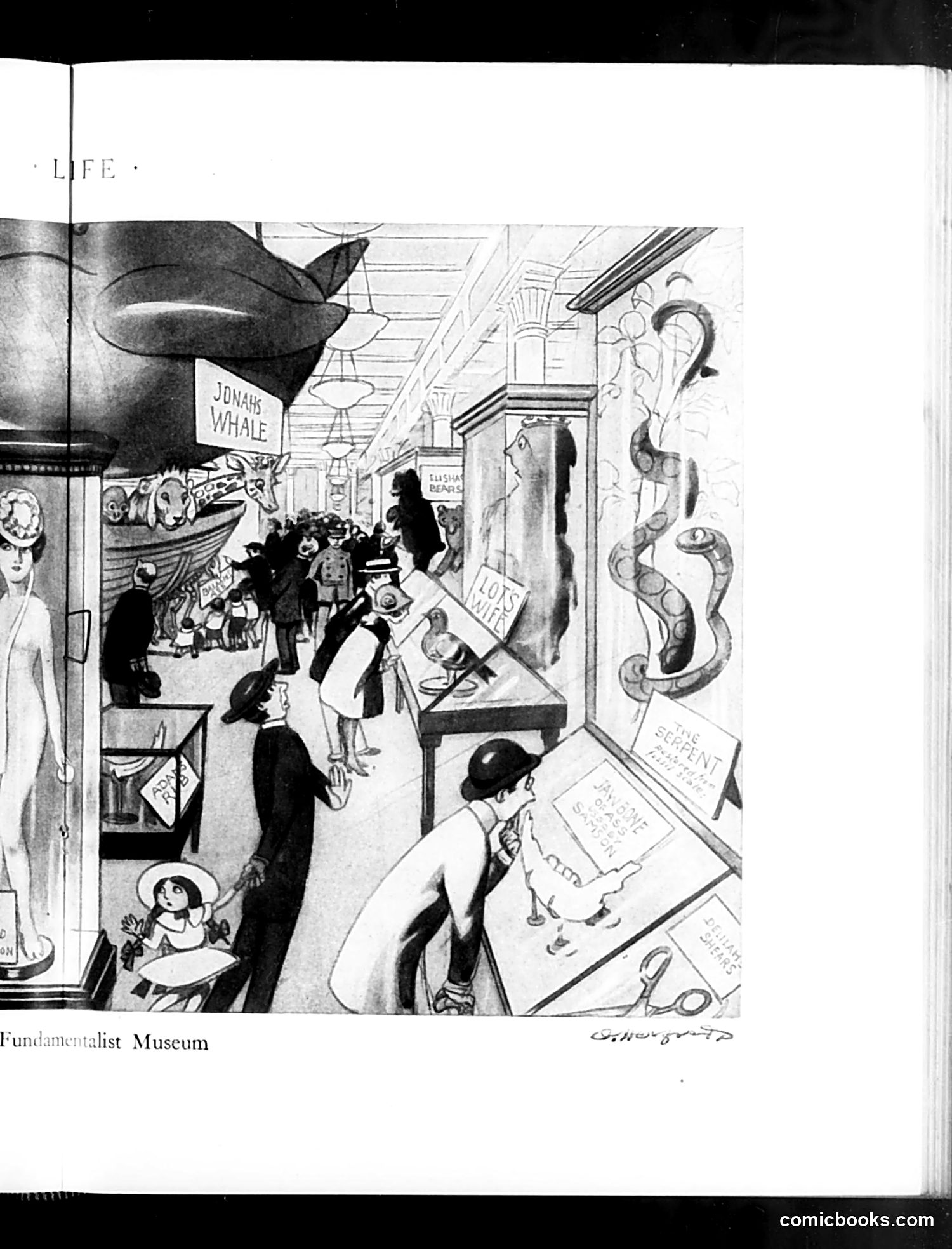
This is a satirical cartoon titled "Fundamentalist Museum" depicting a museum exhibition space crowded with visitors viewing various displays. The visible signs reference biblical and religious subjects, including "Jonah's Whale" (prominently displayed as a large model on the left), "Elisha's Bears," and what appear to be other literalist interpretations of biblical stories. The satire targets religious fundamentalism—specifically the literal belief in biblical accounts as historical fact. The cartoon mocks the idea of a museum dedicated to displaying these stories as scientific or historical exhibits. The crowded, carnival-like atmosphere suggests the satire views such fundamentalist interpretation as entertainment rather than serious theology, poking fun at early-20th-century American fundamentalist movements that emphasized literal biblical truth.
This is a theater review of Samuel Shipman's play "Cheaper to Marry," critiquing both the work and Shipman's dramatic style generally. The reviewer identifies Shipman as a playwright who constructs plays around simple domestic arguments—here, that marriage is financially prudent compared to maintaining an unmarried mistress. The play features Robert Warwick, Florence Eldridge, Allan Dinehart, and Claiborne Foster. The satire targets Shipman's formula: he presents obvious moral lessons (comparing married versus unmarried expenses) with "considerable show of satisfaction," then tangles characters in contrived plot knots to reach predetermined conclusions. The reviewer grudgingly admits Shipman's plays are engaging despite being intellectually thin—they "march" forward compellingly even as audiences may resent their manipulative simplicity. The final jab suggests the play ends prematurely, perhaps deliberately to hide its weaknesses.
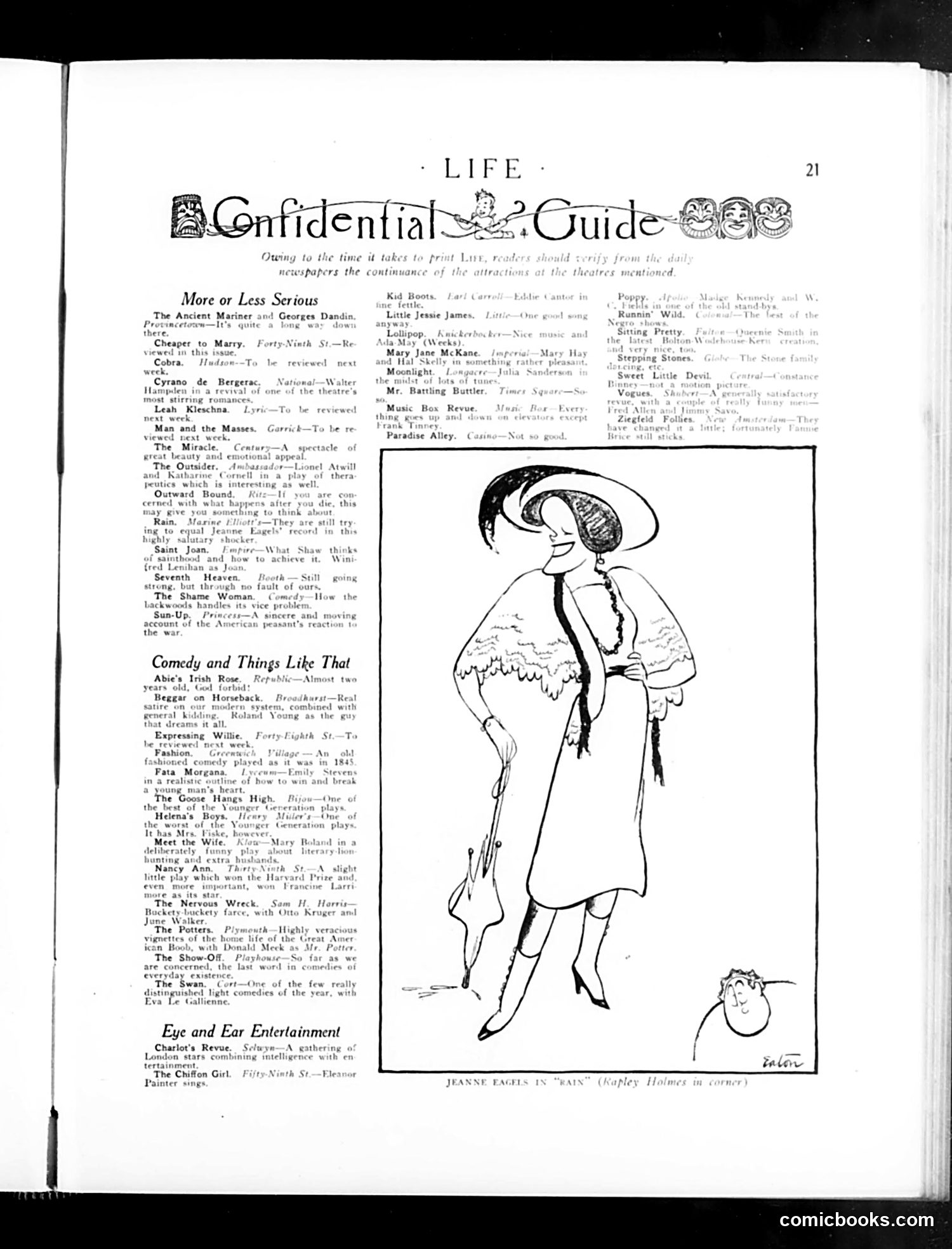
This page is a **theater guide** listing Broadway shows and reviews, not a political cartoon. The only illustration is a fashion sketch titled "Jeanne Eagles in 'Rain'" (credited to artist Kahler), showing a woman in 1920s attire with a large hat and feathered wrap. The page catalogs current theatrical offerings organized by genre: "More or Less Serious" plays, "Comedy and Things Like That," and "Eye and Ear Entertainment" (musicals/revues). Notable shows listed include *Abie's Irish Rose*, *The Nervous Wreck*, and *The Swan*. Jeanne Eagles was a famous actress of the era—the illustration depicts contemporary fashion rather than satirizing a person or event. This appears to be standard entertainment journalism from the 1920s, helping readers navigate New York's theatrical season.
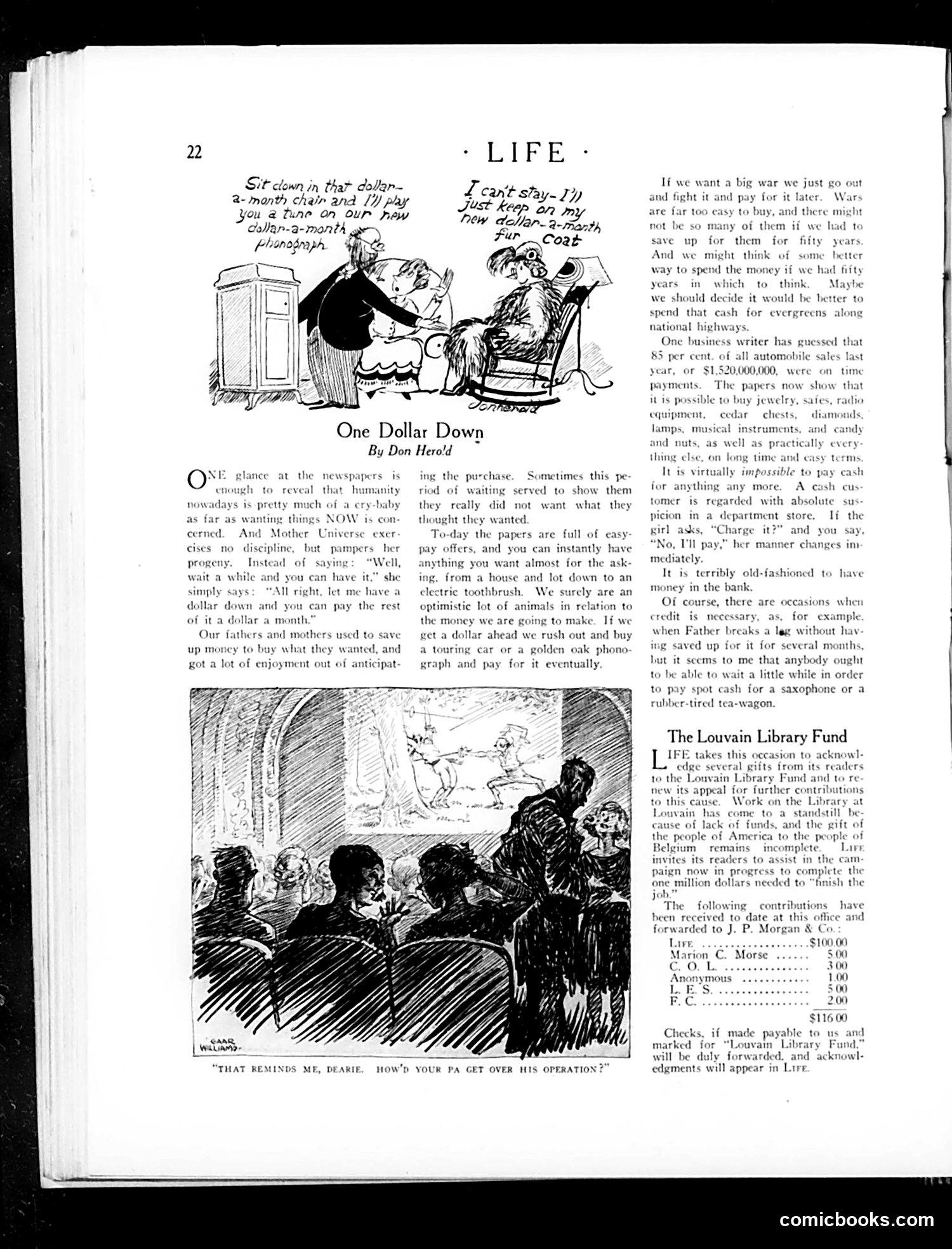
This Don Herold cartoon satirizes 1920s installment-buying culture. The top illustration shows a couple negotiating furniture purchases on a "dollar-down" plan—paying monthly for items they couldn't otherwise afford. The accompanying essay argues this reflects broader American consumer behavior: people buy luxuries (touring cars, phonographs, jewelry, musical instruments) on credit rather than saving. Herold mocks this as childish impatience, contrasting it with older generations who saved first. The satire's target is optimistic American consumerism and credit's normalization. A salesman's response—"Charge it?"—shows how commonplace easy payments had become. The author suggests this frivolous spending might be redirected toward public goods like "evergreens along national highways." The bottom illustration (unrelated) appears to be a separate joke about someone's father's medical operation. The page also announces contributions to the **Louvain Library Fund**, a post-WWI reconstruction effort for Belgium's damaged university.
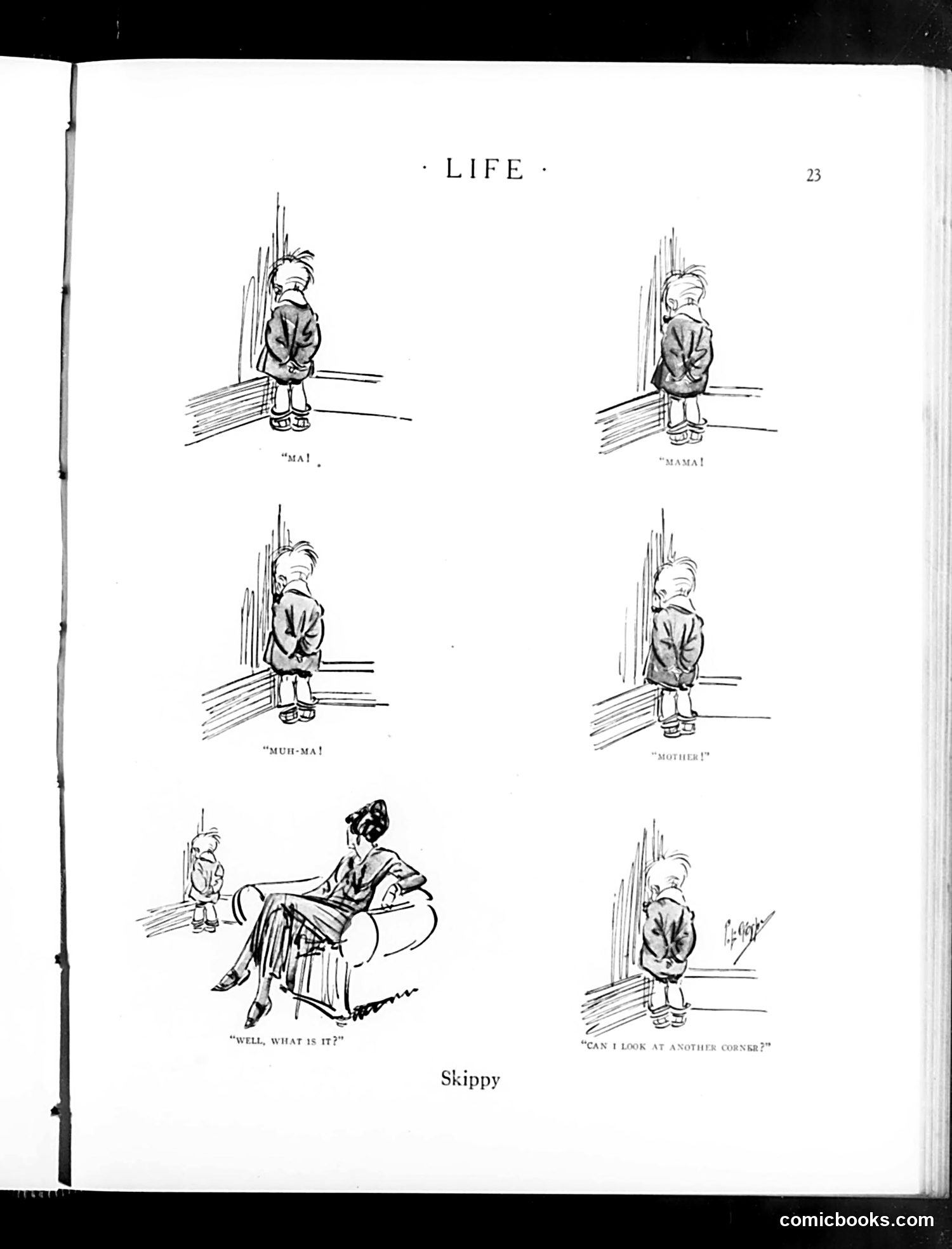
This page presents "Skippy," a comic strip by the cartoonist credited at bottom. The narrative follows a young child attempting to communicate with his mother. The sequence shows the boy calling "Ma!", "Mama!", and "Muh-ma!" with increasing urgency before finally shouting "Mother!" The humor derives from the child's escalating desperation—he cycles through increasingly formal address terms to get his mother's attention. When she finally appears and asks "Well, what is it?", he requests permission to "look at another corner," suggesting his urgent appeals were for something trivial. The joke satirizes childhood behavior: the dramatic buildup of emotional intensity for minor, inconsequential desires—a relatable observation about parent-child dynamics that remains humorous across eras.
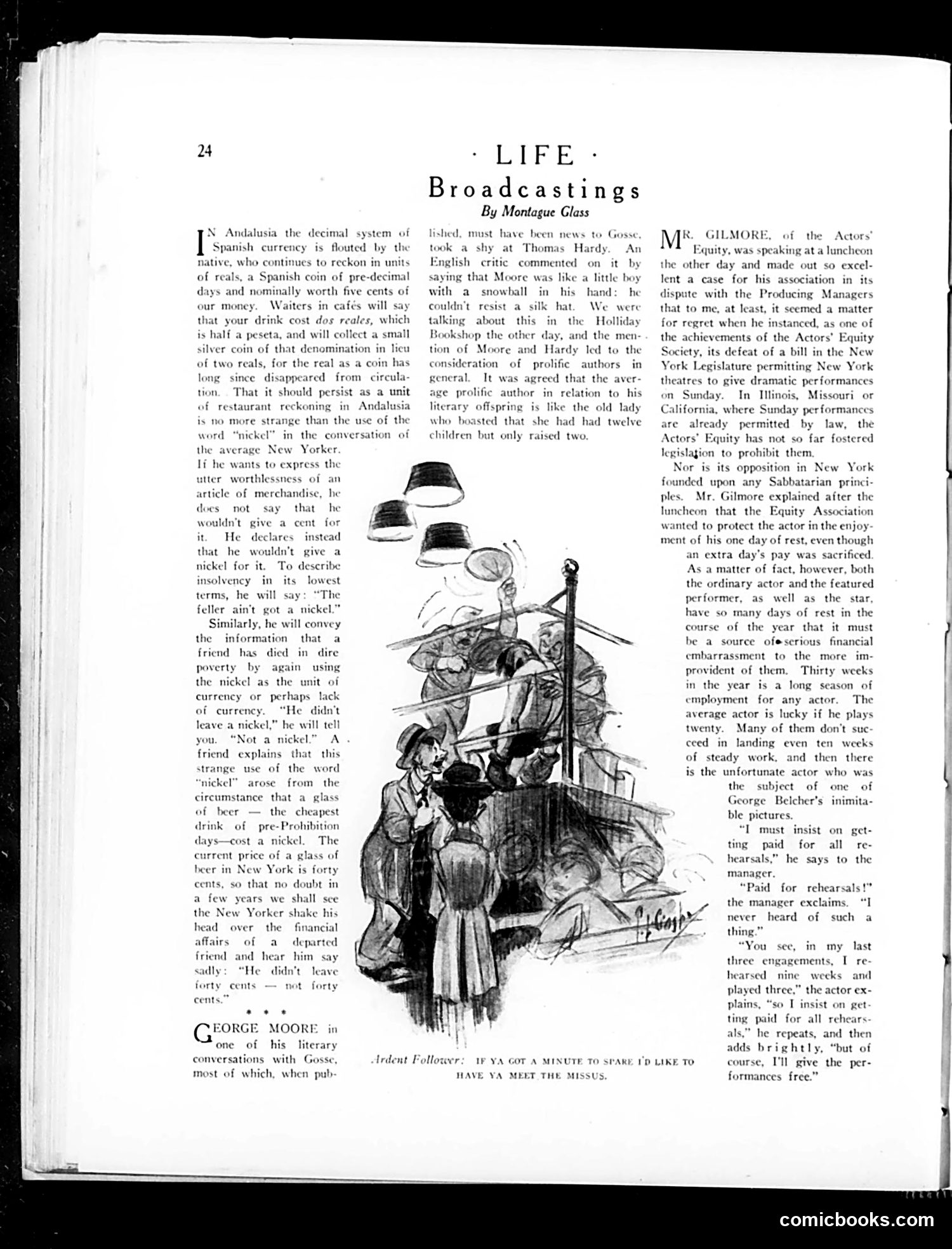
This page contains two satirical pieces by Montague Glass about social and economic oddities. **Left column:** Discusses linguistic anachronisms—how New Yorkers still use "nickel" as a unit of worthlessness despite beer now costing forty cents (not five). The point: language preserves obsolete economic realities long after inflation makes them irrelevant. **Center cartoon:** A sketch (artist signed "H. Goss") showing a man introducing a woman with the caption "If ya got a minute to spare I'd like to have ya meet the missus"—appears to be satirizing working-class social awkwardness or dating customs, though context is unclear. **Right column:** Critiques the Actors' Equity Society's opposition to Sunday theatrical performances in New York on grounds of protecting actors' rest days. Glass argues this is hypocritical: actors already have ample unemployment (only ~20 weeks annual employment for most), so financial hardship—not rest—is their actual concern. The satire questions their true motives.
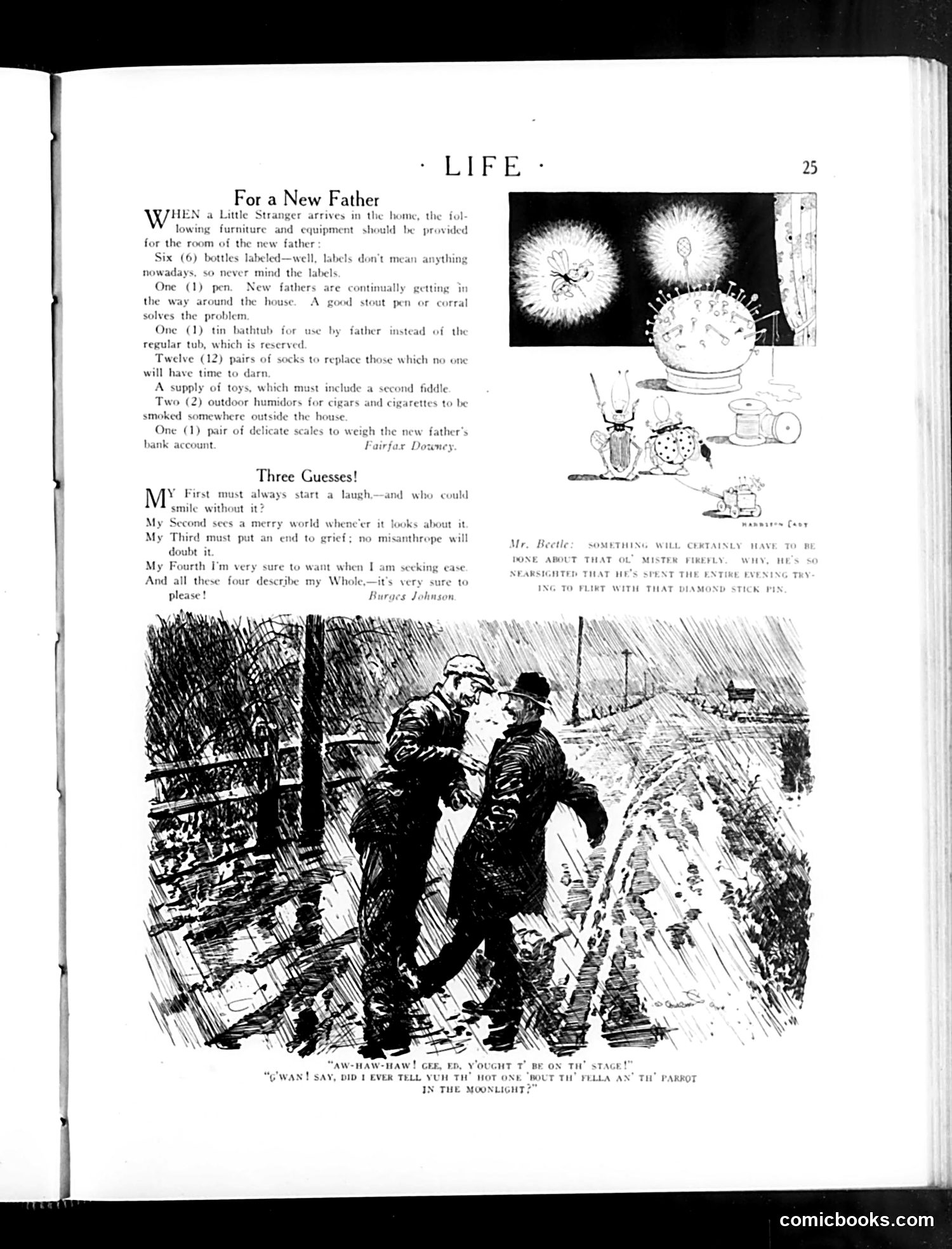
This page contains humorous advice for new fathers, reflecting early 20th-century gender roles and domestic expectations. **"For a New Father"** offers tongue-in-cheek practical items (bottles, pens, bathtub) a new father should have, satirizing the assumption that men are unprepared for infant care and domestic life. **"Three Guesses!"** presents a quote (attributed to Burack Johnson) about desiring a wife who laughs, sees the world merrily, and ends grief—romanticizing idealized marriage while subtly critiquing male expectations of women. **The lower illustration** depicts two men on railroad tracks telling bawdy jokes ("the parrot in the moonlight"), representing working-class male camaraderie and the entertainment value of risqué storytelling. The caption about "Mr. Beetle" suggests the insect must abandon courtship because he cannot compete with a man carrying a diamond pin—a commentary on male competition and materialism in romance. Overall, the page satirizes masculine domesticity, male-female relationships, and period attitudes toward courtship and marriage through gentle humor.
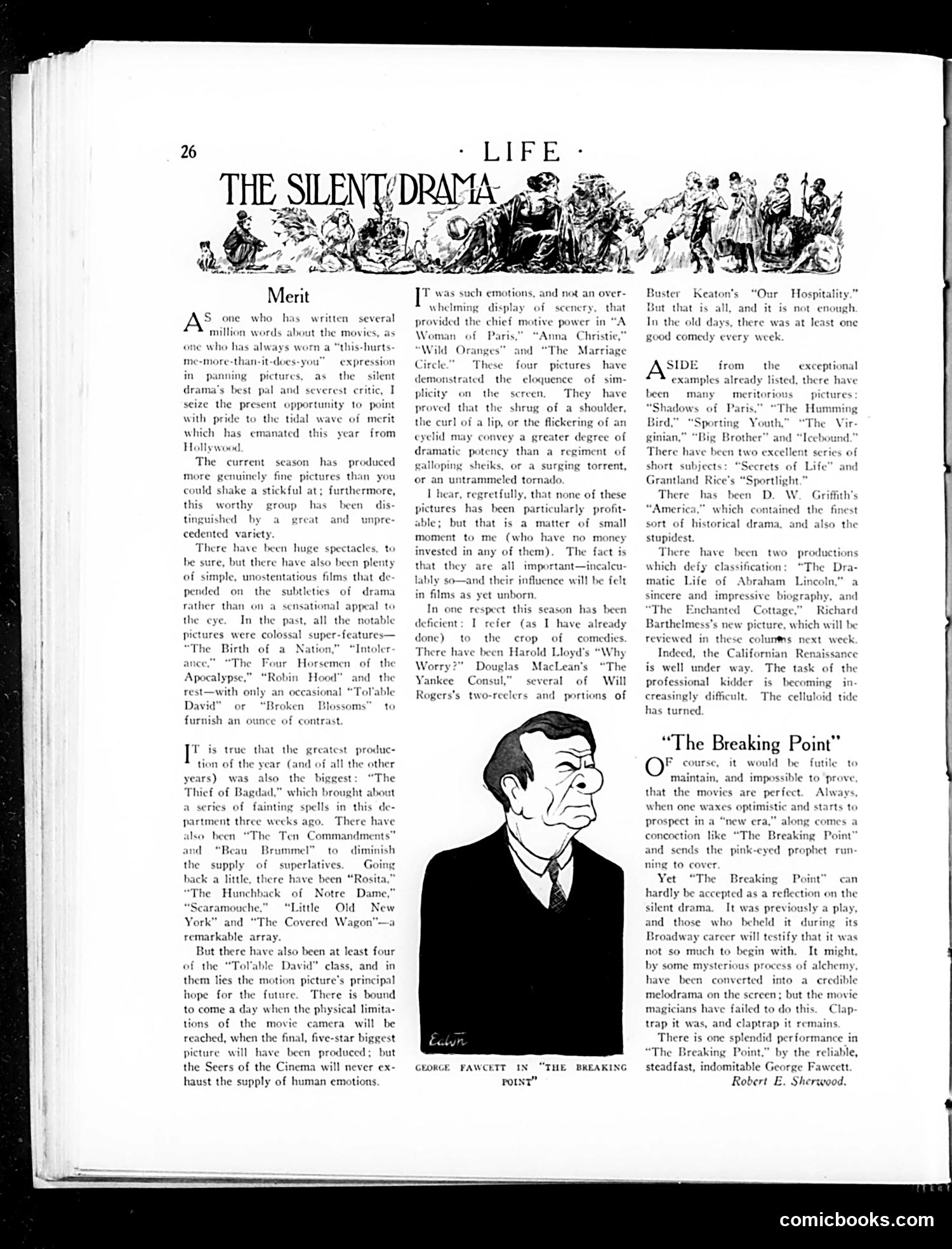
This is a film criticism column reviewing the 1923 movie season. The author praises Hollywood's recent output, noting genuine quality beyond mere spectacle—citing emotional restraint in films like "Anna Christie" and "Wild Oranges" as superior to lavish set pieces. The **caricature shown is George Fawcett** in "The Breaking Point," identified by the caption. The dour expression appears illustrative of the film being reviewed. **Key context a modern reader would miss:** - References to now-obscure silent films and stars (Harold Lloyd, Douglas MacLean, Buster Keaton) - "The Thief of Bagdad" and "The Ten Commandments" as major productions - The author's concern that smaller, emotion-driven dramas ("like 'Tolable David'") weren't profitable, yet predicted their future influence - The critique that even a great year lacked sufficient comedies The column essentially argues that **artistic merit matters more than box-office success**—a progressive stance for 1920s film criticism.
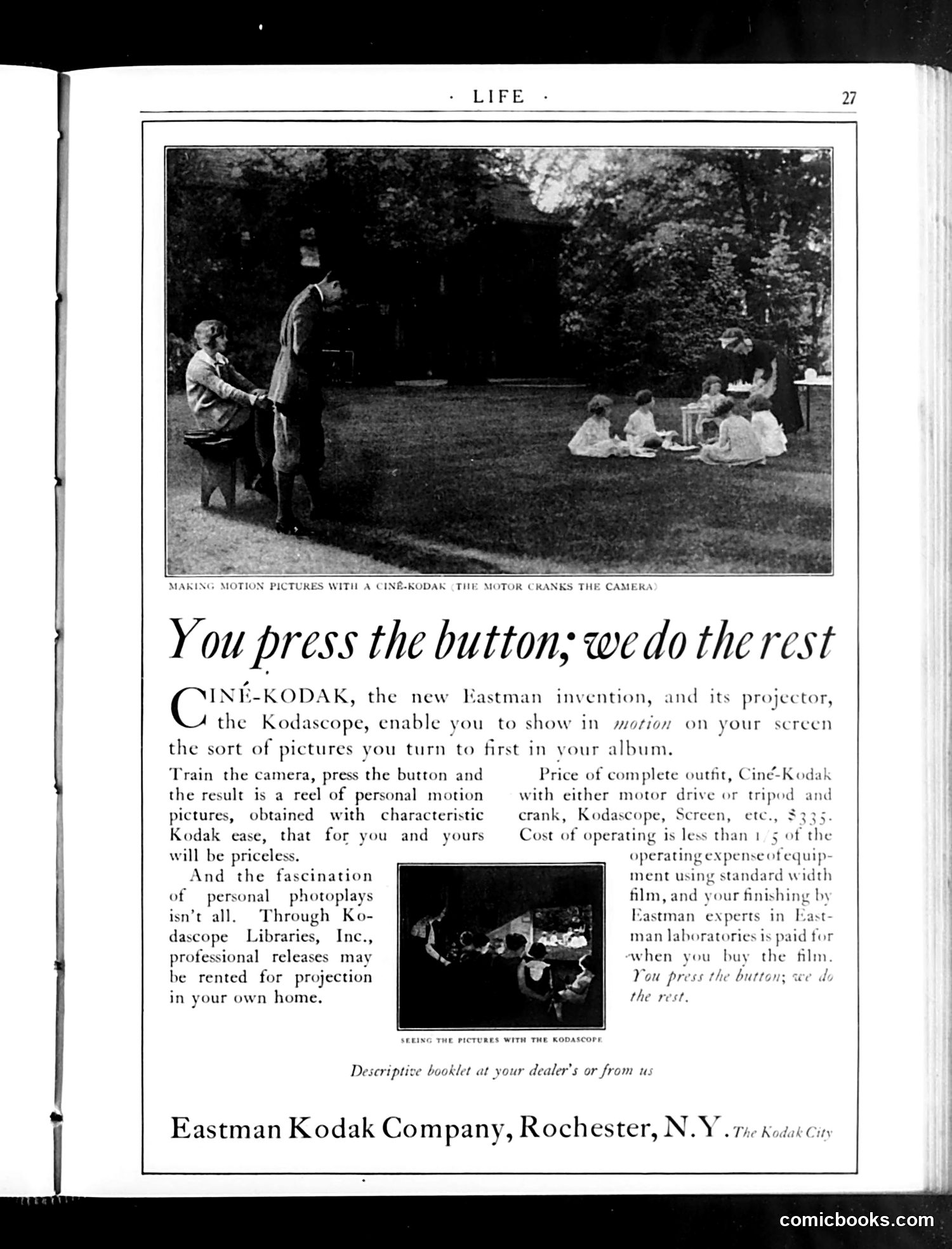
This is a full-page advertisement, not a political cartoon. It promotes Eastman Kodak's new Cine-Kodak motion picture camera and Kodascope projector—early consumer film equipment. The top photograph shows the camera in use outdoors, with people operating it and others being filmed. The lower inset image shows people viewing projected film. The ad's appeal to consumers centers on the slogan "You press the button; we do the rest"—emphasizing ease of use. For approximately $335, buyers could film personal moments (children, family events) and project them at home, or rent professional films through Kodascope Libraries for home viewing. The advertisement targets middle-class consumers interested in home entertainment and documenting family life—a novel luxury. It positions amateur filmmaking as accessible and the finishing/processing as handled by Eastman experts, removing technical barriers for ordinary users.
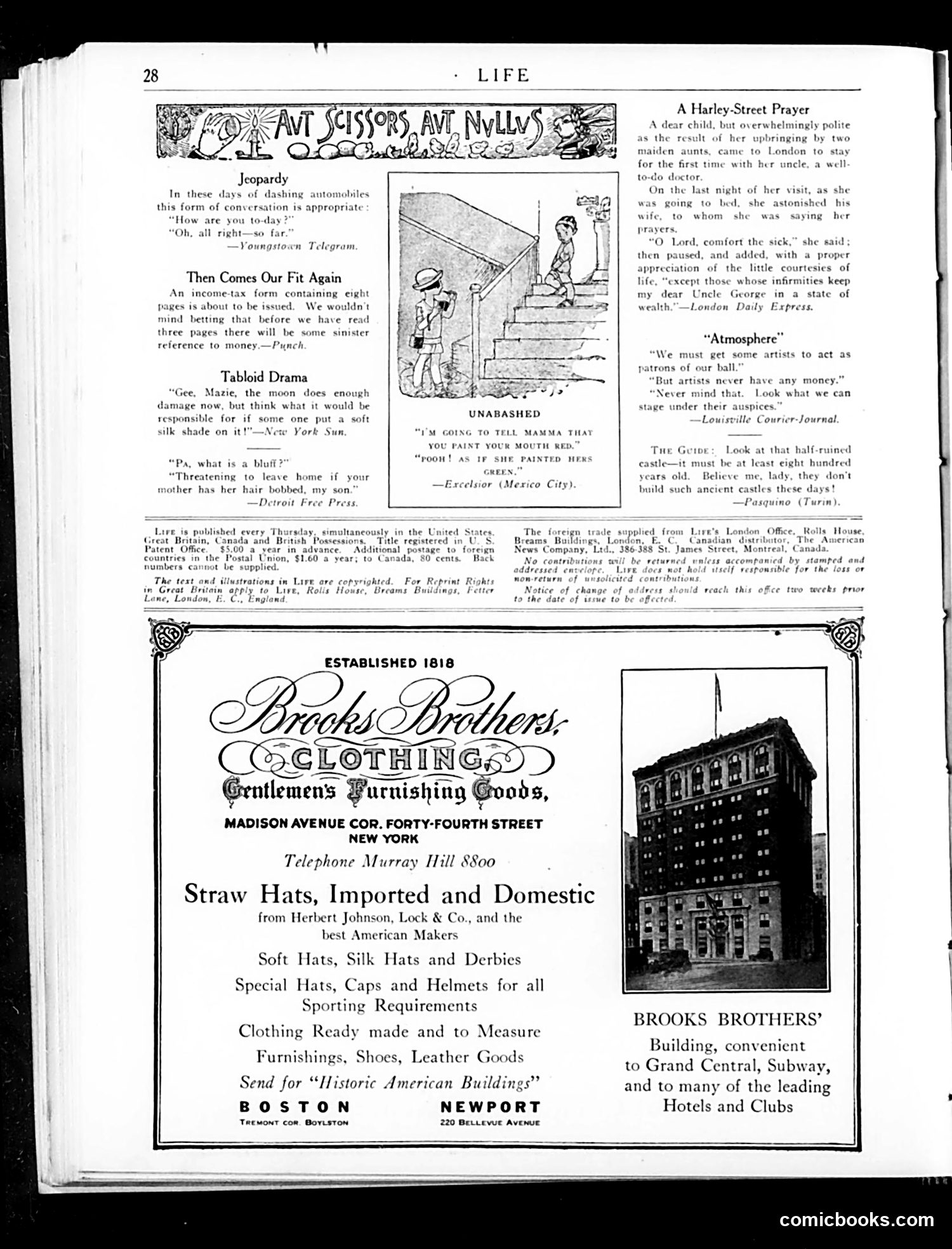
This page contains several brief satirical sketches typical of Life's humor section, plus advertising. **"A Harley-Street Prayer"** mocks overly polite British etiquette. A young visitor to a Harley Street doctor (London's medical district) responds to greeting with "Oh, all right—so far"—suggesting such formal politeness produces cautious, non-committal replies. **"Then Comes Our Fit Again"** jokes about income tax forms, predicting that before people finish reading the complicated form, money will inevitably become a depressing topic again. **"Tabloid Drama"** presents brief quips: one mocks sentimental newspaper stories about the moon; another involves a child threatening to tell his mother on a girl, implying she uses cosmetics. The final sketch plays on the word "bluff"—a father warns his son that mothers threaten to leave home over bobbed hair (a 1920s scandal). The page is primarily **advertising**, dominated by Brooks Brothers' clothing promotion featuring their building photograph.
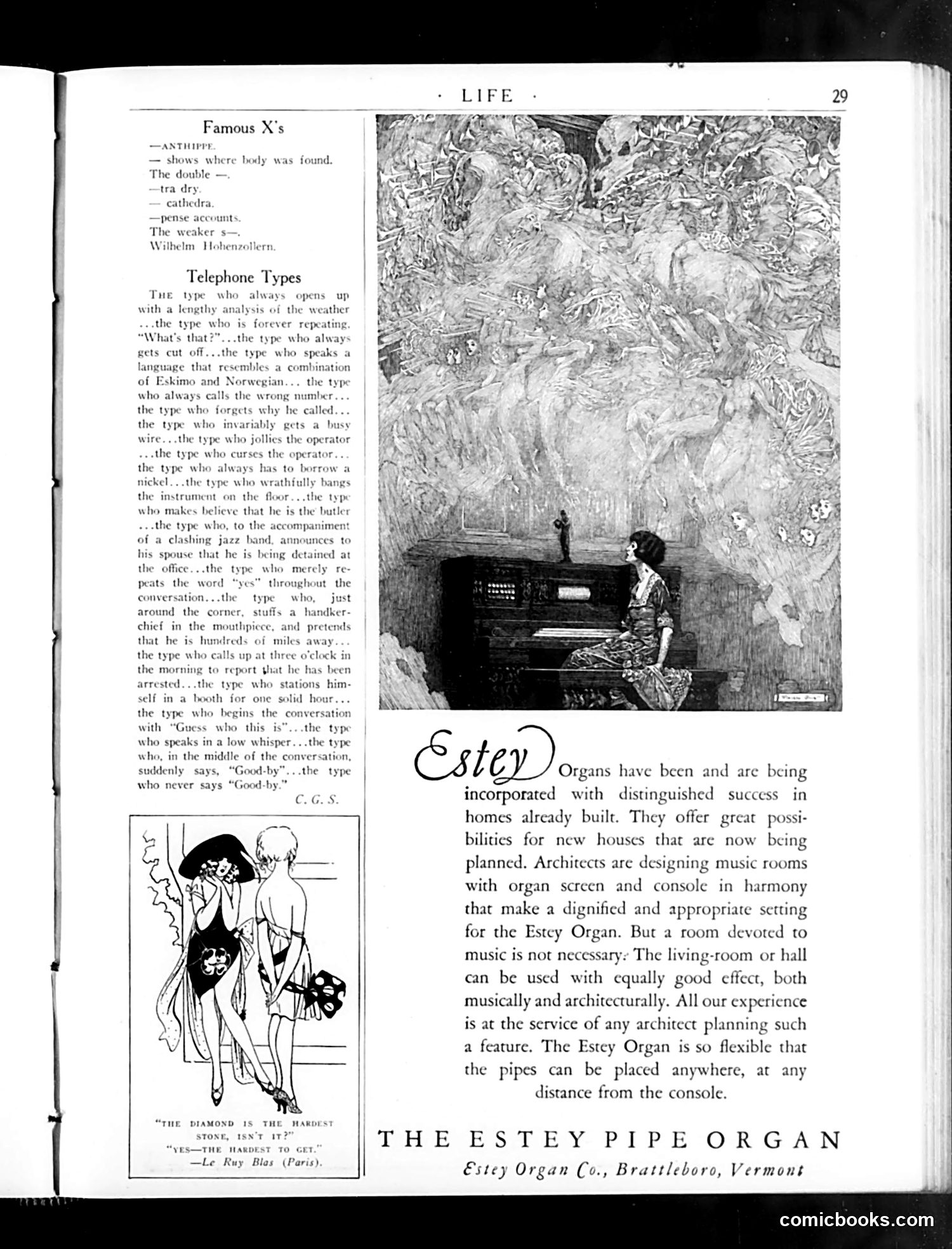
This page contains two distinct sections: **"Famous X's"** (upper left) is a humorous list of historical/notable figures identified only by cryptic clues—likely a quiz game for readers. References include "Antihppe," "The Double," and "Wilhelm Hohenzol[n]" (likely Wilhelm II, the German Kaiser), playing on the magazine's satirical tradition of oblique commentary. **"Telephone Types"** (center-left) is a comedic essay cataloging absurd telephone user stereotypes—the weather bore, the wrong-number caller, the operator abuser, the jazz-band interrupter, etc. This satirizes the then-still-novel telephone technology and the social awkwardness it created. The humor relies on readers recognizing these annoying personality types in their own social circles. The page is otherwise dominated by **Estey Organ advertising** (lower right), a product placement typical of Life's revenue model. The advertisement includes a photograph of the organ installation. The small cartoon (lower left) appears unrelated—a fashion or social commentary illustration with the caption about diamonds being "the hardest stone."
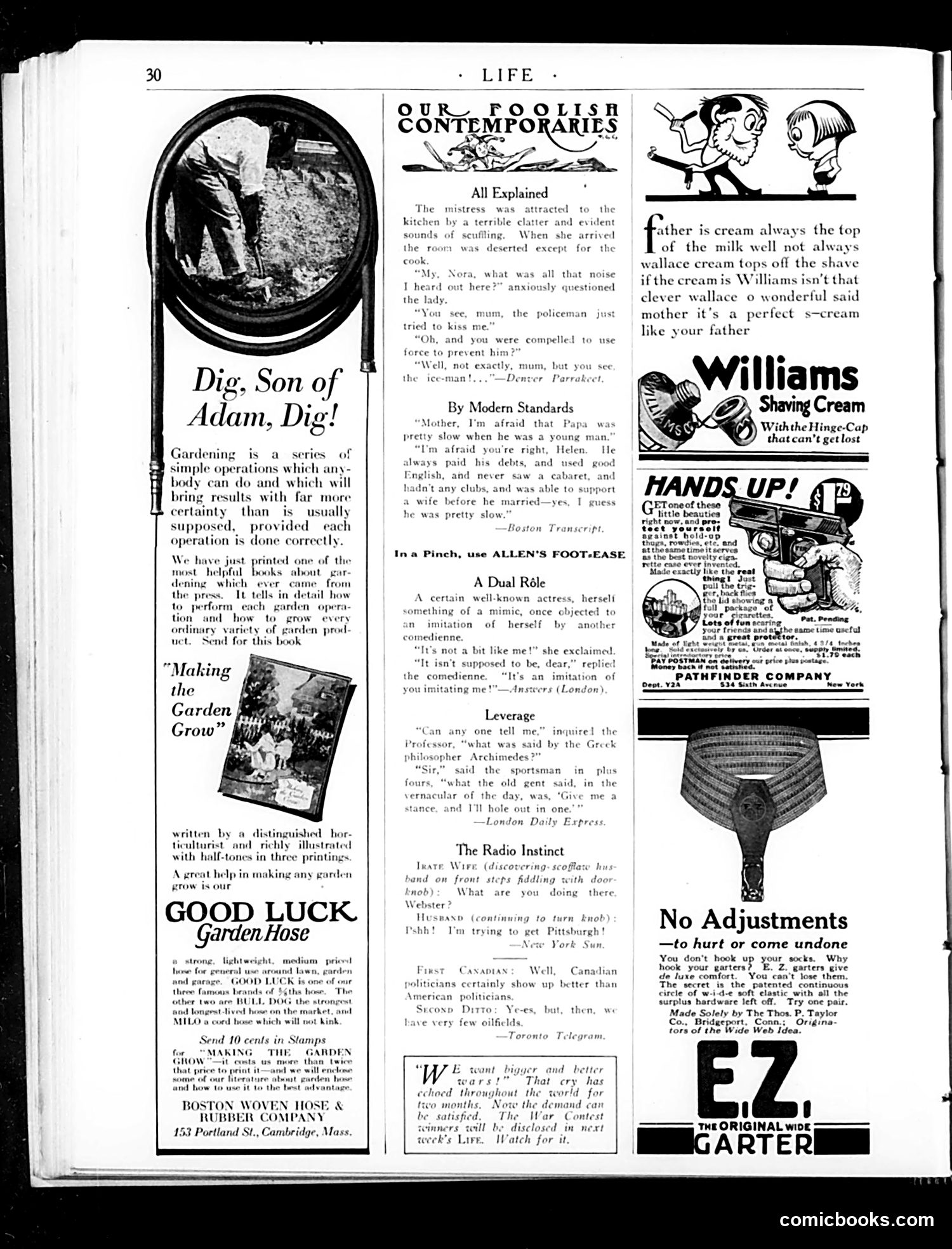
This page is primarily **advertising and humor content** rather than political cartoons. The main elements include: **"Dig, Son of Adam, Dig!"** — A gardening instructional feature promoting a book on horticultural techniques, with a circular inset photograph showing someone digging. **Humor Pieces** ("Our Foolish Contemporaries") — Several short comedic anecdotes about domestic life and social situations, including: - A story about a mistress and police officer (unclear exact meaning without fuller context) - A joke about an actress doing impressions - References to Greek philosophers and sportsmen **Advertisements** dominate the right side: Williams Shaving Cream, Allen's Foot-Ease, E.Z. garters, Good Luck Garden Hose, and Pathfinder Company products. **No clear political satire** is evident. The humor appears aimed at middle-class domestic situations and product endorsements typical of 1920s-era Life magazine content. The page reflects period attitudes toward gender roles and consumer culture rather than addressing specific political events.
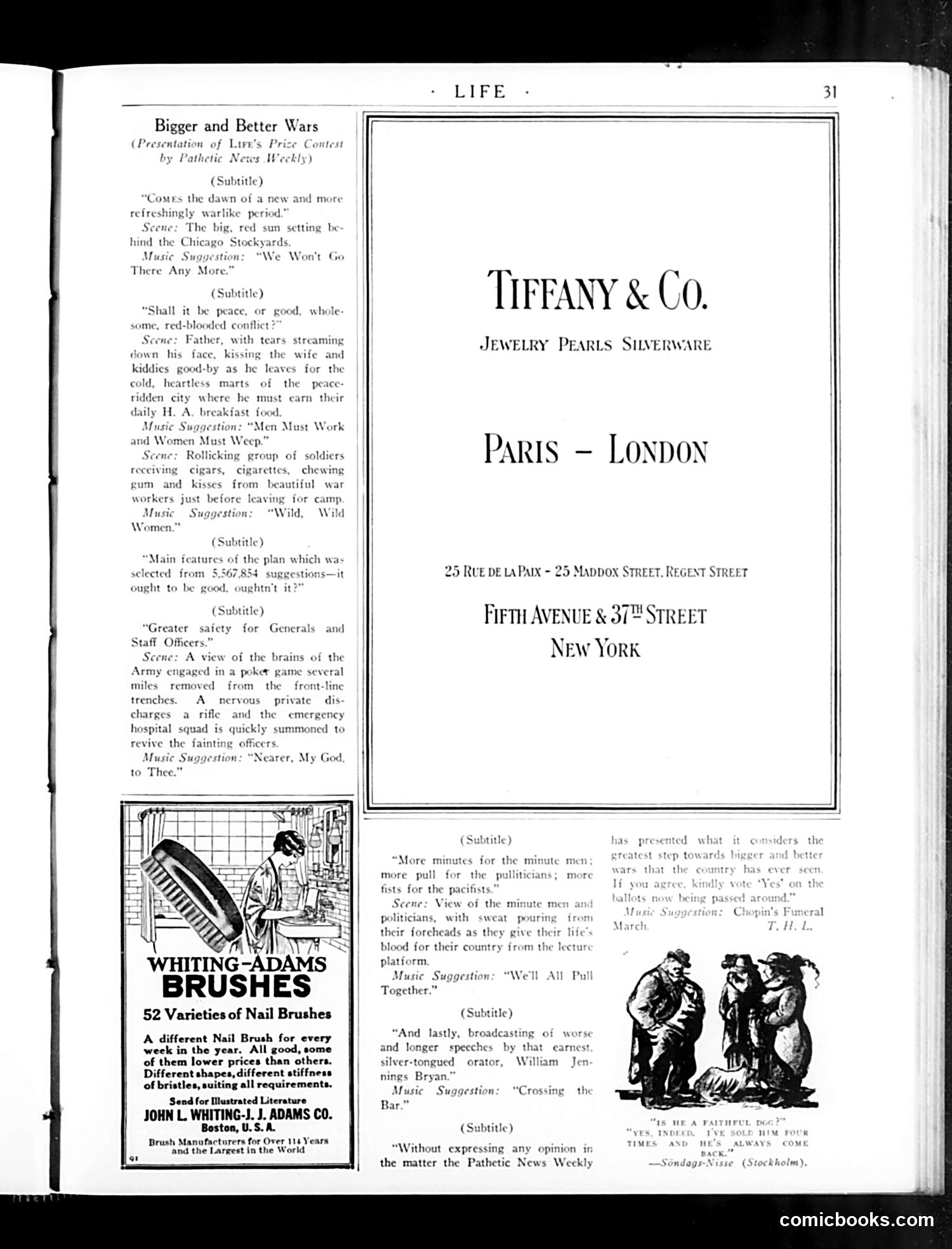
This page presents Life's satirical critique of American enthusiasm for World War I, presented as mock "Pathetic News Weekly" content. The satire mocks pro-war propaganda through several scenarios: a tearful father leaving his family for combat; soldiers receiving kisses and cigarettes from women before deployment; and politicians far from danger playing poker while soldiers die in trenches. The recurring theme attacks the disconnect between those promoting war (politicians giving speeches, comfortable generals away from frontlines) and those actually fighting and dying. References to William Jennings Bryan (the "silver-tongued orator") suggest criticism of pacifist or anti-war speakers being overshadowed. The subtitle "Greater safety for Generals and Staff Officers" particularly emphasizes the hypocrisy: military leadership stays safe while regular soldiers face carnage. The page satirizes how American society glamorized war sacrifice while insulating elites from consequences.
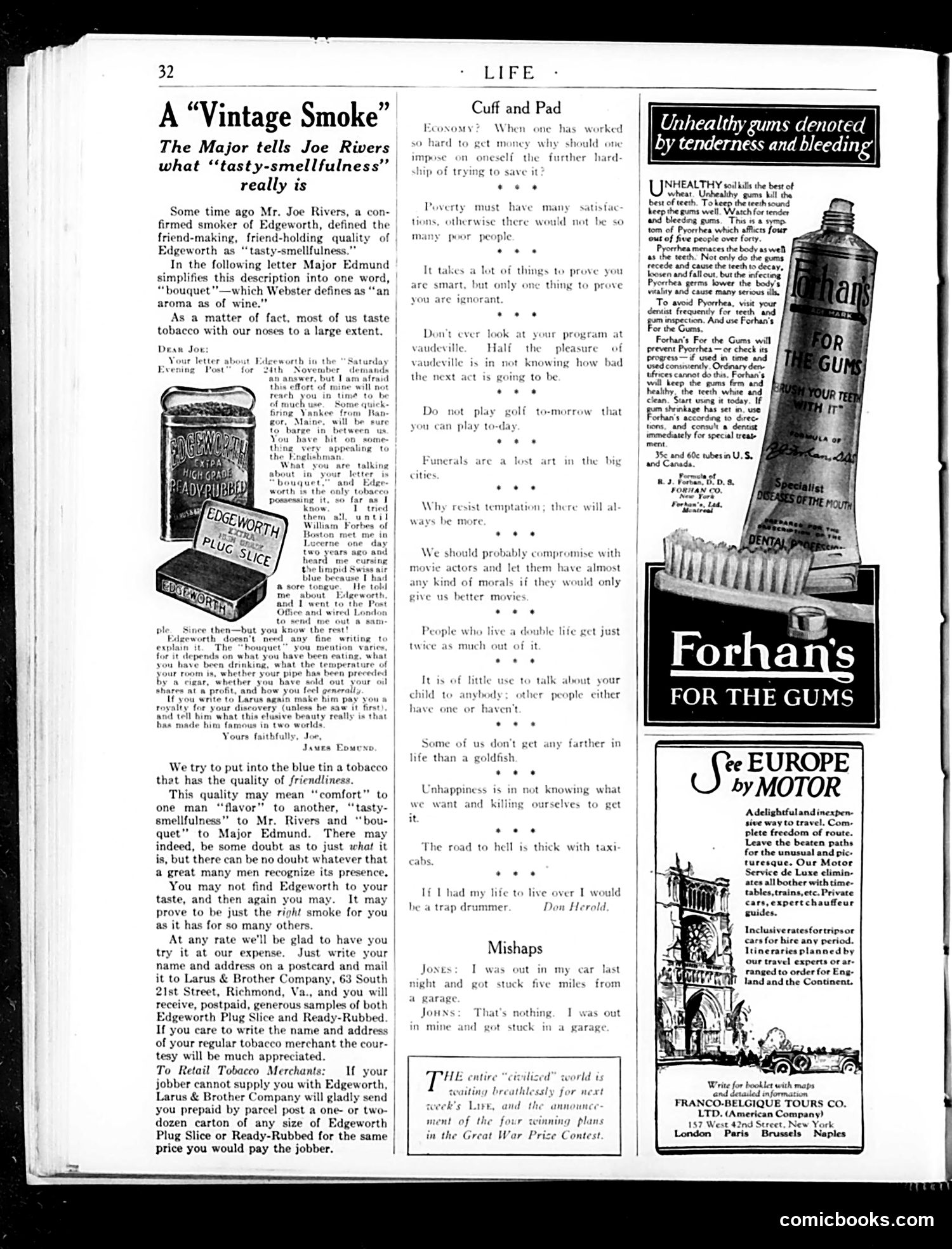
This page consists primarily of **advertisements disguised as editorial content**, a common early 20th-century magazine practice. The main feature is an **Edgeworth tobacco ad** framed as a letter from "Major Edmund" to "Joe Rivers," debating what makes tobacco appealing. The joke plays on subjective taste: one man calls it "tasty-smellfulness," the Major calls it "bouquet" (like wine). The satire gently mocks how people use fancy language to justify personal preferences—here, smoking quality. The right side features a **Forhan's toothpaste advertisement** warning about gum disease (pyorrhea), which appears ironic given the tobacco promotion opposite it. Below is a **travel agency ad** for "See Europe by Motor." The "Mishaps" section contains brief humorous anecdotes about getting cars stuck. **Context for moderns:** This reflects an era when cigarettes/tobacco were heavily advertised and their health dangers were either unknown or deliberately concealed. The juxtaposition with dental health ads reveals period attitudes—oral hygiene was promoted while smoking's dangers went unmentioned.
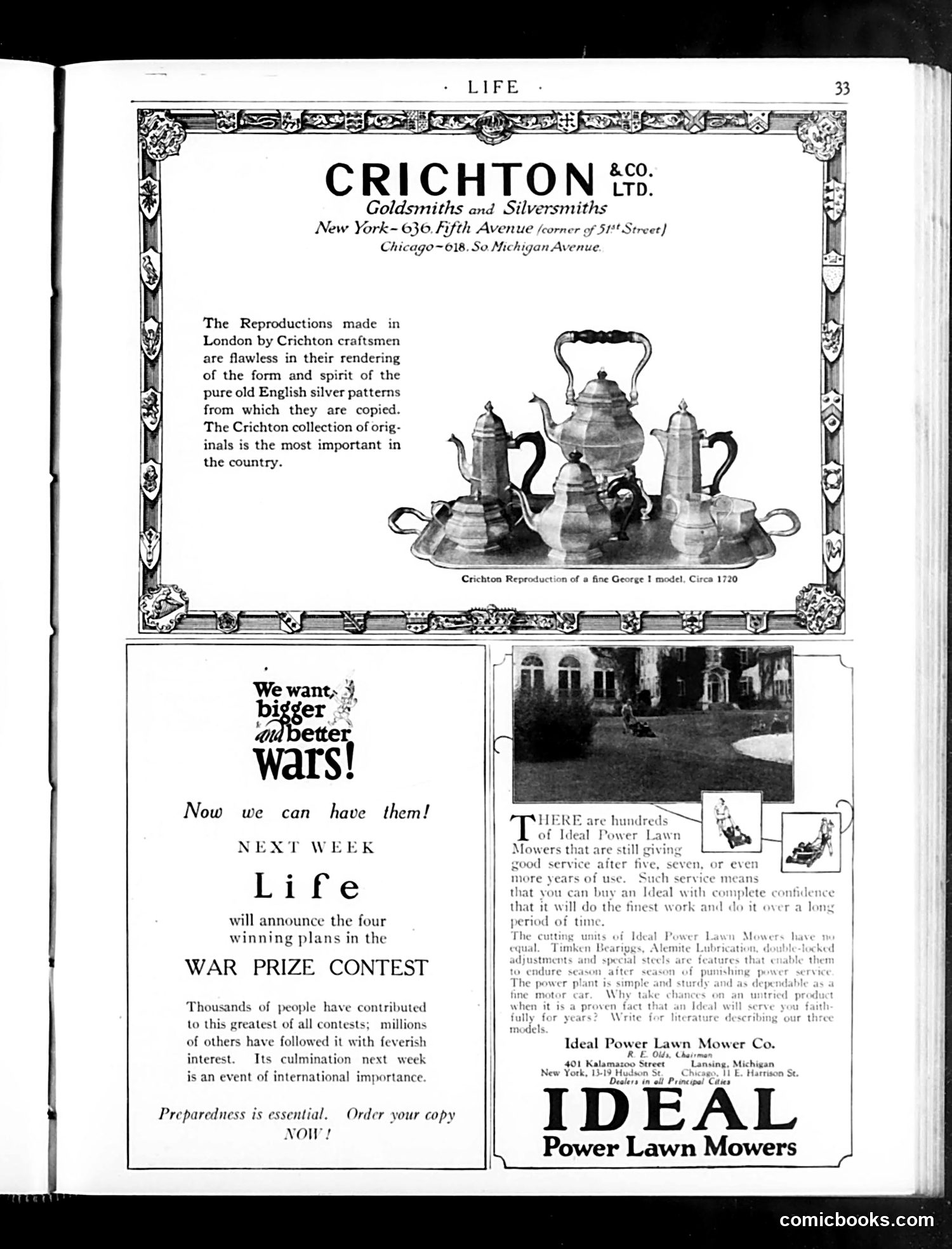
This page is primarily **commercial advertising** interspersed with a contest announcement, not satire or political commentary. The **top section** promotes Crichton & Co., a luxury goldsmith and silversmith retailer, showcasing reproduction English silver tea service sets from circa 1720. The copy emphasizes their craftmanship and prestigious collection. The **left column** announces Life magazine's upcoming "War Prize Contest"—a major public competition where thousands contributed entries. The announcement urges readers to "order your copy NOW" to see the four winning plans, calling it "an event of international importance." The **right section** advertises Ideal Power Lawn Mowers, emphasizing their durability and reliability after years of use. The "Preparedness is essential" language reflects World War I-era messaging, though this appears to be standard advertising copy rather than editorial satire. The page lacks cartoon commentary—it's purely commercial content from Life's advertising sections.
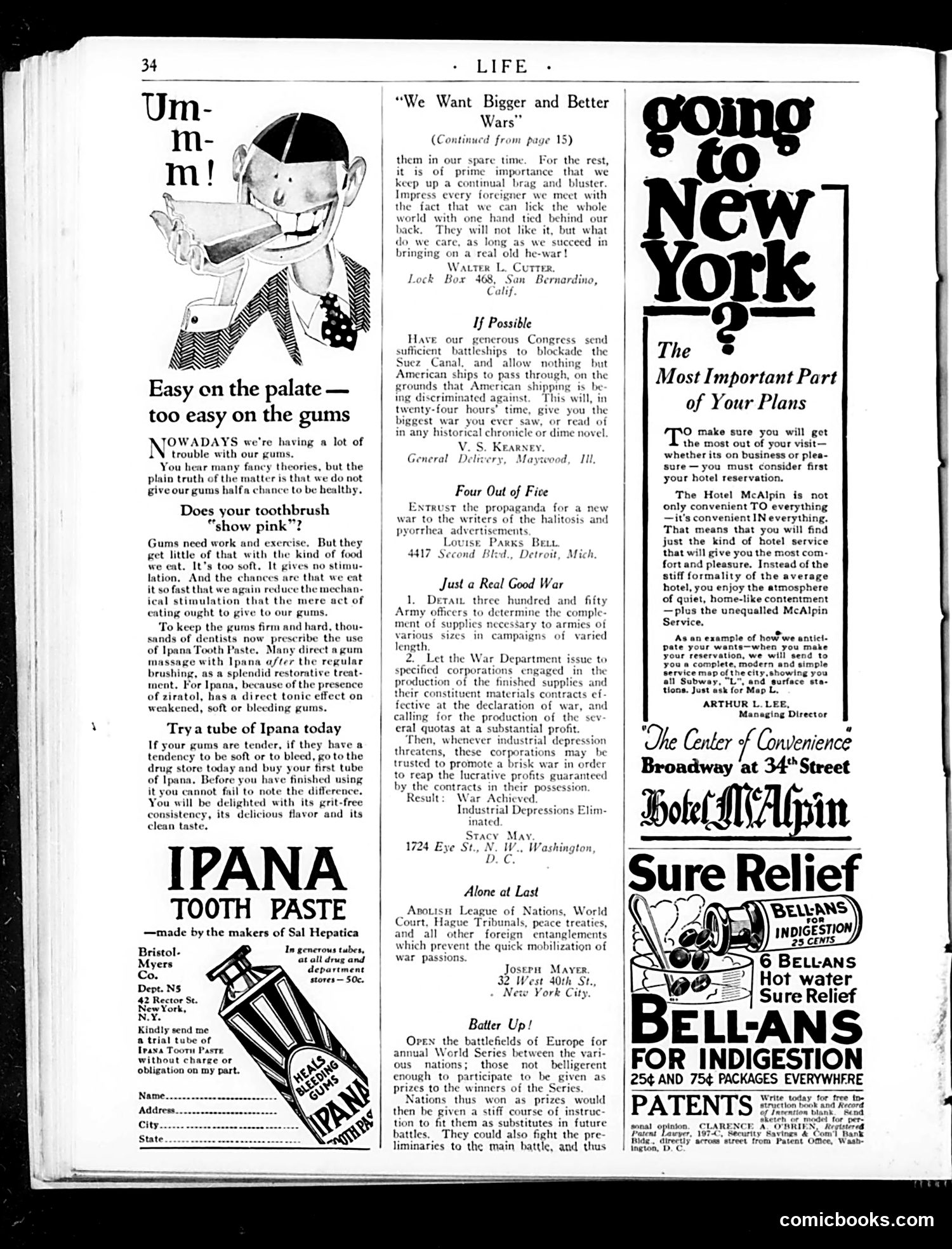
This page primarily features **advertisements** (Ipana Toothpaste, Hotel McAlpin, Bellans) rather than editorial cartoons. The main satirical content is a **letters column titled "We Want Bigger and Better Wars,"** where readers submit darkly humorous suggestions for provoking international conflict. Authors propose absurd schemes: blockading the Suez Canal, using halitosis advertisements for propaganda, having the War Department guarantee war profits to corporations, and converting Europe into a baseball World Series between nations. **The satire's target**: American militarism and war profiteering in the post-WWI era. These tongue-in-cheek letters mock those who cynically view war as economically beneficial, who promote nationalism through advertising techniques, and who treat international relations as entertainment or profit opportunities. **Context**: This likely dates to the 1920s-30s, when isolationist sentiment and criticism of arms manufacturers ("merchants of death") were strong American political currents. The humor is darkly cynical—exaggerating real anxieties about corporate war-profiteering into absurdist proposals.
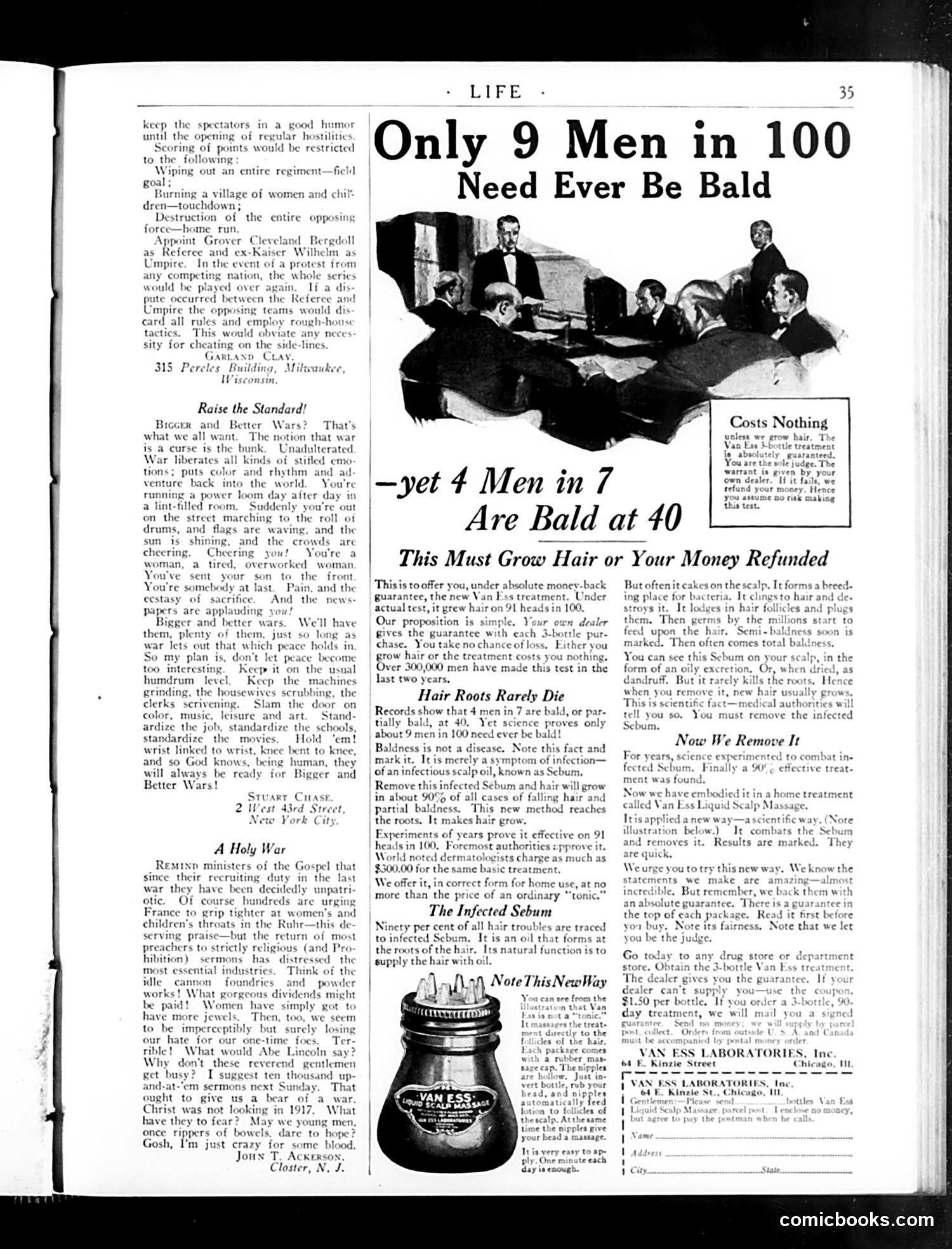
This page contains **two distinct elements**: a satirical letter about warfare and a hair-loss advertisement. ## The "Raise the Standard!" Satire The letter mocks post-WWI enthusiasm for "bigger and better wars." The author sarcastically argues that war provides excitement to dull industrial life—workers marching with flags instead of tending looms. He proposes absurd "football rules" for future conflicts (touchdowns for destroying regimes, etc.), with Grover Cleveland and ex-Kaiser Wilhelm as officials. The satire targets jingoism and nostalgia for wartime nationalism that emerged after World War I. It's darkly ironic—presenting warmongering as obviously ridiculous by taking it to logical extremes. ## The Van Ess Hair Treatment Advertisement The ad promises hair regrowth based on pseudoscience: claiming 91% of baldness stems from "infected sebum" (scalp oil), not actual root death. It offers a money-back guarantee and claims 300,000 men have tested it. **Context**: Early 20th-century patent medicines routinely made unsubstantiated health claims. This represents typical advertising of that unregulated era.
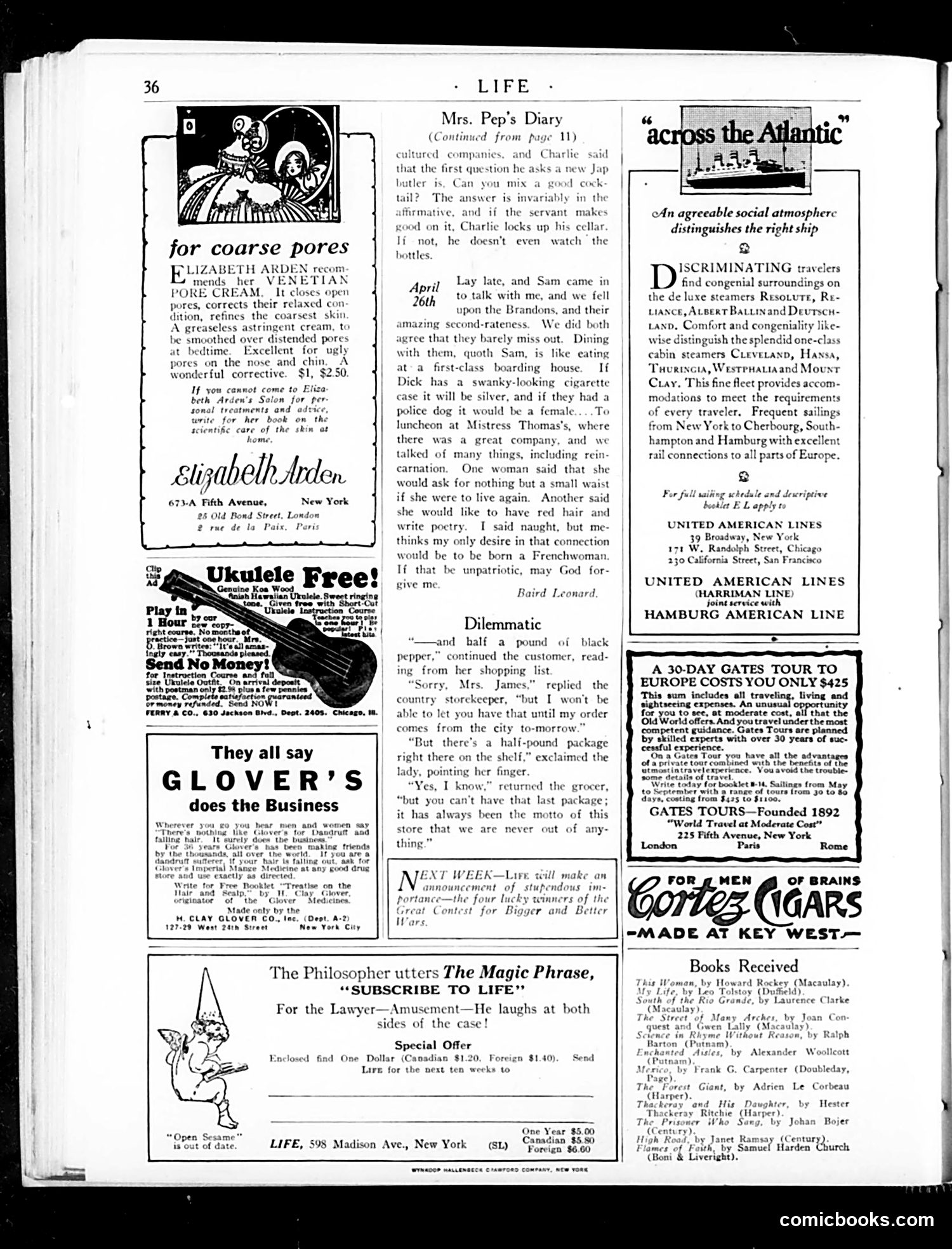
This page is primarily **advertising and miscellaneous content** rather than political satire. The dominant elements include: **Advertisements:** Multiple beauty and consumer product ads (Elizabeth Arden pore cream, Glover's products, ukulele lessons, shipping lines, European tours, Cortez cigars). **"Mrs. Pep's Diary"** is a gossip column discussing upper-class social observations—notably a snobby critique of the "Brandon" couple as "second-rate," and musings about reincarnation preferences. The final entry shows casual snobbery about being born French rather than American. **"Dilemmatic"** is a brief humorous anecdote about a grocer refusing to sell his last package of black pepper to a customer, maintaining an absurd store policy of "never being out of anything." These are light social commentary and humor typical of Life's satirical style, mocking pretension and absurdity in everyday life, rather than focused political cartoons. The page reflects 1920s consumer culture and upper-class social attitudes.
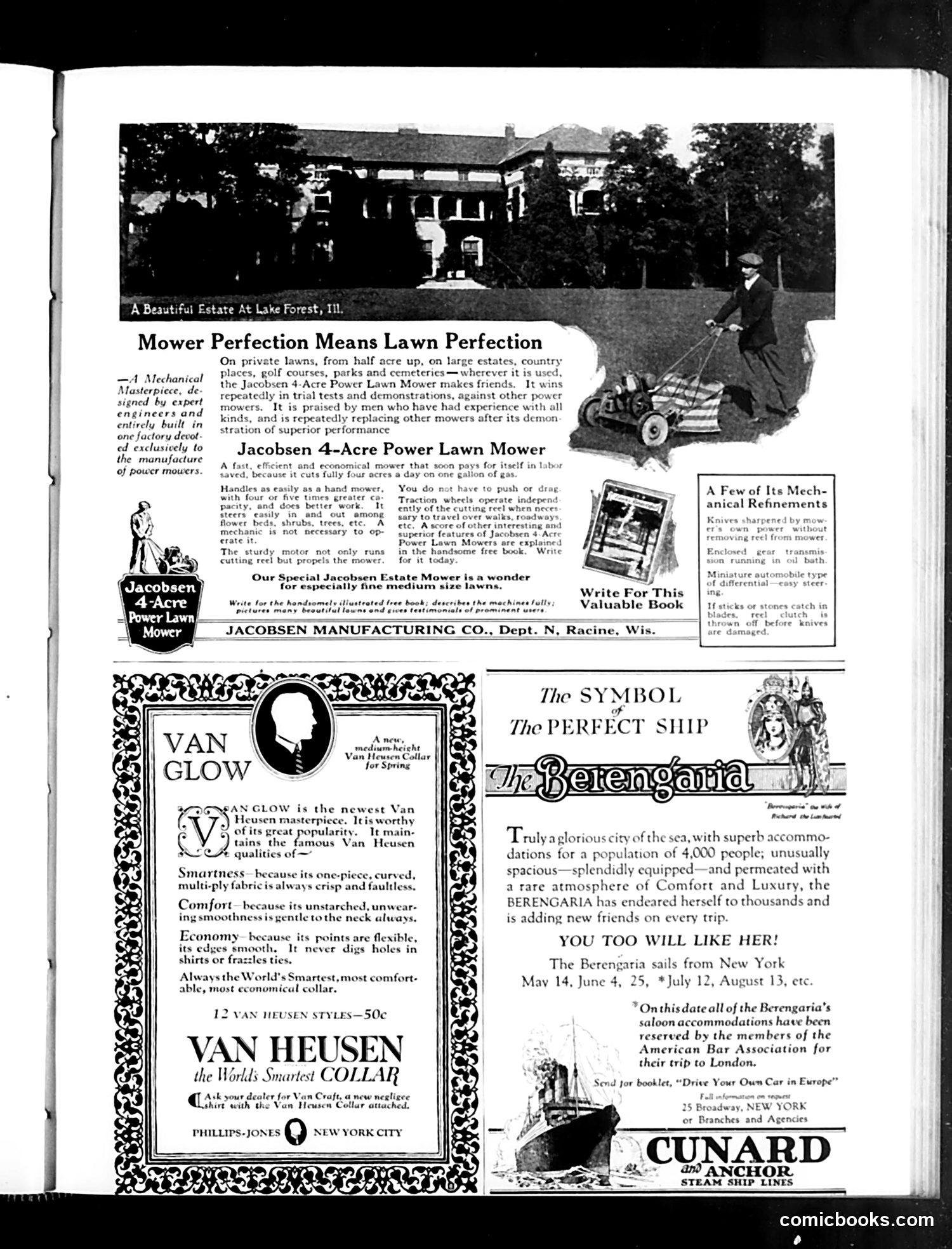
This page is **primarily advertising** rather than satire or political commentary. It contains four distinct commercial advertisements: 1. **Jacobsen 4-Acre Power Lawn Mower** (top): Promotes an mechanized lawn mower as superior to hand-operated alternatives, emphasizing efficiency and ease of operation for estates and golf courses. 2. **Van Heusen Collar** (bottom left): Advertises a new "medium-height" collar style, highlighting practical qualities (durability, comfort, economy) valued by Depression-era consumers. 3. **Berengaria Ship** (right): Promotes luxury ocean travel, notably mentioning a reserved sailing for American Bar Association members traveling to London. 4. **Cunard Anchor Steam Ship Lines** (bottom right): Supporting cruise line advertisement. The page reflects **1920s-1930s consumer culture**: mechanization of domestic labor, emphasis on practical efficiency, and aspirational leisure travel for professional classes. No political cartoons or satirical content is present; this is a straightforward advertising layout typical of Life magazine's revenue model.
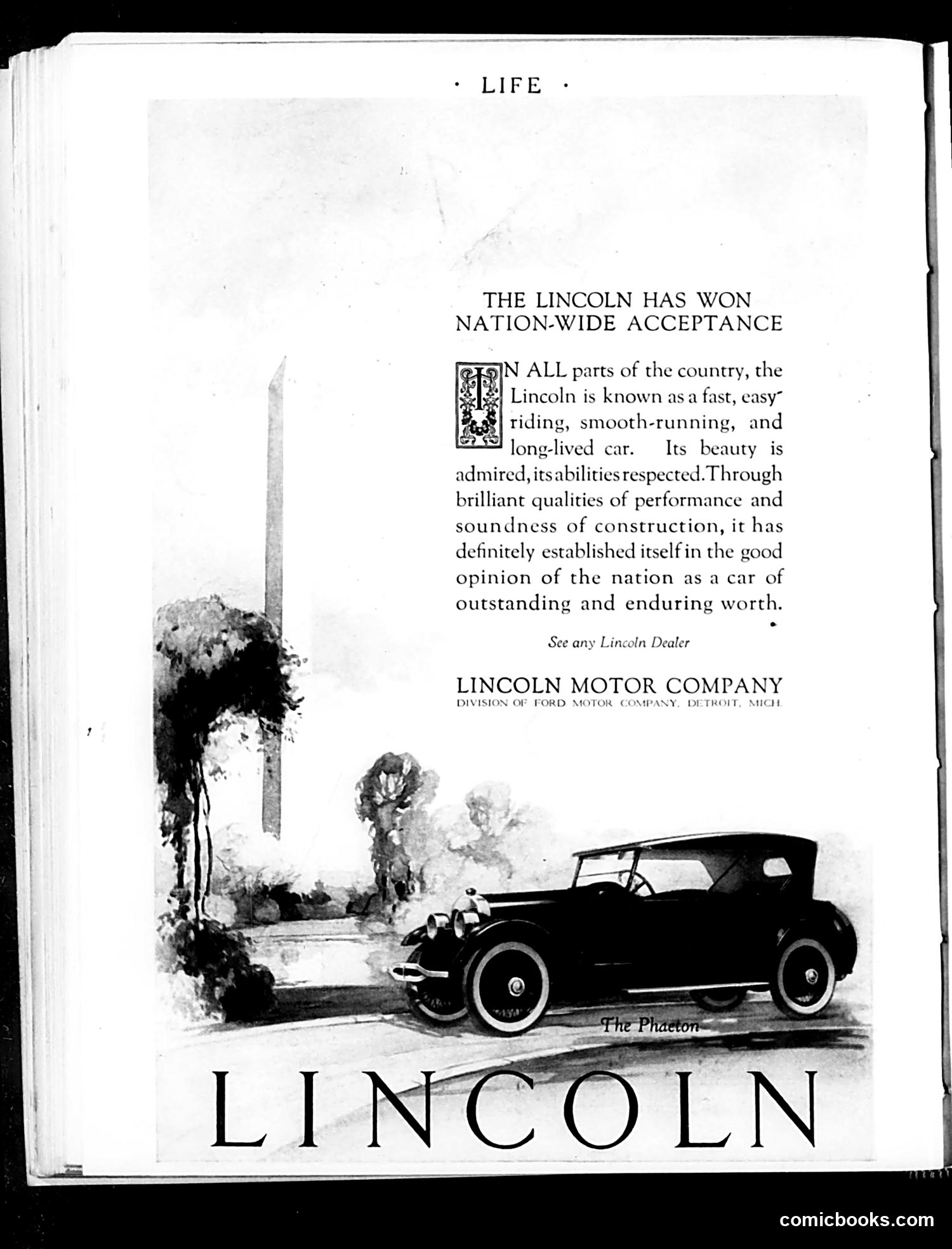
This is **not a cartoon or satire** — it's a **straightforward automobile advertisement** for the Lincoln motor car, a division of Ford Motor Company. The page features: - A luxury automobile (labeled "The Phaeton") photographed against an idealized landscape with a prominent monument (appears to be the Washington Monument) - Marketing copy praising the Lincoln's performance, beauty, and reliability across America - A call to action directing readers to visit Lincoln dealers The patriotic imagery (monument, elegant setting) positions the Lincoln as distinctly American and prestigious. This reflects early automotive advertising strategy: associating luxury cars with national pride and established quality. There is **no political satire, caricature, or joke** — Life magazine, while known for humor and satire in other sections, also carried paid advertisements like this one.