
Life, 1924-05-01 · page 22 of 40
Life — May 1, 1924 — page 22: what you’re looking at
What you’re looking at
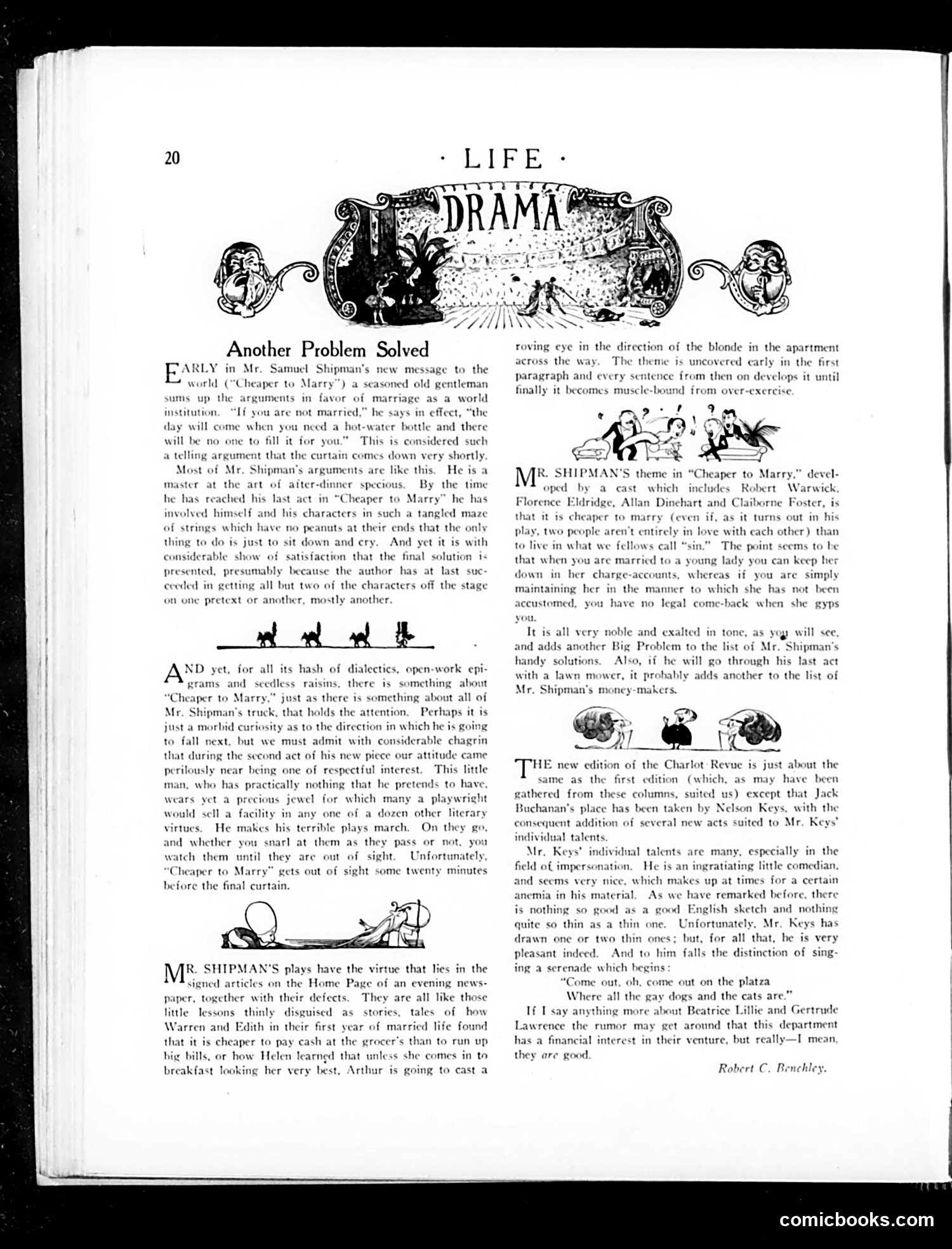
This is a theater review of Samuel Shipman's play "Cheaper to Marry," critiquing both the work and Shipman's dramatic style generally. The reviewer identifies Shipman as a playwright who constructs plays around simple domestic arguments—here, that marriage is financially prudent compared to maintaining an unmarried mistress. The play features Robert Warwick, Florence Eldridge, Allan Dinehart, and Claiborne Foster. The satire targets Shipman's formula: he presents obvious moral lessons (comparing married versus unmarried expenses) with "considerable show of satisfaction," then tangles characters in contrived plot knots to reach predetermined conclusions. The reviewer grudgingly admits Shipman's plays are engaging despite being intellectually thin—they "march" forward compellingly even as audiences may resent their manipulative simplicity. The final jab suggests the play ends prematurely, perhaps deliberately to hide its weaknesses.
📄 Transcribed text from this page (OCR, searchable)
Machine-transcribed from the original scan — historical spelling and the odd misread are preserved.
Another Problem Solved ARLY in Mr world (“Cheaper to Marry”) a seasoned old gentleman Samuel Shipman’s new message to the sums up the arguments in favor of marriage as a world institution. “If you are not married,” he says in effect, “the day will come when you need a hot-water bottle and there This is considered such a telling argument that the curtain comes down very shortly Most of Mr. Shipman’s arguments are like this. He is a master at the art of aiter-dinner specious. By the time he has reached his last act in “Cheaper to Marry” he has will be no one to fill it for you.” involved himself and his characters in such a tangled maze of strings which have no peanuts at their ends that the only And yet it is with considerable show of satisfaction that the final solution thing to do is just to sit down and ery presented, presumably because the author has at last s ceeded in getting all but two of the characters off the stage on one pretext or another, mostly another. — A wow 2 AAND vets for all its hash of dialectics, open-work epi- ‘ams and seedless raisins, there is something about ‘Cheaper to Marry,” just as there is something about all of Mr. Shipman’s truck, that holds the attention. Perhaps it is just a morbid curiosity as to the direction in which he is going to fall next, but we must admit with considerable chagrin that during the second act of his new piece our attitude came perilously near being one of respectful interest. This little man, who has practically nothing that he pretends to have wears yet a precious jewel for which many a playwright would sell a facility in any one of a dozen other literary virtues. He makes his terrible plays march. On they go, and whether you snarl at them as they pass or not, you watch them until they are out of sight. Unfortunately, ‘Cheaper to Marry” gets out of sight some twenty minutes before the final curtain. MIB. SHIPMAN’S plays have the virtue that Ties in the signed articles on the Home Page of an evening news- paper, together with their defects. They are all like those little lessons thinly disguised as stories, tales of how Warren and Edith in their first year of married life found that it is cheaper to pay cash at the grocer’s than to run up hig bills, or how Helen learned that unless she comes in to breakfast looking her very best, Arthur is going to cast a “71111\\\\SSS “fer roving eye in the direction of the blonde in the apartment across the way. The theme is uncovered carly in the first paragraph and every sentence from then on develops it until finally it becomes muscle-bound from over-exercise R. SHIPMAN’S theme in “Cheaper to Marry,” devel- oped by a cast which includes Robert Warwick Florence Eldridge, Allan Dinehart and Claiborne Foster, that it is cheaper to marry (even if, as it turns out in his play, two people aren't entirely in love with each other) than to live in what we fellows call “sin.” The point seems to be that when you are married to a young lady you can keep her Jown in her charge-accounts, whereas if you are simply maintaining her in the manner to which she has not been accustomed, you have no legal come-back when she gyps you It is all very noble and cxalted in tone, as yoy will sce and adds another Big Problem to the list of Mr. Shipman’s handy solutions, Also, if he will go through his last act with a lawn mower, it probably adds another to the list of Mr. Shipman’s money-makers. “> CF em THe new edition of the Charlot Revue is just about the same as the first edition (which, as may have been gathered from these columns, suited us) except that Jack Buchanan's place has been taken by Nelson Keys, with the consequent addition of several new acts suited to Mr. Keys’ individual talents. Mr. Keys’ individual talents are many, especially in the field of impersonation. He is an ingratiating little comedian, and seems very nice, which makes up at times for a certain anemia in his material. As we have remarked before, there » good as a good English sketch and nothing Unfortunately, Mr. Keys has drawn one or two thin ones; but, for all that, he is ver: pleasant indeed. And to him falls the distinction of sing- ing a serenade which begins: “Come out, oh, come out on the platza Where all the gay dogs and the cats are.” ing more about Beatrice Lillie and Gertrude is nothing quite so thin as a thin one, Tf I say an Lawrence the rumor may get around that this departmen has a financial interest in their venture, but really—I mean, they are good. Robert C. Benchley. comicbooks.com