
Life, 1924-05-01 · page 26 of 40
Life — May 1, 1924 — page 26: what you’re looking at
What you’re looking at
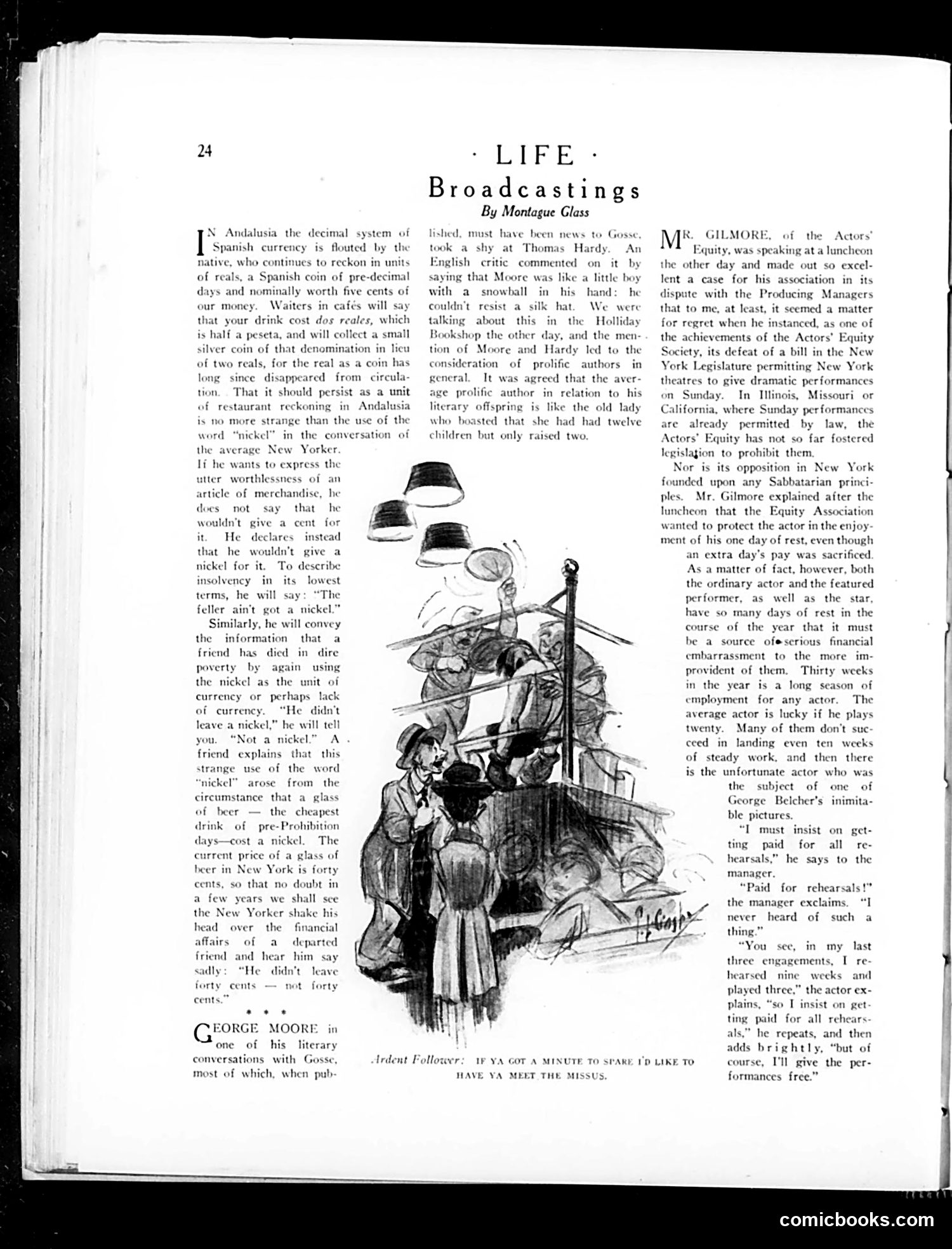
This page contains two satirical pieces by Montague Glass about social and economic oddities. **Left column:** Discusses linguistic anachronisms—how New Yorkers still use "nickel" as a unit of worthlessness despite beer now costing forty cents (not five). The point: language preserves obsolete economic realities long after inflation makes them irrelevant. **Center cartoon:** A sketch (artist signed "H. Goss") showing a man introducing a woman with the caption "If ya got a minute to spare I'd like to have ya meet the missus"—appears to be satirizing working-class social awkwardness or dating customs, though context is unclear. **Right column:** Critiques the Actors' Equity Society's opposition to Sunday theatrical performances in New York on grounds of protecting actors' rest days. Glass argues this is hypocritical: actors already have ample unemployment (only ~20 weeks annual employment for most), so financial hardship—not rest—is their actual concern. The satire questions their true motives.
📄 Transcribed text from this page (OCR, searchable)
Machine-transcribed from the original scan — historical spelling and the odd misread are preserved.
N Andalusia the decimal system of Spanish currency is flouted by the native, who continues to reckon in units of reals, a Spanish coin of pre-decimal days and nominally worth five cents of Waiters in cafés will say h is half a peseta, and will collect a small silver coin of that denomination in licu our money that your drink cost dos reales, whi of two reals, for the real as a coin has ff since disappeared from circula tion. That it should persist as a unit of restaurant reckoning in Andalusia is no more strange than the use of the word “nickel” in the conversation of the average New Yorker li he wants to express the utter worthlessness of an article of merchandise, he does not say that he wouldn't give a cent for it. He declares instead that he wouldn't give a nickel for it. insolvency in its lowest 1) To describe terms, he will say: “The feller ain't got a nickel.” Similarly, he will convey the information that a friend has died in dire poverty by again using the nickel as the unit of currency or perhaps lack currency le didn't = ¢.a nickel,” he will tell “Not a nickel.” A friend explains that this strange use of the word “nickel” arose from the circumstance that a beer the cheapest drink of _ pre-Prohibition days—cost a nickel. The current price of a glass of beer in New York is forty cents, so that no doubt in a few years we shall sce the New Yorker shake his head over the affai friend and hear him say financial s of departed sadly: “He didn't leave iorty cents not forty cents.” oe. EORGE MOORE in one of his literary conversations with Gosse, most of which, when pub ~—( Irdent Follower LIFE - Broadcastings By Montague Glass ished, must have been news took a shy at Thomas Hardy. An English critic commented on it by saying that Moore was like a little boy Gosse with a snowball in his hand: he couldn't resist a silk hat. We were talking about this in the Holliday Bookshop the « tion of Moc r day, and the men- ¢ and Hardy led to the 1 of prolific authors in considera general. It was agreed that the aver- prolific author in relation to his literary offspring is like the old lady who boasted that she had had twelve children but only raised two. —— Smee iy) HAVE YA MEET THE MISSUS IP YA GOT A MINUTE TO SPARE I'D LIKE TO q" GILMORE, of the Actors Equity, was speaking at a luncheon the other day and made out so excel- lent a case for his association in its dispute with the Producing Managers that to me, at least, it seemed a matter for regret when he instanced, as one of the achievements of the Actors’ Equity Society, its defeat of a bill in the New York Legislature permitting New York theatres to give dramatic performances on Sunday. In Illinois, Missouri or California, where Sunday performances are already permitted by law, the Actors’ Equity has not so far fostered legislagion to prohibit them, ir is its opposition in New York founded upon an Sabbatarian princi ples. Mr. Gilmore explained after the luncheon that the Equity Association wanted to protect the actor in the enjoy ment of his one day of rest, even though an extra day's pay was sacrificed As a matter of fact, however, both the ordinary actor and the featured performer, as well as the. star, have so many days of rest in the course of the year that it must be a source ofeserious financial embarrassment to the more im- provident of them. Thirty weeks in the year is a long season of employment for any actor. The tor is lucky if he plays twenty. Many of them don't suc: ceed in landing even ten weeks of steady work, and then there is the unfortunate actor who was the subject of one of average a George Belcher’s inimita- ble pictures. “I must insist on get- ting paid for all re- hearsals,” he says to the manager. “Paid for rehearsals!” vy the manager exclaims. “I never heard of such a thing.” “You sec, in my last three engagements, I re hearsed nine weeks and played three,” the actor ex- plains, “so I insist on get ting paid for all ret als,” he repeats, and then adds brightly, “but of rs course, I'll give the per- mances free. comicbooks.com |