
Life, 1924-05-01 · page 18 of 40
Life — May 1, 1924 — page 18: what you’re looking at
What you’re looking at
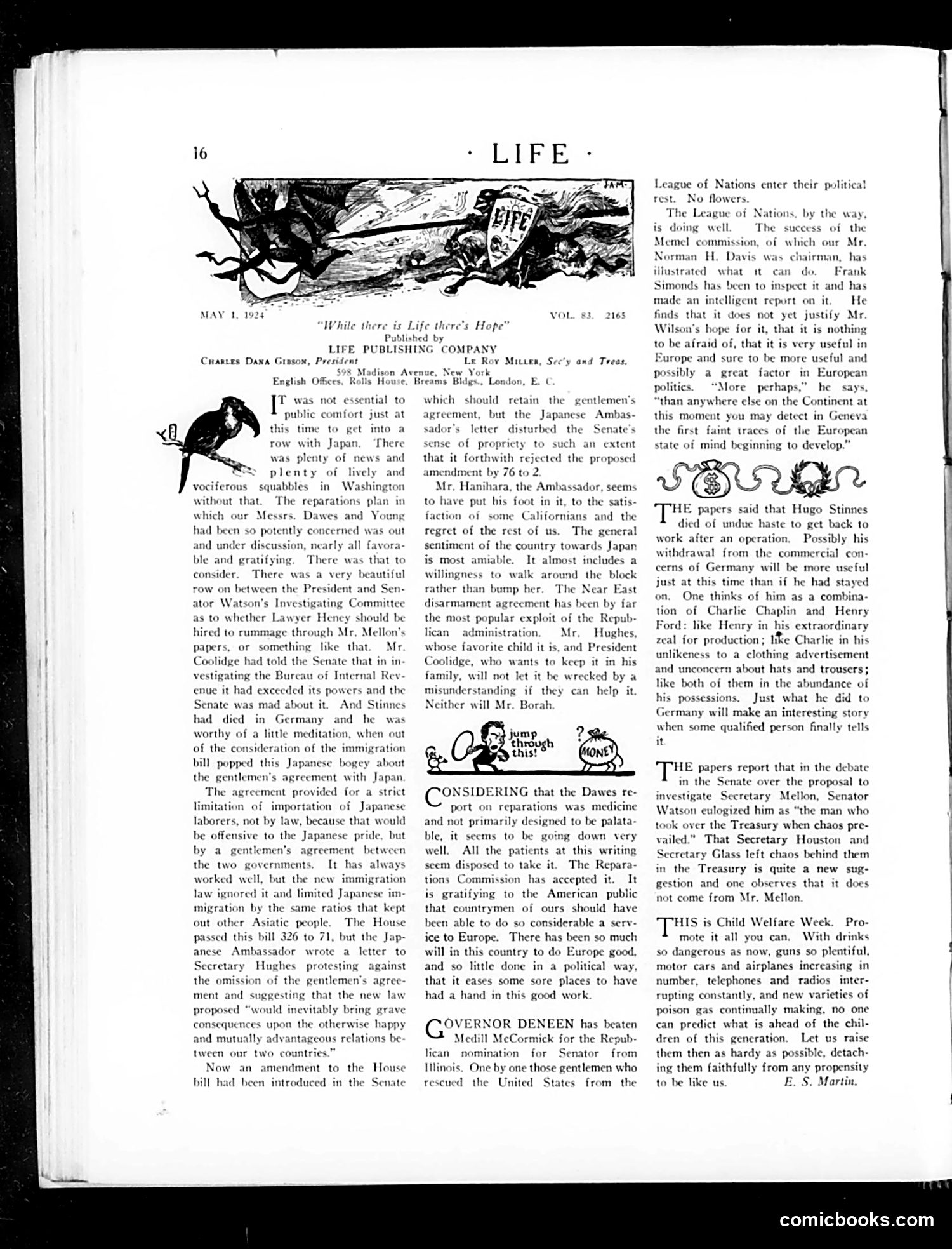
This page discusses several political controversies of 1924. The main cartoon (top left) appears to show a dead or dying figure labeled "Life," satirizing public exhaustion with constant political turmoil. The text critiques the Japanese immigration controversy: Japan's Ambassador Hanihara protested the new immigration law that violated the "gentlemen's agreement" limiting Japanese laborers. His letter offended the Senate so deeply they rejected a compromise amendment 76-2, satisfying California nativists but disappointing those favoring better U.S.-Japan relations. The page also mentions President Coolidge's handling of the Mellon investigation, noting he told the Senate it exceeded its authority—angering senators who had investigated Treasury corruption. Finally, it notes Governor Deneen's primary victory over Medill McCormick in Illinois, observing that one-by-one, the politicians who kept America out of the League of Nations are being defeated politically—their moment passing.
📄 Transcribed text from this page (OCR, searchable)
Machine-transcribed from the original scan — historical spelling and the odd misread are preserved.
Cantes Dana om, President $ Ma Rolls House, English Offices, T was not essential to public comfort just at time to get into a row with Japan, ‘There was plenty of news and lively and Washington without that. The reparations plan in Messrs. Dawes and You had been so potently concerned was out this plenty of vociferous squabbles in which r discussion, nearly all favora There was a and unc ble and gratifying. was that to beautiful President and Sen- consider. There very row on between the ator Watson’s Investigating Committee as to whether Lawyer Heney should be hired to rummage through Mr. Mellon's papers, or something like that. Mr Coolidge had told the Senate that in in- vestigating the Bureau of Internal Rev- enue it had exceeded its powers and the Senate was mad about it. And Stinnes had Germany and he was worthy of a little meditation, when out died in of the consideration of the immigr bill popped this Japanese about the gentlemen's agreement with Japan rict limitation of importation of Japanese laborers, not bogey The agreement provided for a y law, because that would be offensive to the Japanese pride, but by a gentlemen's agreement between the two governments. It has always worked well, but the new immigration law i nored it and limited Japanese im migration by the same ratios that kept out other Asiatic people. The House passed this bill 326 to 71, but the Jap- Ambassador wrote a letter to Secretary Hughes protesting against the omission of the gentlemen's agree- anese ment and suggesting that the new law proposed “would inevitably bring grave consequences upon the otherwise happy and mutually advantageous relations be tween our two countries.” Now an amendment to the House bill had heen introduced in the Senate Published by LIFE PUBLISHING COMPANY Le Roy Mitten, Sec’y and Treas. ison Avenue, New York Breams Bldgs, London, E. ( which should retain the agreement, but the Japanese letter disturbed the propriety to such an gentlemen's Ambas- sador’s Senate's sense of extent that it forthwith rejected the proposed amendment by 76 to 2. Mr. Hanihara, the Ambassador, seems to have put his foot in it, to the satis- faction of Californians and the regret of the rest of us. The gener: sentiment of the country towards Japan is most amiable. It almost includes a willingness to around the block The Near East disarmament agreement has been by far some walk rather than bump her the most popular exploit of the Repul lican Mr. Hughes whose favorite child it is, and President Coolidge, who wants to keep it in his family, will not let it be wrecked by a misunderstanding if they can help it either will Mr. Borah administration IDERING that the Dawes re- port on reparations was medicine and not primarily designed to be palata ble, it seems to be going down very well. All the patients at this writing seem disposed to take it. The Repara- tions Commission has accepted it. It is gratifying to the American public that countrymen of ours should have been able to do so considerable a serv- ice to Europe. There has been so much will in this country to do Europe good, and so little done in a political way, that it eases some sore places to have had a hand in this good work. OVERNOR DE ZEN has beaten Medill McCormick for the Repub- ican nomination for Senator from Illinois. One by one those gentlemen who rescucd the United States from the League of Nations enter the political rest. No flowers. The League of Nations, by the way, is doing well The success of the Memel commission, of which our Mr. Norman H. Davis was chairman, has illustrated what at can do. rank Simonds has been to inspect it and has made an intelligent report on it. He finds that it does not yet justify Mr. Wilson's hope for it, that it is nothing to be afraid of, that it is very useful in Europe and sure to be more useful and possibly a great factor in European politics. “More perhaps,” he “than anywhere else on the Continent at says, this moment you may detect in Geneva the first state of faint traces of the European mind beginning to develop.” TE NerE # iar HE papers said that Hugo Stinnes died of undue haste to get back to work after an operation. Possibly his withdrawal from the commercial con- cerns of Germany will be more useful just at this time than if he had stayed on. One thinks of him as a combina- tion of Charlie Chaplin and Henry Ford: like Henry in his extraordinary zeal for production; Ie Charlie in his unlikeness to a clothing advertisement and unconcern about hats and trousers; like both of them in the abundance of his possessions. Just what he did to Germany will make an interesting story when some qualified person finally tells it THE papers report that in the debate in the Senate over the proposal to investigate Secretary Mellon, Senator Watson culogized him as “the man who took over the Treasury when chaos pre- vailed.” That Secretary Houston and Seeretary Glass left chaos behind them in the Treasury is quite a new sug- gestion and one observes that it does not come from Mr. Mellon. HIS is Child Welfare Week. Pro- mote it all you can. With drinks so dangerous as now, guns so plentiful, motor cars and airplanes increasing in number, telephones and radios inter- rupting constantly, and new varieties of poison gas continually making, no one can predict what is ahead of the chil- dren of this generation. Let us raise them then as hardy as possible, detach- ing them faithfully from any propensity to be like us. E. S. Martin. comicbooks.com