
Life, 1924-05-01 · page 28 of 40
Life — May 1, 1924 — page 28: what you’re looking at
What you’re looking at
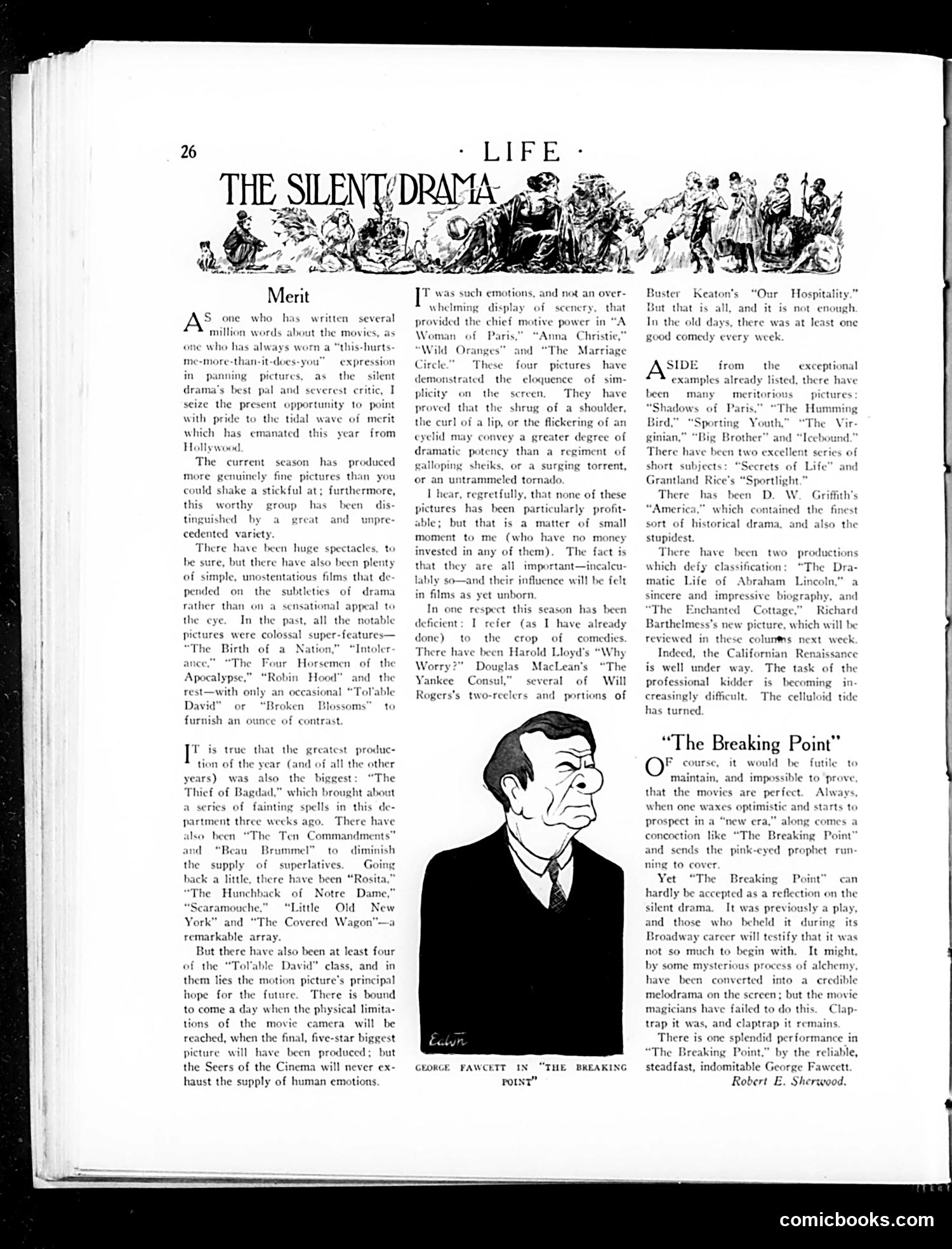
This is a film criticism column reviewing the 1923 movie season. The author praises Hollywood's recent output, noting genuine quality beyond mere spectacle—citing emotional restraint in films like "Anna Christie" and "Wild Oranges" as superior to lavish set pieces. The **caricature shown is George Fawcett** in "The Breaking Point," identified by the caption. The dour expression appears illustrative of the film being reviewed. **Key context a modern reader would miss:** - References to now-obscure silent films and stars (Harold Lloyd, Douglas MacLean, Buster Keaton) - "The Thief of Bagdad" and "The Ten Commandments" as major productions - The author's concern that smaller, emotion-driven dramas ("like 'Tolable David'") weren't profitable, yet predicted their future influence - The critique that even a great year lacked sufficient comedies The column essentially argues that **artistic merit matters more than box-office success**—a progressive stance for 1920s film criticism.
📄 Transcribed text from this page (OCR, searchable)
Machine-transcribed from the original scan — historical spelling and the odd misread are preserved.
ne who has written several million words about the movies, as one who has always we a “this-hurts. me-more-than-it-does-you” — expression in panning pictures, as the silent drama’s best pal and severest critic, I seize the present opportunity to point with pride to the tidal wave of merit emanated this which has Holly wor The current produced more genuinely fine pictures than you could shake a stickful at; furthermore, year from season has this worthy group has been dis- tinguished by 4 t and unpre- cedented variety There have been huge spectacles, to be sure, but there have also been plenty s films that de subtleties of of simple, unostentat pended on the drama rather than on a sensational appeal to In the past, all the notable s were colos Birth of a . Four “Robin an oc Broken furnish an ounce of contrast. the eye pict “The super-features— Nation,” “In Horsemen of Hood” and Tol'able ance,” he Apocalypse, rest—with on David” or sional that the greatest produc- Il the other “The which brought about [tis tree tion of the year (and of also. the Thief of Bagdad,” years) was biggest a series of fainting spells in this de- partment three weeks ago. There have also been “The Ten Commandments” nd “Beau Brummel” to diminish the supply of superlatives. Goi back a little, there have been “Rosita he Hunchback of Notre Dame, “Lite Old New » Covered Wagon"—a caramouche York” and remarkable array. 3ut there have also been at least four of the ‘able David” class, and in them lies the motion picture's principal hope for the future. There is bound to come a day when the physical limita- tions of the movie camera will be reached, when the final, five-star bigg picture will have been producec the Seers of the Cinema will never ex- haust the supply of human emotions. T was such emotions, and not an over- whelming display of scenery, that provided the chief motive power in “Anna Christie,’ “The Marriage pictures Woman of ris, Wild Cirele Oranges” and These four demonstrated the eloquence of plicity on the They proved that the shrug of a shoulder, the curl of a lip, or the flickering of an have sim- screen. have eyelid may convey a greater degree of dramatic potency than a regiment of sheiks, or an untrammeled tornado, I hear, regretfully, that none of these pictures has been particularly profit- able; but that is a matter of small moment to me (who have no money invested in any of them). The impx lably so—and their influence will be felt in films as yet unborn fact is that they are all —incaleu- In one respect this season has been deficient: I refer done) to the crop of comedies There have been Harold Lloyd's “Why Worry?” Douglas MacLean’s “The Yankee Consul, Rogers's two-reelers and (as I have already several port GEORGE FAWCETT IN “THE BREAKING POINT” “Our all, and it Buster Keaton's Hospit is not enough old ¢ good comedy every week ASIDE from the examples already listed, there have many ys, there was at least one exceptional been meritorious pictures Paris.” “The Humming Youth, Vir- ginian,” “Big E and.” There have been two excellent series of erets of Life” and “Shadows of Bird,” “Sporting ort subjects Grantland Rice's “Sportlight.” There has been D. W. Gr “America,” which contained the sort of fith’s finest historical drama, and also the stupidest There have been two produ “The Abraham Lin which defy classification : Life of sincere and impressive biography The Enchanted Barthelmess’s new picture, which will be colunMs next week Indeed, the Californian is well under way. The task of the professional kidder is dificult. The matic Cottage,” Richard reviewed in these Renaissance becoming in: creasingly celluloid tide has turned. “The Breaking Point’ Ofse # maintaii would be futile to impossible to ‘prove that the movies are perfect. Always when one waxes optimistic and starts to prospect in a “ concoction like “The Breaking Point” and sends the pink-eyed pre ew era, ning to cover Yet “The Breaking Point” can hardly be accepted as a reflection on the silent drama. It was previously a play, who beheld it Broadway career will testify that it was It might, by some mysterious process of alchemy and_ those during its not so much to begin with. have been converted i a credible melodrama on the screen; but the movie magicians have failed to do this. Clap trap it was, and claptrap it remains There is one splendid performance in “The Breaking Point,” by the reliable, steadfast, indomitable George Fawcett Robert E. Sherwood. comicbooks.com