
A complete issue · 36 pages · 1924
Life — April 10, 1924
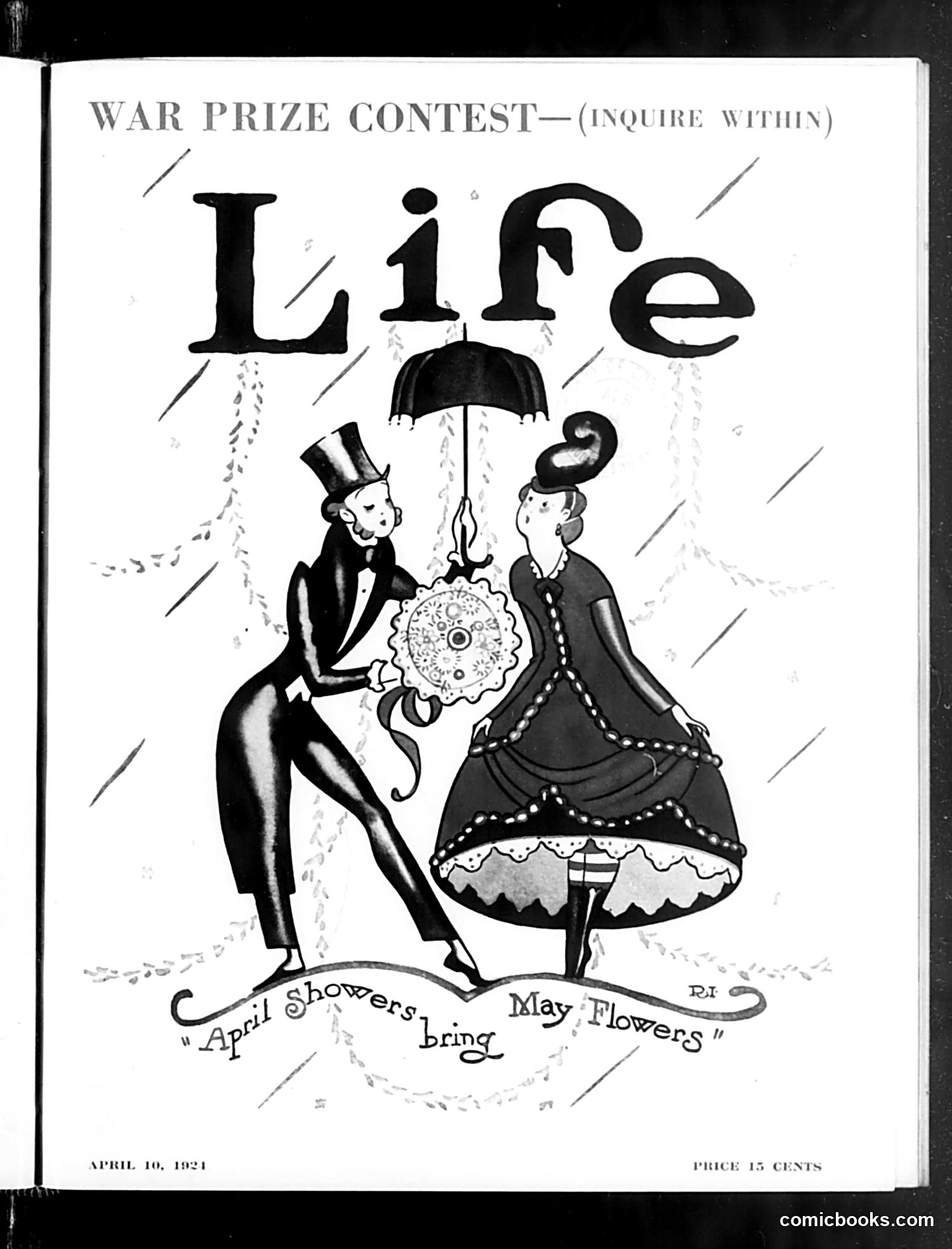
This is a "War Prize Contest" announcement featuring a satirical illustration playing on the phrase "April Showers Bring May Flowers." The cartoon depicts two elegantly dressed figures—a man in a top hat holding an umbrella and a woman in an ornate dress—sheltering what appears to be a decorative bomb or explosive device. The visual pun suggests that instead of flowers, wartime "prizes" (weapons/explosives) will emerge from April showers. The satire likely comments on post-WWI weapons proliferation or disarmament concerns. Rather than nature's renewal, the cartoon darkly suggests military hardware as the season's "bounty." The contest itself invited readers to submit entries, though the specific prize details require additional context. The stylized figures and art deco design are typical of Life's early 1920s aesthetic.
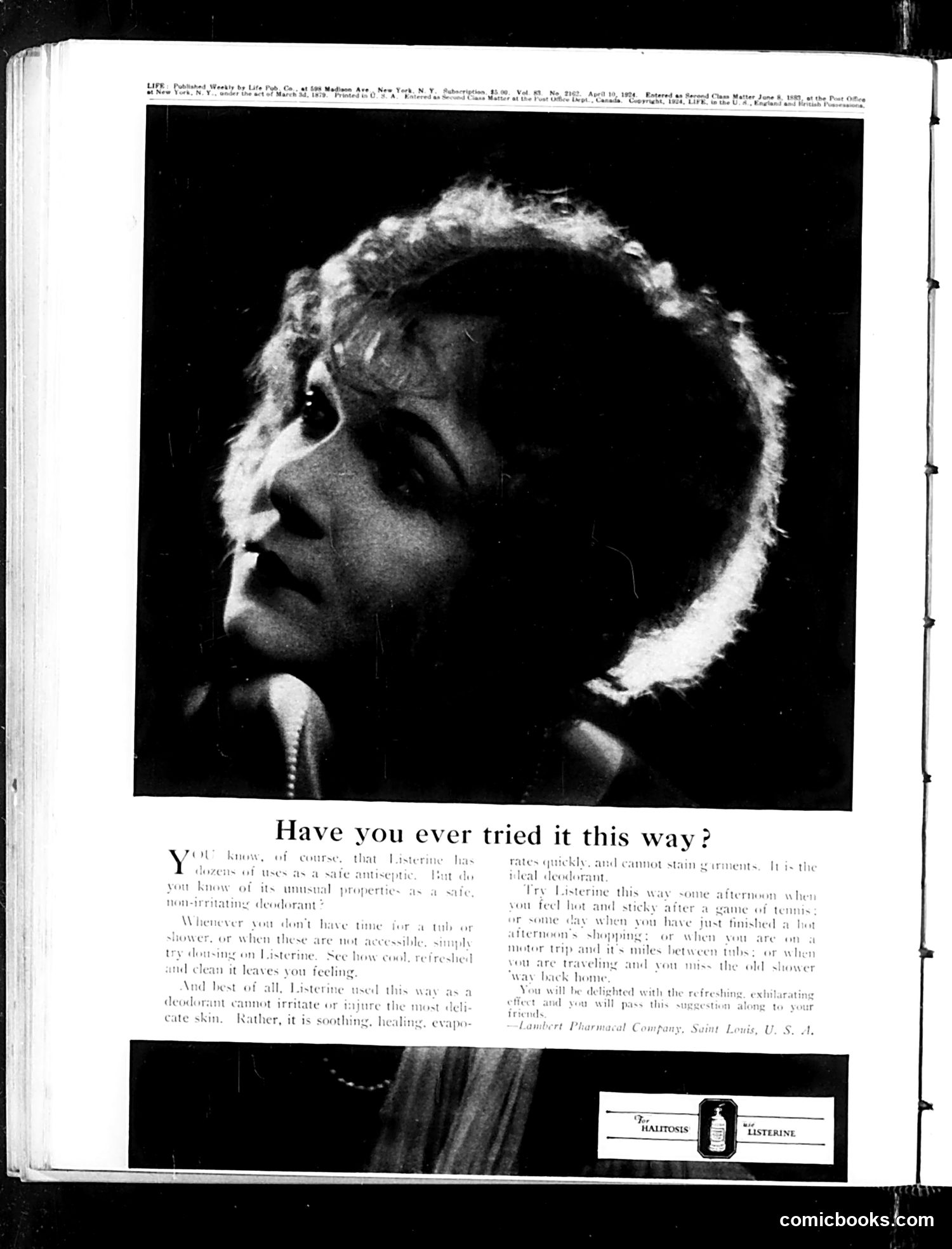
This is primarily a **Listerine mouthwash advertisement**, not political satire. The page features a glamorous woman's profile photograph with the headline "Have you ever tried it this way?" The ad promotes Listerine as a multipurpose antiseptic and deodorant—not just for oral hygiene but for general skin care and underarm use. The text emphasizes its refreshing properties and ability to combat perspiration odor, positioning it as a practical solution for various hygiene needs throughout the day ("between jobs," while traveling, after shopping). The woman's styled appearance exemplifies 1920s beauty standards the ad targets. This represents typical early-twentieth-century marketing that broadly promoted antiseptics for multiple bodily uses before modern advertising standards developed.

This is not a political cartoon but rather a **vintage advertisement for Hupmobile automobiles**, published in *Life* magazine (likely early 20th century). The image shows a detailed technical diagram of an automobile's internal mechanical components—gears, engines, and parts—meant to demonstrate manufacturing quality to potential buyers. The accompanying text argues that the Hupmobile's superiority lies in its internal construction, not visible to consumers. The ad emphasizes that fine parts "cannot be made" poorly, and that buying a Hupmobile guarantees lasting value and performance compared to cheaper competitors. This is straightforward commercial messaging, not satire—Life magazine frequently published both humor and advertising. The "proof" presented is technical specification rather than social commentary.
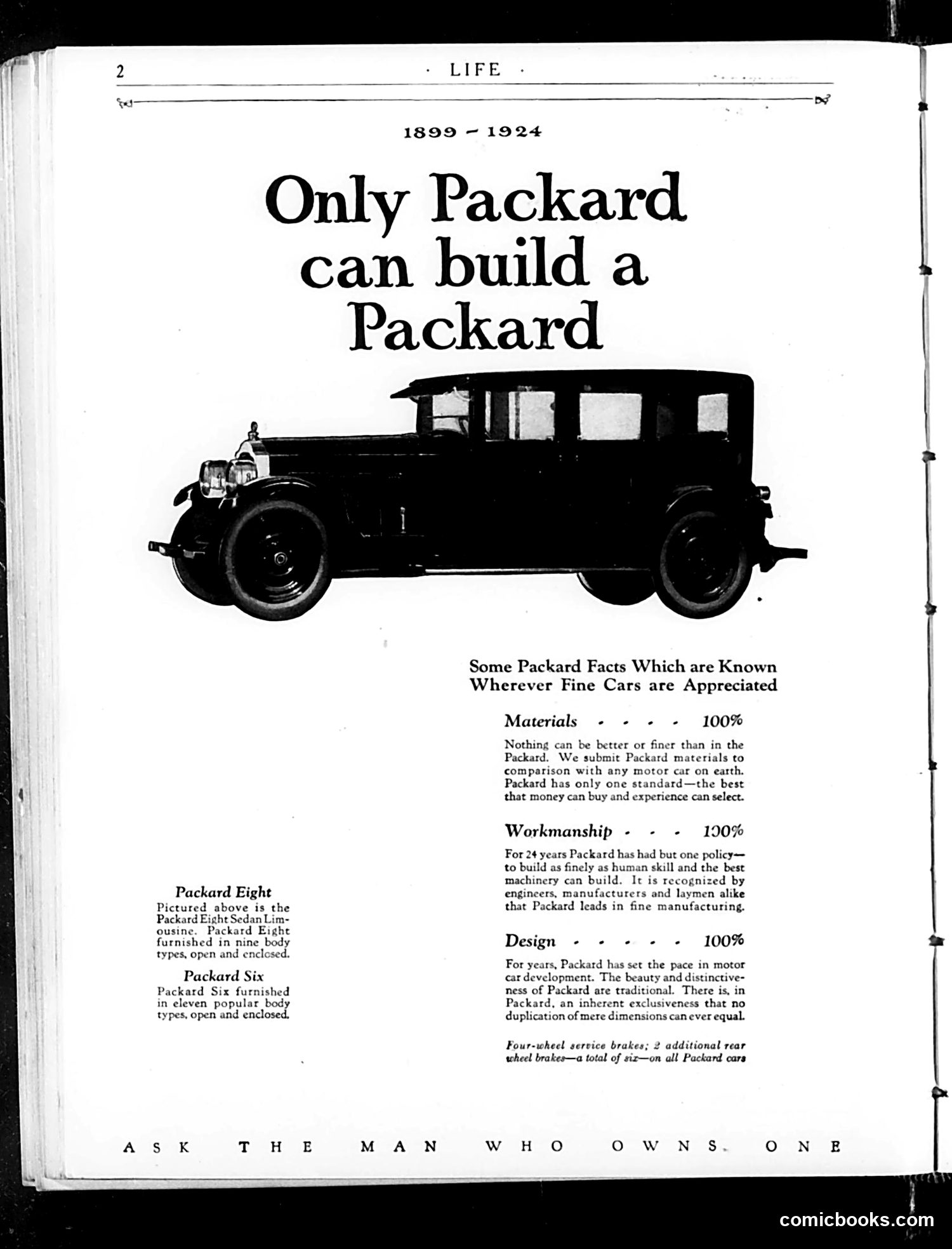
This is **not a cartoon or satire** — it's a straightforward **automobile advertisement** for Packard vehicles, appearing in *Life* magazine during 1899-1924. The page promotes Packard cars through claims about superior materials, workmanship, and design. It features an illustration of a Packard Eight sedan and describes two popular models: the Packard Eight (nine body types) and Packard Six (eleven body types). The tagline "Only Packard can build a Packard" emphasizes brand exclusivity and quality. The closing line "Ask the man who owns one" was Packard's famous advertising slogan, implying satisfied customer testimony. This represents typical early automotive marketing positioning Packard as a luxury, high-quality competitor in America's growing car market.
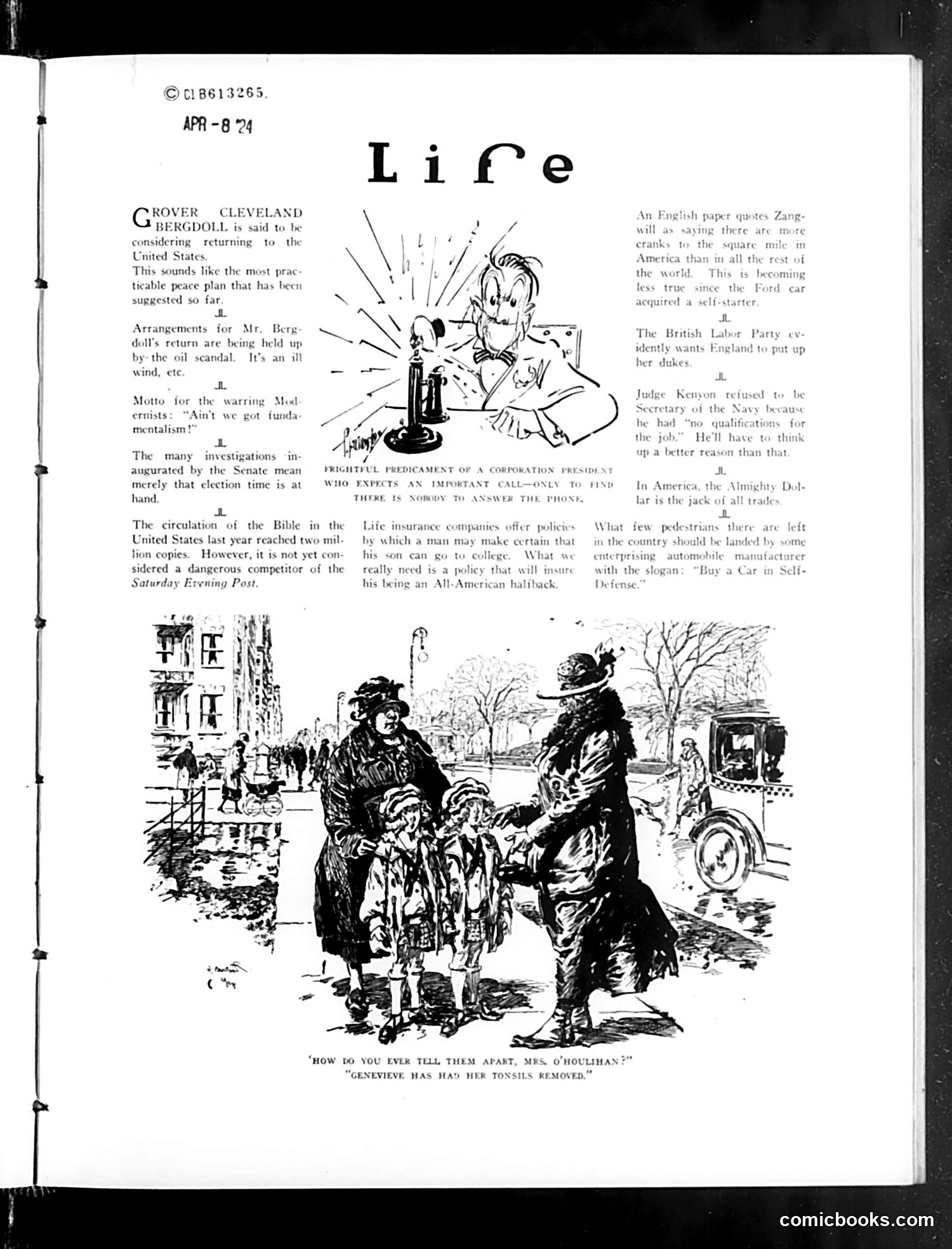
The top cartoon depicts a corporation president receiving an urgent phone call, captioned "Fruitful predicament of a corporation president who expects an important call—only to find there is nobody to answer the phone." This satirizes business anxiety about staffing and communication disruptions, likely referencing post-WWI labor concerns or strikes. The lower illustration shows two women and children on a city street, with the caption "How do you ever tell them apart, Mrs. O'Houlihan?" "Genevieve has had her tonsils removed." This appears to mock Irish families, using tonsil removal as a humorous way to distinguish between similar-looking children—reflecting period stereotypes about large Irish-American families. Both pieces employ gentle, satirical humor targeting contemporary social anxieties and ethnic stereotypes.
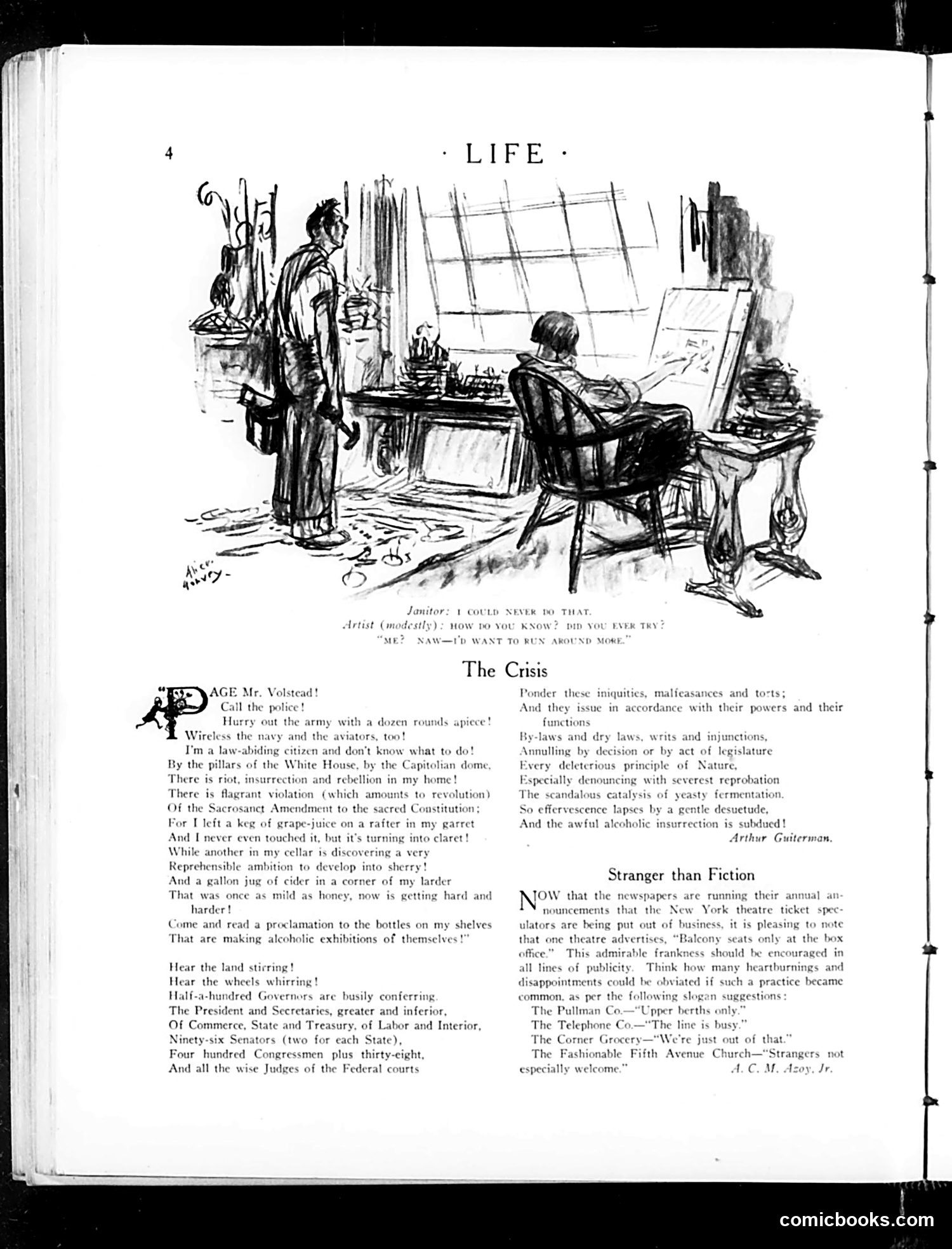
The top cartoon depicts an artist's studio scene with dialogue between a janitor and artist. The janitor claims he "could never do that," while the modestly-dressed artist responds, "How do you know? Did you ever try? 'Me? Saw—I'd want to run around more.'" The joke satirizes the gap between artistic ambition and practical capability—the janitor assumes he couldn't create art without attempting it, preferring physical activity to disciplined studio work. Below, "The Crisis" is a satirical poem mocking bureaucratic chaos and governmental dysfunction—referencing violations of constitutional principles, excessive regulation, and administrative absurdity. It names specific agencies (White House, Capitol) and criticizes overreach. The final section, "Stranger than Fiction," humorously reports theater and business establishments discouraging customers through absurd policies, suggesting reality proves more ridiculous than theatrical fiction.
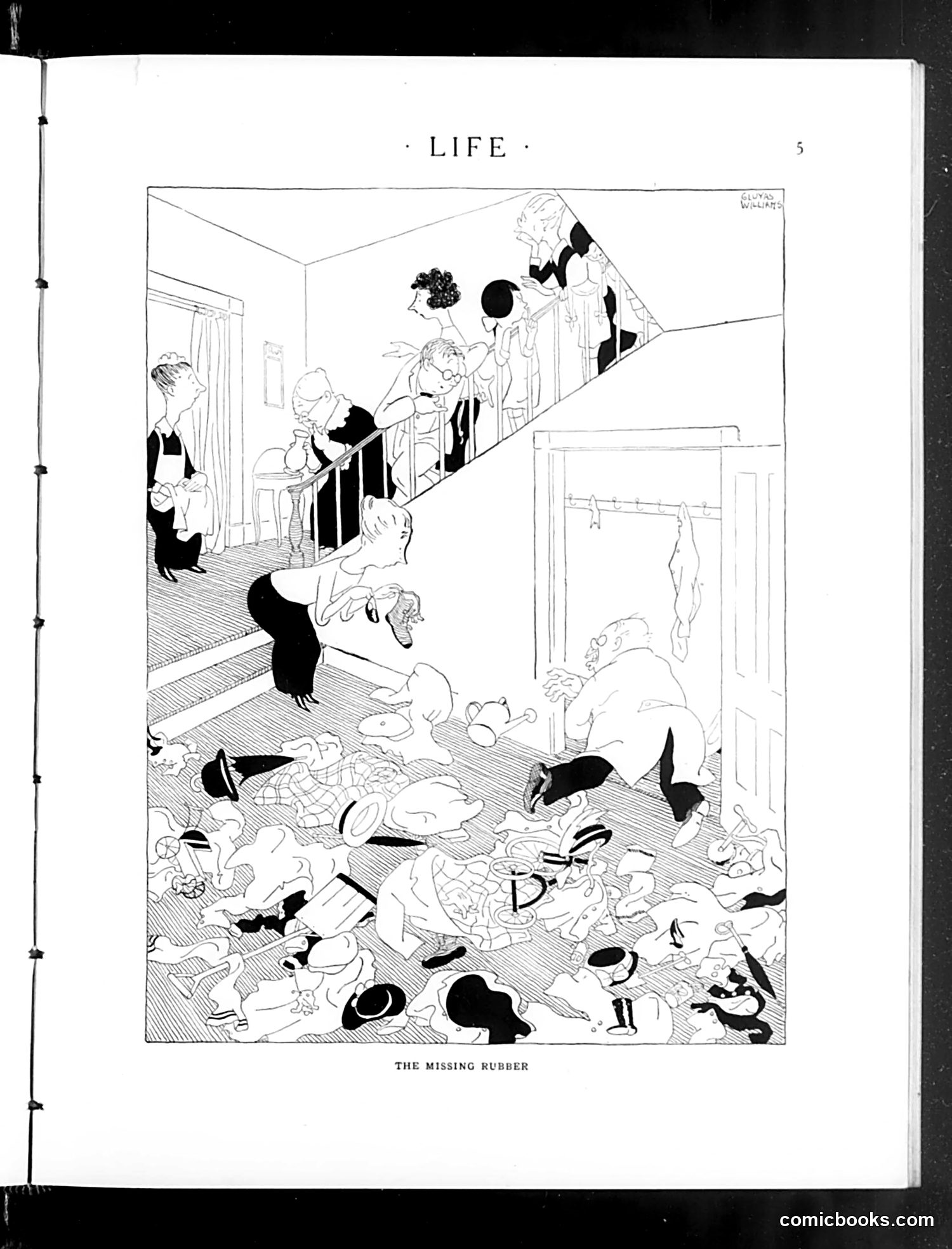
This cartoon satirizes chaos at what appears to be a formal social gathering or reception. The title "The Missing Rubber" suggests a humorous mystery plot—likely a playing card reference (rubber = card game round) or possibly referring to an eraser/rubber object that's gone missing. The scene depicts well-dressed guests in the background (left side, standing formally) contrasted with the foreground showing complete disorder: overturned furniture, scattered items, and people apparently searching frantically across the floor. The visual joke plays on the incongruity between refined social pretense and underlying chaos—suggesting that even respectable gatherings can devolve into undignified scrambling over minor lost items. The specific identity of figures remains unclear from the image alone.
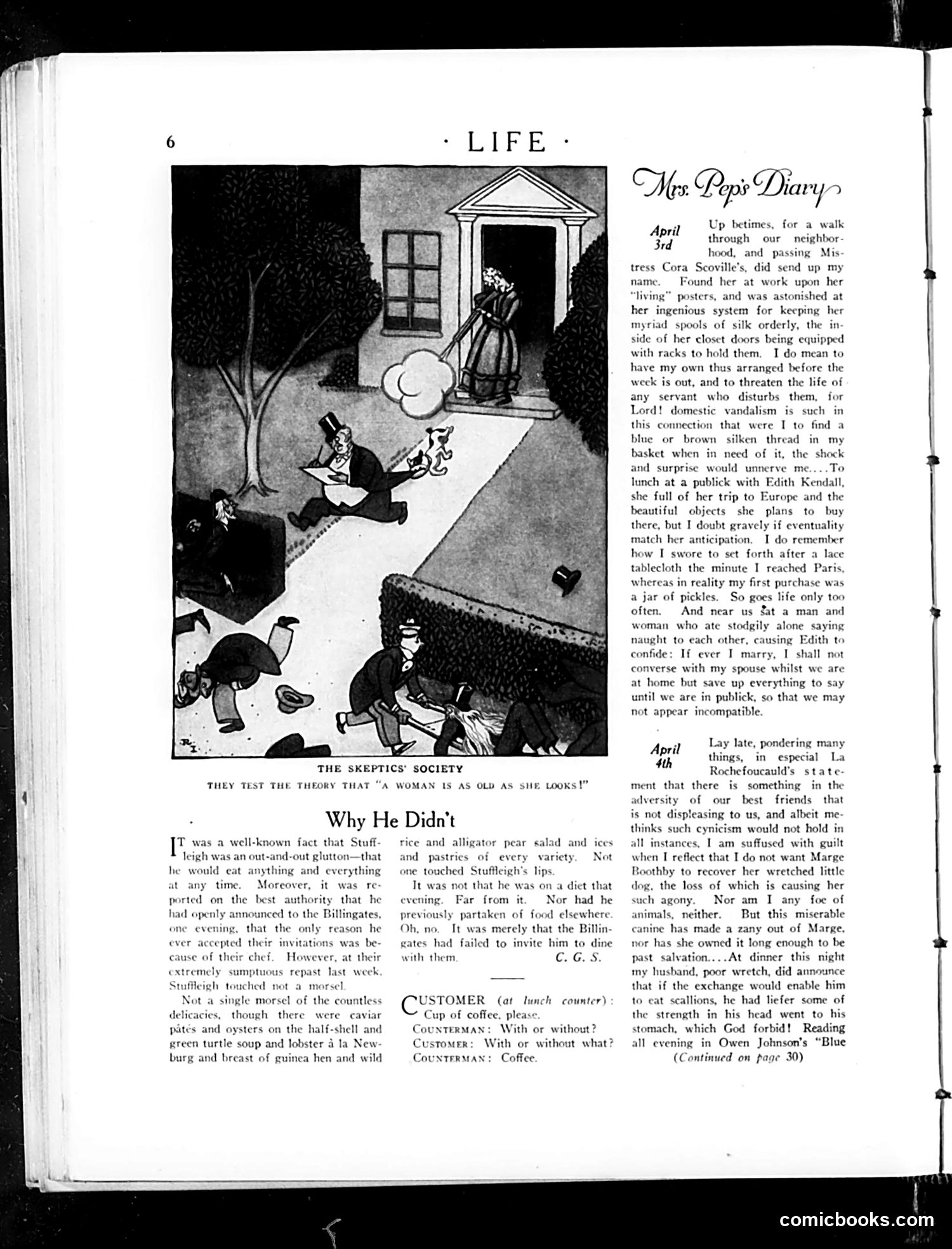
This cartoon illustrates the satirical concept that "a woman is as old as she looks." The image shows a group of men testing this theory by observing women of various ages and appearances. The central joke mocks both the superficiality of judging women's worth by appearance and the pseudo-scientific pretensions of men claiming to evaluate feminine age. The "Skeptics' Society" frames this as a mock-serious investigation, suggesting these men are pompous in their analysis of women's looks. The accompanying text and illustrations emphasize the social expectation—even among women themselves—that appearance determines a woman's value. This satirizes the vanity culture and rigid beauty standards of the era, while poking fun at men's presumed authority in assessing women's desirability and age.
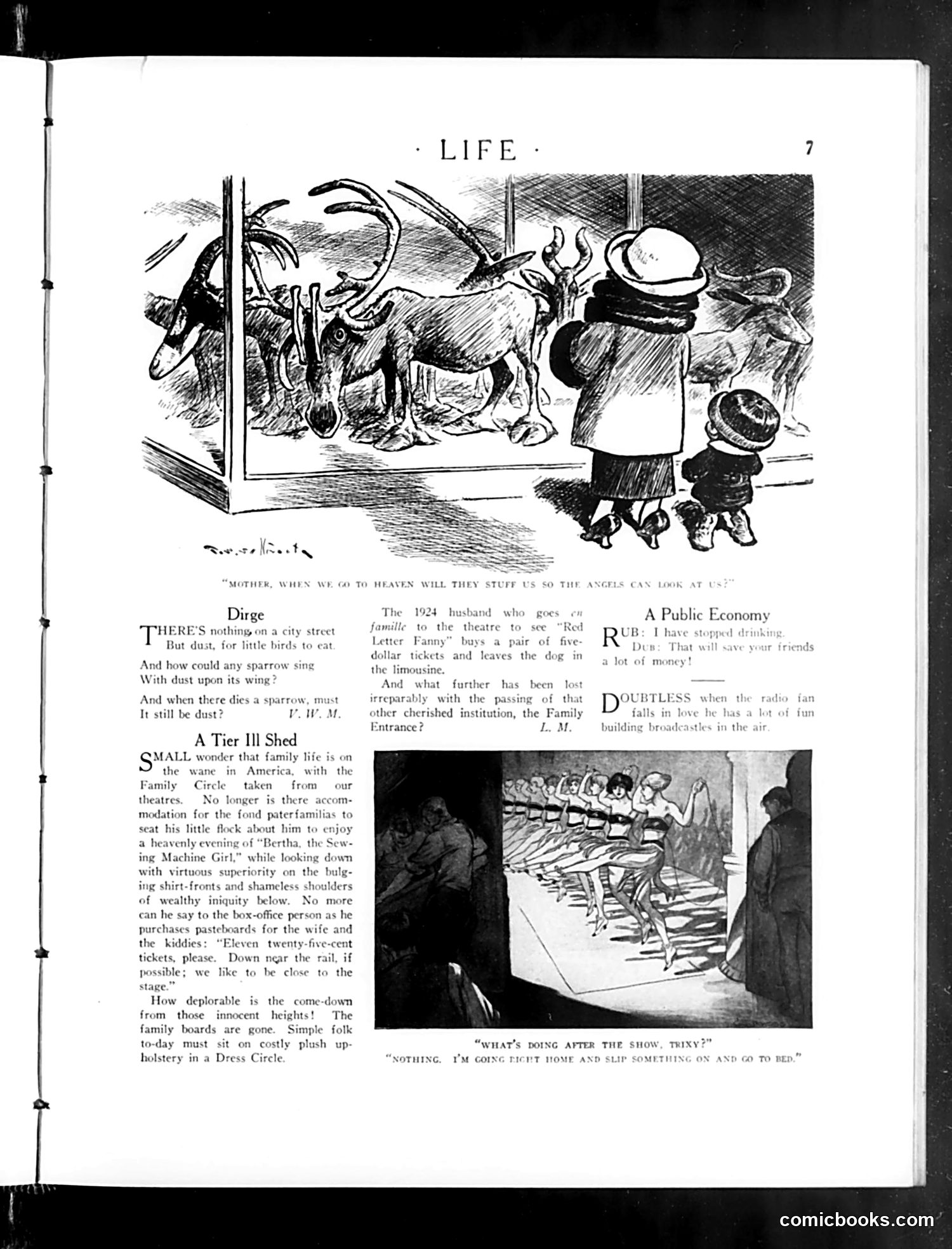
This page contains two satirical pieces about American middle-class life in the 1920s. **"Dirge"** (left column) laments the decline of family theater-going. The poem mourns how working-class family life has deteriorated—children no longer sing, sparrows disappear from city streets—using theatrical tradition as a metaphor for vanishing cultural institutions. **"A Tier III Shed"** critiques how theater attendance has become economically stratified. The satire describes families now sitting in cheap upper-balcony seats rather than "Dress Circles," stripped of dignity. The cartoon above (showing adults and children at theater) illustrates this democratization of entertainment. **"A Public Economy"** (top right) mocks radio broadcasts replacing theater as family entertainment—a cheaper alternative that saves money. The overall theme: modern consumer culture and economic pressures are eroding traditional middle-class leisure activities and social status markers.
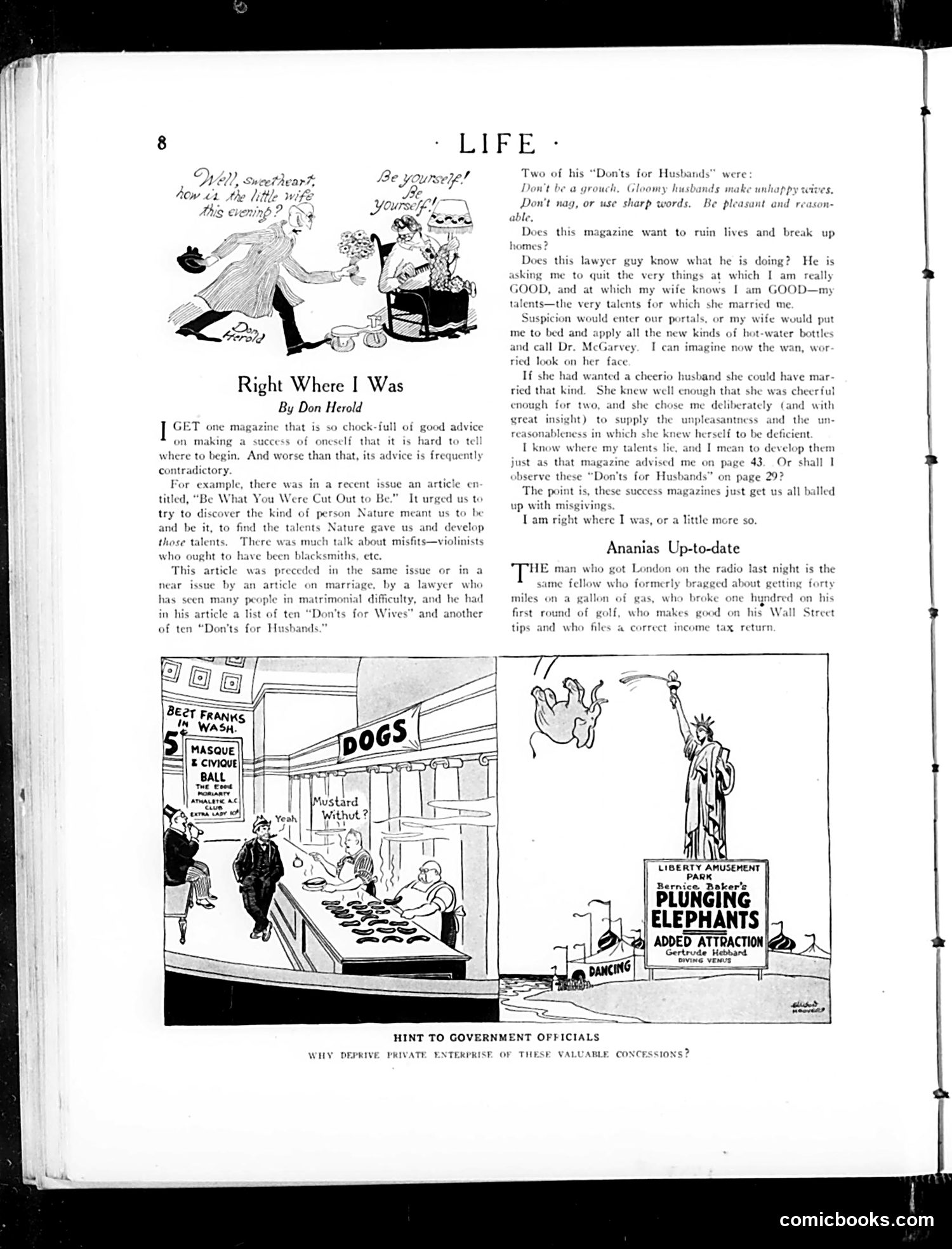
This satirical piece critiques marriage advice columns. Herald argues that magazines publishing "Don'ts for Husbands" and "Don'ts for Wives" create marital discord by encouraging suspicion and resentment between spouses. He uses himself as example: a successful man with talents his wife knows and appreciates. Such magazine advice, he argues, would poison this relationship by suggesting he hide his abilities and that she monitor his behavior—introducing doubt where none existed. The cartoon below (captioned "Hint to Government Officials") depicts a hot-dog stand, suggesting private enterprise's value. It satirizes government control of business, implying authorities shouldn't deprive people of these useful commercial operations. The page reflects 1920s-era concerns about commercial advice culture and government regulation of private business.
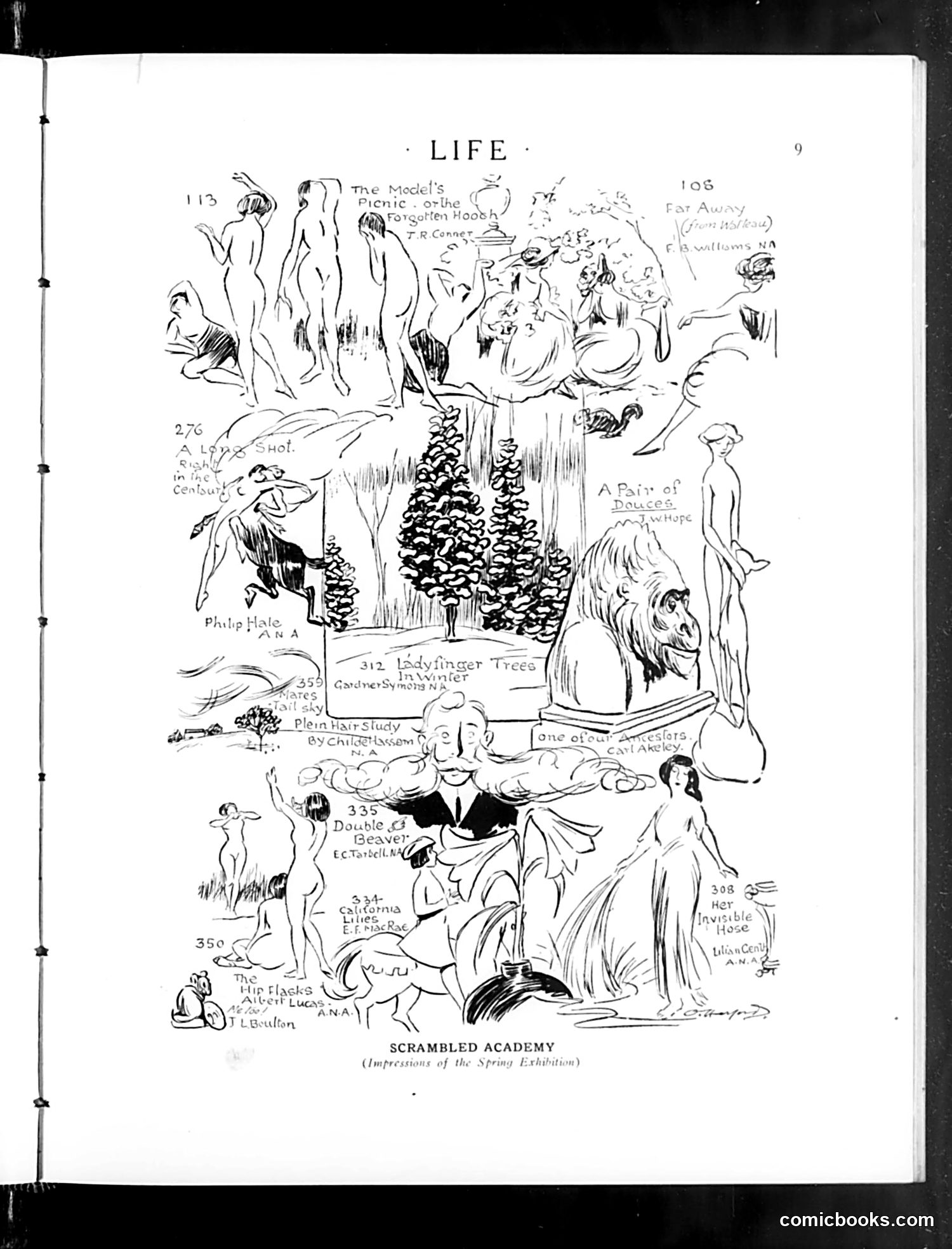
This is a satirical cartoon titled "Scrambled Academy (Impressions of the Spring Exhibition)" mocking an art academy's spring show. The page features numerous numbered sketches of nude and clothed figures in various poses, labeled with artist names and artwork titles. The satire appears to target the pretentiousness of academic art exhibitions—the "scrambled" layout and deliberately crude, exaggerated drawings mock the formal presentations of classical figure studies and sculpture. References like "The Model's Picnic," "Ladyfinger Trees," and absurdist titles suggest ridicule of overly earnest or nonsensical artworks being exhibited. The central figure wearing formal attire appears to represent an academy administrator or critic surrounded by chaotic artistic output, emphasizing the disorganization and absurdity the cartoonist attributes to the exhibition itself.
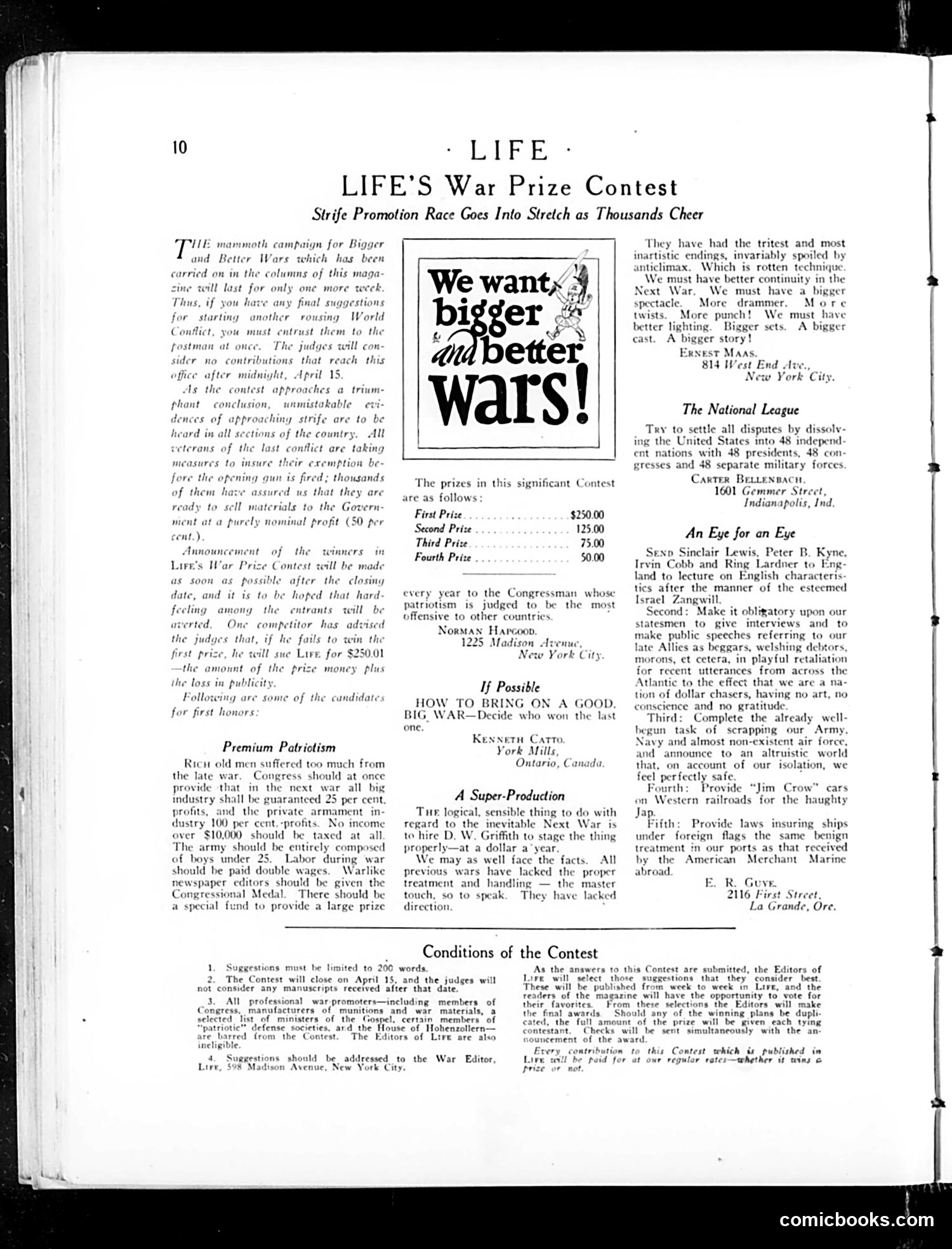
This page announces **Life's War Prize Contest**, soliciting reader submissions for ideas to improve future warfare. The central graphic simply states "We want bigger and better wars!"—a blunt satirical critique of American militarism and complacency about conflict. The contest invites readers to propose improvements across categories like strategy, entertainment value, and military efficiency. Accompanying the contest are mock "suggestions" from named readers proposing absurd reforms: higher soldier wages, all-youth armies, profitable wars, and better dramatic narratives. The satire works through exaggeration: by treating war as improvable entertainment rather than tragedy, Life mocks how society had normalized and commercialized armed conflict. This reflects post-WWI disillusionment with warfare's glorification. The sarcastic tone critiques both militaristic attitudes and public indifference to war's human costs.
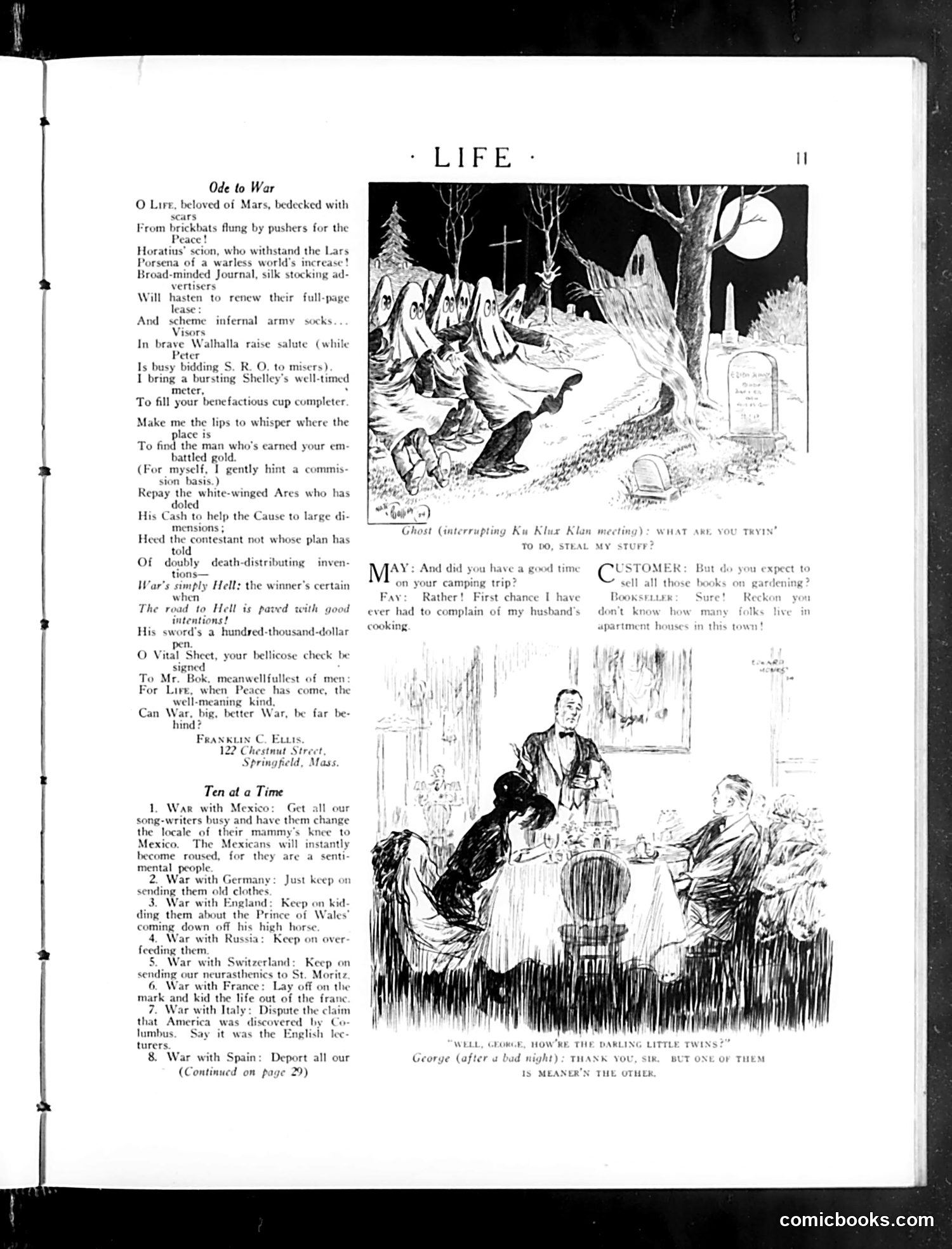
This page contains two distinct satirical pieces: **"Ode to War"** (left): A poem mocking military recruitment and wartime propaganda, attacking the romanticization of war through references to "Walhalla," heroic sacrifice, and patriotic rhetoric. The author (Franklin C. Ellis) critiques how war is marketed to the public. **"Ten at a Time"** (below): A numbered satire suggesting humorous "solutions" to various international conflicts—"War with Mexico," "War with Germany," "War with England," etc.—each with absurdist remedies (send clothes, kids, overstock). This mockingly exposes how casually nations entertained war as policy. The bottom cartoon shows a dinner scene where a man thanks another for darling twins, with the punchline revealing one child is "Meaner's the other"—likely a separate domestic joke. These pieces collectively satirize both militarism and American international relations attitudes.
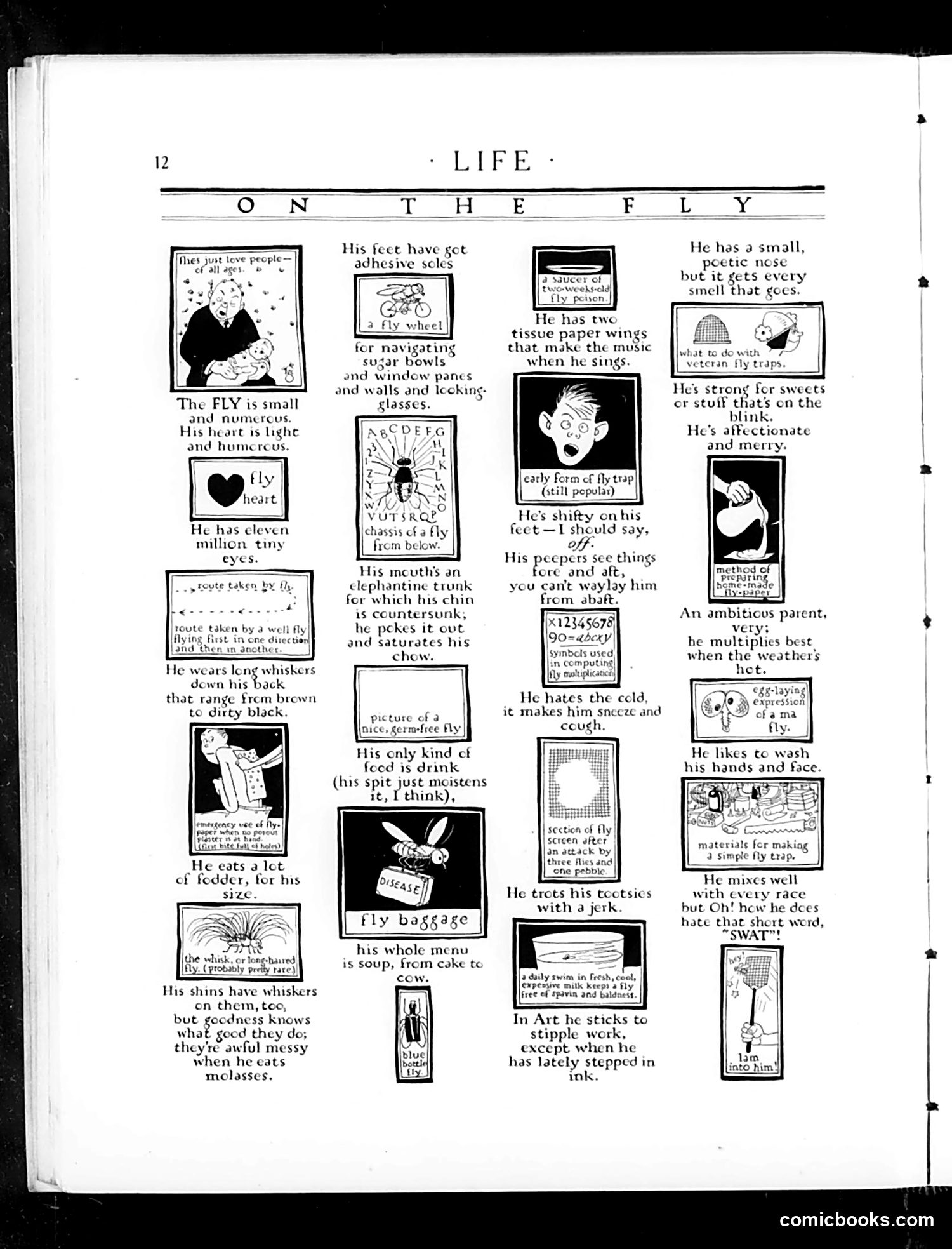
This is a humorous illustrated feature about a fly's characteristics and behavior, not political satire. The page uses small comic panels and text to humorously anthropomorphize a housefly, describing its anatomy ("eleven million tiny eyes," "elephantine trunk" mouth) and habits (eating ice cream, washing, mixing with "every race"). The satire is gentle and biological rather than political—it's primarily observational humor about fly behavior presented through exaggerated, whimsical descriptions. The feature appears designed to entertain readers by making the common housefly seem simultaneously alien and relatable through detailed, absurdist commentary on its eating, navigation, and domestic presence.
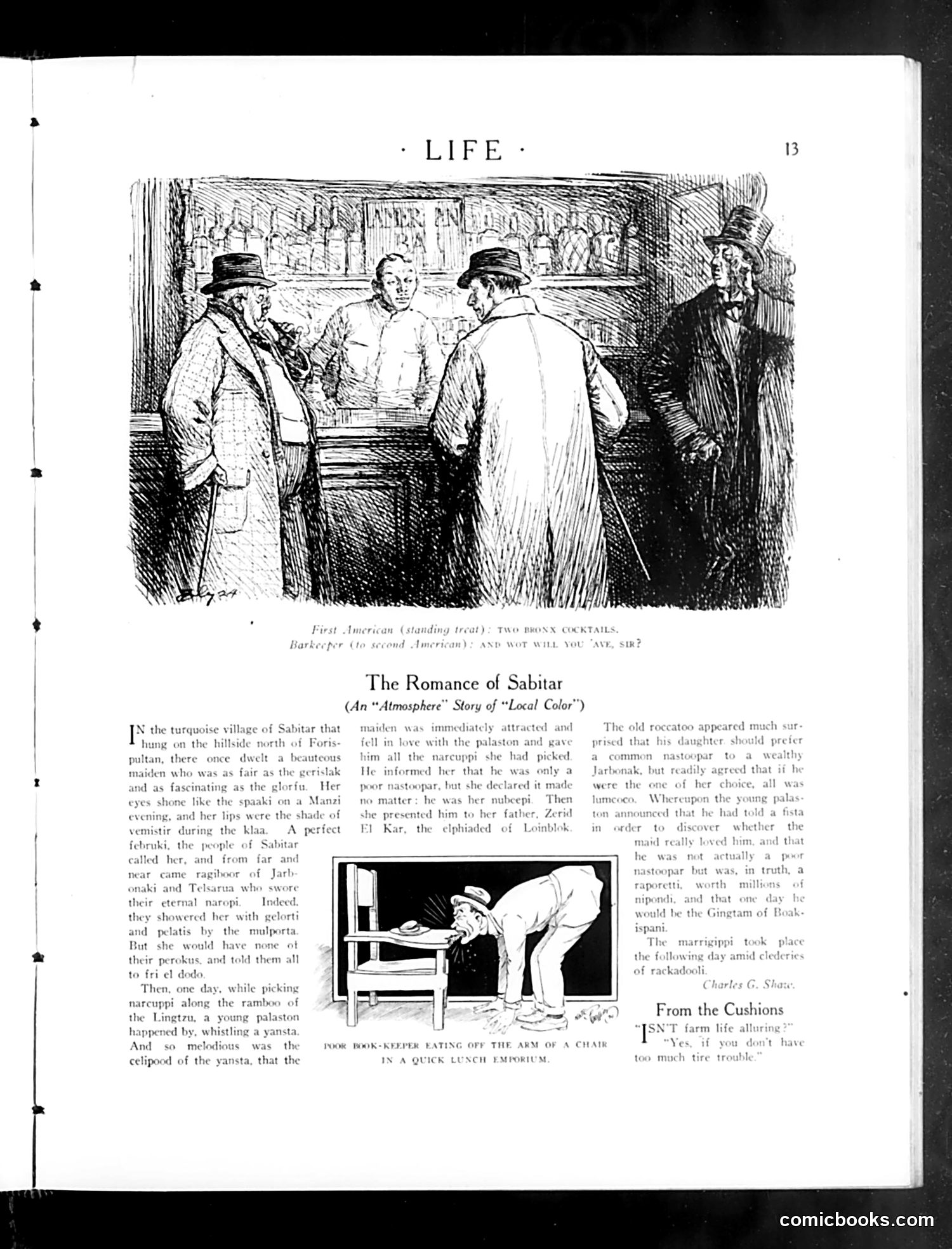
This page contains two separate pieces of satirical content: **Top cartoon**: Shows men at a bar. The caption reads: "First American (standing treat): TWO BRONX COCKTAILS. Barkeeper (to second American): AND WOT WILL YOU 'AVE, SIR?" The joke satirizes American tourists abroad, likely in England. It mocks the "Bronx cocktail" (a popular American drink of that era) as a distinctly American beverage, while the British barkeeper's accent ("wot") emphasizes cultural difference. The humor lies in the contrast between American drinking customs and British refinement. **Lower section**: "The Romance of Sabitar," a short story about life in an Indian village, accompanied by an illustration of a man eating lunch. Below this is "From the Cushions," an advice column with a farming question about tire trouble.
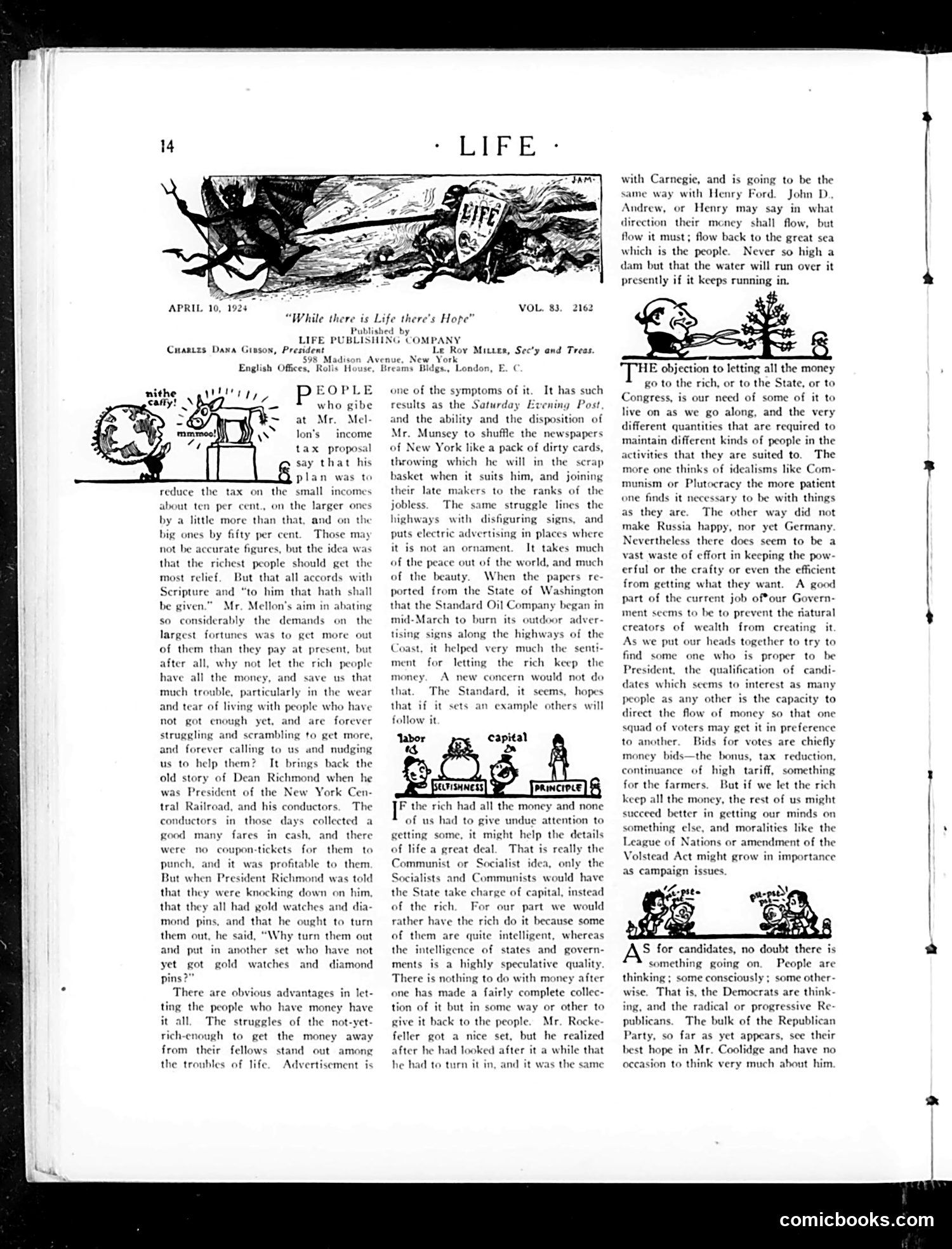
This page critiques wealth distribution and taxation policy during the 1920s. The main editorial argues against allowing the wealthy to keep all money, citing President Coolidge's recent tax proposals. The cartoons depict competing ideologies: one shows figures labeled "Capital," "Labor," and "Principle" in conflict—representing tension between business interests, workers, and moral governance. Another illustrates Democrats versus Republicans on candidate selection. The article attacks both wealthy industrialists (Rockefeller, Carnegie, Ford) and radical solutions (Communism), instead advocating moderate redistribution. It criticizes the Standard Oil Company's highway advertising and proposes that government should direct wealth flow "back to the people" rather than concentrate it among the rich—a Progressive Era argument about capitalism's proper limits.
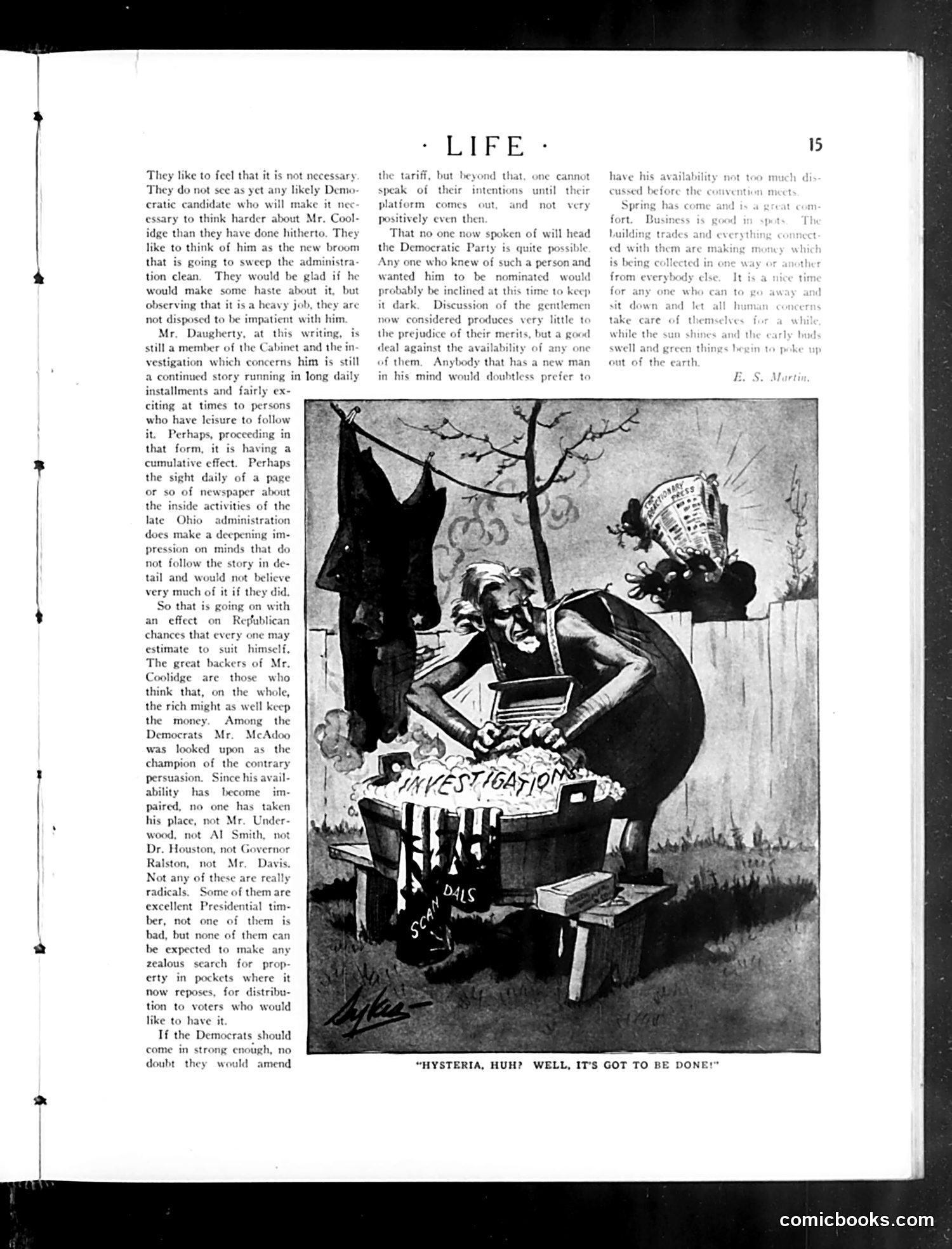
This cartoon satirizes Democratic Party investigations into Republican scandals during the Coolidge administration. The figure at the desk labeled "INVESTIGATION" appears to be conducting a probe, while papers scattered about are labeled "SCANDAL" and other evidence. The caption reads "Hysteria, huh? Well, it's got to be done!" The text discusses how Democrats are investigating Republican wrongdoing but face resistance from those claiming the investigations are merely partisan "hysteria." The cartoon mocks the Democrats' investigative efforts as theatrically dramatic, suggesting their theatrical presentation undermines their credibility. The page critiques both the Republicans' resistance to accountability and the Democrats' perceived sensationalism in pursuing investigations into Coolidge-era corruption.
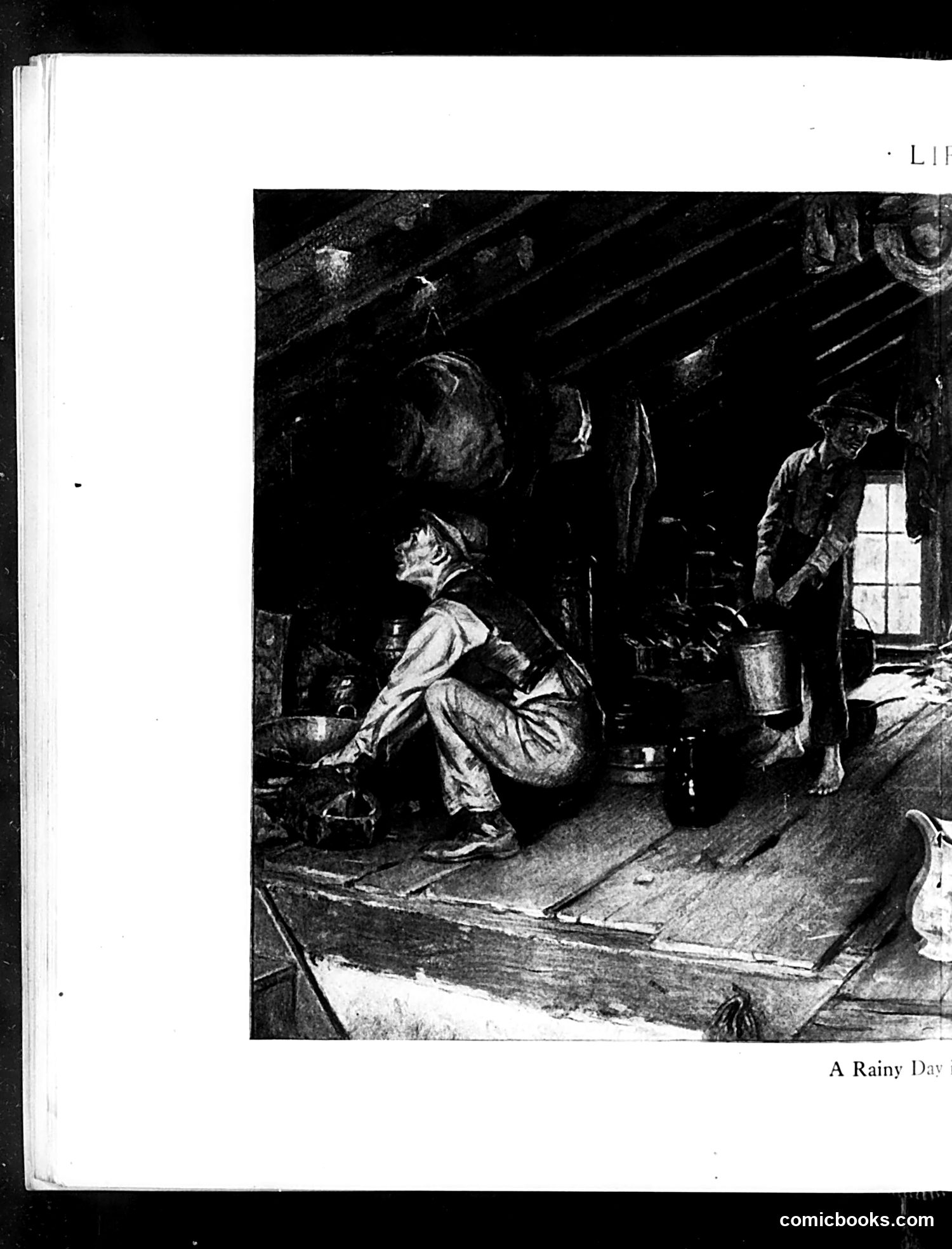
This appears to be a genre scene rather than political satire—a black and white illustration depicting an indoor domestic or working-class setting during bad weather. A seated figure in the foreground is the focal point, surrounded by standing figures in what looks like a modest interior space with exposed wooden beams and a small window showing light outside. The title "A Rainy Day" suggests this depicts how ordinary people pass time during inclement weather, likely capturing a moment of social interaction or daily life. The composition and dramatic lighting are characteristic of early 20th-century Life magazine's illustrative style, which often featured humanistic scenes of everyday American life rather than explicit political commentary. Without additional context, the specific social commentary—if any—remains unclear from the image alone.
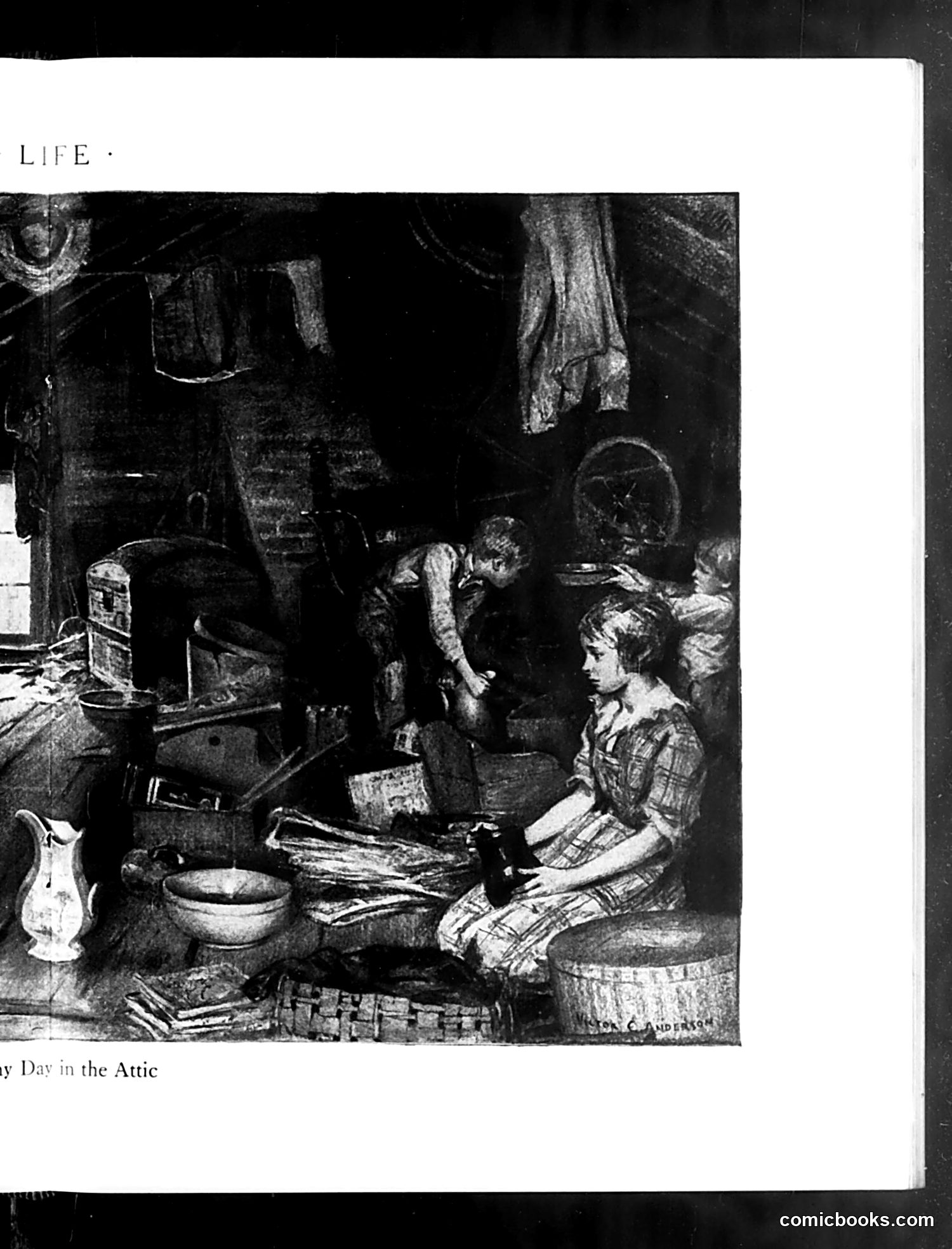
This appears to be a domestic scene rather than a political cartoon. The image shows what looks like a family or household group in an attic space during rainy weather, engaged in everyday activities. A woman in a checkered dress sits prominently in the foreground, while other figures work around her in the cramped, cluttered space. The satire likely comments on domestic life—perhaps the tedium of indoor confinement, makeshift living conditions, or family dynamics during bad weather. The attic setting suggests modest circumstances or crowded conditions, which may be poking fun at middle-class American home life. Without clearer OCR text or additional context about the publication date, the specific satirical target remains somewhat unclear, though the scene appears to be gentle domestic humor rather than pointed political satire.
This is a theater review of James K. Hackett's production of *Macbeth* at the Equity Theatre. The critic praises the overall performance but identifies one scene as unbearably bad: when Macbeth, fresh from murdering Duncan, stops mid-flight to deliver a lengthy poetic speech about sleep rather than panicking realistically. The satire targets Shakespeare's dramatic writing—specifically the artificiality of having a murderer pause to philosophize during genuine crisis. The critic sardonically notes this same flaw appears throughout Shakespeare's works, comparing it unfavorably to contemporary playwright Samuel Shipman (now obscure). The joke is that the critic is "picking flaws" in Shakespeare himself—traditionally sacrosanct—treating him like any other writer whose overwrought dialogue would merit ridicule. The proposed cartoon series would humorously expose famous historical couples' actual mundane conversations, contrasting reality with theatrical grandeur.
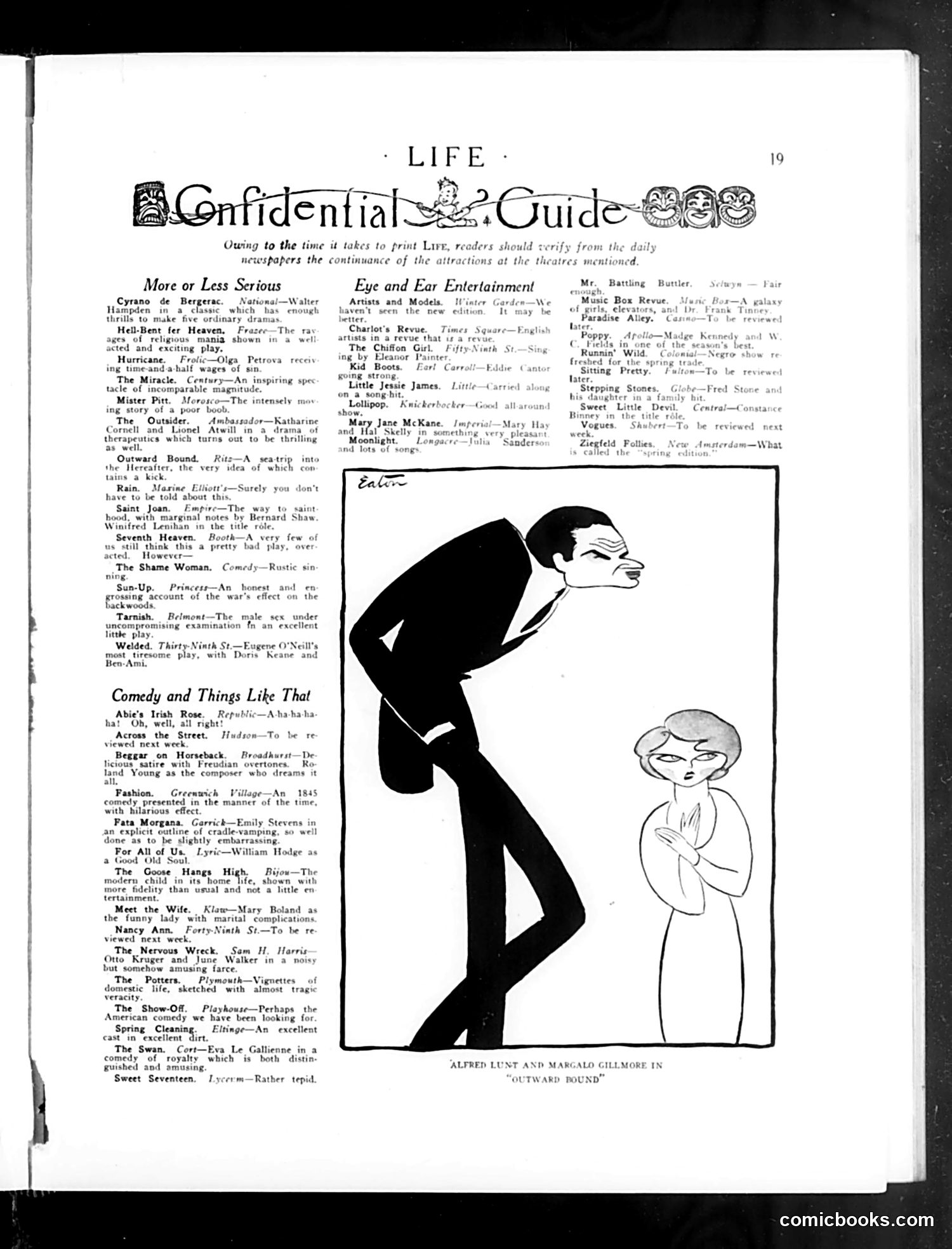
This page from *Life* magazine is primarily a theater guide listing current Broadway productions with brief reviews. The illustration features a dramatic scene from the play "Outward Bound," starring Alfred Lunt and Margalo Gillmore (credited below the image). The cartoon shows a man in formal attire leaning back in an exaggerated pose while a woman in lighter clothing appears to gesture toward him. The stylized, theatrical illustration is typical of period entertainment promotion—designed to capture the play's dramatic tone and appeal to readers. "Outward Bound" (referenced in the text as a play worth seeing) appears to have been a fantasy drama involving characters' fates after death. The illustration's theatrical exaggeration and the play's inclusion in *Life's* entertainment section reflects how the magazine covered popular stage productions as cultural commentary and entertainment news for readers. The page itself is essentially advertisement and entertainment journalism rather than political satire.
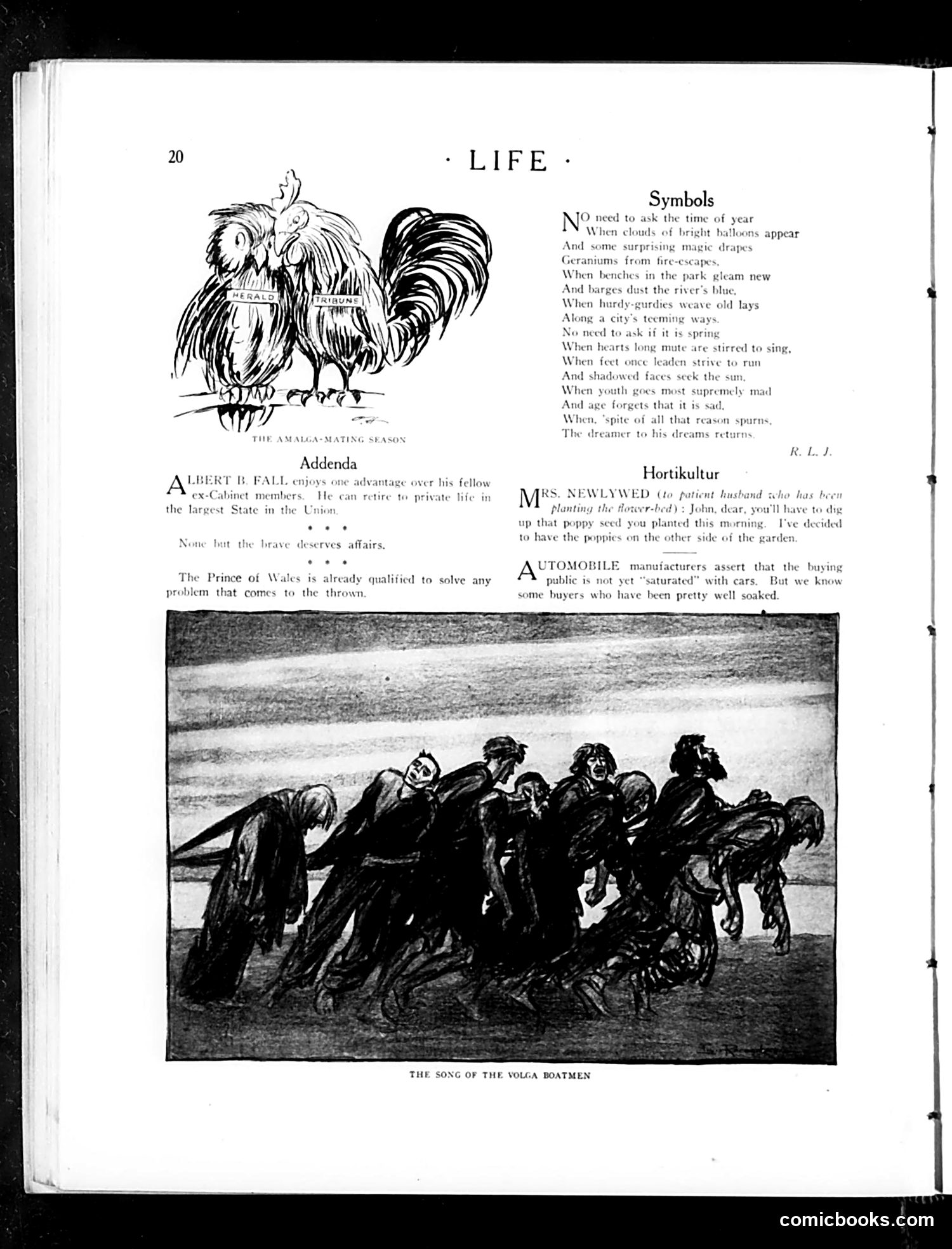
**The Main Cartoon:** "The Song of the Volga Boatmen" depicts laborers straining to pull a heavy barge—a reference to the famous Russian folk song about working-class hardship. This appears to be satirizing either Russian revolutionary movements or, more likely given the American context, labor struggles and working-class exploitation in America during the early 20th century. **The Addenda Section** contains three brief satirical items: one about a politician retiring to "the largest State" (likely a comment on Teddy Roosevelt and the American West); a comment that the Prince of Wales is "qualified to solve any problem"; and a "Hortikultur" joke about newlyweds disagreeing on where to plant poppies (with an implied drug reference that's risqué for the era). **Overall Context:** This appears to be a general satirical commentary on contemporary social issues—labor, politics, marriage, and consumerism—typical of Life magazine's format mixing political and social humor with lighter domestic jokes.
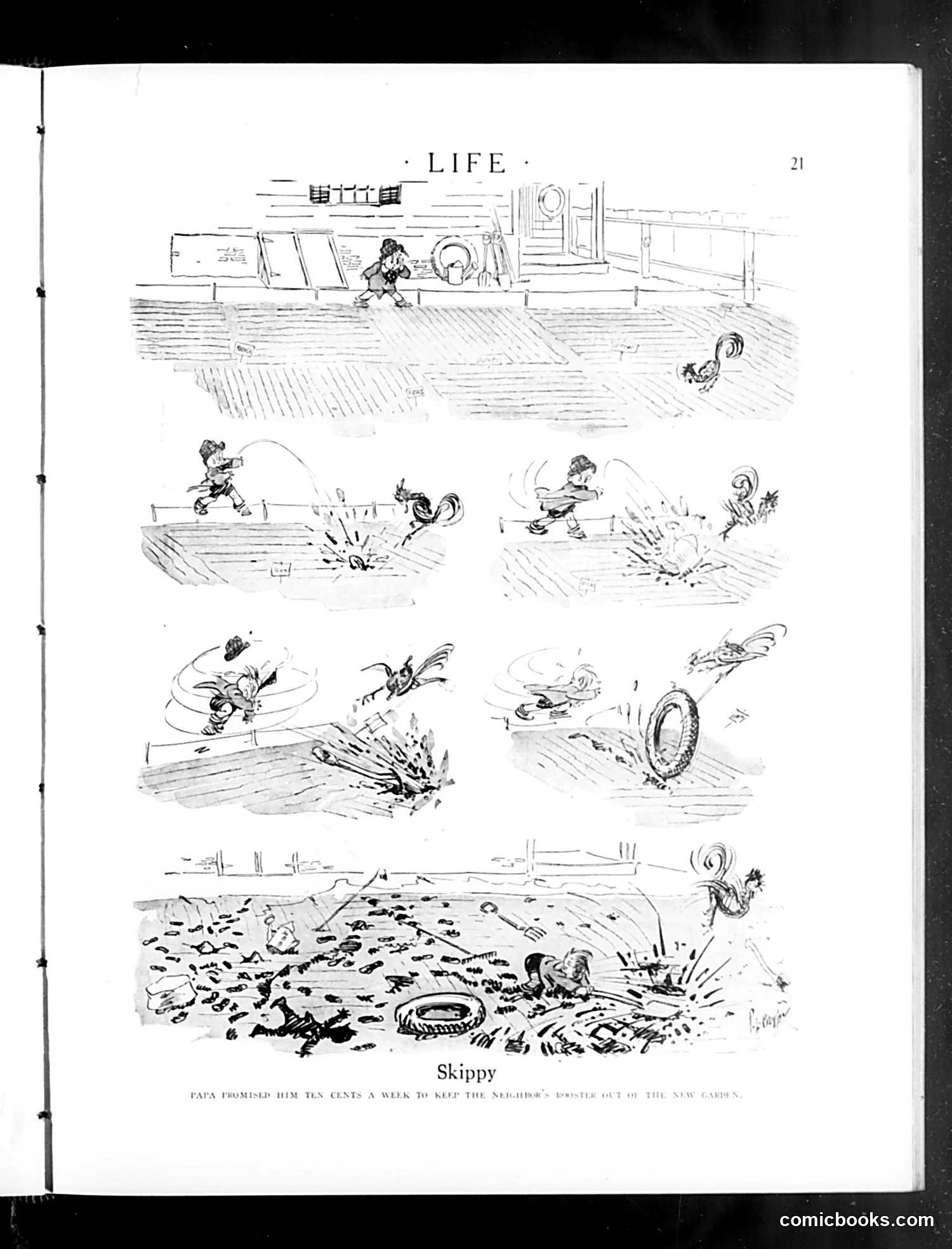
This is a comic strip titled "Skippy" showing a mischievous child creating chaos on what appears to be a residential street or dock area. The strip depicts a sequence of escalating pranks and accidents: the child sets off explosions, creates splashing incidents, and generally wreaks havoc with various objects. The caption reads: "Papa promised him 10 cents a week to keep the neighbor's rooster out of the new garden." The satire targets parental discipline and childhood misbehavior. The joke is that Skippy has been given a small financial incentive to keep a neighbor's rooster away, but instead uses this opportunity for destructive pranks that clearly cause far more damage than the rooster ever could. It's a commentary on how poorly-thought-out bribes can backfire spectacularly.
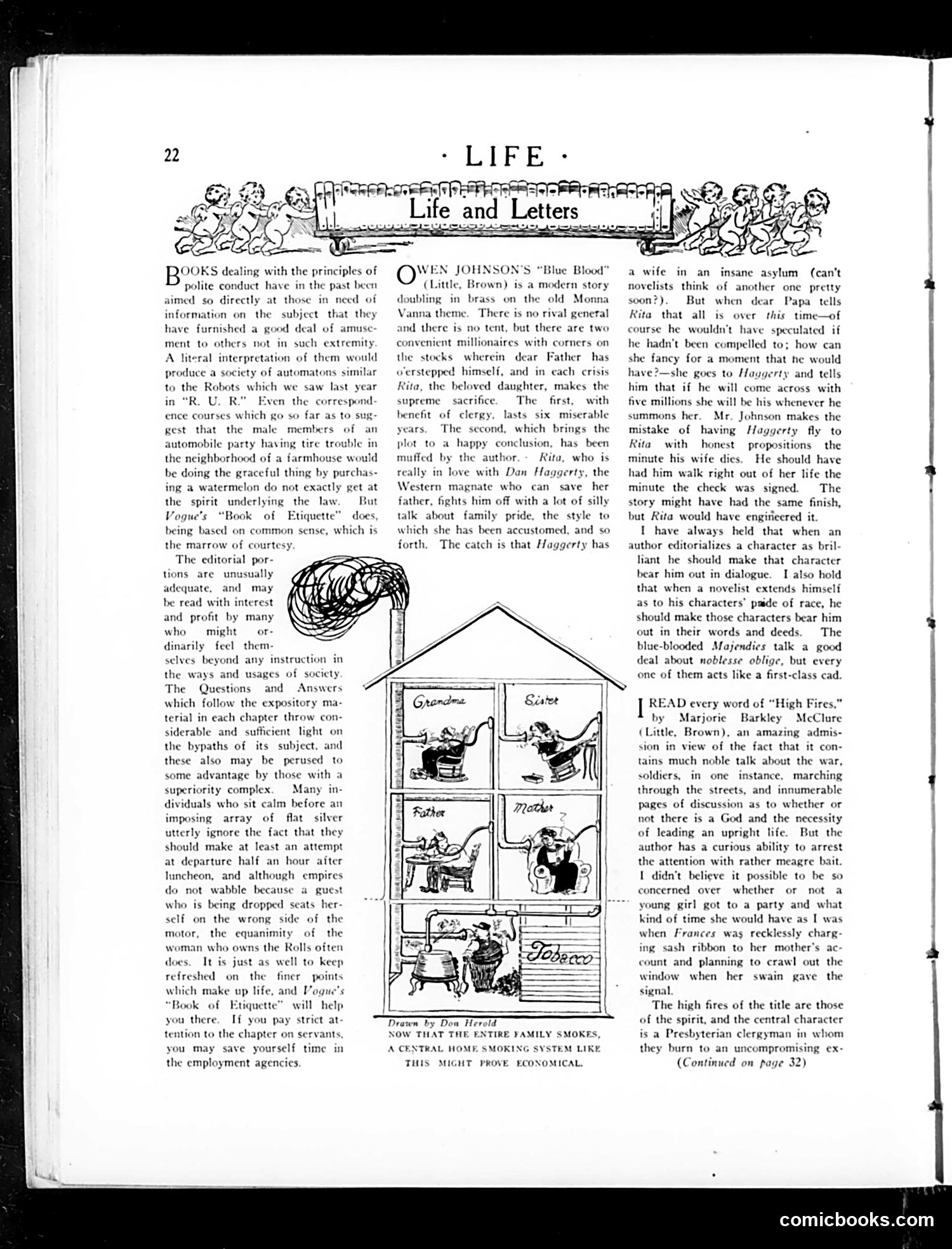
This page contains book reviews discussing etiquette and fiction. The cartoon by Don Herold (bottom center) satirizes modern domestic life: it depicts a cross-section house labeled with family members' names (Grandma, Father, Mother, etc.), each smoking in different rooms. The caption reads: "NOW THAT THE ENTIRE FAMILY SMOKES, A CENTRAL HOME SMOKING SYSTEM LIKE THIS MIGHT PROVE ECONOMICAL." The joke targets the social shift of women smoking becoming acceptable—a relatively recent and controversial development in the 1920s. Herold mocks this by suggesting that since "the entire family" now smokes, installing central ventilation would be practical household economics, treating smoking as a normal domestic utility rather than a scandalous habit. The text reviews two books: Vogue's "Book of Etiquette" and Owen Johnson's novel "Blue Blood," criticizing the latter's melodramatic plot and characterization.
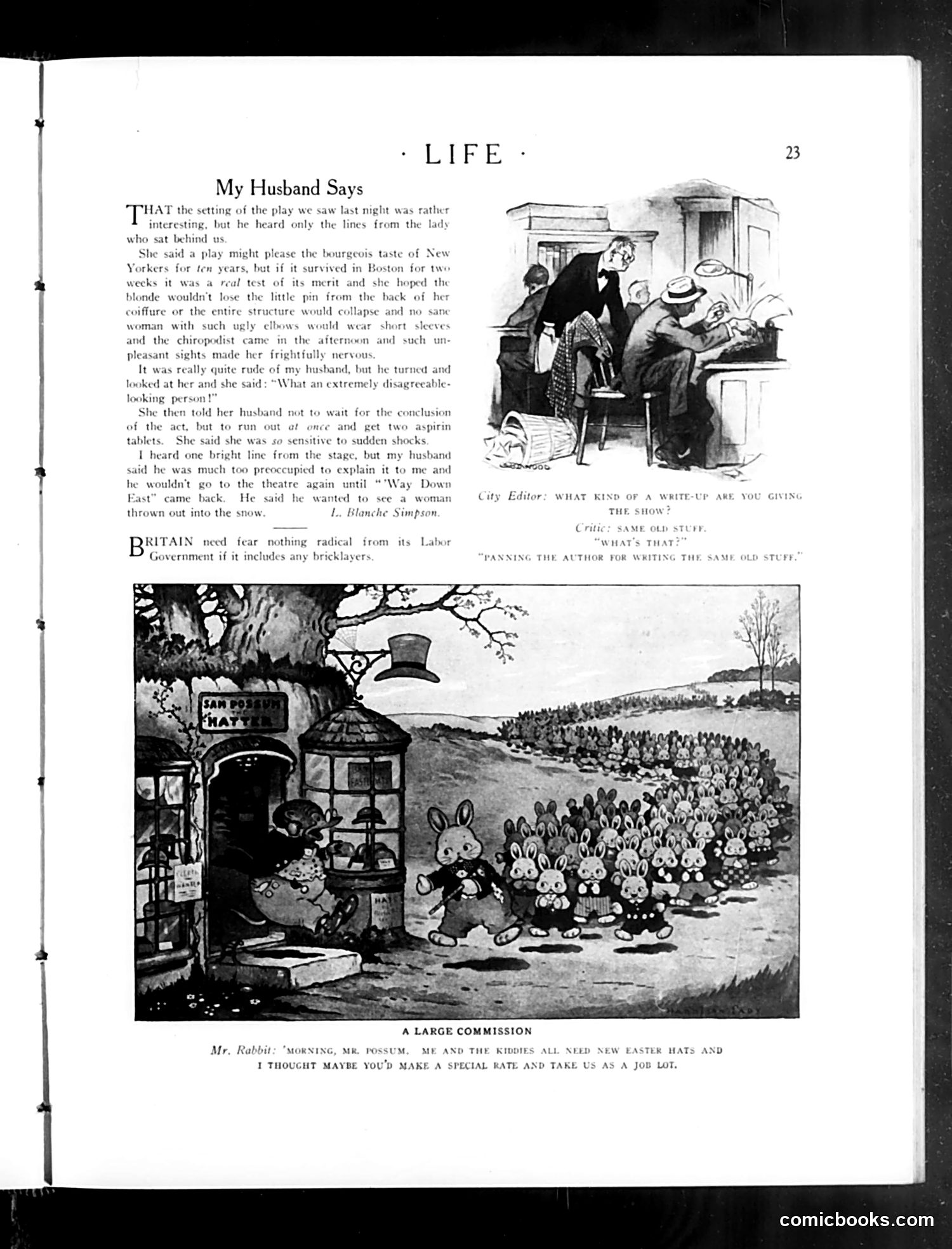
**"My Husband Says"** satirizes pretentious theater criticism. A husband condescendingly dismisses a Broadway play, criticizing its trivial aesthetics (a woman's hairpin) and shallow appeal to "bourgeois" New Yorkers, then declares he'll only return for "Way Down East"—a melodrama featuring literal physical peril (a woman thrown into snow). The joke: his claim to sophistication masks preference for sensationalism over substance. **The City Editor/Critic exchange** mocks journalistic laziness: when asked what write-up he's giving the show, the critic replies "same old stuff," and the editor accuses him of "panning the author for writing the same old stuff"—circular reasoning exposing how critics mechanically recycle complaints. **"A Large Commission"** (cartoon): Mr. Rabbit pitches Mr. Possum for a bulk Easter hat order for his numerous kiddies. The humor relies on animal characters and the absurdist image of rabbits needing hats, likely satirizing either commercial negotiations or post-war economic adjustments, though specific context remains unclear.
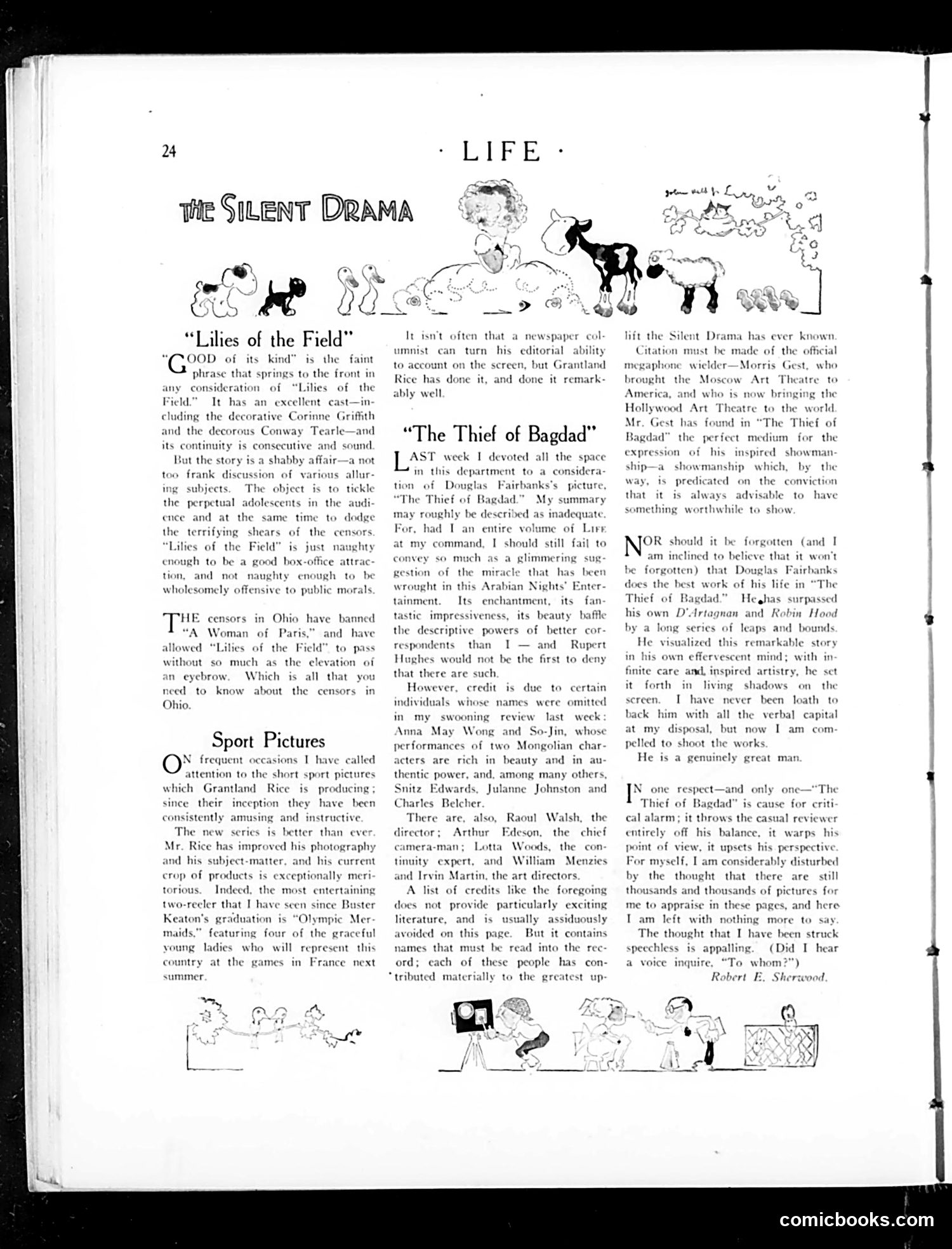
This page contains film criticism from Life magazine's entertainment section. The main reviews discuss three movies: **"Lilies of the Field"** - A satirical critique of a film with good cast (Corinne Griffith, Conway Tearle) but weak plot. The reviewer notes the censors in Ohio banned it, yet it's neither offensive enough to warrant censorship nor wholesome enough to deserve it—a jab at inconsistent film regulation. **"Sport Pictures"** - Praise for Grantland Rice's short athletic films, highlighting production quality improvements. **"The Thief of Bagdad"** - Extensive praise for this Douglas Fairbanks Arabian Nights adventure, with particular credit to Morris Gest (who brought Moscow Art Theatre to America) for the film's artistic vision. The reviewer credits supporting actors like Anna May Wong and So-Jin, plus technical crew, arguing this represents Fairbanks' finest work. The tone is sophisticated film criticism aimed at educated readers interested in cinema as an art form.
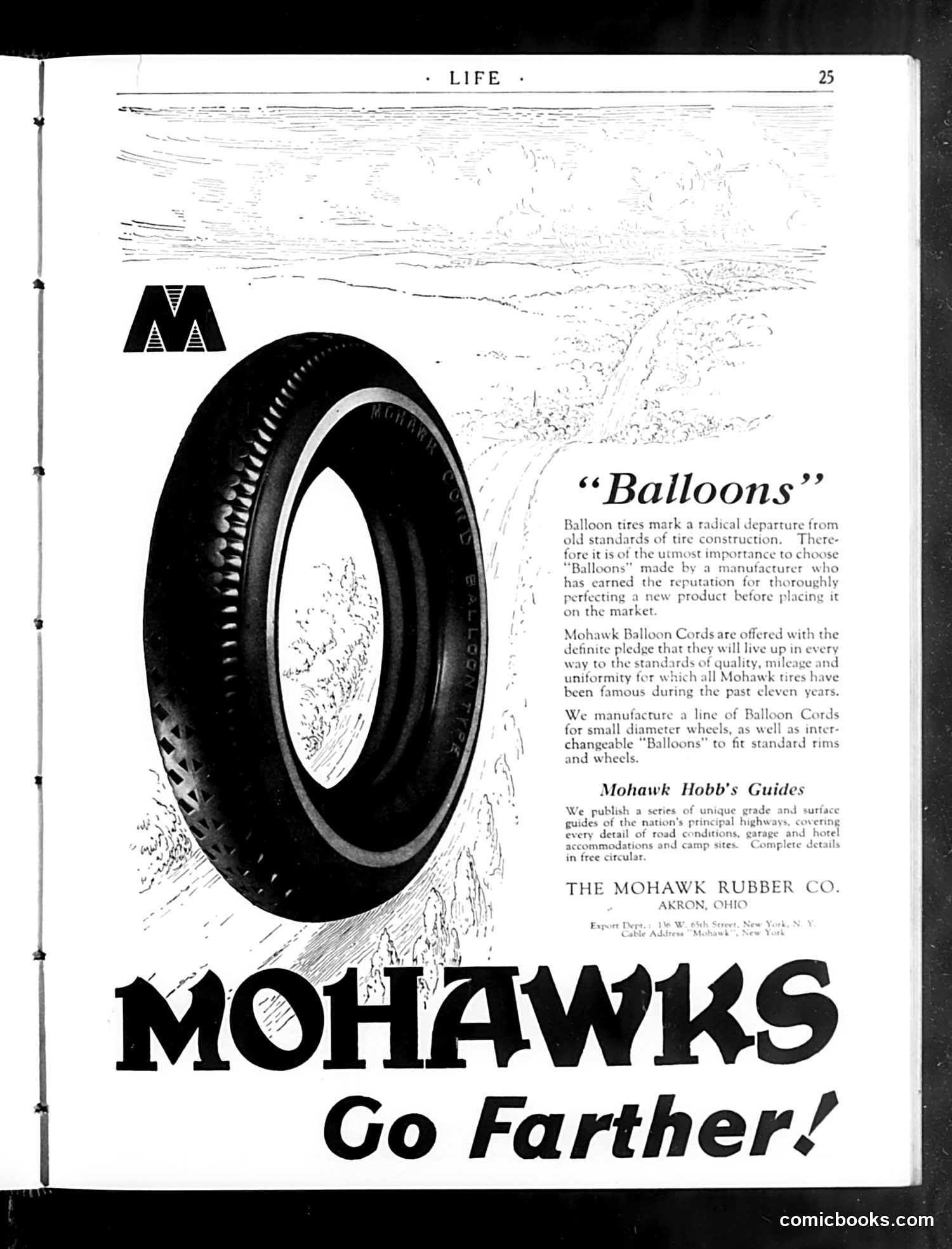
This is a **product advertisement**, not political satire. The Mohawk Rubber Company promotes their "Balloon" tire line—a new automotive tire technology featuring balloon-type construction that represented a significant departure from older tire designs. The large tire illustration dominates the page. The text emphasizes that Mohawk "Balloons" meet high quality standards and offers various sizes for different vehicles. A secondary section mentions "Mohawk Hobb's Guides"—travel guides covering American highways, accommodations, and camp sites. The tagline "**Go Farther!**" is a straightforward marketing appeal, suggesting these superior tires enable longer-distance travel. This reflects 1920s automobile culture and expanding American road infrastructure. There is no political cartoon or satire present—this is purely commercial advertising from the era when Life magazine contained substantial paid advertising alongside editorial content.
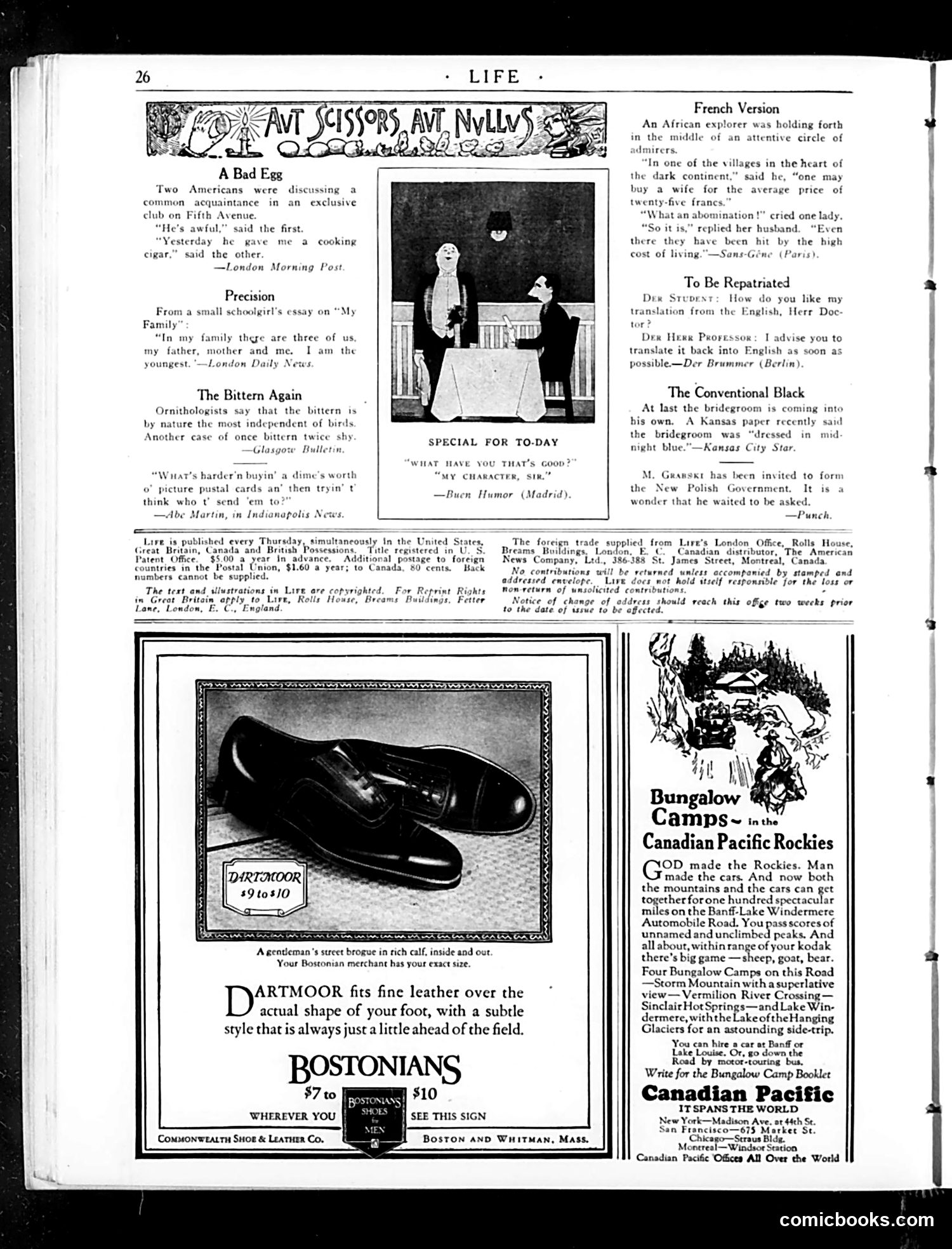
This page comprises **short satirical anecdotes and advertisements** rather than political cartoons. The humor pieces mock social pretension and language mishaps: - **"A Bad Egg"**: Two Fifth Avenue club members discuss giving a friend a "cooking cigar"—presumably a deliberately bad cigar as a prank, implying the friend is insufferable. - **"Precision"**: A schoolgirl's essay states "In my family there are three of us"—unintentionally ambiguous phrasing mocking childish writing. - **"The Bittern Again"**: References the phrase "once bitten, twice shy," suggesting independence through avoiding repeated mistakes. The **French/German/Spanish anecdotes** translated here include humor about wife-purchasing costs in Africa and translation errors. **"The Conventional Black"** jokes about a Kansas newspaper calling a bridegroom's outfit "midnight blue" instead of black. The remainder is **advertising**: Dartmoor shoes and Canadian Pacific Railway bungalow camps. No political satire is present on this page.
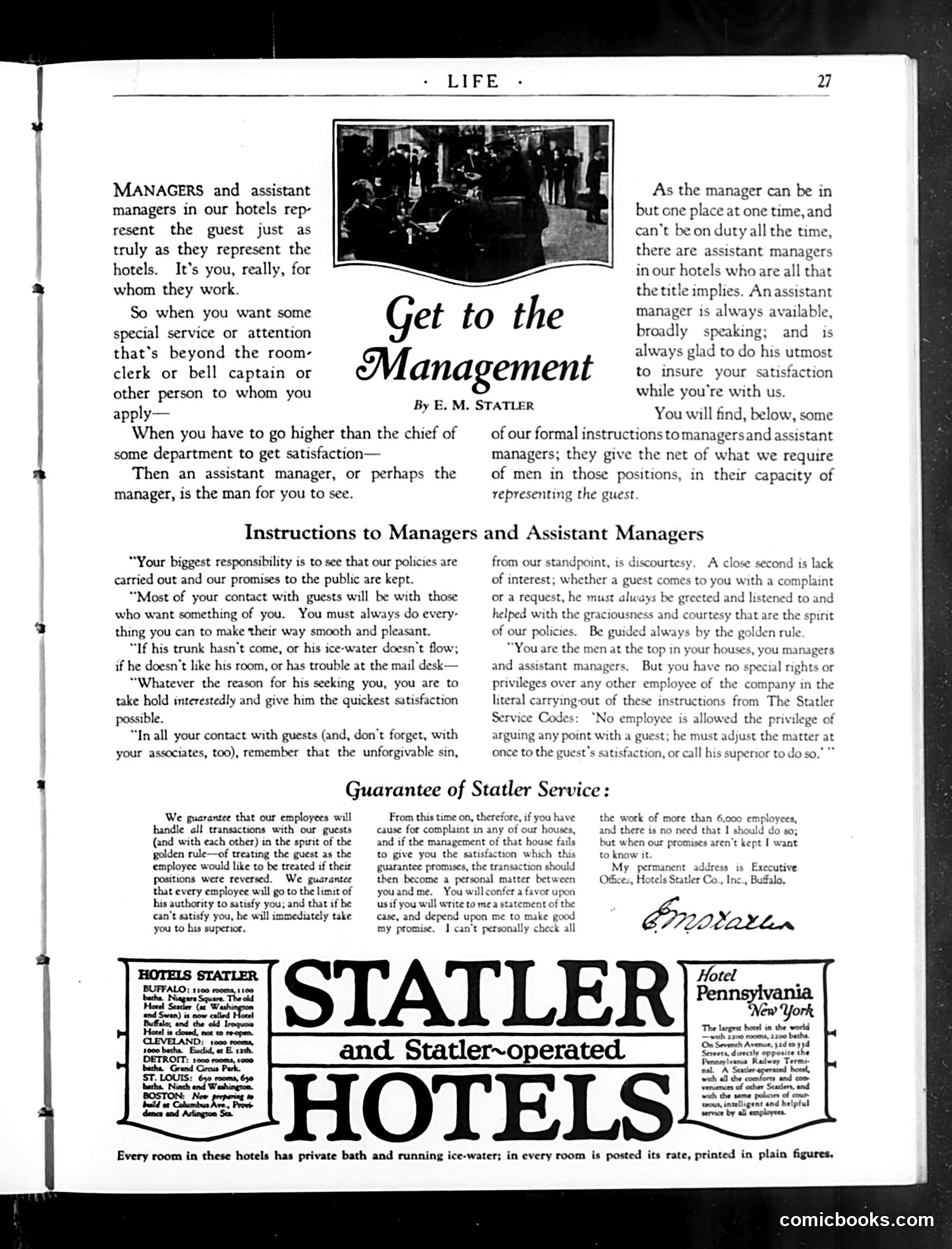
This is primarily **corporate advertising** for Statler Hotels, not editorial content or satire. The page promotes the company's service philosophy by publishing instructions to managers and a customer service guarantee. The article, signed by E.M. Statler (the hotel chain's founder), emphasizes that managers and assistant managers "represent the guest" and should handle all complaints with courtesy and efficiency. The "unforgivable sin" is discourtesy. Notably, Statler promises personal accountability—customers unhappy with local management can escalate directly to him via letter. This was part of a broader early-20th-century trend where major corporations (railroads, hotels, department stores) published their customer service policies as advertising. The approach positioned Statler as progressive and customer-focused by guaranteeing employees couldn't argue with guests and must escalate complaints up the chain if needed. **There is no cartoon or satire here**—it's straightforward promotional material presenting corporate ideology as hospitality innovation.
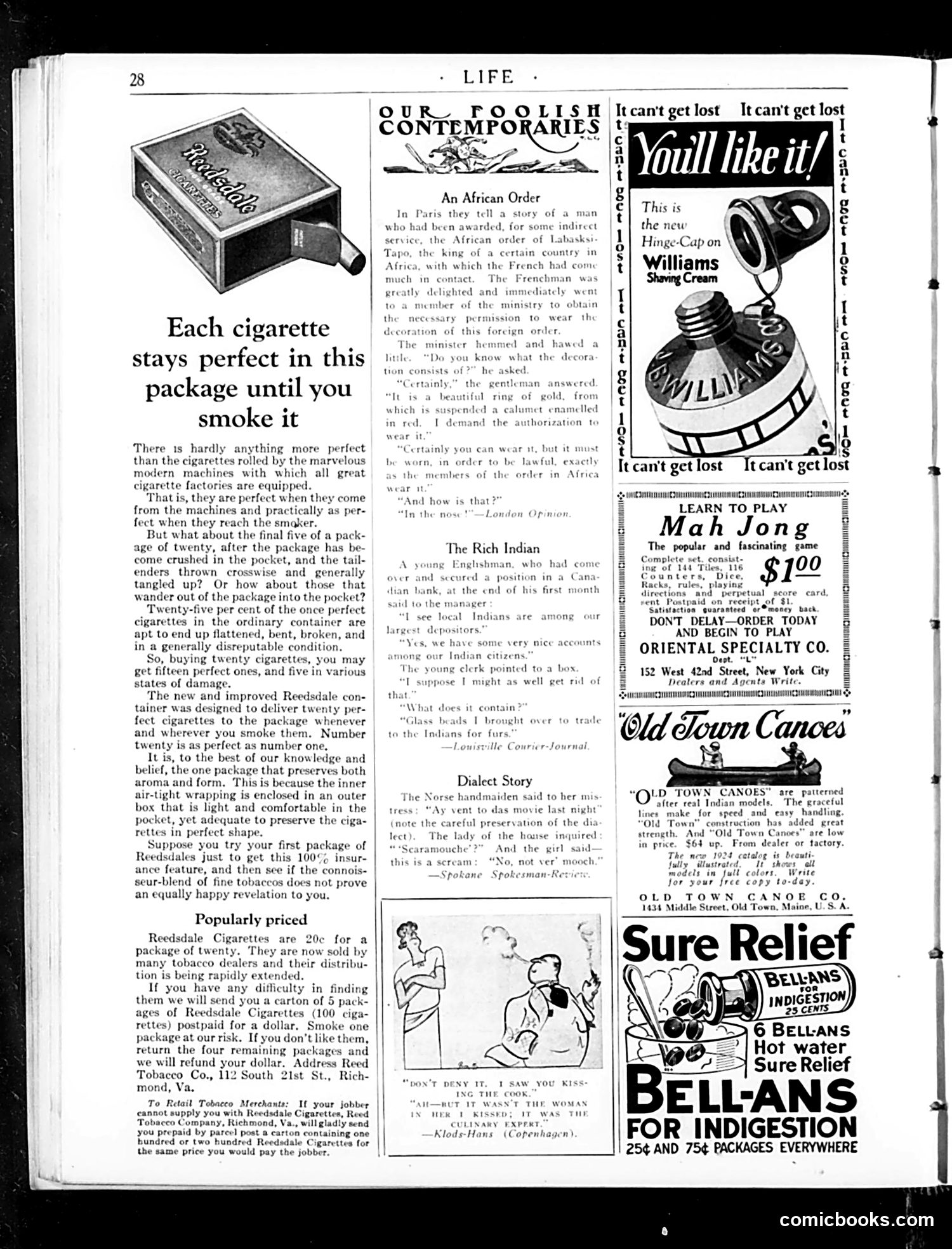
This page is primarily **advertising**, not political satire. The dominant content is a Reedsdale Cigarettes advertisement explaining their new protective packaging design—a practical marketing pitch claiming the inner air-tight wrapping preserves cigarettes from damage during everyday pocket-carrying. The small "Our Foolish Contemporaries" section contains three brief humorous anecdotes: 1. **"An African Order"**: A Frenchman receives a decoration from an African king; a minister asks if he knows what it represents, implying comedic ignorance about foreign honors. 2. **"The Rich Indian"**: A young Englman working in Canada asks a manager about hiring local Indians, then reveals he wants to trade them "furs"—a joke about colonial misunderstandings. 3. **"Dialect Story"**: A Norse housemaid's mishearing of "Seamstress" as "Screamers" creates confusion. These are gentle, light ethnic/dialect humor typical of 1920s Life magazine—mocking foreigners and immigrant accents rather than engaging substantive satire. The page reflects period attitudes toward colonialism and linguistic differences.
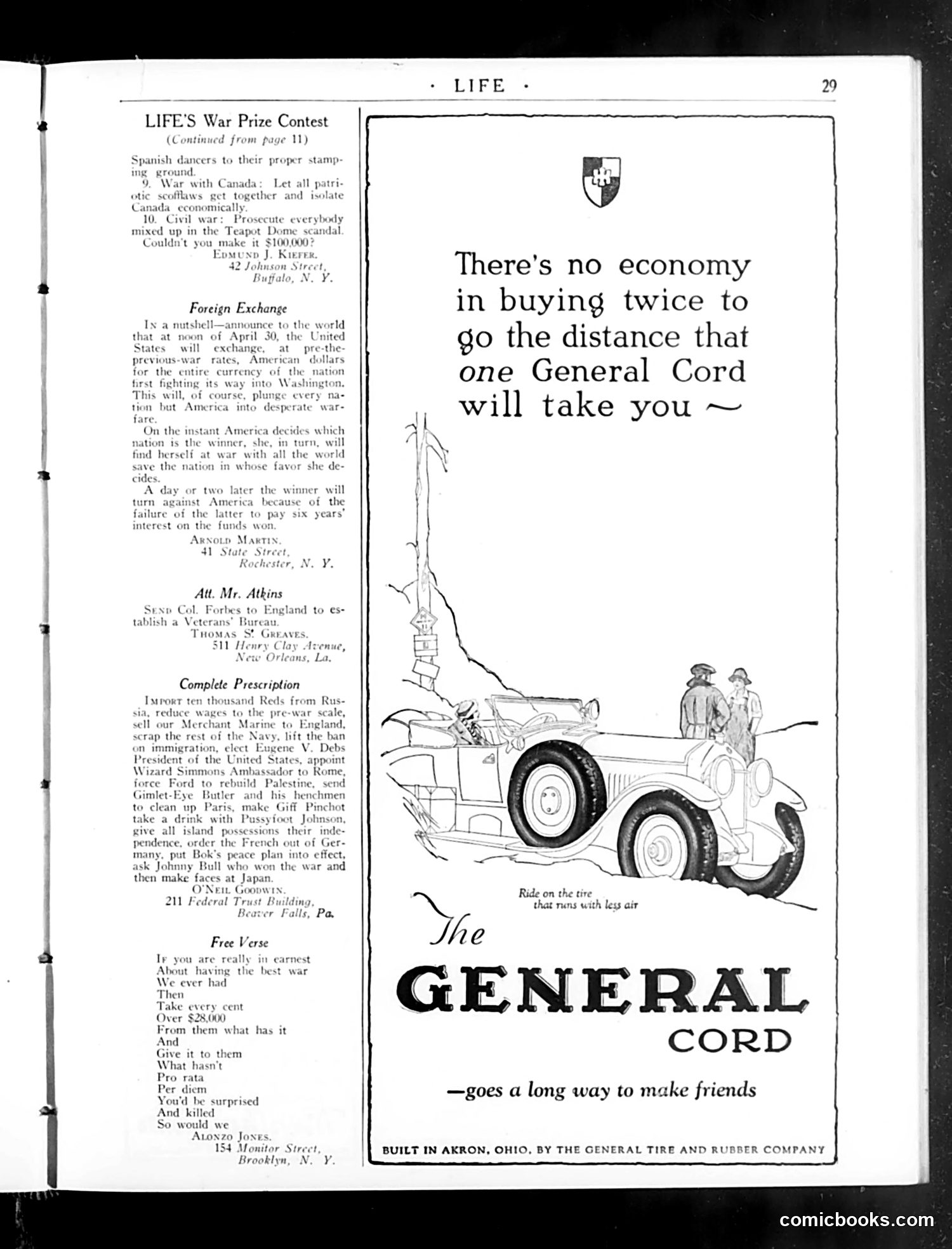
This page contains **Life's War Prize Contest**—a satirical competition inviting readers to submit humorous "solutions" to post-WWI problems. The left column showcases absurd contest entries, including proposals to prosecute everyone involved in the Teapot Dome scandal (a real 1920s corruption affair), wage war on Canada, and implement radical economic policies. The entries mock both contemporary political figures and ideologies: references to Eugene Debs (socialist presidential candidate), proposals resembling communist rhetoric, and jingoistic war-making suggestions. The satire targets the era's ideological confusion and public's desire for simple fixes to complex post-war problems. **The right side is a General Cord tire advertisement**—unrelated to the contest. The ad's tagline "goes a long way to make friends" humorously contrasts with the hostile, satirical "solutions" on the facing page, creating accidental irony through page placement. The overall effect: Life magazine ridicules both public political discourse and corporate advertising simultaneously.
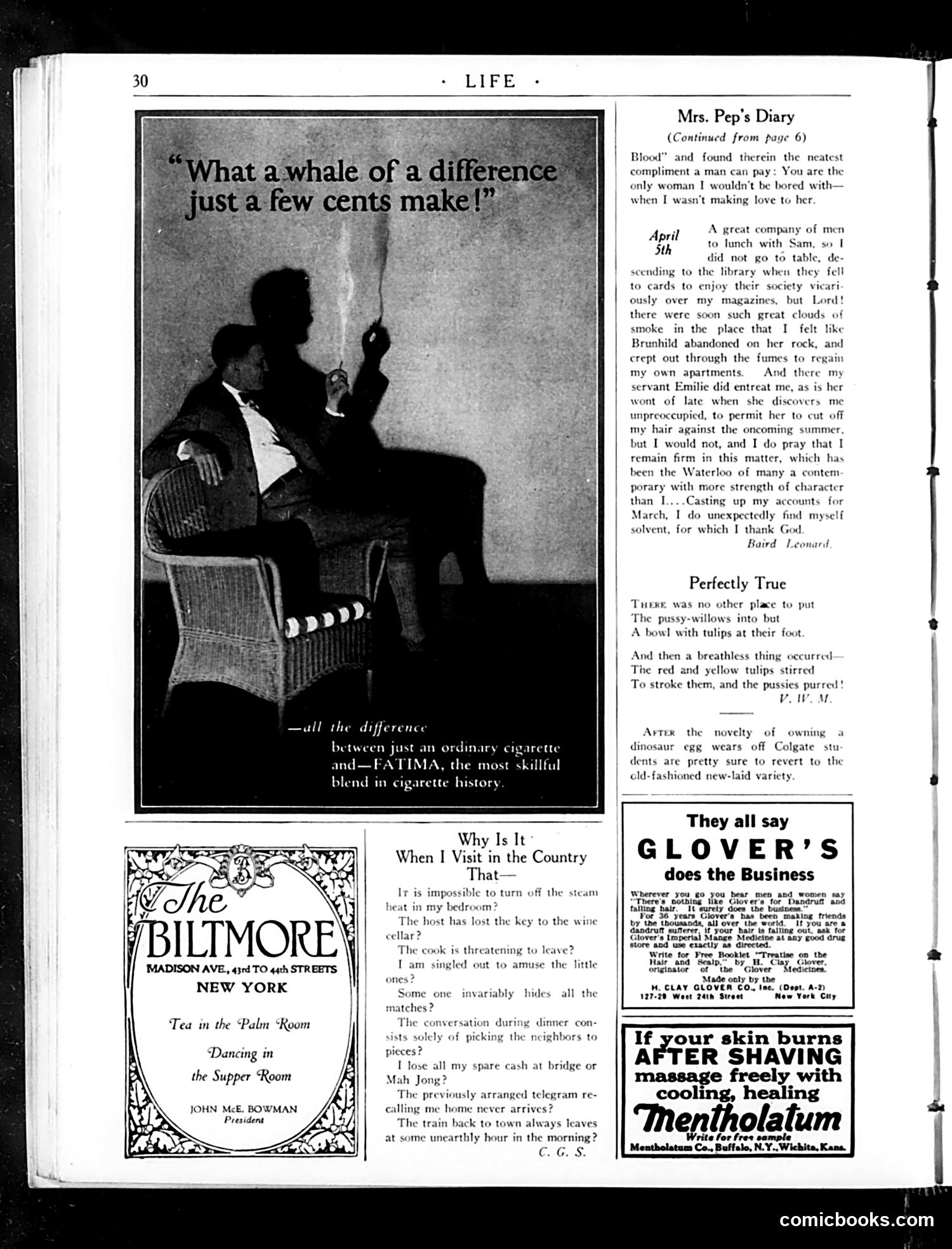
This page is primarily **advertisements and light humor columns** rather than political satire. The main cigarette advertisement uses a romantic silhouette of a couple to tout **Fatima cigarettes** as superior to "ordinary" brands—a typical early 20th-century advertising claim with no deeper meaning. Below that, **"The Biltmore"** hotel advertisement promotes luxury dining and dancing in New York City. The humor content includes: - **"Why Is It When I Visit in the Country That—"**: A list of relatable suburban annoyances (broken steam heat, lost wine cellar keys, cook threatening to quit, hidden matches, losing money at cards). This is genteel satire mocking country-house visits among the wealthy. - **"Mrs. Pep's Diary"**: A serialized fictional diary entry about upper-class social life and domestic concerns (servants, hair, accounting). - **"Perfectly True"**: A whimsical poem about tulips and pussy-willows. The remaining content consists of patent medicine and personal care product advertisements (**Glover's** hair treatment, **Mentholatum** skin salve). There is **no political content** on this page.
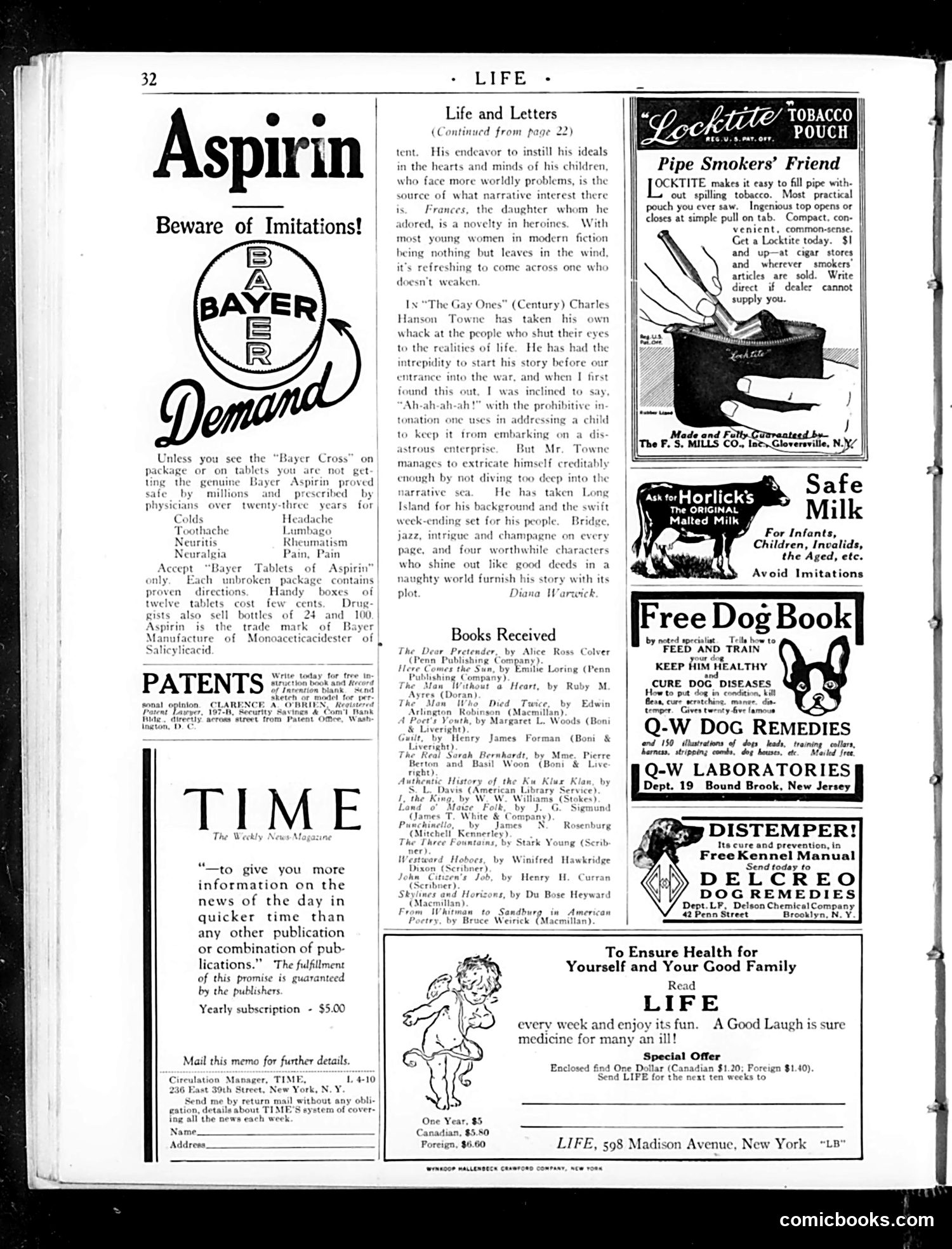
This page is primarily **advertising and editorial content** rather than political satire. The dominant feature is a large **Bayer Aspirin advertisement** warning against counterfeit versions—a genuine commercial concern of the 1920s when trademark protection was newly important and generic imitation products were common. The page includes a "Life and Letters" column reviewing contemporary novels (works by Charles Hanson Towne and others), a "Books Received" listing, and various period advertisements for consumer products: tobacco pouches, malted milk, dog remedies, and distemper cures. The **TIME Magazine subscription notice** promotes its competitor publication's speed in news delivery. The small illustration of a cherub at bottom-center is generic decorative art accompanying a LIFE magazine self-promotion. **No significant political satire or caricature appears on this page.** It reflects typical 1920s magazine content: commercial advertising, literary criticism, and product promotion targeting middle-class readers concerned with health, pets, and current events.
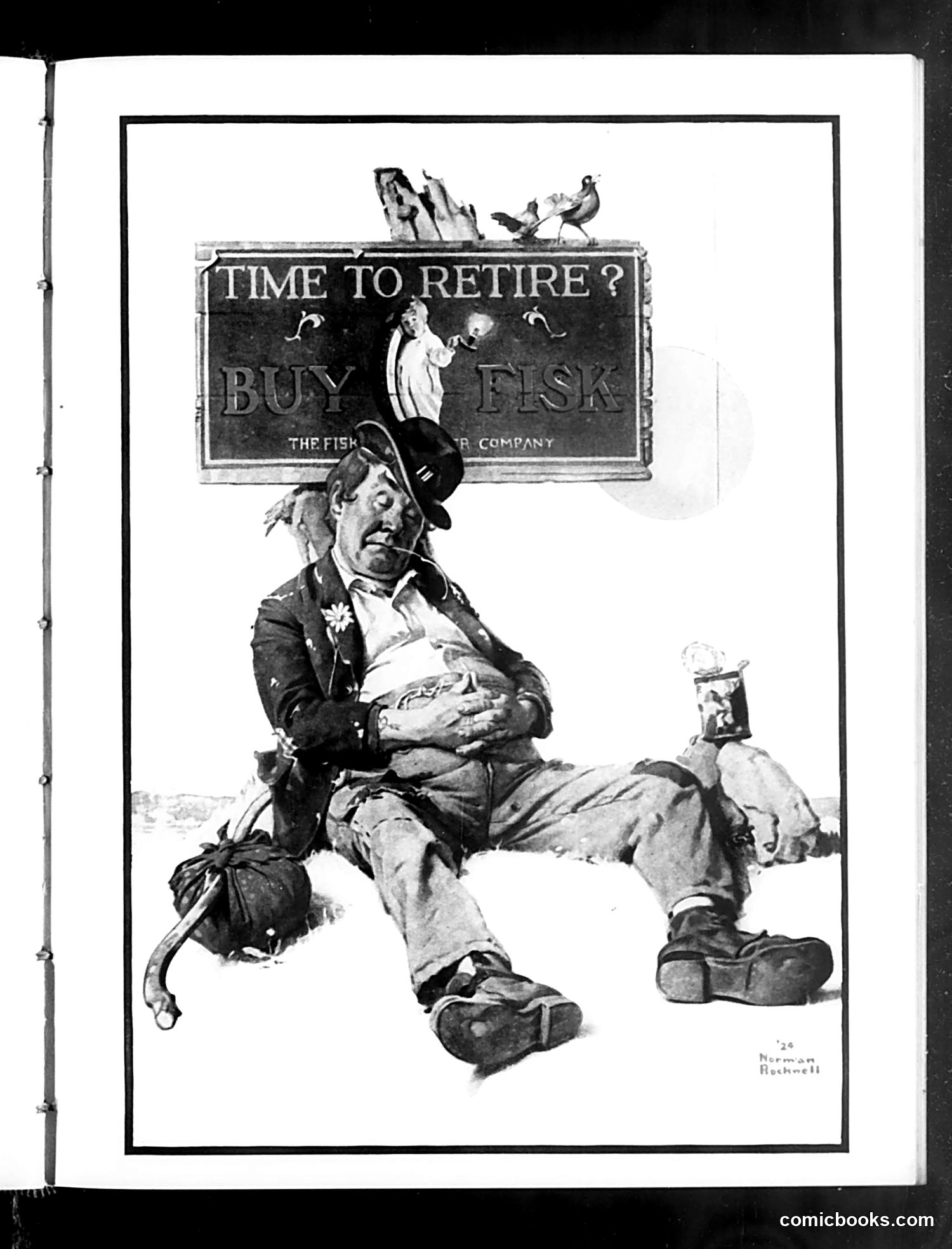
This is a Norman Rockwell illustration advertising fish products. The cartoon depicts a rotund, disheveled man sitting contentedly with a fish, seemingly relaxed and well-fed. The sign above reads "TIME TO RETIRE?" with "BUY FISK" on either side (likely "Fisk" brand fish). The satire suggests that eating fish provides such nourishment and satisfaction that one could comfortably retire—implying the product's quality and nutritional value makes life easier. The man's appearance and posture humorously suggest someone who has achieved comfort through proper diet. This is a vintage advertisement using gentle humor to promote fish consumption, typical of early 20th-century commercial illustration in *Life* magazine.
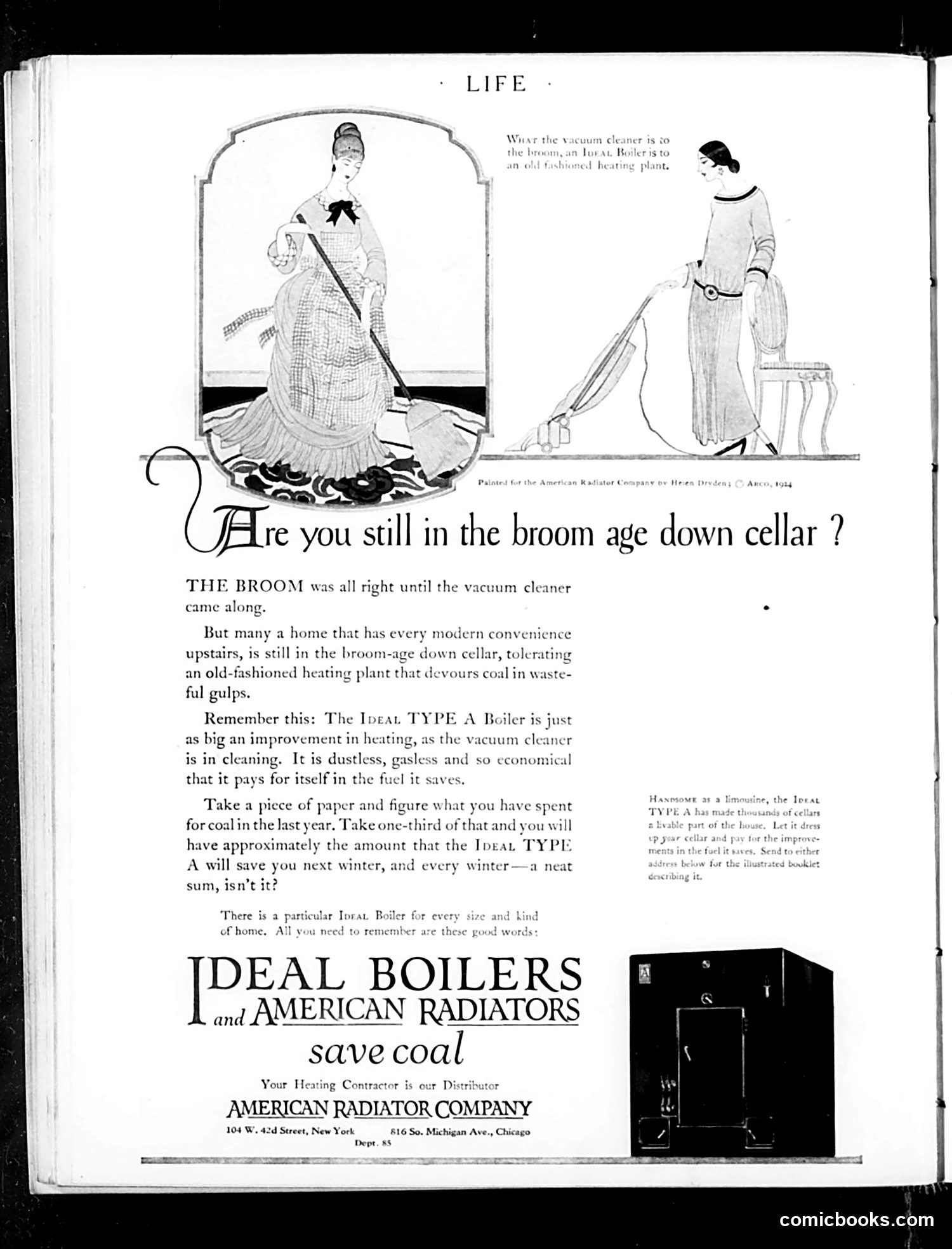
This is primarily a **product advertisement** for Ideal Boilers and American Radiators, not a political cartoon. The page uses a clever comparison: just as vacuum cleaners modernized household cleaning, Ideal boilers should modernize home heating. The illustration shows women—one vacuuming upstairs (modern), one with traditional cleaning implements downstairs (old-fashioned)—to satirize the contradiction of having modern conveniences while still using outdated coal heating systems. The "joke" targets homeowners' inconsistency: why tolerate wasteful, dusty coal furnaces when cleaner alternatives exist? The ad claims the Ideal TYPE A boiler saves approximately one-third of annual coal costs. This reflects the 1920s context when vacuum cleaners represented cutting-edge domestic technology, making the comparison to outdated heating particularly pointed. The satire gently shames readers into upgrading their heating systems by equating them with those still using brooms.