
Life, 1924-04-10 · page 20 of 36
Life — April 10, 1924 — page 20: what you’re looking at
What you’re looking at
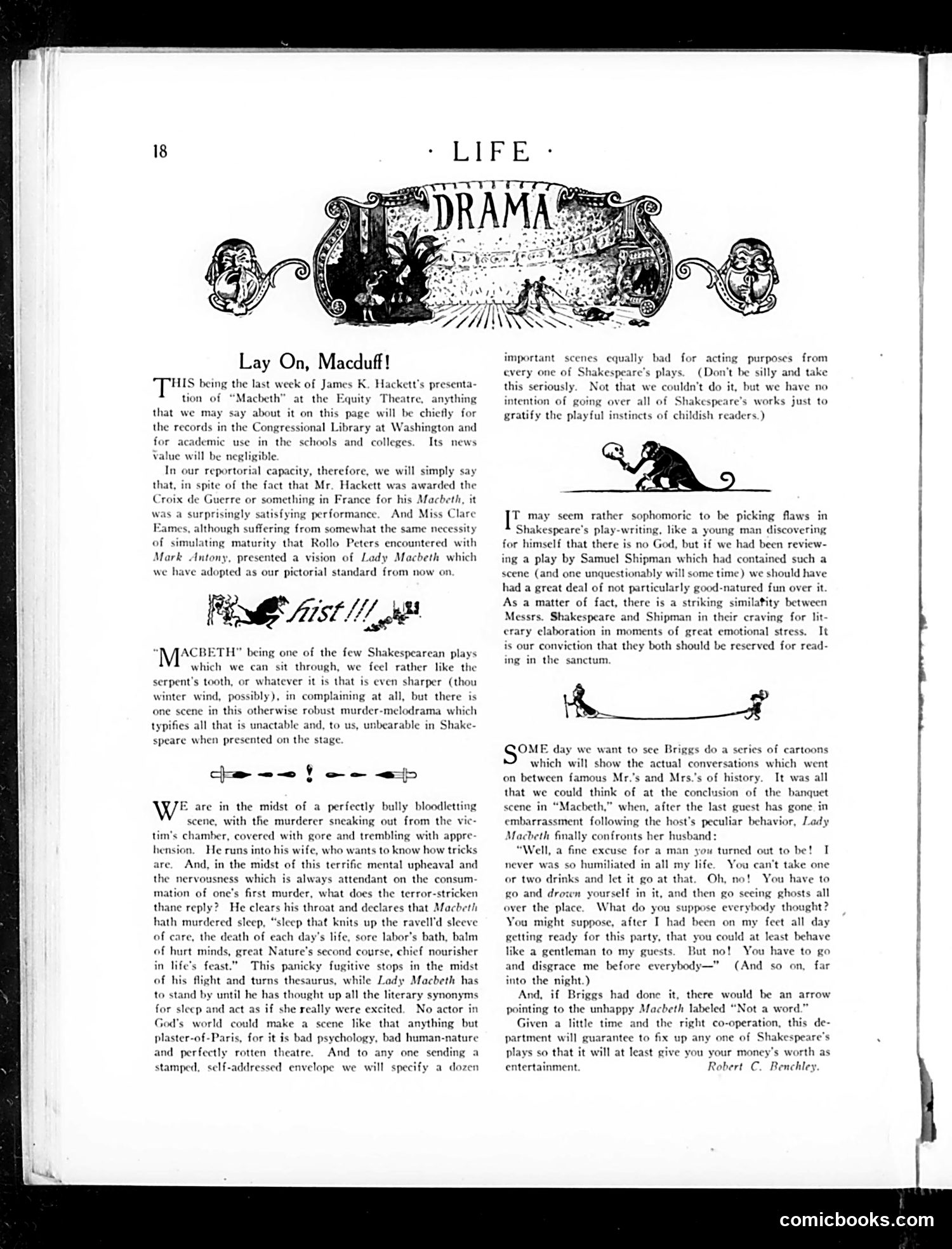
This is a theater review of James K. Hackett's production of *Macbeth* at the Equity Theatre. The critic praises the overall performance but identifies one scene as unbearably bad: when Macbeth, fresh from murdering Duncan, stops mid-flight to deliver a lengthy poetic speech about sleep rather than panicking realistically. The satire targets Shakespeare's dramatic writing—specifically the artificiality of having a murderer pause to philosophize during genuine crisis. The critic sardonically notes this same flaw appears throughout Shakespeare's works, comparing it unfavorably to contemporary playwright Samuel Shipman (now obscure). The joke is that the critic is "picking flaws" in Shakespeare himself—traditionally sacrosanct—treating him like any other writer whose overwrought dialogue would merit ridicule. The proposed cartoon series would humorously expose famous historical couples' actual mundane conversations, contrasting reality with theatrical grandeur.
📄 Transcribed text from this page (OCR, searchable)
Machine-transcribed from the original scan — historical spelling and the odd misread are preserved.
Lay On, Macduff! THIS being the last week of James K, Hackett’s presen tion of beth” at the Equity Theatre, anything that we may say about it on this page will be chiefly for the records in the Congressional Library at Washington and fc academic use in the schools and colleges. Its news alue will be negligible In our reportorial capacity, therefore, we will simply say that, in spite of the fact that Mr. Hackett was awarded the Croix de Guerre or something in France for his Macbeth, it was a surprisingly satisfying performance. And Miss Clare mes, although suffering from somewhat the same necessity of simulating maturity that Rollo Peters encountered with Mark Antony, presented a vision of Lady Macbeth which we have adopted as our pictorial standard from now on $ ACBETH” being one of the few Shakespearean plays which we can sit through, we feel rather like the serpent's tooth, or whatever it is that is even sharper (thou winter wind, possibly), in complaining at all, but there is one scene in this otherwise robust murder-melodrama which typifies all that is unactable and, to us, unbearable in Sha speare when presented on the stage. che —— f oe «<p ¢ in the midst of a perfectly bully bloodletting W tim's chamber, covered with gore and trembling scene, with the murderer sneaking out from the vic- ith appre: hension. He runs into his wife, who wants to know how tricks are. And, in the midst of this terrific mental upheaval and the nervousness which is always attendant on the consum- mation of one’s first murder, what does the terror-stricken thane reply? He clears his throat and declares that Macbeth hath murdered sleep, “sleep that knits up the ravell'd sleeve of care, the death of each day's life, sore labor's bath, balm of hurt minds, great Nature J course, chief nourisher in life's feast.” This panicky fugitive stops in the midst of his flight and turns thesaurus, while Lady Macbeth has to stand by until he has thought up all the literar: for sleep and act as if she really were excited. God's world could make a scene like that anything but plaster-of-Paris, for it is bad psychology, bad human-nature and perfectly rotten theatre. And to any one sending a stamped, self-addressed envelope we will specify a dozen ynonyms No actor in important scenes equally bad for act every one of Shakespeare's plays. (Don't be silly and take this seriously. Not that we couldn't do it, but we have no intention of going over all of Shakespeare’s works just to gratify the playful instincts of childish readers.) purposes from T may seem rather sophomo to be picking flaws in Shakespeare's play-writing, like a young man discovering for himself that there is no God, but if we had been review- ing a play by Samuel Shipman which had contained such a scene (and one unquestionably will some time) we should have had a great deal of not particularly good-natured fun over it As a matter of fact, there is a striking similatity between Messrs. Shakespeare and Shipman in their craving for lit- crary elaboration in moments of great emotional stress. It is our conviction that they both should be reserved for read- ing in the sanctum. : rn OME day we want to sce Briggs do a series of cartoons which will show the actual conversations which went on between famous Mr.’s and Mrs.’s of history. It was all that we could think of at the conclusion of the banquet scene in “Macbeth,” when, after the last guest has gone in embarrassment following the host's peculiar behavior, Lady Macbeth finally confronts her husband: “Well, a fine excuse for a man you turned to be! I never was so humiliated in all my life. You can't take one or two drinks and let it go at that. Oh, no! You have to go and drown yourself in it, and then go seeing ghosts all over the place. What do you suppose everybody thought? You might suppose, after I d been on my feet all day getting ready for this party, that you could at least behave like a gentleman to my guests. But no! You have to go and disgrace me before everybody—" (And so on, far into the night.) And, if Briggs had done it, there would be an arrow pointing to the unhappy Macbeth labeled “Not a word.” Given a little time and the right co-operation, this de- partment will guarantee to fix up any one of Shakespeare's plays so that it will at least give you your money's worth as entertainment Robert C. Benchley. comicbooks.com