
Life, 1924-04-10 · page 16 of 36
Life — April 10, 1924 — page 16: what you’re looking at
What you’re looking at
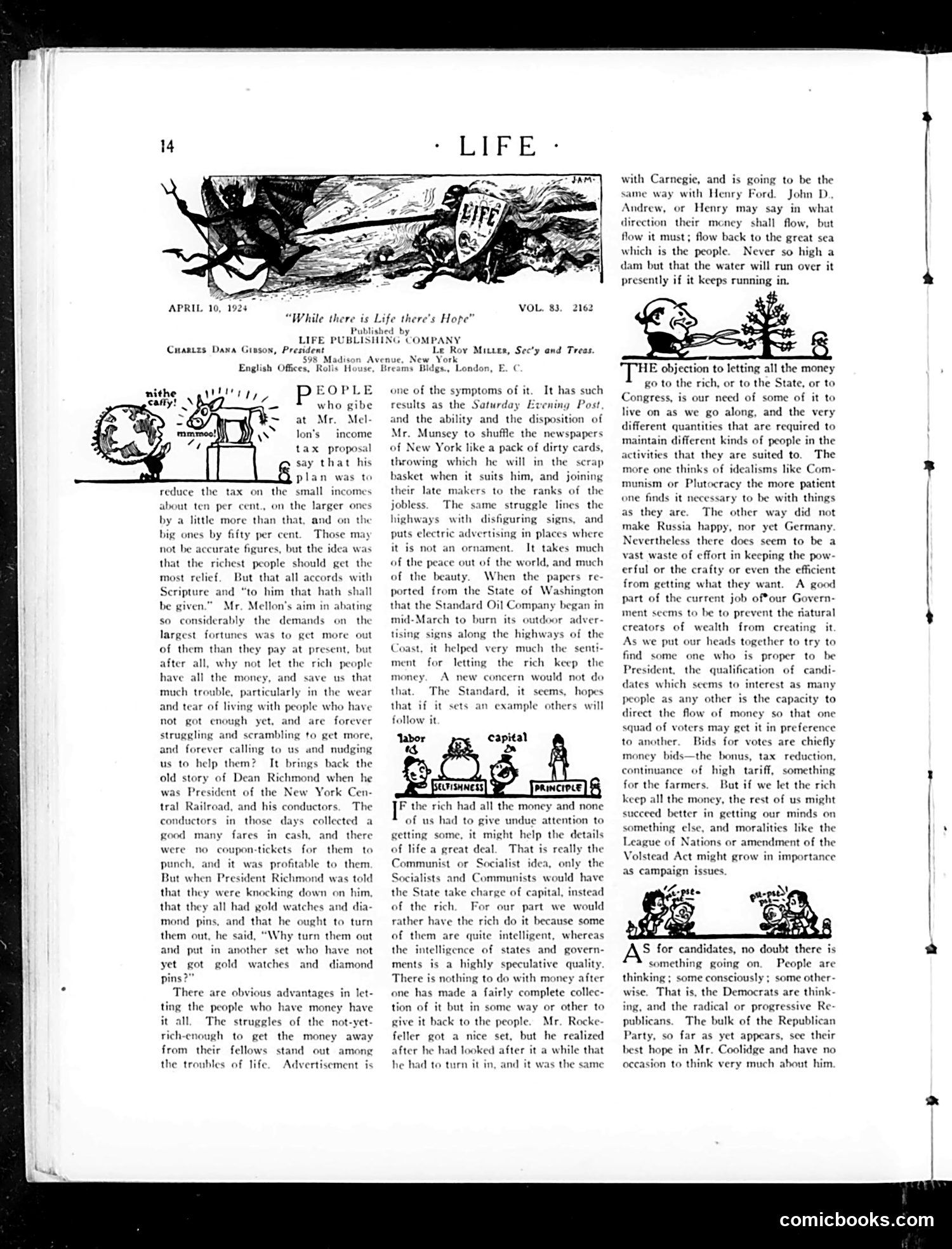
This page critiques wealth distribution and taxation policy during the 1920s. The main editorial argues against allowing the wealthy to keep all money, citing President Coolidge's recent tax proposals. The cartoons depict competing ideologies: one shows figures labeled "Capital," "Labor," and "Principle" in conflict—representing tension between business interests, workers, and moral governance. Another illustrates Democrats versus Republicans on candidate selection. The article attacks both wealthy industrialists (Rockefeller, Carnegie, Ford) and radical solutions (Communism), instead advocating moderate redistribution. It criticizes the Standard Oil Company's highway advertising and proposes that government should direct wealth flow "back to the people" rather than concentrate it among the rich—a Progressive Era argument about capitalism's proper limits.
📄 Transcribed text from this page (OCR, searchable)
Machine-transcribed from the original scan — historical spelling and the odd misread are preserved.
VOL. 83. 2162 “While there is Life there's Hope” LIFE PUBLISHID Cuastzs Dana G: SON, President 59) English Offices, jolis House EOPLE who gibe at Mr. Mel- Jon's income tax proposal say that his plan was to reduce the tax on the small incomes about ten per cent., on the larger ones by a little more than that, and on the big ones by fifty per cent. Those may not be accurate figures, but the idea was that the richest people should get the most relief. But that all accords with Scripture and “to him that hath shall be given.” Mr. Mellon's aim in abating so considerably the demands on the largest fortunes was to get more out of them than they pay at present, but after all, why not let the rich people have all the money, and save us that much trouble, particularly in the wear and tear of living with people who have not got ¢ ugh yet, and are forever struggling and scrambling to get me and forever calling to us and nudging us to help them? It br ck the old story of Dean Richmond when he was President of the New York Cen- tral Railroad, and his conductors. The conductors in those days collected good ma e, y fares in cash, and there were no coupon-tickets for them to punch, and it was profitable to them But when President Richmond was told that they were knocking down on him, that they all had yold watches and di: mond pins, and that he ought to turn them out, he said, “Why turn them out and put in another set who have not yet got gold watches and diamond pins?” There are obvious advantages in let- ting the people who have money have it all, The struggles of the not-yet- rich-enough to get the money away from their fellows stand the troubles of life it among Advertisement is y + COMPANY Le Roy Mitte: Treas. Sec'y an Madison Avenue, New York Breams Bidgs., London, E. ( one of the symptoms of it. It has such results as the Saturday rning Post and the ability and the disposition of Mr. Munsey to shuffle the newspapers of New York like a pack of dirty cards, throwing which he will in the scrap basket when it suits him, and joining their late makers to the ranks of the jobless. The same struggle lines the highways with disfiguring signs, and puts electric advertising in places where it is not an ornament. It takes much of the peace out of the world, and much of the beauty. When the papers re- ported from the State of Washington that the Standard Oil Company began in mid-March to burn its utdoor adver tising signs along the highways of the Coast, it helped very much the senti- ment for letting the rich keep. the money. A new concern would not do that. The St that if it follow it dard, it seems, hopes an example others will F the rich had all the money and none of us had to give undue attention to getting some, it might help the deta of life a great deal. That is really the Communist or Socialist idea, only the Socialists and Communists would have the State take charge of capital, instead of the rich. For our part we would rather have the rich do it because some of them are quite intelligent, whereas the intelligence of states and govern- ments is a highly speculative quality There is nothing to do with money after one has made a fairly complete collec- tion of it but in some way or other to give it back to the people. Mr. Rocke: feller got a nice set, but he realized after he had looked after it a while that he had to turn it in, and it was the same with same way with Henry I Carnegie, and is going to be the wd. John D Andrew, or Henry may say in what direction their money shall flow, bu flow it must; flow back to the great sea which is the people. Never so high a dam but that the water will run over it presently if it keeps running in. IE objection to letting all the money go to the rich, or to the State, or to Congress, is our need of some of it to live on as we go along, and the very different quantities that are required to maintain different kinds of people in the activities that they are suited to. The more one thinks of idealisms like Com- munism or Plutocracy the more patient one finds it necessary to be with things as they are. The other way did not make Russia happy, nor yet German: Nevertheless there does seem to be vast waste of effort in keeping the pow- erful or the crafty or even the efficient from getting what they want. A good part of the current job of*our Govern- ment seems to be to prevent the iatural cre tors of wealth from creating it As we put our heads together to try to find some one who is proper to be President, the qualification of candi- dates which seems to interest as many people as any other is the capacity to direct the flow of money so that one squad of voters may get it in preference to another. Bids for votes are chiefly money bids—the bonus, tax reduction, continuance of high tariff, something for the farmers. But if we let the rich keep all the money, the rest of us might succeed better in getting our minds on something else, and moralities like the League of Nations or amendment of the Volstead Act might grow in importance as campaign issues. S for candidates, no doubt there is something going on. People are thinking; some consciously ; some other- wise. That is, the Democrats are think- . and the radical or progressive Re- publicans. The bulk of the Republican Party, so far as yet appears, sce their best hope in Mr. Coolidge and have no occasion to think very much ahout him, comicbooks.com