
Life, 1924-04-10 · page 24 of 36
Life — April 10, 1924 — page 24: what you’re looking at
What you’re looking at
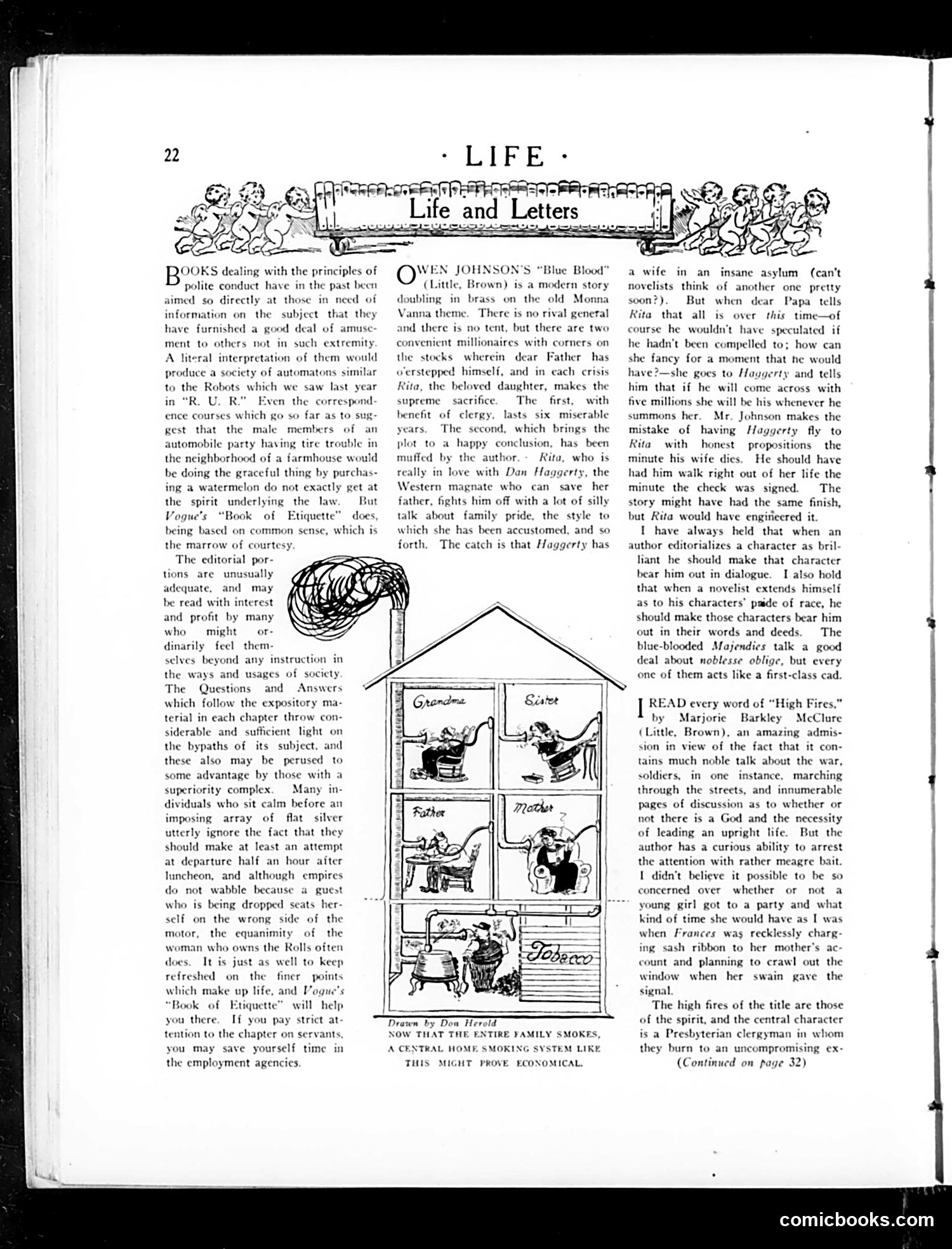
This page contains book reviews discussing etiquette and fiction. The cartoon by Don Herold (bottom center) satirizes modern domestic life: it depicts a cross-section house labeled with family members' names (Grandma, Father, Mother, etc.), each smoking in different rooms. The caption reads: "NOW THAT THE ENTIRE FAMILY SMOKES, A CENTRAL HOME SMOKING SYSTEM LIKE THIS MIGHT PROVE ECONOMICAL." The joke targets the social shift of women smoking becoming acceptable—a relatively recent and controversial development in the 1920s. Herold mocks this by suggesting that since "the entire family" now smokes, installing central ventilation would be practical household economics, treating smoking as a normal domestic utility rather than a scandalous habit. The text reviews two books: Vogue's "Book of Etiquette" and Owen Johnson's novel "Blue Blood," criticizing the latter's melodramatic plot and characterization.
📄 Transcribed text from this page (OCR, searchable)
Machine-transcribed from the original scan — historical spelling and the odd misread are preserved.
OOKS dealing with the principles of polite conduct have in the past been aimed so directly at those in need of information on the subject. th they have furnished a good deal of amuse ment to others not in such extremity A literal interpretation of them would produce a society of automatons similar to the Robots which we saw last year in “R. U. R.” Even the correspond ence courses which go so far as to sug- gest that the mal automobile party having tire trouble in the neighborhood of a farmhouse would be doing the graceful thing by purchas- ing a watermelon do not exactly get at the spirit underlying the law. But Vogue's “Book of Etiquette” does. being based on common sense, which is the marrow of courtesy The editorial por- tions are unusually members of an adequate, and) may be read with interest and profit by many who = might — or- dinarily feel them- selves beyond any instruction in the ways and usages of society The Questions and Answers which follow the expository ma- terial in each chapter throw con- siderable and sufficient light on the bypaths of its subject, and these also may be perused some advantage by those with a superiority complex. Many in- dividuals who sit calm before an imposing array of flat. silver utterly ignore the fact that they should make at least an attempt at departure half an hour after luncheon, and although empires do not wabble because a guest who is being dropped seats her self on the wrong side of the motor, the equanimity of the woman who owns the Rolls often does. It is just as well to keep refreshed on the finer points which make up life, and Vogue's “Book of Etiquette” will help you there. If you pay strict at tention to the chapter on servants. you ma the emple save yourself time in ment agencies. WEN JOHNSON’S “Blue Blood” (Little, Brown) is a modern story doubling in brass on the old Monna Vanna theme. There is no rival general and there is no tent, but there are two convenient millionaires with corners on the stocks wherein dear Father has o'erstepped himself, and in each crisis Rita, the beloved daughter, makes the supreme sacrifice. The first, with benefit of clergy, lasts six miserable years. The second, which brings the plot to a happy conclusion, has been muffed by the author. - Rita, who is really in love with Dan Haggerty, the Western magnate who can save her father, fights him off with a lot of silly talk about family pride, the style to which she has been accustomed, and so forth. The catch is that Haggerty has on by Don Herold NOW THAT THE ENTIRE FAMILY SMOKES, A CENTRAL HOME SMOKING SYSTEM LIKE THIS MIGHT PROVE ECONOMICAL. a wife in an insane asylum (can't novelists think of another one pretty soon?). But when dear Papa tells Rita that all is over this time—of course he wouldn't have speculated if he hadn't been compelled to; how can she fancy for a moment that ne would have —she goes to Haygerty and tells him that if he will come across with five millions she will be his whenever he summons her. Mr, Johnson makes the mistake of having Haggerty fly to Rita with honest propositions _ the minute his wife dies. He should have had him walk right out of her life the minute the check was signed. The story might have had the same finish, but Rita would have engineered it. I have always held that when an author editorializes a character as bril- liant he should make that character bear him out in dialogue. I also hold that when a novelist extends himself as to his characters’ paide of race, he should make those characters bear him out in their words and deeds. The blue-blooded Majendies talk a good deal about noblesse oblige, but every one of them acts like a first-class cad. READ every word of “High Fires, by Marjorie Barkley McClure (Little, Brown), an amazing admis- sion in view of the fact that it con- tains much noble talk about the war, soldiers, in one instance, marching through the streets, and innumerable pages of discussion as to whether or not there is a God and the necessity of leading an upright life. But the author has a curious ability to arrest the attention with rather meagre bait. I didn't believe it possible to be so concerned over whether or not a young girl got to a party and what kind of time she would have as I was when Frances was recklessly charg- ing sash ribbon to her mother’s ac- vunt and planning to crawl out the window when her swain gave the signal The high fires of the title are those of the spirit, and the central character is a Presbyterian clergyman in whom they burn to an uncompromising ¢x- (Conti "ve aller comicbooks.com