
A complete issue · 36 pages · 1924
Life — January 17, 1924
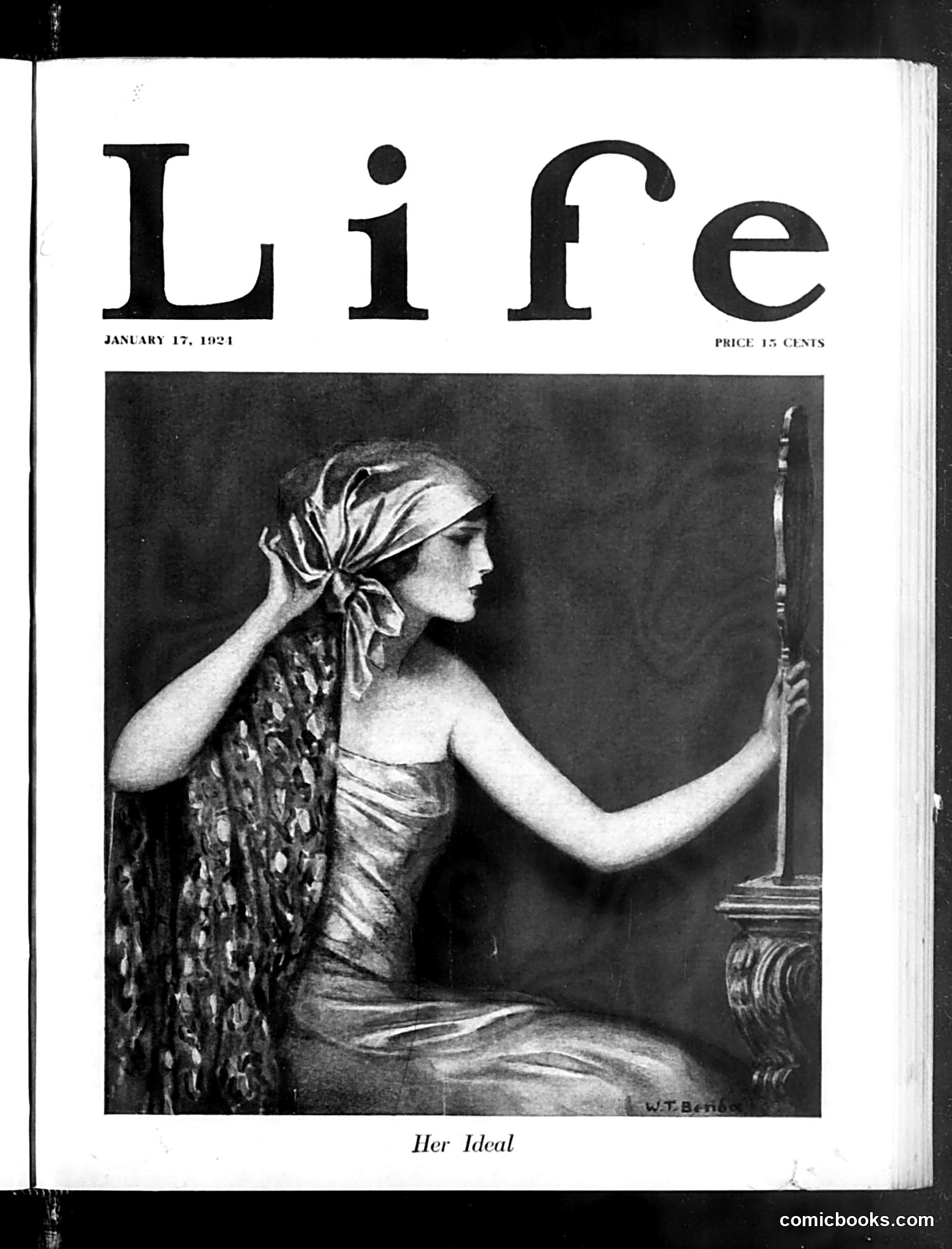
This is a magazine cover titled "Her Ideal," featuring a portrait photograph by W.T. Benda. The image shows a woman in profile, wearing a decorative headscarf and what appears to be an elegant draped garment, gazing at her reflection in a mirror. The satire likely comments on female vanity and beauty standards of the 1920s Jazz Age era. The titled "Her Ideal" suggests irony—the woman admires her own reflection, possibly satirizing contemporary obsession with personal appearance, fashion, and self-image during this period of social change for women. The sophisticated styling and mirror imagery were typical visual tropes Life magazine used to mock societal preoccupations with beauty and materialism among the leisure class.
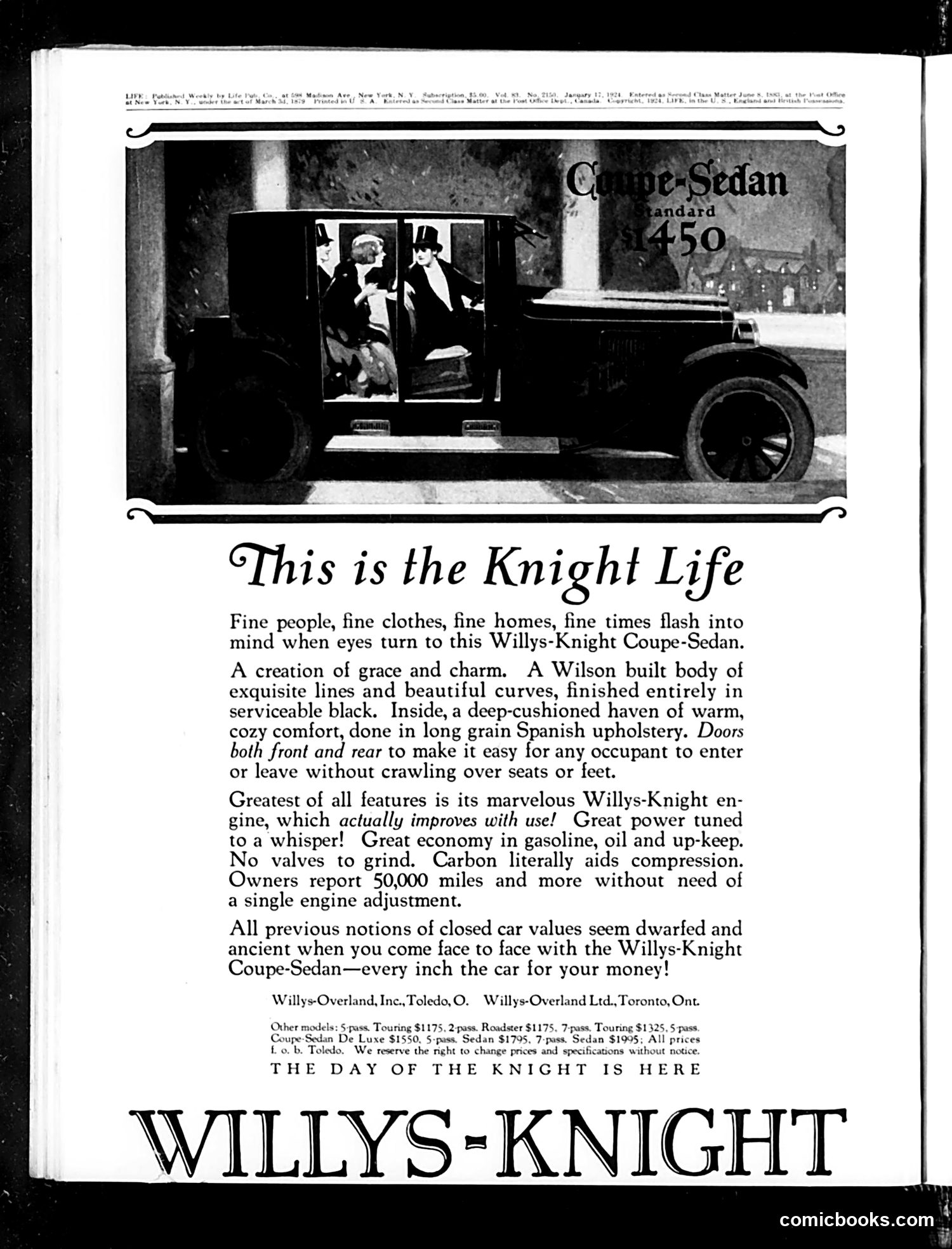
This page is primarily **advertising, not satire or cartoon content**. It's a Willys-Knight automobile advertisement from Life magazine, promoting their "Coupe-Sedan" model. The ad uses the phrase "This is the Knight Life" as a pun on the car's brand name. The imagery shows well-dressed passengers in formal attire (appearing to be from the 1920s based on clothing and styling), reinforcing the advertisement's appeal to affluent buyers. The copy emphasizes luxury features—Spanish upholstery, ease of entry/exit, and the engine's reliability (claiming 50,000 miles without adjustment). The slogan "The Day of the Knight is Here" is a straightforward marketing claim rather than political commentary. This is a straightforward luxury goods advertisement targeting upper-class consumers, not satirical content.
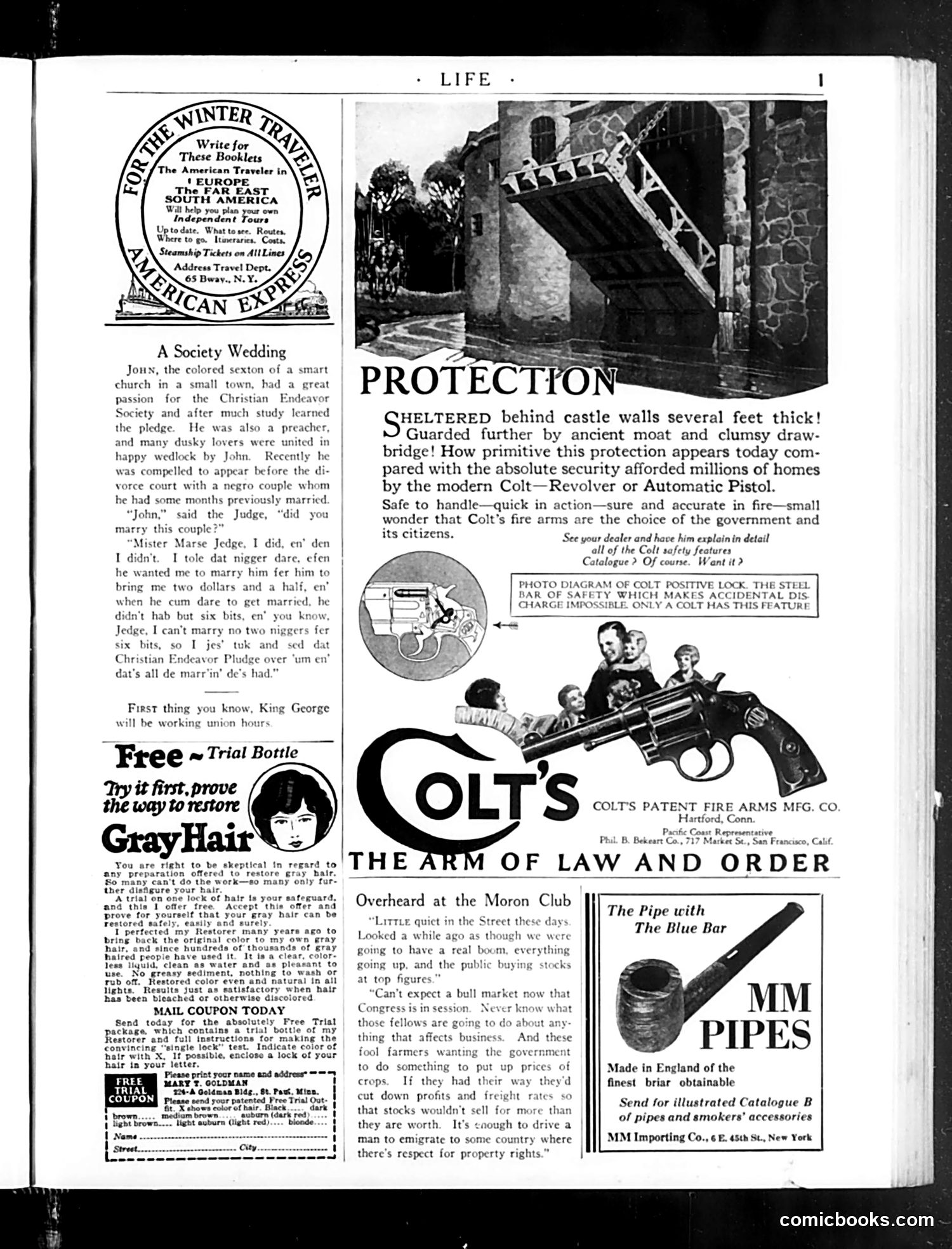
This page is primarily **advertisements** rather than satirical content. The main pieces are: 1. **"A Society Wedding"** — a brief humorous story about John, a Black church sexton, appearing in court for marrying a couple without license. The joke relies on racial stereotypes and dialect humor typical of early 20th-century publications. 2. **Colt Firearms Advertisement** — titled "The Arm of Law and Order," featuring a revolver and families, marketing guns as home protection against unspecified threats (likely reflecting period anxieties). 3. **Gray Hair Restorer & MM Pipes advertisements** — standard commercial promotions. The "society wedding" anecdote uses racist caricature and vernacular speech patterns common to the era's humor, reflecting attitudes we'd now recognize as offensive.
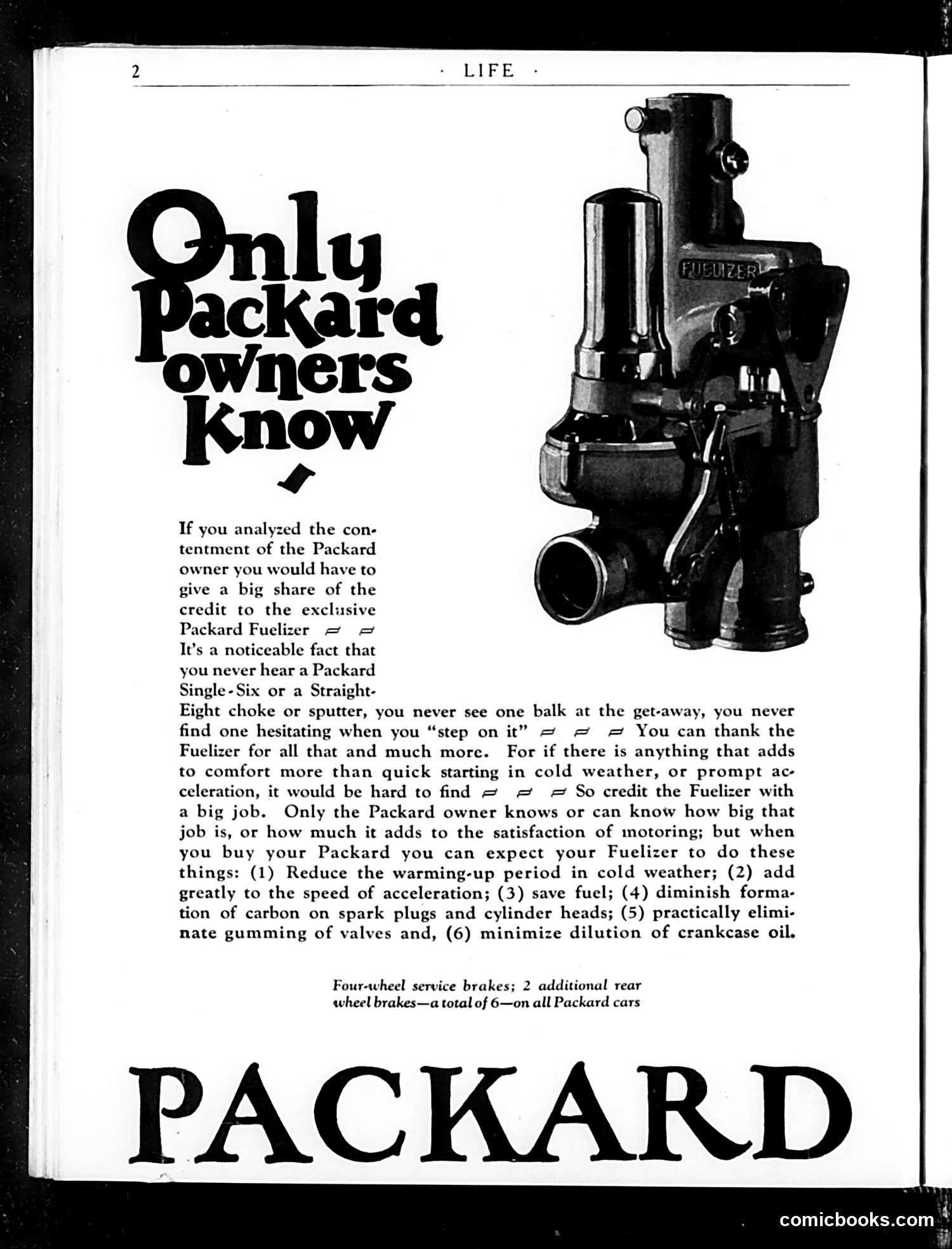
This is **not a cartoon or satire page**—it's a straightforward **automobile advertisement** for Packard cars, specifically highlighting the "Packard Fuelizer" (a fuel injection system). The ad targets Packard owners, claiming that only they understand the real benefits of their vehicle's exclusive technology. It lists six specific advantages the Fuelizer provides: faster cold-weather starting, quicker acceleration, fuel economy, reduced carbon buildup, valve cleanliness, and less oil dilution. The large image shows the Fuelizer component itself. The ad also mentions Packard's advanced braking system (four-wheel service brakes plus two additional rear-wheel brakes). This represents typical 1920s-30s automobile advertising emphasizing technical superiority and luxury positioning.
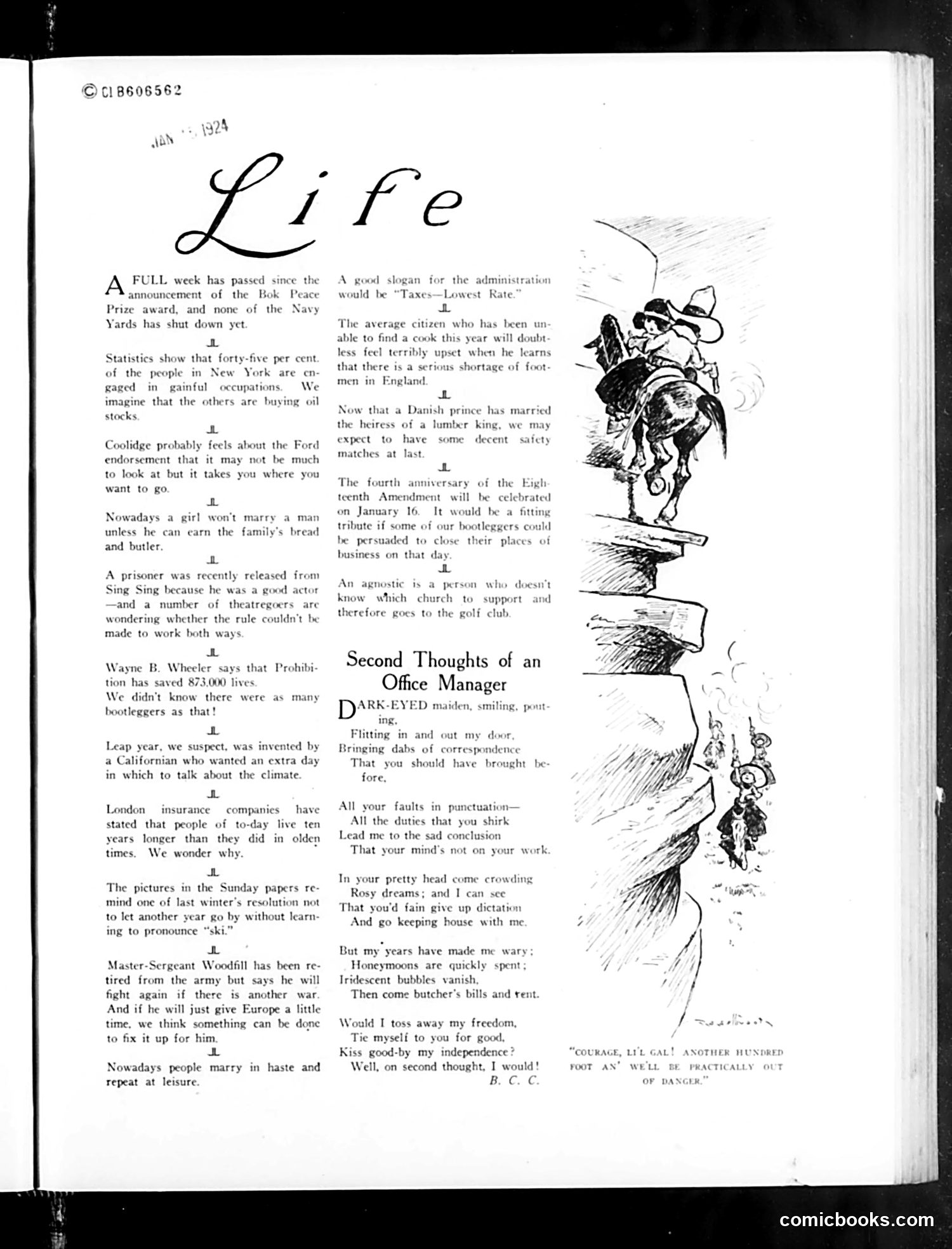
This page contains satirical commentary and a poem titled "Second Thoughts of an Office Manager." The right side features a sketch of a woman on what appears to be a horse or similar mount, jumping over an obstacle, with the caption "COURAGE, LI'L GAL! ANOTHER HUNDRED FOOT AN' WE'LL BE PRACTICALLY OUT OF DANGER." The left column presents brief social commentary on 1920s topics: Prohibition's claimed effectiveness, marriage and employment expectations, shortage of footmen in England, and a Danish royal wedding. The poem criticizes a female office employee, listing her shortcomings (unpunctuality, shirking duties) while the speaker wrestles with temptation to abandon his independence for romance. The overall theme appears to satirize post-WWI gender dynamics and workplace relations, typical of Life's humor during this era.
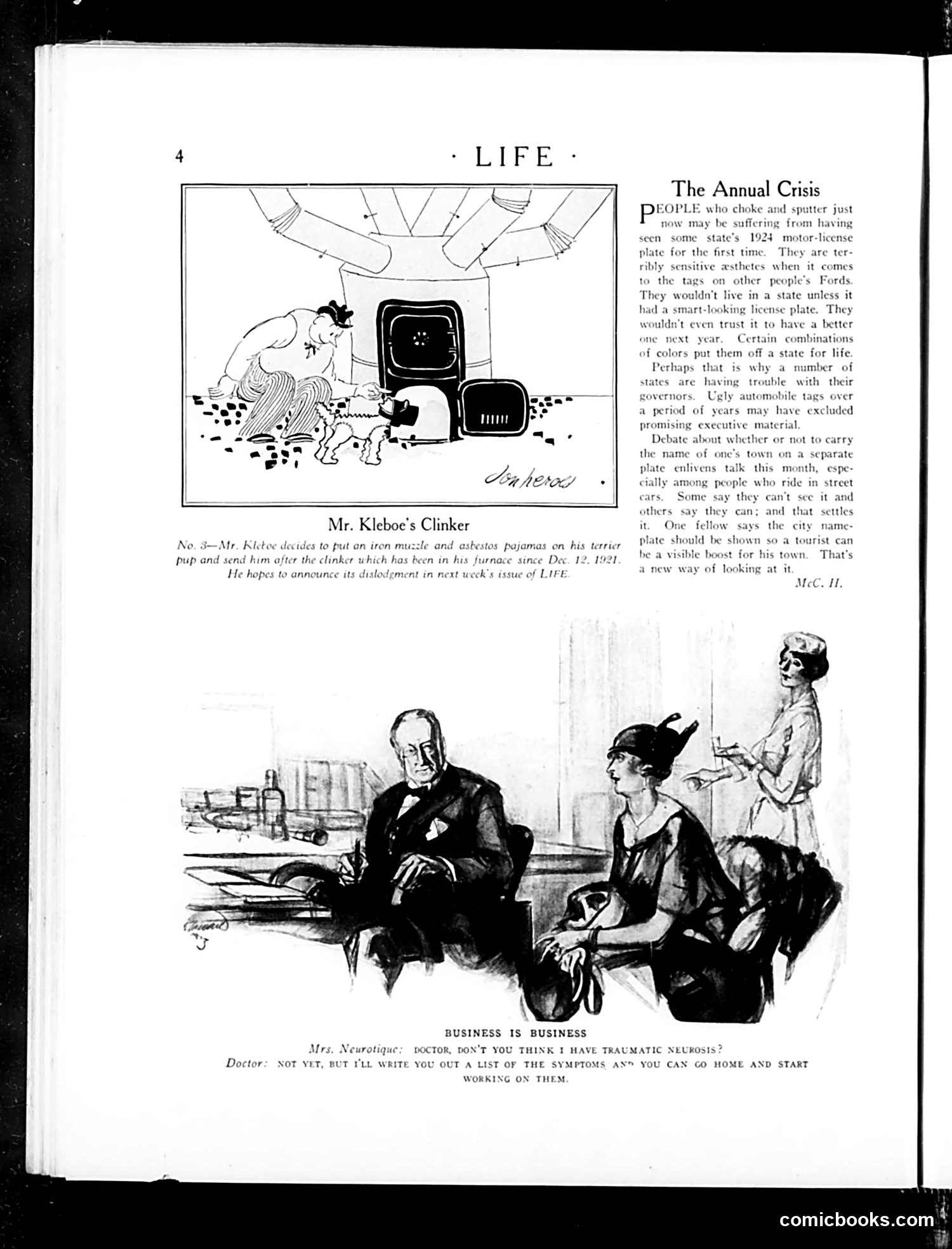
This 1924 *Life* magazine page contains two satirical pieces: **"Mr. Kleboe's Clinker"** (top): A visual joke about a man planning to mail his dog wearing an iron muzzle and pajamas to announce the dog's "disbandment." This appears to be absurdist humor mocking something contemporaneous—likely a personal or social scandal—through an intentionally ridiculous proposed solution. **"Business is Business"** (bottom): A doctor tells a female patient he won't examine her but will write down symptoms so she can "work on them" at home. The satire targets the dismissive treatment of women's health concerns and the profit-driven nature of medical practice, presenting the doctor as more interested in billing than actual care. Both cartoons employ *Life*'s characteristic irreverent humor to critique contemporary social behaviors and professional ethics.
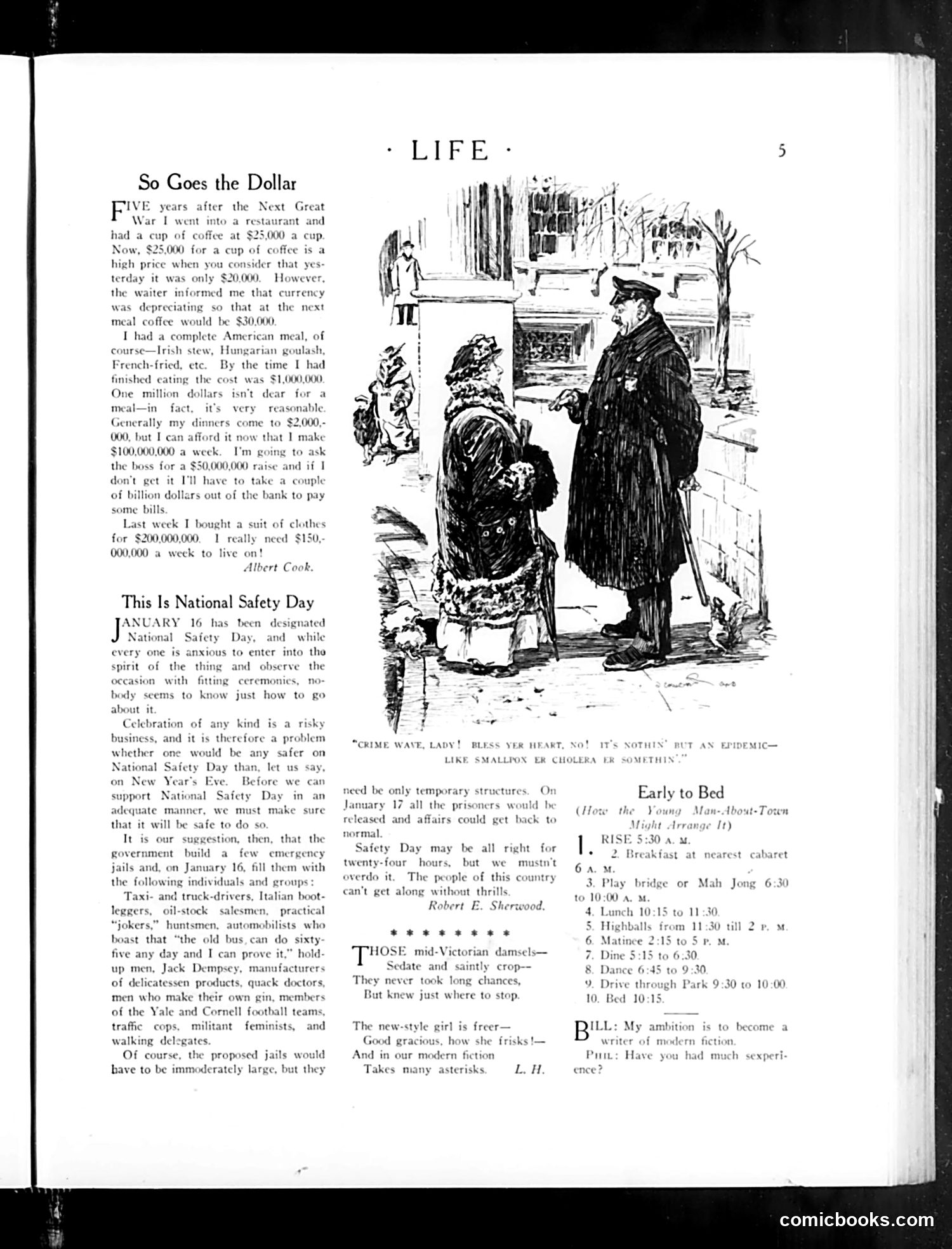
This page contains three satirical pieces about economic hardship, likely from the post-WWI period. **"So Goes the Dollar"** by Albert Cook satirizes inflation through absurdist humor—a cup of coffee costing $25,000, eventually requiring million-dollar meals. It mocks currency depreciation and the impossibility of budgeting. **The main cartoon** depicts a street encounter with the caption "Crime Wave, Lady! Bless yer heart, no! It's nothin' but an epidemic—like smallpox er cholera er somethin'." This appears to reference actual crime waves (possibly during Prohibition), presenting crime as a widespread social disease rather than isolated criminal acts. **"This Is National Safety Day"** proposes tongue-in-cheek solutions for January 16th safety observance—including temporary jails to control dangerous elements (reckless drivers, "quack doctors," football fans, etc.), satirizing society's inability to maintain order.
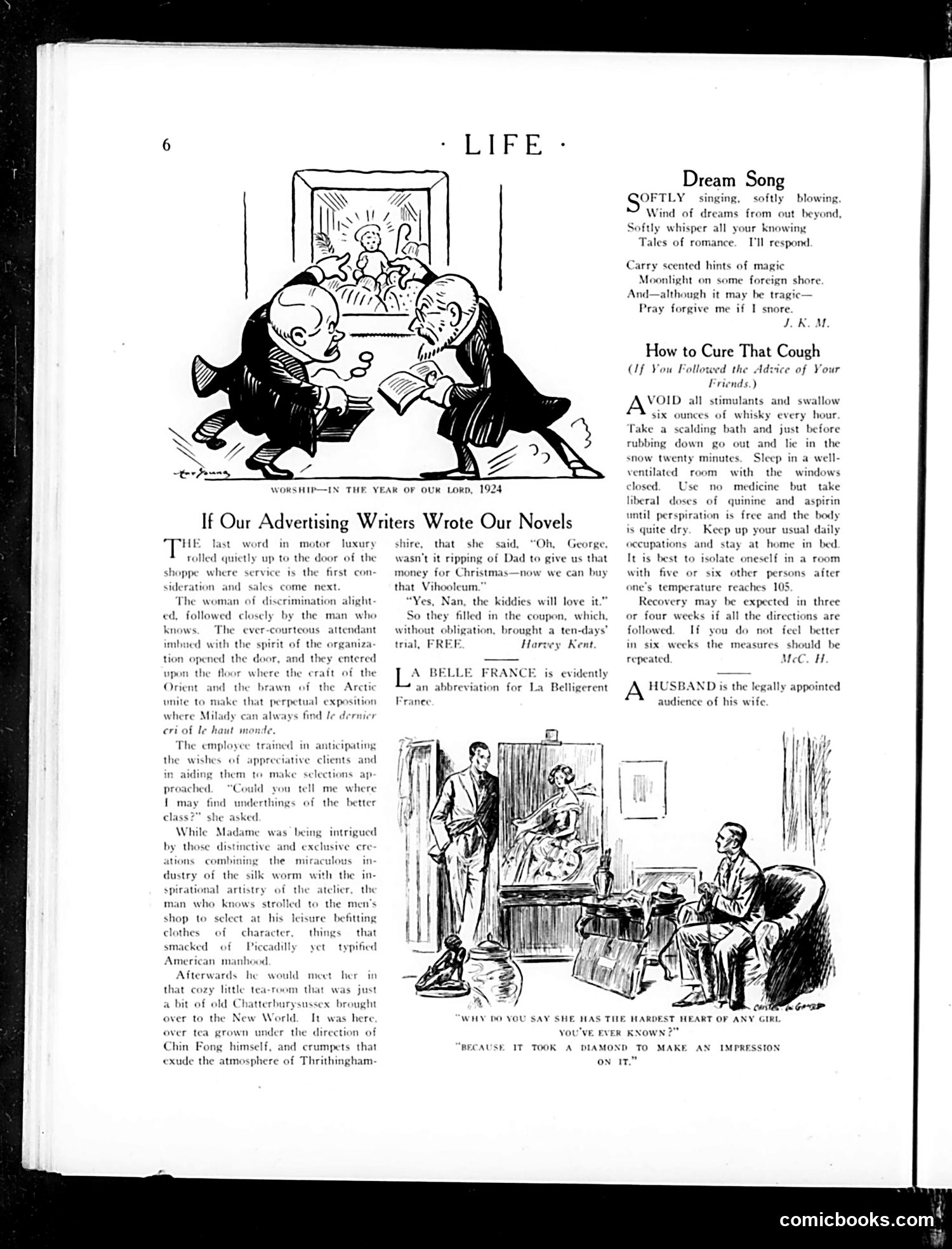
This page contains satirical content mocking advertising and consumer culture. The main article, "If Our Advertising Writers Wrote Our Novels," parodies how advertising language infiltrates literature. It describes a wealthy woman shopping for luxury items—mentioning a motor car, silk, and an expensive "Vitreoloeum"—using exaggerated sales-speak rather than natural dialogue. The accompanying illustration depicts a domestic scene where a husband confronts his wife about her expensive tastes, with the caption suggesting a woman needs "a diamond to make an impression." This satirizes both advertising's appeal to vanity and marital tensions over spending. The page also includes unrelated content: a poem ("Dream Song"), health advice ("How to Cure That Cough"), and a definition of "husband." Overall, it critiques early 20th-century consumer culture and commercial manipulation of language.
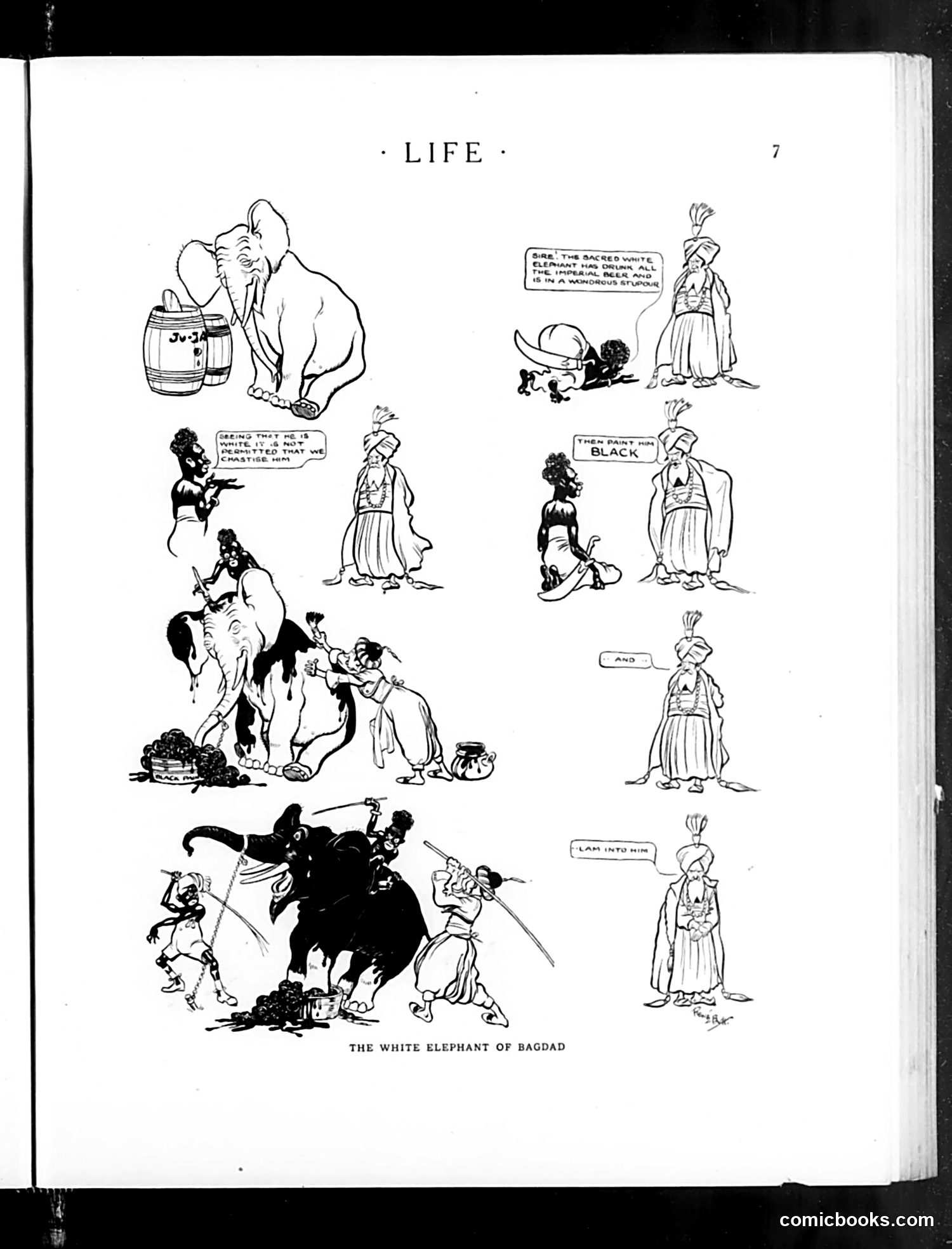
This satirical cartoon series depicts the legendary "white elephant"—a gift so burdensome and costly to maintain that it becomes a curse rather than blessing. The narrative shows a woman (likely representing a nation or government) receiving the white elephant as a gift, then struggling through increasingly chaotic scenes as she attempts to care for it: painting it black to hide its identity, despairing at its upkeep, and finally battling to control it alongside her helpers. The "White Elephant of Bagdad" was a popular metaphor in early 20th-century political satire for unwanted territorial acquisitions or financial obligations. The cartoon likely critiques a specific government expenditure or foreign entanglement that became unexpectedly costly and difficult to manage.
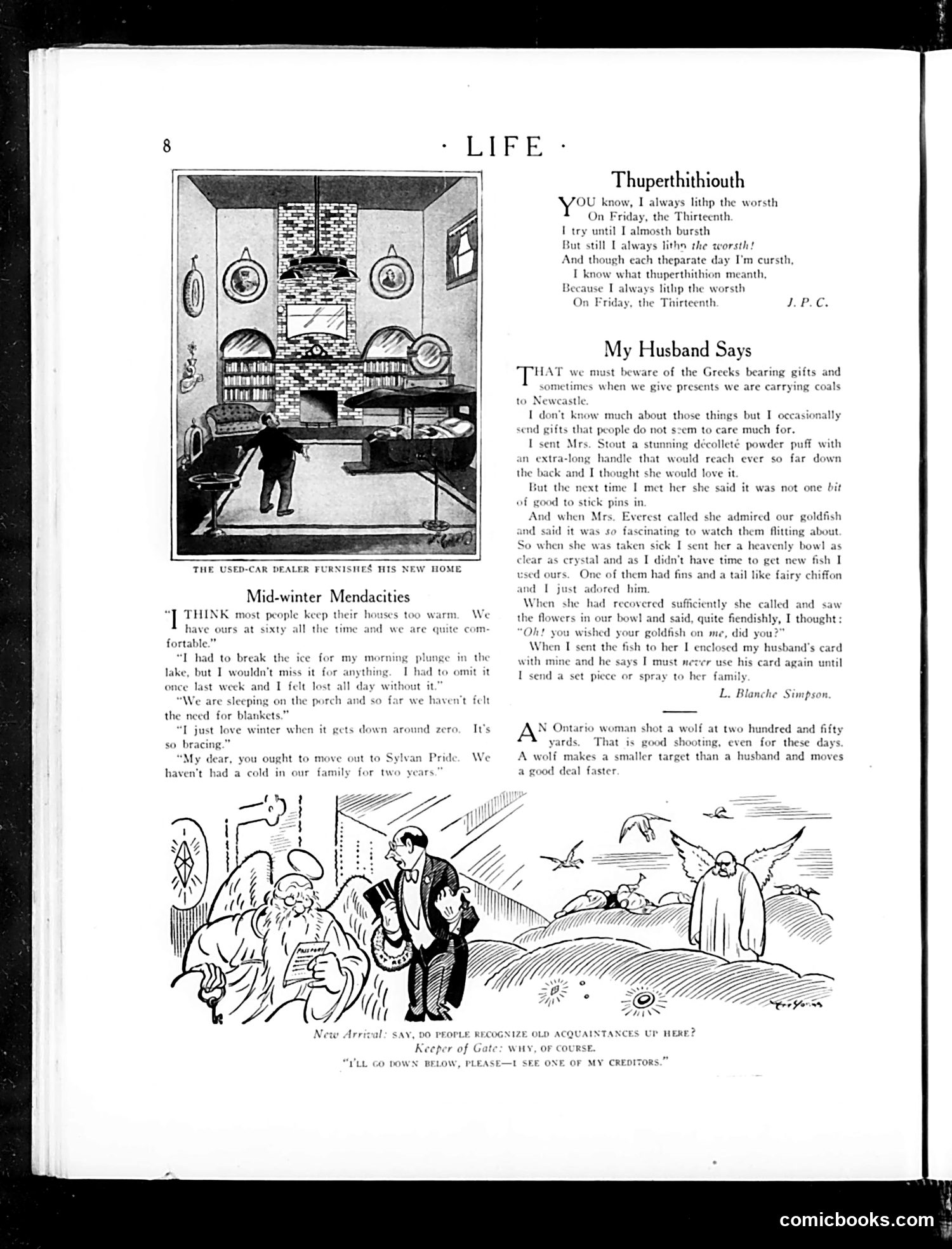
This page contains three satirical pieces: 1. **"The Used-Car Dealer Furnishes His New Home"** — An illustration showing a man in a sparse room with mismatched, low-quality furnishings. The satire targets the used-car dealer profession, implying they were considered disreputable or shifty characters who couldn't afford or didn't deserve nice things. 2. **"My Husband Says"** and **"Mid-winter Mendacities"** — Humorous essays about domestic life, gift-giving etiquette, and keeping houses too warm in winter. 3. **"New Arrival" cartoon** — A heavenly scene where a recently deceased person meets Saint Peter/the Keeper of the Gate. The joke concerns financial debts following death, with the spirit joking about going "down below" to find creditors. The overall tone reflects early-to-mid 20th century American domestic and social satire.
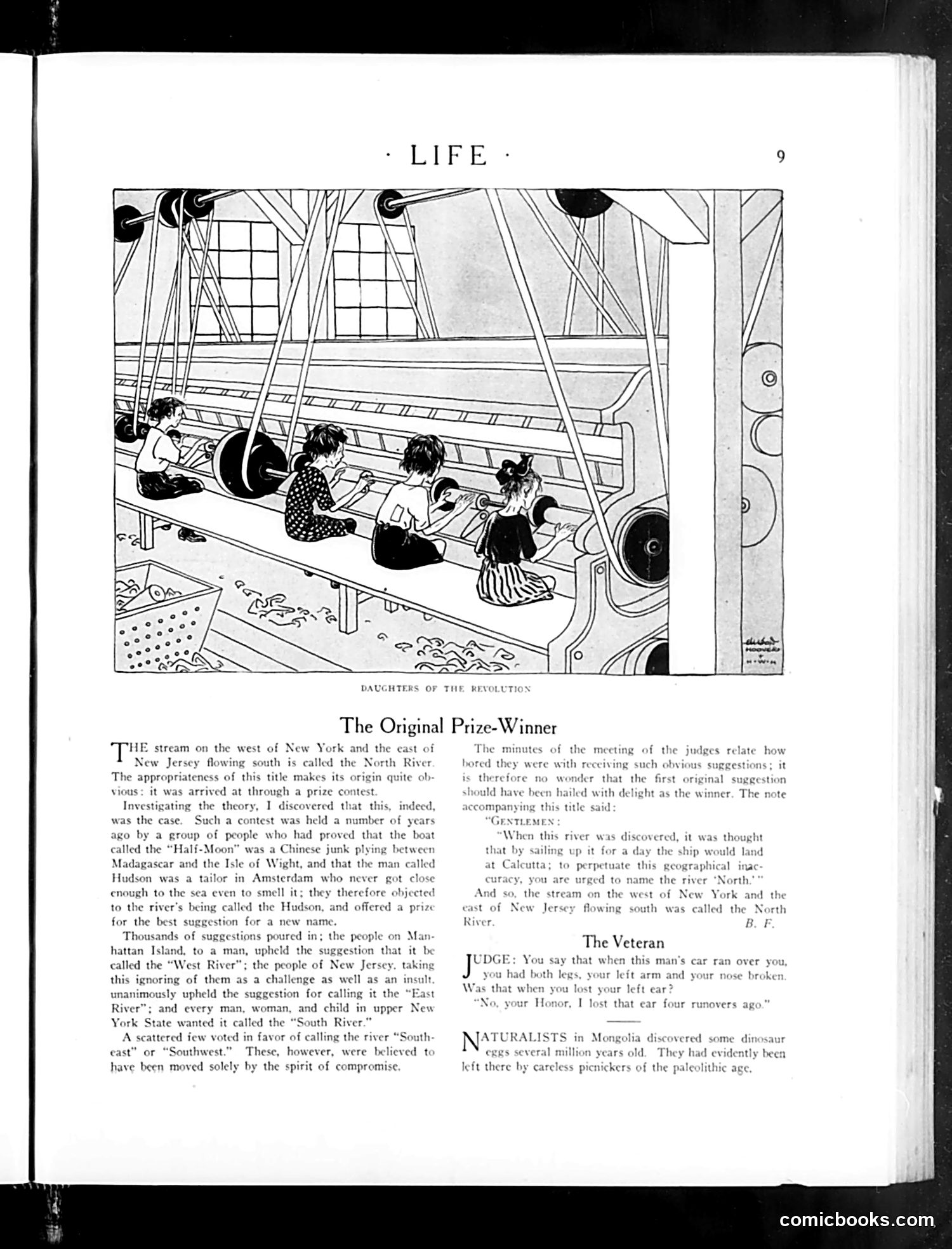
The cartoon titled "Daughters of the Revolution" depicts children sitting in what appears to be a modern, industrial interior space, illustrating a humorous essay below. The text discusses a contest to name the North River (flowing between New York and New Jersey). The essay humorously catalogs various suggested names: "Half-Moon" (referencing a Chinese junk), "Hudson" (after the explorer/a Dutch tailor), and competing proposals like "East River" and "South River." The satire mocks the absurdity of public naming contests and the conflicting claims people make based on historical or personal reasoning. The accompanying sections "The Veteran" and a brief note about "Naturalists in Mongolia" appear unrelated to the main cartoon. The overall point satirizes civic pride, historical competition, and how democratic processes produce ridiculous compromise solutions.
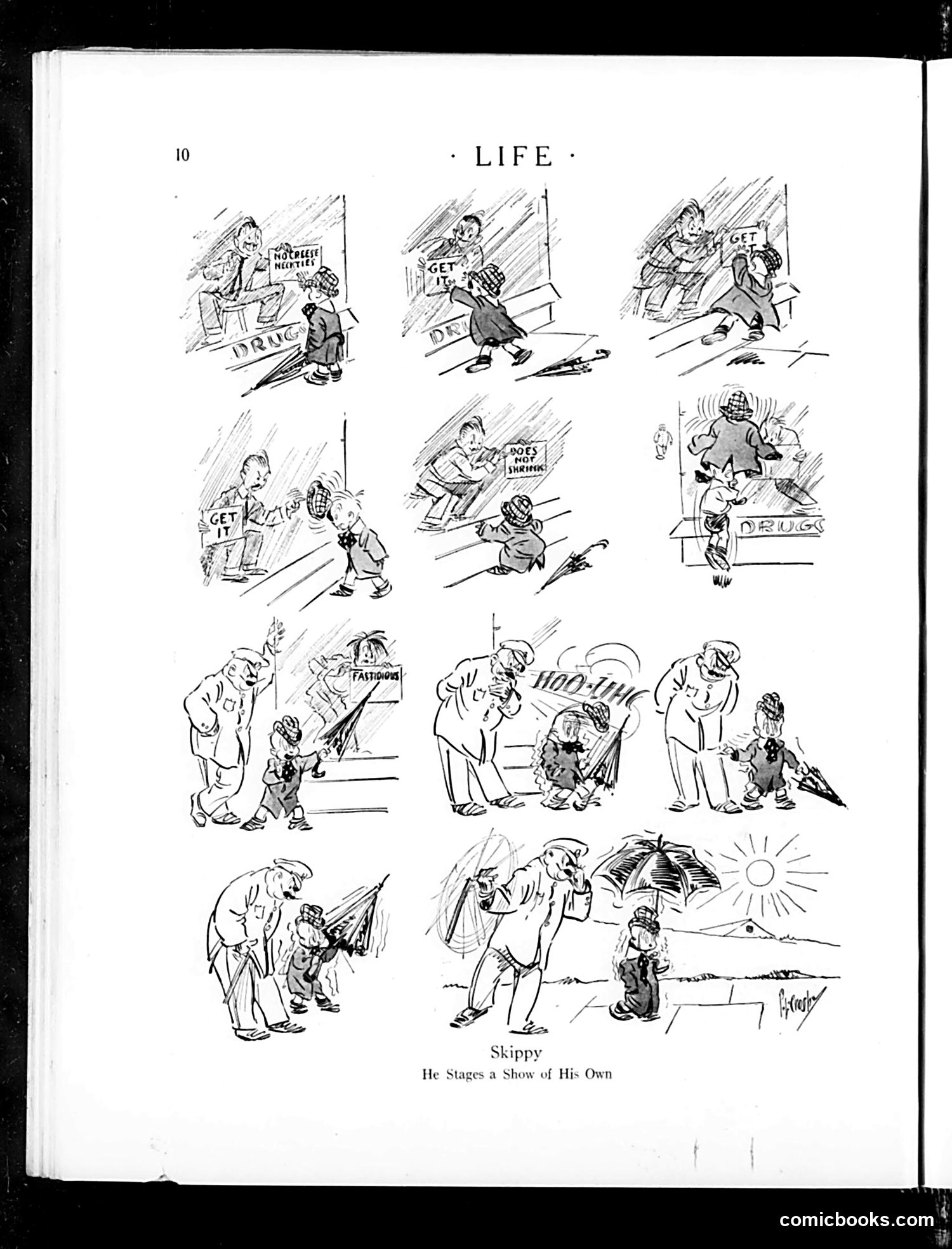
This is a comic strip sequence featuring Skippy, a popular early-20th-century children's character. The strip depicts a young boy attempting various schemes to get drugs or medicines—visible signs read "GET IT," "DRUGS," and "HOO-TIM" (likely a patent medicine). The satire targets the era's widespread availability and aggressive marketing of patent medicines and drugs to children. Each panel shows Skippy trying different con tactics (mimicking an adult, begging, performing) to acquire these substances from druggists, ultimately succeeding through persistent antics. The comic mocks both the ease with which children could access unregulated "medicines" and the questionable products themselves—a serious public health concern of that period that Life magazine frequently satirized.
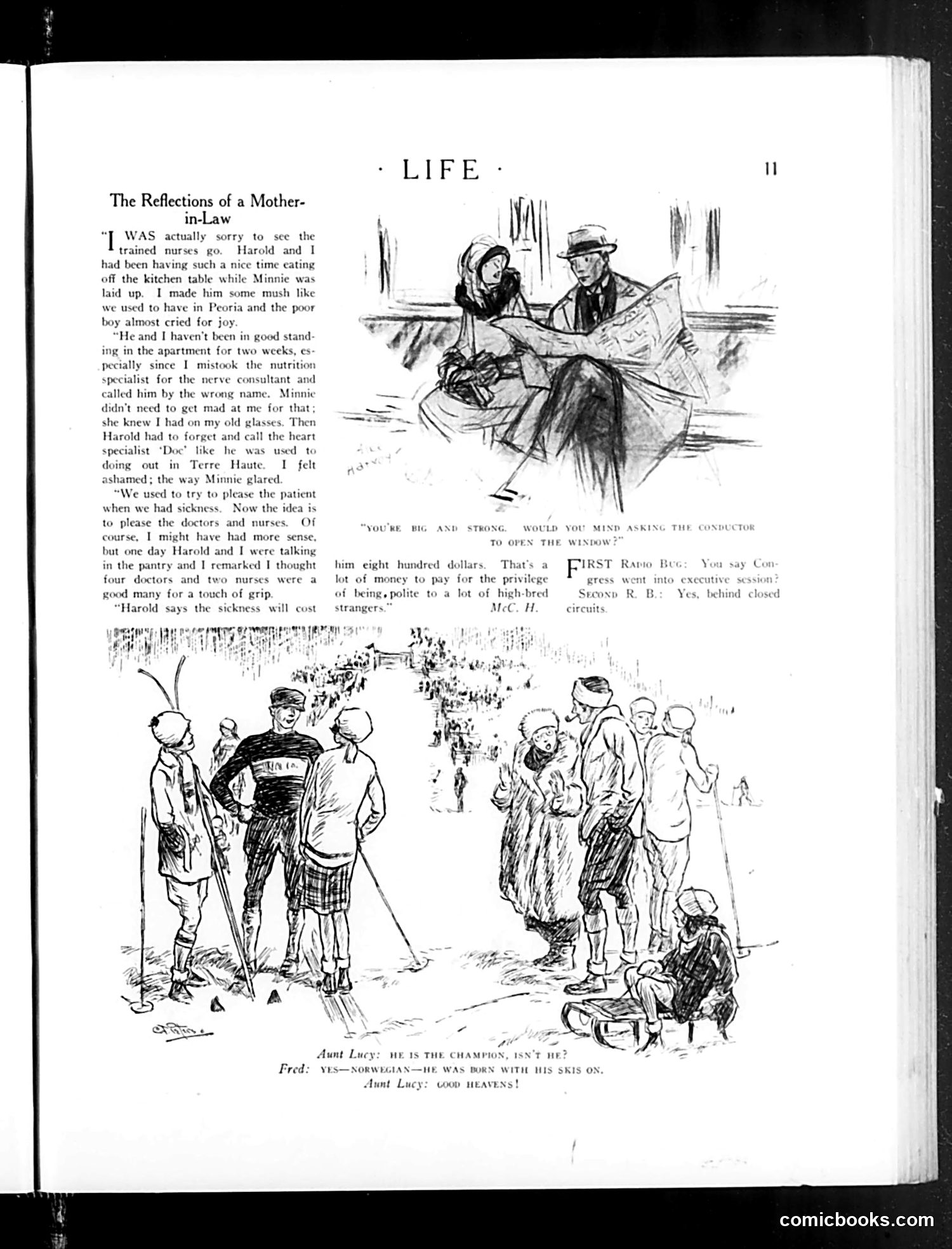
This page contains two satirical cartoons about early 1900s American social life. **Top cartoon**: Shows a couple in a train compartment. The caption references asking a conductor to open a window, satirizing the pretensions of wealthy travelers who demand service. **Bottom cartoon**: Depicts a group gathered around a skier. The dialogue identifies "He is the champion, isn't he?" with the response "Yes—Norwegian—he was born with his skis on," followed by "Good heavens!" This mocks American fascination with European superiority and the growing popularity of skiing as an elite winter sport. The humor targets both the class pretension of ski enthusiasts and the era's tendency to regard European accomplishments as inherently superior to American ones. Both cartoons satirize upper-class mannerisms and social climbing of the Gilded Age period.
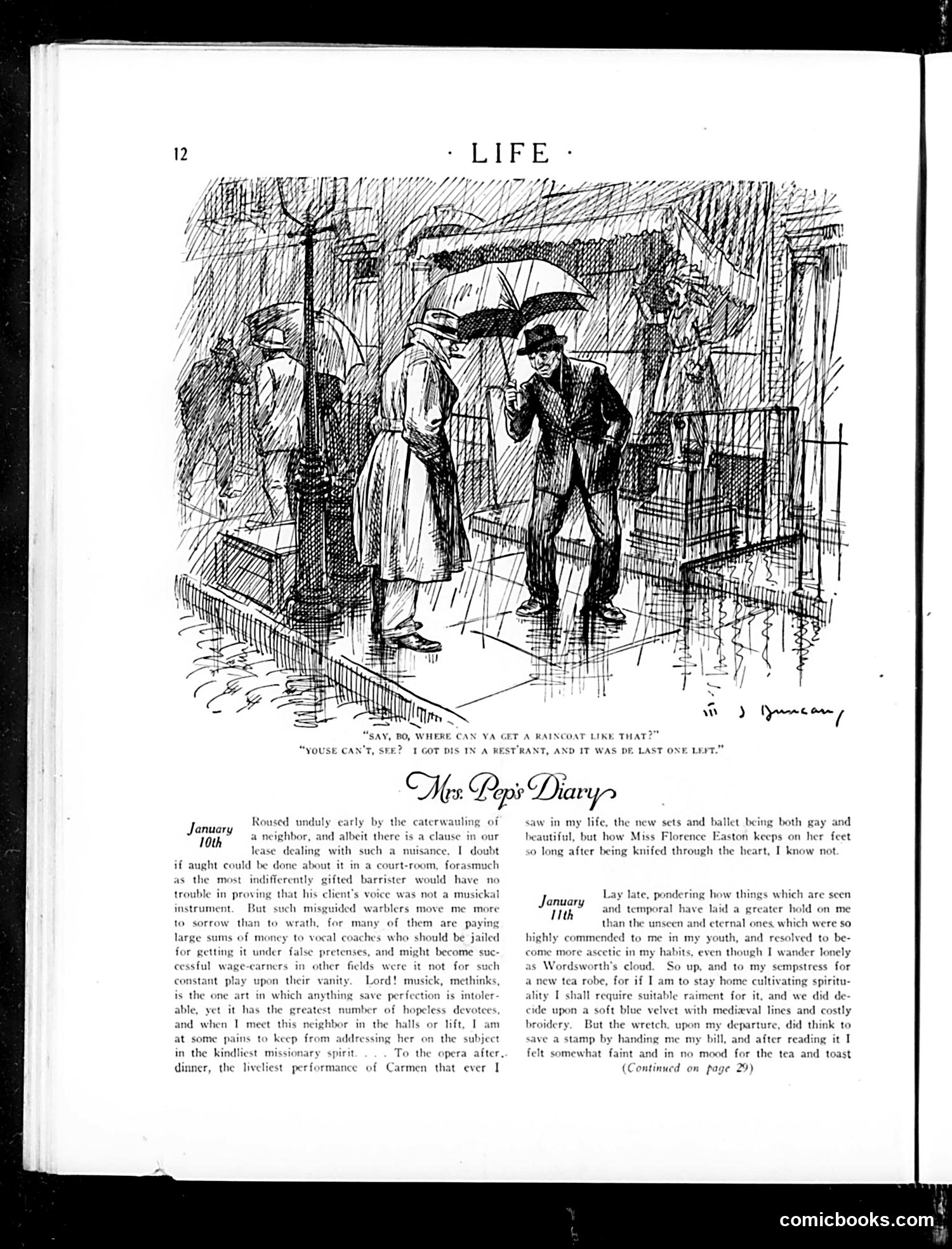
This page contains a satirical cartoon and the beginning of "Mrs. Pep's Diary," a humor column. The cartoon depicts people waiting in the rain outside what appears to be a theater or restaurant. The caption reads: "Say, bo, where can ya get a raincoat like that?" "You can't, see? I got dis in a restaurant, and it was de last one left." **The joke**: Someone has taken a raincoat from a restaurant (likely a coat-check or lost-and-found situation), and in the speaker's exaggerated street dialect, this stolen item has become so desirable that another person wants to know where to get one. The humor relies on the absurdist premise that a restaurant raincoat is somehow fashionable or valuable, and the casual acceptance of petty theft as normal behavior among working-class characters.
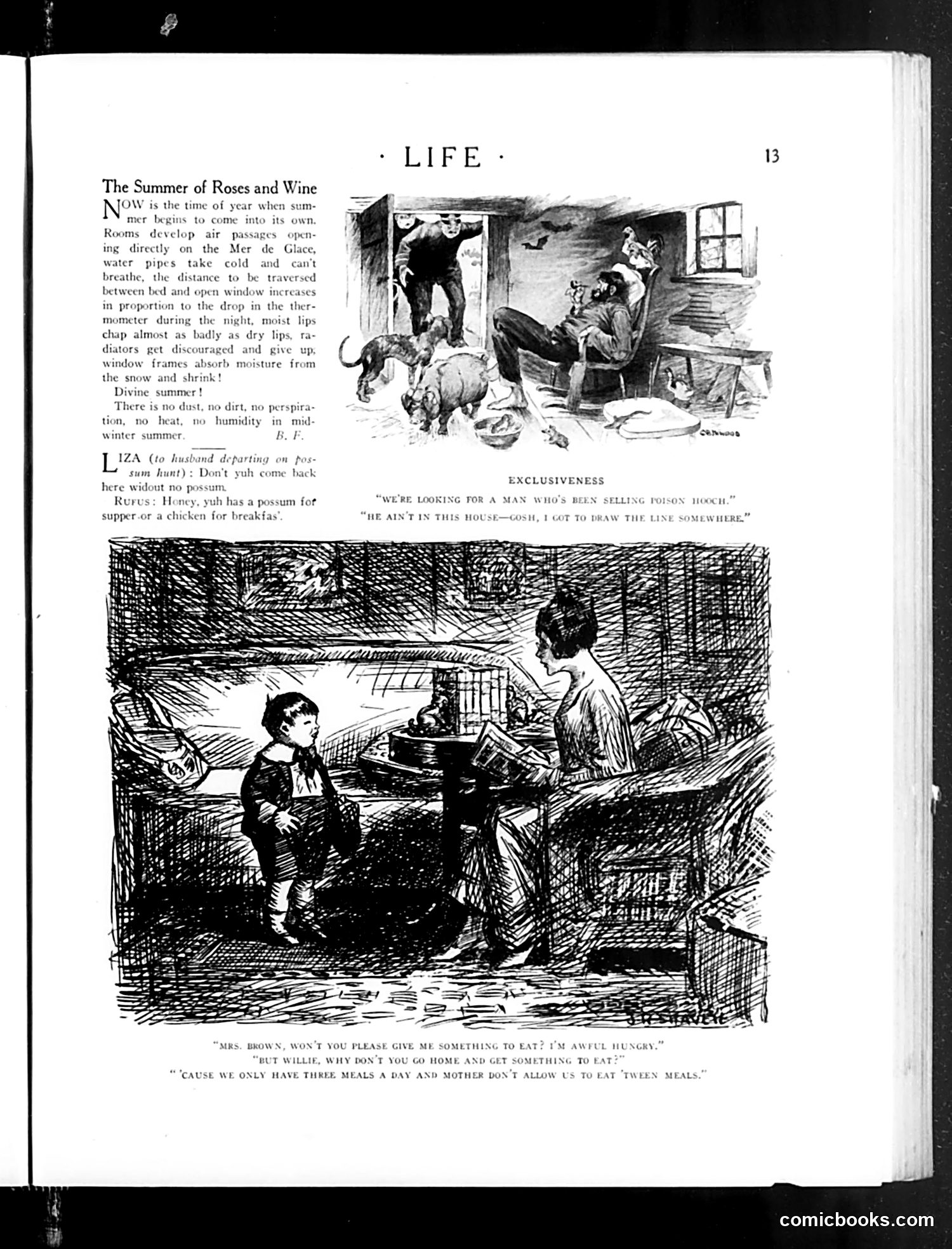
This page contains two satirical illustrations about domestic life and poverty. The upper cartoon depicts a chaotic household where summer heat causes discomfort—lips chap, radiators absorb moisture, and general misery ensues. It illustrates the "divine summer" of the wealthy versus working-class struggles. The lower cartoon shows a hungry child asking Mrs. Brown for food. The child explains he can't eat at home because "we only have three meals a day and mother don't allow us to eat 'tween meals." This satirizes poverty and food scarcity—the child is desperately hungry despite technically having three meals, suggesting those meals are meager or insufficient. The title's ironic reference to "roses and wine" (luxury) contrasts sharply with the grim reality of hungry children, mocking the gap between romanticized summer imagery and working-class hardship.
This page discusses the 1924 U.S. presidential election prospects. The text examines potential Democratic candidates, particularly Mr. McAdoo, who appears to be running on approval of a bonus bill and tariff positions. The article critiques McAdoo as lacking the spiritual heir qualities of Woodrow Wilson—seemingly inheriting Wilson's administrative approach rather than his ideals. The text also mentions President Coolidge's tax reduction program and debates between Republican and Democratic approaches to tariffs and railroad policy. The small cartoon (lower left) shows a figure labeled "Blue Cross Good!" — likely satirizing campaign rhetoric or political posturing during this election cycle, though the specific reference remains unclear without additional context about 1924 campaign imagery.
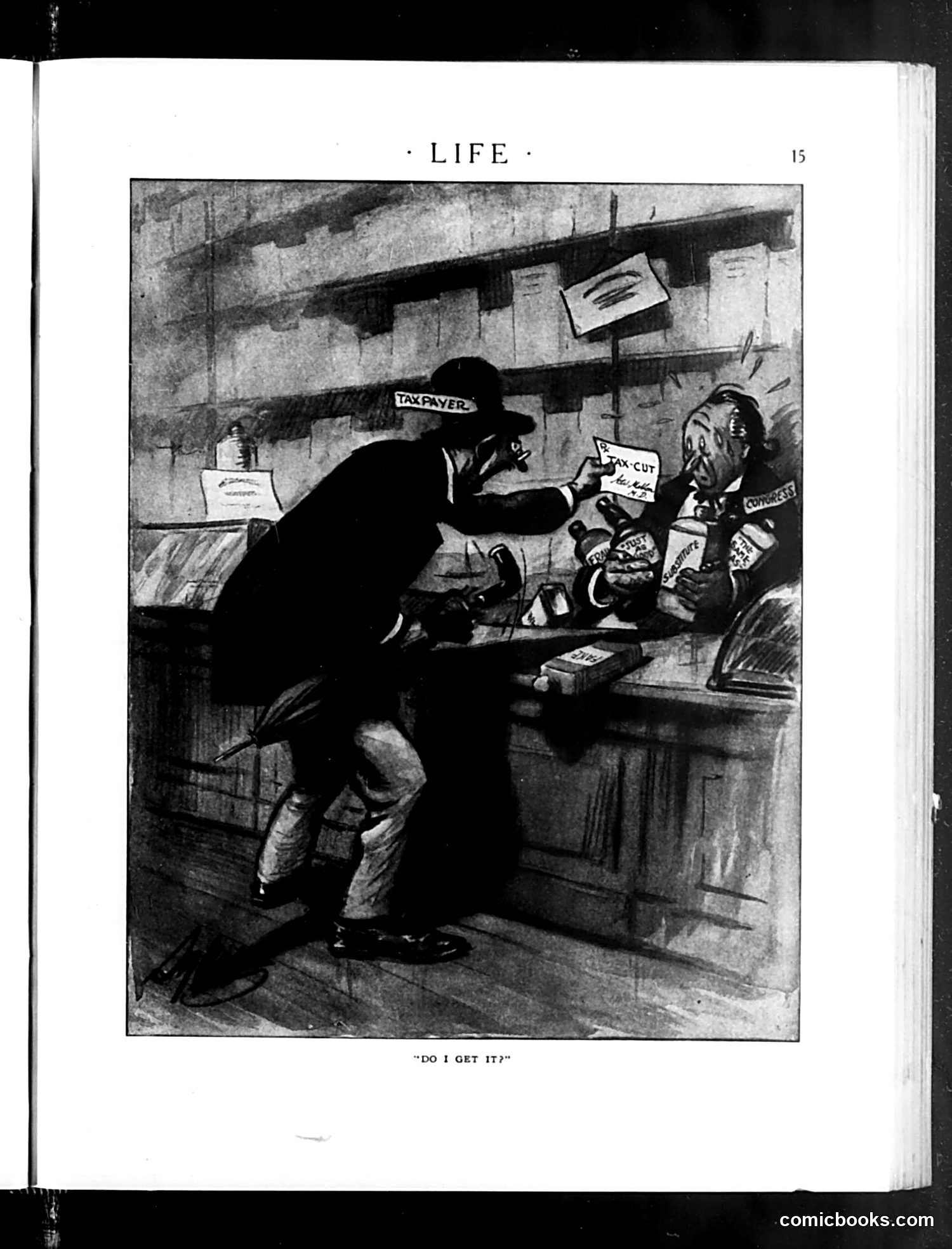
This political cartoon satirizes tax policy debates. A figure labeled "TAXPAYER" (on the left, wearing a hat) confronts what appears to be a government official or bureaucrat across a desk. The official is decorated with medals and insignia, suggesting high rank or authority. The taxpayer presents documents labeled "TAX CUT" while the official holds papers marked "TAX" and "CONGRESS." The cartoon's title "DO I GET IT?" poses the central question: will ordinary citizens actually receive promised tax relief, or will bureaucratic obstruction prevent it? The satire mocks the gap between political promises of tax cuts and their actual implementation—a timeless theme of government inefficiency and the common citizen's frustration with the system.
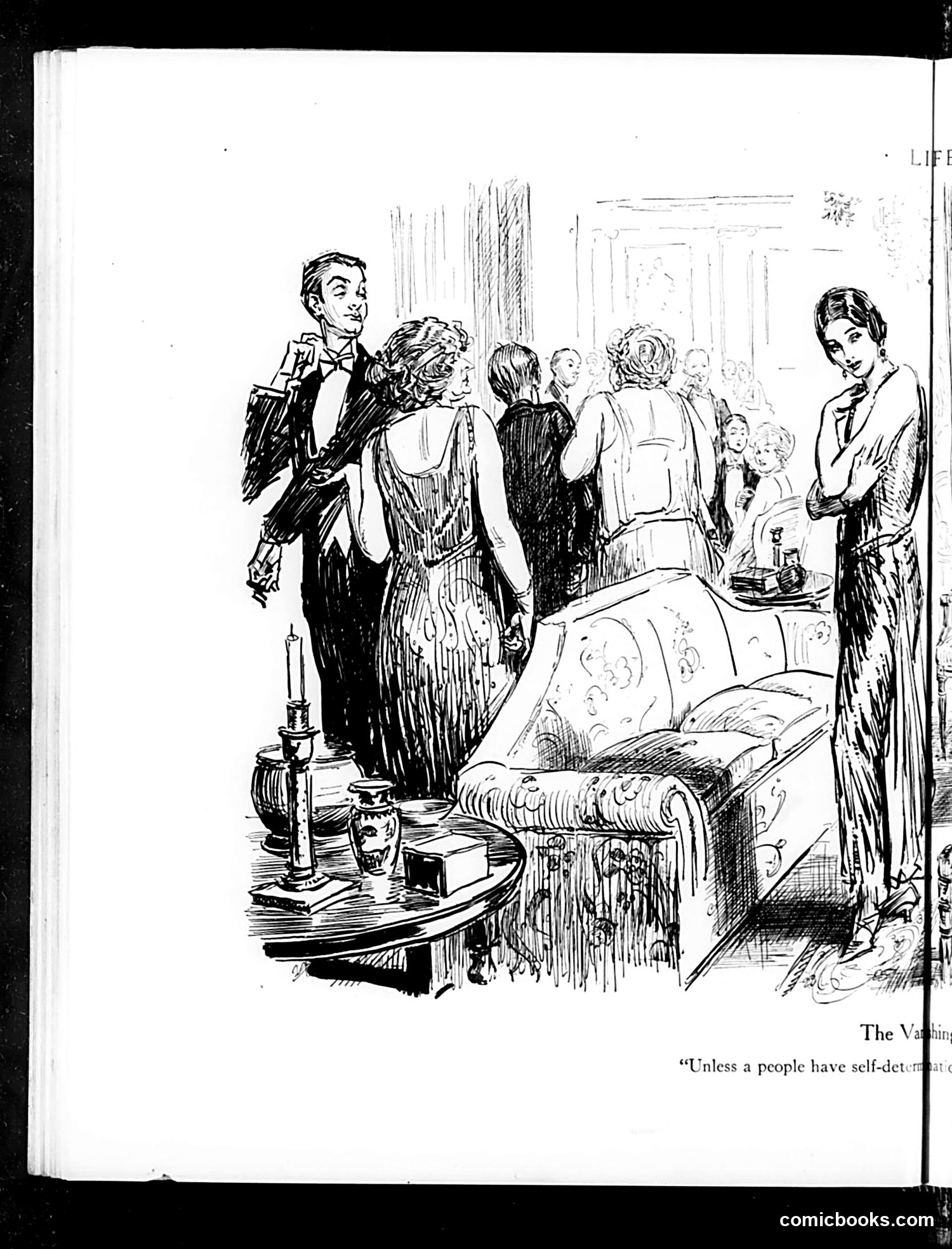
This appears to be a social satire illustration from *Life* magazine depicting an elegant formal gathering or parlor scene. Well-dressed figures in evening wear—men in tuxedos and women in gowns—mingle in what appears to be a wealthy household. A servant or attendant stands on the left near a table with a candelabra. The partial visible quote at bottom—"Unless a people have self-det[ermination]"—suggests this cartoon satirizes upper-class society, likely critiquing wealth, social pretension, or hypocrisy regarding democratic values. The contrast between the quote's serious political message and the frivolous social scene implies irony: these affluent people discussing or embodying democratic ideals while engaged in exclusive, status-conscious socializing. However, without the complete caption or date, the specific political target remains unclear.
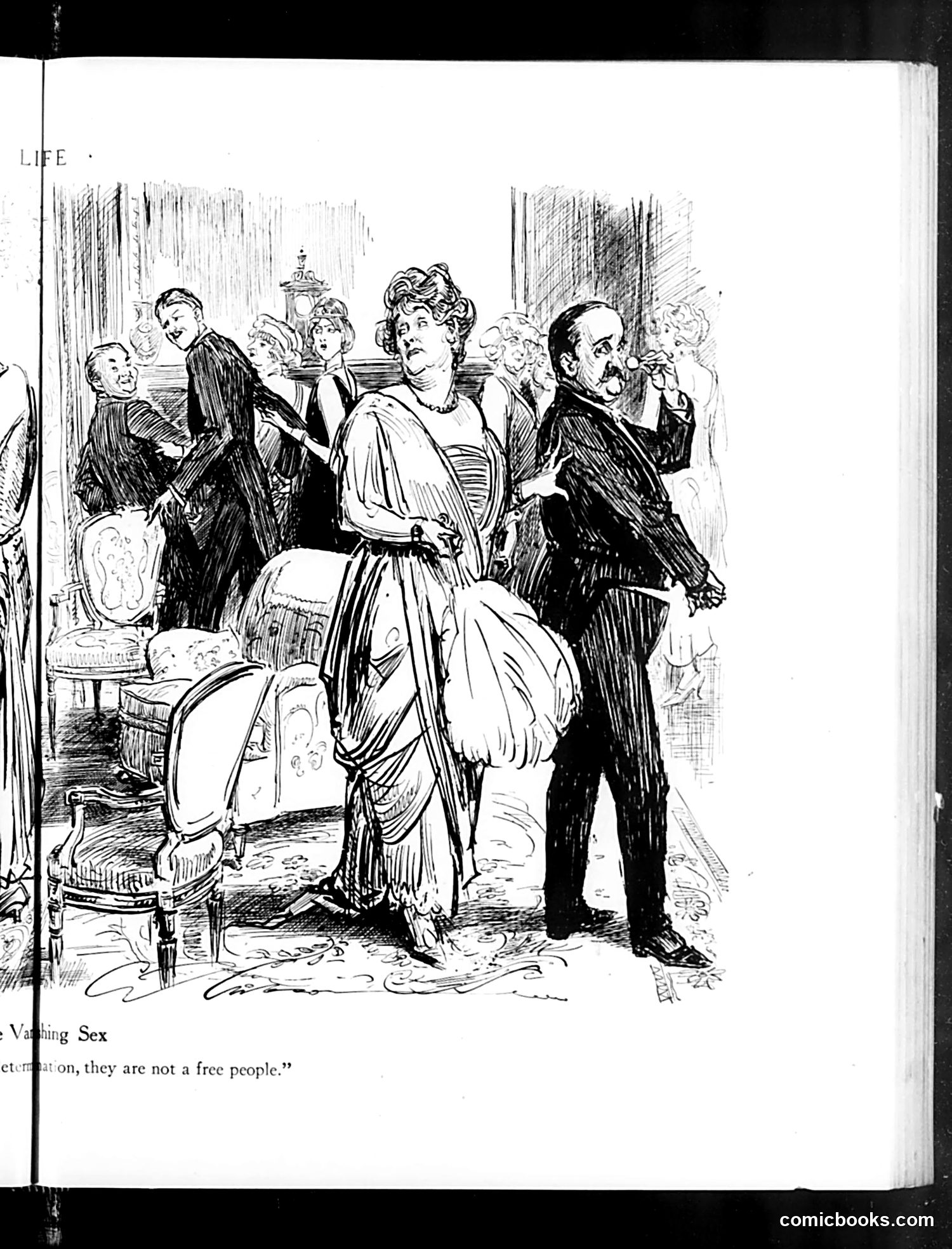
This Life magazine cartoon satirizes women's changing social roles, likely from the early 20th century. The title "The Vanishing Sex" suggests anxiety about traditional femininity disappearing. The scene depicts a formal social gathering where a woman in the center wears relatively plain dress and adopts a masculine posture, while men in dark suits surround her. The accompanying text fragment—"...et: nation, they are not a free people"—suggests commentary on women's liberation or suffrage movements. The satire appears to mock contemporary concerns that women's growing independence and rejection of restrictive feminine conventions represented a loss of traditional womanhood. The "vanishing" refers not to women themselves, but to traditional gender roles that social conservatives feared were disappearing.
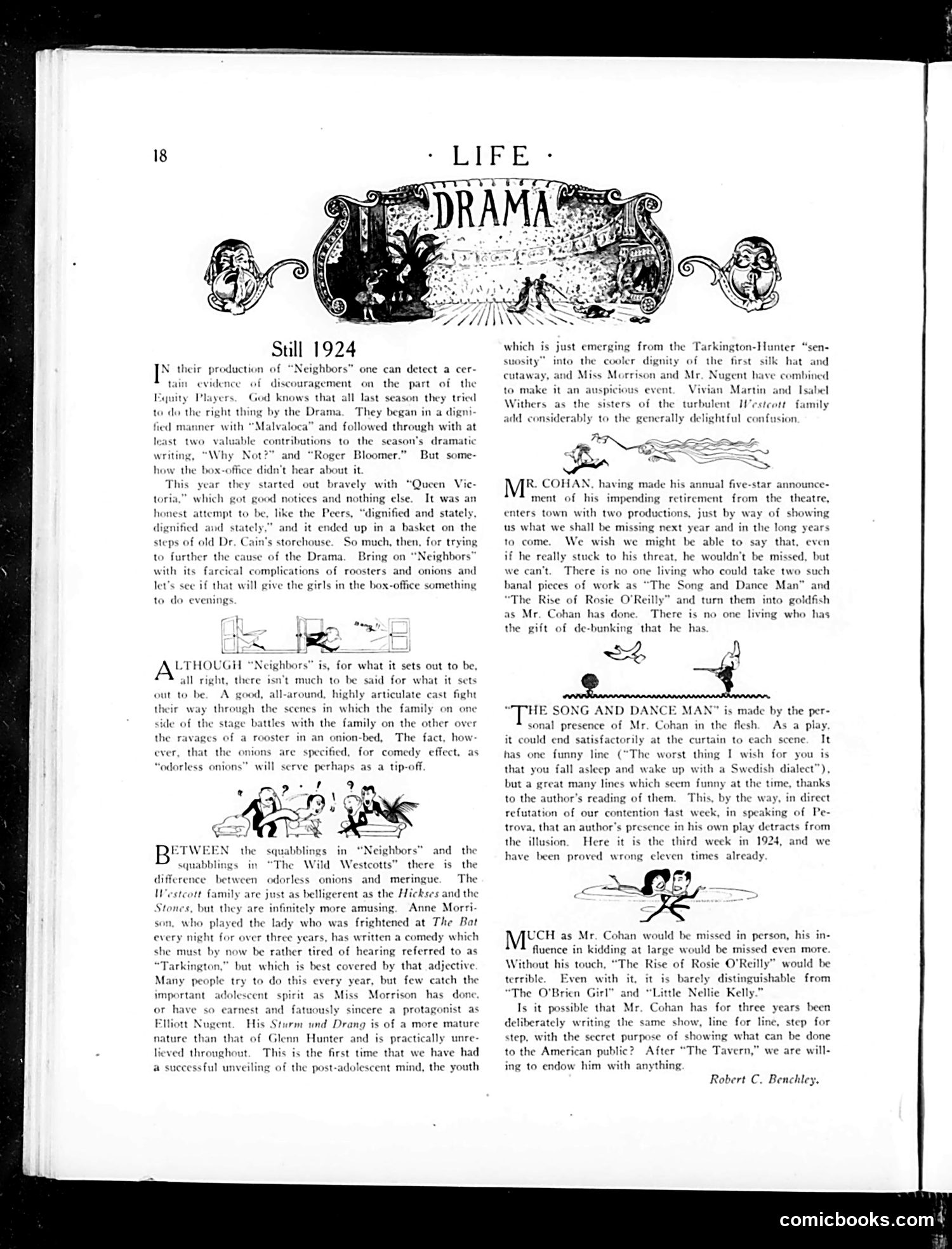
This is a theater criticism page reviewing Broadway productions. The author critiques the Equity Players' season, praising their attempt at serious drama ("Queen Victoria") while noting it failed commercially. He contrasts this with Anne Morrison's comedy "The Wild Westcotts," which successfully captures the "post-adolescent mind"—apparently a Booth Tarkington-influenced coming-of-age sensibility that was fashionable at the time. The review also discusses George M. Cohan's two new productions ("The Song and Dance Man" and "The Rise of Rosie O'Reilly"), crediting Cohan's personal performance talent for elevating otherwise "banal" material. The cartoons appear to be small theatrical vignettes illustrating the reviewed plays' domestic comedy scenarios involving families and farmyard elements (roosters, onions).
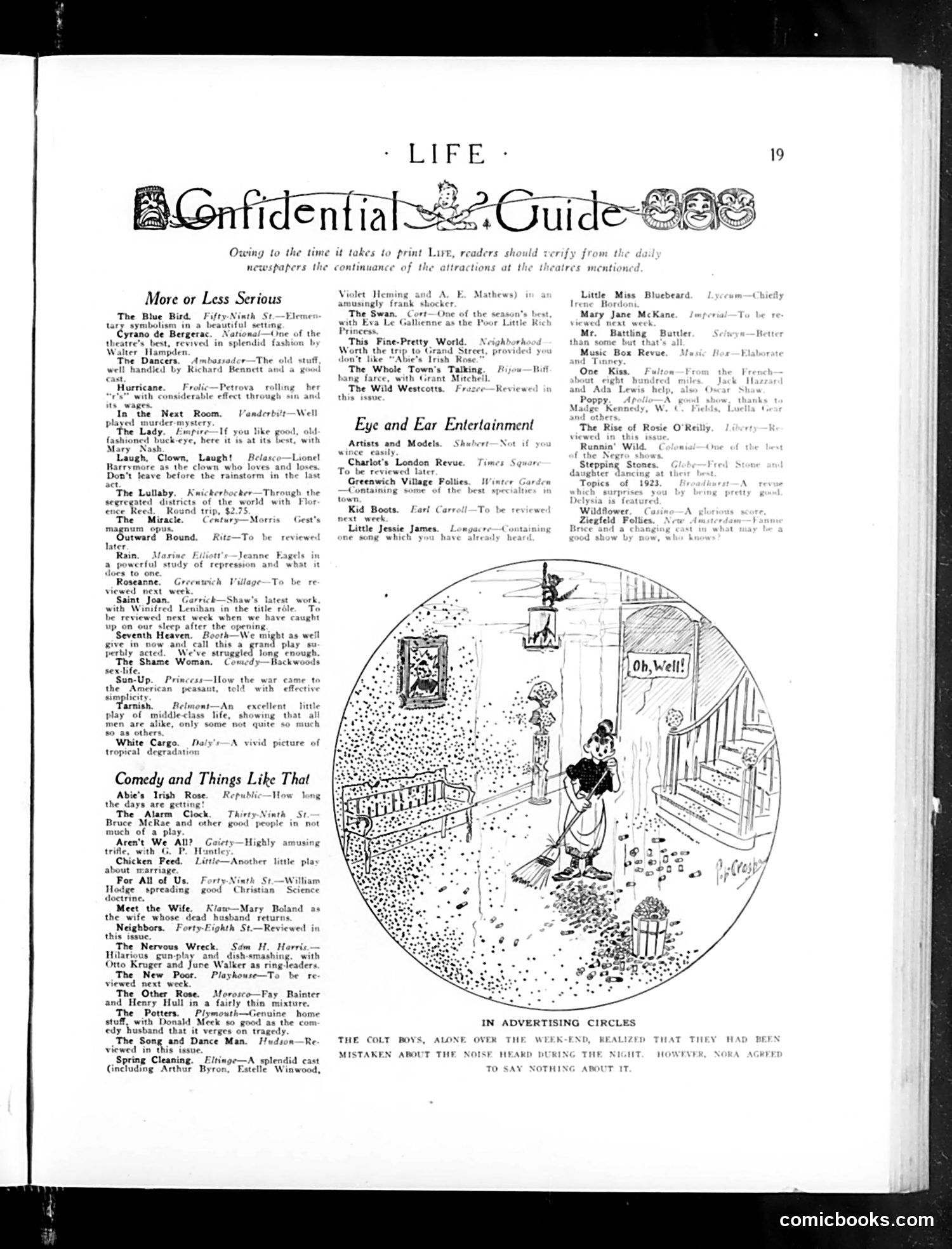
This page is primarily a **theater review and entertainment listing** for Life magazine's "Confidential Guide" section, not a political cartoon. The main content comprises: - **Theater reviews**: Brief critical assessments of Broadway shows ("Cyrano de Bergerac," "Abie's Irish Rose," "The Blue Bird," etc.), typical of entertainment journalism from this era. - **The cartoon**: A small circular illustration showing a woman sweeping up scattered items in a room while exclaiming "Oh, well!" It accompanies a caption in "Advertising Circles" about the "Colt Boys" mistaking noise heard overnight—likely an advertisement or humorous anecdote about a commercial product. The page reflects 1920s theater culture and advertising practices. Without clearer context on the "Colt Boys" reference or product advertised, the specific joke remains unclear, though it appears to be a lighthearted domestic scene meant to humorously promote something to readers.
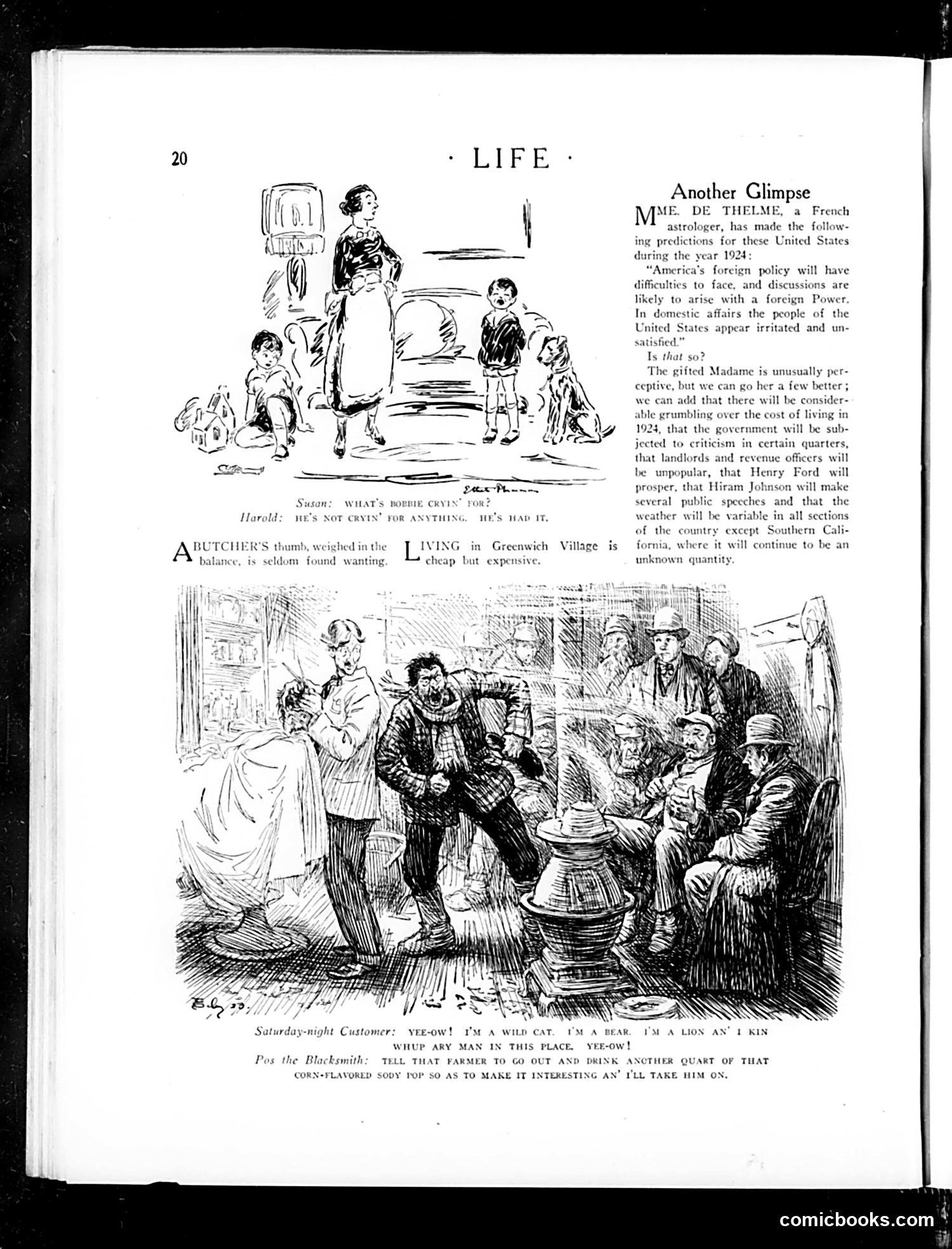
This 1924 Life page contains social satire across multiple cartoons: **Top cartoon**: A mother with children asks "What's Boerie cryin' for?" The boy Harold responds he's "not cryin' for anything, he's mad it"—a joke about childhood tantrum logic. **Middle section**: "Another Glimpse" satirizes French astrologer Mme. de Thelme's 1924 predictions for America. Life responds mockingly with their own "predictions": government criticism, unpopular landlords/tax collectors, Henry Ford's continued success, variable weather everywhere except perpetually sunny Southern California. This mocks both fortune-telling pretension and American social grievances of the early 1920s (cost of living complaints, anti-government sentiment). **Bottom cartoon**: A saloon scene where a drunk customer boasts he can "whup any man" after consuming corn-flavored soda pop. The blacksmith sarcastically suggests giving him another quart to make fighting him "interesting." This satirizes Prohibition-era absurdities—citizens drinking cheap soda substitutes for alcohol. All cartoons target post-WWI American society's anxieties and peculiarities.
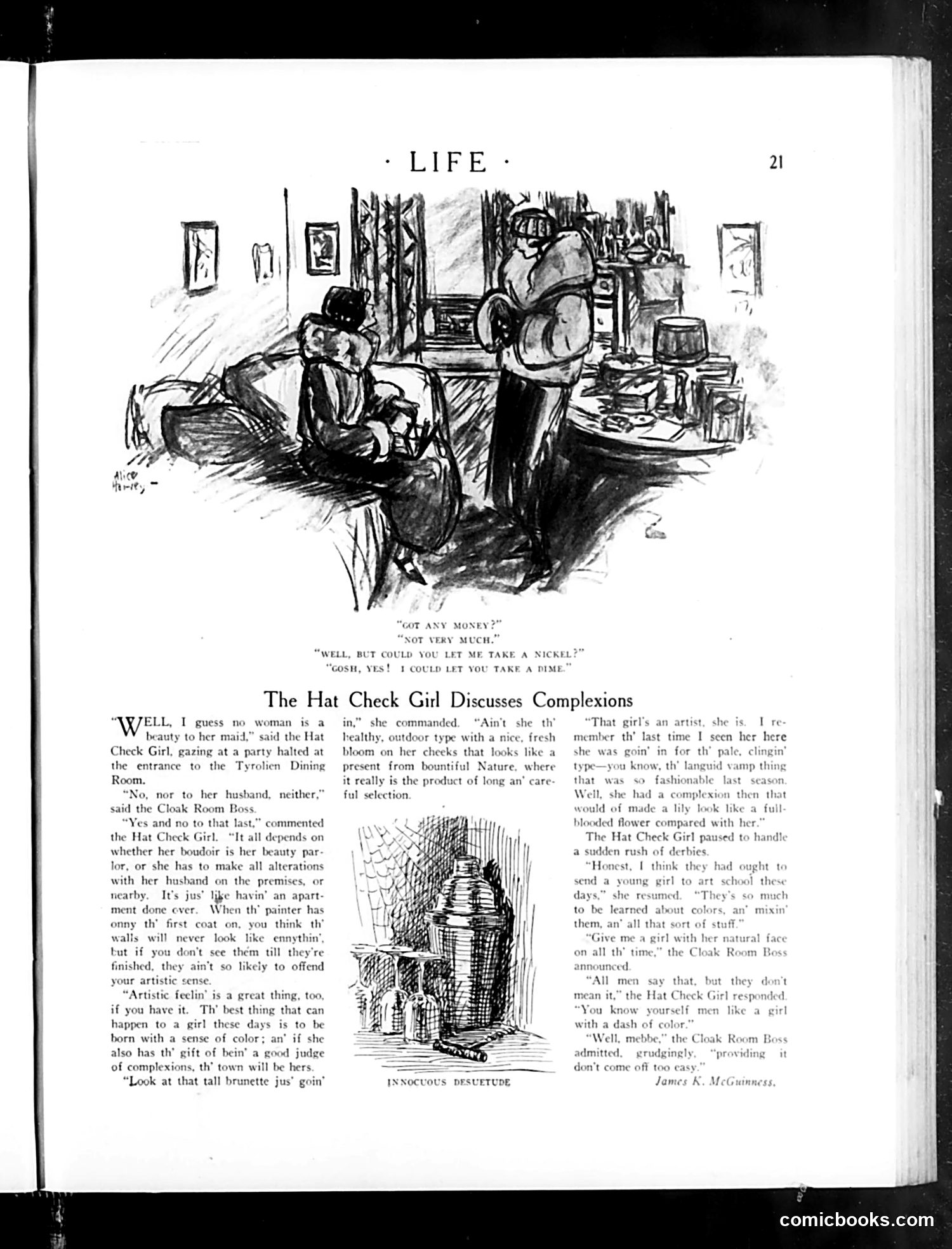
This page from *Life* magazine presents two satirical pieces about women's appearance and social hierarchies in the early 20th century. **The top cartoon** shows a comedic exchange about money between what appears to be working-class characters—likely a hat-check girl and patron negotiating small change (nickels and dimes). **The main article**, "The Hat Check Girl Discusses Complexions," uses working-class female characters (a hat-check girl and cloak-room boss) as social commentators. They gossip about wealthy women's appearances, noting the irony that fashionable women rely entirely on cosmetics and artificial beauty aids, while naturally healthy-looking women possess genuine attractiveness. The satire mocks both the vanity of wealthy women and the idea that true beauty requires constant artificial maintenance—a commentary on cosmetics culture and class differences in how women presented themselves. The working-class speakers position themselves as shrewd judges of authentic versus manufactured femininity.
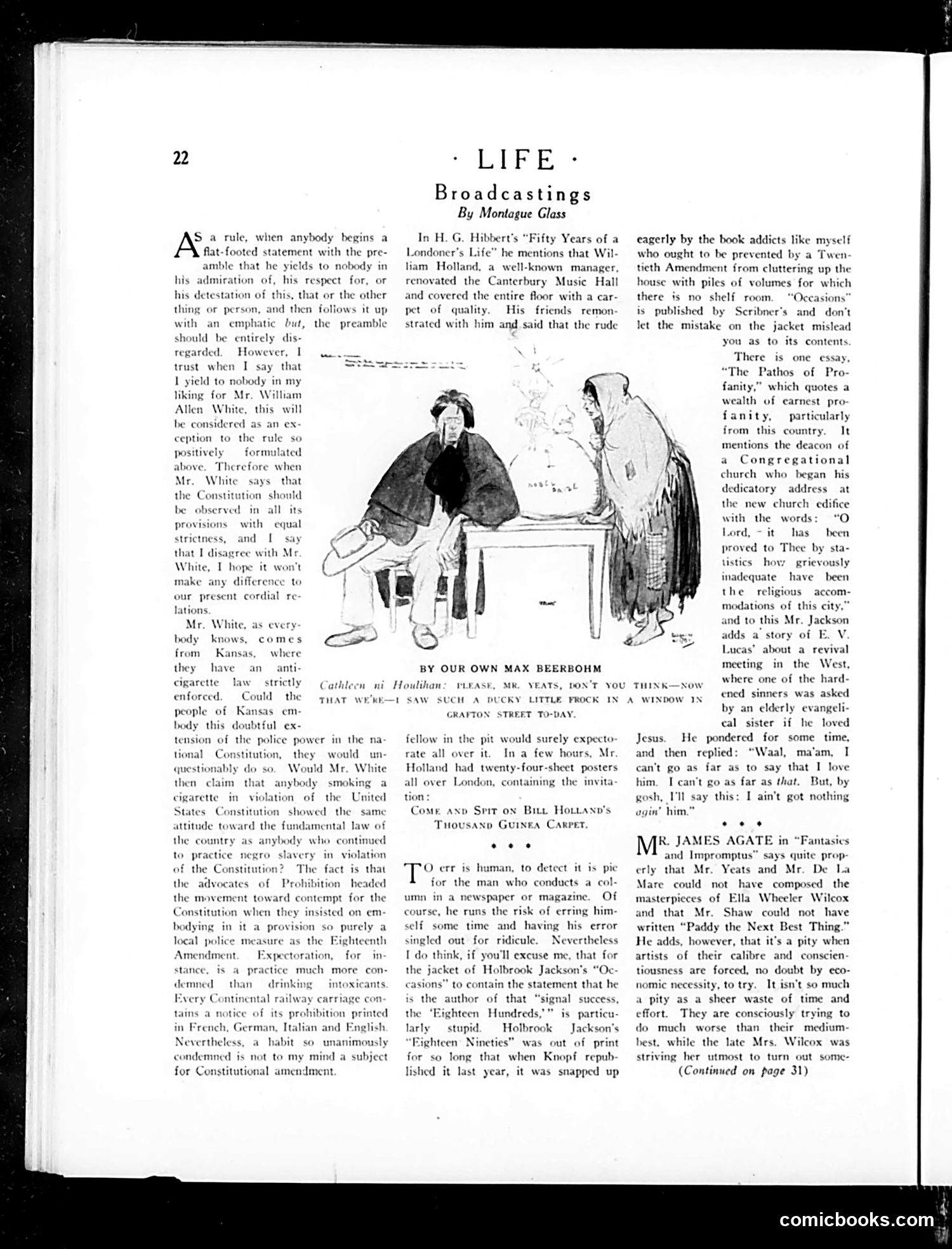
This page contains satirical commentary on American politics and society circa the 1920s. The main article disputes William Allen White's strict Constitutional interpretation, specifically regarding Kansas's anti-cigarette law. The author argues that if we enforce minor police-power provisions like cigarette prohibition through Constitutional amendment, we should have done the same regarding slavery—exposing the hypocrisy of Prohibition advocates who damaged respect for the Constitution itself. The cartoon by Max Beerbohm (credited as "Our Own") depicts a woman admiring another's dress on Grafton Street, a Dublin shopping area. This appears to be humorous social commentary on women's fashion obsession. The "Broadcastings" column discusses publishing errors and literary merit, mentioning Holbrook Jackson's works and Ella Wheeler Wilcox. The overall tone is witty critique of Constitutional inconsistency and cultural pretension.
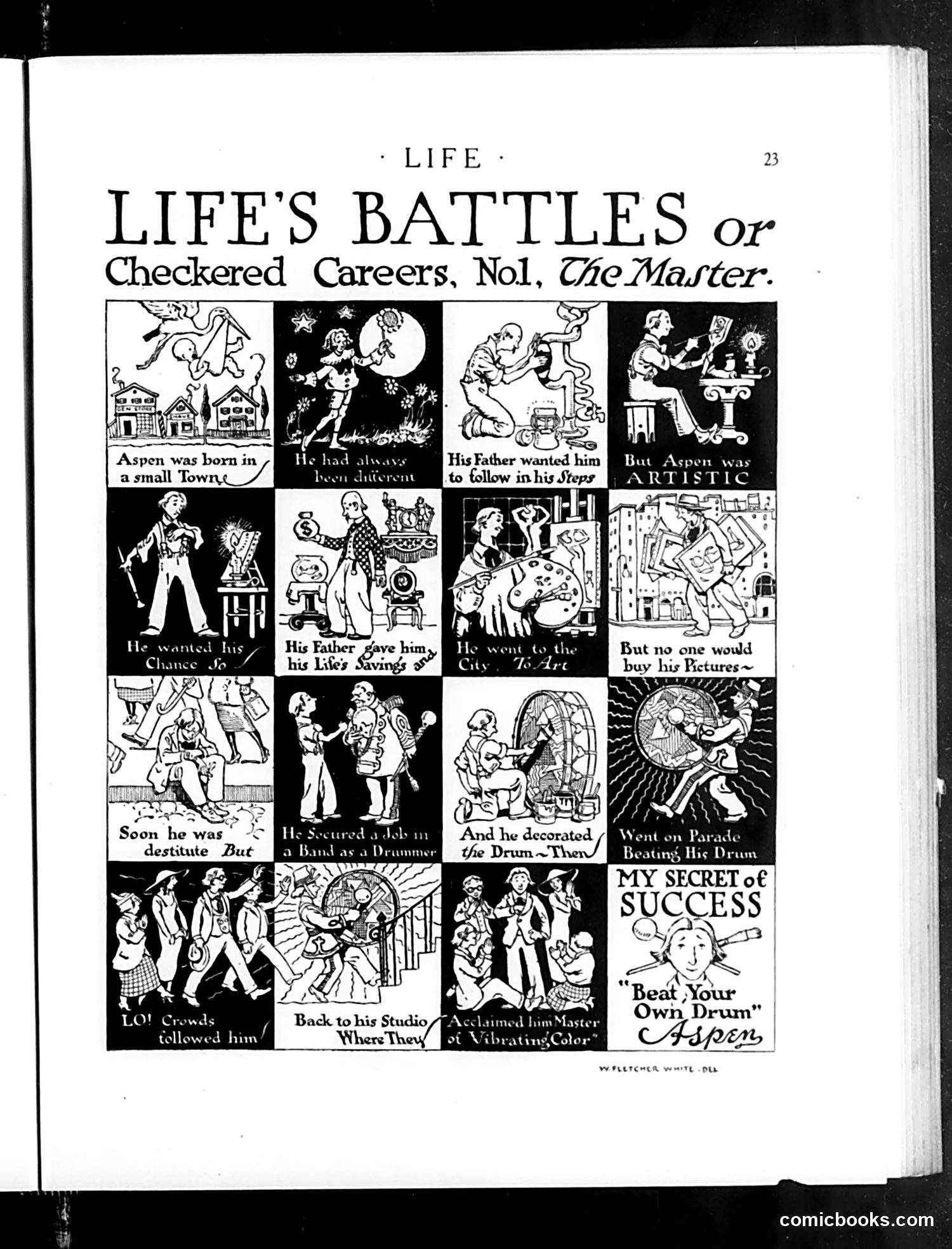
This is a satirical comic strip about a character named Aspen whose life follows a checkered path. Born in a small town, he's naturally artistic despite his father wanting him to follow traditional steps. The strip traces his journey: he seeks his "Chance to" pursue art, becomes destitute, joins a band as a drummer, performs in parades, decorates with "vibrating color," gains crowd following, and eventually returns to his studio where he's "Acclaimed him Master of Vibrating Color." The satire mocks the struggling artist archetype—the romantic notion of the poor but dedicated artist who ultimately achieves success through persistence and individualism. The punchline, "My Secret of Success: 'Beat Your Own Drum,'" plays on this theme: Aspen literally beats a drum but figuratively succeeds by following his own artistic path despite hardship and parental disapproval. It's gentle satire of artistic ambition and nonconformity in early 20th-century America.
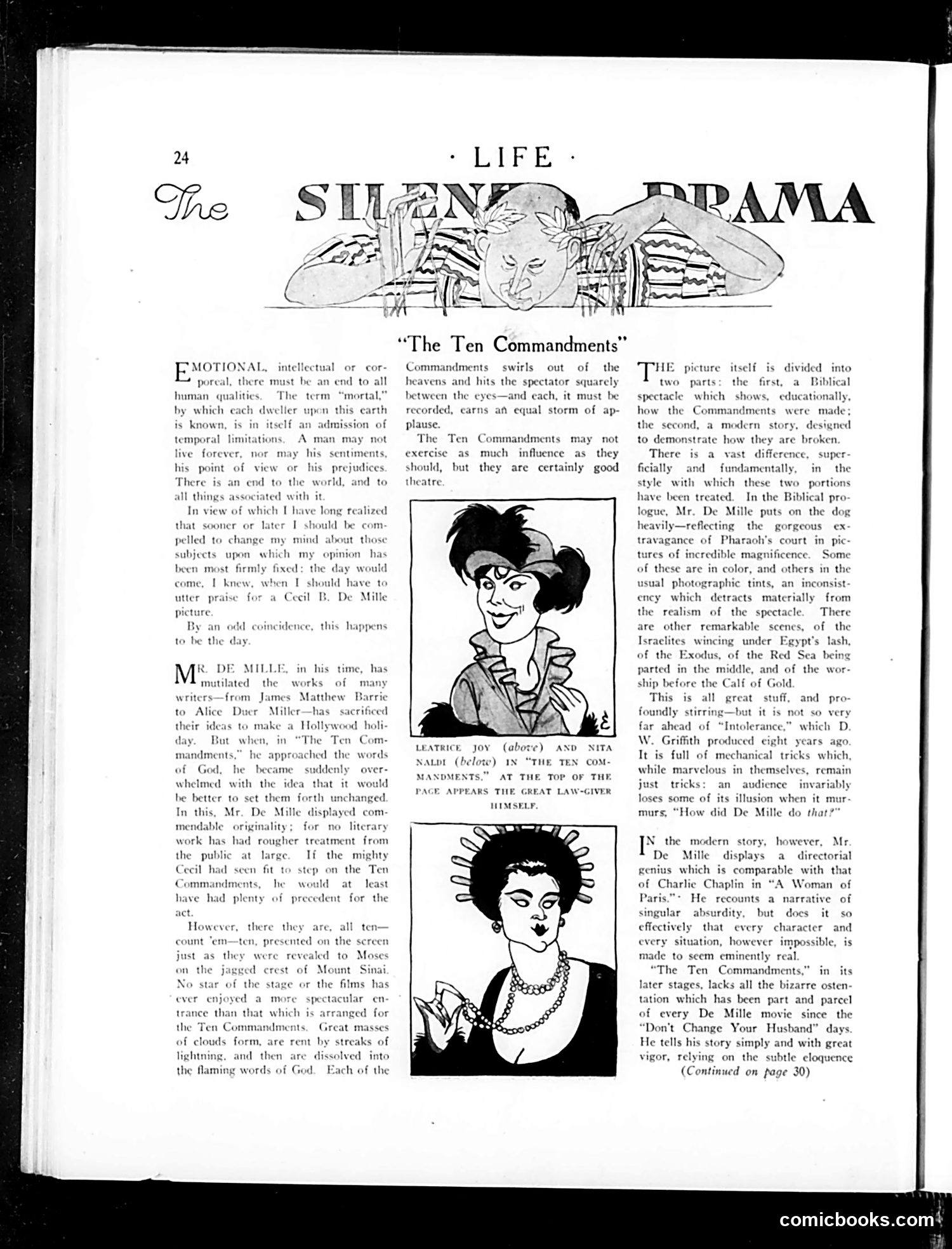
This 1923 *Life* magazine article reviews Cecil B. DeMille's film adaptation of the Ten Commandments. The piece criticizes DeMille's approach while grudgingly acknowledging his spectacle. The article mocks DeMille's pretension: he initially planned to alter the biblical text, then suddenly decided to present it "unchanged"—presented as false humility. The satire targets the film's two-part structure: an over-the-top Egyptian spectacle (with cloud effects and dramatic staging) followed by a modern story about broken commandments. The photos show actresses Leatrice Joy and Nita Naldi. The critic argues that while technically impressive, DeMille's mechanical tricks undermine emotional believability. However, the article praises his later directorial skill (comparing him favorably to Charlie Chaplin), noting he makes impossible situations seem real through subtle eloquence rather than spectacle alone. The overall tone is sardonic—*Life* acknowledges DeMille's talent while mocking his grandiosity and over-reliance on visual effects over storytelling.
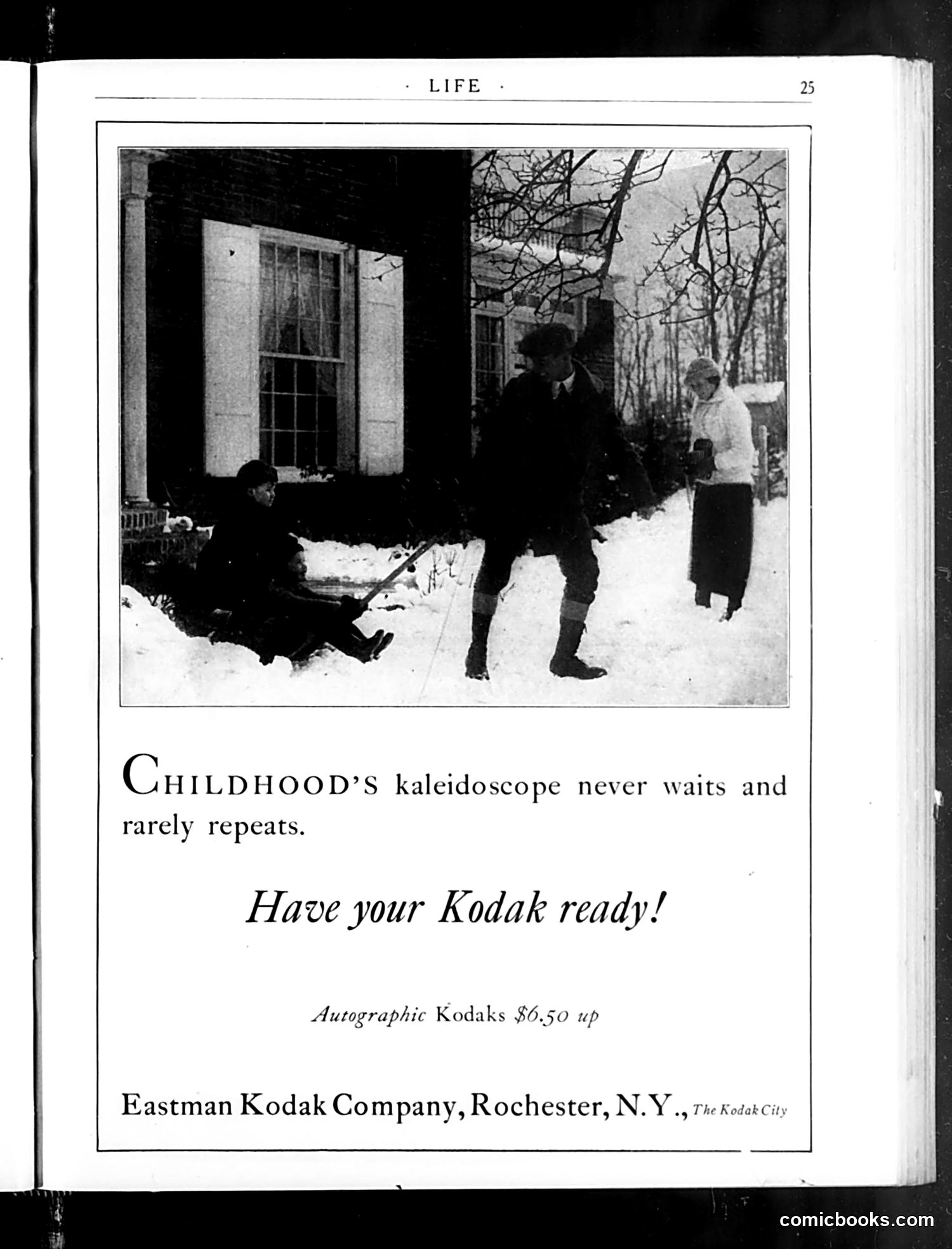
This is a **Kodak advertisement**, not political satire. The page shows a winter scene with children sledding and playing in snow outside a house, while adults watch. The ad's message is straightforward: childhood moments are fleeting and unpredictable ("never waits and rarely repeats"), so photographers should keep their Kodak cameras ready to capture these spontaneous scenes. The "kaleidoscope" metaphor emphasizes how childhood experiences constantly shift and change. The advertisement positions Kodak cameras as essential tools for preserving these transient moments—a classic early-20th-century marketing appeal linking the product to family memories and nostalgia. No political figures or satirical commentary appear here. This is purely commercial persuasion aimed at parents and gift-givers.
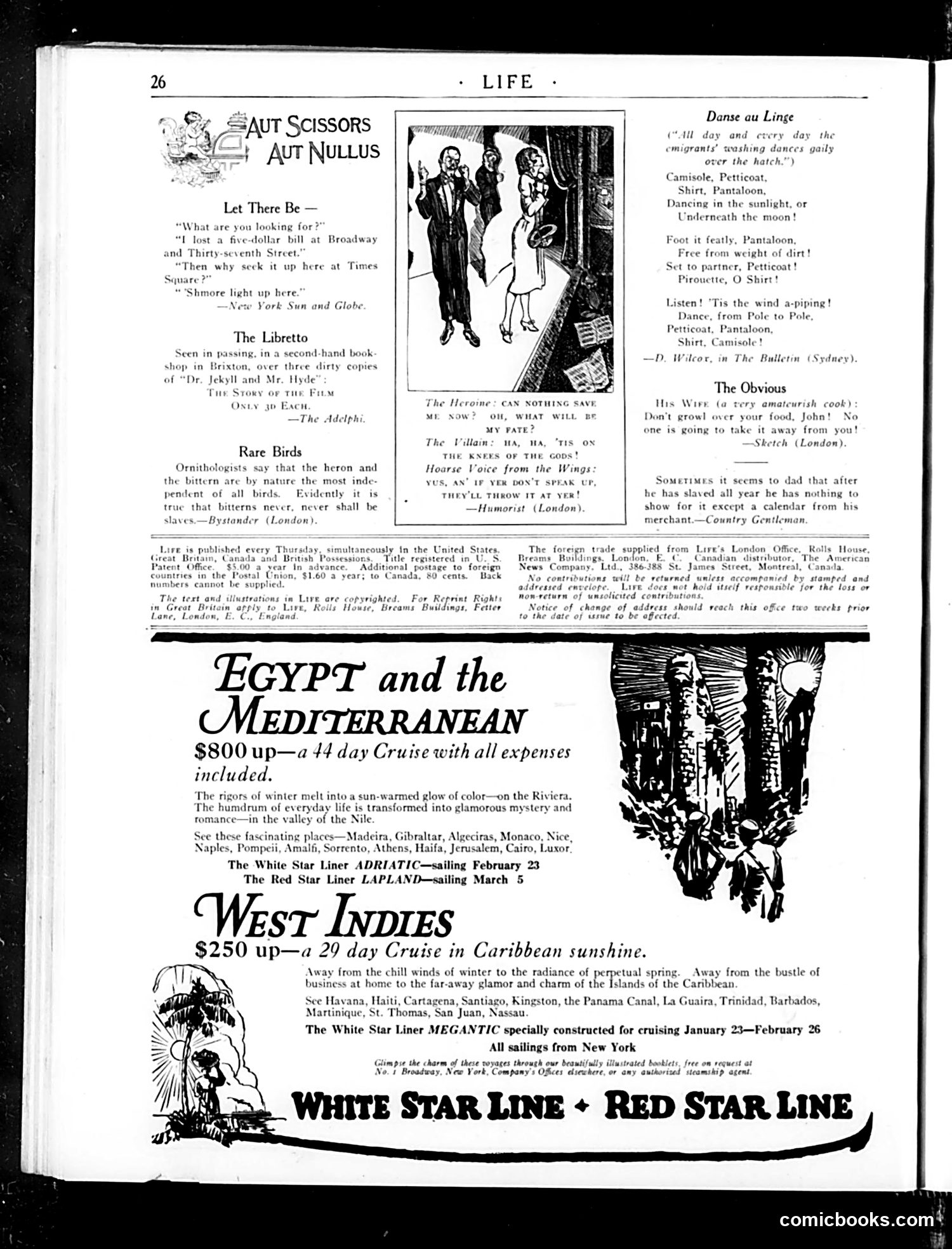
This page consists primarily of **advertisements** for cruise lines (White Star Line and Red Star Line) bookending satirical content. The small cartoons/jokes include: **"Let There Be"** — A New York humor piece about illogical searching (looking for a lost bill at Times Square instead of where it was lost). **"The Libretto"** — A poetic piece about laundry dancing on a clothesline, playing on the word "danse au linge" (literally "dance of linens"). **"Rare Birds"** — A nature observation that bitterns are famously independent birds. **"The Obvious"** — Three short domestic humor sketches: a wife reassuring her husband his food won't be stolen; a theatrical scene with an actor ad-libbing; and a comment on husbands receiving only calendars as yearly rewards. The humor is lighthearted and domestic in nature, typical of 1920s-era satirical magazines. The page functions mainly as a vehicle for maritime cruise advertising aimed at affluent readers.
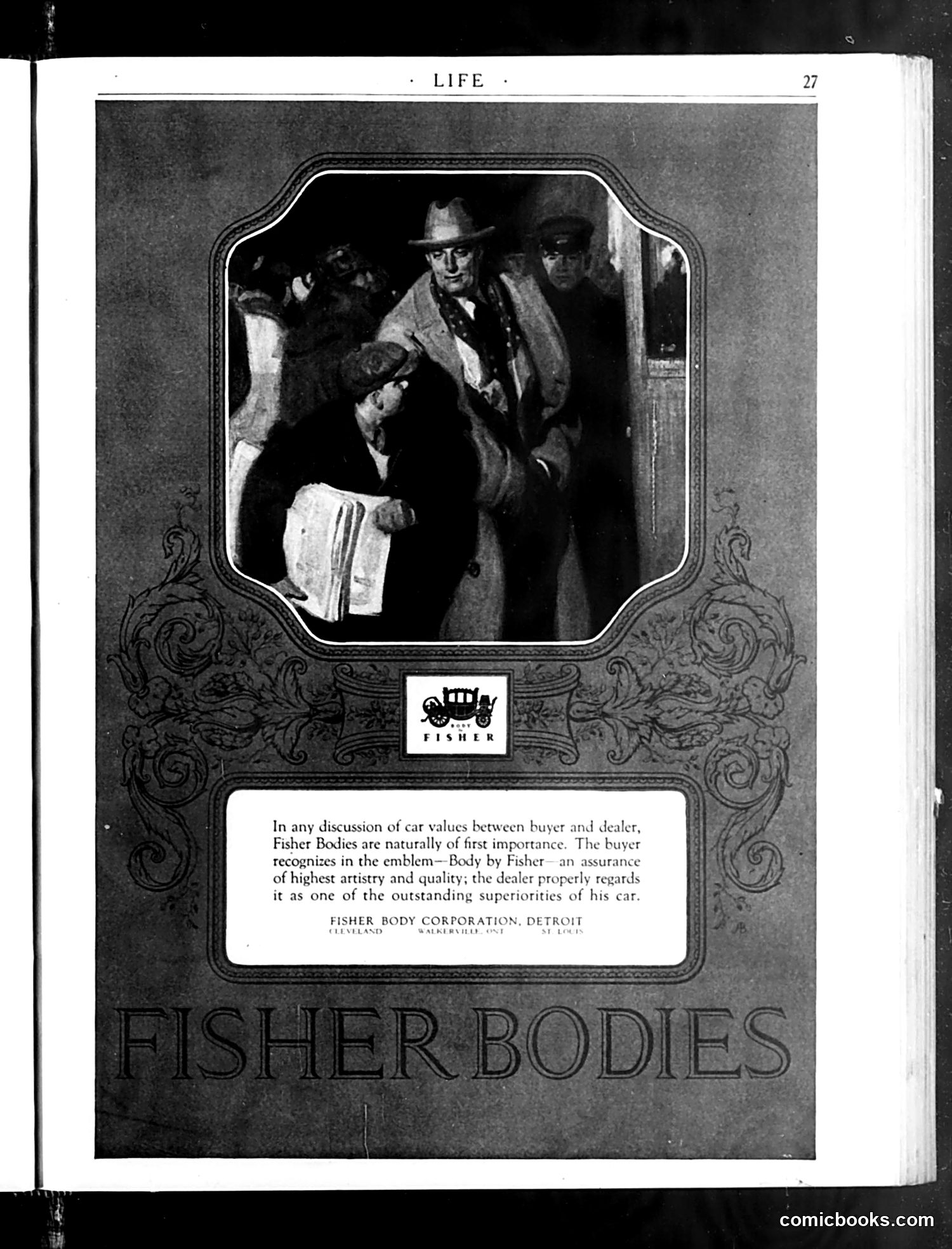
This is a **Fisher Bodies automobile advertisement**, not political satire. The page shows a scene of men in business attire conducting what appears to be a car transaction or negotiation. The ad argues that Fisher Bodies—car body manufacturers—are a crucial factor in determining a vehicle's value. The "Body by Fisher" emblem serves as a quality mark that both buyers recognize as assurance of craftsmanship and dealers tout as a selling point. This is straightforward commercial messaging from the early automotive era, emphasizing brand reputation and manufacturing prestige as sales tools. There is no political cartoon or satire present; it's purely promotional content for Fisher Body Corporation of Detroit.
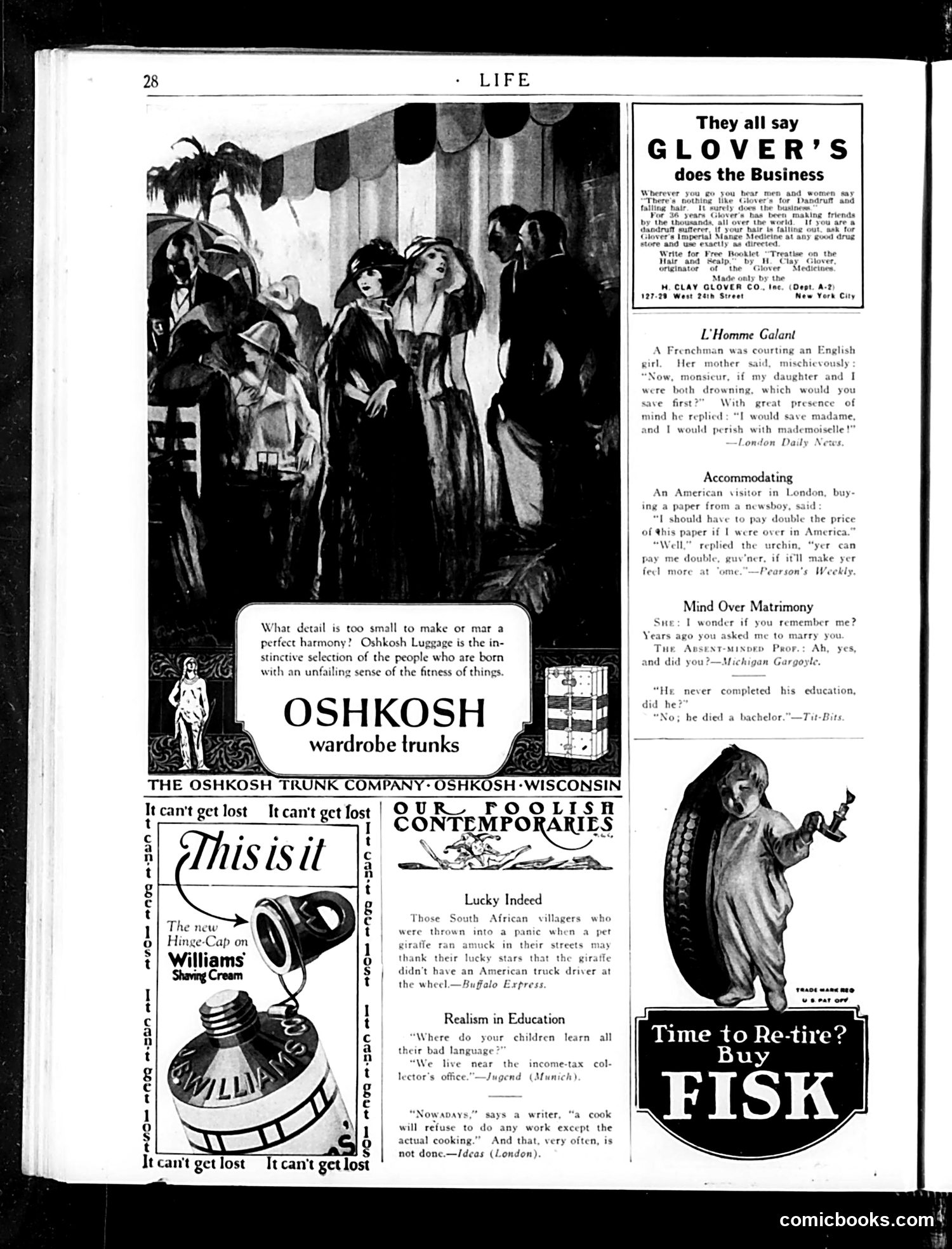
This is primarily an **advertising and humor page** from Life magazine (likely early 20th century). The main content includes: **Advertisements:** - Glover's dandruff medicine - Oshkosh wardrobe trunks (emphasizing durability with the repeated "It can't get lost" slogan) - Williams Shaving Cream - Fisk tires **Humor section** ("Foolish Contemporaries") contains brief satirical anecdotes: - A French suitor's gallantry toward an English woman - An American tourist in London negotiating newspaper prices - A couple's regretful matrimonial memories - South African villagers' luck avoiding a giraffe stampede - Commentary on income-tax collectors as a source of children's "bad language" - Criticism of modern cooks who refuse work beyond actual cooking The satire targets **social pretension, national stereotypes, modern moral decline, and labor attitudes**—typical of early 20th-century magazine humor. The page is essentially a mix of commercial promotion and light social commentary rather than political cartoons.
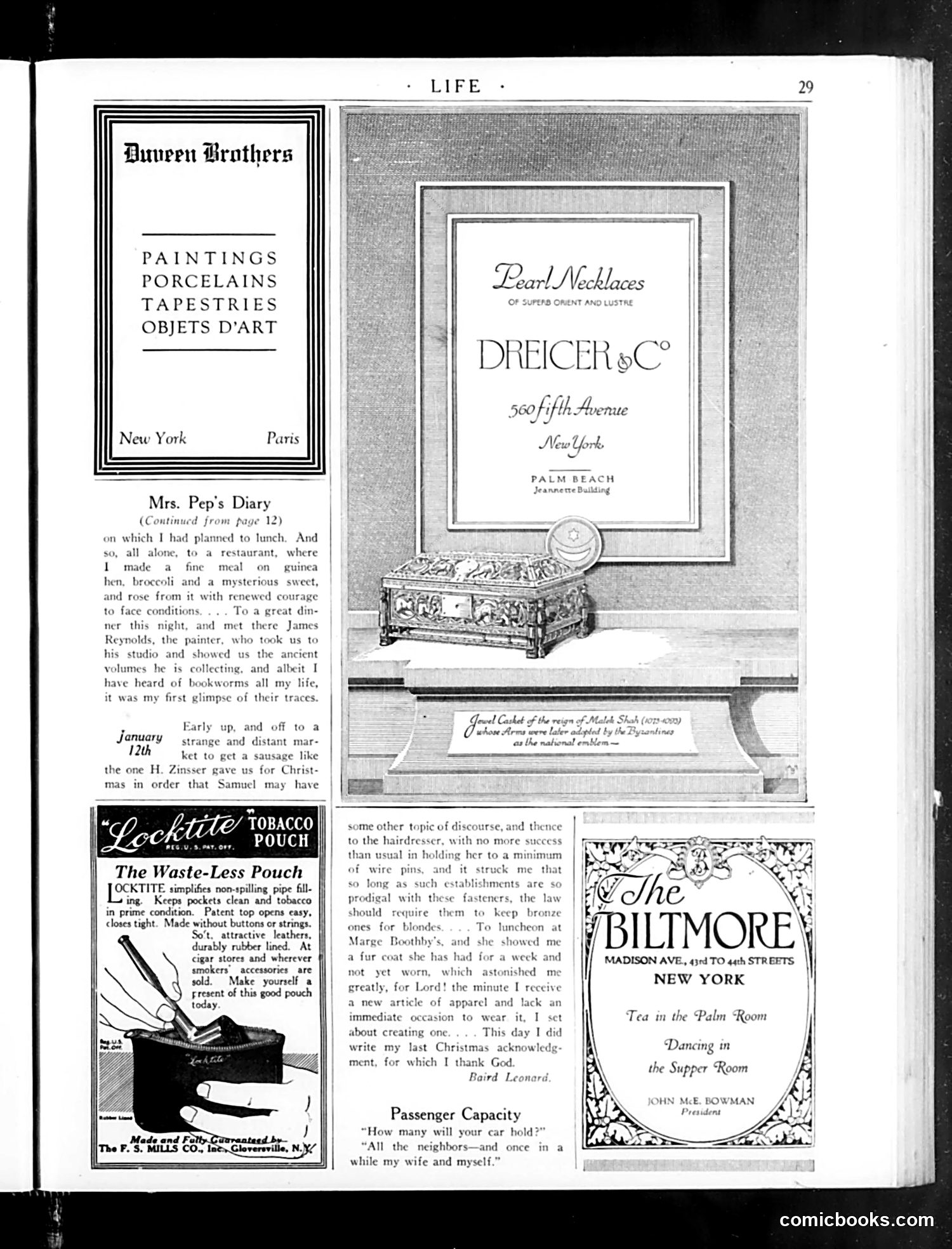
This page is primarily **advertising and society content**, not political satire. The main features are: 1. **"Mrs. Pep's Diary"** — a humor column about mundane upper-class social activities (lunches, dinner parties, shopping). The humor derives from genteel domestic observations rather than satire. 2. **Product advertisements** — including Duveen Brothers (fine art dealers), Dreicer & Co. (pearl necklaces), Locktite tobacco pouch, and the Biltmore Hotel. 3. **"Passenger Capacity"** — a brief joke about a car owner claiming his vehicle holds "all the neighbors" plus occasionally his wife and himself, poking gentle fun at domestic relations and social obligations. The page reflects 1920s-era upper-class leisure culture and consumer advertising rather than political commentary. The humor is mild, domestic, and aimed at an affluent readership. No specific political figures or events are referenced.
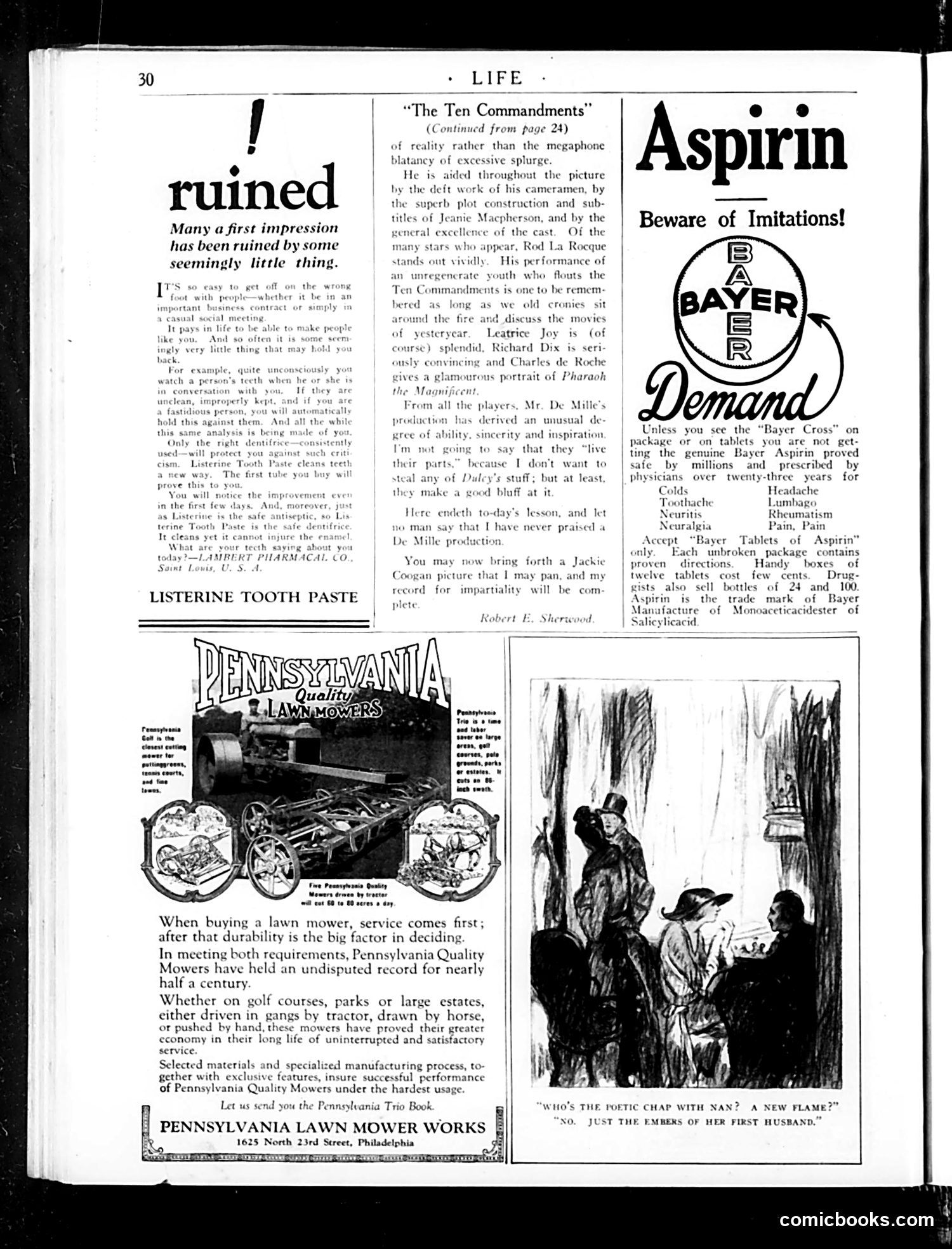
This page mixes advertisements with film criticism and a single-panel cartoon. **The Cartoon** (bottom right): Shows two figures observing a couple. The caption implies dark humor—the "poetic chap" accompanying a woman named Nan is actually the "embers of her first husband," suggesting either death or divorce. This is period social satire about remarriage and infidelity. **Film Review**: Robert E. Sherwood praises Cecil B. DeMille's "The Ten Commandments," noting its technical excellence and cast performances (Rod La Rocque, Leatrice Joy, Richard Dix). He avoids excessive praise to avoid resembling gossip columnist Louella Parsons ("Duley"). **Advertisements**: - **Listerine toothpaste** warns that poor dental hygiene ruins first impressions in social situations - **Aspirin** (Bayer) warns against counterfeits, emphasizing its 23-year track record - **Pennsylvania Lawn Mowers** emphasize durability and service reliability The page reflects 1920s consumer anxieties about authenticity and respectability.
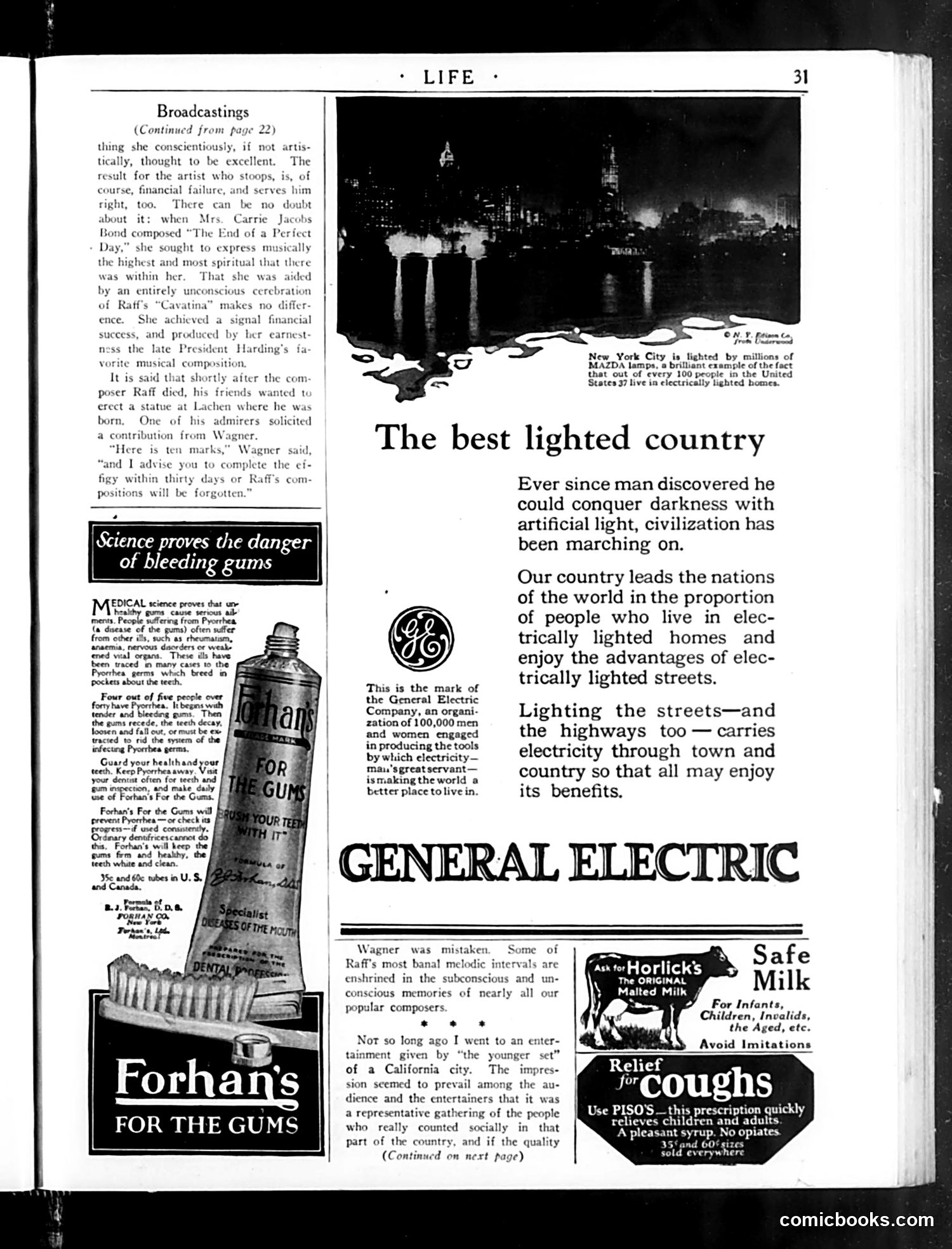
This page mixes editorial content with vintage advertisements. The top section discusses classical composer Raff and his works, noting that Wagner mistakenly thought Raff's "banal melodic intervals" were his own creations—a humorous anecdote suggesting Raff's obscurity despite his influence. The advertisements are period-typical medical and consumer pitches: - **Forhan's For the Gums**: Addresses pyorrhea (gum disease), claiming it causes systemic illness like rheumatism. The product promises to prevent tooth loss. - **General Electric**: A full-page corporate advertisement celebrating American electrical infrastructure, boasting that 37% of Americans live in electrically lit homes—positioning this as civilizational progress. - **Horlick's Malted Milk** and **Piso's Cough Syrup**: Standard health product endorsements. The page reflects early-20th-century anxieties about modern diseases and corporate confidence in technology and commercial solutions. The tone is earnest; satire is minimal—this appears to be straightforward magazine content from Life's less comedic sections.
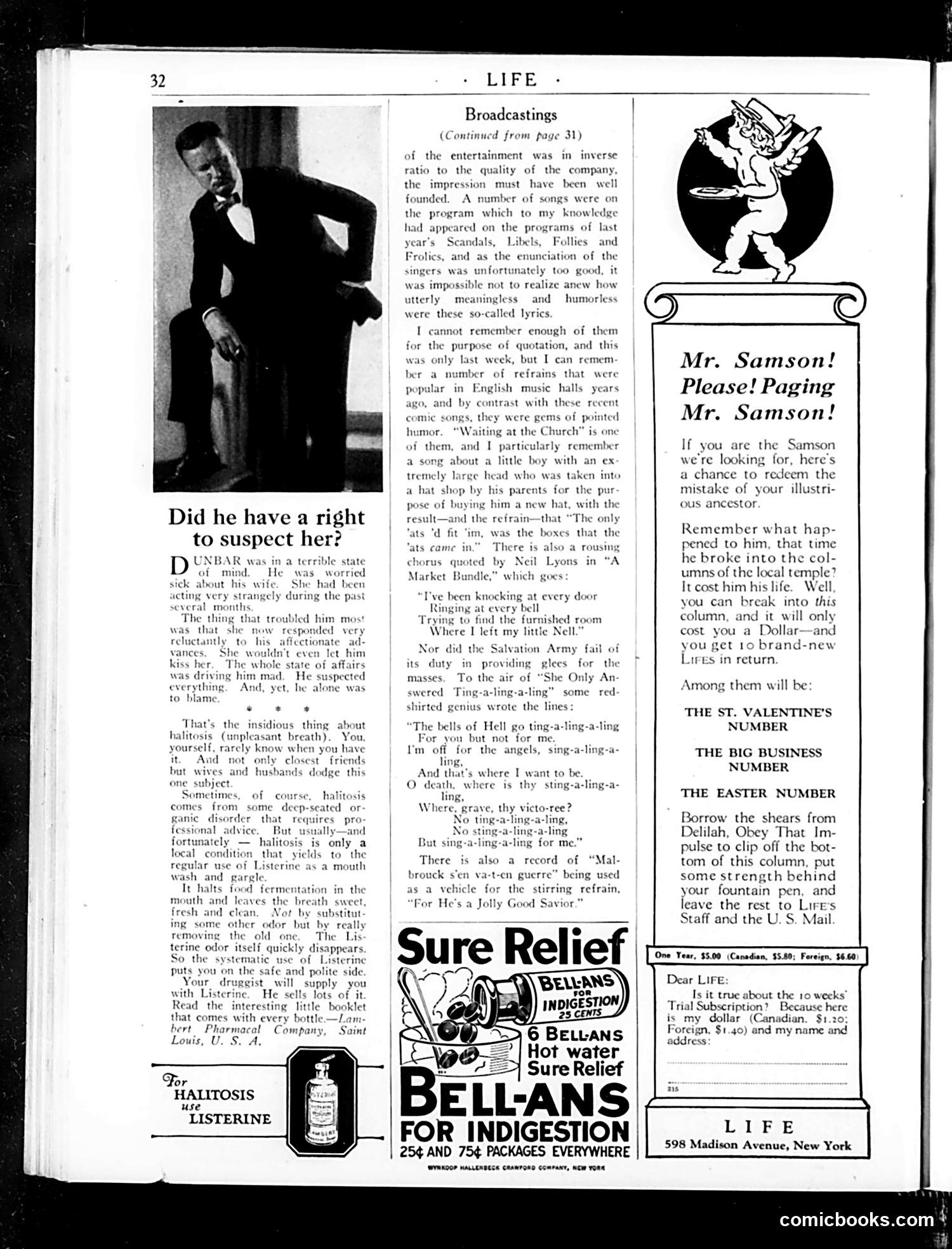
This page contains a **"Broadcastings" column** critiquing radio entertainment, paired with period advertisements. **Main Content:** The article mocks low-quality radio songs from contemporary musical revues (*Scandals, Libels, Follies*), contrasting them unfavorably with older English music-hall humor. The author quotes lyrics from WWI-era soldiers' songs like "The Bells of Hell" to illustrate how even wartime ditties possessed more wit than current broadcast material. **The Cartoon:** "Mr. Samson! Please! Paging Mr. Samson!" is a **biblical reference joke**. It offers to help someone redeem their family name by "breaking into the local temple columns" (the magazine itself)—alluding to Samson's biblical destruction of the temple. The humor relies on readers recognizing the biblical story and appreciating the ironic "redemption" offered. **Advertisements:** The page includes typical 1920s-30s ads for **Listerine** (oral hygiene) and **Bellans** (indigestion relief), representing common patent medicine marketing of the era. The page captures period radio criticism and early 20th-century advertising conventions.
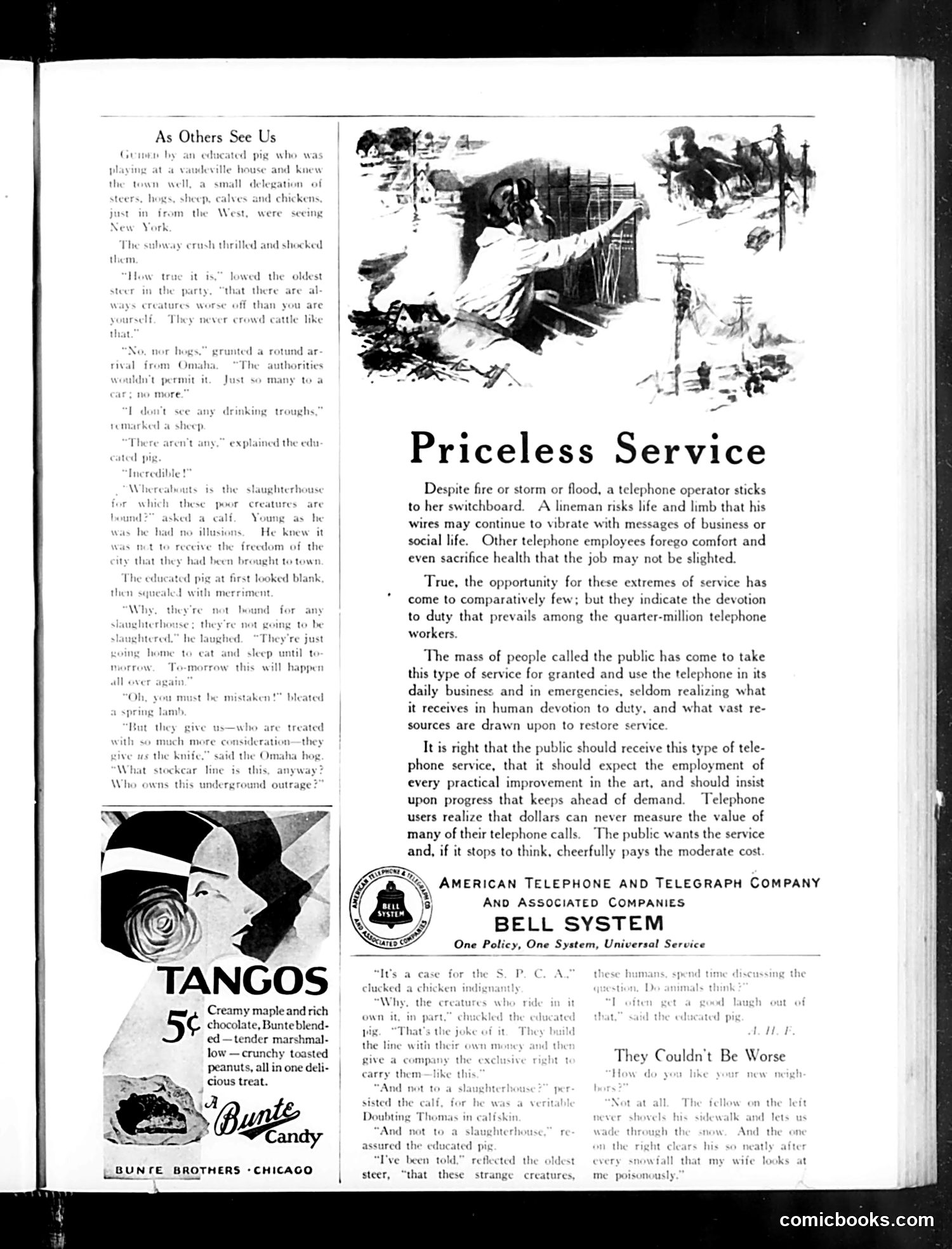
The left-side cartoon satirizes Eastern urbanites' shocked reaction to Western livestock practices. A delegation from the West visits a Vanderbilt estate, bringing cattle, hogs, sheep, and chickens. The educated pig, steer, and other animals express bewilderment at Eastern attitudes toward animal treatment. The satire mocks supposed Eastern pretension and disconnection from agricultural reality. The animals' educated commentary (one notes "they give us—who are treated with so much more consideration—they give us the knife") inverts expectations: the "civilized" East dismisses Western farming as crude, yet treats animals for food regardless. The humor lies in rural animals critiquing Eastern hypocrisy about civilization and morality. The page also features a Bell System telephone company advertisement praising operator devotion during emergencies, and a Bunte candy advertisement.
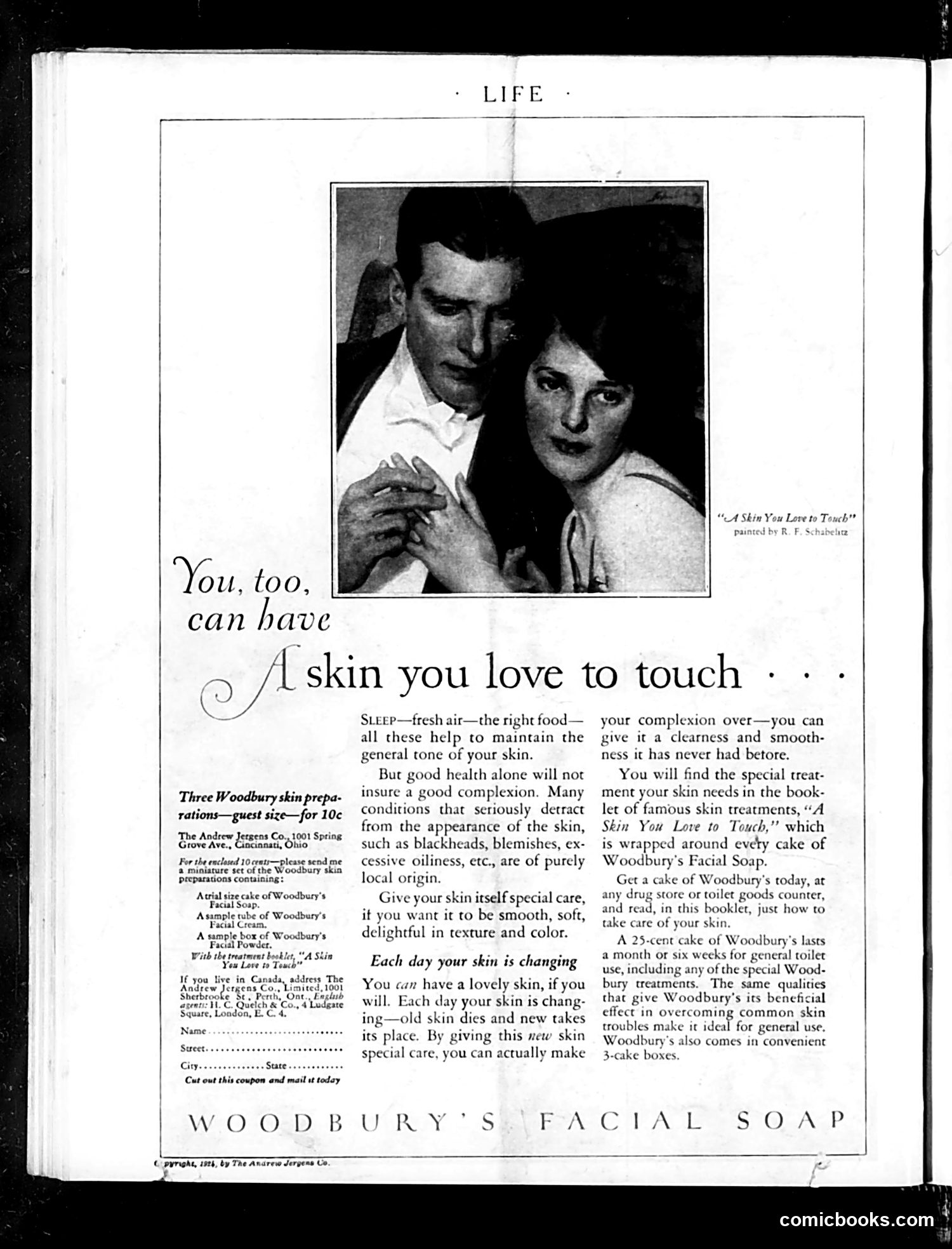
This is not political satire but a **product advertisement** for Woodbury's Facial Soap, disguised within a *Life* magazine page. The image shows a romantic couple, with the caption "A Skin You Love to Touch" (painted by R.F. Schabelitz), depicting the aspirational result of using the product. The advertisement's pitch exploits vanity and romance: if you use Woodbury's skincare regimen, you'll have skin attractive enough to inspire romantic affection. The "three Woodbury skin preparations" are offered as a 10-cent trial to hook consumers into purchasing the 25-cent full-size cake of soap. This represents early 20th-century advertising strategy—associating a mundane toilet product with desirability, romance, and self-improvement. The pseudo-scientific language about "old skin dies and new takes its place" lends false credibility to skincare claims typical of the era.