
Life, 1924-01-17 · page 26 of 36
Life — January 17, 1924 — page 26: what you’re looking at
What you’re looking at
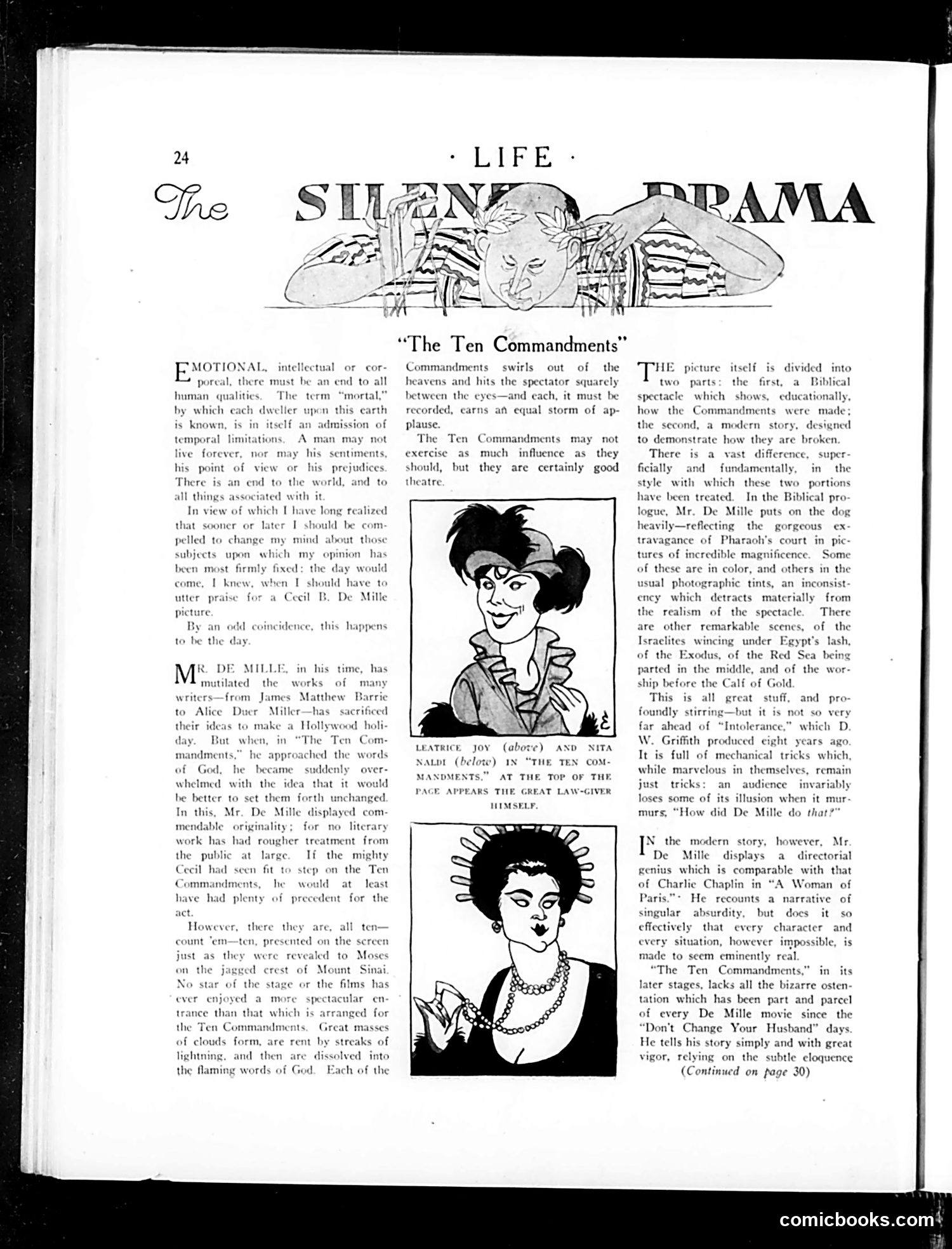
This 1923 *Life* magazine article reviews Cecil B. DeMille's film adaptation of the Ten Commandments. The piece criticizes DeMille's approach while grudgingly acknowledging his spectacle. The article mocks DeMille's pretension: he initially planned to alter the biblical text, then suddenly decided to present it "unchanged"—presented as false humility. The satire targets the film's two-part structure: an over-the-top Egyptian spectacle (with cloud effects and dramatic staging) followed by a modern story about broken commandments. The photos show actresses Leatrice Joy and Nita Naldi. The critic argues that while technically impressive, DeMille's mechanical tricks undermine emotional believability. However, the article praises his later directorial skill (comparing him favorably to Charlie Chaplin), noting he makes impossible situations seem real through subtle eloquence rather than spectacle alone. The overall tone is sardonic—*Life* acknowledges DeMille's talent while mocking his grandiosity and over-reliance on visual effects over storytelling.
📄 Transcribed text from this page (OCR, searchable)
Machine-transcribed from the original scan — historical spelling and the odd misread are preserved.
MOTIONAL, poreal intellectual or cor there m an end te human quali The term “mc by which ler upon this ¢ is known, is sion temporal limitations, A man may 1 live forever, nor may his sentiments his point of or his prejudices und to view There an end to the world with it hich [| have long tealized muld be com those nion has all things a In view of w that sooner or I pelled to change my mind subjects upon whic most firmly Ik utter pra © De beer day would uld have to Mille come . this happens R. DE MILLE, in hi mutilated — the me, has works of Matthew many James Barrie Miller—has a Hollywood holi Ten Com- writers—from to Alice Duer their ideas to make 1 « But when, in “The mandments, words of God, he he approached the became Idenly over- whelmed with the idea that it would he better to set them forth unchanged. In this, Mr. De Mille mendable originality; fo: ) work has had rou, layed com. literary ner treatment from large. Tf the pon the Ten Commandments, he would at least had_ plenty the public at mighty Cecil had seen fit for the have precedent act However, there they count ‘em—ten, presented Mount Sinai or the No star of were crest of the st. films has a more ance than that w spectacular en: ich is arranged for the Ten Commandments. Great masses of clouds form, are rent by streaks of lights the flaming words of vived into ach of the and then are “The Ten Commandments’ Commandments out of the heavens and hits the spectator squarely swirls between the eyes—and cach, it must be recorded, carns af equal storm of ap- plause. The Ten exercise as should, but theatre Commandments not much influence as they they are certainly good may LEATRICE JOY nator (b ) IN AND NITA THE TEN COM- AT THE TOP OF THE APPEARS THE GREAT LAW-GIVER MANDMENTS. PAGE HIMSELF itself is divided into Biblical educationally, THE re two parts: the first, a spectacle which shows, how the Commandments were made; the second, a modern ste designed to demonstrate how they are broken. There is a ficially and style with have been treated. In the Biblical pro logue, Mr. De Mille puts on the dog heavily—reftecting the vast difference, super the two portions fundamentally, in which these Rorgcous ex travagance of Pharaoh's court in pic- otographic tints, an inconsist which detracts materially realism of the spectacle remarkable from There scenes, of the ency the are other Israelites wincing under Egypt's lash, of the Exodus, of the Red Sea bei parted in the middle, and of the w ship before the Calf of Gold. This is all great stuff fondly. stirri it so very far ahead of “Intolerance,” which D. W. Griffith produced eight years ago. It is full of mechanical tricks which while marvelous in themselves, remain just tricks: an invariably loses some of its illusion when it mur murs, “How did De Mille do that?” pro- audience N the mod De Mille directorial genius which is comparable with that of Charlie Chaplin in “A Woman of Paris."* He recounts a singular absurdity, effectively that and every situation, however impossible, is made to seem eminently real “The Ten Commandments,” in its later stages, lacks all the bizarre osten tation which has been part and parcel f De Mille movie since the “Don't Change Your Husband” days He tells his story simply and with great vigor, relying on the subtle eloquence (Continued on page 30) story, however, Mr displays a narrative of but docs it so cha: every acter comicbooks.com*