
Life, 1924-01-17 · page 20 of 36
Life — January 17, 1924 — page 20: what you’re looking at
What you’re looking at
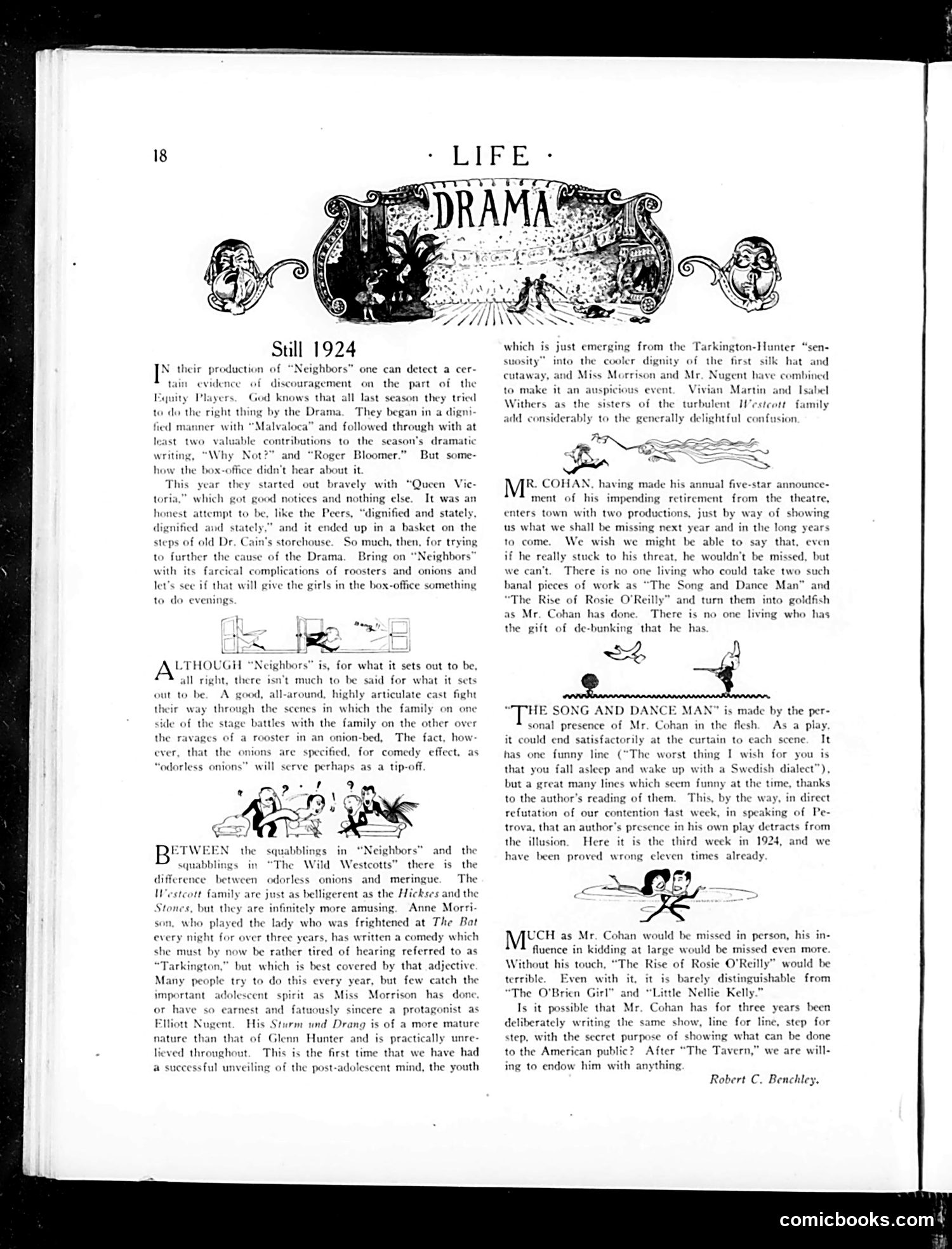
This is a theater criticism page reviewing Broadway productions. The author critiques the Equity Players' season, praising their attempt at serious drama ("Queen Victoria") while noting it failed commercially. He contrasts this with Anne Morrison's comedy "The Wild Westcotts," which successfully captures the "post-adolescent mind"—apparently a Booth Tarkington-influenced coming-of-age sensibility that was fashionable at the time. The review also discusses George M. Cohan's two new productions ("The Song and Dance Man" and "The Rise of Rosie O'Reilly"), crediting Cohan's personal performance talent for elevating otherwise "banal" material. The cartoons appear to be small theatrical vignettes illustrating the reviewed plays' domestic comedy scenarios involving families and farmyard elements (roosters, onions).
📄 Transcribed text from this page (OCR, searchable)
Machine-transcribed from the original scan — historical spelling and the odd misread are preserved.
471 A1\\WNSSSS Sull 1924 production of “Neighbors” one can detect a cer- evidence of discouragement on the part of the Players. God knows that all last season they tried to do the right thing by the Drama. They began in a digni fied manner with “Malvaloca” and followed through with at least two va contributions to the season's dram writi h and “Roger Bloomer.” But some- hear about it This year they started out bravely with “Queen Vie- toria,” which got good notices and nothing else. It was an honest attempt to be, like the Peers, “dignified and stately, dignified stately,” and it ended up in a basket on the steps of old Dr. Cain's storchouse. So much, then, for trying to further the cause of the Drama. Bring on “Neighbors” with its farcical complications of roosters and onions and let's see if that will give the girls in the box-office something to do evenings. ct ‘ he . Bs Kile om Al LTHOUGH “Neighbors” is, for what it sets out to be. all right, there isn’t much to be said for what it sets out to be. A good, all-around, highly articulate cast fight their way through the scenes in which the famil side of the stage battles with the family on the other over the ravages of a rooster in an onion-bed, The fact, how on ¢ ever, that the onions are specified, for comedy effect, as “odorless onions” will serve perhaps as a tip-off the squabblir in “Neighbors” d in “The Wild Westcotts” there is the difference between odorless onions and meringue. The Weste family are just as bel rent as the Hickses and the Stones, but they are infinitely more amusing. Anne Morri- son, who played the lady who was frightened at The Bat every night for over three years, has written a comedy which she must by now be rather tired of hearing referred to as “Tark but which is best covered by that adjective Many people try to do this every year, but few catch the important adolescent. spirit as Miss Morrison has done or have so earnest and fatuously sincere a protagonist as Elliott Nugent. His Sturm und Drang is of a more mature nature than that of Glenn Hunter and is practically unre lieved throughout. This is the first time that we have had a successful unveiling of the post-adolescent mind, the youth which is just emerging from the Tarkington-Hunter “sen- suosity” into the cooler dignity of the first. silk hat and cutaway, and Miss Morrison and Mr. Nugent have combined to make it an auspicious event. Vivian Martin and Isabel Withers as the sisters of the turbulent Westcott family add considerably to the generally delightful con! MIR COHAN. having made his annual five-star announce- ment of his impending retirement from the theatre, enters town with two productions, just by way of showing us what we shall be missing next year and in the long years to come. We wish we might be able to say that, even if he really stuck to his threat, he wouldn't be missed, but we can't. There is no one living who could take two such banal pieces of work as “The Song and Dance Man” and “The Rise of Rosie O'Reilly” and turn them into goldfish as Mr. Cohan has done. There is no one living who has the gift of de-bunking that he has is made by the per- han in the flesh. As a play, it could end satisfactorily at the curtain to each scene. It has one funny line (“The worst thing I wish for you is that you fall asleep and wake up with a Swedish dialect”), but a great many lines which scem funny at the time, thanks to the author's reading of them. This, by the way, in direct refutation of our contention dast week, in speaking of Pe- trova, that an author's presence in his own play detracts from the illusion. Here it is the third week in 1924, and we have been proved wrong eleven times alre: UCH as Mr. Cohan would be missed in person, his in- fluence in kidding at large would be missed even more. Without his touch, “The Rise of Rosie O'Reilly” would be terrible. Even with it, it is barely distinguishable from “The O'Brien Girl” and “Little Nellie Kelly.” Is it possible that Mr. Cohan has for three years been deliberately writing the same show, line for line, step for step, with the secret purpose of showing what can be done to the American public? After “The Tavern,” we are will- ing to endow him with anything Robert C. Benchley. comicbooks.com‘4