
Life, 1924-01-17 · page 16 of 36
Life — January 17, 1924 — page 16: what you’re looking at
What you’re looking at
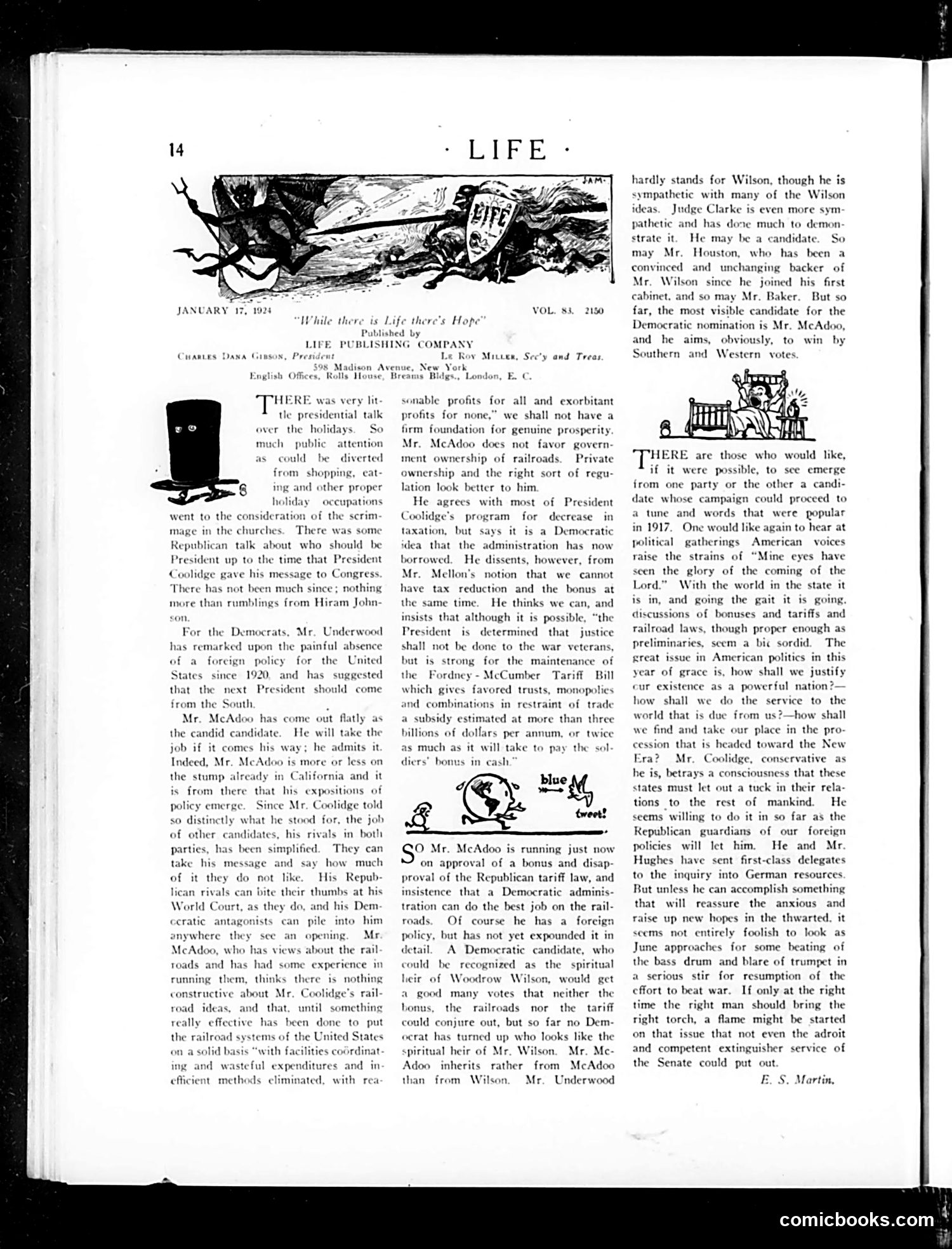
This page discusses the 1924 U.S. presidential election prospects. The text examines potential Democratic candidates, particularly Mr. McAdoo, who appears to be running on approval of a bonus bill and tariff positions. The article critiques McAdoo as lacking the spiritual heir qualities of Woodrow Wilson—seemingly inheriting Wilson's administrative approach rather than his ideals. The text also mentions President Coolidge's tax reduction program and debates between Republican and Democratic approaches to tariffs and railroad policy. The small cartoon (lower left) shows a figure labeled "Blue Cross Good!" — likely satirizing campaign rhetoric or political posturing during this election cycle, though the specific reference remains unclear without additional context about 1924 campaign imagery.
📄 Transcribed text from this page (OCR, searchable)
Machine-transcribed from the original scan — historical spelling and the odd misread are preserved.
While there SS. 2180 LIFE PUBLISHING COMPANY Cartes Dana Ginsox, President 398 Madison Aven: English Offices, Rolls House G[PHERE was very lit tle presidential talk over the holidays. So much public attention as could be diverted from shopping, eat- @ ing and other proper holiday occupations went to the consideration of the scrim mage in the churches. There was some Republican talk about who should be President up to the time that President Coolidge gave his message to Congress There has not been much since ; nothing more than rumblings from Hiram John For the Democrats, Mr. Underwood has remarked upon the painful absence of a foreign policy for the United States since 1920, and has suggested that the next President should come from the South ; Mr. McAdoo has come out flatly as the candid candidate. He will take the job if it comes his way; he admits it Indeed, Mr. McAdoo is more or less the stump already in California and it is from there that his expositions of policy emerge. Since Mr. Coolidge told so distinctly what he stood for, the job of other candidates, his rivals in both parties, has been simplified. They can take his message and say how much of it they do not like. His Repub lican rivals can bite their thumbs at his World Court, as they do, and his Dem ceratic antagonists can pile into him anywhere they see an opening. Mr McAdoo, who has views about the rail roads and has had some experience in running them, thinks there is nothing constructive about Mr, Coolidge’s rai road ideas, and that, until something really effective has been done to put the railroad systems of the United States on a solid basis “with facilities codrdinat ing and wasteful expenditures and in eflicient: methods eliminated, with rea Le Rov Mittex, Sec'y and Treas . New York Breains Bldgs., Lon E. ¢ able profits for all and exorbitant profits for none,” we shall not have a firm foundation for genuine prosperity Mr. McAdoo does not favor govern- ment ownership of railroads. Private ownership and the right sort of regu- lation look better to him. He agrees with most of President Coolidge’s program for decrease in taxation, but says it is a Democratic idea that the administration has now borrowed. He dissents, however, from Mr. Mellon’s notion that we cannot have tax reduction and the bonus at the same time. He thinks we can, and insists that although it is possible, “the President is determined that justice shall not be done to the war veterans, but is strong for the maintenance of the Fordney- McCumber Tariff Bill which gives favored trusts, monopolies and combinations in restraint trade a subsidy estimated at more than three billions of dollars per annum, or twice as much as it will take to pay the sol diers’ bonus in cash g ~» blue O Mr. McAdoo is running just now on approval of a bonus and disap: proval of the Republican tariff law, and insistence that a Democra admini tration can do the best job on the rail- roads. Of course he has a foreign policy, but has not yet expounded it in detail. A Democratic candidate, who could be recognized as the spiritual heir of Woodrow Wilson, would get a good many votes that neither the bonus, the railroads nor the tariff could conjure out, but so far no Dem- ecrat has turned up who looks like the spiritual heir of Mr. Wilson. Mr. Mc- Adoo inherits rather from McAdoo than from Wils Mr. Underwood hardly stands for Wilson, though he is sympathetic with many of the Wilson ideas. Judge Clarke is even more sym pathetic and has done much to demon strate it. He may be a candidate. So may Mr. Houston, who has been a convinced and unchanging backer of Mr. Wilson since he joined his first cabinet, and so may Mr. Baker. But so far, the most visible candidate for the Democratic nomination is Mr. McAdoo, and he aims, obviously, to win by Southern and Western votes HERE are those who would like, if it were possible, to sce emerge from one party or the other a candi- date whose campaign could proceed t a tune and words that were popular in 1917, One would like again to hear at political gatherings American voices raise the strains of “Mine eyes have scen the glory of the coming of the Lord.” With the world in the state it is in, and going the gait it is going, discussions of bonuses and tariffs and railroad laws, though proper enough as preliminaries, scem a bic sordid. The great issue in American politics in this year of grace is, how shall we justify cur existence as a powerful nation?— how shall we the service to the world that is due from us?—how shall we find and take our place in the pro- cession that is headed toward the New Era? Mr. Coolidge, conservative as he is, betrays a consciousness that these states must let out a tuck in their rela- tions to the rest of mankind. He seems willing to do it in so far as the Republican guardians of our foreign policies will Iet him. He and Mr. Hughes have sent first-class delegates to the inquiry into German resources. But unless he can accomplish something that will reassure the anxious and raise up new hopes in the thwarted, it seems not entirely foolish to look as une approaches for some beating of the bass drum and blare of trumpet in a serious stir for resumption of the effort to beat war. If only at the right time the right man should bring the right torch, a flame might be started on that issue that not even the adroit and competent extinguisher service of the Senate could put out Martin, comicbooks.com 4