
Life, 1924-01-17 · page 24 of 36
Life — January 17, 1924 — page 24: what you’re looking at
What you’re looking at
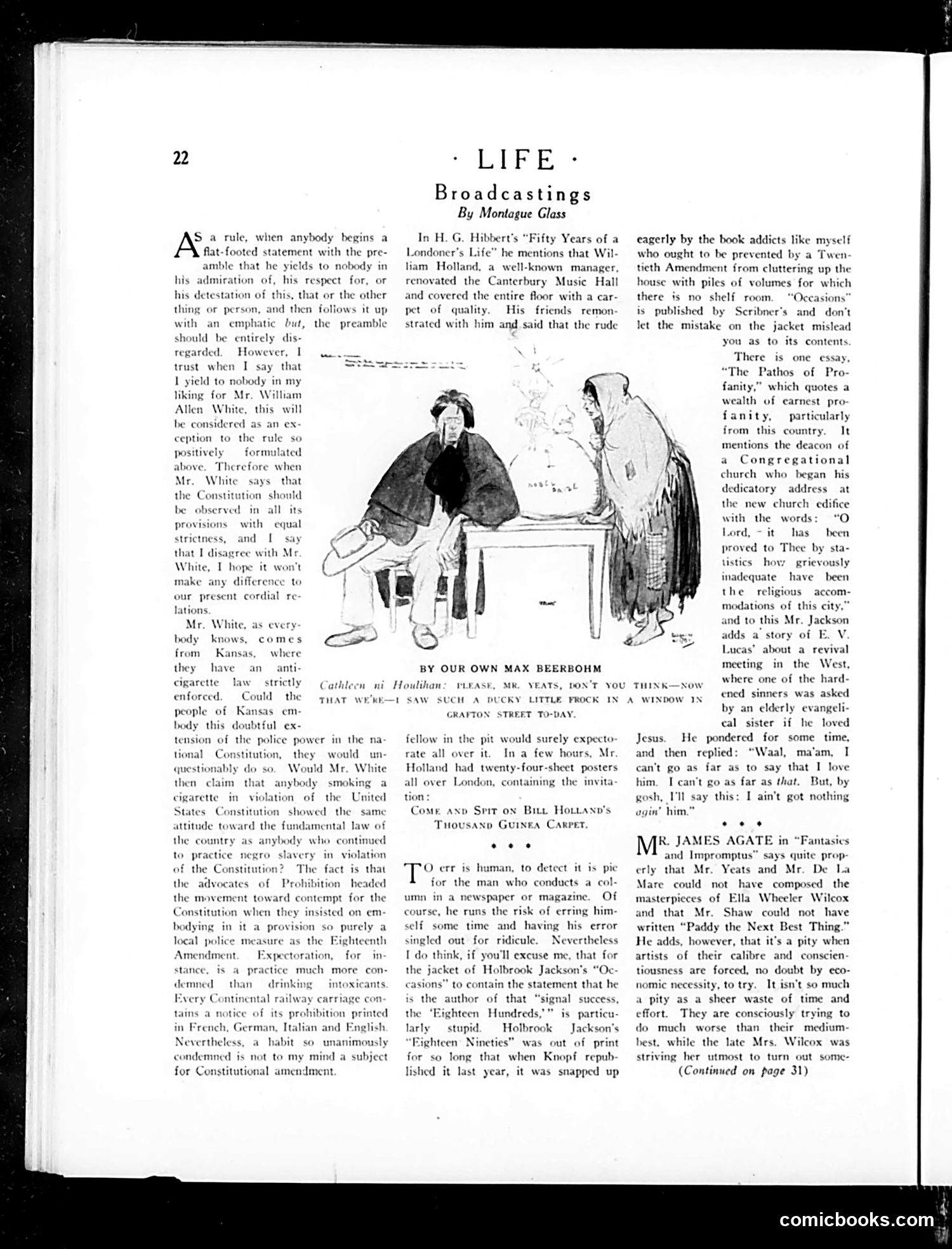
This page contains satirical commentary on American politics and society circa the 1920s. The main article disputes William Allen White's strict Constitutional interpretation, specifically regarding Kansas's anti-cigarette law. The author argues that if we enforce minor police-power provisions like cigarette prohibition through Constitutional amendment, we should have done the same regarding slavery—exposing the hypocrisy of Prohibition advocates who damaged respect for the Constitution itself. The cartoon by Max Beerbohm (credited as "Our Own") depicts a woman admiring another's dress on Grafton Street, a Dublin shopping area. This appears to be humorous social commentary on women's fashion obsession. The "Broadcastings" column discusses publishing errors and literary merit, mentioning Holbrook Jackson's works and Ella Wheeler Wilcox. The overall tone is witty critique of Constitutional inconsistency and cultural pretension.
📄 Transcribed text from this page (OCR, searchable)
Machine-transcribed from the original scan — historical spelling and the odd misread are preserved.
S a rule, when anybody begins a A flat-footed statement with the pre- amble that he yields to nobody in his admiration of, his respect his detestation of this, that or the other thing or person, and then foliows it up with an emphatic but, the preamble should be entirely dis- regarded. However, 1 Ww trust when I say that 1 yield to nobody in my liking for Mr. Wilham Allen White, this will be considered as an ex- ception to the rule so positively formulated above. Therefore when Mr. White says. that the Consti be observed in all its ion should provisions with equal strictness, and [say that I disagree with \ White, I hope it wor make any difference to our present cordial re ions. Mr. White, as every body knows, comes from Kansas, where they have an anti- cigarette law _ strictly enforce Could — the people of Kansas em- body this doubtful ex- tension of the police power in the na THAT WE'kE tional Constitution, they would Would Mr. White smok cigarette in’ violation of the United States Constitution showed the same attitude toward the fundamental law of questionably: « ) then claim that anybody the country as anybody who continued to practice negro. slavery in violation of the Constitution? The fact is that the advocates of Prohibition headed the movement toward contempt for the Constitution when they insisted on em: bodying in it a provision so purely a local police measure as the Eighteenth Amendment. Expectoration, for in stance, is a practice much more con- demned than drinking — intoxicants. Every Conti: al railway carriage con. tains a notice of its prohibition printed in French, German, Italian and English Nevertheless, a habit so condemned is not to my mind a subject for Constitutional amendment unanimously Houlihan LIFE: Broadcastings By Montague Glass In H. G. Hibbert’s “Fi Londoner's Life” he mentions that Wil- liam Holland, a well-known manager, renovated the Canterbury Music Hall and covered the entire floor with a car- pet of quality. His friends remon- strated with him and said that the rude BY OUR OWN MAX BEERBOHM PLEASE, MR. SAW SUCH A DUCKY LITTLE FROCK IN GRAFTON STREET TO-DAY. fellow in the pit would surely expecto rate all over it. In a few hours, Mr Holland had twenty-four-sheet posters all over London, containing the invita tion Come ano Srit on Birt HoLtann’s Tuousann Guinea Carrer, eee Ee err is human, to detect it is pic or the man who conducts a col- umn in a newspaper or magazine. Of course, he runs the risk of erring him- and having his error singled out for ridicule. Nevertheless I do think, if you'll excuse me, that for the jacket of Holbrook Jackson's “Oc casions” to contain the statement that he is the author of that “signal success, the ‘Eighteen Hundred: is particu- larly stupid. Holbrook Jackson's “Eighteen Nineties” was out of print so long that when Knopf repub lished it last year, it was snapped up self. some time A eagerly by the book addicts like myself who ought to be prevented by a Twen ticth Amendment from cluttering up the house with piles of volumes for which there is no shelf room. “Occasions” is published by Scribner's and don't let the mistake on the jacket mislead you as to its contents There is one essay, The Pathos of Pro- fanity,” which quotes a wealth of earnest pro fanity, particularly from this country. It mentions the deacon of a Congregational church who began his dedicatory the new church edifice with the words: “O Lord, - it has — been address at proved to Thee by sta- tistics. how grievously inadequate have been the religious accom- modations of this city, and to this Mr. Jackson adds a’ story of E. V Lucas’ about a revival West, where one of the hard- meeting in the YEATS, DON’T YOU THINK—Now WINDOW 3X ened sinners was asked by an elderly evangeli- cal sister if he loved Jesus. He pondered for some time, and then replied: “Waal, ma‘am, I can't go as far as to say that I love him. I can't go as far as that. But, by gosh, I'll say this: I ain't got nothing agin’ him.” see R. JAMES AGATE in “Fantasies and Impromptus” says quite prop: erly that Mr. Yeats and Mr. De La Mare could not have composed the masterpieces of Ella Wheeler Wilcox and that Mr. Shaw could not have written “Paddy the Next Best Thing.” He adds, however, that it’s a pity when artists of their calibre and conscien tiousness are forced, no doubt by eco- nomic necessity, to try. It isn't so much a pity as a sheer waste of time and effort. They are consciously trying to do much worse than their medium best. while the late Mrs. Wilcox was striving her utmost to turn out some- (Continued on page 31) ; 4 comicbooks.com |