
A complete issue · 36 pages · 1923
Life — September 27, 1923
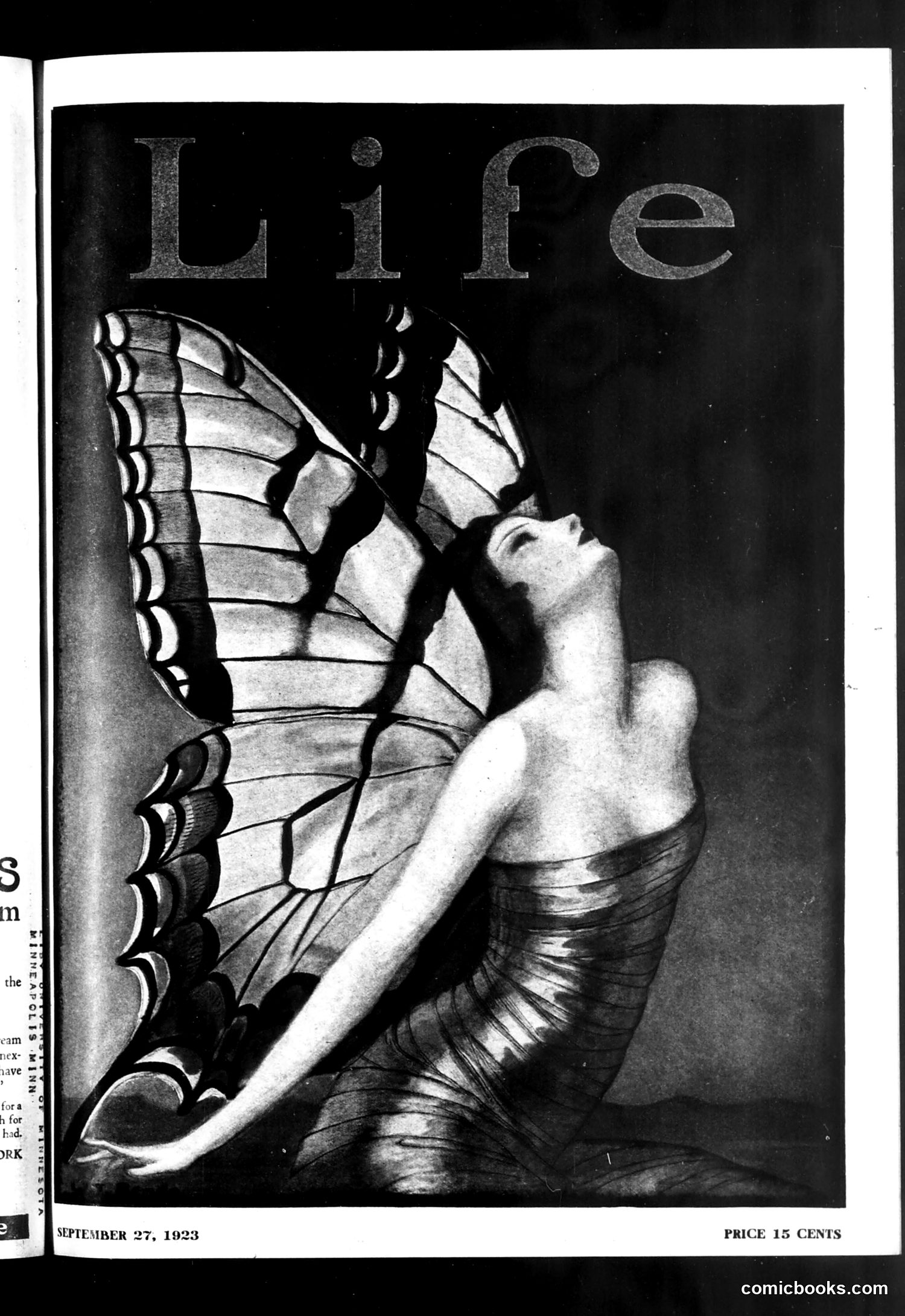
This appears to be a Life magazine cover featuring an Art Deco-style illustration of a woman with large, ornate butterfly wings. The image exemplifies 1920s aesthetic sensibilities—the woman's bare shoulders, bobbed-hair era styling, and the decorative wing design reflect the flapper period and modernist artistic trends popular during the Jazz Age. Without additional OCR text beyond the title "Life" and publication details, the specific satirical or political message isn't entirely clear from the image alone. The butterfly motif may reference themes of transformation, beauty, or femininity, but the particular point of satire—if any—remains uncertain. The cover price of 15 cents and date confirm its authenticity as a 1923 publication.
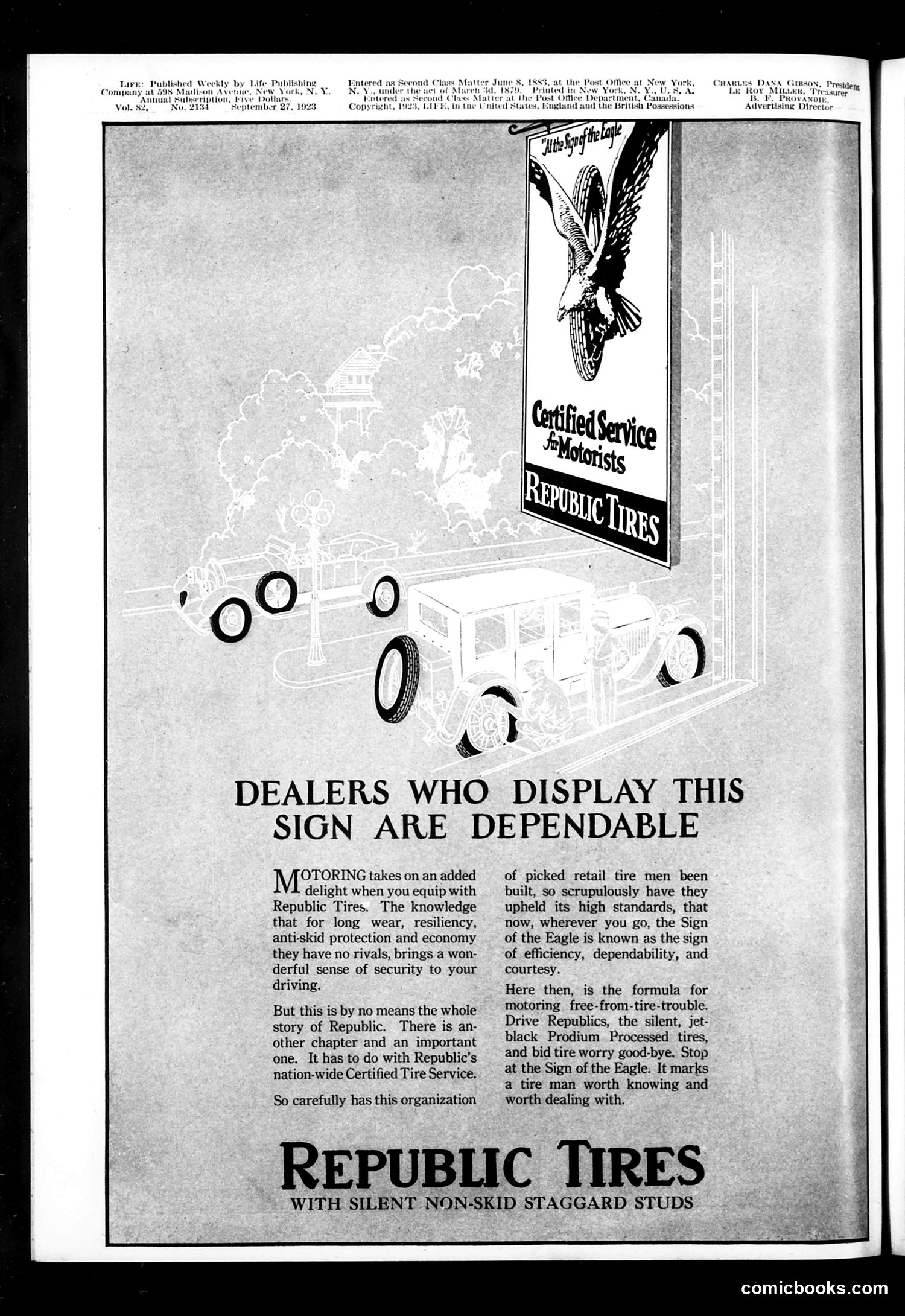
This is primarily a **commercial advertisement** for Republic Tires, not political satire. The page promotes their "Certified Service for Motorists" program, featuring an eagle logo that dealers could display to signal reliability and dependability. The advertisement emphasizes Republic's tire quality (durability, resilience, skid protection) and their network of certified service dealers. The "Sign of the Eagle" serves as a trustworthiness marker—a dealer displaying it is vouched for as "worth knowing and worth dealing with." The visual shows multiple tires surrounding a simplified car, illustrating the product. There is no political cartoon or satire present; this is straightforward early 20th-century consumer advertising using the eagle as a symbol of American quality and reliability.
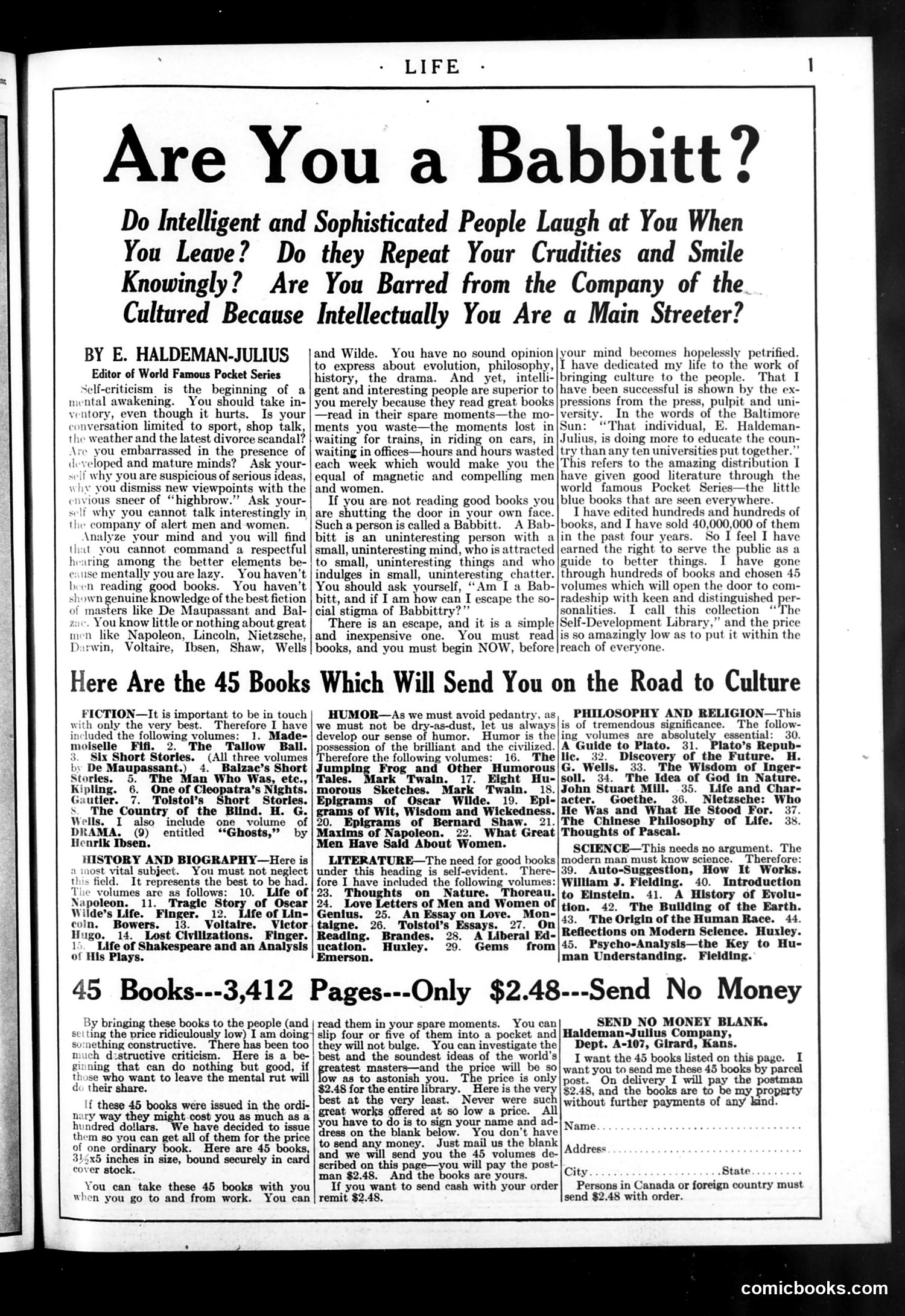
This page is primarily a **book advertisement** rather than a political cartoon. The headline sarcastically addresses people accused of being "Babbits"—a reference to Sinclair Lewis's 1922 novel *Babbitt*, which satirized conformist, intellectually narrow American businessmen. The ad uses social shame as marketing: it mocks readers who lack cultural sophistication, claiming intelligent people laugh at their ignorance. The solution? Purchase these 45 classic books (fiction, philosophy, humor, biography) for only $2.48 to escape this embarrassing status. This reflects 1920s anxieties about American cultural refinement and the emerging "self-improvement" consumer market targeting the middle class. The ad weaponizes insecurity to sell literature as social status.
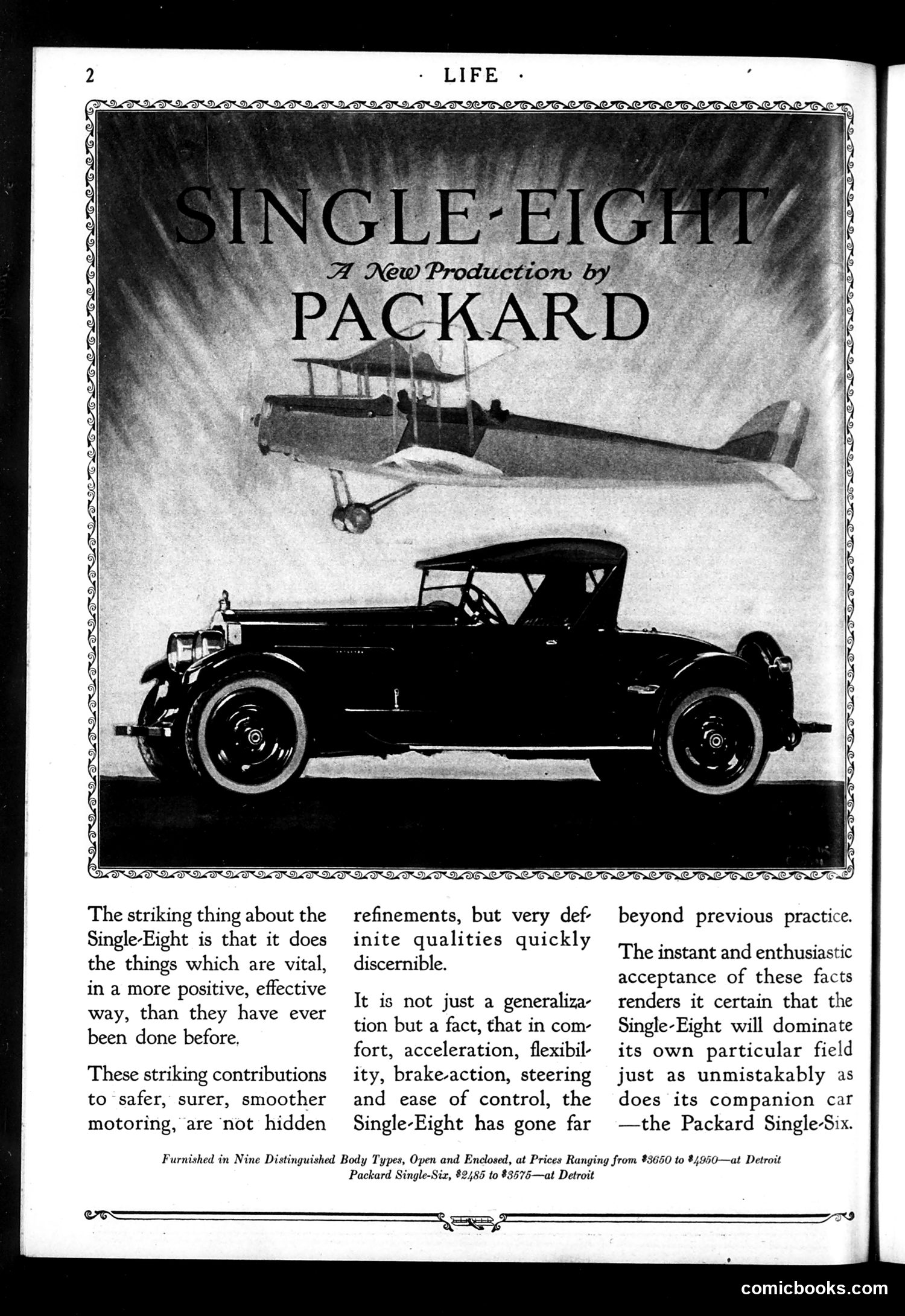
This page is **not a cartoon or satire** — it's a straightforward advertisement for the Packard Single-Eight automobile, published in *Life* magazine. The ad compares two modern technological achievements: an early airplane (appearing above) and the Packard Single-Eight car (below). The text emphasizes the automobile's innovations in comfort, acceleration, steering, and braking — presenting these as practical improvements over previous models. The "striking thing" being advertised is that Packard achieved superior performance in everyday driving concerns. The ad references the companion "Packard Single-Six" model to establish product range. This represents early 20th-century automotive advertising strategy: positioning a car as equally impressive and forward-thinking as aviation technology, appealing to consumers' appetite for modern innovation.
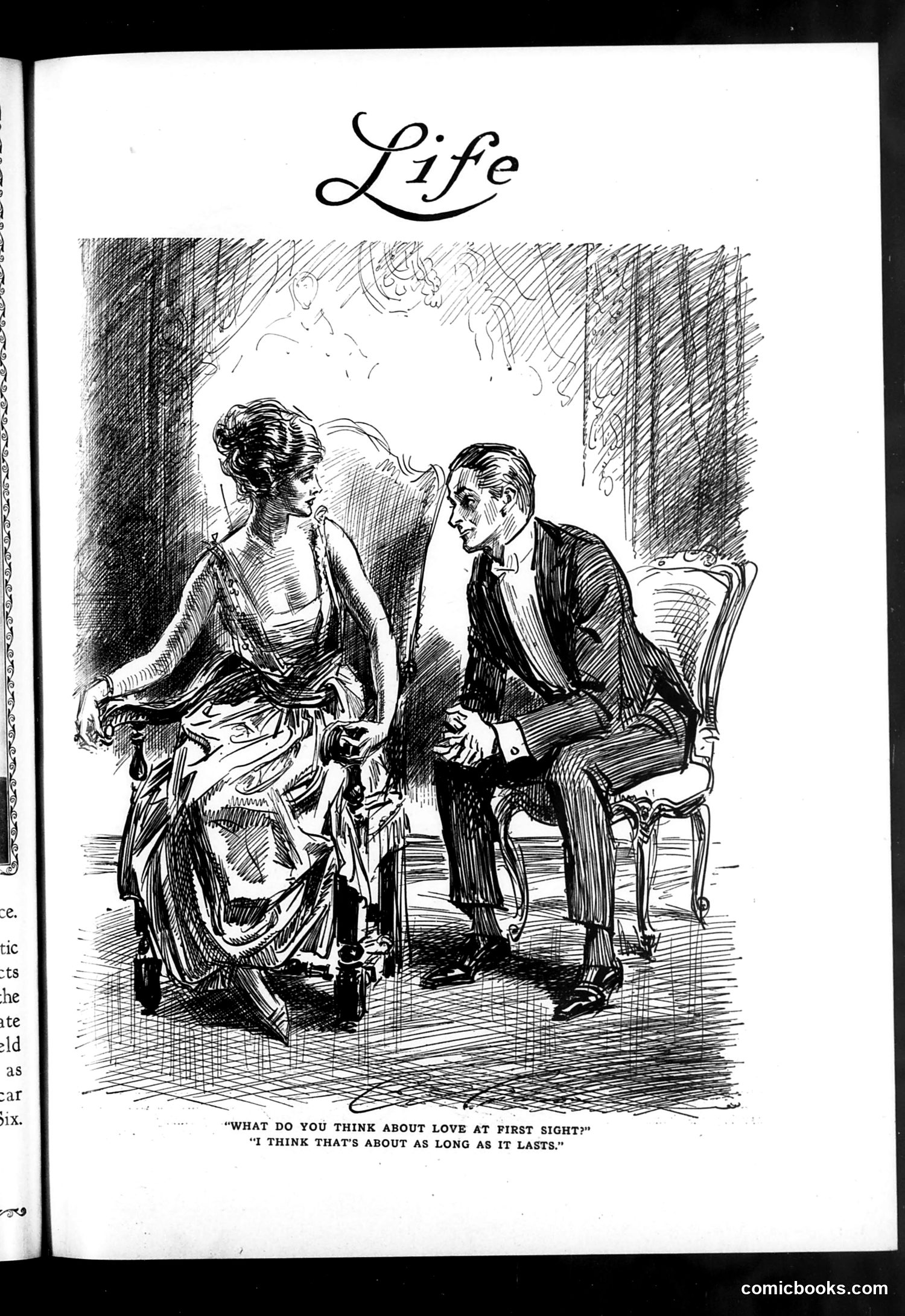
This page from *Life* magazine presents a romantic comedy sketch titled "Life" at the top. The illustration shows a well-dressed couple in an elegant interior—a woman in an evening gown and a man in formal attire—seated and conversing. The caption reads: "WHAT DO YOU THINK ABOUT LOVE AT FIRST SIGHT?" / "I THINK THAT'S ABOUT AS LONG AS IT LASTS." This is satirical social commentary on romantic relationships, specifically mocking the brevity of initial romantic attraction. The joke suggests that "love at first sight" is superficial and short-lived—lasting only as long as the first impression itself. The sophisticated setting and formal dress underscore the irony, presenting what appears to be an elegant romantic scenario while delivering a cynical observation about human nature and relationships.
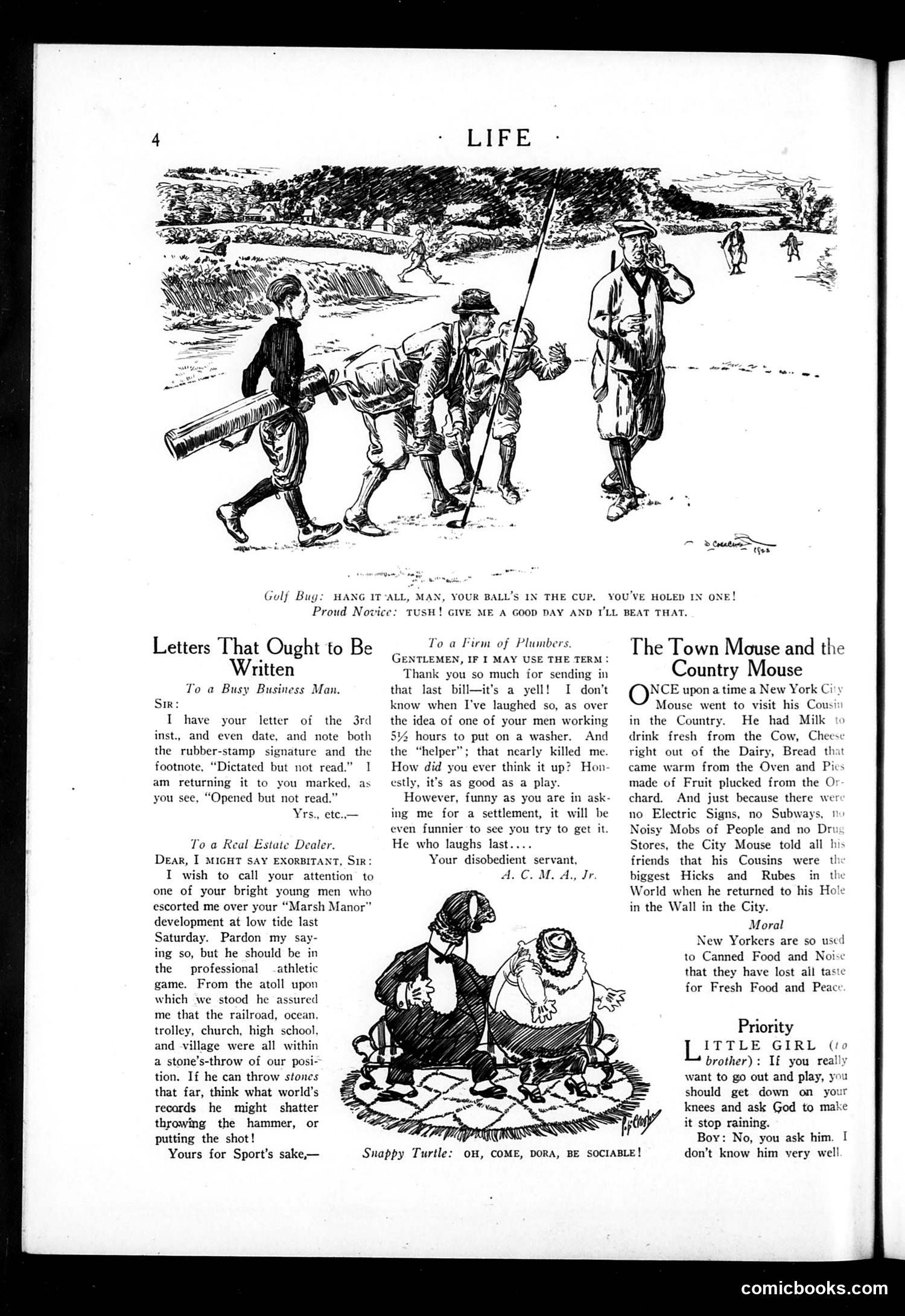
The top cartoon depicts a golf scene with the caption "Golf Bug: HANG IT ALL, MAN, YOUR BALL'S IN THE CUP. YOU'VE HOLED IN ONE!" with a player's proud response about beating his competitor. This satirizes golf enthusiasts' obsessive behavior and their tendency to boast about minor achievements. The page also contains three sections of humorous letters and short stories: "Letters That Ought to Be Written" (satirizing formal correspondence), a real estate dealer's complaint, and "The Town Mouse and the Country Mouse" (contrasting urban versus rural life). The "Snappy Turtle" illustration at bottom appears comedic filler. The overall content represents typical early 20th-century American satirical humor targeting middle-class social pretensions and leisure activities.
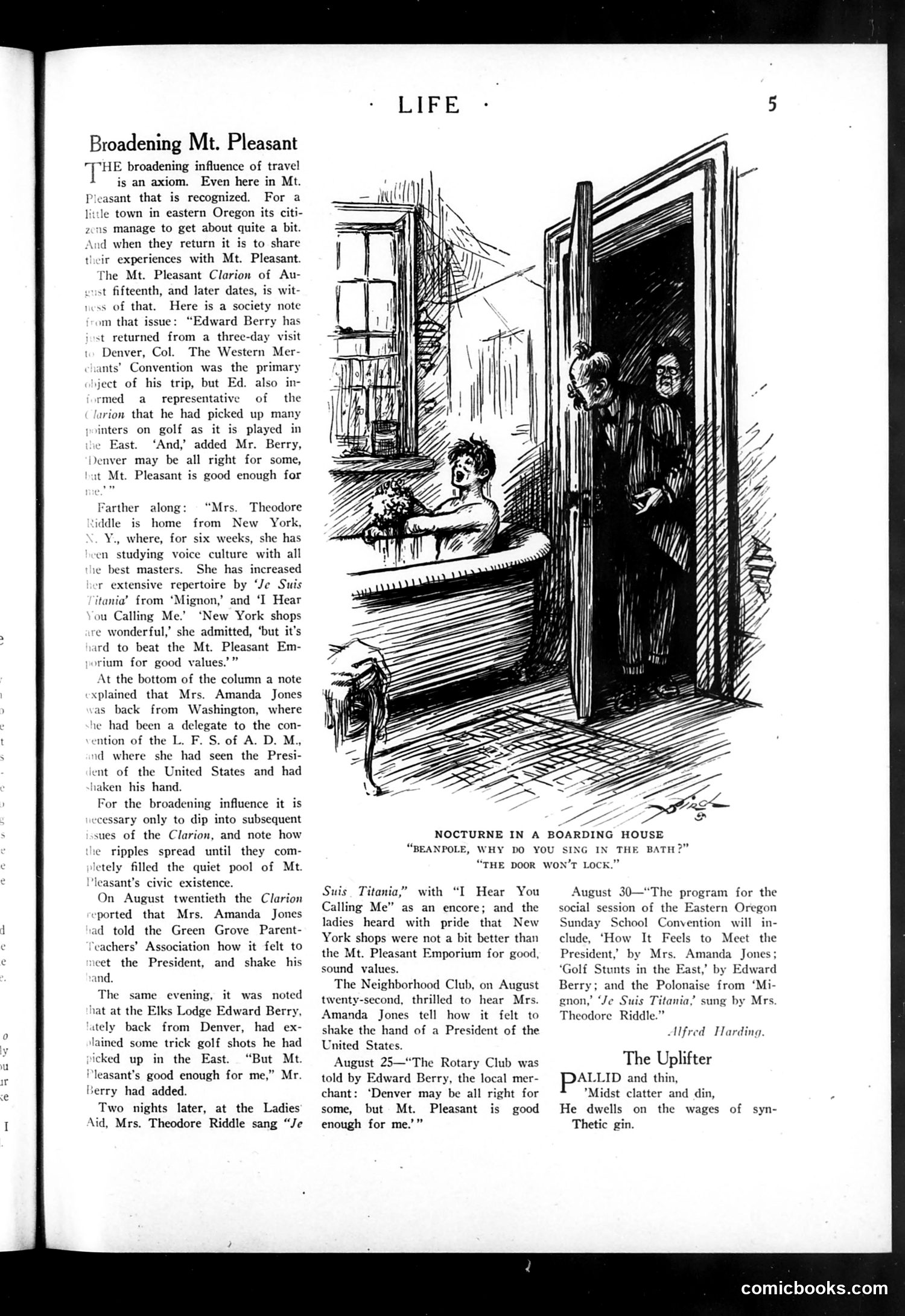
The illustration shows a humorous domestic scene: a woman in a bathtub singing loudly while two figures (appearing to be other boarding house residents) stand at the doorway looking exasperated. The caption reads: "Braspole, why do you sing in the bath?" with the response "The door won't lock." This is a simple comedic sketch about boarding house life—a common living arrangement in early 20th-century America where multiple unrelated people shared accommodations. The joke centers on the woman's lack of privacy and the resulting annoyance to neighbors, suggesting both the cramped, inconvenient conditions of such housing and the obliviousness (or indifference) of residents to their communal impact. It's gentle domestic humor rather than political satire.
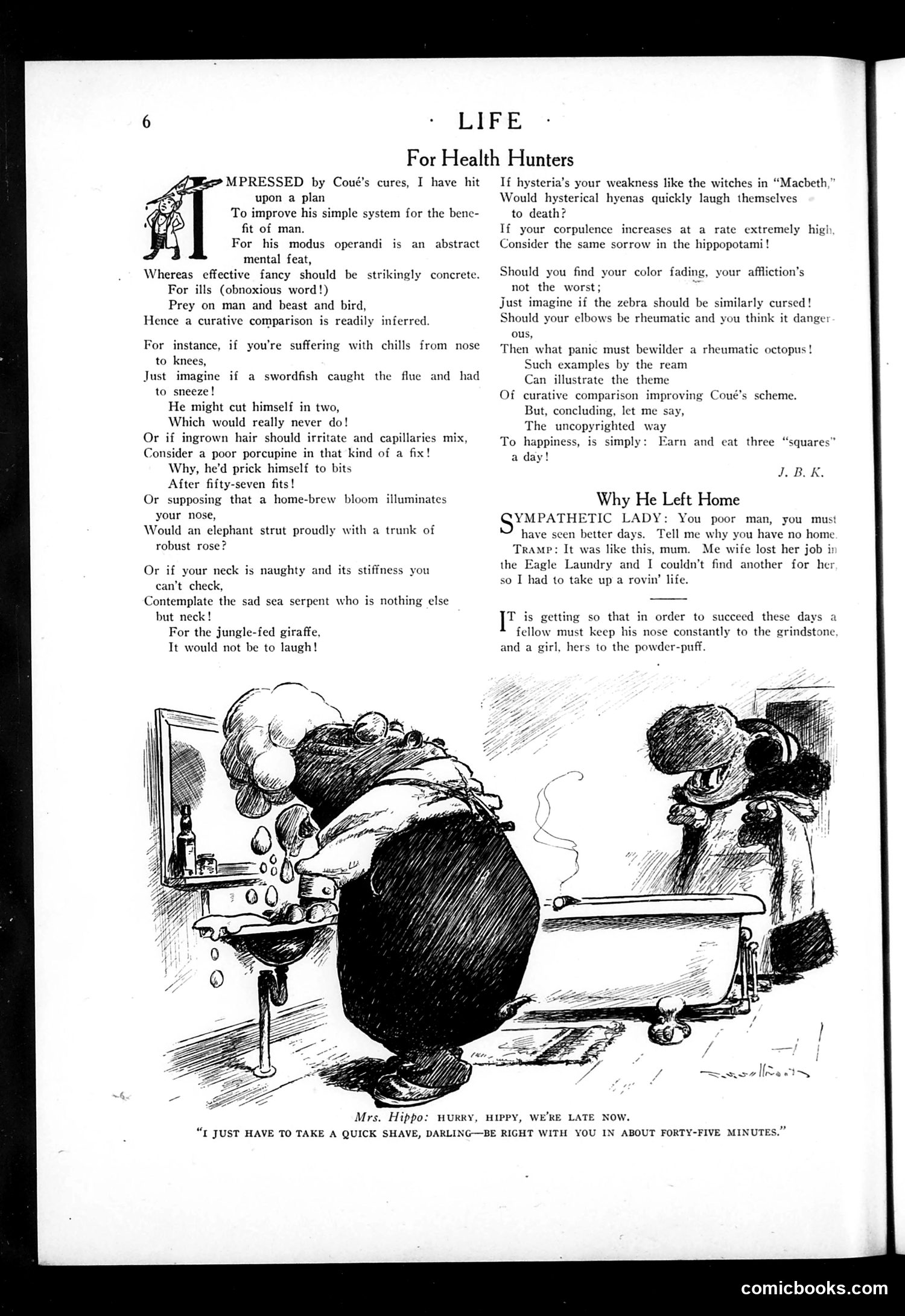
This page contains two distinct satirical pieces: **"For Health Hunters"** (left): A humorous poem mocking Coué's "positive thinking" cure system, which was popular in the 1920s. The satire suggests that comparing one's ailments to animals' afflictions is absurd—a swordfish with the flu wouldn't sneeze, an elephant wouldn't have a trunk problem. The piece ridicules the pseudo-scientific self-improvement trend. **"Why He Left Home"** (right): A domestic cartoon showing Mrs. Hippo rushing her husband, saying she needs forty-five minutes for a quick shave. The humor relies on the visual absurdity of a hippopotamus and the exasperation of domestic life where a woman's grooming needs constantly delay their plans. Both pieces target contemporary foibles: pseudoscience and domestic friction.
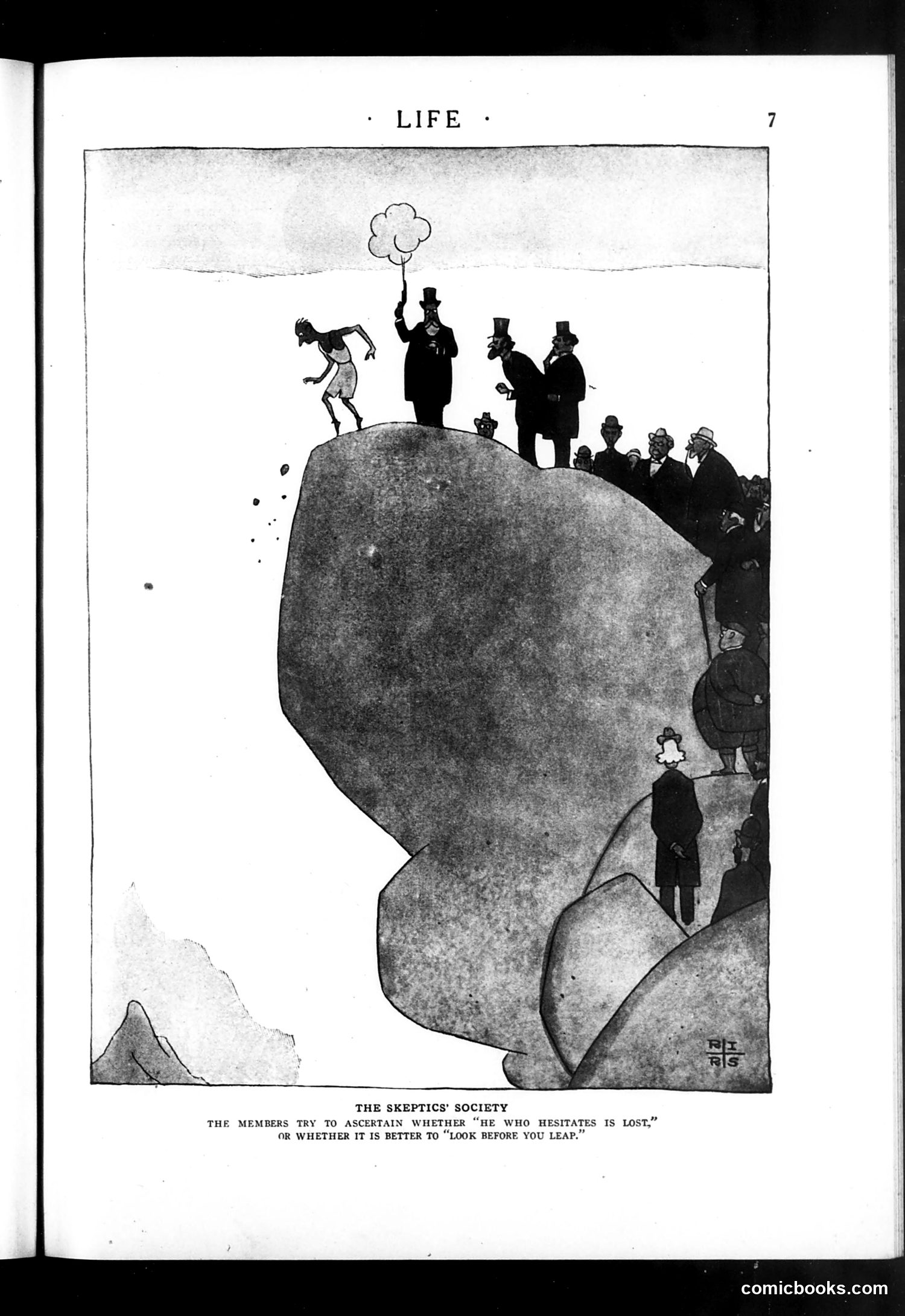
This cartoon satirizes philosophical skepticism and doubt. A group of formally-dressed men (representing skeptics or philosophers) stand atop a massive boulder, debating whether "he who hesitates is lost" or whether it's better to "look before you leap"—two contradictory proverbs about decision-making. Meanwhile, one figure dangles precariously from the boulder's edge, apparently having already fallen or jumped, illustrating the practical consequences of endless philosophical debate. The satire mocks intellectuals who become so consumed arguing abstract principles that they ignore real-world dangers and practical outcomes. The cartoon uses physical comedy—the actual falling figure—to underscore how theoretical deliberation can prove useless or harmful when disconnected from reality.
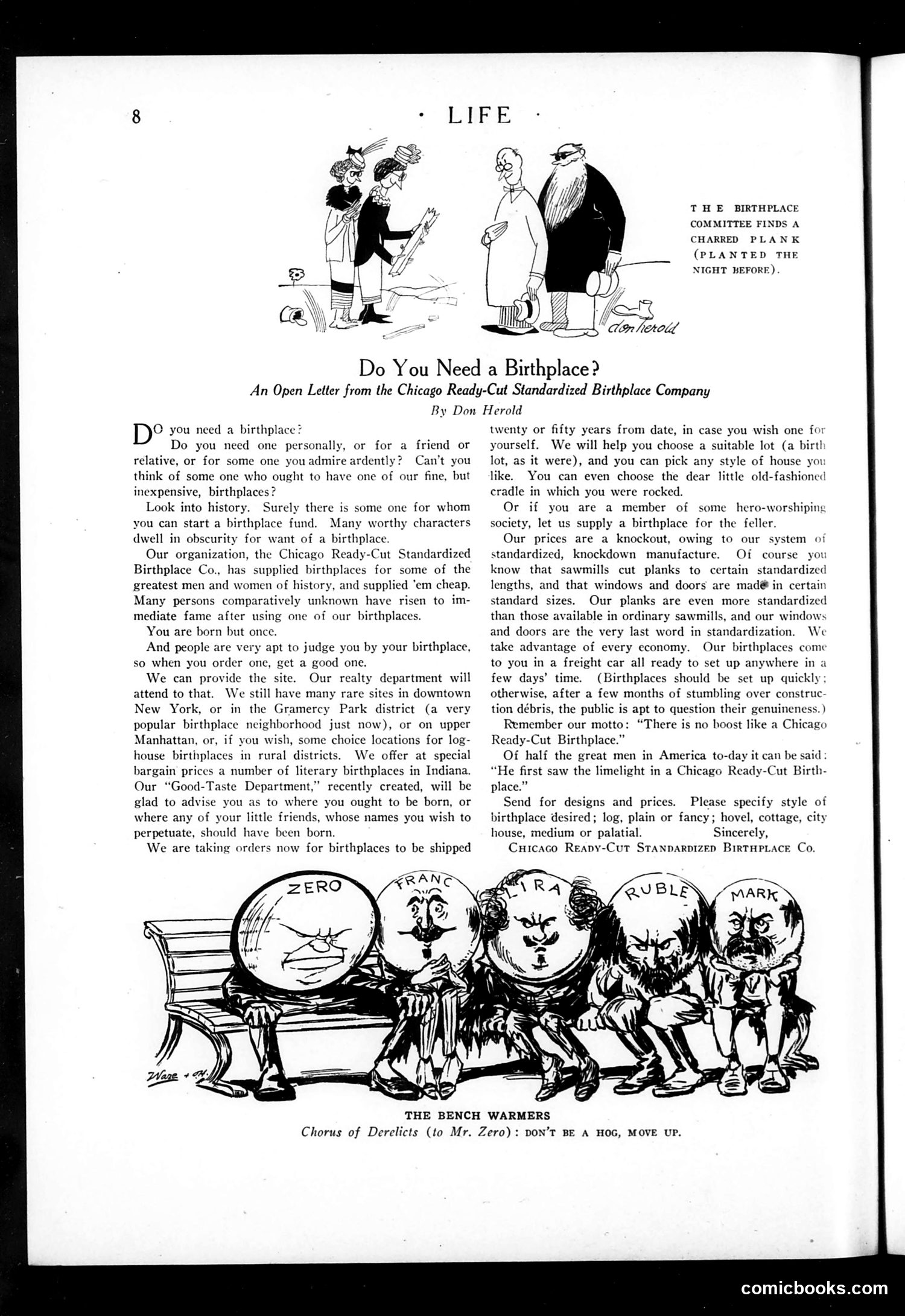
This page satirizes the "Chicago Ready-Cut Standardized Birthplace Company," a fake business offering prefabricated birthplaces for sale. The satire mocks the American obsession with prestigious origins and genealogy—suggesting wealthy or ambitious people might literally purchase a "better" birthplace retroactively. The top cartoons show the company's services: helping clients select appropriate birthplaces (rural cottages, city houses) to enhance their social standing. **The bottom cartoon**, "The Bench Warmers," depicts personified currency (Zero, Franc, Lira, Ruble, Mark) as derelicts, with the caption "Don't be a hog, move up." This satirizes how different national currencies were performing during economic uncertainty, likely referencing post-WWI financial instability. Together, the page ridicules both class pretension and international economic turbulence.
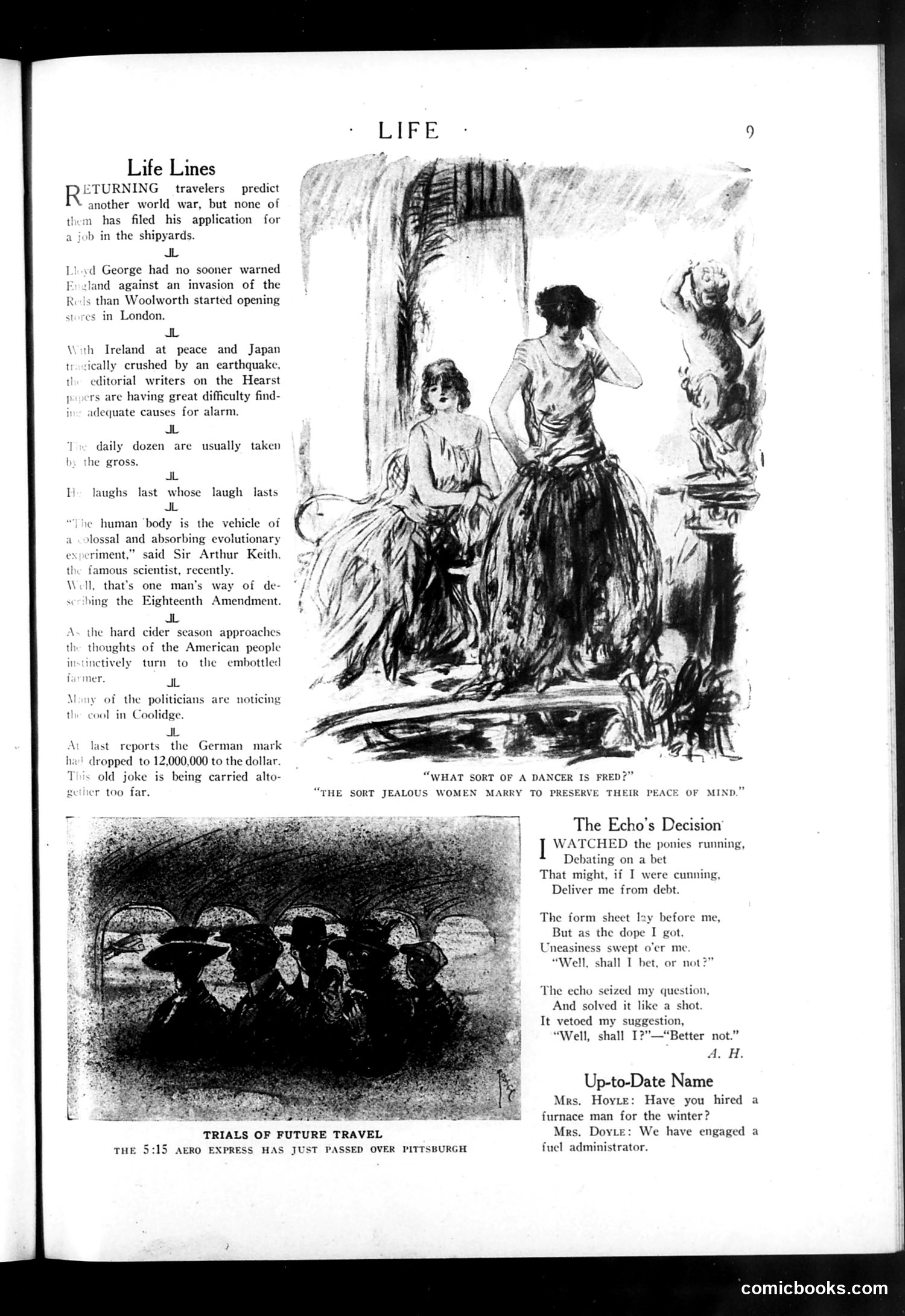
This page contains three distinct pieces: 1. **"Life Lines"** - A brief news commentary column touching on various topics: Lord George's warning about invasion, Ireland's peace, a Japan earthquake, and editorial difficulties finding alarm causes. 2. **Upper cartoon** - Sketches two women discussing a dancer, with caption questioning "What sort of dancer is Fred?" and "The sort jealous women marry to preserve their peace of mind." This satirizes marriages of convenience or appeasement in relationships. 3. **"The Echo's Decision"** - A humorous poem about a man debating whether to bet on ponies, where an echo answers his indecision with "Better not." 4. **Lower photograph** - Captioned "Trials of Future Travel: The 5:15 Aero Express Has Just Passed Over Pittsburgh," showing what appears to be early aviation technology. The page reflects early 20th-century concerns about technology, social relationships, and modern anxieties.
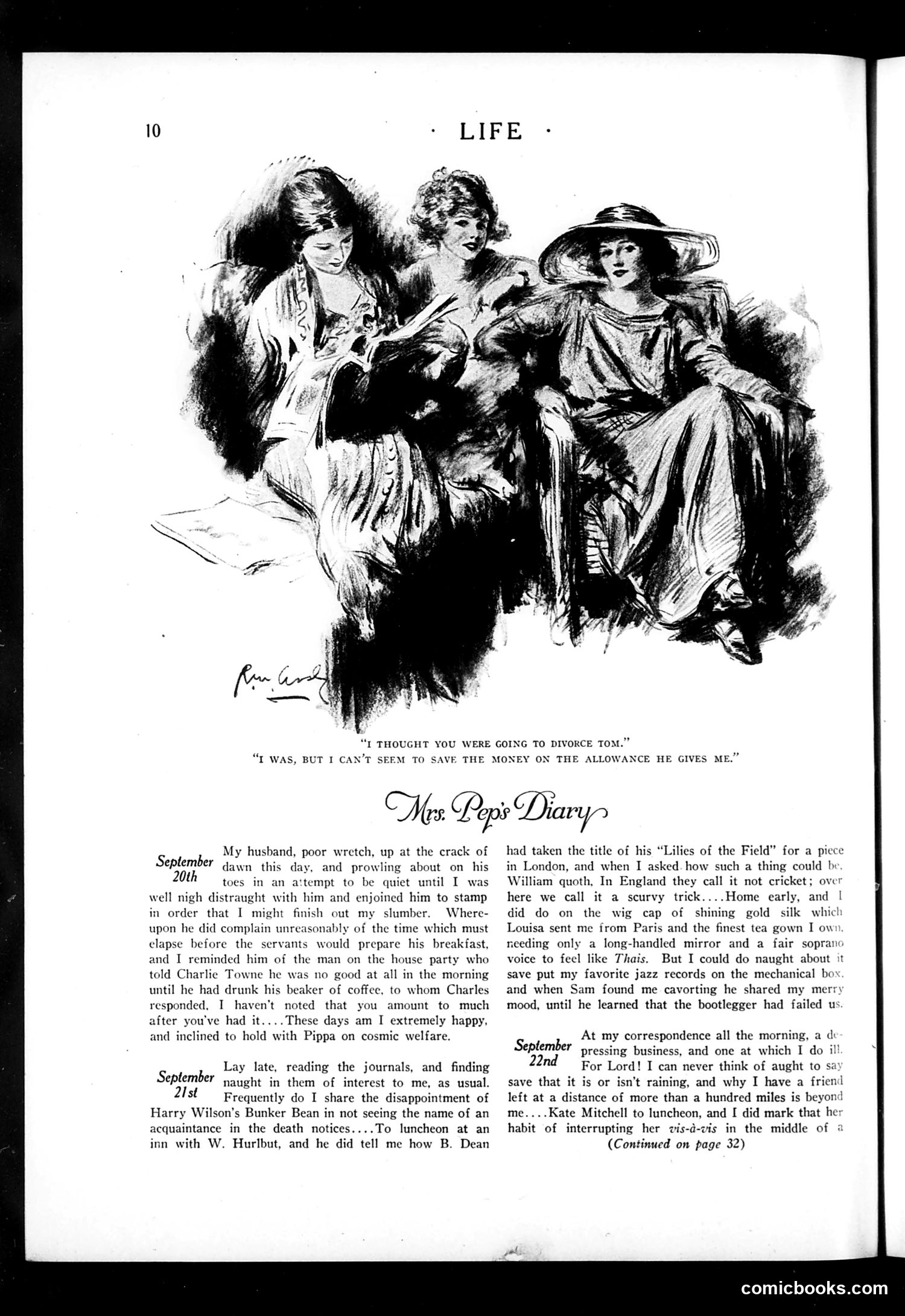
This page features "Mrs. Pep's Diary," a satirical domestic humor column illustrated with a sketch of three fashionable women in conversation. The cartoon caption depicts a wife discussing her husband's financial concerns: she mentions he wanted a divorce but she "can't seem to save the money on the allowance he gives me." The satire targets **marital financial dynamics** of the era—specifically, a wife's limited economic independence and control over household money. The joke's irony: she can't afford to leave her husband because he controls the purse strings so tightly. The diary entries below document mundane domestic life (correspondence, social visits, coffee), reflecting the magazine's satirical focus on upper-class women's leisure culture and domestic preoccupations.
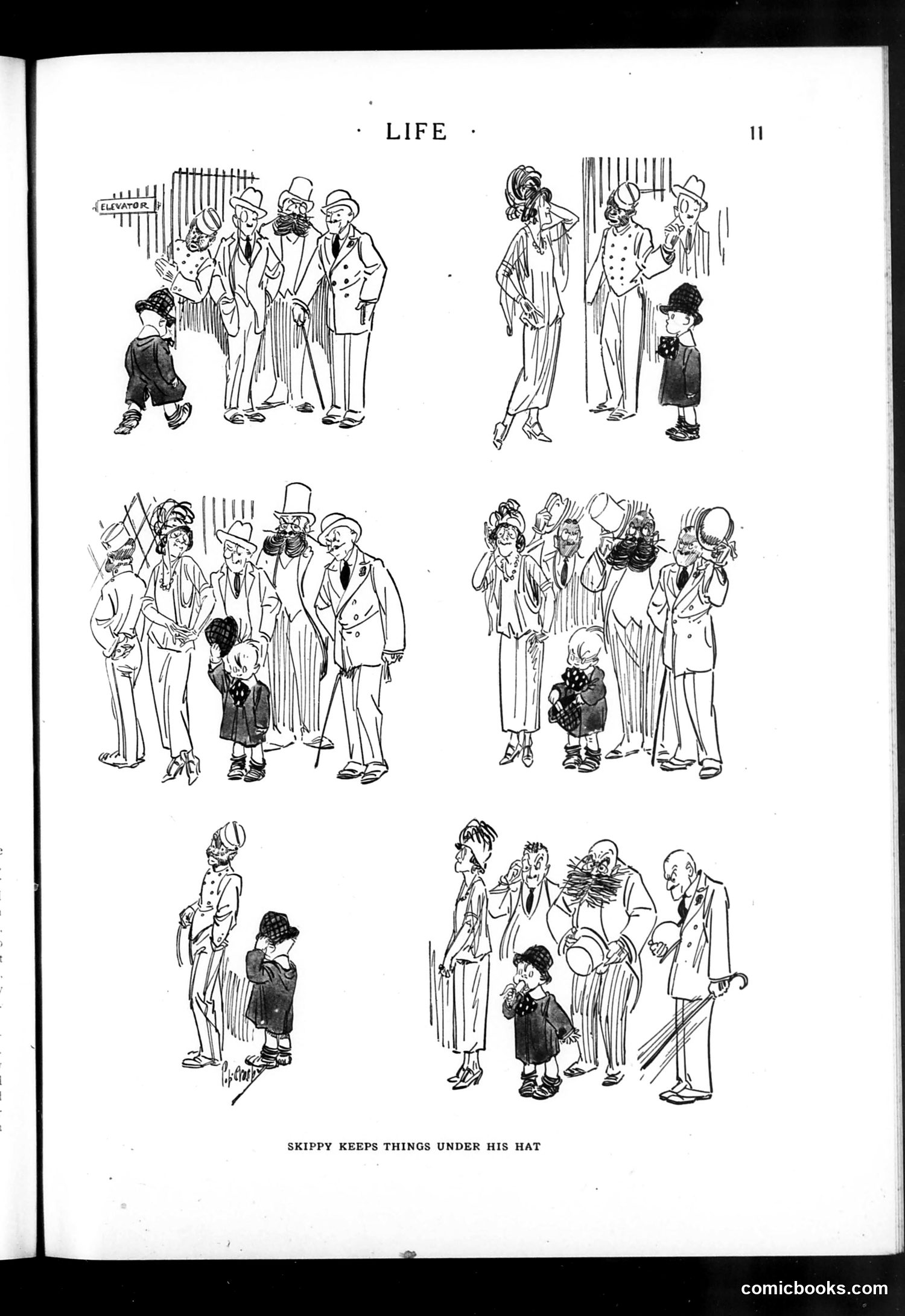
This is a humorous comic strip sequence from *Life* magazine featuring a character named Skippy (a small child in dark clothing). The strip shows Skippy interacting with various well-dressed adults in formal attire—men in suits and top hats, women in 1920s-style clothing. The joke's premise appears to be that Skippy possesses some secret or knowledge ("keeps things under his hat") that the adults around him either want to know or are unaware of. The repeated scenes show different adult groups attempting to engage with or learn something from the diminutive child, suggesting a reversal of typical authority dynamics—the small child holds the upper hand over the formally-dressed, presumably important adults. The humor relies on this size/power inversion common in period children's comics.
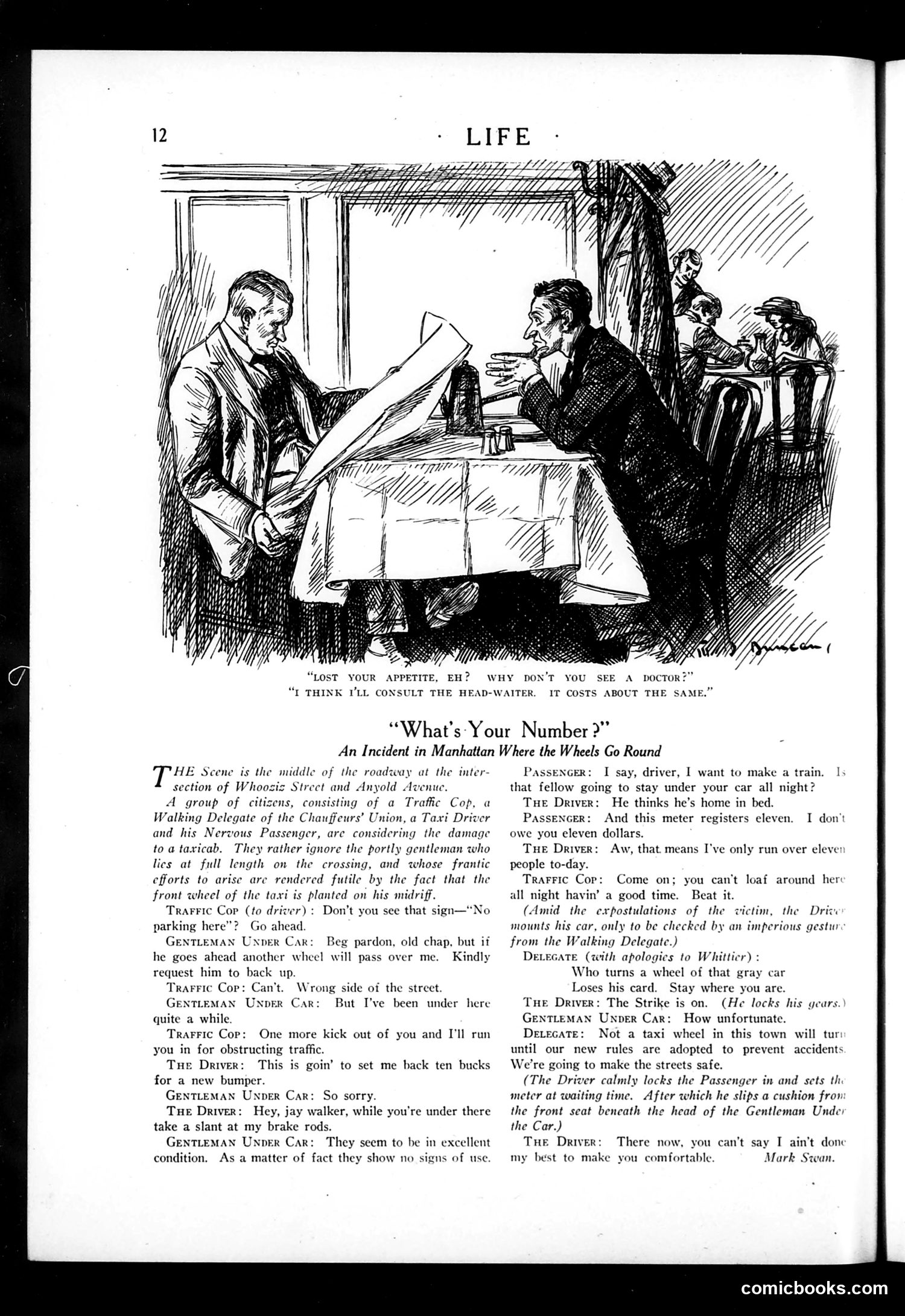
This page contains two distinct pieces: **Top cartoon:** A restaurant scene where a diner complains about lost appetite. The punchline suggests consulting a "head-waiter" instead of a doctor—implying the waiter's expensive bills rival medical fees. This satirizes the pretension and high costs of upscale dining establishments. **Main story: "What's Your Number?"** A comedic sketch set at the intersection of Woolzie Street and Anyold Avenue in Manhattan. It depicts a traffic accident involving a taxi driver, his passenger, and a "Walking Delegate" (a labor union representative) from the Cabbies' Union. The piece satirizes the tensions between taxi drivers, their passengers, and union officials during what appears to be early 20th-century labor disputes over working conditions and street safety regulations in New York City.
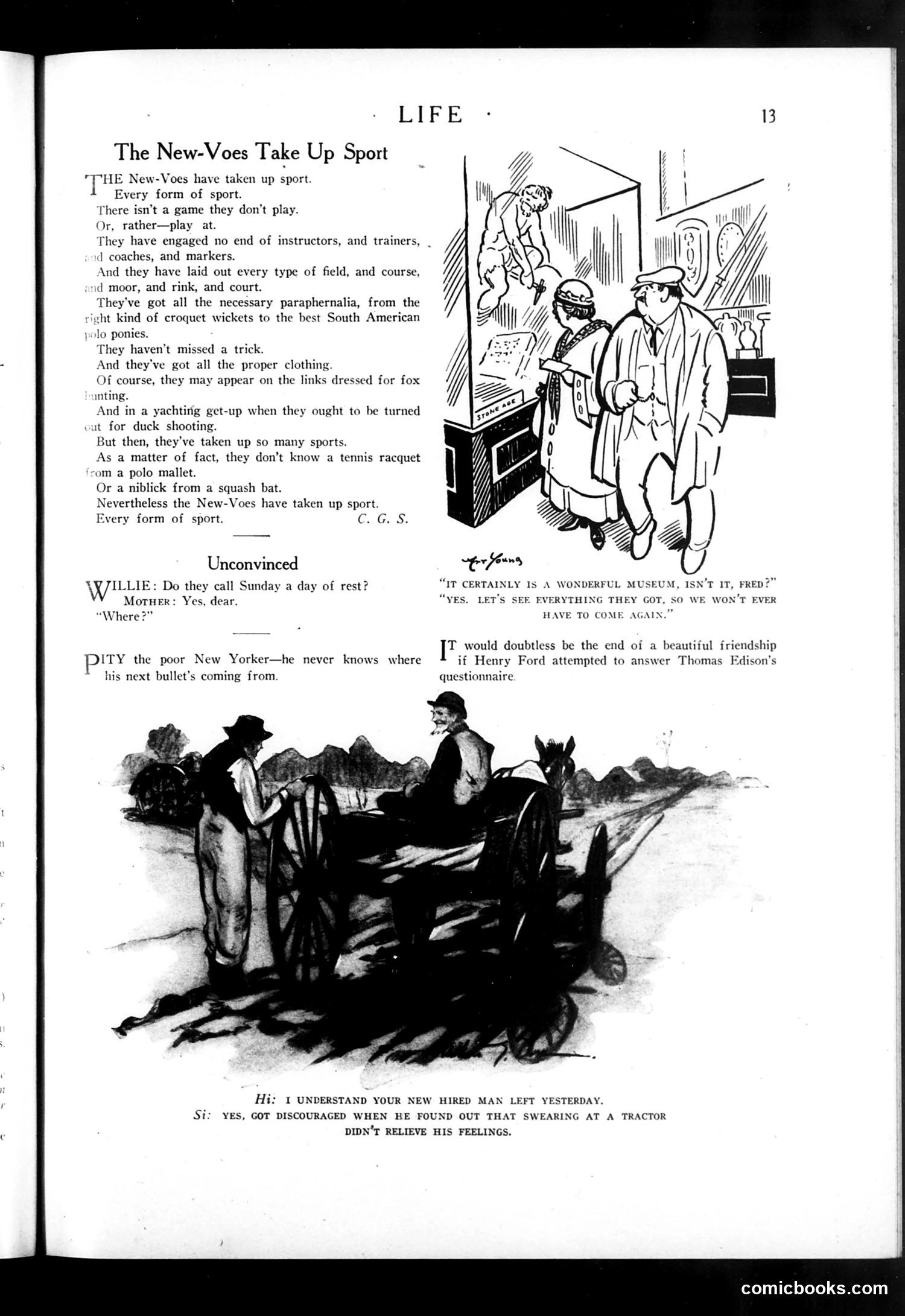
This page contains three satirical pieces mocking the wealthy "New-Voes" (likely "nouveau riche"—newly rich people): 1. **"The New-Voes Take Up Sport"**: A poem satirizing wealthy newcomers who adopt all sports fashions and equipment without genuine knowledge, confusing tennis rackets with polo mallets and lacking proper understanding. 2. **"Unconvinced"**: A brief joke where a mother explains Sunday is a "day of rest," mocking New Yorkers' ignorance about rural life customs. 3. **Bottom cartoon**: Shows a man in a car confronting a farmer about an employee's swearing, satirizing the wealthy's disconnect from working-class behavior and rural culture. The overall theme: nouveau riche affectation and incompetence in both leisure and understanding ordinary people's lives.
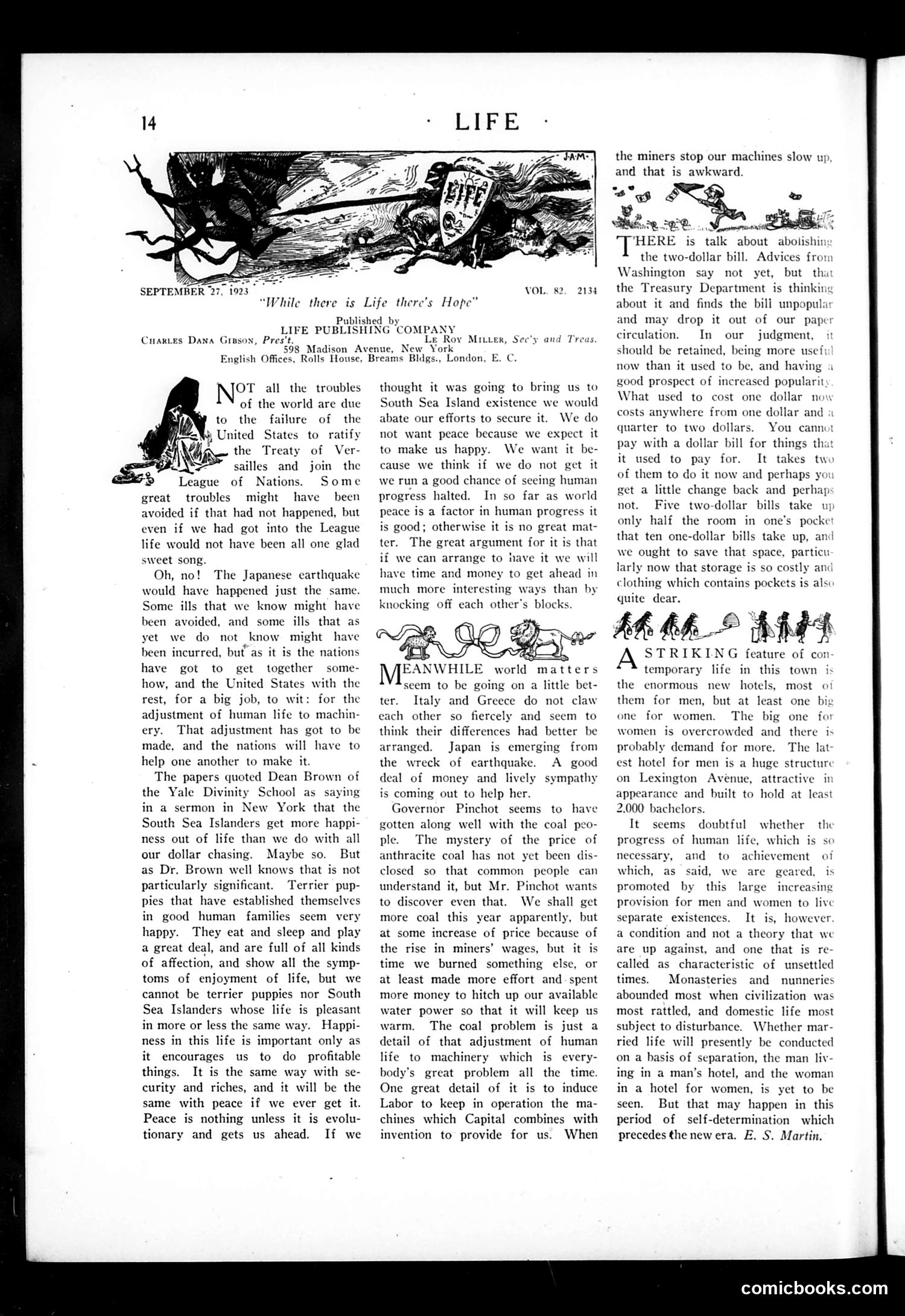
The masthead cartoon depicts a skeletal death figure holding a sign reading "LIFE," playing on the magazine's title. This accompanies the editorial's discussion of global peace and the League of Nations. The main article argues that world troubles stem from the failed U.S. ratification of the Treaty of Versailles and League membership. It references the recent Japanese earthquake (September 1, 1923) as an example requiring international cooperation. The piece advocates that peace, though difficult, is necessary for human progress—not merely idealistic philosophy but practical economic necessity. A secondary editorial discusses inflation and labor issues, specifically coal miners' demands and wage increases. The cartoons and text together present Life's progressive stance: that American isolationism harms global stability and domestic prosperity alike.
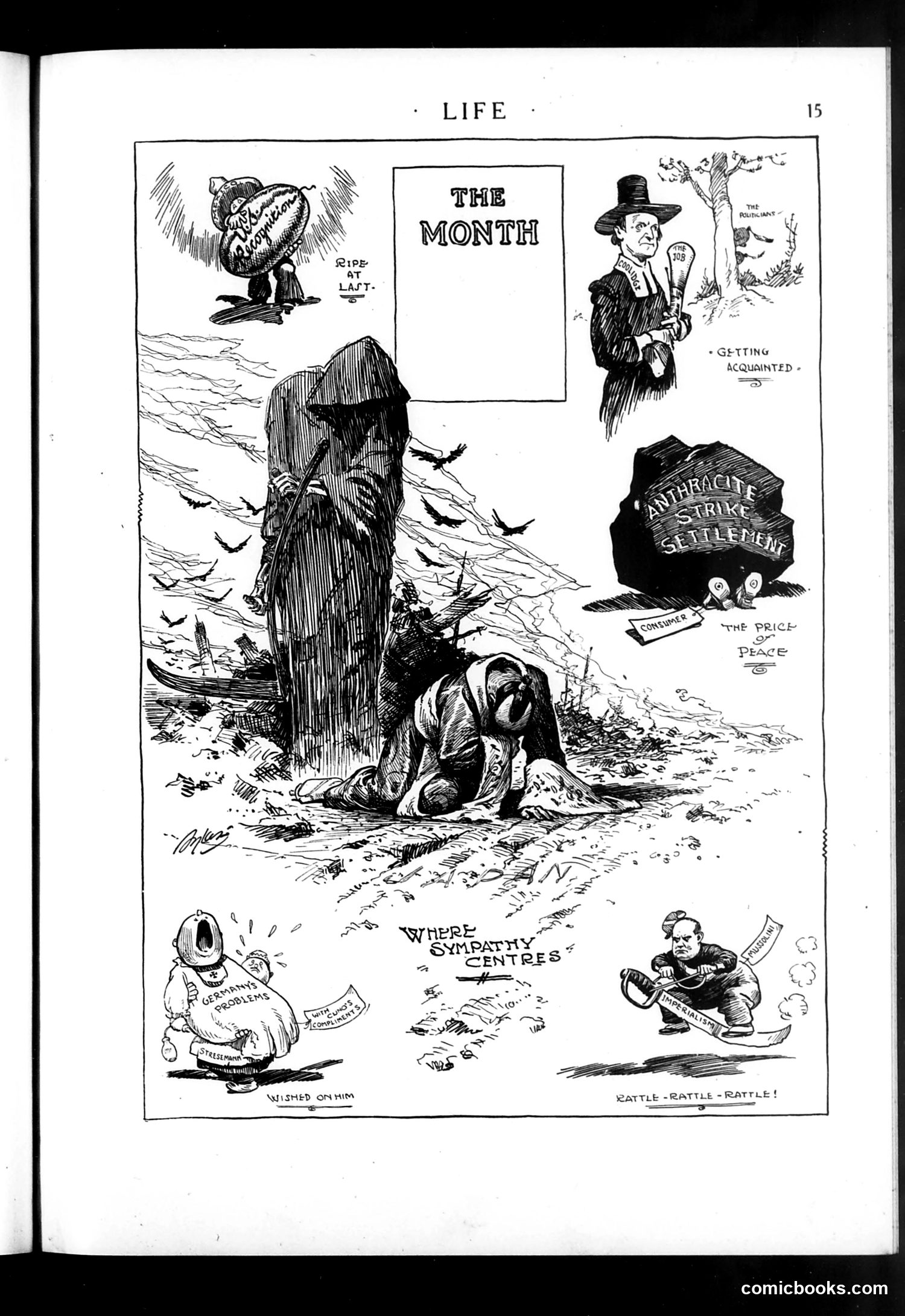
This satirical cartoon addresses the **anthracite coal strike settlement**, likely from 1902. The central image shows a man kneeling beneath a large tree stump labeled "ANTHRACITE STRIKE SETTLEMENT," suggesting the weight of negotiated peace. Surrounding vignettes mock various responses: "Getting Acquainted" shows a figure meeting the settlement terms; "The Price of Peace" depicts costs paid; "Where Sympathy Centres" reveals where public concern lay (likely with different stakeholders); and "Rattle-Rattle-Rattle" appears to mock rattling of sabers or continued agitation. The cartoon suggests that while the strike ended, the "price" was heavy and sympathies remained divided among miners, operators, and the public. The artist criticizes the compromise as burdensome rather than truly satisfactory to all parties.
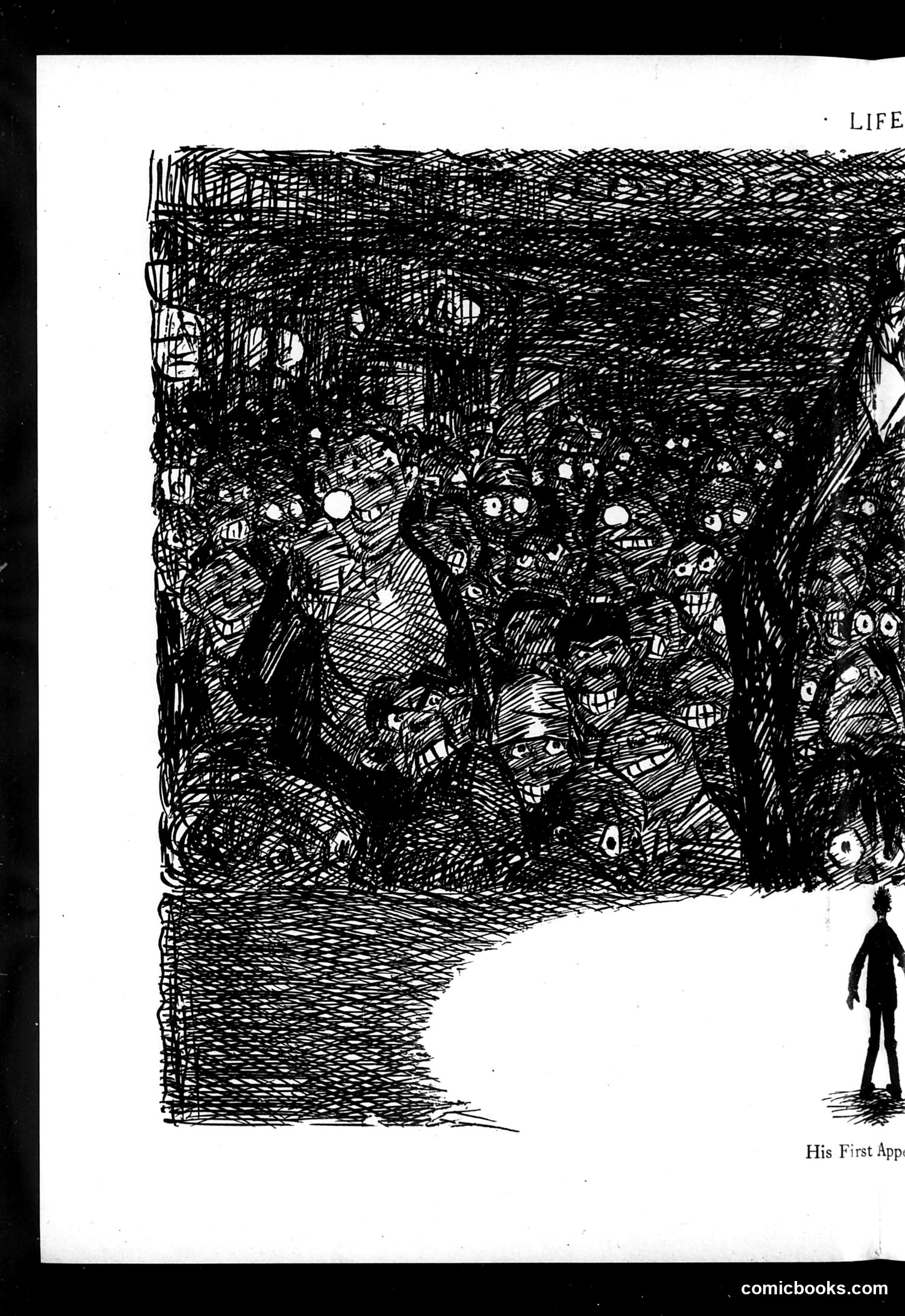
This appears to be a satirical illustration from *Life* magazine showing a solitary figure standing before a massive, densely-packed crowd of grotesque or caricatured faces filling an interior space. The title fragment reads "His First App[earance]" (likely "His First Appearance"). The cartoon likely satirizes a performer's or public figure's debut before an intimidating or overwhelming audience. The exaggerated, almost nightmarish rendering of the crowd—with emphasized eyes and mouths—suggests anxiety or the disorienting nature of facing masses of scrutiny. Without additional context or visible date information, I cannot identify the specific figure or event being mocked, but the composition clearly conveys themes of performance anxiety, public judgment, or the overwhelming nature of sudden fame or public attention.
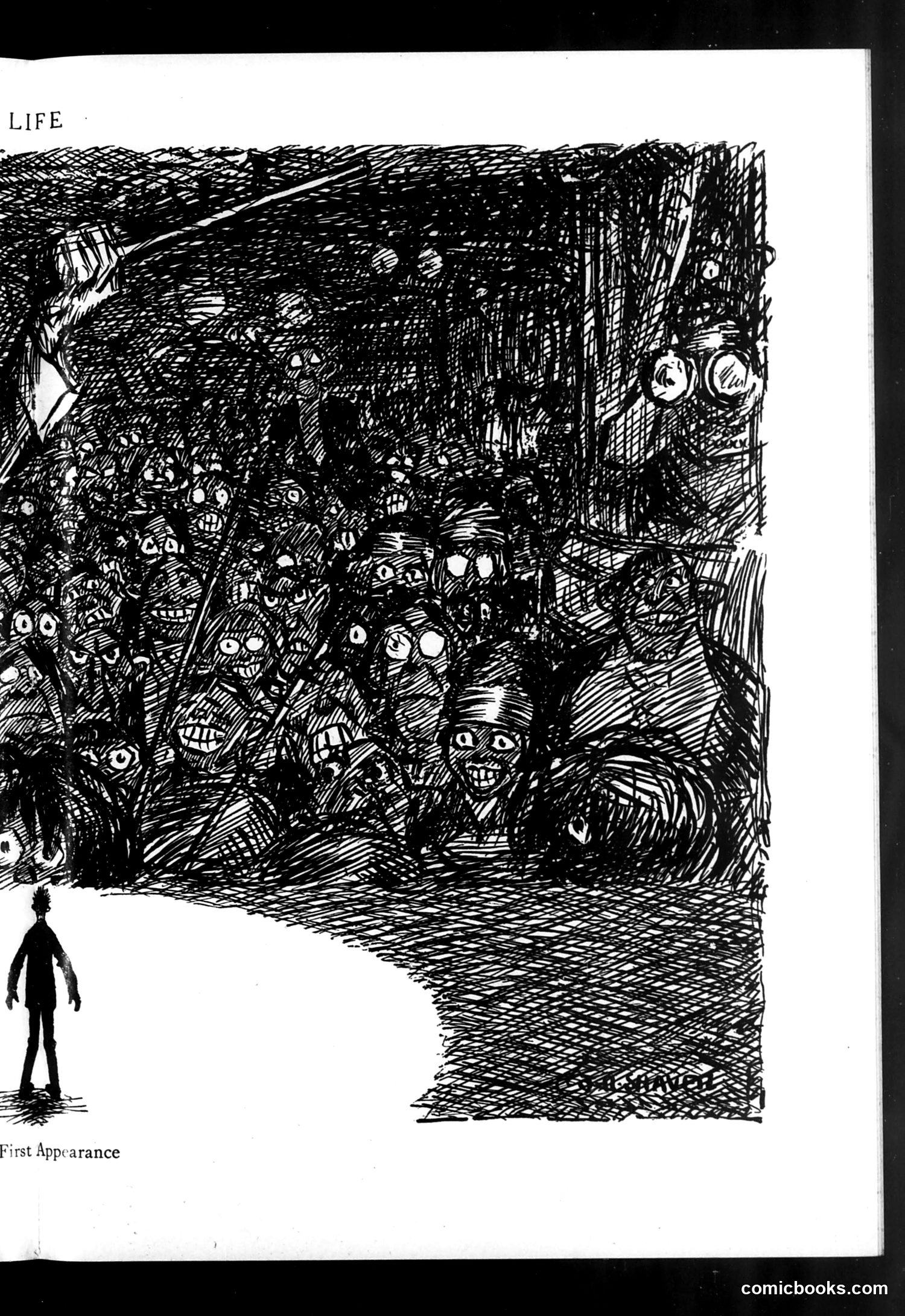
This ink drawing depicts a solitary human figure standing before a massive, densely-packed crowd of grotesque creatures with exaggerated features—wide eyes and prominent teeth. The creatures appear animalistic or monstrous, rendered in chaotic cross-hatching. The cartoon likely satirizes encountering an overwhelming mass of humanity or society—possibly critiquing urbanization, immigration, or mass culture. The lone figure's small scale emphasizes human insignificance before collective forces. The creatures' caricatured features suggest the artist viewed "the masses" with dark humor or social anxiety. Without specific publication date or artist attribution visible, the exact political target remains unclear, though the theme echoes early-20th-century anxieties about modern society's dehumanizing effects.
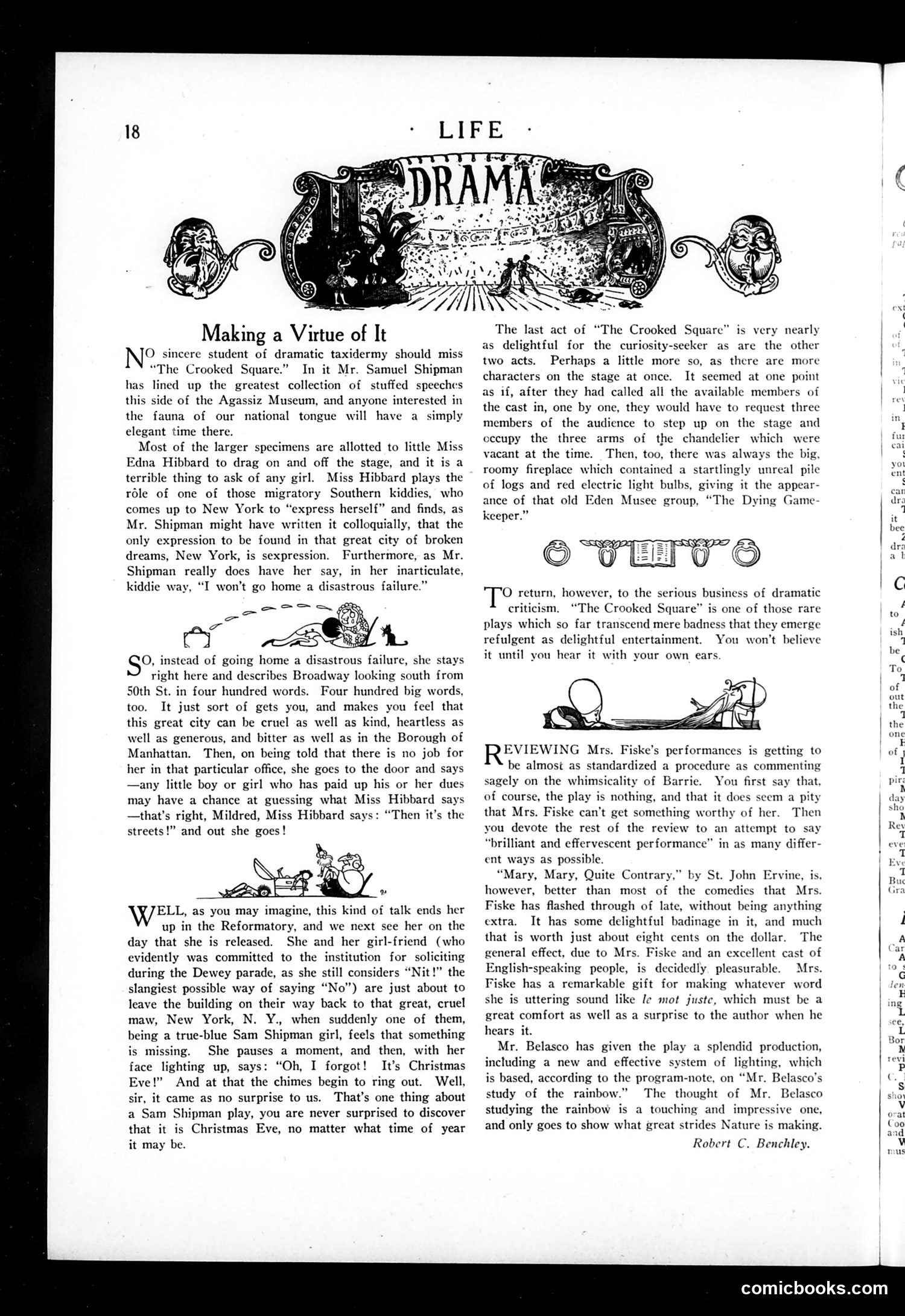
This is a theater review of the play "The Crooked Square" by Samuel Shipman, featuring actress Edna Hibbard. The critic uses heavy satire to demolish the production. The reviewer mocks the play's melodramatic dialogue as "stuffed speeches"—artificial and lifeless as taxidermied animals. Hibbard plays a Southern girl who comes to New York seeking self-expression but instead delivers lengthy, overwrought monologues (400 words describing Broadway). When rejected for a job, she dramatically declares "Then it's the streets!"—leading to her arrest and reformatory sentence. The satire peaks when the critic notes the play inexplicably ends on Christmas Eve, despite no seasonal setup, and includes absurdly fake stage props (electric light bulbs posed as fireplace logs). The reviewer sarcastically praises how the play "transcends mere badness" to become entertainingly terrible. The broader point: early 20th-century melodrama was overwrought, predictable, and emotionally manipulative—yet audiences found perverse enjoyment in its earnest awfulness.
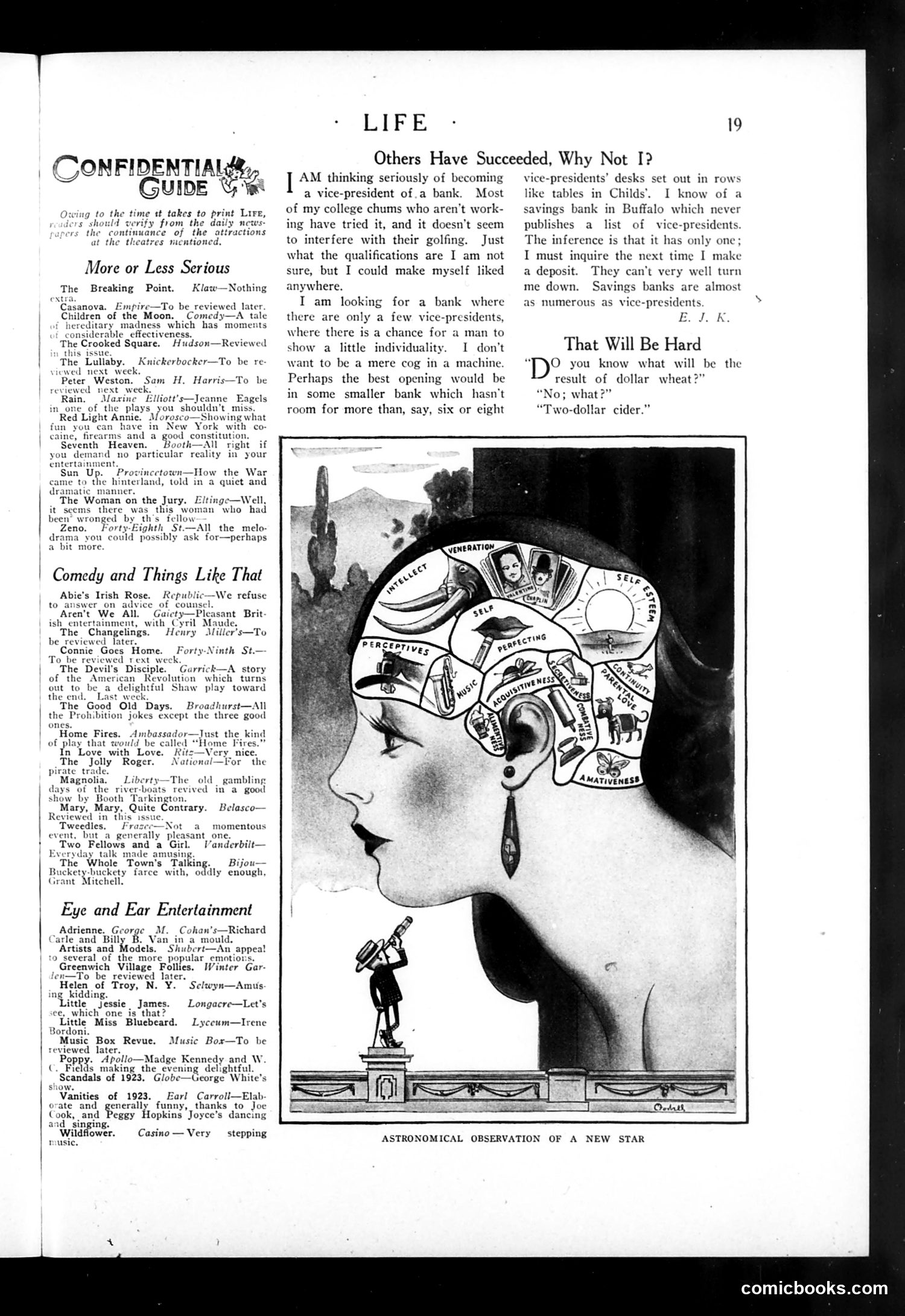
This full-page cartoon satirizes the shallow ambitions of 1920s white-collar workers. The illustration shows a profile of a man's head with his brain depicted as a phrenological map—a pseudoscientific head-reading system popular in the era. Inside the brain are labeled sections representing different mental faculties: "Observation," "Perception," "Self-esteem," and various other capacities, arranged like a map of territories. Below, a tiny figure with a telescope observes this "new star"—the ambitious young man himself. **The satire:** The accompanying text reveals the subject's reasoning for becoming a bank vice-president: it won't interfere with his golfing, and his college friends who aren't working have already tried it. The cartoon mocks the era's tendency toward empty careerism—pursuing prestigious titles without genuine qualification or effort, reducing human ambition to measurable but meaningless "mental faculties." It's a critique of 1920s corporate mediocrity and social climbing.
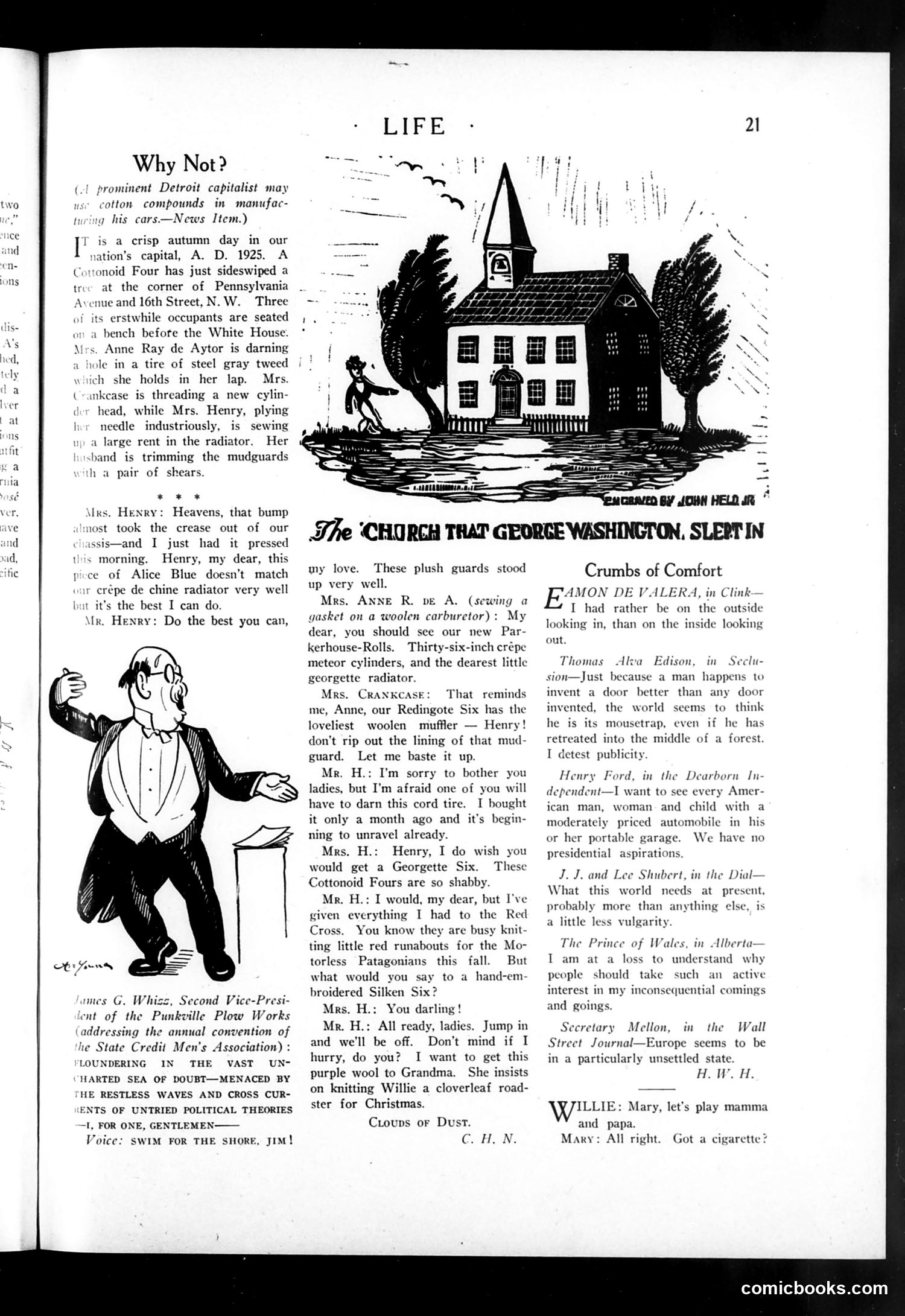
This 1925 *Life* magazine page satirizes wealthy Americans' obsession with consumer goods during the prosperous 1920s. **The main cartoon** depicts society women casually sewing fabric parts onto a broken-down automobile—treating expensive car components (radiator, mudguards, tires) as if they were clothing. The joke: these wealthy people are so fixated on material consumption that they absurdly conflate fashion with automobiles, using textile terminology ("crépe de chine," "georgette") for car parts. Their casual chat about competing luxury vehicles (Rolls-Royce, various "Sixes") while literally stitching their car together mocks both conspicuous consumption and the era's rapid automobile adoption. **Secondary jokes** include a child asking for a cigarette while playing house—mocking 1920s parenting and smoking normalization. **"Crumbs of Comfort"** collects quotes from famous figures (Edison, Ford, de Valera) offering vague wisdom. The page overall satirizes Jazz Age materialism and the car culture transforming American society in the post-WWI economic boom.
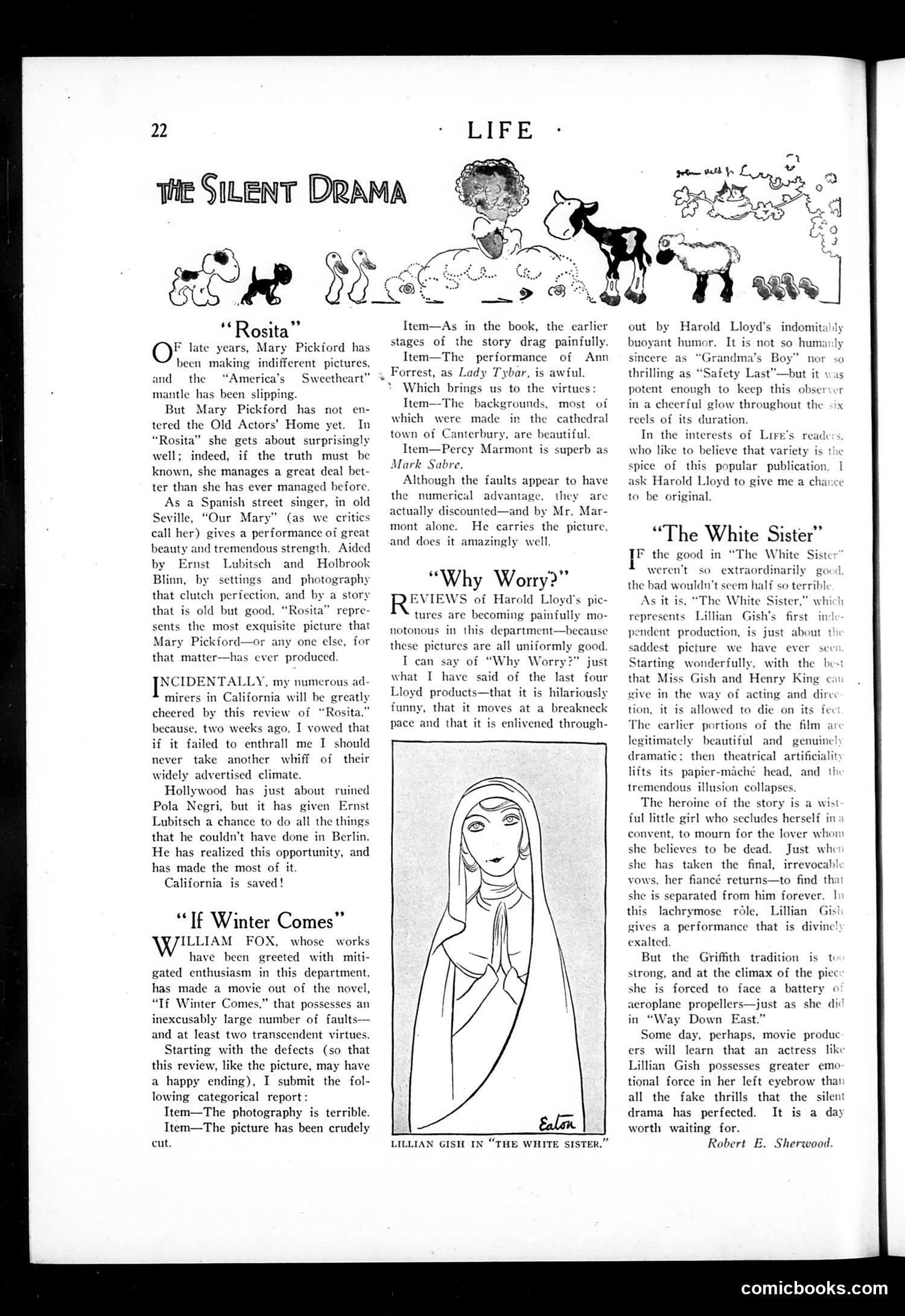
This page reviews four silent films from the early 1920s. The critic praises **Mary Pickford's "Rosita,"** noting her career had been declining but this Spanish street-singer role showcases her talent alongside director Ernst Lubitsch's artistry. **"If Winter Comes"** (William Fox) is critiqued for poor photography and editing, though Percy Marmont's performance partially redeems it. **"Why Worry?"** features Harold Lloyd, whose comedies the critic finds consistently excellent—hilariously funny with breakneck pacing, though not quite matching his earlier hits "Grandma's Boy" or "Safety Last." **"The White Sister"** stars Lillian Gish in her first independent production. Despite a magnificent opening with Gish and director Henry King, the film deteriorates into theatrical artificiality, making it "the saddest picture we have ever seen." The reviews reflect 1920s cinema standards: emphasis on photography quality, star performances, and directorial skill in silent film storytelling. The tone is sophisticated, assuming readers knew these prominent silent-film personalities.
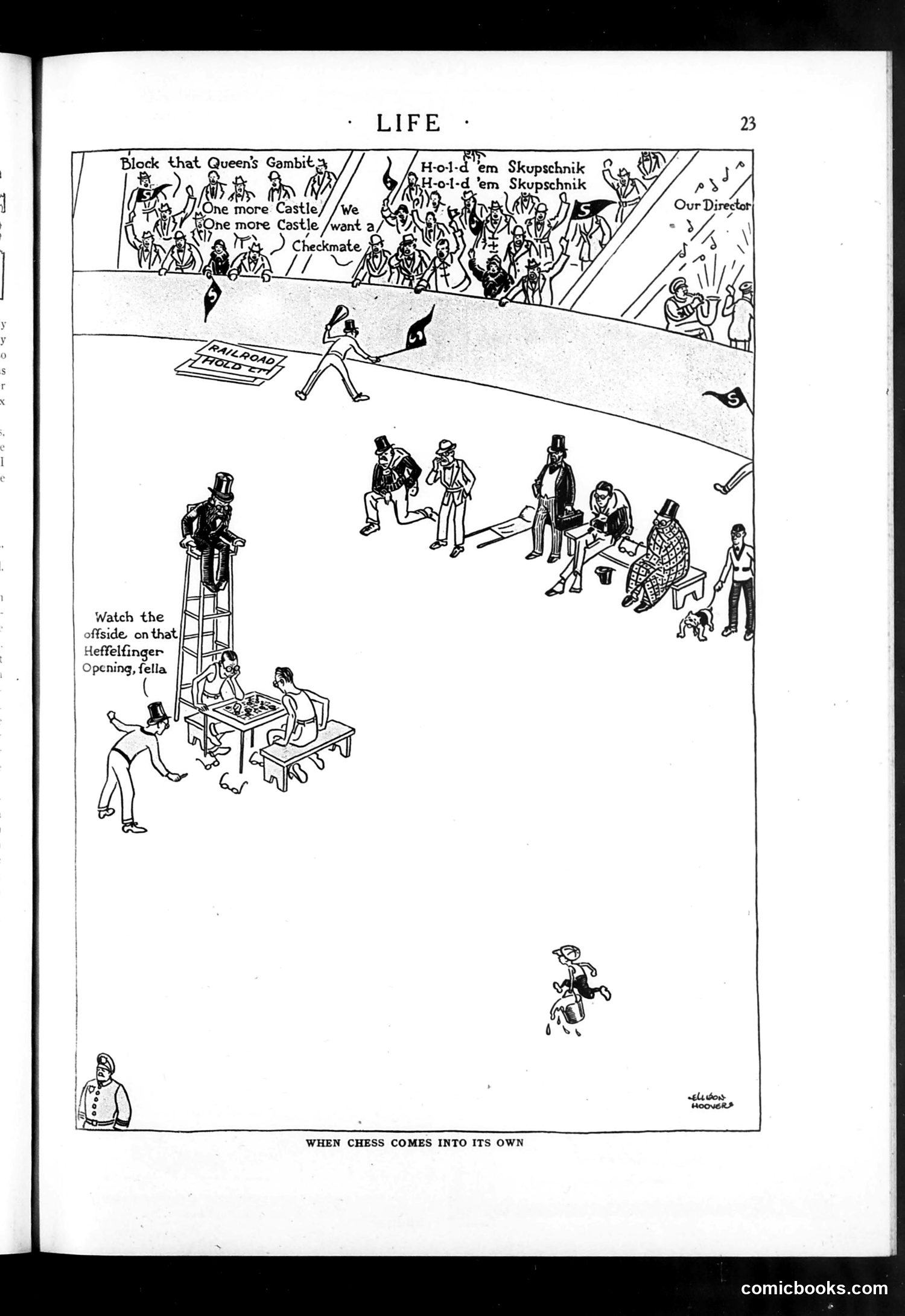
This cartoon satirizes chess obsession among the wealthy and leisured classes. The title "When Chess Comes Into Its Own" depicts an elaborate outdoor chess scene where upper-class figures in top hats engage in the game while crowds gather above (likely at a stadium or viewing area). The joke appears to be that chess—traditionally an intellectual pursuit—has become a spectator sport with the same fanfare as popular entertainment. References to "Skupschnik" and "Hold 'em" suggest chess players are adopting gambling terminology, implying the game has become commercialized and sensationalized for mass consumption. The contrast between the formal, dignified nature of chess and its presentation here as popular entertainment mocks both elite pretension and the era's tendency to turn any activity into a public spectacle.
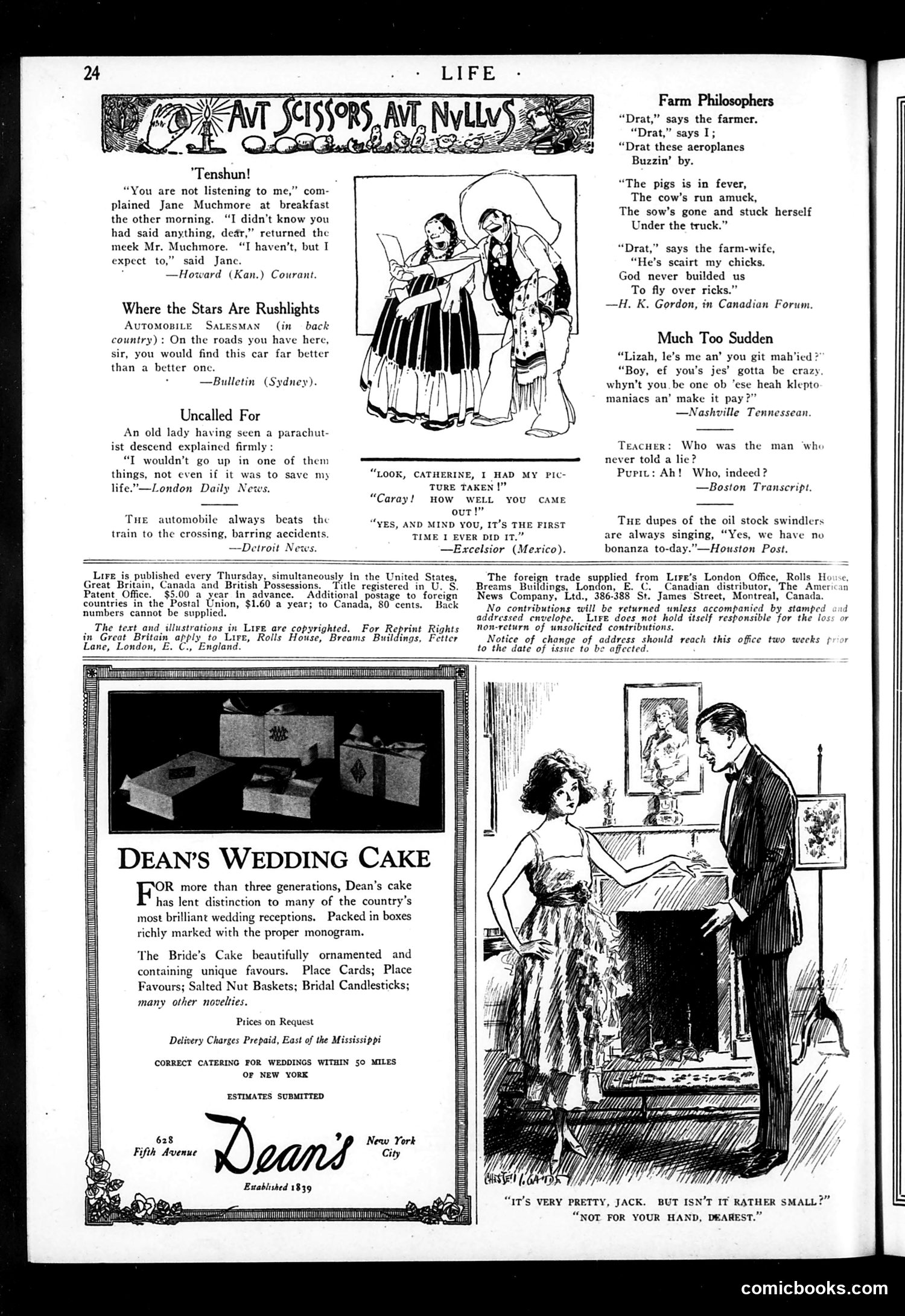
This page contains multiple short humorous anecdotes and advertisements typical of Life's satirical format. The main cartoon shows a couple examining what appears to be a small ring box, with the woman commenting it's "rather small" and the man replying it's "not for your hand, dearest"—a joke playing on the woman's implication about his hand size or masculinity. The page's humor pieces mock contemporary social dynamics: a henpecked husband, automobile salesmen, parachute skeptics, and rural dialect speakers complaining about airplanes disrupting farm life. The "Farm Philosophers" section satirizes rural resistance to modern aviation technology, with farmers blaming planes for livestock ailments. A Dean's Wedding Cake advertisement occupies the lower left, promoting luxury wedding services—representing the magazine's mixed content of satire alongside upscale consumer advertising. The overall tone reflects early 20th-century American middle-class anxieties about modernization, gender relations, and social change.
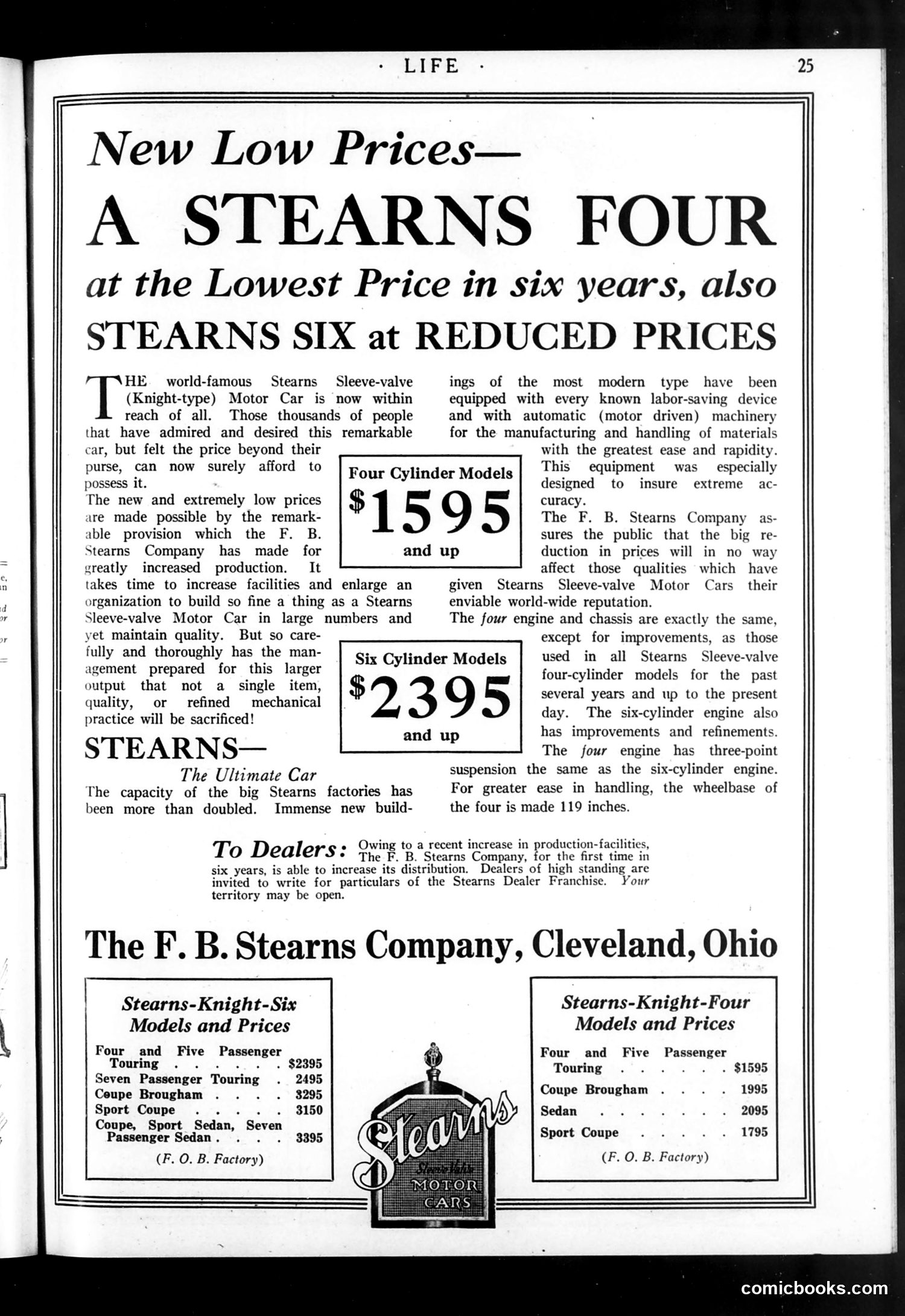
This page is **primarily advertising**, not satire or political commentary. It announces reduced prices for Stearns automobiles—the Four-cylinder model at $1,595 (lowest in six years) and the Six-cylinder at $2,395. The "joke" or appeal is economic rather than satirical: the company claims price reductions are possible through doubled factory capacity and modern manufacturing efficiency, without sacrificing quality. This reflects early 20th-century industrial optimism about mass production making luxury goods affordable. The text reassures potential buyers that cost-cutting doesn't mean inferior engineering—the engines and chassis remain unchanged except for improvements. A dealer recruitment section targets entrepreneurs interested in franchise opportunities. There are no identifiable caricatures or political figures. The Stearns company logo appears centrally. This represents straightforward commercial messaging to middle-class and affluent readers of *Life* magazine, emphasizing technological progress and expanded consumer access to quality automobiles.
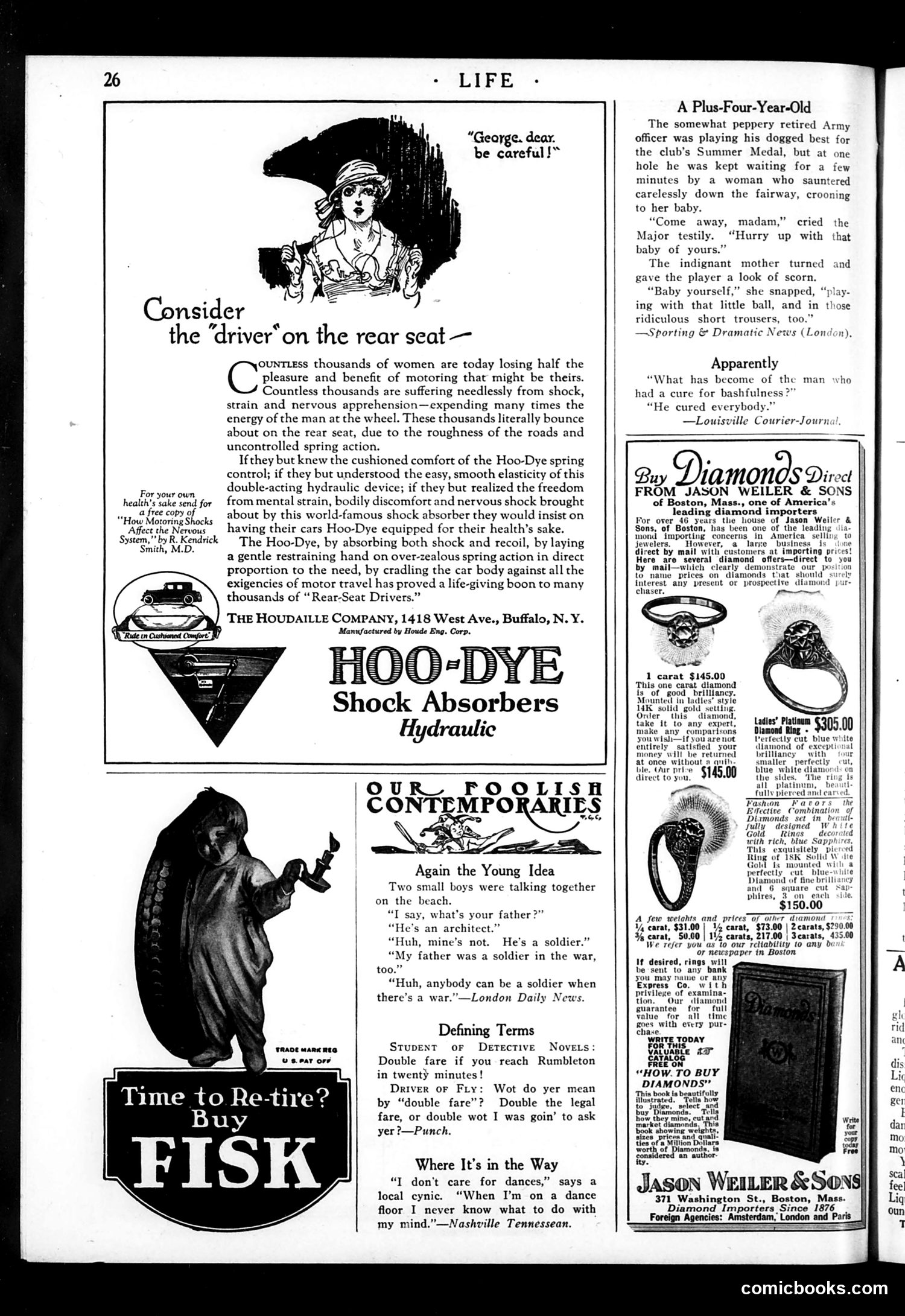
This page from *Life* magazine presents satirical commentary on early 20th-century social issues through brief humorous anecdotes and advertisements. **Main Content:** The dominant advertisement for Hoo-Dye Shock Absorbers uses satire to critique women as "rear-seat drivers"—passengers who bounce uncomfortably on poorly-sprung automobile seats. The ad paradoxically sympathizes with women's discomfort while reinforcing the stereotype that women are anxious, nervous passengers rather than drivers themselves. **Supporting Humor Pieces:** - "A Plus-Four-Year-Old" mocks an elderly golfer in old-fashioned attire (plus-fours) who complains about a woman on the fairway; she retorts by insulting his appearance and clothing. - "Defining Terms" presents a Cockney taxi driver misunderstanding "double fare" as a joke about linguistic ambiguity. - Other brief items mock contemporary social pretensions and marital dynamics. The page reflects 1920s attitudes toward women, automobiles, and class distinction through lighthearted ridicule rather than serious critique.
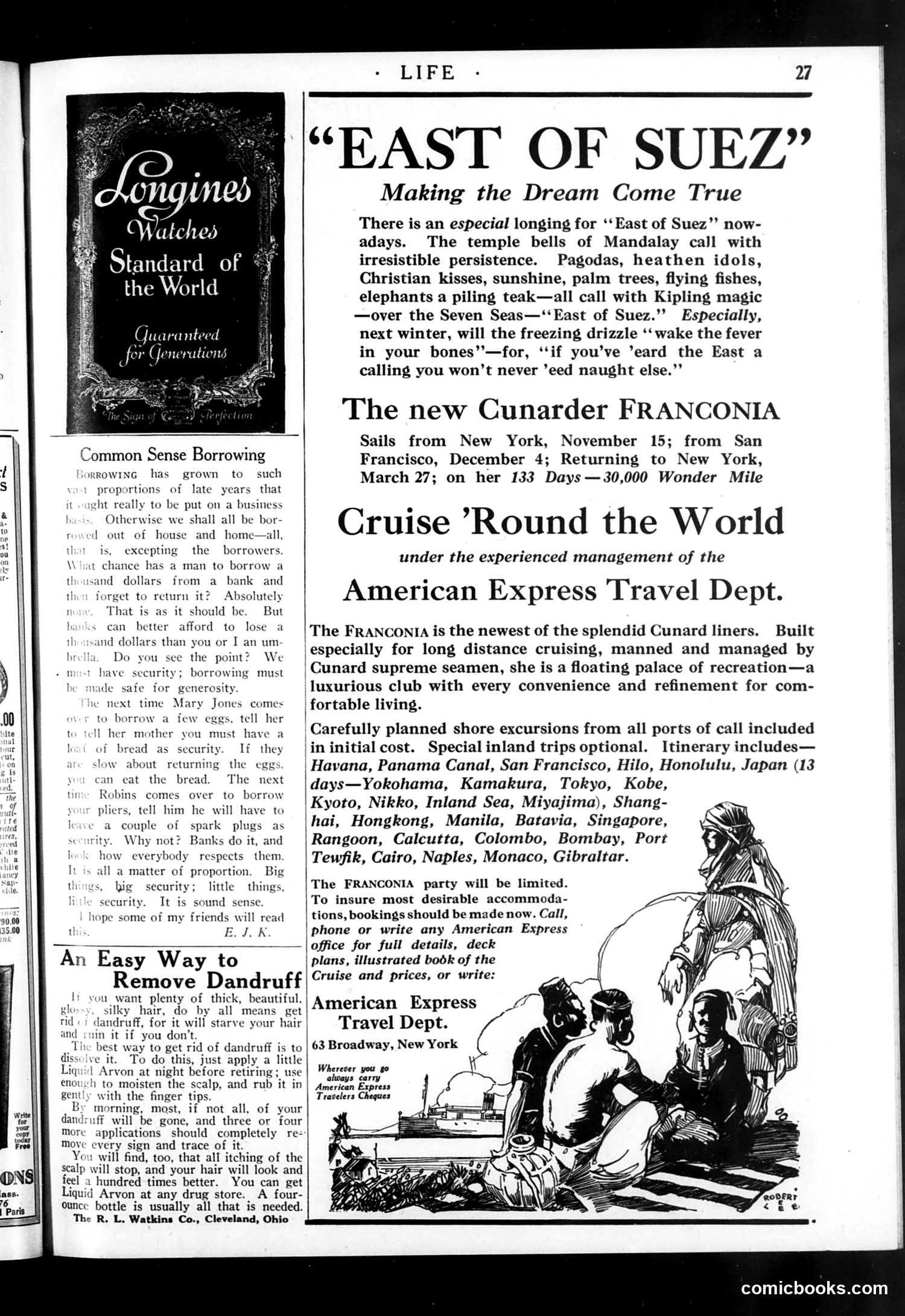
This page is primarily **advertising**, not political satire. The main content promotes the Cunard liner *Franconia* and a luxury world cruise managed by American Express Travel Department. The "East of Suez" headline references **Rudyard Kipling's romantic imagery of exotic Asia**—temple bells, pagodas, elephants, palm trees. The ad copy evokes colonial-era longing for Oriental adventure, quoting Kipling's famous phrase about the East's irresistible allure. The advertisement promises a 133-day round-the-world cruise departing November 1923, visiting ports from Havana through Asia (Japan, Hong Kong, Singapore, Colombo) to Europe. It emphasizes the ship as a "floating palace" with luxurious accommodations and planned shore excursions. The page also contains minor articles on practical topics: "Common Sense Borrowing" (about financial prudence) and "An Easy Way to Remove Dandruff" (promoting Liquid Arvon product). These reflect typical *Life* magazine content mixing satire, lifestyle advice, and advertising.
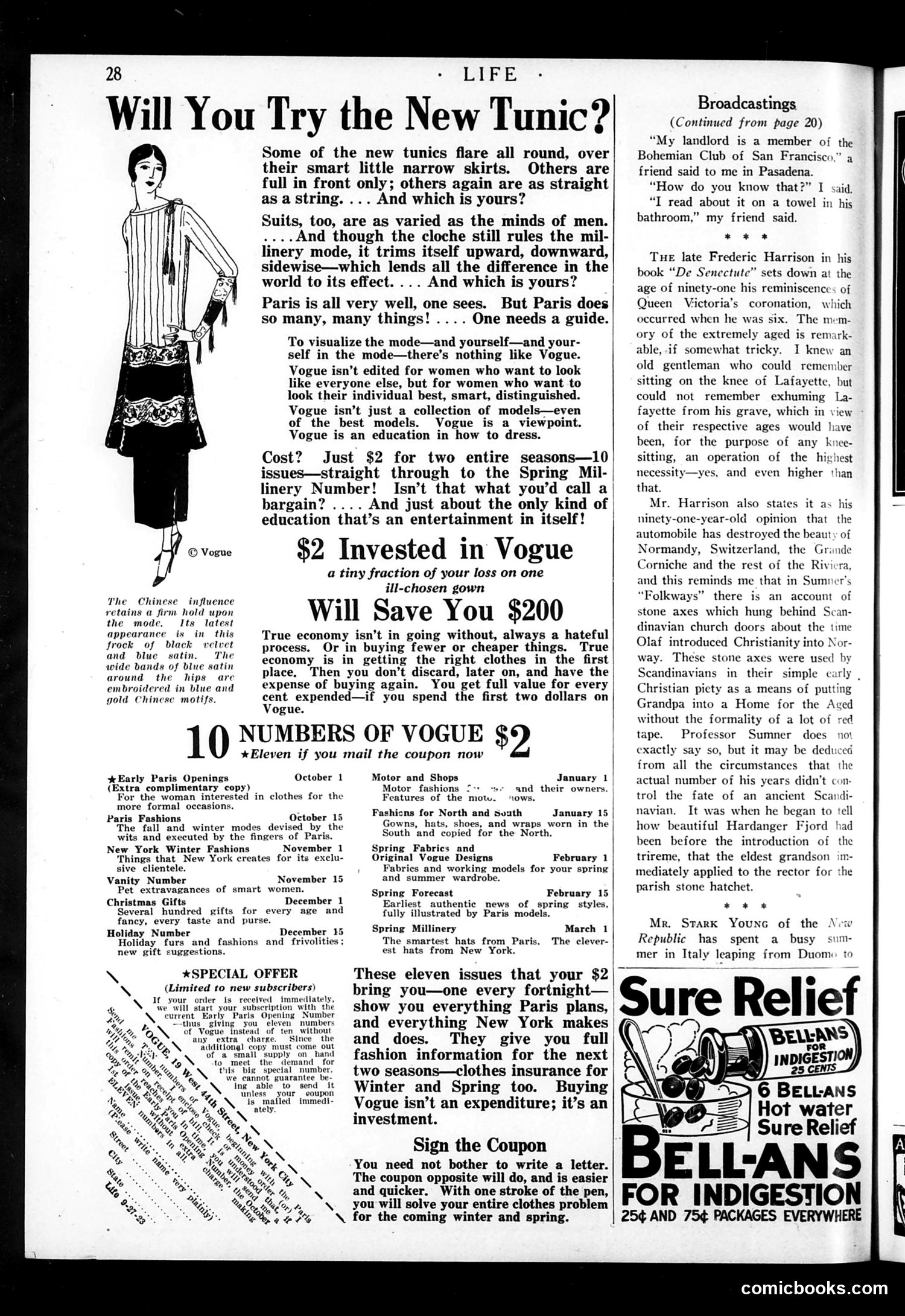
This page is primarily **fashion advertising**, not political satire. It promotes Vogue magazine subscriptions to women readers interested in contemporary 1920s fashion. The main feature, "Will You Try the New Tunic?", discusses fashionable women's clothing of the era—specifically tunics (loose overgarments), suits, and the "cloche" hat that dominated millinery. The illustration shows a woman modeling a "Chinese influence" dress featuring black velvet, blue satin, and gold Chinese motifs, reflecting 1920s fascination with Asian aesthetics. The advertisement emphasizes that Vogue offers fashion guidance for "women who want to look their individual best, smart, distinguished"—positioning the magazine as an educational investment rather than mere luxury. For just $2 covering two seasons, subscribers gain guidance that supposedly prevents costly fashion mistakes (saving $200). The "Broadcastings" section contains unrelated anecdotes about historical memory and modern life—not satire, but light editorial content typical of the magazine's miscellaneous features.
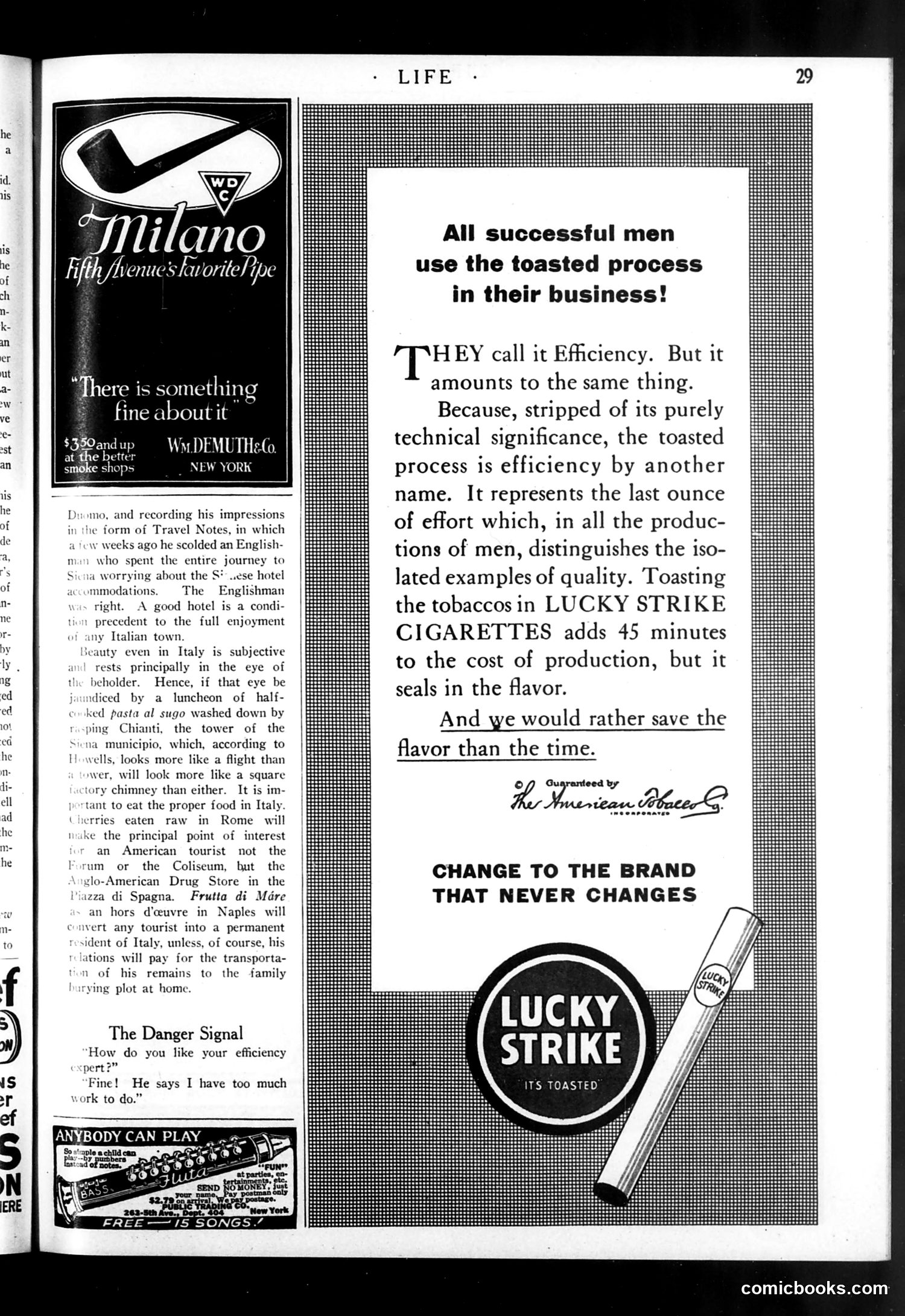
This page combines editorial travel commentary with cigarette advertising. **Left side:** A Milano pipe advertisement and travel notes mocking American tourists in Italy. The text humorously describes how tourists' preconceptions—shaped by bad hotel experiences or eating pasta—distort their perception of Italian landmarks, which then appear ugly or mundane. It's satirizing American provincialism abroad. **Center:** A brief joke titled "The Danger Signal" about an efficiency expert who tells his boss he has too much work—ironic commentary on how efficiency experts often create more problems. **Right side:** A Lucky Strike cigarette advertisement claiming their "toasted process" represents business efficiency and quality. The ad argues that adding 45 minutes to production cost (toasting tobacco) preserves flavor better than saving time—a marketing appeal to successful businessmen valuing quality over shortcuts. The page is primarily **advertising-driven**, with satirical content secondary.
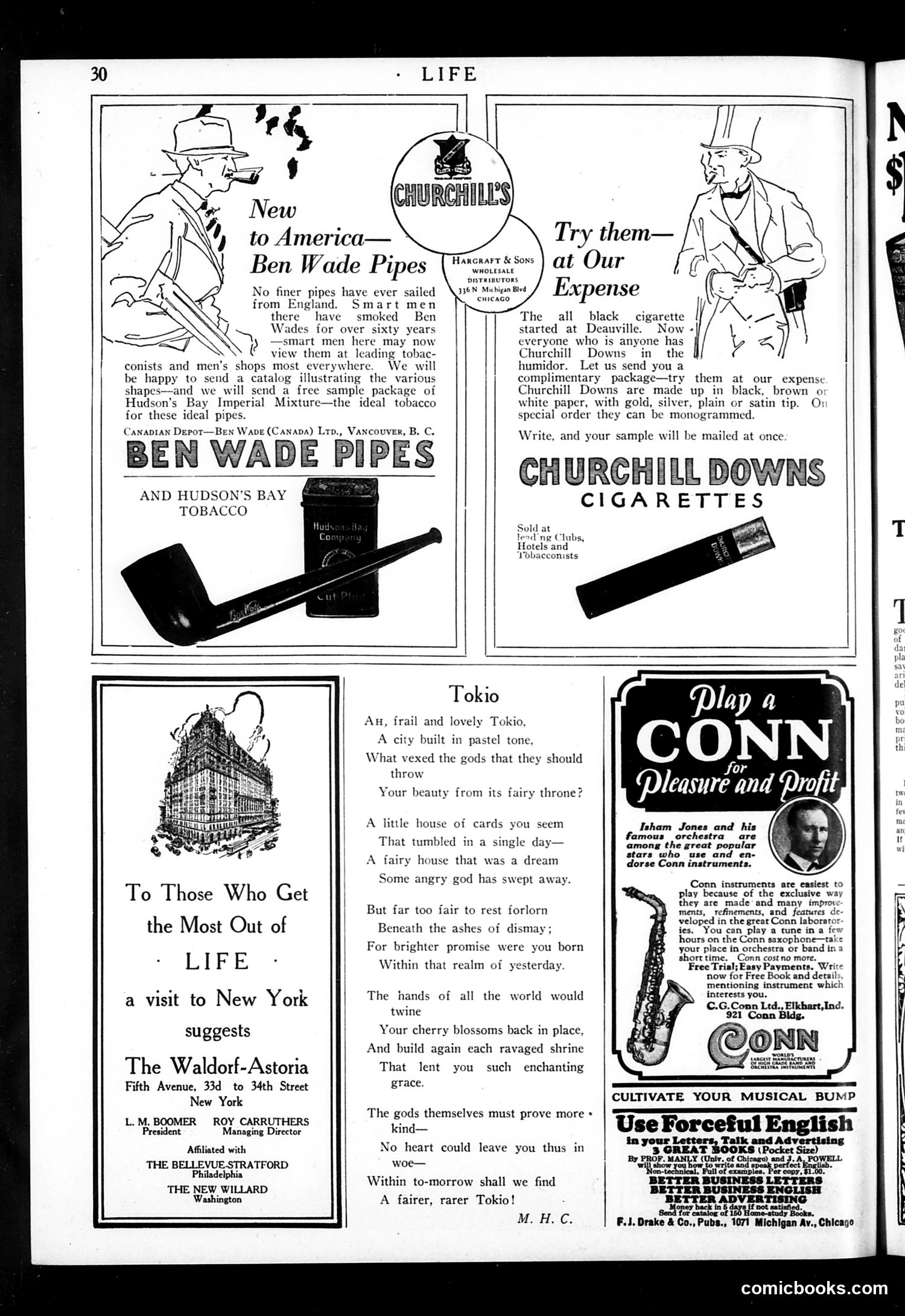
This is primarily an **advertising page** with minimal satire. The content includes: **Advertisements:** - **Ben Wade Pipes**: British pipes marketed to American consumers as prestigious imports - **Churchill Downs Cigarettes**: "All black cigarettes" positioned as fashionable luxury goods, offering free samples - **Conn Musical Instruments**: Saxophones endorsed by bandleader Isham Jones, emphasizing ease of learning - **Waldorf-Astoria Hotel**: A luxury NYC hotel advertisement - **Business writing guides**: Self-improvement books **Poetry Section:** A sentimental poem titled "Tokio" (by M.H.C.) mourns the destruction of Tokyo, likely referencing the 1923 Great Kanto earthquake. It romanticizes the city as a "fairy house" destroyed by divine wrath, expressing hope for rebuilding—reflective of post-disaster American sentiment toward Japan. The page reflects 1920s consumer culture and luxury marketing rather than political satire.
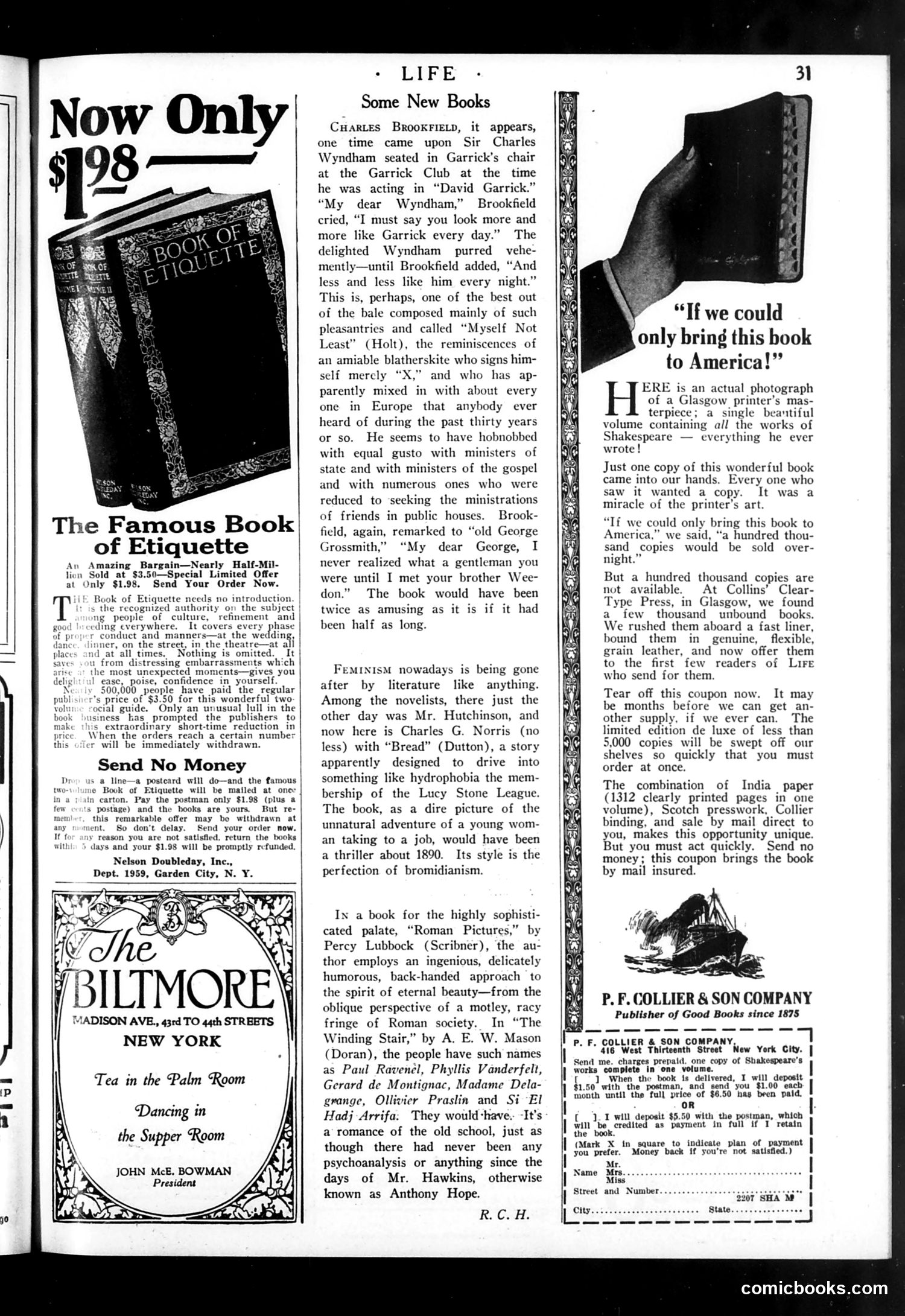
This is primarily a book review and advertising page, not a political cartoon. The main content consists of: **Book Reviews:** Critical assessments of three works—Charles Brookfield's memoir "Myself Not Least" (praised for witty anecdotes), Charles G. Norris's novel "Bread" (mocked as outdated anti-feminist propaganda), and Percy Lubbock's "Roman Pictures" (praised as sophisticated). **The Satire:** The "Bread" review ridicules how the novel treats women's employment as scandalous—a style the reviewer calls "bromidianism" (tedious cliché). This reflects 1920s debates over women's roles. **Advertisements:** Including a famous "Book of Etiquette" bargain offer and an extraordinary claim about a complete Shakespeare volume from a Glasgow printer, with the caption "If we could only bring this book to America!"—likely satirizing inflated advertising claims. The page reflects Jazz Age literary criticism and consumer culture of the period.
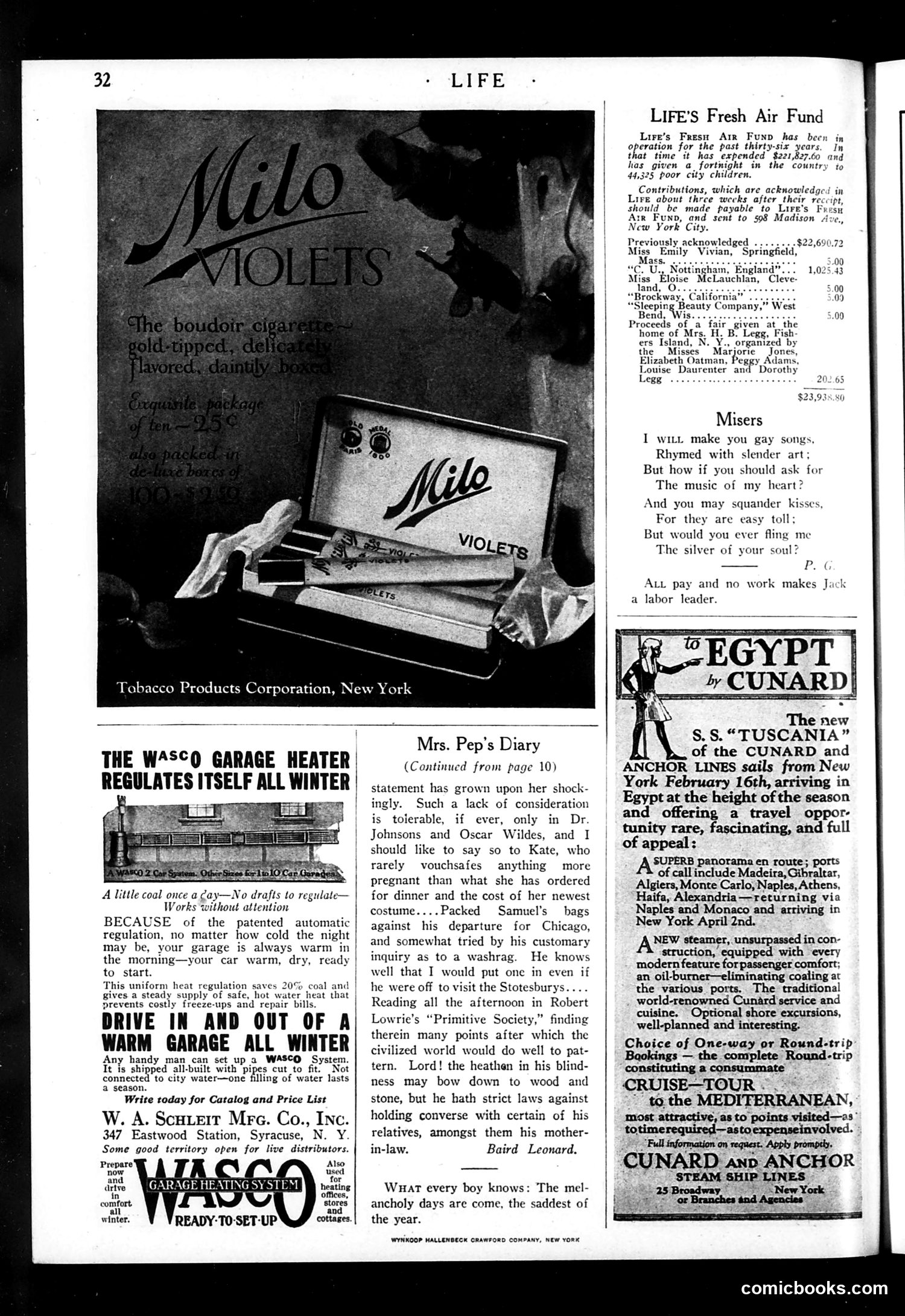
This page contains mostly **advertisements and filler content**, not political cartoons requiring historical context. The main visual advertisement promotes the **Wasco Garage Heater**, a coal-burning heating system marketed to car owners for keeping garages warm in winter—a practical consumer product reflecting early 20th-century automobile ownership concerns. The **Mrs. Pep's Diary** column is a society gossip feature about upper-class domestic life, including complaints about servants' inattentiveness and references to reading about "primitive societies." The **poetry section** includes generic verse about love and a quip that "all pay and no work makes Jack a labor leader"—a light jab at labor activism, though not developed as satire. The remaining content consists of **travel advertisements** (Cunard cruise line to Egypt) and notices for **Life's Fresh Air Fund**, a charitable initiative sending poor city children to the countryside. This appears to be a typical 1920s Life magazine page emphasizing consumer goods, society notes, and charitable announcements rather than satirical commentary.
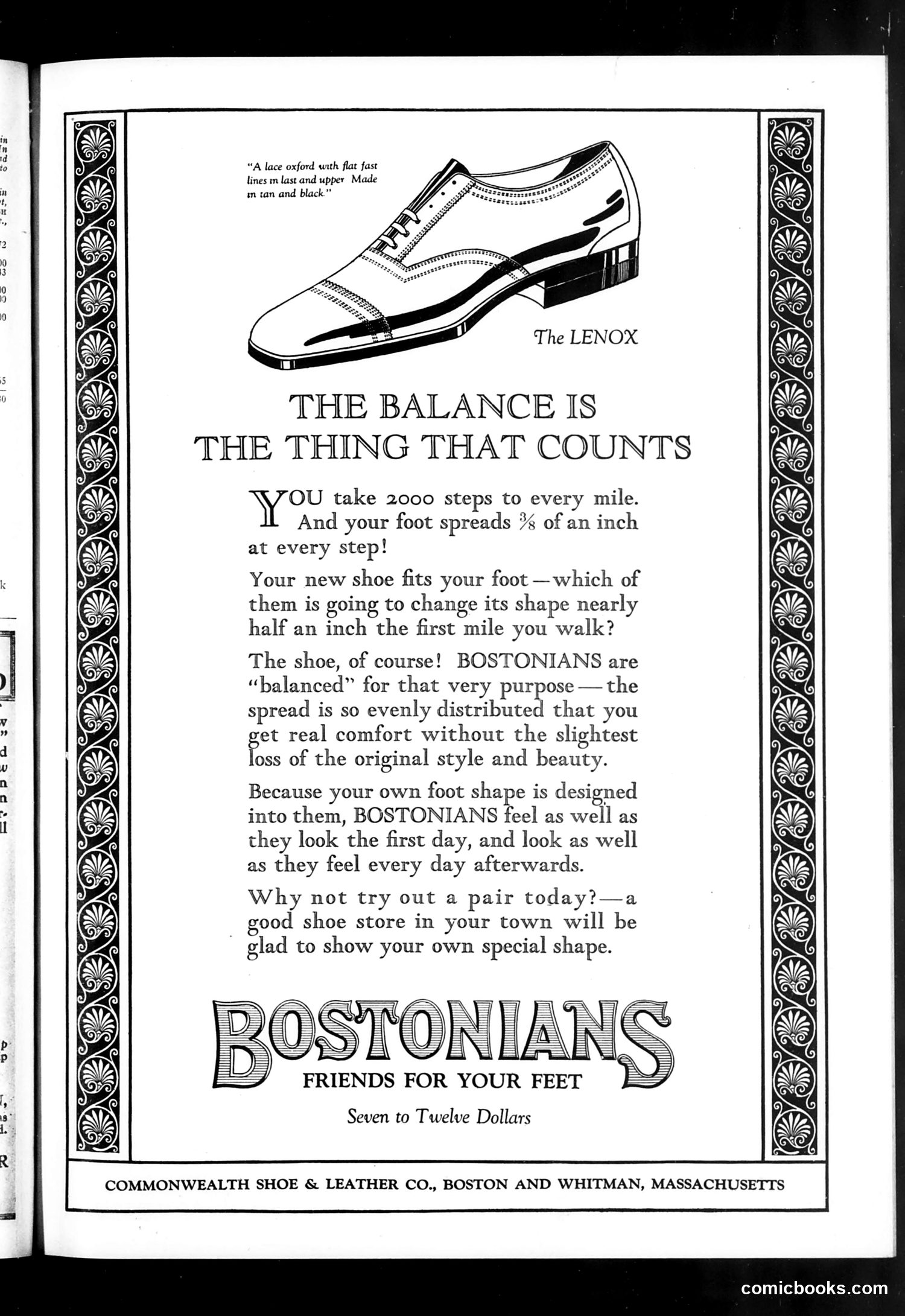
This is a **product advertisement**, not political satire. It promotes "Bostonians" shoes, manufactured by Commonwealth Shoe & Leather Co. of Boston and Whitman, Massachusetts. The ad employs pseudo-scientific marketing language to sell shoes as ergonomically superior. It claims that feet spread 3/8 of an inch per mile walked, and argues that Bostonians shoes are specially "balanced" to accommodate this expansion while maintaining comfort and style. The copy suggests the shoe molds to individual foot shape, providing both immediate comfort and lasting appearance. The illustration shows "The Lenox" model—a lace oxford in tan and black—presented as the embodiment of this balanced design philosophy. The tagline "Friends for Your Feet" positions the shoes as trustworthy companions, while the price range ("Seven to Twelve Dollars") indicates these were mid-range products. This appears to be early-to-mid 20th-century advertising using period marketing tropes about scientific shoe design.
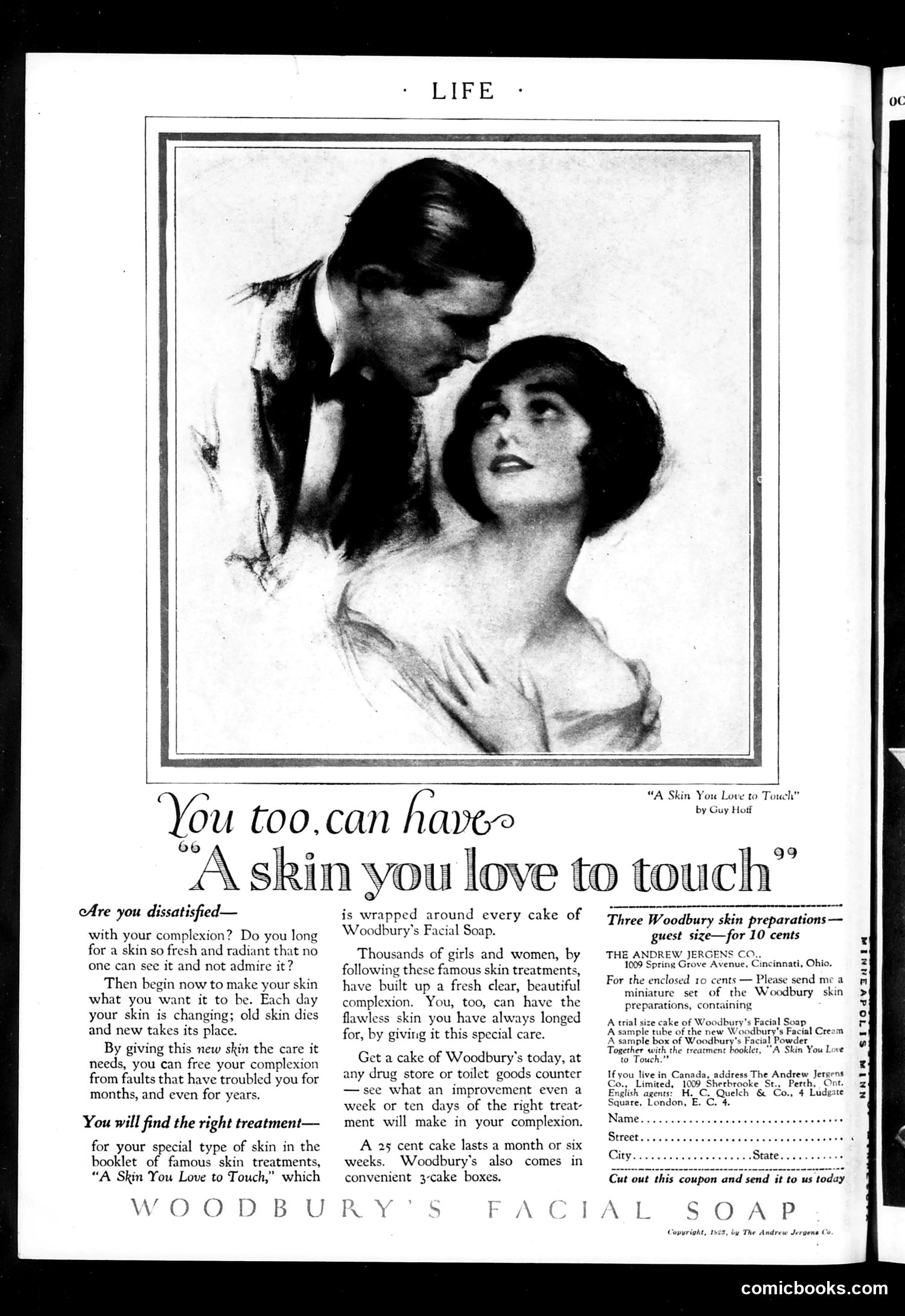
This is primarily a **beauty product advertisement**, not political satire. The page features an illustration by Guy Hoff showing a man and woman in an intimate moment, captioned "A Skin You Love to Touch." The ad targets women concerned about complexion, promising that Woodbury's Facial Soap will transform dull or troubled skin into "fresh, clear, beautiful" skin through regular use. The tagline explicitly links personal attractiveness to romantic desirability—the couple's closeness suggests that improved skin leads to romantic appeal. This reflects early 20th-century advertising strategies: combining beauty anxiety with romantic/sexual motivation. The offered "guest size" samples for 10 cents were a standard marketing tactic to encourage trial purchases. There is no political cartoon or satire on this page—it's a straightforward commercial advertisement using romantic imagery to sell skincare products.