
Life, 1923-09-27 · page 24 of 36
Life — September 27, 1923 — page 24: what you’re looking at
What you’re looking at
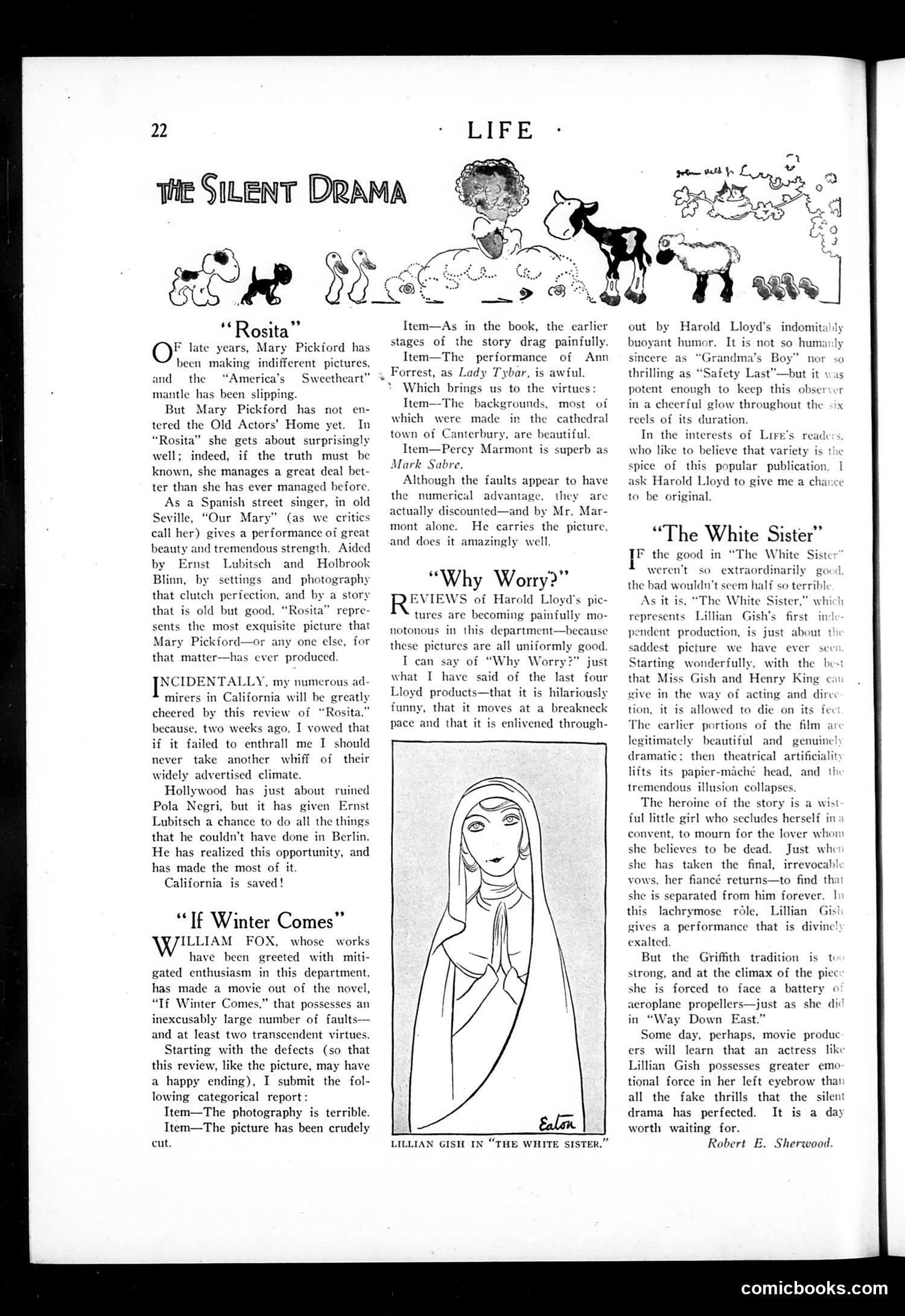
This page reviews four silent films from the early 1920s. The critic praises **Mary Pickford's "Rosita,"** noting her career had been declining but this Spanish street-singer role showcases her talent alongside director Ernst Lubitsch's artistry. **"If Winter Comes"** (William Fox) is critiqued for poor photography and editing, though Percy Marmont's performance partially redeems it. **"Why Worry?"** features Harold Lloyd, whose comedies the critic finds consistently excellent—hilariously funny with breakneck pacing, though not quite matching his earlier hits "Grandma's Boy" or "Safety Last." **"The White Sister"** stars Lillian Gish in her first independent production. Despite a magnificent opening with Gish and director Henry King, the film deteriorates into theatrical artificiality, making it "the saddest picture we have ever seen." The reviews reflect 1920s cinema standards: emphasis on photography quality, star performances, and directorial skill in silent film storytelling. The tone is sophisticated, assuming readers knew these prominent silent-film personalities.
📄 Transcribed text from this page (OCR, searchable)
Machine-transcribed from the original scan — historical spelling and the odd misread are preserved.
22 Tie SILENT DRAMA Ay eon **Rosita” O late years, Mary Pickiord has been making indifferent pictures, and mantle has been slipping. the Sweetheart” But Mary Pickford has not en- tered the Old Actors’ Home yet. In “Rosita” she gets about surprisingly well; indeed, if the truth must be known, she manages a great deal bet- ter than she has ever managed hefore As a Spanish street singer, in old Seville, “Our Mary” (as we critics call her) gives a performance of great beauty and tremendous strength. Aided by Ernst Lubitsch Holbrook Blinn, by settings and photography that clutch perfection, and by a story that is old but good, “Rosita” repre- sents the most exquisite picture that Mary Pickford—or any one else, for that matter—has ever produced. NCIDENTALLY, my numerous ad- mirers in California will be greatly cheered by this review of “Rosita.” because, two weeks ago, I vowed that if it failed to enthrall me I should never take of their widely advertised climate. Hollywood has just about ruined Pola Negri, but it has given Ernst Lubitsch a chance to do all the things that he couldn’t have done in Berlin. He has realized this opportunity, and has made the most of it. California is “If Winter Comes” ILLIAM FOX, whose works have been greeted with miti- gated enthusiasm in this department, has made a movie out of the novel, “Tf Winter Comes,” that possesses an inexcusably large number of faults— and at least two transcendent virtues. Starting with the defects (so that this review, like the picture, may have a happy ending), I submit the fol- lowing categorical report: Item—The photography is terrible. Item—The picture has been crudely cut. “America’s and another w saved ! Item—As in the book, the earlier stages of the story drag painfully. Item—The performance of Ann Forrest, as Which brings us to the virtues: Item—The which town of Canterbur Item—Percy Marmont is superb as Mark Sabre. Although the faults appear to have the advantage, actually discounted—and by Mr. Mar- mont alone. He carries the picture and does it amazingly well “Why Worry? :VIEWS of Harold Lloyd's pic- tures are becoming painfully mo- notonous in this department—because these pictures are all uniformly good. I can say of “Why Worry j what said of the Lloyd products—that it is hilariously funny, that it moves at a breakneck pace and that it is enlivened through- Lady Tybar, is awful. rounds, most the cathedral are beautiful. bai of were made in numerical they are I have LILLIAN GISH IN “THE WHITE SISTER.” out by Harold Lloyd's indomit: buoyant humor. It is not so humaily sincere as “Grandma’s Boy” thrilling as “Safety Last”—but it \ potent enough to keep this observer in a cheerful g! reels of its duration. In the interests of L who like to believe that va spice of this popular publication, 1 ask Harold Lloyd to give me a chance nor so y throughout the six to be original. “The White Sister” F the good in “The White Sist weren't so extraordinarily good. the bad wouldn't seem half so terribk As it is, “The White Sister,” Lillian Gish’s pendent production, is just about t wh represents first in saddest picture we have ever se Starting wonderfully, with the bes that Miss Gish and Henry King « give in the way of acting and dire tion, it is allowed to die on its fe The earlier portions of the film ar legitimately genuine dramatic; then theatrical artificialit lifts its papier-mi tremendous illusion collapses. The heroine of the story is a wist ful little girl who secludes herself in convent, to mourn for the lover whom Just whe she has taken the final, irrevocab! her fiancé returns—to find tha she is separated from him forever. | this lachrymose Lillian Gis gives a performance that is divine! exalted. But the Griffith tradition is t strong, and at the climax of the piec forced to face a battery « aeroplane propellers—just as she did in “Way Down East.” Some day, perhaps, movie produc s will learn that like Lillian Gish possesses greater emo tional force in her left eyebrow thai all the fake thrills that the drama has perfected. It is a day worth waiting for. Robert E. Sherwood. beautiful and ché head, and tt she believes to be dead. vows. role, she is an actress comicbooks.com