
Life, 1923-09-27 · page 16 of 36
Life — September 27, 1923 — page 16: what you’re looking at
What you’re looking at
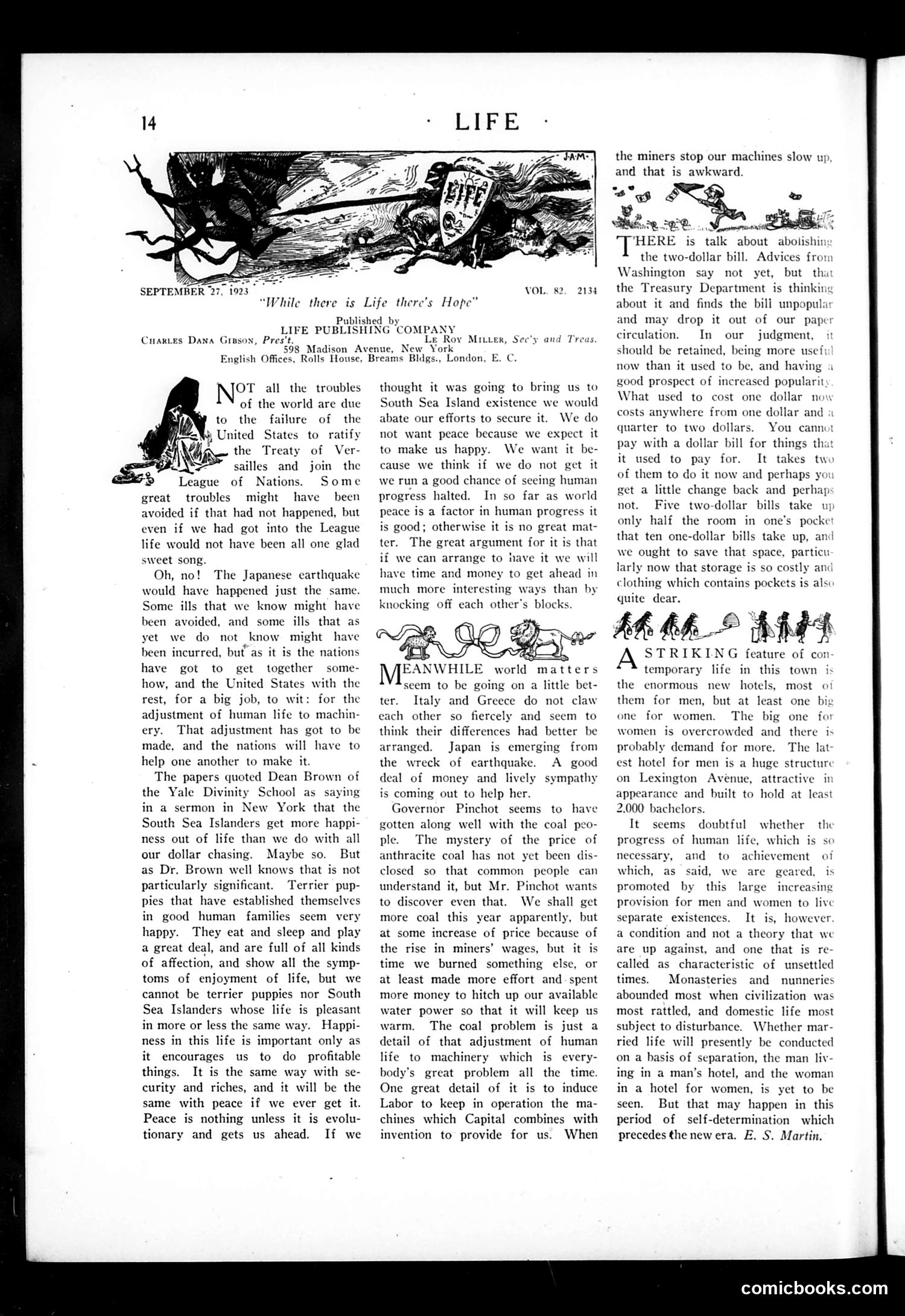
The masthead cartoon depicts a skeletal death figure holding a sign reading "LIFE," playing on the magazine's title. This accompanies the editorial's discussion of global peace and the League of Nations. The main article argues that world troubles stem from the failed U.S. ratification of the Treaty of Versailles and League membership. It references the recent Japanese earthquake (September 1, 1923) as an example requiring international cooperation. The piece advocates that peace, though difficult, is necessary for human progress—not merely idealistic philosophy but practical economic necessity. A secondary editorial discusses inflation and labor issues, specifically coal miners' demands and wage increases. The cartoons and text together present Life's progressive stance: that American isolationism harms global stability and domestic prosperity alike.
📄 Transcribed text from this page (OCR, searchable)
Machine-transcribed from the original scan — historical spelling and the odd misread are preserved.
“While there is Life there's Ho Published by IFE PUBLISHING COMPANY Cuartes Dana Gipson, Pres’t. 598 Madison English Offices, Rolls House, OT all the troubles of the world are due to the failure of the %, United States to ratify as the Treaty of Ver- Wis sailles and join the League of Nations. Some great troubles might have been avoided if that had not happened, but even if we had got into the League life would not have been all one glad sweet song. Oh, no! The Japanese earthquake would have happened just the same. Some ills that we know might have been avoided, and some ills that a yet we do not know might have been incurred, but’ as it is the nations have got to get together some- how, and the United States with the rest, for a big job, to wit: for the adjustment of human life to machin- That adjustment has got to be made, and the nations will to help one another to make it. The papers quoted Dean Brown of the Yale Divinity School as saying in a sermon in New York that the South Sea Islanders get more happi- ness out of life than we do with all our dollar chasing. Maybe so. But as Dr. Brown well knows that is not particularly significant. Terrier pup- pies that have established themselves in good human families seem very happy. They eat and sleep and play a great deal, and are full of all kinds of affection, and show all the symp- toms of enjoyment of life, but we cannot be terrier puppies nor South Sea Islanders whose life is pleasant in more or less the same way. Happi- ness in this life is important only as it encourages us to do profitable things. It is the same way with se- curity and riches, and it will be the same with peace if we ever get it. Peace is nothing unless it is evolu- tionary and gets us ahead. If we ery. have Le Roy venue, New York Breams Bld; London Miter, Sec'y and E. C. thought it was going to bring us to South Sea Island existence we would abate our efforts to secure it. We do not want peace because we expect it to make us happy. We want it be- cause we think if we do not get it we run a good chance of seeing human progress halted. peace is a factor in human progress it is good; otherwise it is no great mat- ter. The great argument for it is that if we can arrange to have it we will have time and money to get ahead in much more interesting ways than by knocking off each other's blocks. In so far as world matters seem to be going on a little bet- ter. Italy and Greece do not claw each other so fiercely and seem to think their differences had better be world arranged. Japan is emerging from the wreck of earthquake. A good deal of money and lively sympathy is coming out to help her. Governor Pinchot have gotten along well with the coal peo- ple. The mystery of the price of anthracite coal has not yet been dis- closed so that common people can understand it, but Mr. Pinchot wants to discover even that. We shall get more coal this year apparently, but at some increase of price because of the rise in miners’ wages, but it is time we burned something else, or at least made more effort and. spent more money to hitch up our available water power so that it will keep us The coal problem is just a detail of that adjustment of human life to machinery which is every- body’s great problem all the time. One great detail of it is to induce Labor to keep in operation the ma- chines which Capital combines with invention to provide for us. When seems to warm, the miners stop our machines slow up. and that is awkward. ne ones. % "HERE is talk about abolishir the two-dollar bill. Advices from Washington say not yet, but tha the Treasury Department is thinking about it and finds the bili unpopula and may drop it out of our paper In judgment, should be retained, being more usef now than it used to be, and having good prospect of increased popularit What to dollar no costs anywh: circulation. our used cost from one dollar and quarter to two dollars. You cannot pay with a dollar bill for things that it used to pay for. It takes of them to do it now and perhaps yo get a little change back and perhap: not. Five two-dollar bills take only half the room in one’s pock that ten one-dollar bills take up, and we ought to save that space, particu larly now that storage is so costly clothing which contains pockets is als quite dear. Ahh © Ahad STRIKING feature of con * *% temporary 1 in this the hotels, most oi them for men, but at least one big for women. The big one for women is overcrowded and there is probably demand for more. The lat est hotel for men is a huge structure on Lexington Avenue, attractive it appearance and built to hold at least 2,000 bachelors. It seems doubtful progress of human lif y, and to achievement as said, we are geared, is promoted by this large increasing provision for men and women to live separate existences. It a condition and not a theory that we are up against, and one that is re- called as characteristic of unsettled times. Monasteries and nunneries abounded most when civilization was most rattled, and domestic life most subject to disturbance. Whether mar- ried life will presently be conducted on a basis of separation, the man liv- ing in a man’s hotel, and the woman in a hotel for women, is yet to be seen. But that may happen in this period of self-determination which precedes the new era. E. S. Martin. one two anc town is enormous new one whether — the which is so of is, however comicbooks.com