
Life, 1923-09-27 · page 20 of 36
Life — September 27, 1923 — page 20: what you’re looking at
What you’re looking at
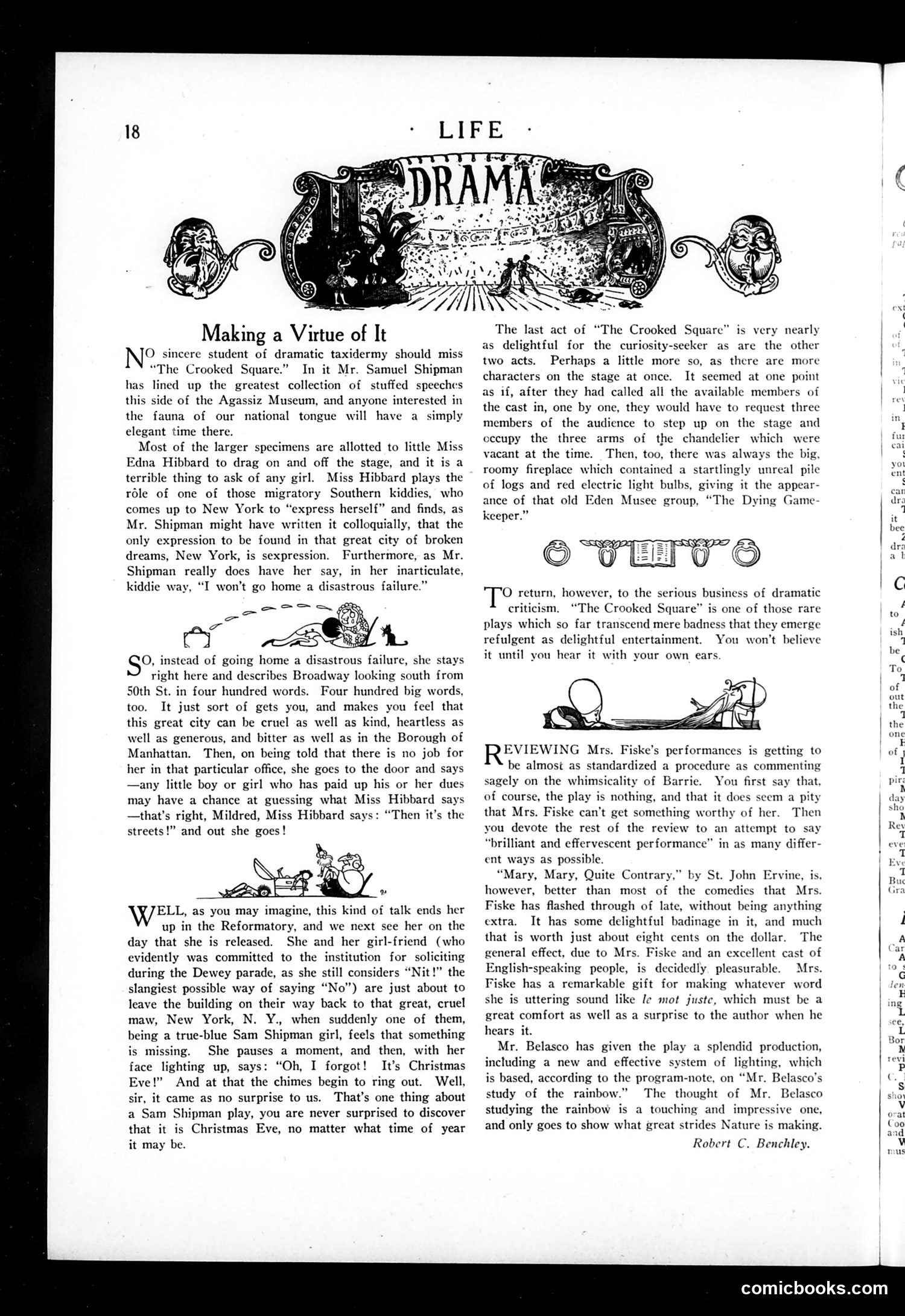
This is a theater review of the play "The Crooked Square" by Samuel Shipman, featuring actress Edna Hibbard. The critic uses heavy satire to demolish the production. The reviewer mocks the play's melodramatic dialogue as "stuffed speeches"—artificial and lifeless as taxidermied animals. Hibbard plays a Southern girl who comes to New York seeking self-expression but instead delivers lengthy, overwrought monologues (400 words describing Broadway). When rejected for a job, she dramatically declares "Then it's the streets!"—leading to her arrest and reformatory sentence. The satire peaks when the critic notes the play inexplicably ends on Christmas Eve, despite no seasonal setup, and includes absurdly fake stage props (electric light bulbs posed as fireplace logs). The reviewer sarcastically praises how the play "transcends mere badness" to become entertainingly terrible. The broader point: early 20th-century melodrama was overwrought, predictable, and emotionally manipulative—yet audiences found perverse enjoyment in its earnest awfulness.
📄 Transcribed text from this page (OCR, searchable)
Machine-transcribed from the original scan — historical spelling and the odd misread are preserved.
Making a Virtue of It O sincere student of dramatic taxidermy should miss “The Crooked Square.” In it Mr. Samuel Shipman has lined up the greatest collection of stuffed speeches this side of the Agassiz Museum, and anyone interested in the fauna of our national tongue will have a simply elegant time there. Most of the larger specimens are allotted to little Miss Edna Hibbard to drag on and off the stage, and it is a terrible thing to ask of any girl. Miss Hibbard plays the réle of one of those migratory Southern kiddies, who comes up to New York to “express herself” and finds, as Mr. Shipman might have written it colloquially, that the only expression to be found in that great city of broken dreams, New York, is sexpression. Furthermore, as Mr. Shipman really does have her say, in her inarticulate, kiddie way, “I won’t go home a disastrous failure.” O, instead of going home a disastrous failure, she stays right here and describes Broadway looking south from 50th St. in four hundred words. Four hundred big words, too. It just sort of gets you, and makes you feel that this great city can be cruel as well as kind, heartless as well as generous, and bitter as well as in the Borough of Manhattan. Then, on being told that there is no job for her in that particular office, she goes to the door and says —any little boy or girl who has paid up his or her dues may have a chance at guessing what Miss Hibbard says —that’s right, Mildred, Miss Hibbard says: “Then it’s the streets!” and out she goes! ELL, as you may imagine, this kind of talk ends her up in the Reformatory, and we next see her on the day that she is released. She and her girl-friend (who evidently was committed to the institution for soliciting during the Dewey parade, as she still considers it!” the slangiest possible way of saying “No’”) are just about to leave the building on their way back to that great, cruel maw, New York, N. Y., when suddenly one of them, being a true-blue Sam Shipman girl, feels that something is missing. She pauses a moment, and then, with her face lighting up, says: “Oh, I forgot! It’s Christmas Eve!” And at that the chimes begin to ring out. Well, sir, it came as no surprise to us. That’s one thing about a Sam Shipman play, you are never surprised to discover that it is Christmas Eve, no matter what time of year it may be. The last act of “The Crooked Square” is very nearly as delightful for the curiosity-seeker as are the other two acts. Perhaps a little more so, as there are more characters on the stage at once. It seemed at one point as if, after they had called all the available members of the cast in, one by one, they would have to request three members of the audience to step up on the stage and eccupy the three arms of the chandelier which were vacant at the time. Then, too, there was always the big, roomy fireplace which contained a startlingly unreal pile of logs and red electric light bulbs, giving it the appear- ance of that old Eden Musee group, “The Dying Game- keeper.” 'O return, however, to the serious business of dramatic criticism. “The Crooked Square” is one of those rare plays which so far transcend mere badness that they emerge refulgent as delightful entertainment. You won't believe it until you hear it with your own ears. JIEWING Mrs. e’s performances is getting to be almost as standardized a procedure as commenting sagely on the whimsicality of Barrie. You first say that, of course, the play is nothing, and that it does seem a pity that Mrs. Fiske can’t get something worthy of her. Then you devote the rest of the review to an attempt to say “brilliant and effervescent performance” in as many differ- ent ways as possible. “Mary, Mary, Quite Contrary,” by St. John Ervine, is, however, better than most of the comedies that Mrs. Fiske has flashed through of late, without being anything extra. It has some delightful badinage in it, and much that is worth just about eight cents on the dollar. The general effect, due to Mrs. Fi English-speaking people, is decidedly pleasurable. Mrs. Fiske has a remarkable gift for making whatever word she is uttering sound like le mot juste, which must be a great comfort as well as a surprise to the author when he hears it. Mr. Belasco has given the play a splendid production, including a new and effective tem of lighting, which is based, according to the program-note, on “Mr. Belasco’s study of the rainbow.” The thought of Mr. Bel studying the rainbow is a touching and impressive one, and only goes to show what great strides Nature is making. Robert C. Benchley. and an excellent cast of Jasco comicbooks.com of out the 7 | the | one orat Coo and mus