
A complete issue · 36 pages · 1923
Life — September 13, 1923
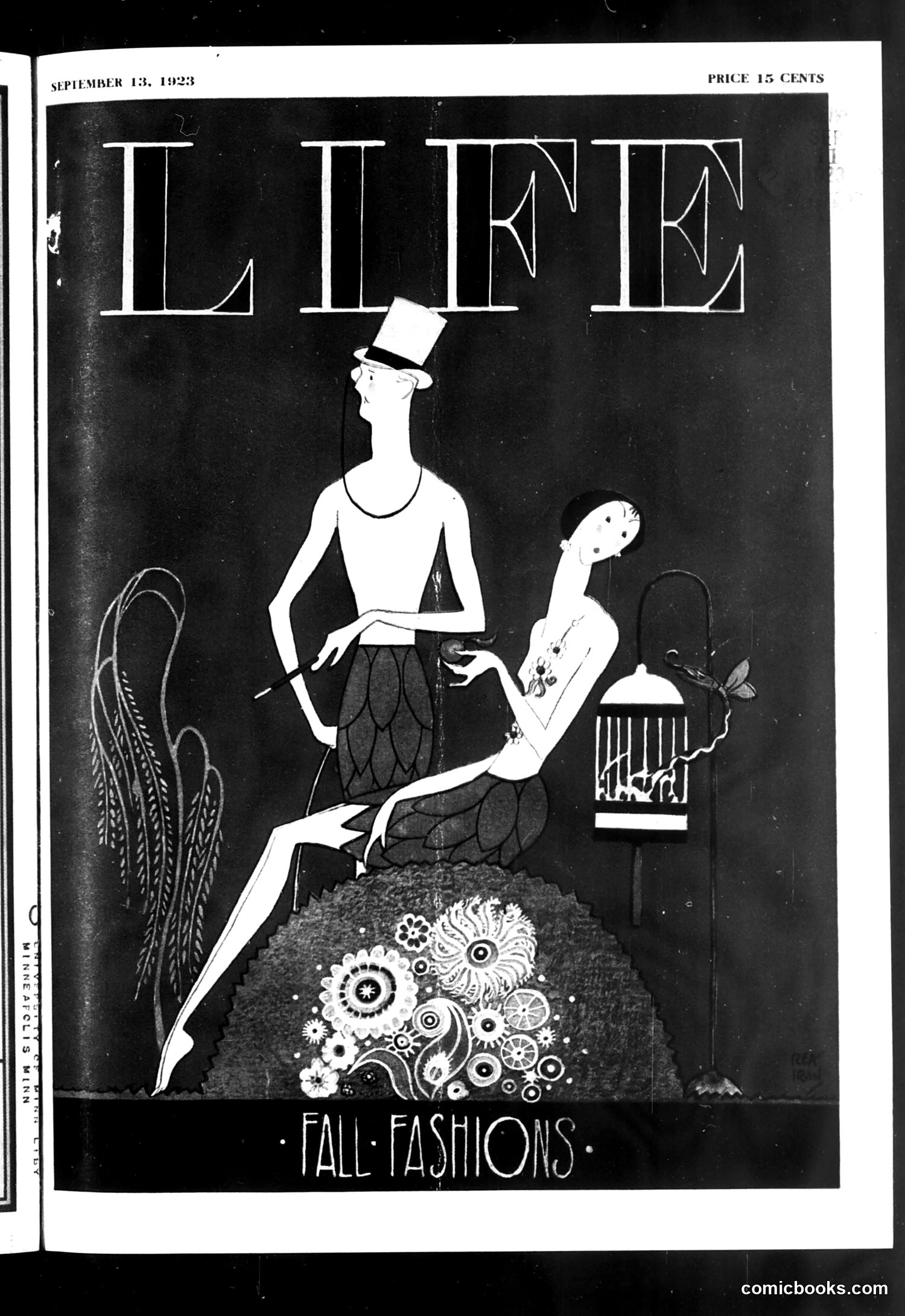
This is a *Life* magazine cover from September 13, 1923, priced at 15 cents. The cover advertises "Fall Fashions" and features Art Deco-style illustration typical of the 1920s. The image depicts two fashionable women in 1920s attire—one standing in a top hat and short skirt, the other seated and reclining. Below them sits a large decorative globe or sphere covered in mechanical gears and ornamental designs, alongside potted plants and a birdcage. The satire appears to critique the frivolous nature of high fashion and modern consumerism during the prosperous Jazz Age. The mechanical globe suggests industrial progress, while the women's exaggerated poses and styling mock the era's obsession with fashionable appearance over substance. The overall composition ironically juxtaposes mechanized modernity with decorative excess.
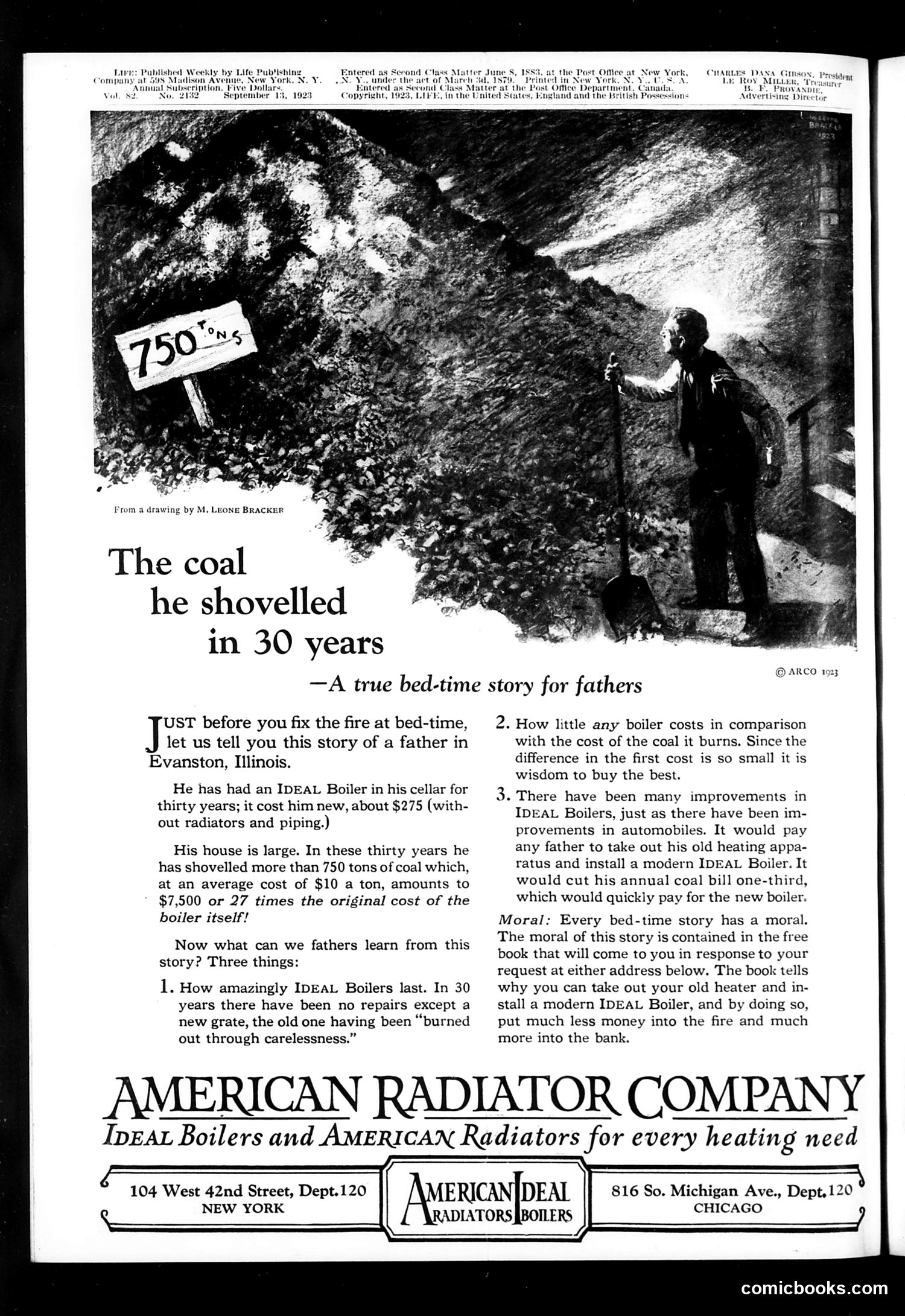
This is primarily **a paid advertisement**, not satire or editorial content. It's a 1923 ad for American Radiator Company's Ideal Boilers, placed in *Life* magazine. The "cartoon" is actually a **product testimonial illustration** by M. Leone Bracker showing a man in Evanston, Illinois who has shoveled 750+ tons of coal over 30 years while using the same Ideal Boiler. The "750 TONS" sign emphasizes the boiler's durability. The ad's humor is gentle and practical rather than satirical—it uses a relatable scenario (fathers maintaining home heating) to argue that buying a good boiler is economical long-term. The "bedtime story for fathers" framing makes a mundane purchase seem wholesome and family-focused. This reflects 1920s advertising strategy: using credible customer stories to sell heating equipment during an era when coal furnaces were standard home infrastructure.
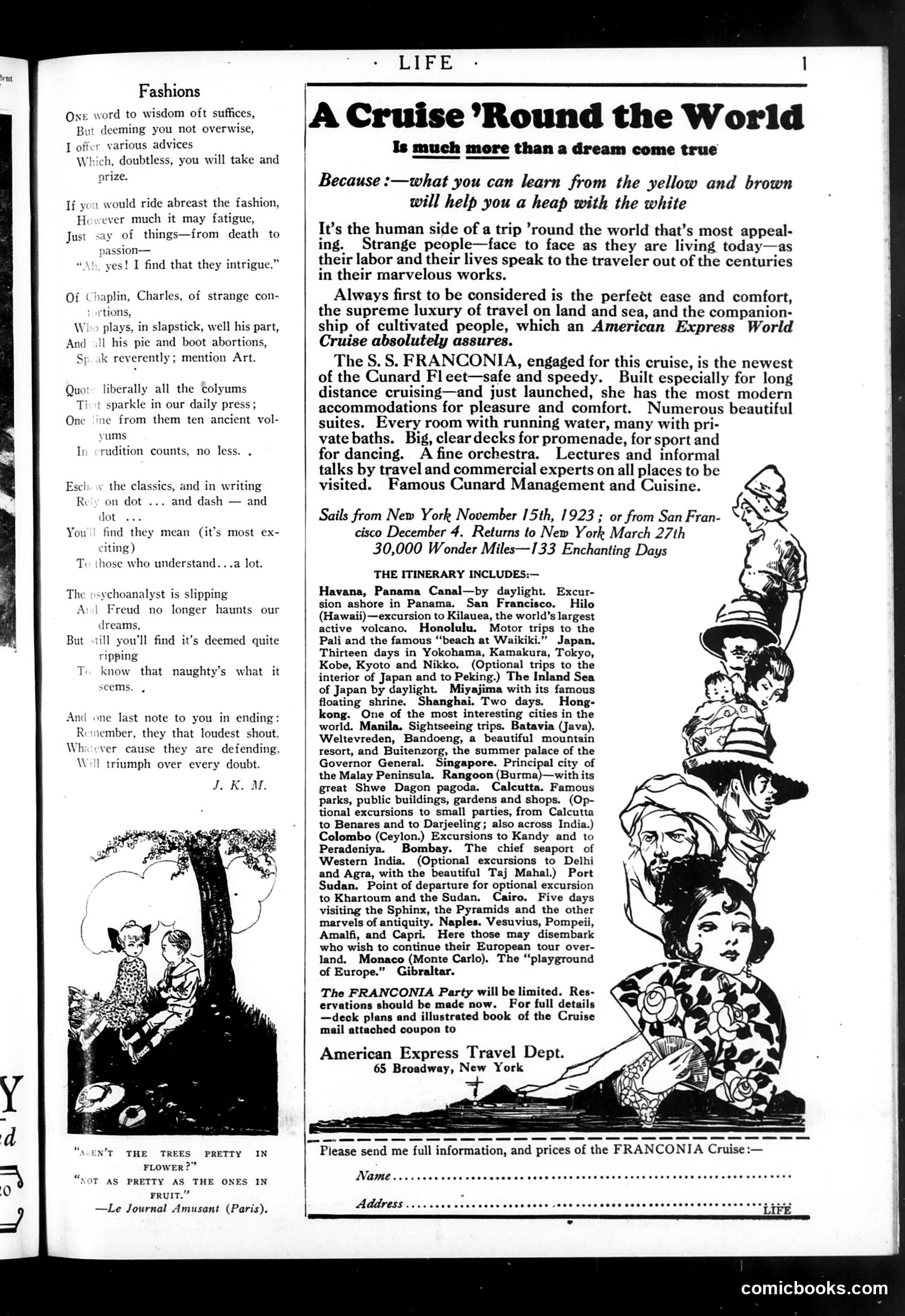
This page contains two distinct elements: **Left side ("Fashions"):** A poetry column by J.K.M. offering fashion advice, accompanied by an illustration of two figures beneath a tree. The poem references Chaplin and Charles (likely Charlie Chaplin, the famous silent-film comedian), suggesting contemporary fashion trends mimicked celebrity styles. The satirical tone mocks those who slavishly follow fashion fads. **Right side:** A full-page advertisement for the S.S. Franconia cruise ship, promoting a 133-day world tour departing November 1923. The ad emphasizes luxury travel and features illustrated figures in period dress representing destinations (Egypt, Asia, etc.). The tagline cruelly suggests observing exotic peoples helps one "keep with the white"—reflecting the deeply racist attitudes of 1920s travel marketing. The page juxtaposes fashion satire with explicit racist tourism advertising.
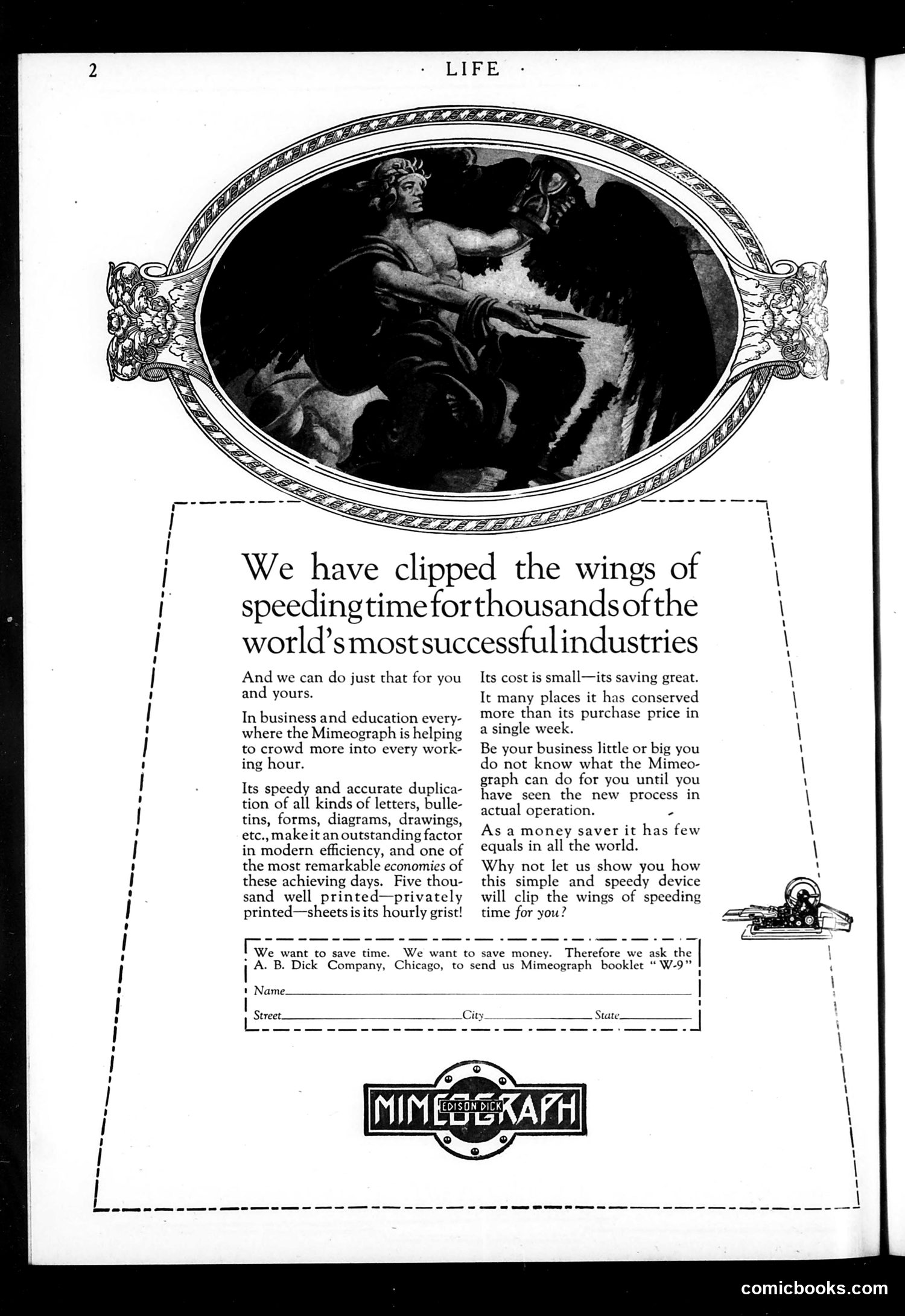
This is primarily a **Mimeograph machine advertisement** from the A.B. Dick Company of Chicago, not a political cartoon. The elliptical image at top depicts **Pegasus (winged horse) with a figure**, symbolizing speed—the ad's central metaphor. The headline claims the Mimeograph has "clipped the wings of speeding time" by enabling rapid document duplication. The advertisement targets business and educational markets, emphasizing how the machine increases efficiency by quickly copying "letters, bulletins, forms, diagrams, drawings, etc." The copy stresses cost savings and that the device "has few equals in all the world." A tear-away coupon invites readers to request a product demonstration booklet. This represents early 20th-century mechanical office technology marketed through aspirational imagery connecting speed and progress to business success.
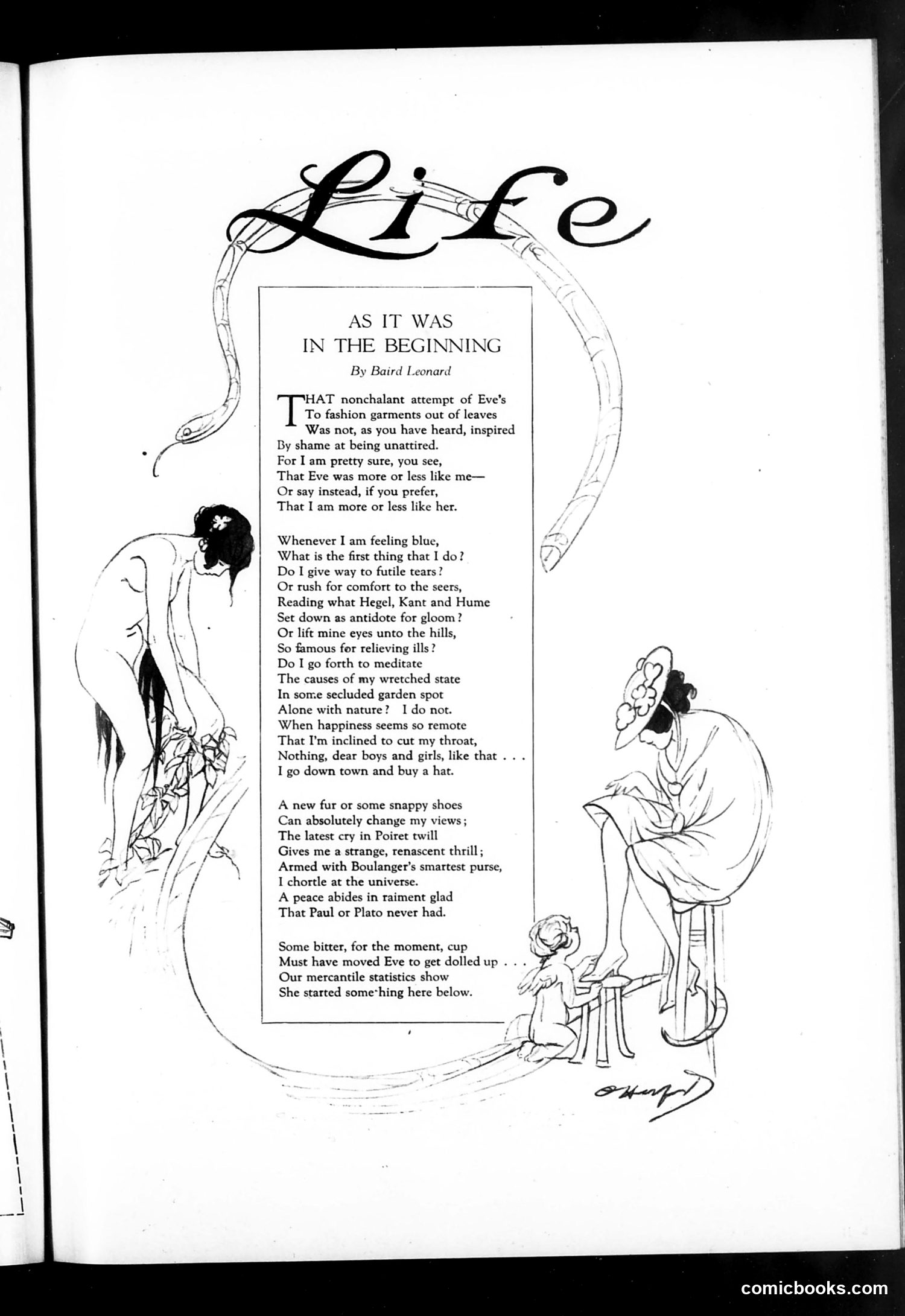
This satirical poem compares modern women to Eve, suggesting they share similar weaknesses for material temptation. The speaker—apparently a melancholic man—contrasts Eve's fall through forbidden fruit with contemporary women's susceptibility to fashion and consumer goods: "A new fur or some snappy shoes / Can absolutely change my views." The illustrations show fashionably dressed women with a serpent motif framing the text, explicitly linking Eve's biblical temptation to modern consumerism. The satire targets both women's shopping habits and the emerging consumer culture of the era, suggesting that what once was spiritual corruption is now merely commercial manipulation. The tone is cynical mockery of female materialism disguised as philosophical comparison.
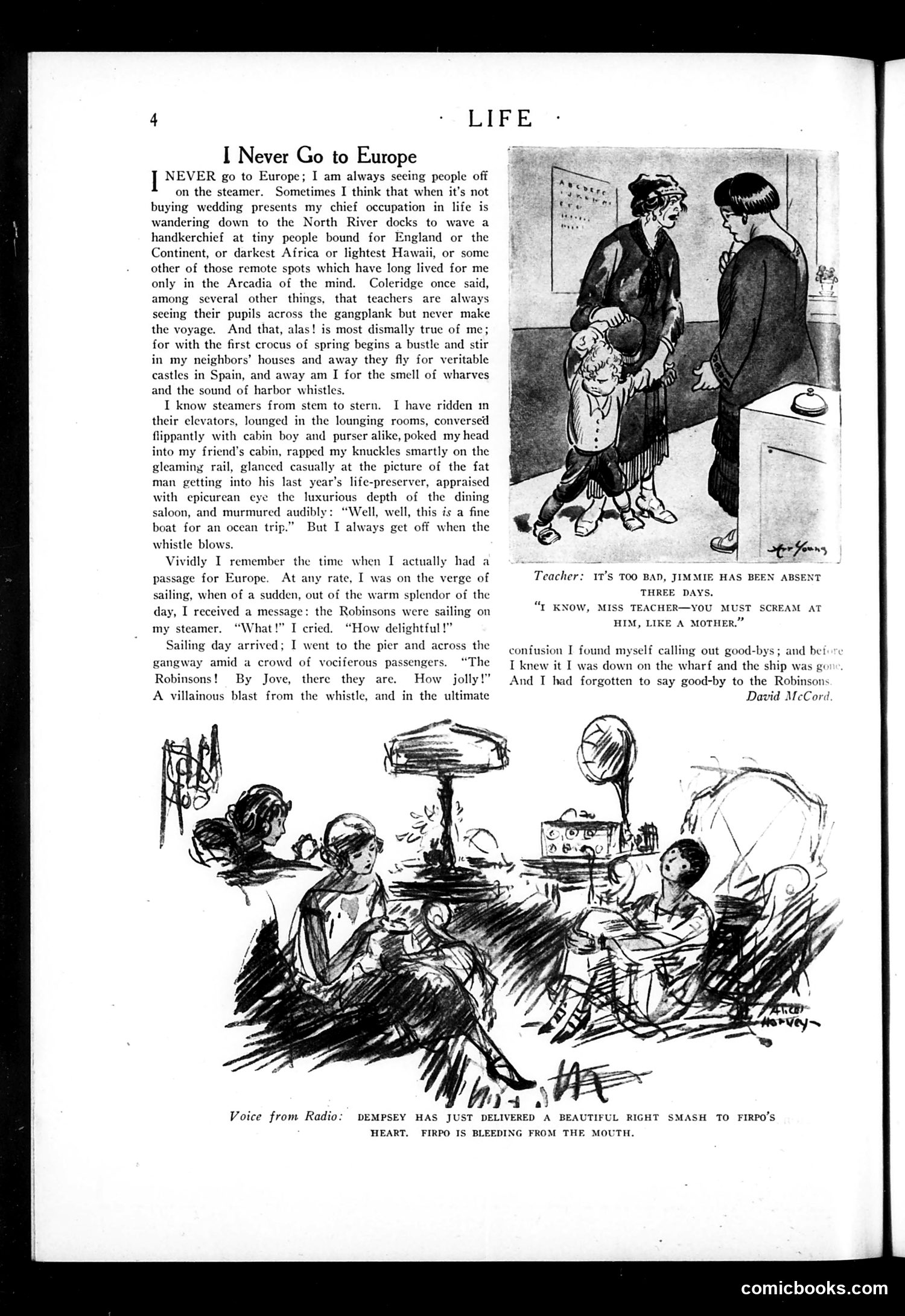
This page contains an essay titled "I Never Go to Europe" by David McCord, accompanied by two illustrations. The top cartoon depicts a schoolteacher scolding a truant student (Jimmie), saying "it's too bad, Jimmie has been absent three days" with the child's mother present. The caption includes the teacher's exhortation to "scream at him, like a mother." The bottom illustration, titled "Voice from Radio," shows a domestic scene with radio listeners. The caption references "Dempsey has just delivered a beautiful right smash to Firpo's heart. Firpo is bleeding from the mouth"—likely referencing the famous 1923 boxing match between Jack Dempsey and Luis Firpo, which was being broadcast over radio. This illustrates early radio's role in bringing live sports commentary into American homes.
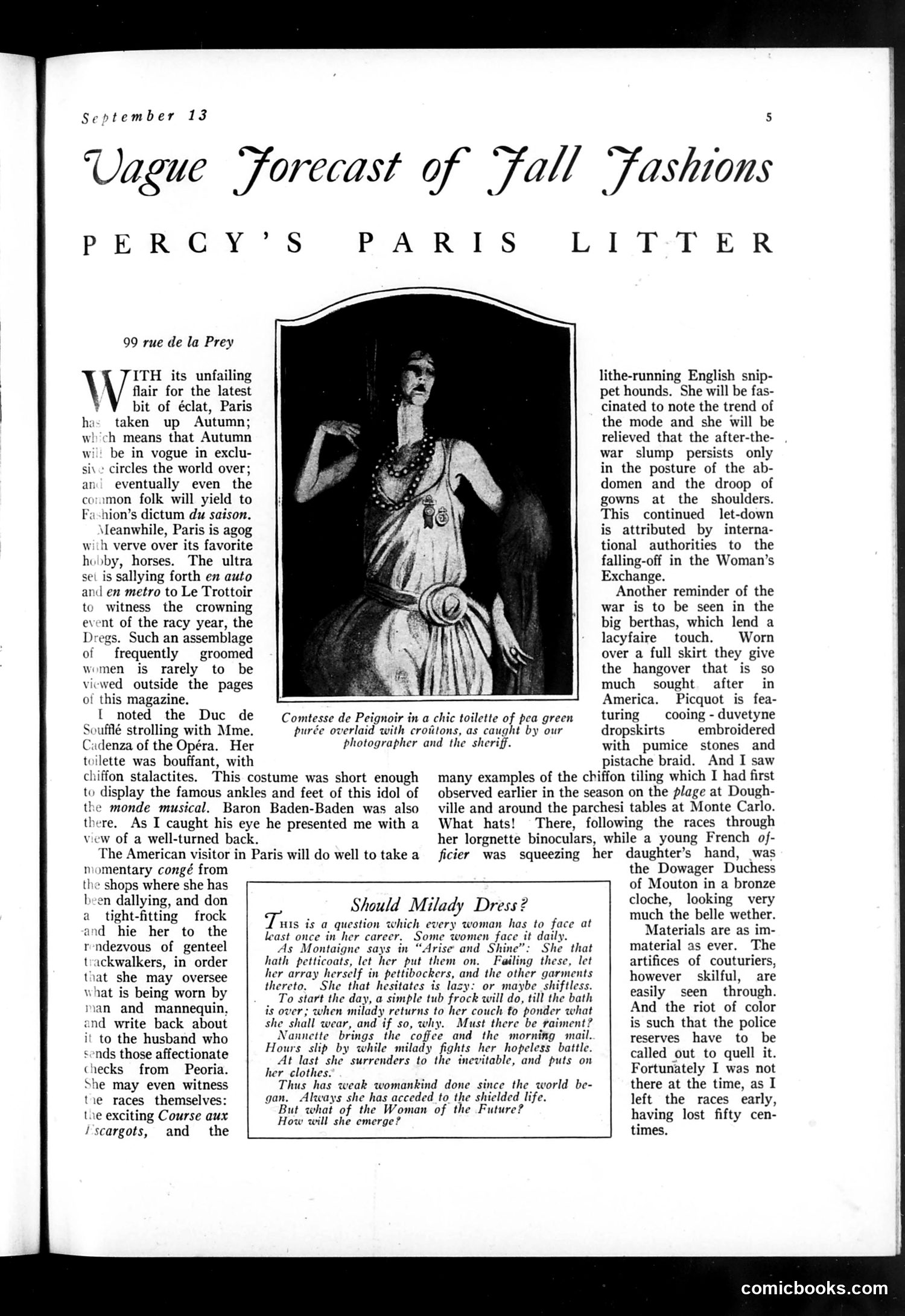
This page satirizes post-WWI women's fashion through Percy's "Paris Letter" from 99 rue de la Prey. The main illustration shows a woman in a chic green dress with crotons overlay—fashionable Parisian styling. The satire targets the "after-the-war slump" in women's fashion, mocking the persistence of drooping shoulders and let-down hemlines that designers attributed to the "Woman's Exchange." The text jokes about women adopting masculine postures and war-influenced aesthetics. The inset box "Should Milady Dress?" humorously questions whether women should prioritize practical housework clothing or maintain elaborate fashion standards, satirizing the tension between post-war "New Woman" functionality and traditional feminine aesthetic expectations. The overall tone gently mocks both Parisian fashion pretensions and American women's compliance with them.
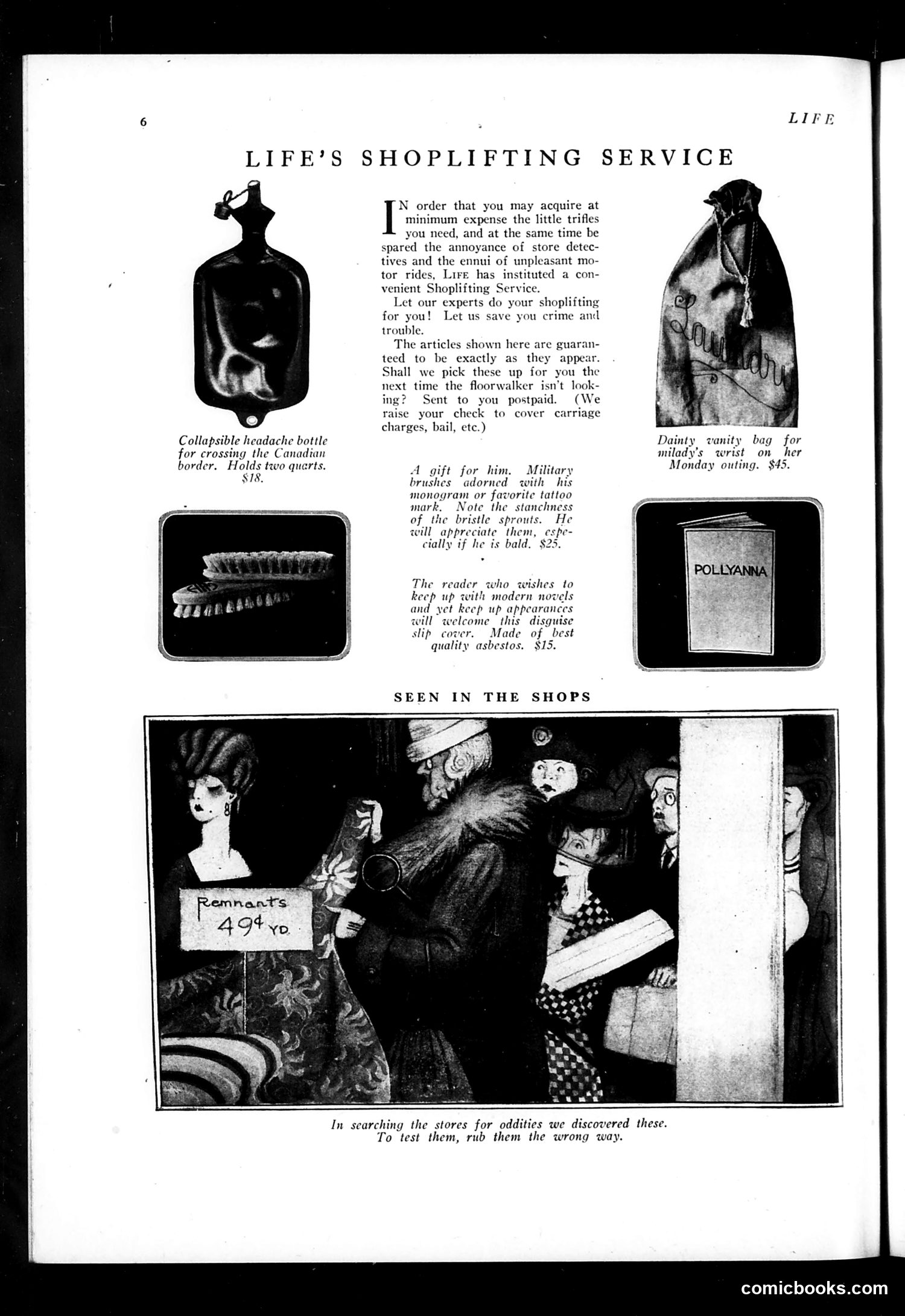
This page is primarily **satirical advertising** rather than political commentary. Life magazine humorously offers a fake "Shoplifting Service" — claiming to acquire small items for readers while avoiding store detectives and "unpleasant motor rides" (arrest). The items advertised include practical goods: a collapsible headache bottle for Canadian border crossings ($18), military brushes ($25), a vanity bag ($15), and denture slip covers ($13). The bottom illustration labeled "Seen in the Shops" depicts well-dressed shoppers examining merchandise marked "Remnants 49¢ YD," satirizing the desperation of bargain-hunting during what appears to be an economically challenging period. The caption jokes about discovering "additives" in stores, suggesting product quality concerns. The humor targets consumerism and economic anxieties of the era.
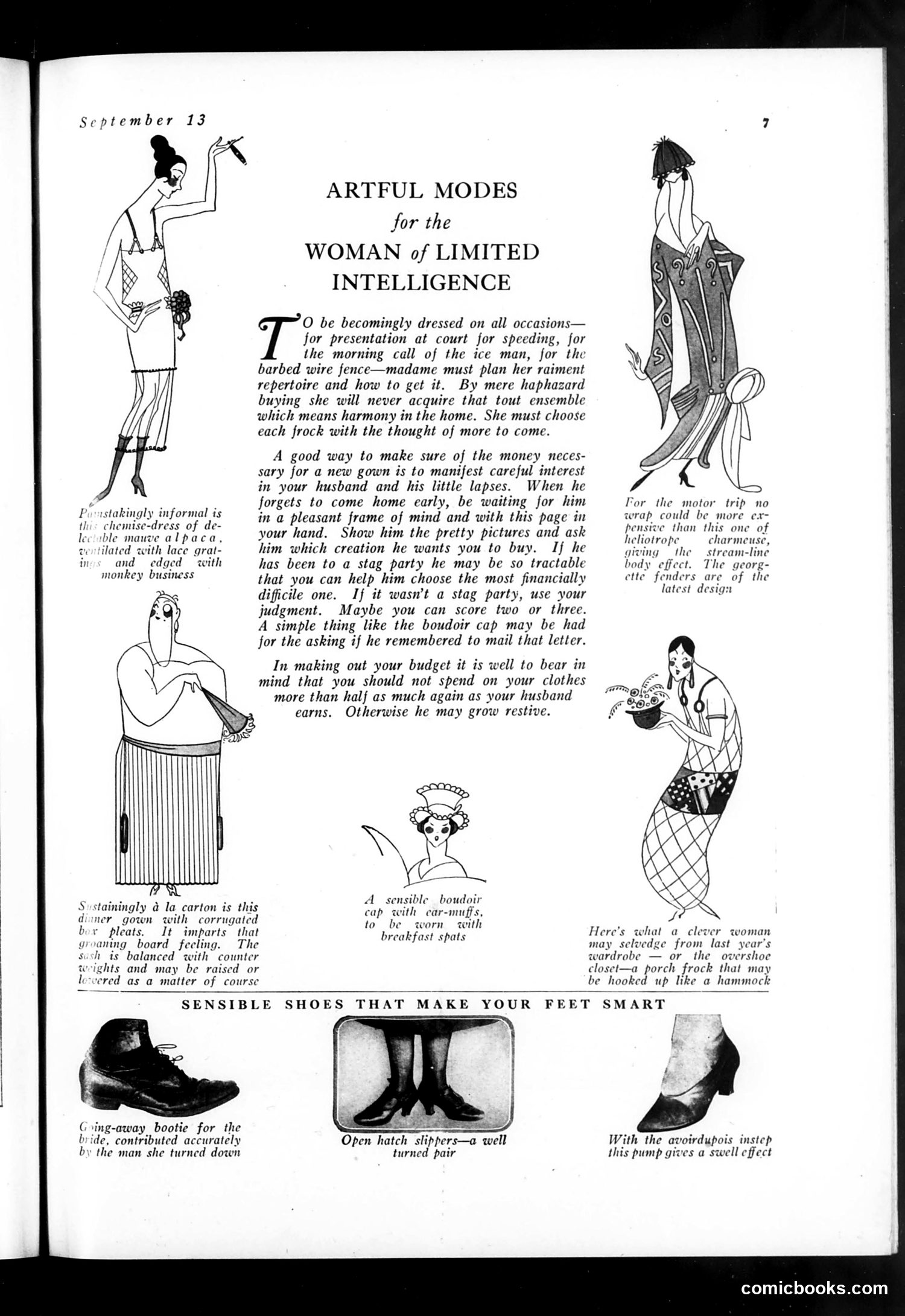
This satirical piece mocks women of modest intellect through fashion advice. The title itself is the joke—it's deliberately insulting, suggesting certain women lack intelligence. The satire works by offering practical budgeting tips (don't spend more than half your clothing budget relative to husband's earnings) and modest wardrobe suggestions while framing them as necessary because these women supposedly can't manage sophistication. The accompanying illustrations show unflattering female figures in various outfits. The lower section on "Sensible Shoes" continues the mockery with crude drawings of footwear. This reflects 1920s-era sexist attitudes presenting women—particularly those of limited means or education—as dim-witted yet vain, needing paternalistic guidance on how to dress appropriately within their station.
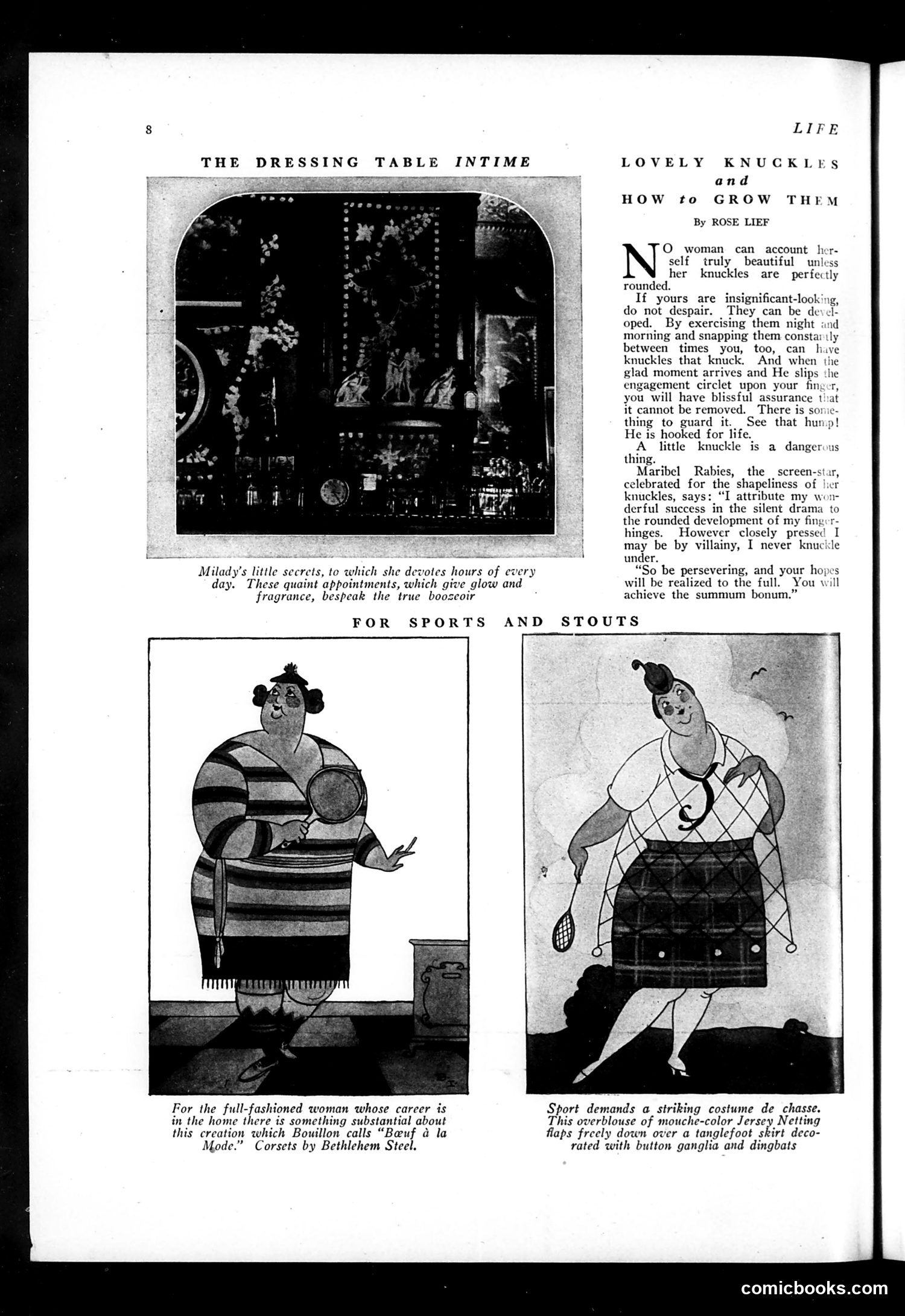
This page combines beauty advice with fashion satire for different body types. The top article by Rose Lief addresses women with underdeveloped knuckles, offering exercises to improve them—reflecting early 20th-century beauty standards that valued perfectly rounded knuckles as an aesthetic requirement. The bottom two cartoons mock fashion and body consciousness. Both feature heavyset women: the left illustration shows a woman in striped clothing with a corset advertisement (Bethlehem Steel corsets), satirizing the fashion industry's promise to reshape bodies. The right cartoon depicts a woman in sports attire, mocking how athletic wear claims to flatter unfashionable figures. Together, these images satirize the fashion industry's exploitation of women's insecurities and unrealistic body standards through corsetry and specialized clothing.
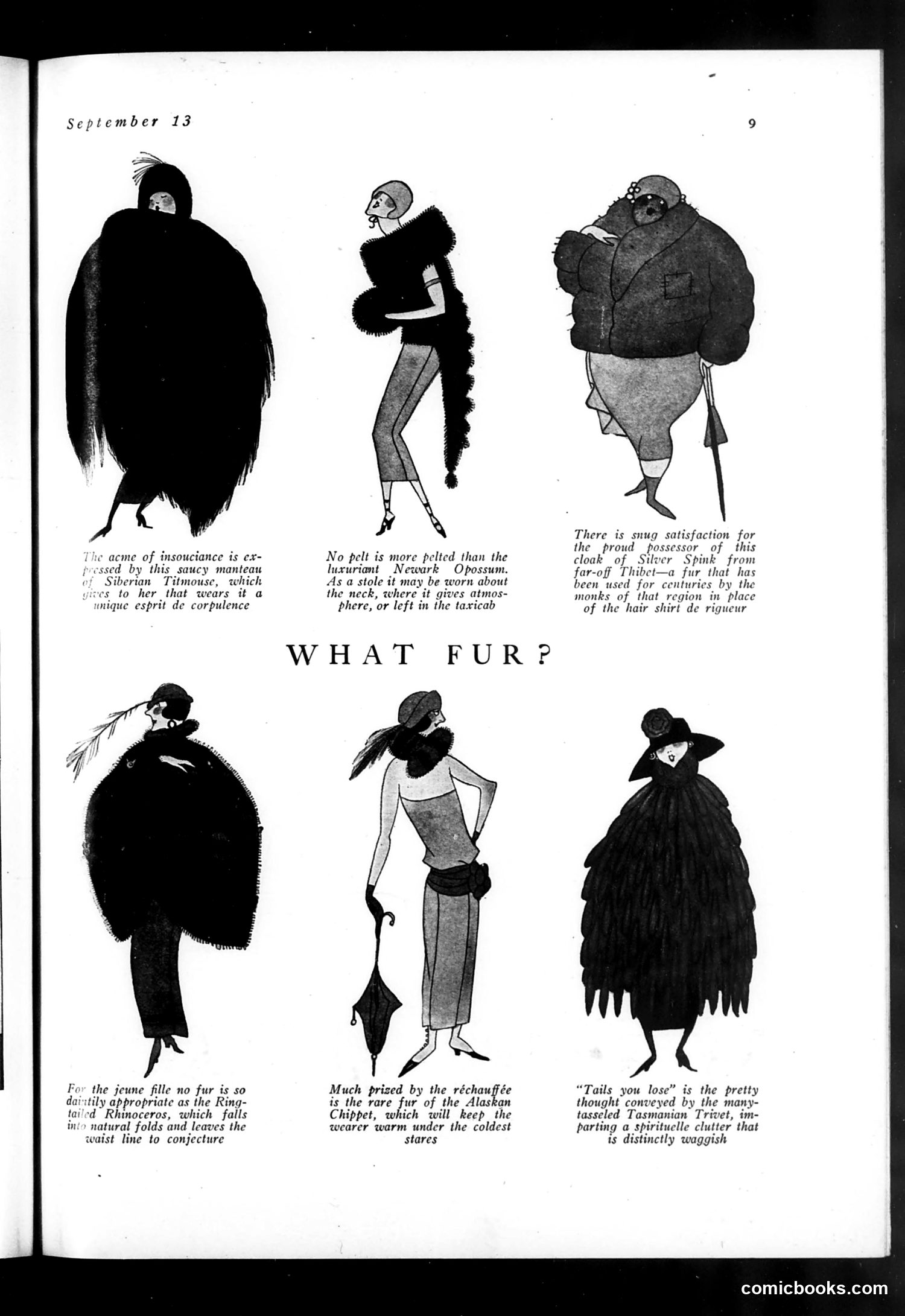
This page satirizes 1920s women's fashion, specifically the wearing of fur garments. Six illustrated figures display different fur styles with accompanying commentary on each. The satire targets the extravagance and pretension of fur fashion among wealthy women. Each caption mockingly describes a fur type—ranging from "saucy manteau" to "Alaskan Chippet"—with tongue-in-cheek language about warmth, elegance, and status. The humor lies in exposing how fur-wearing was simultaneously impractical (some furs are too heavy or awkwardly shaped) yet socially prized as a luxury status symbol. The exaggerated body shapes of the illustrated women further ridicule the fashion's vanity. This reflects broader 1920s satire of women's consumer culture and the arbitrary nature of fashion trends during the Jazz Age.
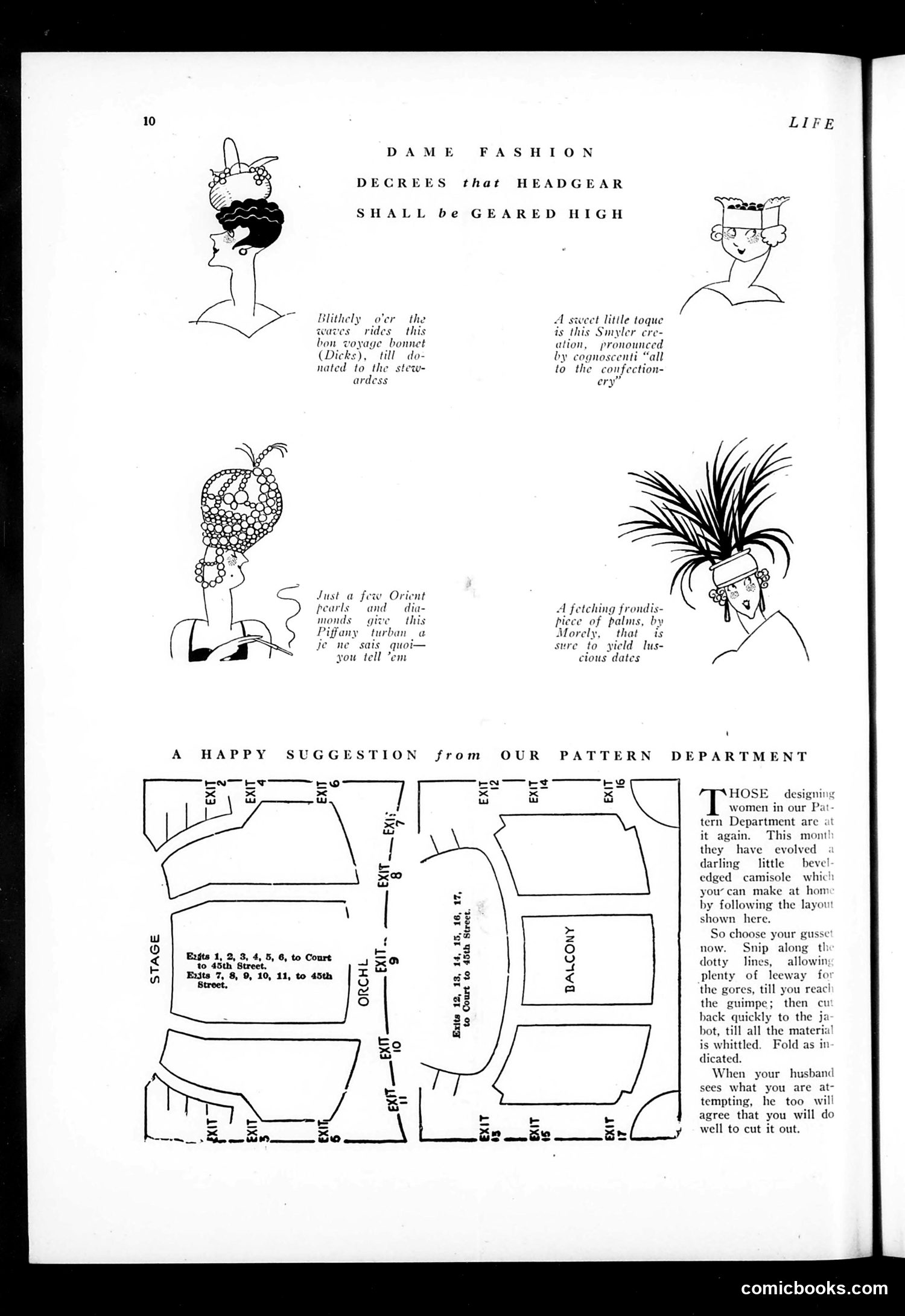
This page from *Life* magazine focuses on women's fashion, specifically high headwear. The upper section satirizes the trend of excessively tall and elaborate hats through illustrated examples: a "bon voyage bonnet," an ornate "Snyler creation," a jeweled "Pilgrim turban," and a "frontispiece of palms." The accompanying text mocks these impractical designs with dry humor, noting that even modest variations might seem excessive to observers. The lower section provides a practical sewing pattern for a "beveled camisole" that readers can make at home, addressed to "those designing women in our Pattern Department." The satire targets the absurdity of Edwardian-era millinery fashion—when women's hats were famously enormous, decorated with feathers, fruit, and other ornaments—while simultaneously offering readers a useful DIY alternative.
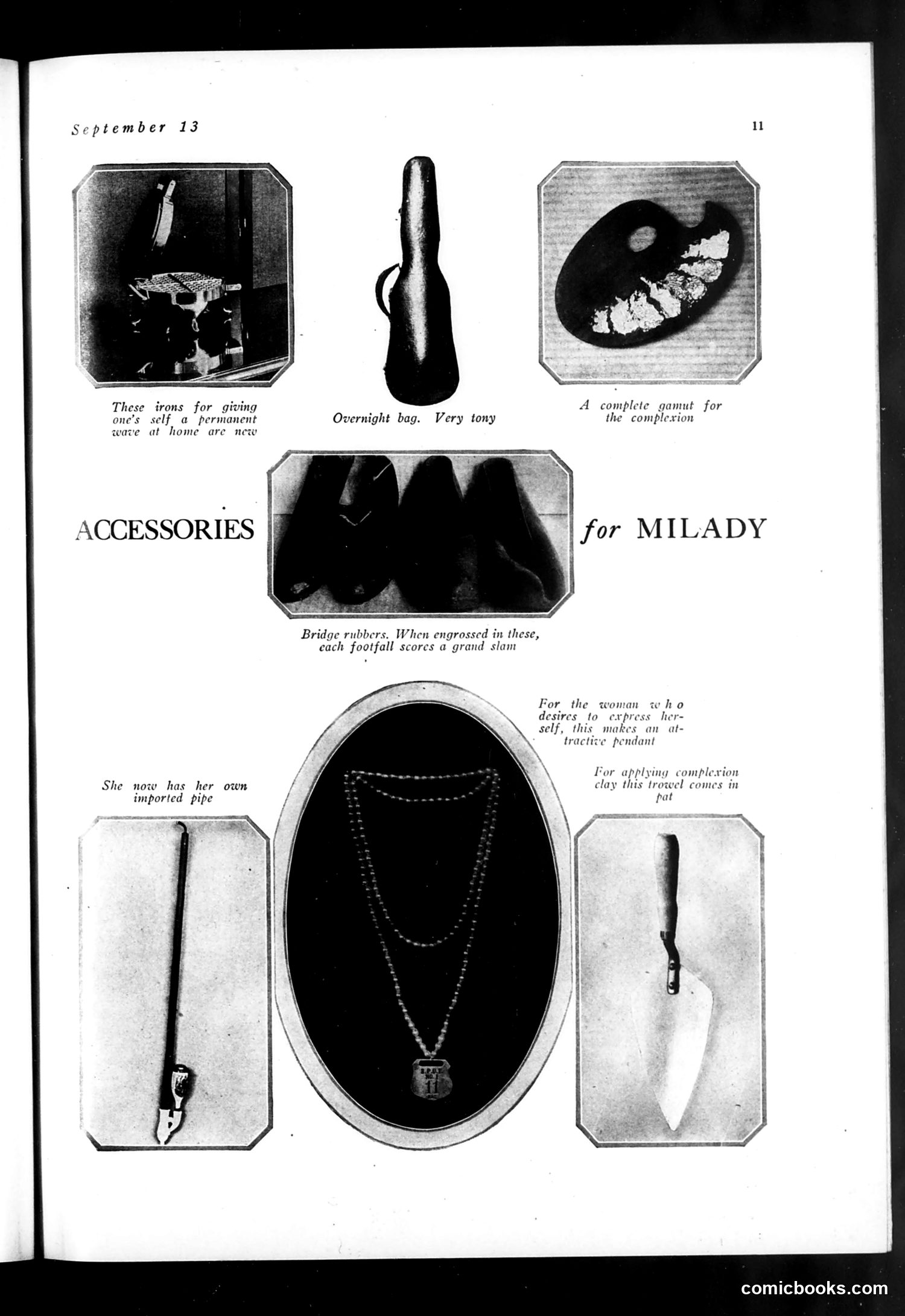
This is a satirical advertisement page mocking women's beauty and vanity products of the early 20th century. The page presents various items with ironic captions suggesting they're remedies for "milady's" physical flaws: - Irons for giving "a permanent wave at home" - An "overnight bag" (very long) - A "complete gamut for the complexion" - "Bridge rubbers" for footfall - An "attractive pendant" - An "oven imported pipe" - Complexion clay in a trowel The satire targets the era's obsession with feminine beauty standards and the proliferation of dubious cosmetic products marketed to women. By presenting exaggerated or absurd "solutions" to beauty concerns, the page ridicules both the products themselves and the insecurities they exploit.
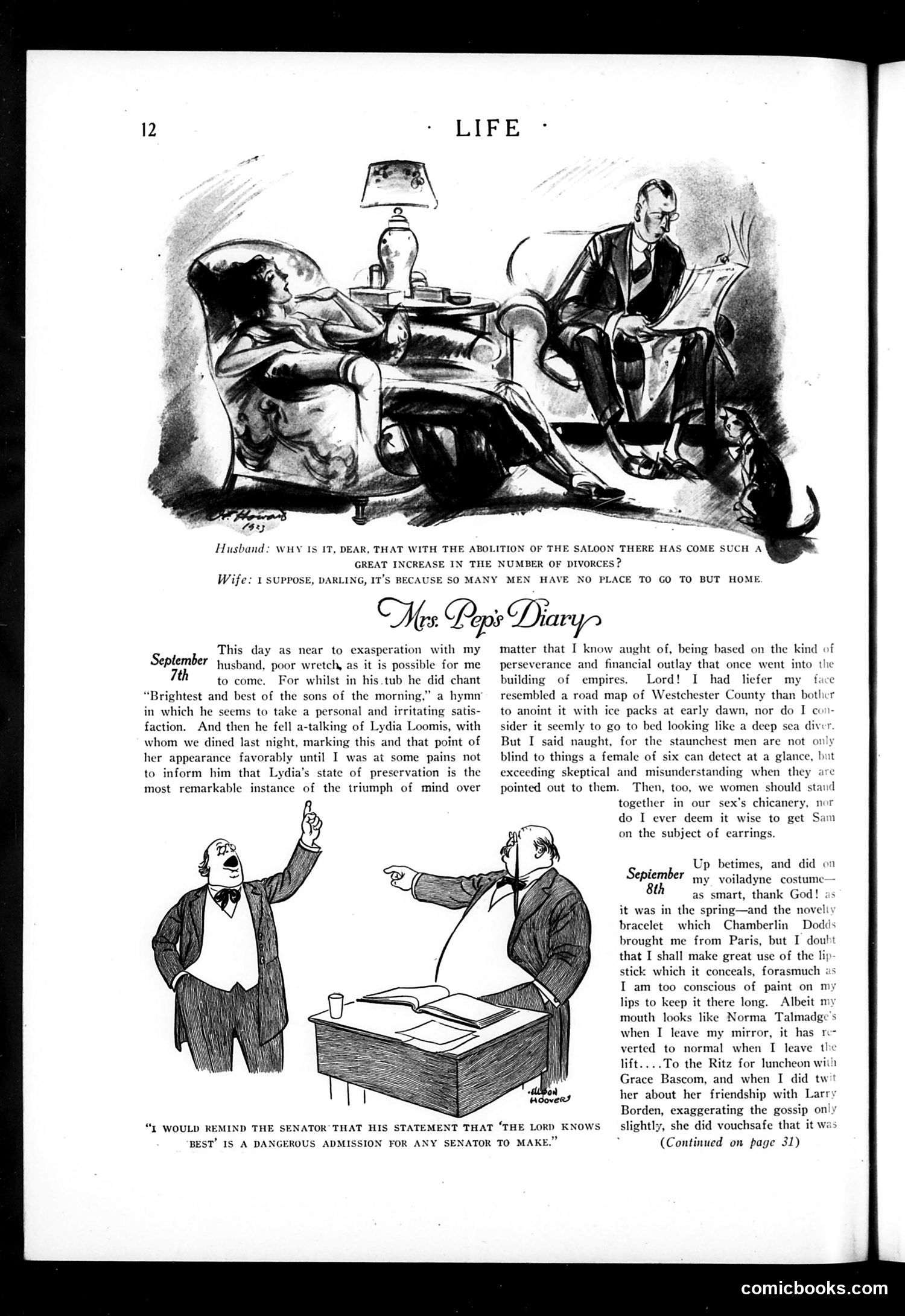
**Top Cartoon:** A husband asks his wife why closing saloons has increased divorces. She responds that men now have nowhere to go, so they stay home—implying domestic conflict results from forced togetherness. This satirizes Prohibition (the abolition of saloons), suggesting the law created unintended social consequences by eliminating male social spaces. **"Mrs. Pep's Diary":** A satirical society column mocking upper-class women's vanity and shallow concerns. The diary entries reference social events, fashion (a Paris bracelet, voilà costume), and gossip about acquaintances like "Larry Borden." The accompanying cartoon shows two men arguing, with a caption about a senator's statement being "dangerous." This section ridicules elite social pretension and frivolous female interests typical of 1920s satirical humor.
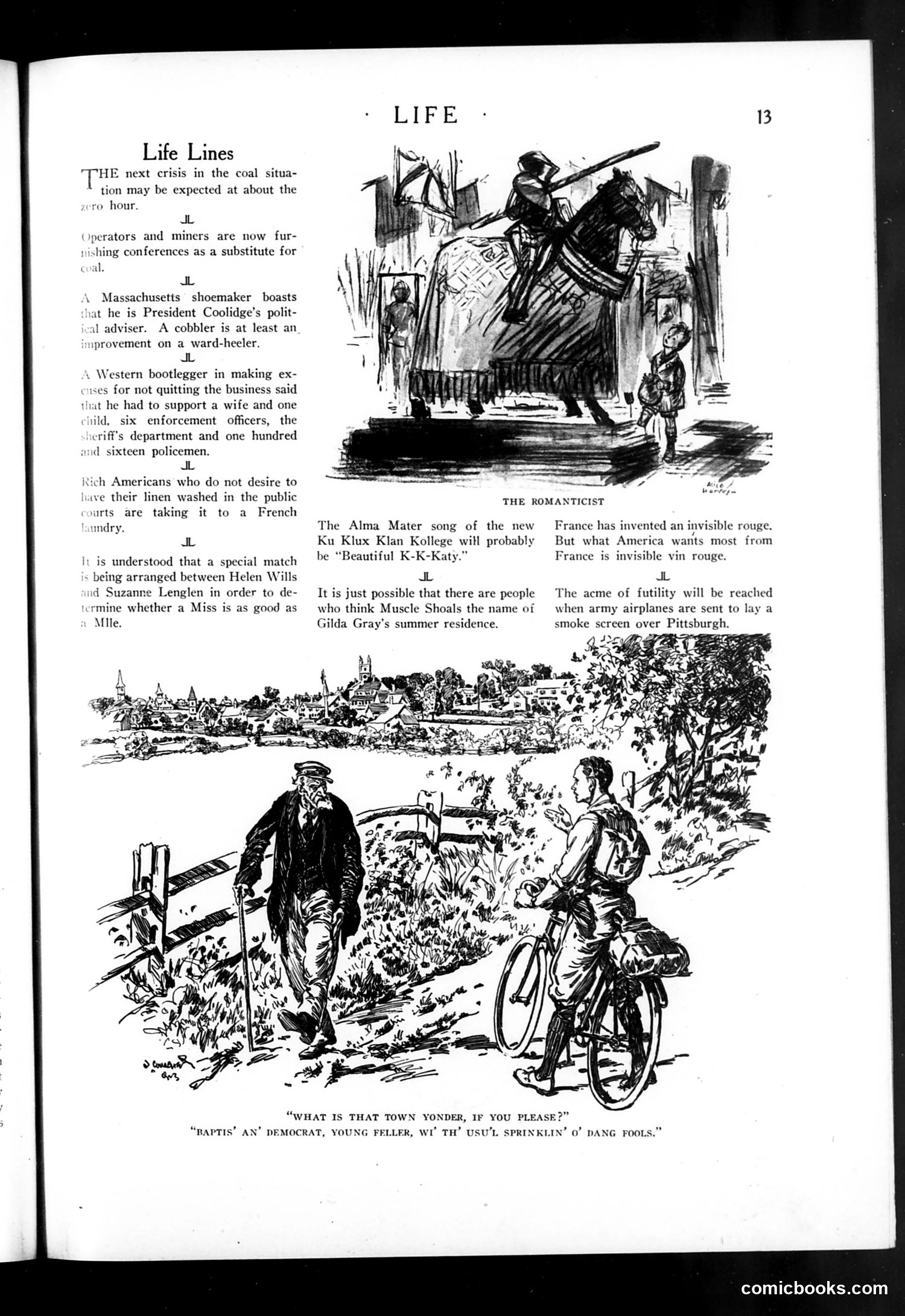
This page contains satirical "Life Lines" commentary and two editorial cartoons. **Top cartoon ("The Romanticist"):** Shows a mounted cavalry officer on a rearing horse, apparently representing romantic/militaristic idealism. **Bottom cartoon:** Depicts an elderly man with a cane encountering a young cyclist. The caption's dialect suggests the old man is asking about the town, with the young cyclist responding dismissively using colloquial language ("Baptis' an' Democrat...sprinklin' o' bang fools"). This appears to satirize generational disconnect—the traditionalist elder questioning modern youth culture and political apathy. The rural setting and dialect humor were common Life magazine devices for mocking social change during the early 20th century. The overall effect is conservative social commentary on declining civic engagement among younger Americans.
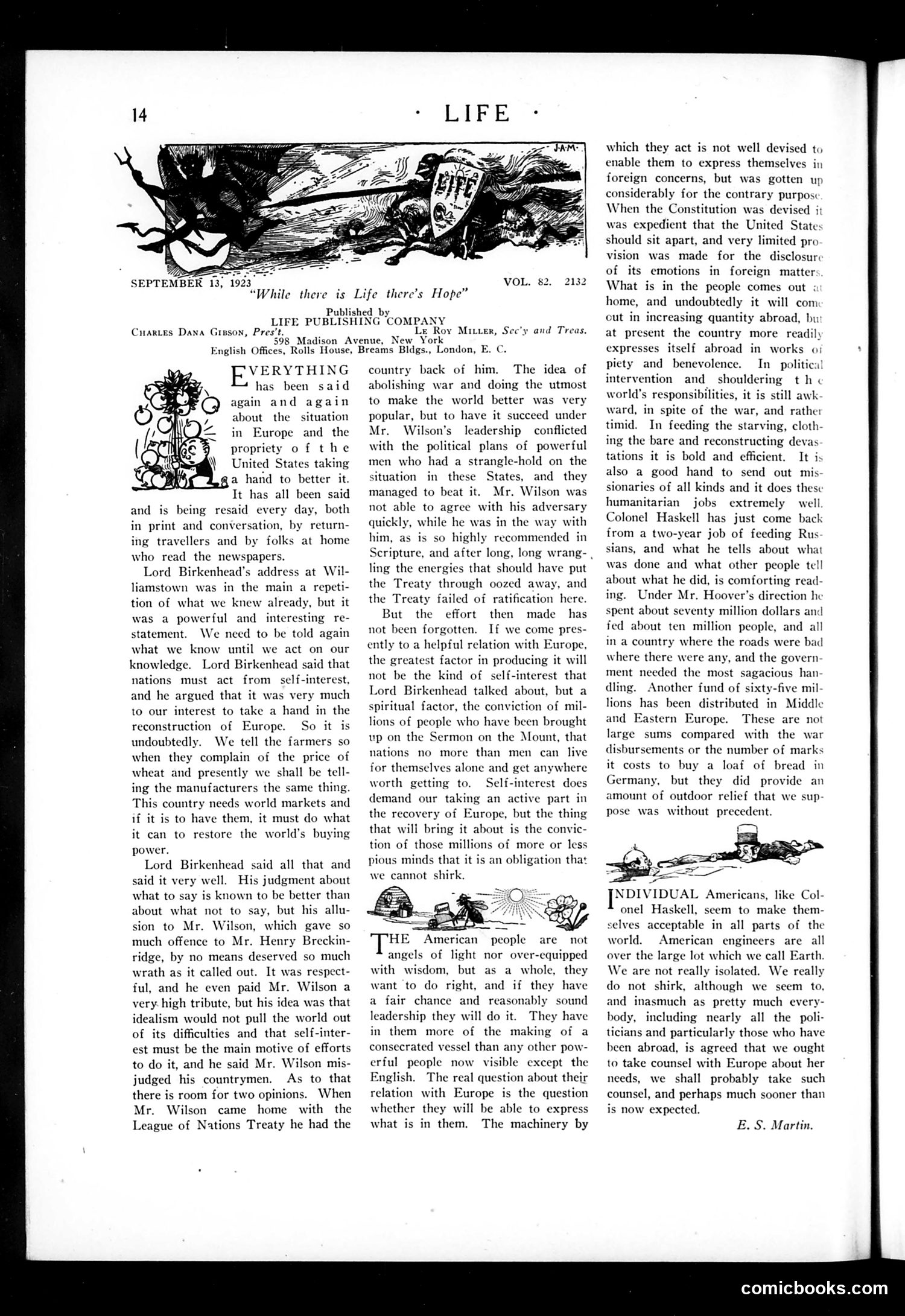
The masthead cartoon depicts **Lady Liberty** (holding a shield marked "Constitution") appearing exhausted or defeated, with what appears to be a dead bird or dove nearby—likely symbolizing failed peace efforts or internationalism. The accompanying article criticizes President **Woodrow Wilson's** foreign policy, particularly regarding **European reconstruction** and the failed **League of Nations Treaty**. The text argues Wilson's idealism was admirable but impractical, and that American self-interest (not altruism) should guide foreign aid to Europe. The piece advocates for pragmatic American intervention in European recovery—justified by American interests rather than humanitarian ideals. This reflects 1923 post-WWI isolationist sentiment and skepticism toward Wilson's internationalist vision.
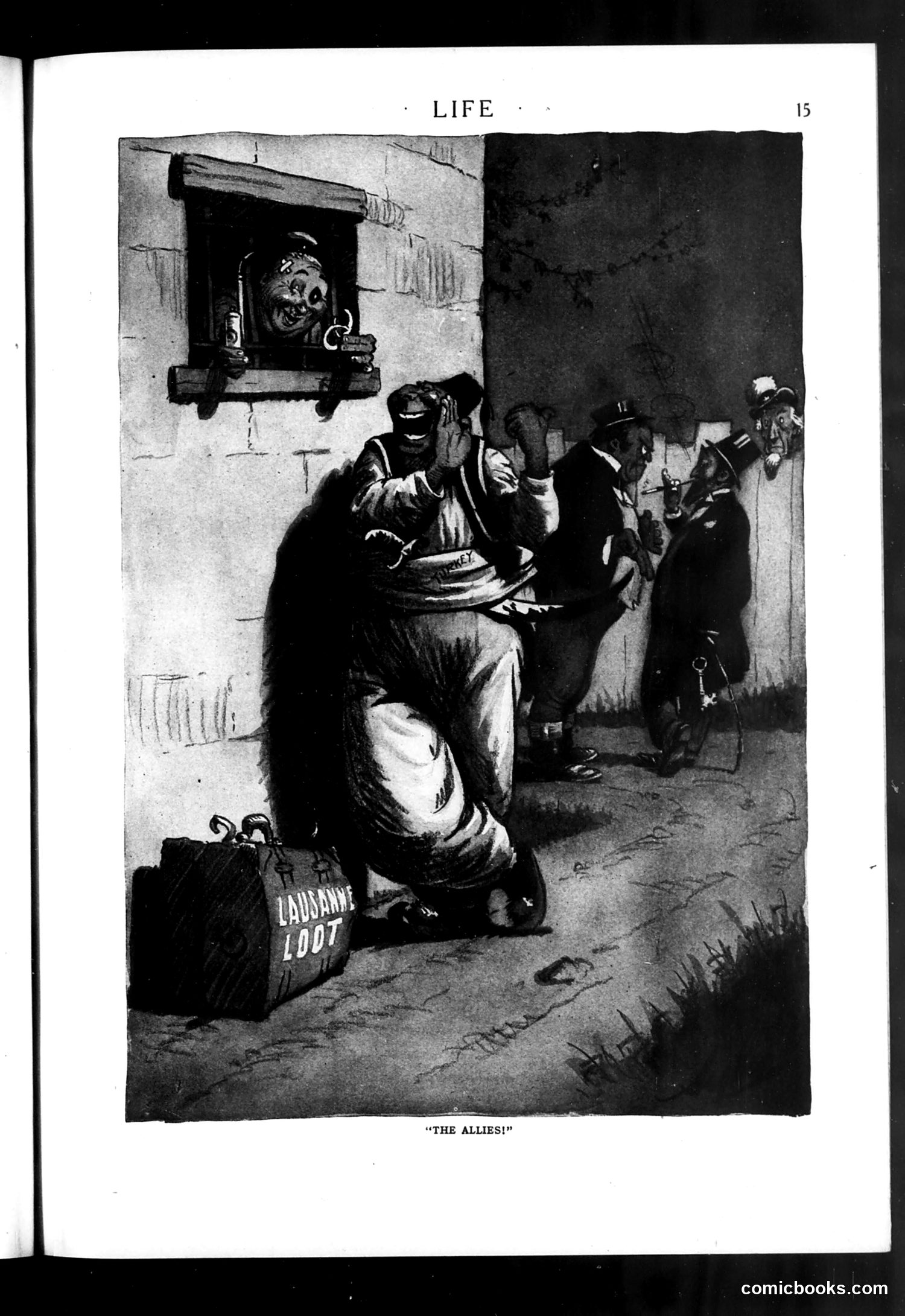
This is a satirical cartoon depicting what appears to be wartime Allied cooperation. A figure emerges from a window above (likely representing a national leader or government), while below, soldiers or representatives of Allied nations interact in a narrow street or alley setting. One figure carries luggage marked "LAUSANNE" (a Swiss city), suggesting diplomatic negotiations or meetings. The satire likely critiques the practical difficulties of Allied unity during warfare—the cramped quarters and awkward positioning suggest tension, miscommunication, or uncomfortable compromises between different nations supposedly working together. The title "The Allies!" uses ironic emphasis to mock their coordination. Without a clear date visible, the specific historical moment remains uncertain, though this appears to reference World War I or interwar diplomatic efforts.
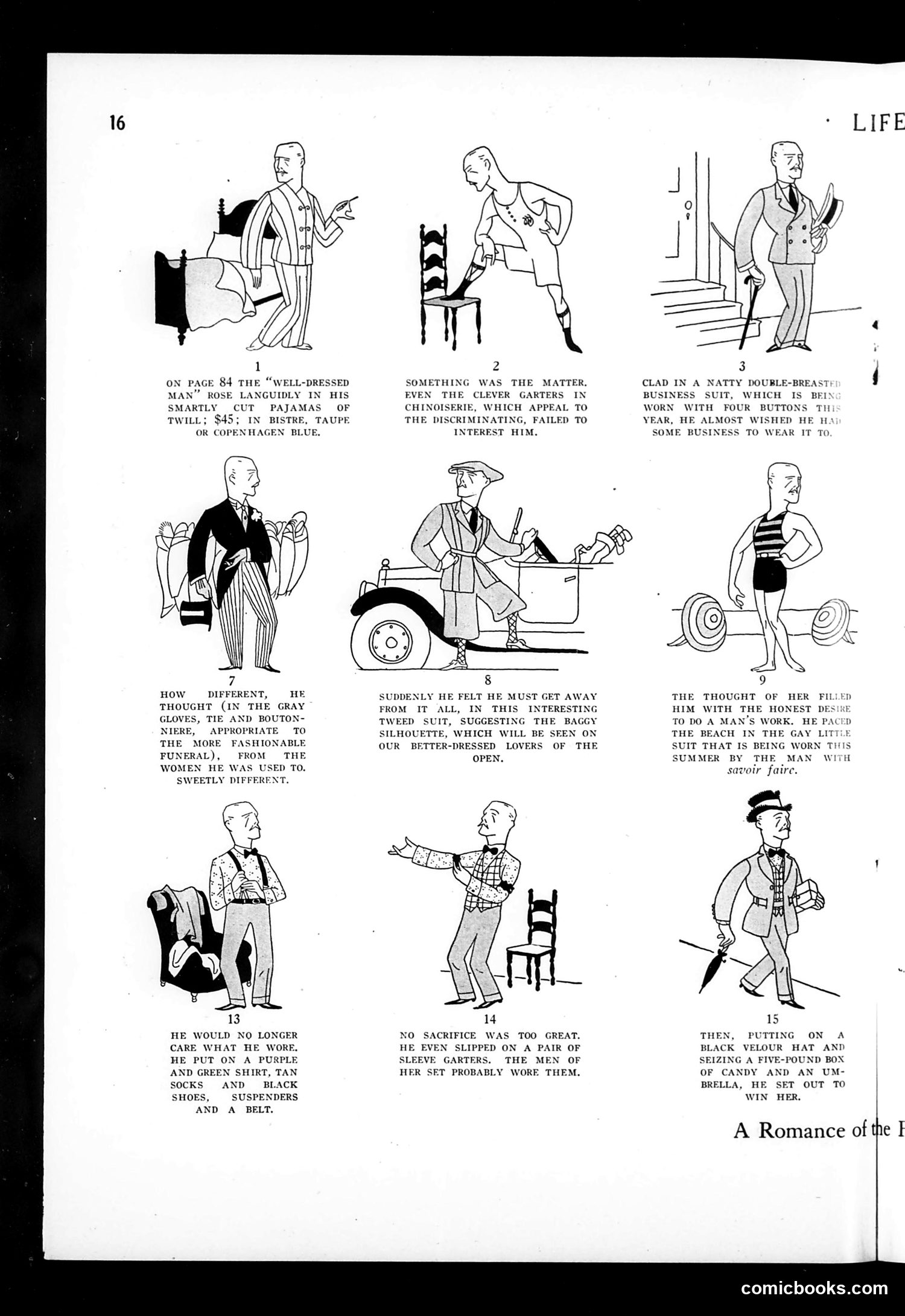
This appears to be a satirical comic sequence about a fashionable man's romantic pursuit. The narrative follows a well-dressed gentleman through various outfit changes and emotional states as he attempts to win over a woman. The satire targets **male fashion consciousness and superficiality**: the protagonist obsesses over clothing details (specific suit prices, garter styles, color combinations) while experiencing emotional turmoil about romance. Each panel shows him in different ensembles—from expensive tailored wear to casual beach attire—as if the *right outfit* will solve his romantic problems. The humor lies in depicting a man adopting traditionally feminine preoccupations with fashion and appearance. The text emphasizes specific garment costs and designers, mocking both consumerism and the notion that dressing well equals romantic success. By panel 15, he's reduced to carrying candy and an umbrella—superficial romantic gestures to match his superficial wardrobe focus. The reference to "*savoir faire*" (worldly sophistication) underscores the irony: despite his fashionable appearance, he lacks genuine romantic competence.
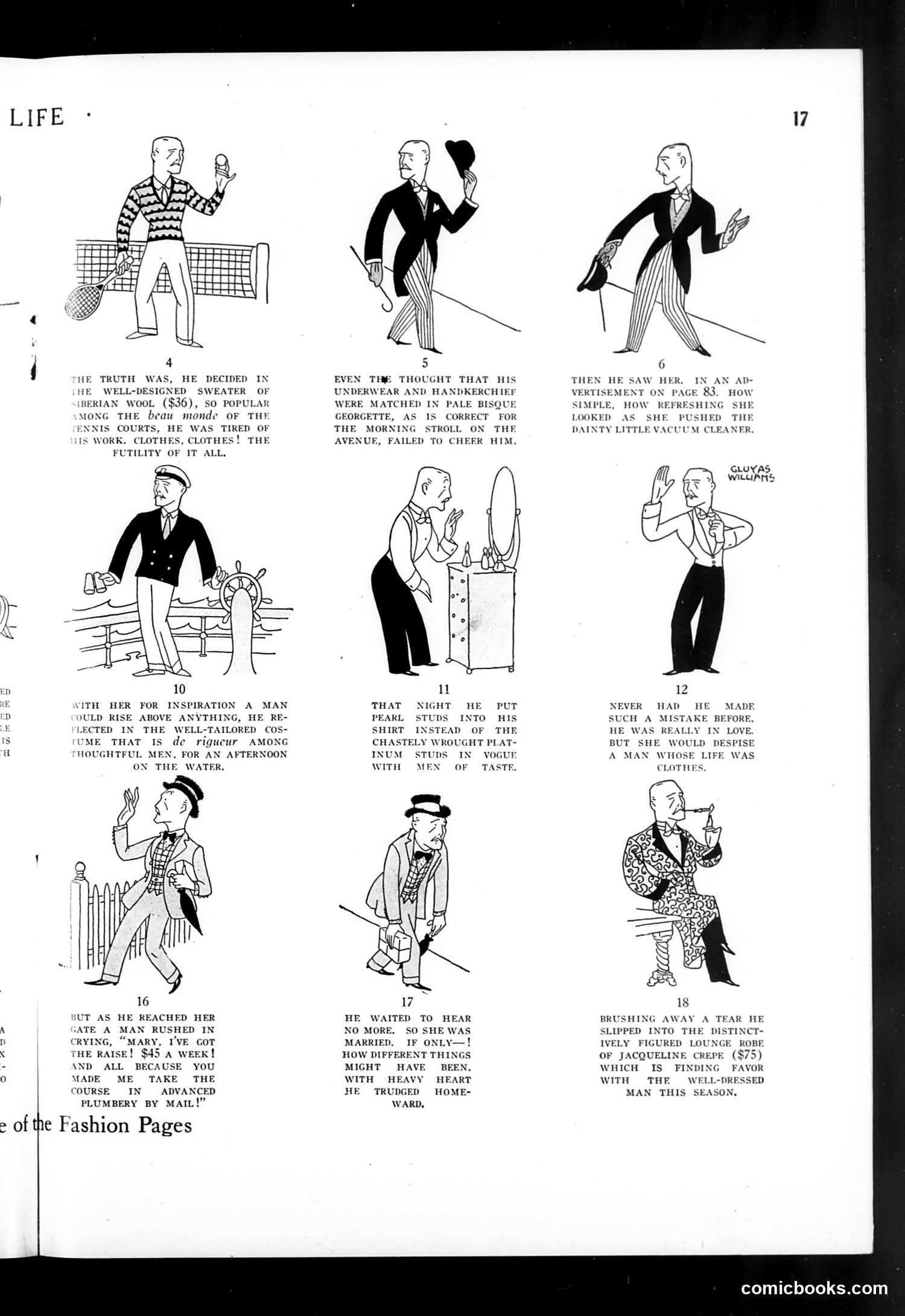
This is a satirical comic strip mocking fashion advertising and male vanity. It follows a well-dressed man obsessed with expensive, carefully coordinated clothing—Siberian wool sweaters ($36), matched underwear in "pale bisque," pearl shirt studs, and designer robes ($75). The joke: Despite claiming to despise the "futility" of caring about clothes, he remains enslaved to fashion consumption. When he spots a woman in a vacuum cleaner advertisement and falls in love with her simple, practical nature, he resolves to change—but immediately buys an expensive designer robe ($75) anyway. The satire targets *Life* magazine's own fashion advertising industry: men claim to reject materialism while obsessively purchasing status goods. The irony is unresolved—he's trapped in consumerism even while recognizing its emptiness. The cartoon mocks both male pretension and the magazine's complicity in promoting unnecessary luxury goods to readers.
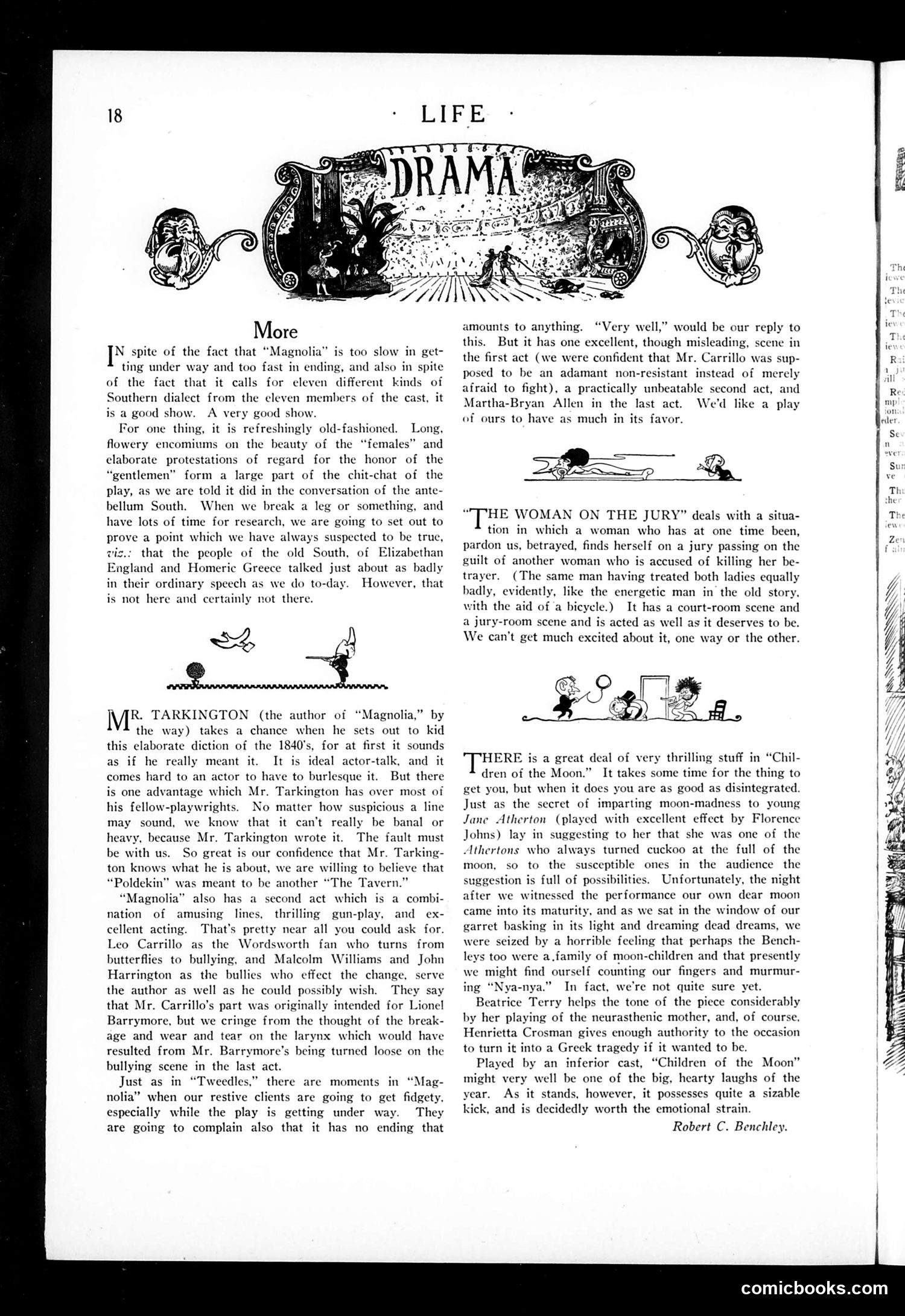
This page reviews three theatrical productions. The critic discusses "Magnolia," a play by Booth Tarkington that deliberately mimics and gently parodies the elaborate, flowery speech patterns of the antebellum South. The reviewer notes the irony: actors struggle with the archaic dialogue, uncertain whether Tarkington intended it sincerely or mockingly—but trusts his talent enough to assume satire. The play stars Leo Carrillo and features competent supporting performances, though the critic finds its ending weak. The page also briefly reviews "The Woman on the Jury" (unremarkable) and "Children of the Moon" (initially slow but eventually compelling). The small cartoon illustrations appear to be generic theatrical vignettes rather than commentary on specific figures or political issues. The tone reflects early 20th-century theatrical criticism—sophisticated, somewhat arch, focused on acting quality and dramatic structure.
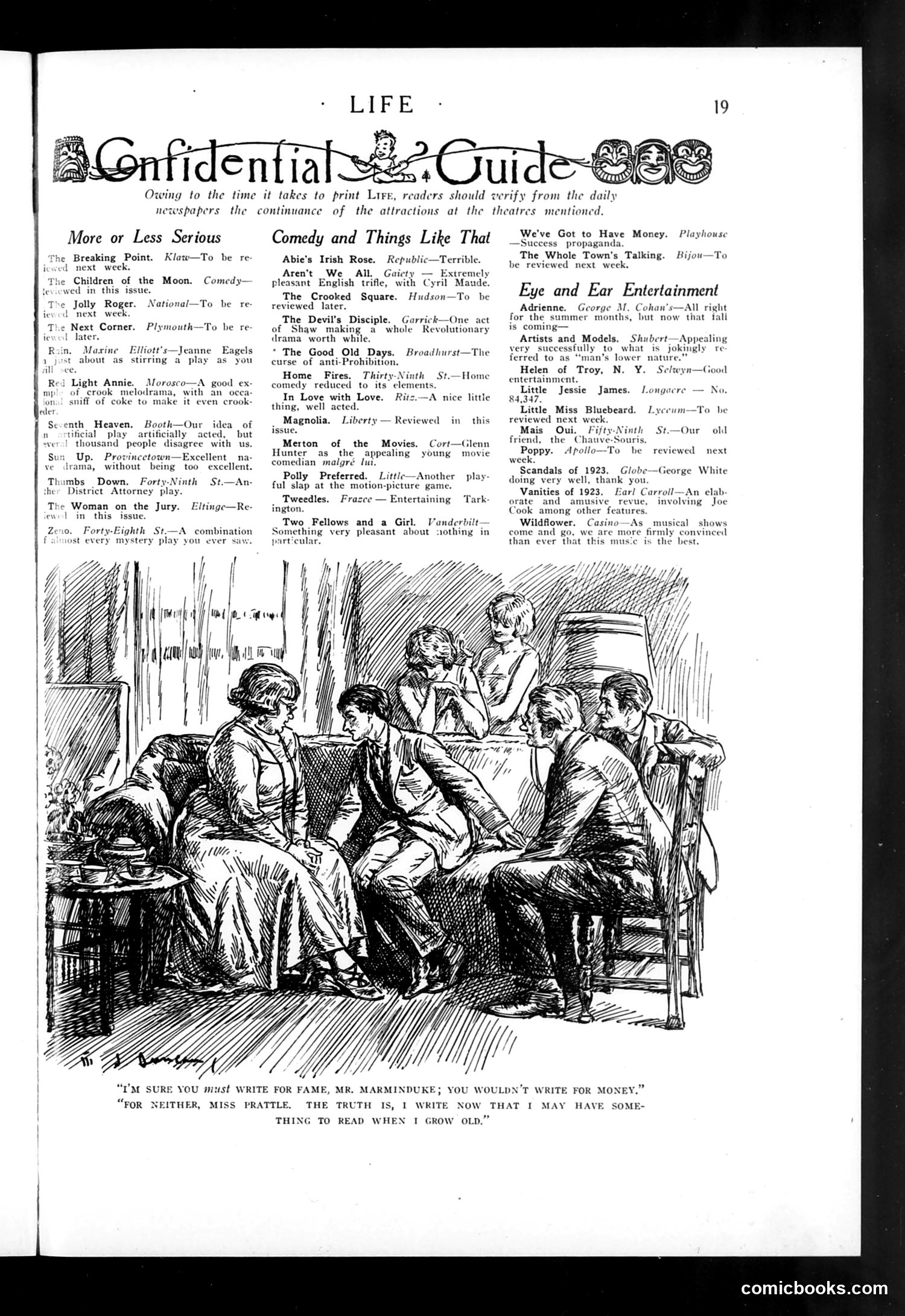
This page from *Life* magazine presents theatrical reviews alongside a cartoon satirizing artistic pretension. **The Cartoon:** A man (Mr. Marminduke) sits with several people in what appears to be a social gathering. When challenged about whether he writes for fame or money, he replies that he writes for neither—claiming he writes now "that I may have something to read when I grow old." **The Satire:** The joke mocks self-important artists who claim lofty, impractical motivations for their work while avoiding admission of mercenary interests. Marminduke's absurd answer (writing purely for his future entertainment) is presented as pretentious nonsense—a deflection from the reality that artists either seek fame or income. Miss Prattle's skeptical tone suggests everyone recognizes this as transparent posturing. **Context:** This reflects early 1920s cultural attitudes toward artistic vanity and the gap between artists' stated ideals and actual motivations—a recurring *Life* target.
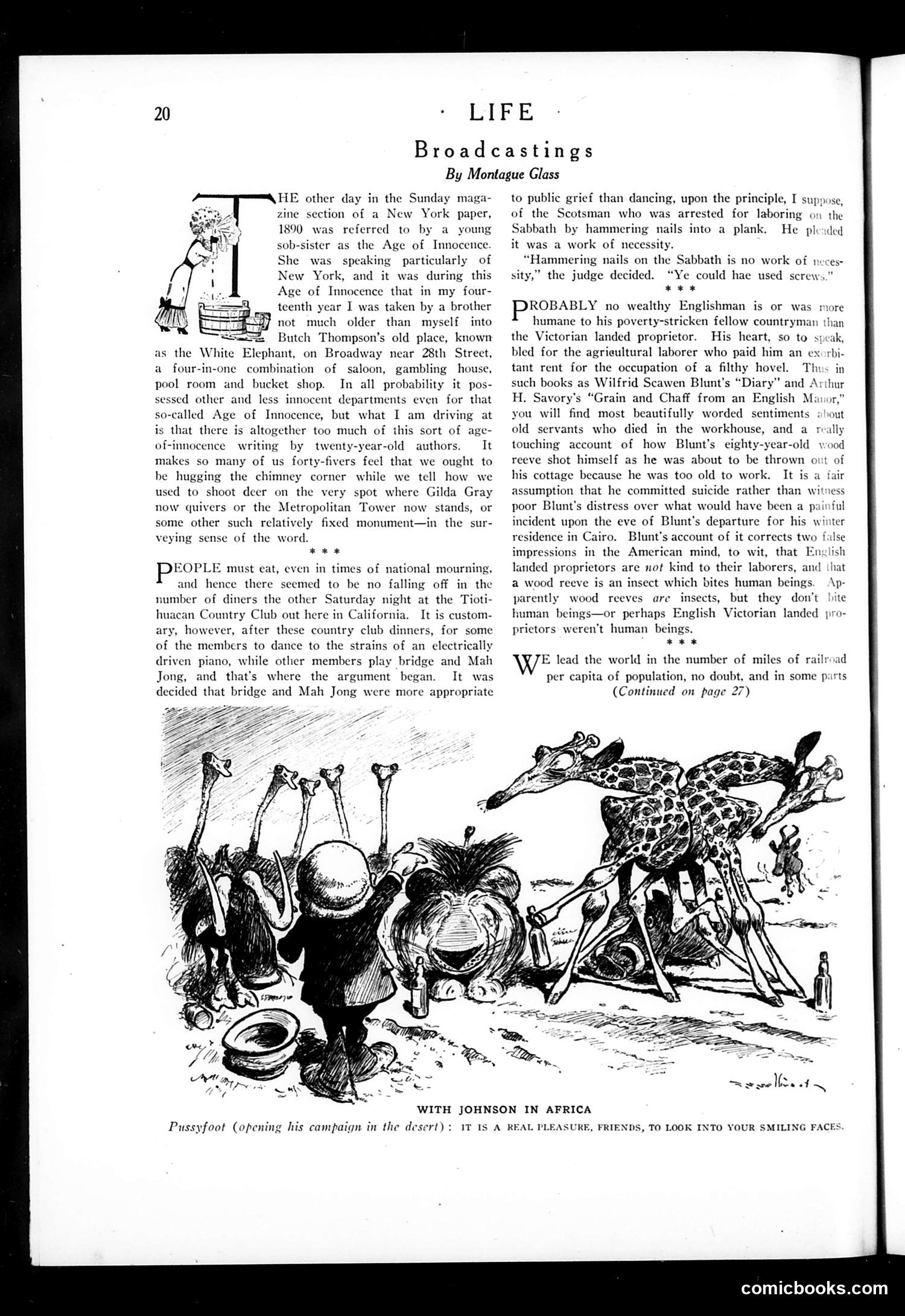
This page from *Life* magazine contains satirical essays by Montague Glass rather than political cartoons. The humor targets several subjects: **"Age of Innocence" critique**: Glass mocks young writers romanticizing 1890s New York as innocent, when it actually contained saloons, gambling houses, and corruption. He suggests these authors should stop pretending nostalgia when they're too young to remember the era authentically. **Country Club hypocrisy**: The anecdote about choosing bridge over dancing after a national mourning period satirizes the arbitrary moral reasoning of the wealthy—comparing it to a judge's absurd ruling that a Scotsman's Sabbath nail-hammering was necessary (but screws wouldn't be). **English landlord sentimentality**: Glass exposes Victorian landed proprietors' self-serving sympathy for laborers they exploited. He notes their accounts of workers' suicides conveniently emphasize the proprietors' own distress rather than addressing systemic poverty. The bottom illustration captioned "With Johnson in Africa" appears unrelated to the text—likely from a separate feature about explorer or entertainer Jack Johnson.
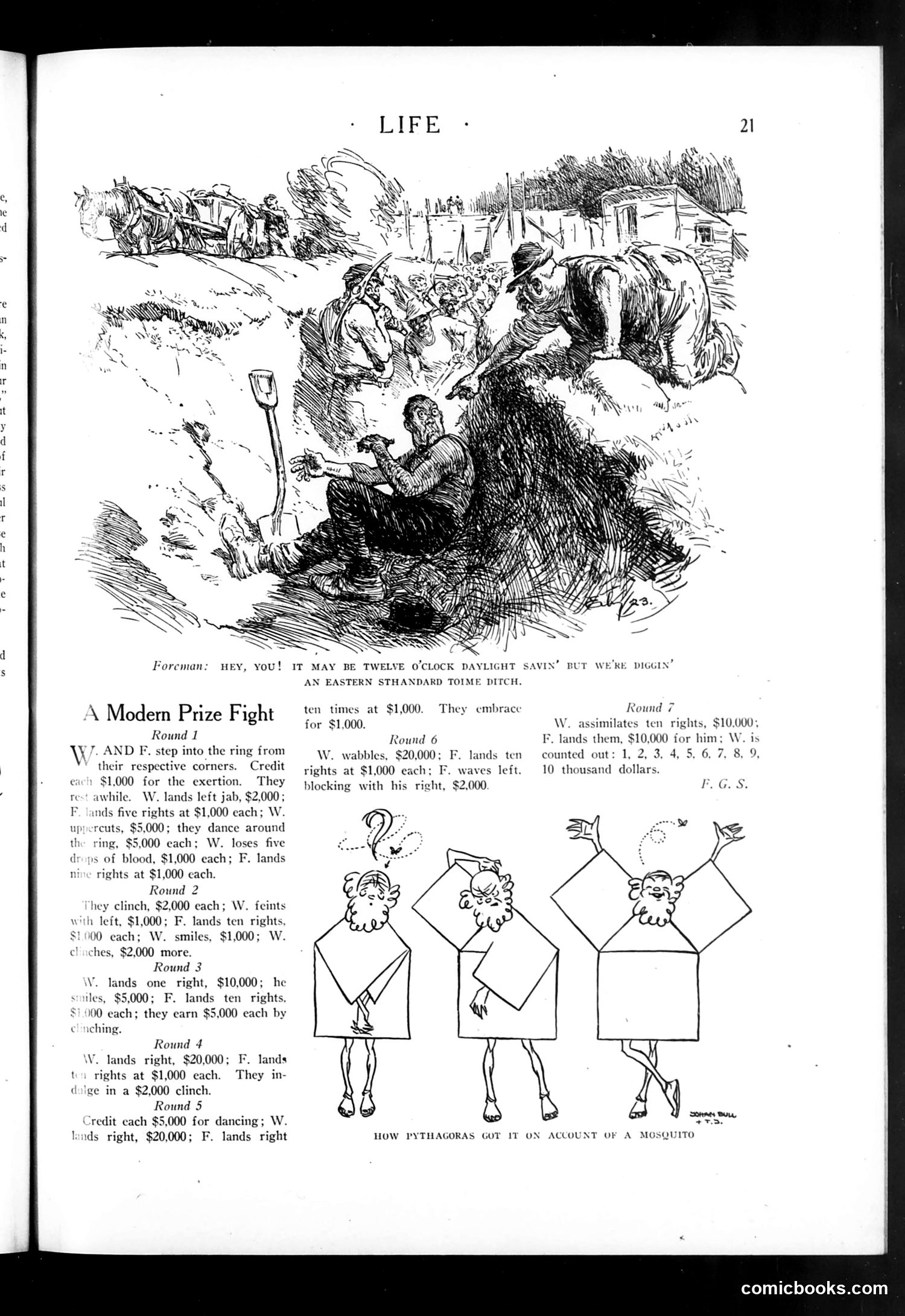
**"A Modern Prize Fight"** satirizes the commercialization of boxing in the early 20th century. The detailed accounting shows every action—punches, clinches, dancing, even bleeding—assigned monetary values ($1,000-$20,000 per move). The joke critiques how professional boxing had become less about athletic competition and more about staged entertainment designed to generate revenue for promoters and fighters. The illustration depicts a laborers' dispute (note the shovel and "Eastern Standard Time ditch"), where a foreman dismisses workers' concerns about daylight savings time. The bottom cartoon, "How a Mosquito Got It on Account of Pythagoras," appears to be an unrelated humorous illustration. Together, these pieces reflect Life magazine's satirical commentary on American commercialism and labor issues of the era.
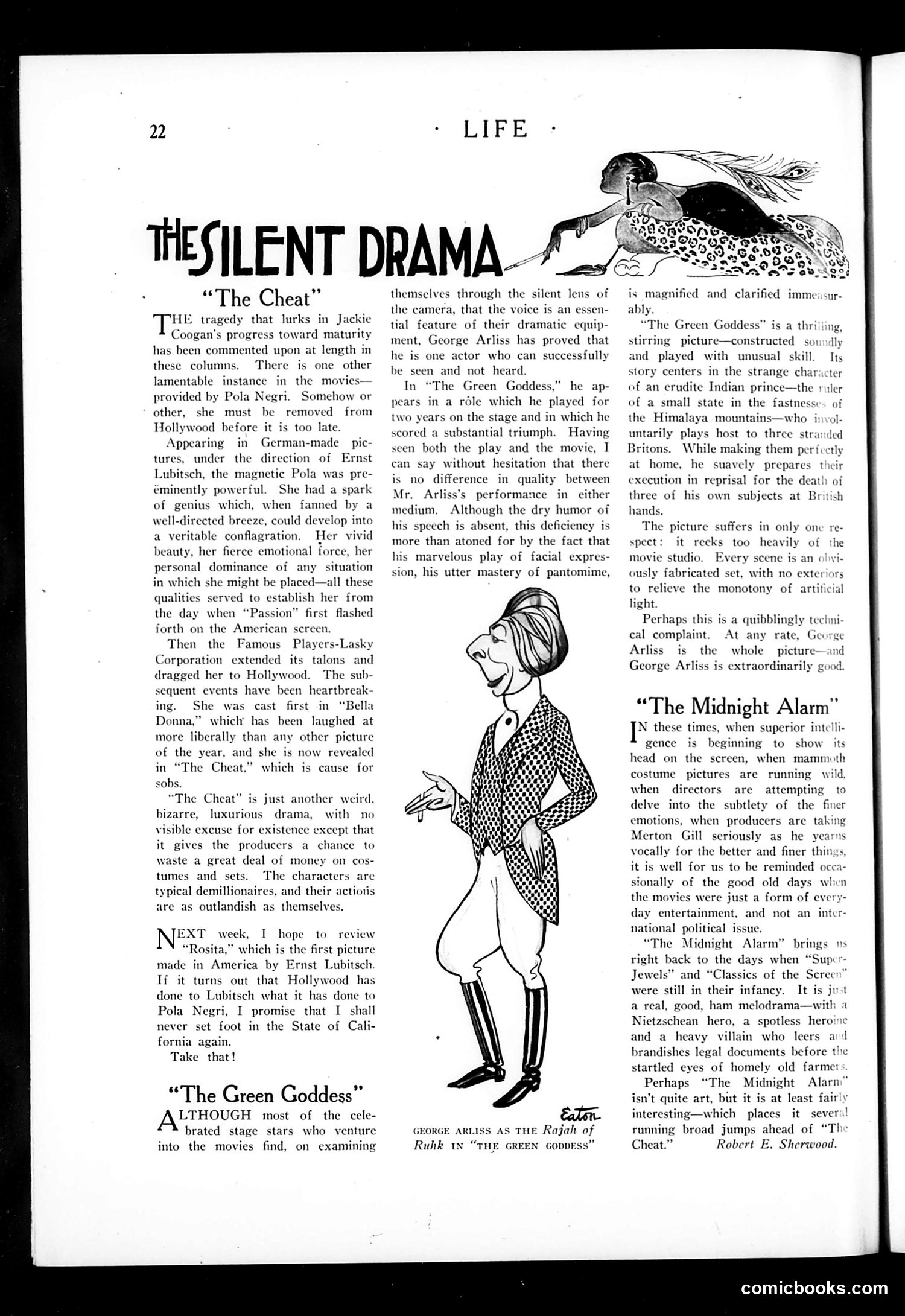
This Life magazine page reviews three silent films, critiquing how Hollywood mishandled European talent. **Main targets:** - **Pola Negri**: A powerful German actress (directed by Ernst Lubitsch) whose talent was squandered after Paramount's Players-Lasky Corporation brought her to Hollywood. Her recent films "Bella Donna" and "The Cheat" are ridiculed as wasteful, bizarre productions. - **George Arliss**: Praised for successfully transitioning to silent film in "The Green Goddess," proving actors don't need dialogue to captivate audiences through facial expression and pantomime. **The satire:** The critic laments Hollywood's destructive effect on foreign artistic talent, contrasting Negri's European success with her American failure. The accompanying caricature of Negri emphasizes exaggerated features, mocking her roles in these "luxurious" but meaningless dramas. **Context:** This reflects 1920s anxieties about Hollywood's commercialism overwhelming genuine artistry.
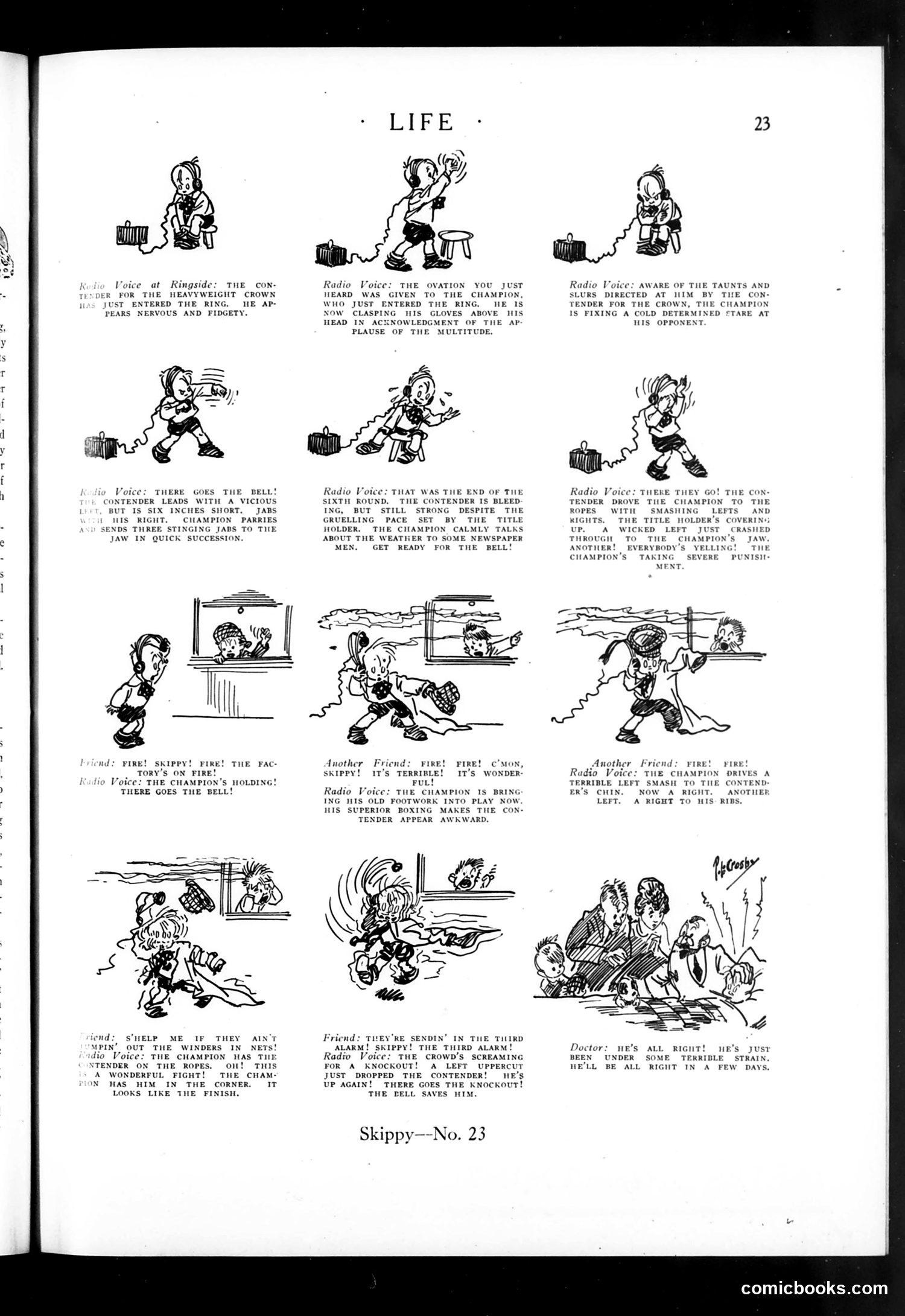
This is a "Skippy" comic strip (a popular children's comic of the era) using a boxing match as extended metaphor for a factory fire. The strip intercuts between a radio broadcast of a heavyweight championship fight and friends alerting young Skippy to an actual fire at a factory. The satire works through dramatic contrast: while the radio announcer breathlessly describes boxing action with sports clichés ("gruelling pace," "superior boxing"), the actual emergency—a factory fire requiring multiple alarms—unfolds as the "real" drama. The champion's composure during the match parallels Skippy's calm response to crisis. The final panel reveals the "strain" mentioned was the fire, not the boxing match, suggesting that everyday dangers (industrial accidents) are more significant than entertainment spectacles, even championship fights. The doctor's reassurance provides comedic relief while reinforcing the strip's implicit message about what truly matters.
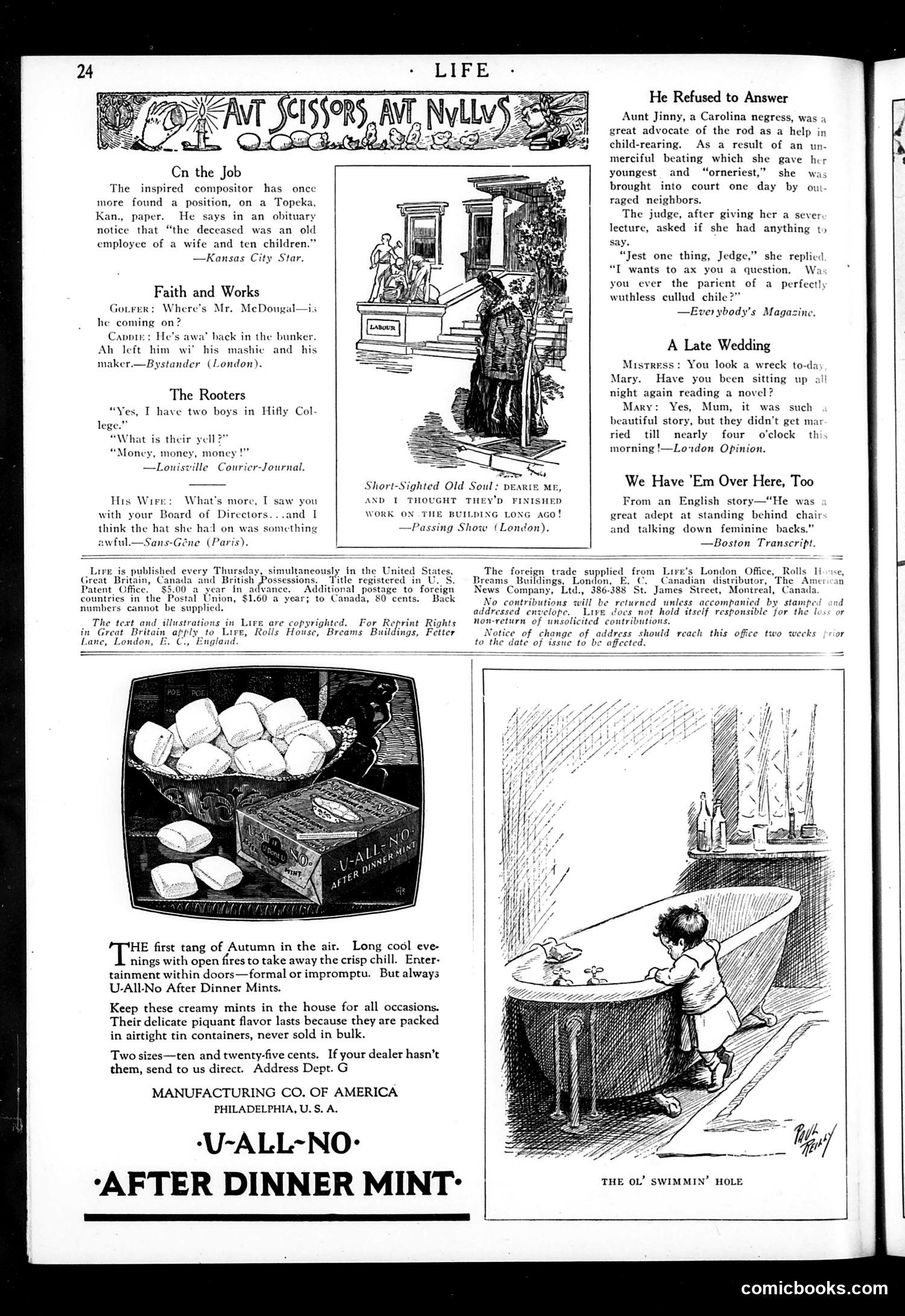
This page contains several brief humorous anecdotes and two cartoon illustrations typical of early 20th-century Life magazine. **"He Refused to Answer"** recounts a court case involving an enslaved woman named Aunt Jinny from Carolina who beat a child severely. When the judge asks if she has anything to say, she responds by turning the question back on him—asking if he was ever a "perfectly worthless cullud chile" (using period dialect/slur). The humor relies on the defendant's impudence and role reversal. **"The Ol' Swimmin' Hole"** cartoon depicts a child in a bathtub, suggesting the innocent rural swimming hole has been replaced by urban indoor plumbing—a comment on modernization and lost childhood simplicity. The page also includes brief comedic exchanges on topics like employment, golf, and marriage, plus an advertisement for U-All-No After Dinner Mints. The content reflects Life's typical mix of social observation and light satire aimed at middle-class readers.
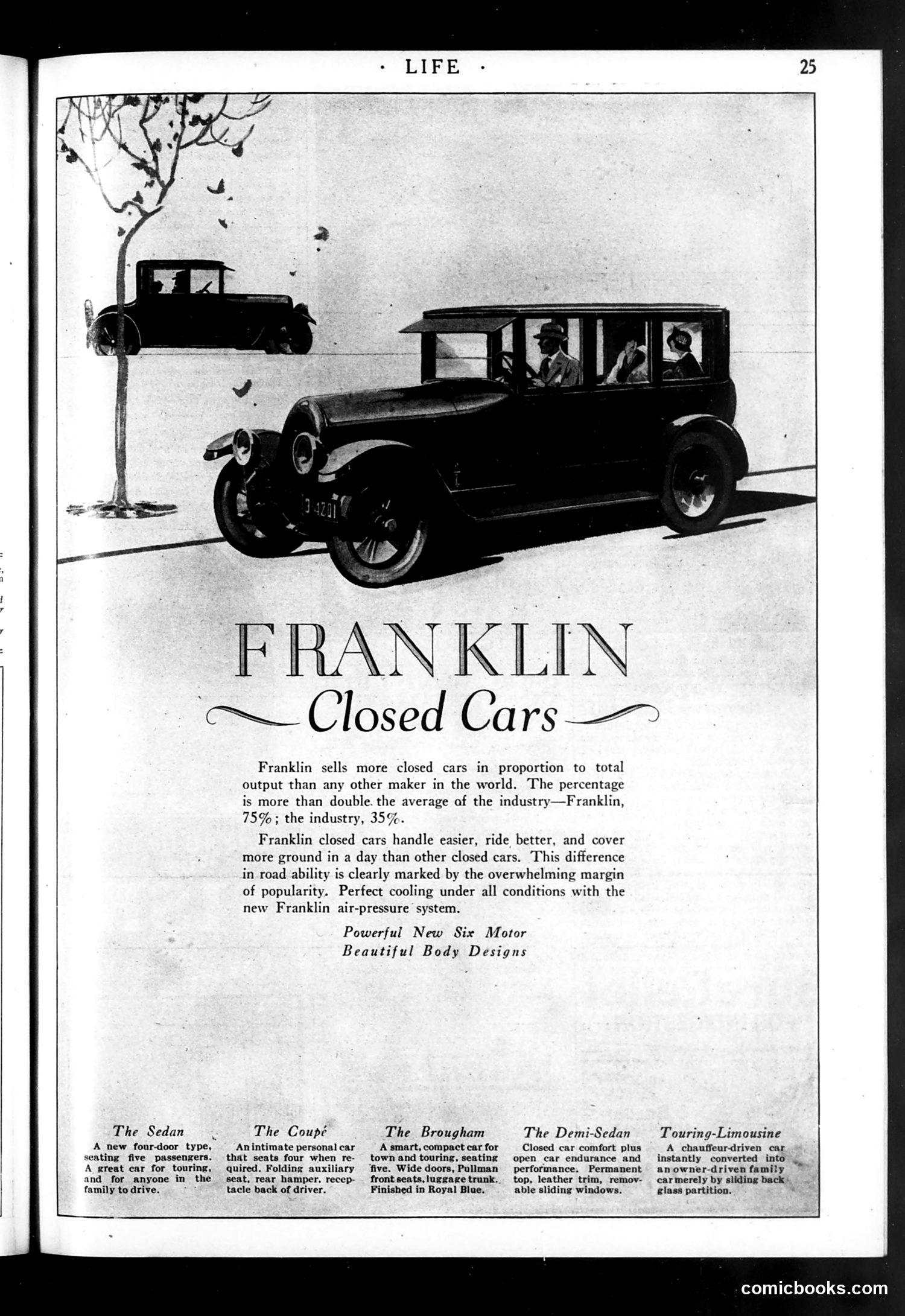
This is primarily a **Franklin automobile advertisement**, not satire or a political cartoon. It appears from a 1920s issue of *Life* magazine. The ad promotes Franklin's closed-car models (sedan, coupé, brougham, demi-sedan, touring-limousine) by claiming Franklin sells a higher proportion of closed cars than competitors—75% versus the industry average of 35%. The copy emphasizes superior handling, ride quality, cooling system, and design. The visual shows two silhouetted automobiles: a smaller car on a pole (possibly indicating market leadership or aspirational status) and a larger, more detailed sedan with passengers visible through windows. **For modern readers**: This reflects early automotive marketing when "closed cars" (enclosed cabins) were still competing with open-air models. Franklin's pitch emphasizes practicality and comfort as signs of market dominance—a common advertising strategy positioning market share as proof of superiority. There is no political cartoon content on this page; it is straightforward period advertising.
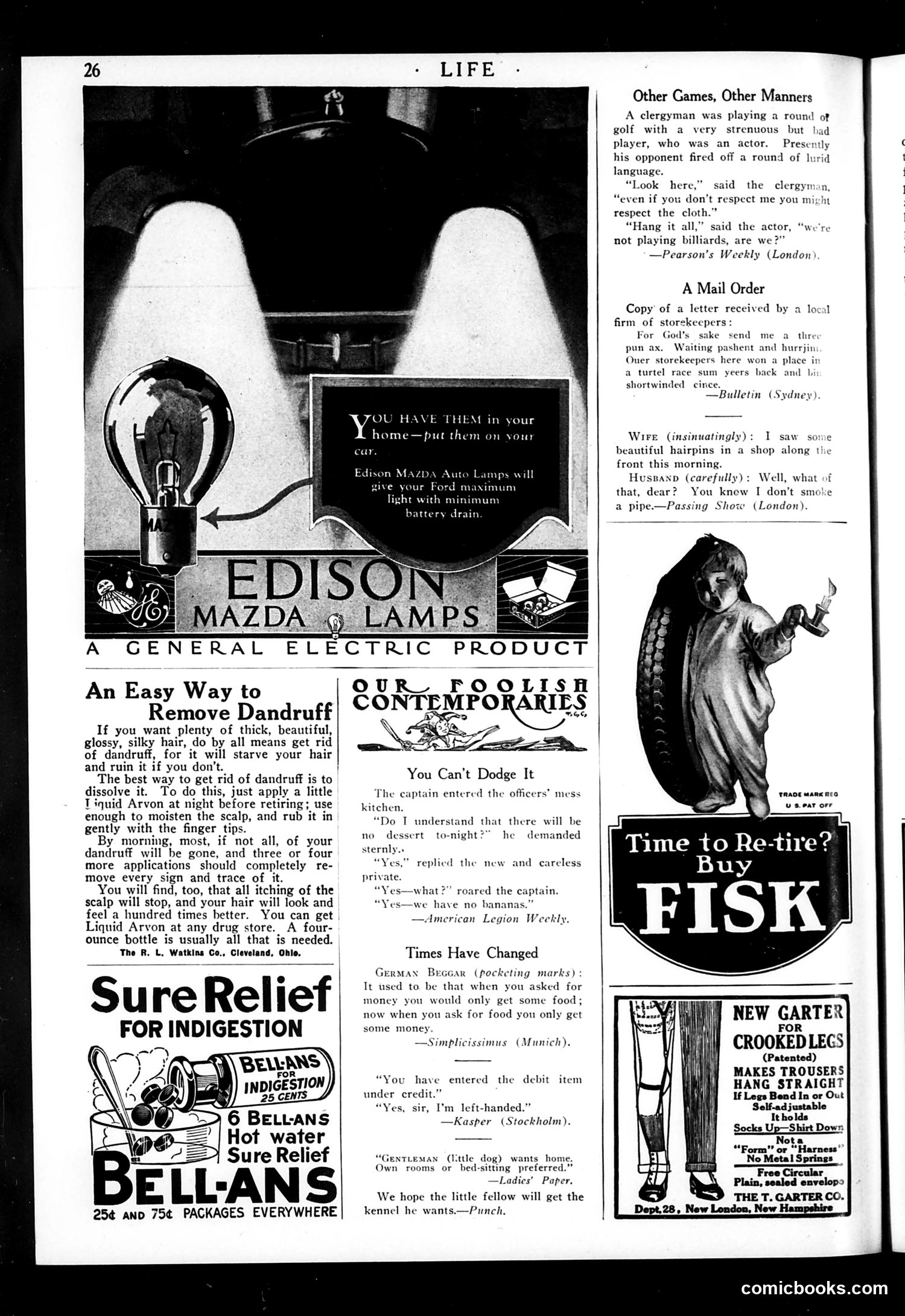
This page consists primarily of **advertisements and reprinted short humor pieces** rather than original cartoons. The content includes: **Advertisements:** Edison Mazda lamps, Liquid Arvon dandruff treatment, Bellans indigestion remedy, Fisk tires, and Carter garter products dominate the layout. **Humor Section ("Our Foolish Contemporaries"):** This column reprints jokes from international publications (Pearson's Weekly, American Legion Weekly, Punch, etc.). The jokes are gentle social observations: - A clergyman vs. an actor golfer trading insults about propriety - A humorous misspelled mail order ("pun ax" for "penax") - A husband caught in a hairpin discovery - A captain and private's exchange about missing bananas (likely a reference to the 1920s-30s popular song "Yes! We Have No Bananas") - Post-WWI commentary on economic hardship **Context:** These are lighthearted, cross-cultural humor pieces reflecting everyday manners and modest social tensions—typical of Life's satirical approach during this era (appears to be 1920s-30s based on references).
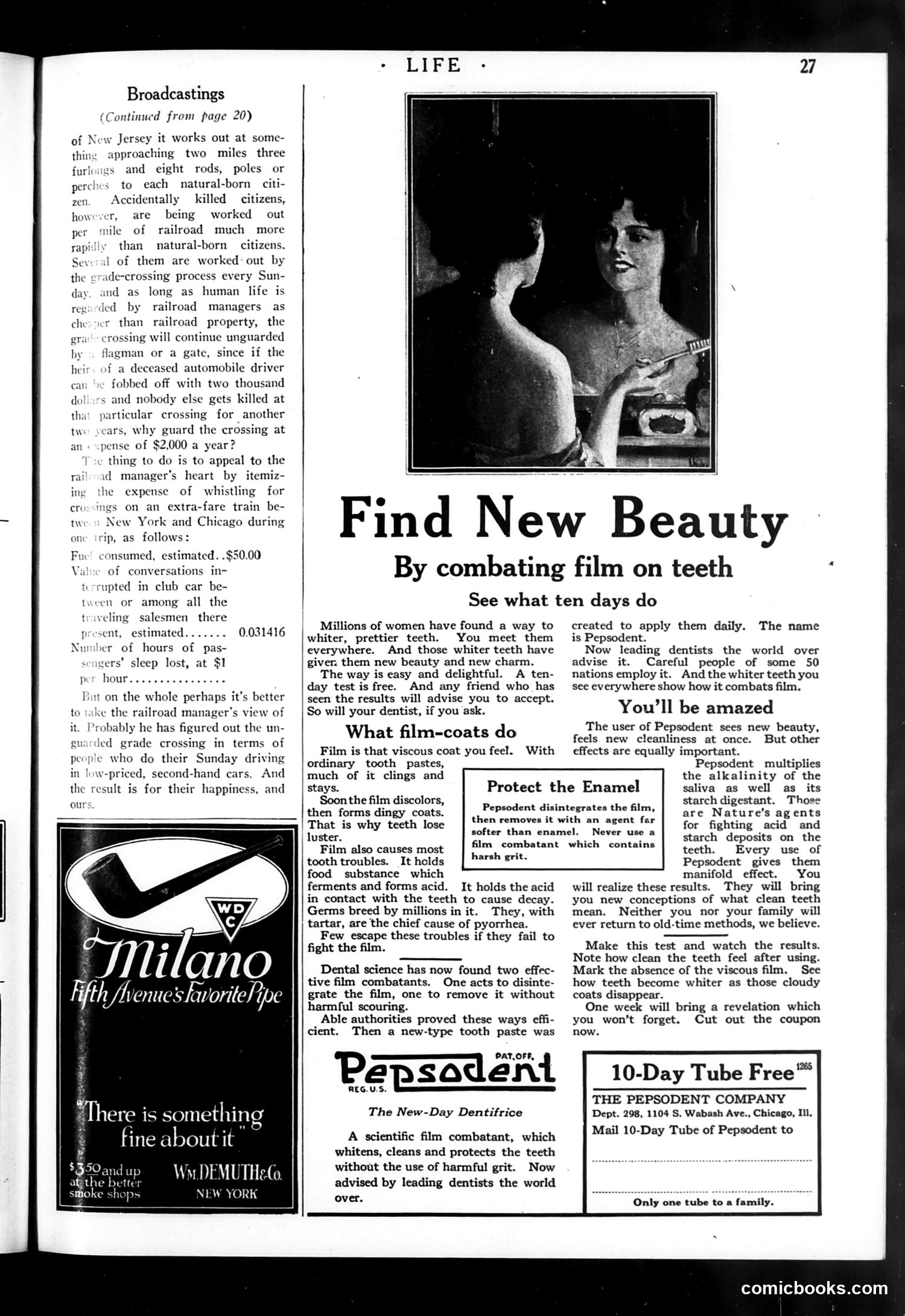
This page is primarily **advertising**, not political satire. The dominant content is a Pepsodent toothpaste advertisement promoting a new dental product that claims to remove "film" from teeth and whiten them in ten days. The small text column on the left ("Broadcastings") is a satirical commentary on railroad safety, specifically mocking railroad managers' reluctance to install grade crossing guards. The author argues that railroad companies value property protection over human life, calculating that the cost of safety measures ($2,000/year) outweighs settlements for accidental deaths. The satire suggests railroad managers would need their "hearts itemized" to care about passenger safety. The page also includes a Milano pipe advertisement at bottom left. The content reflects early-20th-century concerns about both industrial safety negligence and consumer product marketing making health claims.
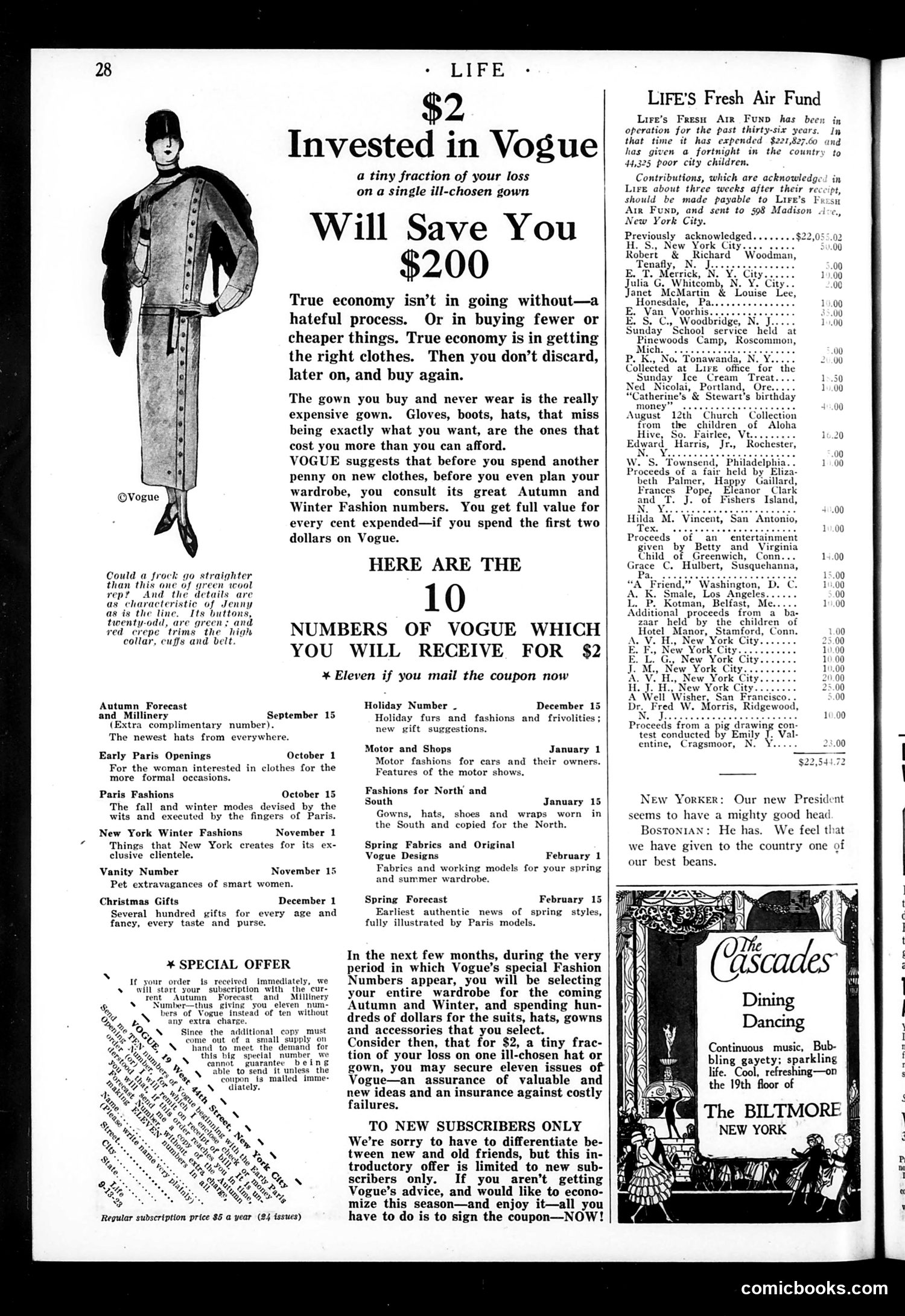
This page is primarily **advertising**, not satire. It's a 1910s-era advertisement for Vogue magazine placed in *Life* magazine. The main pitch: A $2 Vogue subscription (11 issues) will save you $200 by helping you buy the "right clothes" initially, preventing wasteful purchases of ill-fitting garments you'll later discard. The accompanying illustration shows a fashionable woman in a green wool dress, exemplifying the styled elegance Vogue promises. The ad emphasizes that true economy means investing in quality fashion advice upfront rather than buying cheap or wrong items repeatedly. It lists ten Vogue fashion issues available annually (Autumn Forecast, Paris Fashions, Holiday Number, etc.), each addressing different seasonal needs. A secondary element: the page includes a small section promoting *Life*'s Fresh Air Fund—a genuine charitable program sending poor children to the countryside—showing $22,541.72 in recent donations. The "special offer" targets new subscribers only, creating urgency by suggesting limited availability of the complimentary extra issue.
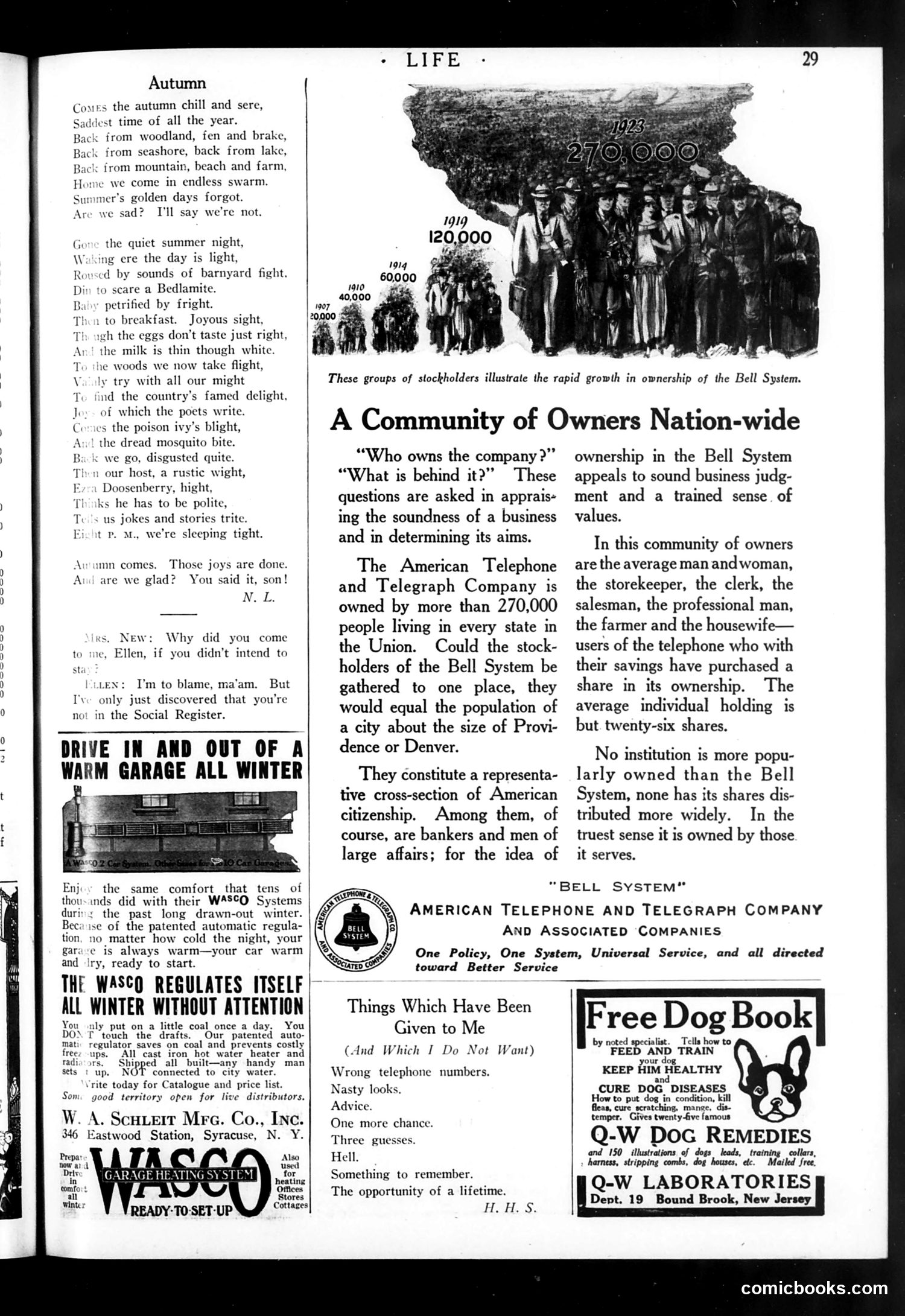
This page is primarily **advertising and corporate public relations**, not political satire. The dominant feature is a Bell System advertisement depicting stockholder growth through silhouetted crowd figures labeled with years (1907-1925), illustrating the company's expansion. The accompanying text emphasizes that AT&T is owned by over 270,000 ordinary Americans—"the average man and woman, the storekeeper, the clerk, the salesman"—each holding modest shares (averaging 26). This presentation counters potential criticism of monopolistic corporate power by portraying wide, democratic ownership. The left column contains a poem titled "Autumn," likely unrelated to the Bell content—standard magazine filler. Below are advertisements for WASCO garage heating systems and Q-W dog remedies—typical early 20th-century product marketing. There is **no political cartoon or satire** on this page. The Bell System ad functions as defensive corporate messaging, subtly arguing that large American corporations serve ordinary citizens who collectively own them.
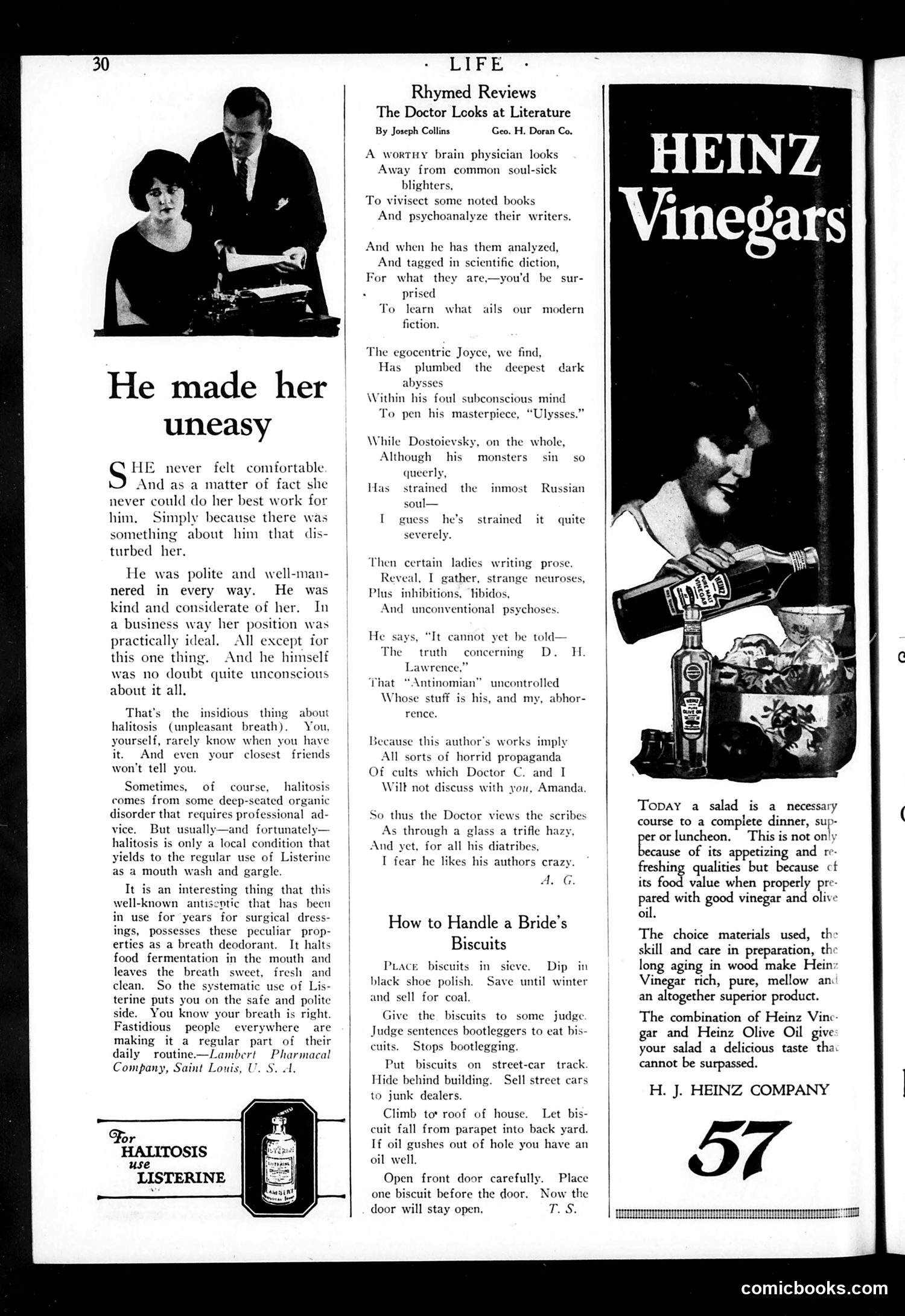
**Main Content:** The page features a **Listerine advertisement** disguised as editorial content, using a narrative about workplace discomfort caused by halitosis (bad breath). The accompanying photograph shows a man and woman at a desk; the woman appears visibly uncomfortable. The ad's message: bad breath damages professional relationships, but Listerine solves this "insidious" problem. **Literary Satire Section:** "Rhymed Reviews" mocks modernist authors—particularly **James Joyce** (Ulysses) and **Dostoevsky**—through the persona of a doctor psychoanalyzing writers. The satire ridicules both the authors' psychological neuroses and the trend of applying Freudian analysis to literature. D.H. Lawrence receives particular criticism for "propaganda." **Humor Piece:** "How to Handle a Bride's Biscuits" is absurdist satire about inedible wedding gifts, suggesting humorous (illegal) uses: selling as coal, feeding to bootleggers as punishment, discovering oil wells. The page exemplifies 1920s Life: mixing advertisements with literary criticism and topical humor reflecting Prohibition-era concerns and modernism's cultural anxiety.
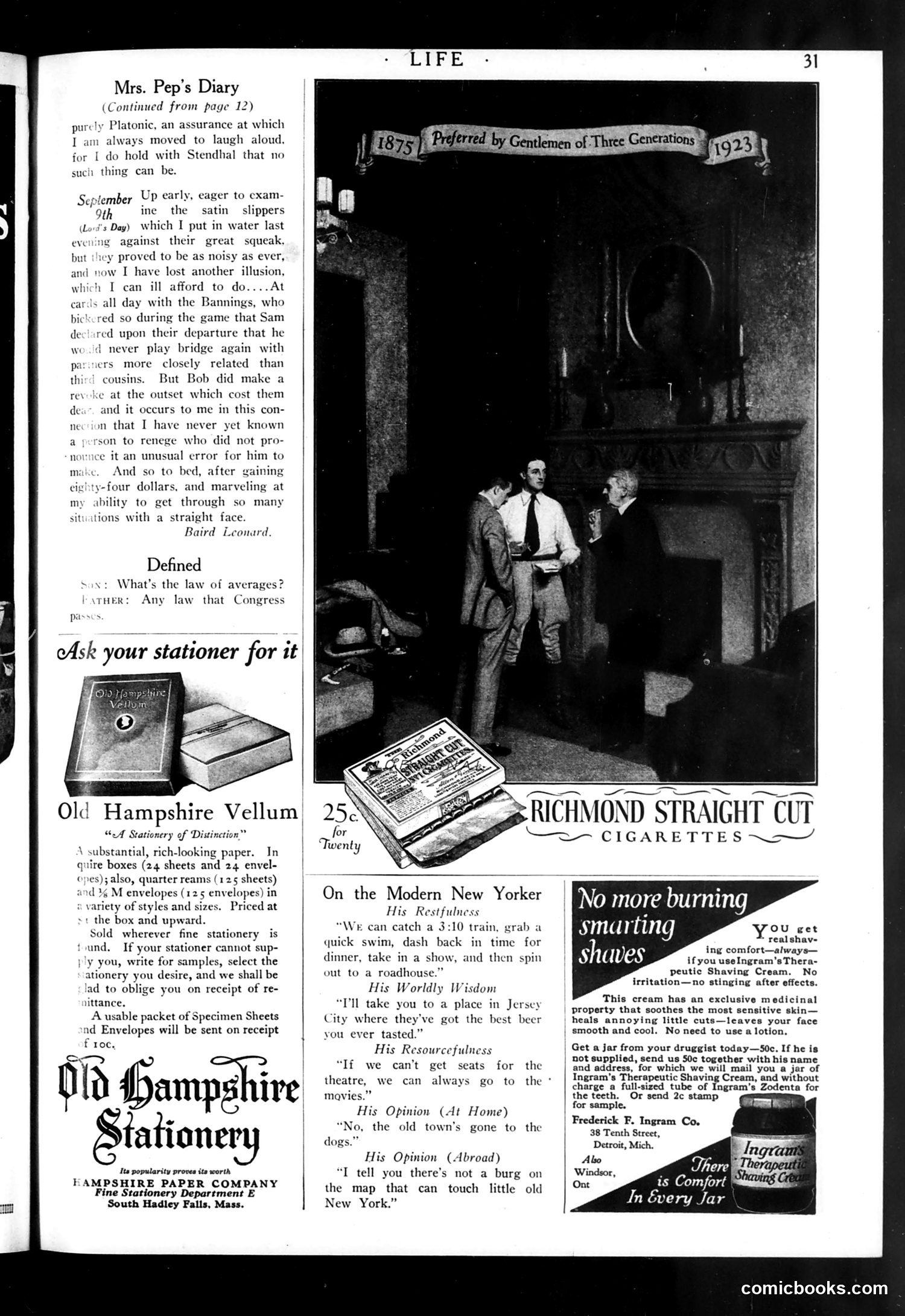
This page contains satirical social commentary typical of early 1920s Life magazine. The main cartoon, titled "On the Modern New Yorker," presents four vignettes mocking the stereotypical fast-paced Manhattan lifestyle. Each section—"His Restfulness," "His Worldly Wisdom," "His Resourcefulness," and "His Opinion"—humorously contrasts the New Yorker's frantic, superficial existence (catching trains, swimming, attending shows, grabbing beer) with his provincial boasting about New York superiority. The satire targets the pretentious, hurried urban sophistication of 1920s New York society—the subject can barely relax, yet constantly brags about his city's superiority despite never appreciating its actual culture. Mrs. Pep's Diary entry and the "Defined" joke about Congress represent typical magazine filler content. The rest comprises period advertisements for stationery, cigarettes, and shaving cream—reflecting the magazine's commercial base alongside its satire.
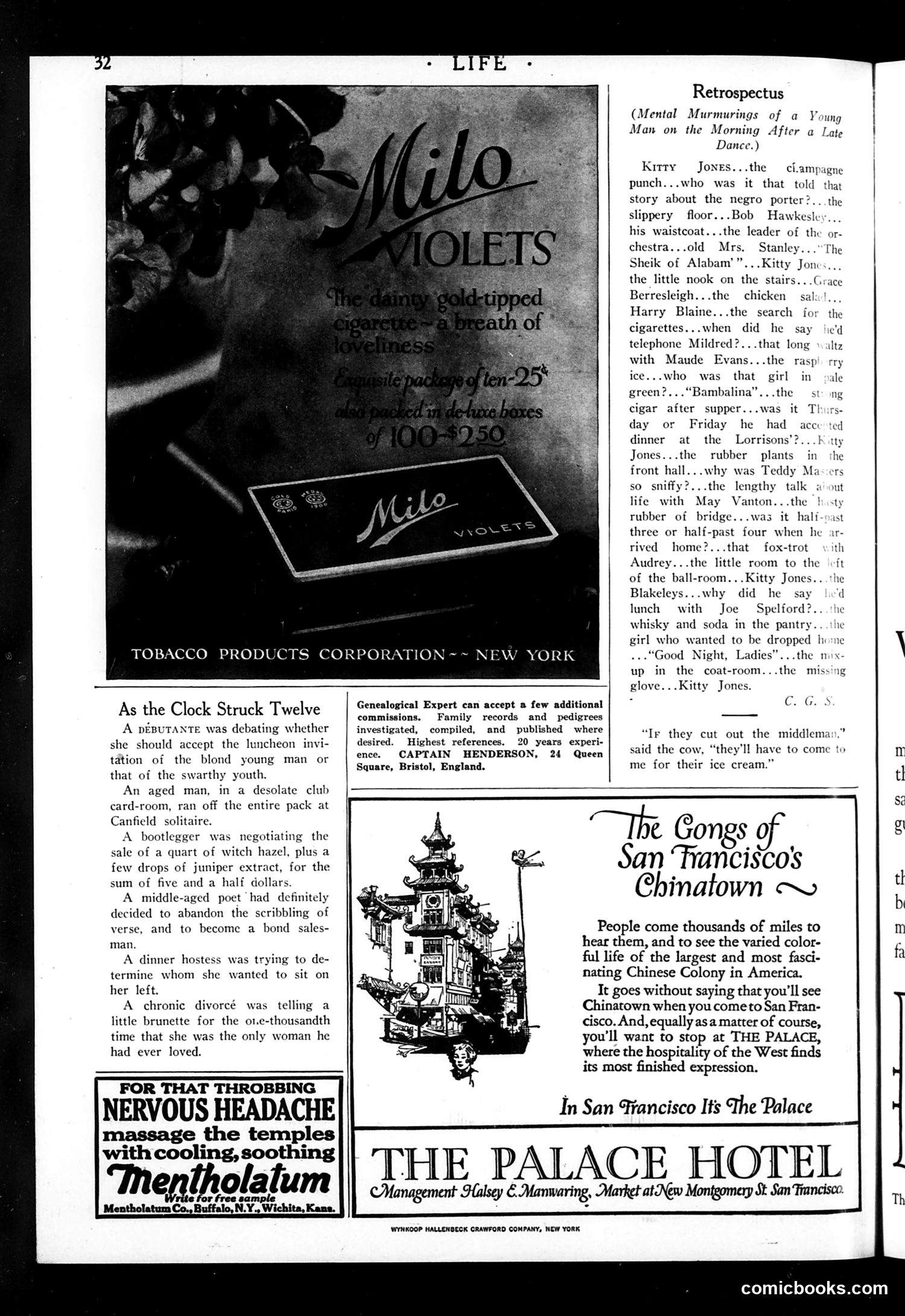
This page from *Life* magazine (a satirical publication) contains three distinct pieces: **"Retrospectus" (right column):** A humorous stream-of-consciousness monologue depicting a young man's fragmented memories the morning after a late dance. The satire lies in the absurdity of his scattered recollections—mixing trivial details (champagne punch, cigarette searches, rubber plants) with romantic encounters and social awkwardness. It mocks the pretensions and vapid social life of the Jazz Age upper class. **"As the Clock Struck Twelve" (left column):** Six brief satirical vignettes about various social types—a debutante choosing suitors, a Prohibition-era bootlegger selling witch hazel as liquor, a poet abandoning verse for sales, a host managing dinner seating, a serial divorcé. These mock contemporary social absurdities and hypocrisy. **Advertisements:** The page also contains ads for Milo Violets cigarettes, Mentholatum ointment, and The Palace Hotel in San Francisco—standard commercial content for the era. The overall tone is lighthearted mockery of Jazz Age social pretension and modern life's contradictions.
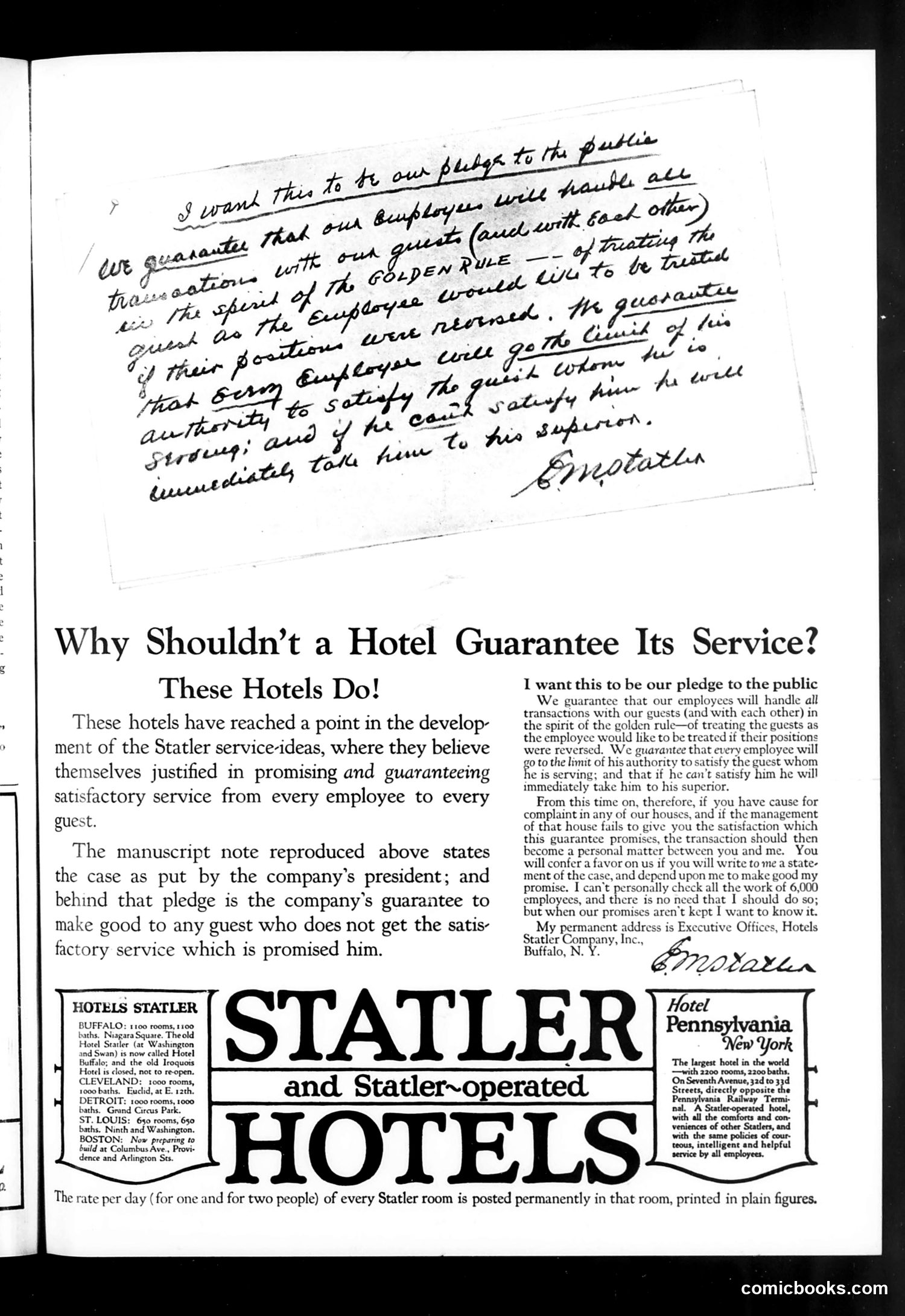
This is primarily a **hotel industry advertisement**, not satire. The Statler hotel chain promotes its service guarantee—a business innovation for the era. The handwritten note (purportedly from the company president) pledges that employees will treat guests with respect and follow the "Golden Rule." The guarantee promises: if a guest receives poor service, management will address it; if management fails, the complaint becomes a personal matter between guest and president. The company claims it personally monitors 6,000 employees' work. The rhetorical question "Why Shouldn't a Hotel Guarantee Its Service?" suggests this was novel—most hotels apparently didn't make such promises. The ad lists multiple Statler locations and emphasizes transparent pricing posted in each room. This reflects early 20th-century business philosophy: service standardization and customer accountability as competitive advantages, presented as progressive corporate responsibility.
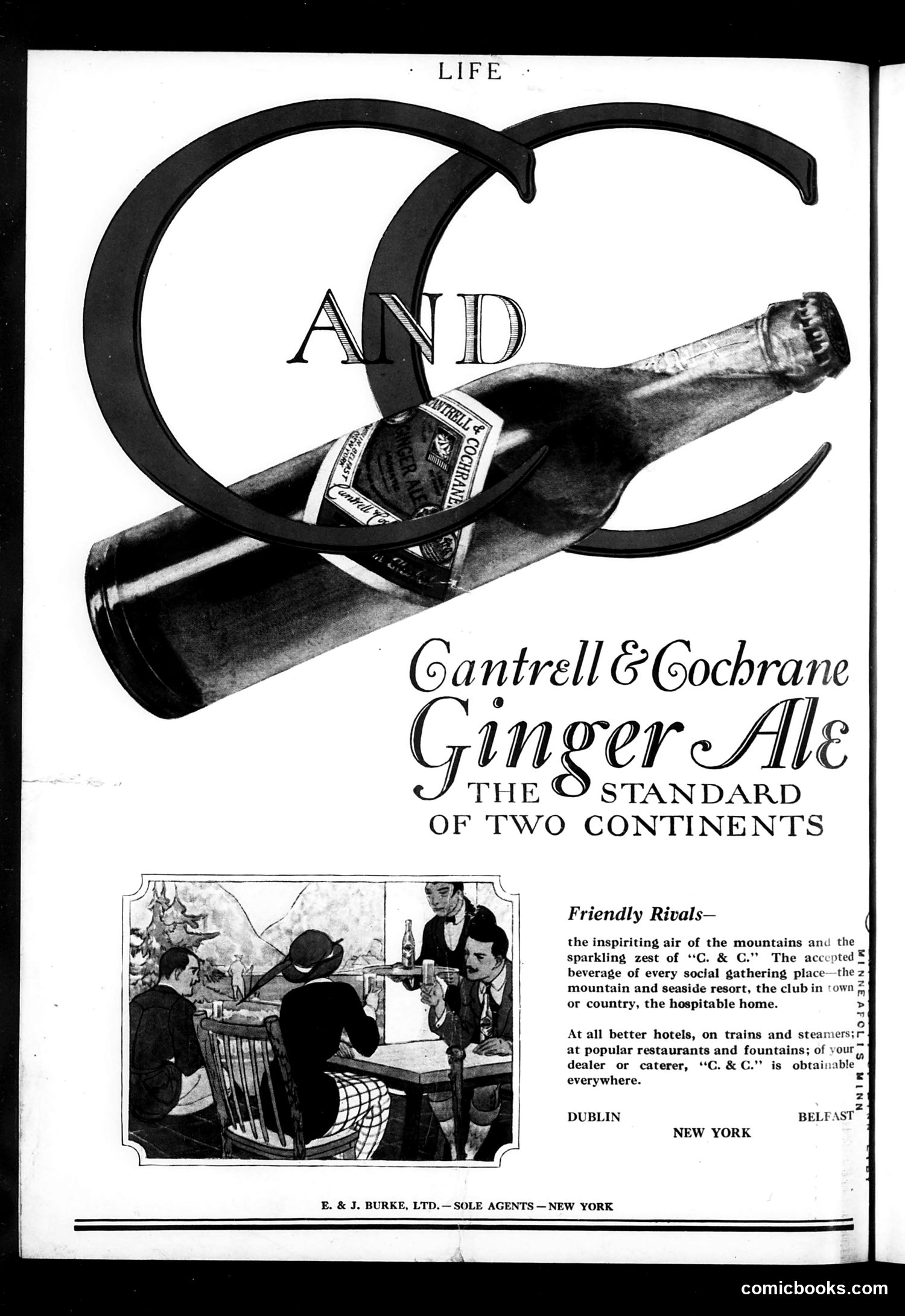
This is primarily a **product advertisement**, not political satire. It promotes Cantrell & Cochrane Ginger Ale as "the standard of two continents" (Ireland and America, given the Dublin/Belfast/New York distribution). The visual element—a hand holding a bottle emerging from an ornate "C&C" monogram—is decorative branding rather than commentary. The small photograph below shows people in a social setting, illustrating the product's marketing pitch: that ginger ale is the fashionable beverage at "every social gathering place." The page exemplifies early 20th-century *Life* magazine advertising, which often occupied substantial space alongside actual editorial content. While *Life* was known for satire and humor, this particular page is straightforward commercial promotion emphasizing the drink's availability across hotels, restaurants, and social venues in both countries.