
Life, 1923-09-13 · page 20 of 36
Life — September 13, 1923 — page 20: what you’re looking at
What you’re looking at
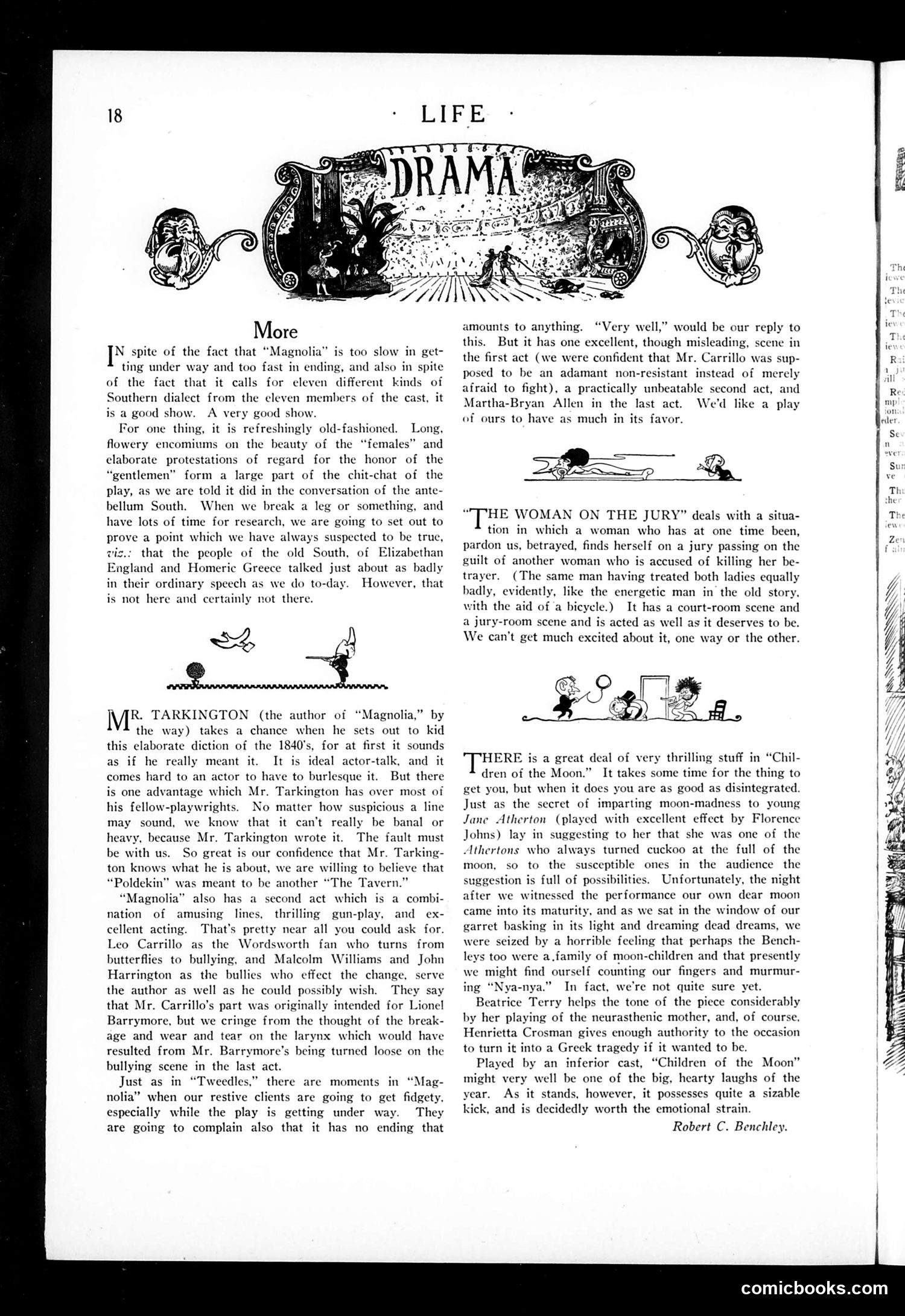
This page reviews three theatrical productions. The critic discusses "Magnolia," a play by Booth Tarkington that deliberately mimics and gently parodies the elaborate, flowery speech patterns of the antebellum South. The reviewer notes the irony: actors struggle with the archaic dialogue, uncertain whether Tarkington intended it sincerely or mockingly—but trusts his talent enough to assume satire. The play stars Leo Carrillo and features competent supporting performances, though the critic finds its ending weak. The page also briefly reviews "The Woman on the Jury" (unremarkable) and "Children of the Moon" (initially slow but eventually compelling). The small cartoon illustrations appear to be generic theatrical vignettes rather than commentary on specific figures or political issues. The tone reflects early 20th-century theatrical criticism—sophisticated, somewhat arch, focused on acting quality and dramatic structure.
📄 Transcribed text from this page (OCR, searchable)
Machine-transcribed from the original scan — historical spelling and the odd misread are preserved.
N spite of the fact that “Magnoli too slow in get- ting under way and too fast in ending, and also in spite of the fact that it calls for eleven different kinds of puthern dialect from the eleven members of the cast, it a good show. A very good show. For one thing, it is refreshingly old-fashioned. Long, flowery encomiums on the beauty of the “females” and elaborate protestations of regard for the honor of the “gentlemen” form a large part of the chit-chat of the play, as we are told it did in the conversation of the ante- bellum South. When we break a leg or something, and have lots of time for research, we are going to set out to prove a point which we have always suspected to be true, that the people of the old South, of Elizabethan England and Homeric Greece talked just about as badly in their ordinary speech as we do to-day. However, that is not here and certainly not there. = i R. TARKINGTON (the author of “Magnolia,” by the way) takes a chance when he sets out to kid this elaborate diction of the 1840's, for at first it sounds as if he really meant it. It is ideal actor-talk, and it comes hard to an actor to have to burlesque it. But there is one advantage which Mr. Tarkington has over most of his fellow-playwrights. No matter how suspicious a line may sound, we know that it can't really be banal or because Mr. Tarkington wrote it. The fault must be with us. So great is our confidence that Mr. Tarking- ton knows what he is about, we are willing to believe that “Poldekin” was meant to be another “The Tavern.” “Magnolia” also has a second act which is a combi- nation of amusing lines, thrilling gun-play, cellent acting. That's pretty near all you could ask for. Leo Carrillo as the Wordsworth fan who turns from butterflies to bullying, and Malcolm Williams and John Harrington as the bullies who effect the change, serve the author as well as he could possibly wish. They say that Mr. Carrillo's part was originally intended for Lionel Barrymore, but we cringe from the thought of the bre: age and wear and tear on the larynx which would have resulted from Mr. Barrymore’s being turned loose on the bullying scene in the last act. Just as in “Tweedles,” there are moments in “Mag- nolia” when our restive clients are going to get fidgety, especially while the play is getting under way. They are going to complain also that it has no ending that and ex- amounts to anything. “Very well,” would be our reply to this. But it has one excellent, though misleading, scene in the first act (we were confident that Mr. Carrillo was sup- posed to be an adamant non-resistant instead of merely afraid to fight), a practically unbeatable second act, and Martha-Bryan Allen in the last act. We'd like a play of ours to have as much in its favor. 2, & HE WOMAN ON THE JURY” deals with a situa- tion in which a woman who has at one time been, pardon us, betrayed, finds herself on a jury passing on the guilt of another woman who is accused of killing her be- trayer. (The same man having treated both ladies equally badly, evidently, like the energetic man in the old story. h the aid of a bicycle.) It has a court-room scene and a jury-room scene and is acted as well as it deserves to be. We can't get much excited about it, one way or the other. HERE is a great deal of very thrilling stuff in “Chil- dren of the Moon.” It takes some time for the thing to get you, but when it does you are as good as disintegrated. Just as the secret of imparting moon-madness to young Jane Atherton (played with excellent effect by Florence Johns) lay in suggesting to her that she was one of the Athertons who always turned cuckoo at the full of the moon, so to the susceptible ones in the audience the suggestion is full of possibilities. Unfortunately, the night after we witnessed the performance our own dear moon came into ii and as we sat in the window of our garret basking in its light and dreaming dead dreams, we ed by a horrible feeling that perhaps the Bench- ys too were a.family of moon-children and that presently we might find ourself counting our fingers and murmur- ing “Nya-nya.” In fact, we're not quite sure yet. Beatrice Terry helps the tone of the piece considerably by her playing of the neurasthenic mother, and, of course, Henrietta Crosman gives enough authority to the occasion to turn it into a Greek tragedy if it wanted to be. Played by an inferior cast, “Children of the Moon” might very well be one of the big, hearty laughs of the year. As it stands, however, it possesses quite a sizable kick, and is decidedly worth the emotional strain. Robert C. Benchley. comicbooks.com SS S : RASS BAY aS Se: wy pated