
Life, 1923-09-13 · page 24 of 36
Life — September 13, 1923 — page 24: what you’re looking at
What you’re looking at
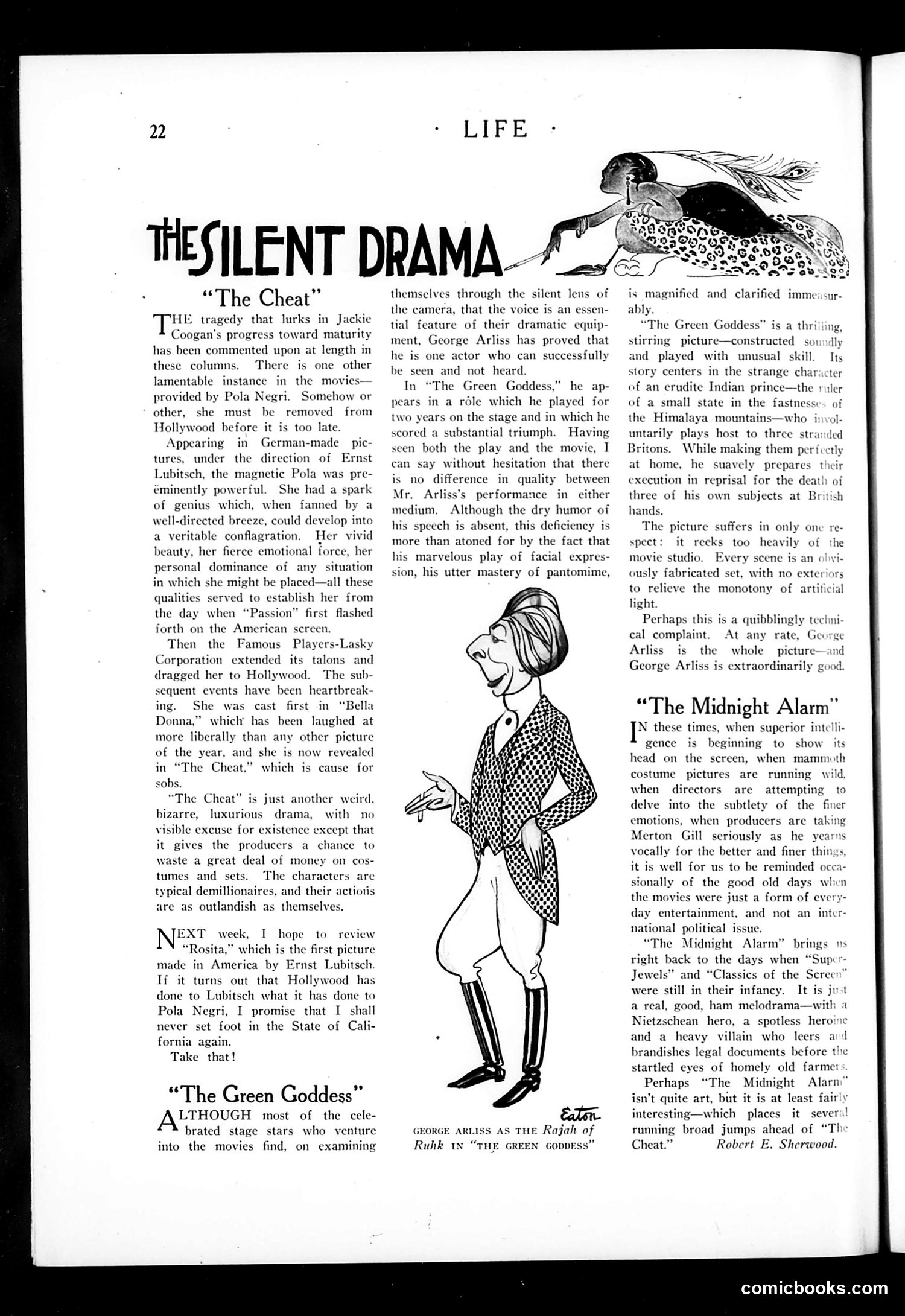
This Life magazine page reviews three silent films, critiquing how Hollywood mishandled European talent. **Main targets:** - **Pola Negri**: A powerful German actress (directed by Ernst Lubitsch) whose talent was squandered after Paramount's Players-Lasky Corporation brought her to Hollywood. Her recent films "Bella Donna" and "The Cheat" are ridiculed as wasteful, bizarre productions. - **George Arliss**: Praised for successfully transitioning to silent film in "The Green Goddess," proving actors don't need dialogue to captivate audiences through facial expression and pantomime. **The satire:** The critic laments Hollywood's destructive effect on foreign artistic talent, contrasting Negri's European success with her American failure. The accompanying caricature of Negri emphasizes exaggerated features, mocking her roles in these "luxurious" but meaningless dramas. **Context:** This reflects 1920s anxieties about Hollywood's commercialism overwhelming genuine artistry.
📄 Transcribed text from this page (OCR, searchable)
Machine-transcribed from the original scan — historical spelling and the odd misread are preserved.
TESILENT DRAMA “The Cheat” HE tragedy that lurks in Jackie Coogan’s progress toward maturity has been commented upon at length in these columns. There other lamentable instance in the movies— provided by Pola Negri. Somehow or other, she removed from Hollywood before it is too late. Appearing in German-made _pic- tures, under the direction of Ernst Lubitsch, the magnetic Pola was pre- éminently powerful. She had a spark of genius which, when fanned by a is one must be well-directed breeze, could develop into a veritable conflagration. Her vivid beauty, her fierce emotional force, her personal dominance of any situation in which she might be placed—all these qualities served to establish her from the day when “Passion” first flashed forth on the American screen. Then the Players-Lasky Corporation extended its talons and dragged her to Hollywood. The sub- sequent events have been heartbreak- ing. She cast “Bella Donna,” which has been laughed at more liberally than any other picture of the year, and she is now revealed in “The Cheat.” which is cause for sobs. Famous was first in “The Cheat” is just another weird, bizarre, luxurious drama, with no visible excuse for existence except that it gives the producers a chance to waste a great deal of money on cos- tumes and sets. The characters are typical demillionaires, and their actions are as outlandish as themselves. N T week, I hope to review Rosita,” which is the first picture made in America by Ernst Lubitsch. If it turns out that Hollywood has done to Lubitsch what it has done to Pola Negri, I promise that I shall never set foot in the State of Cali- fornia again. Take that! “The Green Goddess” LTHOUGH most of the cele- brated stage stars who venture into the movies find, on examining themselves through the silent lens of the camera, that the voice is an essen- tial feature of their dramatic equip- ment, George Arliss has proved that he is one actor who can successfully en and not heard. In “The Green Goddess,” he ap- pears in a role which he played for two years on the stage and in which he scored a substantial triumph. Having n both the play and the movie, I can say without hesitation that there is no difference in quality between be st Mr. Arliss’s performance in either Although the dry humor of his speech is absent, this deficiency is more than atoned for by the fact that his marvelous play of facial expres- sion, his utter mastery of pantomime, medium. GEORGE ARLISS AS THE Rajah of Ruhk 1x “tHE GREEN GODDESS” is magnified and clarified immexsur- ably. “The Green Goddess” is a thrilling, stirring picture—constructed sowndly and played with skill. Its story centers in the strange character of an erudite Indian prince—the ruler of a small state in the fastnesses of the Himalaya mountains—who invol- untarily plays host to three stranded Britons. While making them pericctly at home, he suavely prepares their 1 for the death of three of his own subjects at Br unusual execution in rep} hands. The picture suffers in only on spect: it reeks too heavily movie studio. ously fabricated set, with no exter Every scene is an « to relieve the monotony of. artif light. Perhaps this is a quibblingly tec cal complaint. At any rate, G Arliss is the whole picture—and George Arliss is extraordinarily good. “The Midnight Alarm” I these times, when superior intelli- gence is beginning to show its head on the screen, when mammoth costume pictures are running wild, when attempting to delve into the subtlety of the finer emotions, when producers are taking Merton Gill seriously as he yearns vocally for the better and finer things, it is well for us to be reminded occa- sionally of the good old days when the movies were just a form of every: day entertainment. and not an inter- directors are national political issue. “The Midnight Alarm” brings 1s right back to the da: Jewels” and “Classics of the Screen” were still in their infancy. It is just a real, good, ham melodrama—with a Nietzschean hero, a spotless hero and a heavy brandishes legal documents before the startled eyes of homely old farmers. Perhaps “The Midnight Alarm” isn’t quite art, but it is at least fairly interesting—which places it running broad jumps ahead of “TI Cheat.” Robert E. Sherwood. when “Sup: villain who leers aid several comicbooks.com