
Life, 1923-09-13 · page 16 of 36
Life — September 13, 1923 — page 16: what you’re looking at
What you’re looking at
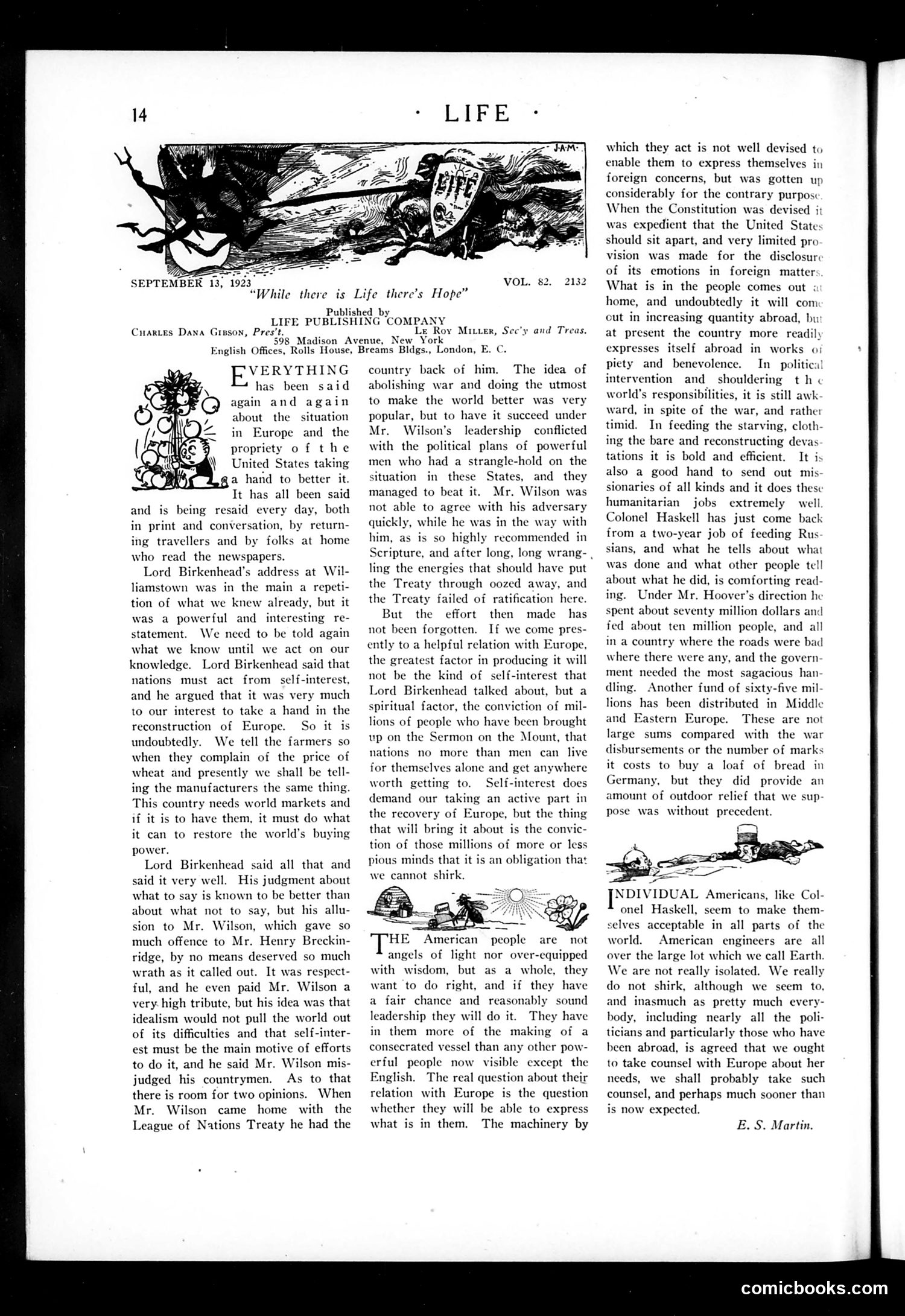
The masthead cartoon depicts **Lady Liberty** (holding a shield marked "Constitution") appearing exhausted or defeated, with what appears to be a dead bird or dove nearby—likely symbolizing failed peace efforts or internationalism. The accompanying article criticizes President **Woodrow Wilson's** foreign policy, particularly regarding **European reconstruction** and the failed **League of Nations Treaty**. The text argues Wilson's idealism was admirable but impractical, and that American self-interest (not altruism) should guide foreign aid to Europe. The piece advocates for pragmatic American intervention in European recovery—justified by American interests rather than humanitarian ideals. This reflects 1923 post-WWI isolationist sentiment and skepticism toward Wilson's internationalist vision.
📄 Transcribed text from this page (OCR, searchable)
Machine-transcribed from the original scan — historical spelling and the odd misread are preserved.
SEPTEMBER 13, 1923, “While there is Life there’s Hope” Published by LIFE PUBLISHING COMPANY Cuartes Dana Gipson, Pres’t. Roy Minter, Sec’y and Treas. 598 Madison Avenue, New York English Offices, Rolls Hous ERYTHING has been said again and again about the situation in Europe and the propriety of the United States taking ga hand to better it. It has all been said and is being resaid every day, both in print and conversation, by return- ing travellers and by folks at home who read the newspapers. Lord Birkenhead’s address at Wil- liamstown was in the main a repeti- tion of what we knew already, but it was a powerful and interesting re- We need to be told again what we know until we act on our knowledge. Lord Birkenhead said that nations must act from. self-interest, and he argued that it was very much to our interest to take a hand in the reconstruction of Europe. So it is undoubtedly. We tell the farmers so when they complain of the price of wheat and presently we shall be tell- ing the manufacturers the same thing. This country needs world markets and if it is to have them, it must do what it can to restore the world’s buying power. Lord Birkenhead said all that and said it very well. His judgment about what to say is known to be better than about what not to say, but his allu- sion to Mr. Wilson, which gave so much offence to Mr. Henry Breckin- ridge, by no means deserved so much wrath as it called out. It was respect- ful, and he even paid Mr. Wilson a very high tribute, but his idea was that idealism would not pull the world out of its difficulties and that self-inter- est must be the main motive of efforts to do it, and he said Mr. Wilson mis- judged his countrymen. As to that there is room for two opinions. When Mr. Wilson came home with the League of Nations Treaty he had the statement. Breams Bldgs., London, E. C. country back of him. The idea of abolishing war and doing the utmost to make the world better was very popular, but to have it succeed under Mr. Wilson’s leadership conflicted with the political plans of powerful men who had a strangle-hold on the situation in these States, and they managed to beat it. Mr. Wilson was not able to agree with his adversary quickly, while he was in the w: him, as is so highly recommended in with Scripture, and after long, long wrang- , ling the energies that should have put the Treaty through oozed away, and the Treaty failed of ratification here. But the effort then not been forgotten. If we come pres- ently to a helpful relation with Europe, the greatest factor in producing it will not be the kind of self-interest that Lord Birkenhead talked about, but a spiritual factor, the conviction of mil- lions of people who have been brought up on the Sermon on the Mount, that nations for themselves alone and get anywhere worth getting to. Self-interest does demand our taking an active part in the recovery of Europe, but the thing that will bring it about is the convic- tion of those millions of more or less pious minds that it is an obligation that we cannot shirk. made has no more than men can live HE American people are not angels of light nor over-equipped with wisdom, but as a whole, they want to do right, and if they have a fair chance and reasonably sound leadership they will do it. They have in them more of the making of a consecrated vessel than any other pow- erful people now visible except the English. The real question about their relation with Europe is the question whether they will be able to express what is in them. The machinery by which they act is not well devised to enable them to express themselves in foreign concerns, but was gotten up considerably for the contrary purposi When the Constitution was devised it was expedient that the United States should sit apart, and very limited pro vision was made for the disclosur: of its emotions in foreign matter. What is in the people comes out : home, and undoubtedly it will com out in increasing quantity abroad, by at present the country more readily expresses itself abroad in works oj piety and benevolence. In_ politica! intervention and shouldering t h ¢ world’s responsibilities, it is still awk ward, in spite of the war, and rather timid. In feeding the starving, cloth- ing the bare and reconstructing devas tations it is bold and efficient. It is also a good hand to send out mis sionaries of all kinds and it does these humanitarian jobs extremely well Colonel Haskell has just come back from a two-year job of feeding Rus sians, and what he tells about what was done and what other people tell about what he did, is comforting read- ing. Under Mr. Hoover's direction he spent about seventy million dollars and fed about ten million people, and all in a country where the roads were bad where there were any, and the govern ment needed the most sagacious han- dling. Another fund of sixty-five mil- lions has been distributed in Middle and Eastern Europe. These are not large sums compared with the war disbursements or the number of marks it costs to buy Germany, but they did provide an amount of outdoor relief that we sup pose was without precedent. loaf of bread in onel Haskell, seem to mak selves acceptable in all parts of the world. American engineers are all over the large lot which we call Earth. We are not really isolated. We really do not shirk, although we seem to, and inasmuch as pretty much eve body, including nearly all the poli- ticians and particularly those who have been abroad, is agreed that we ought to take counsel with Europe about her needs, we shall probably take such counsel, and perhaps much sooner than is now expected. E. S. Martin. comicbooks.com