
Life, 1923-09-13 · page 22 of 36
Life — September 13, 1923 — page 22: what you’re looking at
What you’re looking at
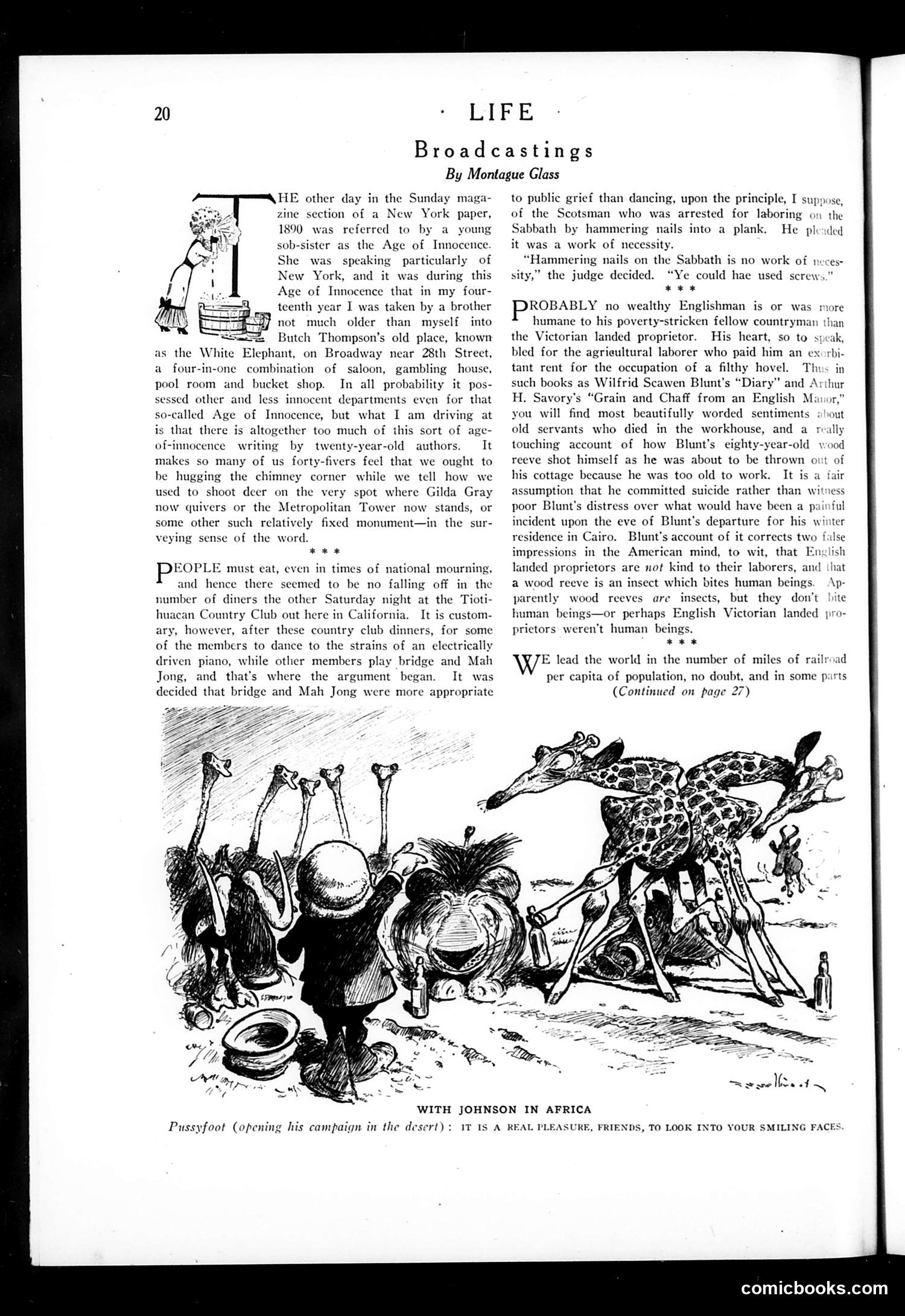
This page from *Life* magazine contains satirical essays by Montague Glass rather than political cartoons. The humor targets several subjects: **"Age of Innocence" critique**: Glass mocks young writers romanticizing 1890s New York as innocent, when it actually contained saloons, gambling houses, and corruption. He suggests these authors should stop pretending nostalgia when they're too young to remember the era authentically. **Country Club hypocrisy**: The anecdote about choosing bridge over dancing after a national mourning period satirizes the arbitrary moral reasoning of the wealthy—comparing it to a judge's absurd ruling that a Scotsman's Sabbath nail-hammering was necessary (but screws wouldn't be). **English landlord sentimentality**: Glass exposes Victorian landed proprietors' self-serving sympathy for laborers they exploited. He notes their accounts of workers' suicides conveniently emphasize the proprietors' own distress rather than addressing systemic poverty. The bottom illustration captioned "With Johnson in Africa" appears unrelated to the text—likely from a separate feature about explorer or entertainer Jack Johnson.
📄 Transcribed text from this page (OCR, searchable)
Machine-transcribed from the original scan — historical spelling and the odd misread are preserved.
LIFE Broadcastings By Montague Glass HE other day in the Sunday maga- zine section of a New York paper, 1890 was referred to by a young sob-sister as the Age of Innocence. She speaking particularly of New York, and it was during this Age of Innocence that in my four- teenth year I was taken by a brother not much older than myself into Butch Thompson's old place, known as the White Elephant, on Broadway near 28th Street, a four-in-one combination of saloon, gambling house, pool room and bucket shop. In all probability it pos- sessed other and less innocent departments even for that so-called Age of Innocence, but what I am driving at is that there is altogether too much of this sort of age- of-innocence writing by twenty-year-old authors. It makes so many of us forty-fivers feel that we ought to be hugging the chimney corner while we tell how we used to shoot deer on the very spot where Gilda Gray now quivers or the Metropolitan Tower now stands, or some other such relatively fixed monument—in the sur- veying sense of the word. xk was OPL and hence there seemed to be no falling off in the number of diners the other Saturday night at the Tioti- huacan Country Club out here in California. It is custom- ary, however, after these country club dinners, for some of the members to dance to the strains of an electrically driven piano, while other members play bridge and Mah Jong, and that's where the argument began. It was decided that bridge and Mah Jong were more appropriate = must eat, even in times of national mourning, to public grief than dancing, upon the principle, I suppose, of the Scotsman who vw arrested for laboring on the Sabbath by hammering nails into a plank. He pleaded it was a work of necessity. Hammering nails on the sity,” the judge decided. * Sabbath is no work of neces- e could hae used screws.” ee ROBABLY no wealthy Englishman is or was more humane to his poverty-stricken fellow countryman than the Victorian landed proprietor. His heart, so to speak, bled for the agricultural laborer who paid him an exorbi- tant rent for the occupation of a filthy hov Thus in such books as Wilfrid Scawen Blunt’s “Diary” and Arthur H. Savory'’s “Grain and Chaff from an English Maior,” you will find most beautifully worded sentiments about old servants who died in the workhouse, and a really touching account of how Blunt’s eighty-year-old wood reeve shot himself as he was about to be thrown out of his cottage because he was too old to work. It is a fair assumption that he committed suicide rather than witness poor Blunt's distress over what would have been a painful incident upon the eve of Blunt's departure for hi: residence in Cairo. Blunt's account of it corrects two false impressions in the American mind, to wit, that English landed proprietors are not kind to their laborers, and (hat a wood reeve is an insect which bites human beings. Ap- parently wood reeves are insects, but they don’t /ite human beings—or perhaps English Victorian landed pro- prietors weren't human beings. *** winter E lead the world in the number of miles of railroad per capita of population, no doubt, and in some parts (Continued on page 27) JOHNSON IN AFRICA IT IS A REAL PLEASURE, FRIENDS, TO LOOK INTO YOUR SMILING FACES, comicbooks.com