
A complete issue · 40 pages · 1923
Life — September 6, 1923
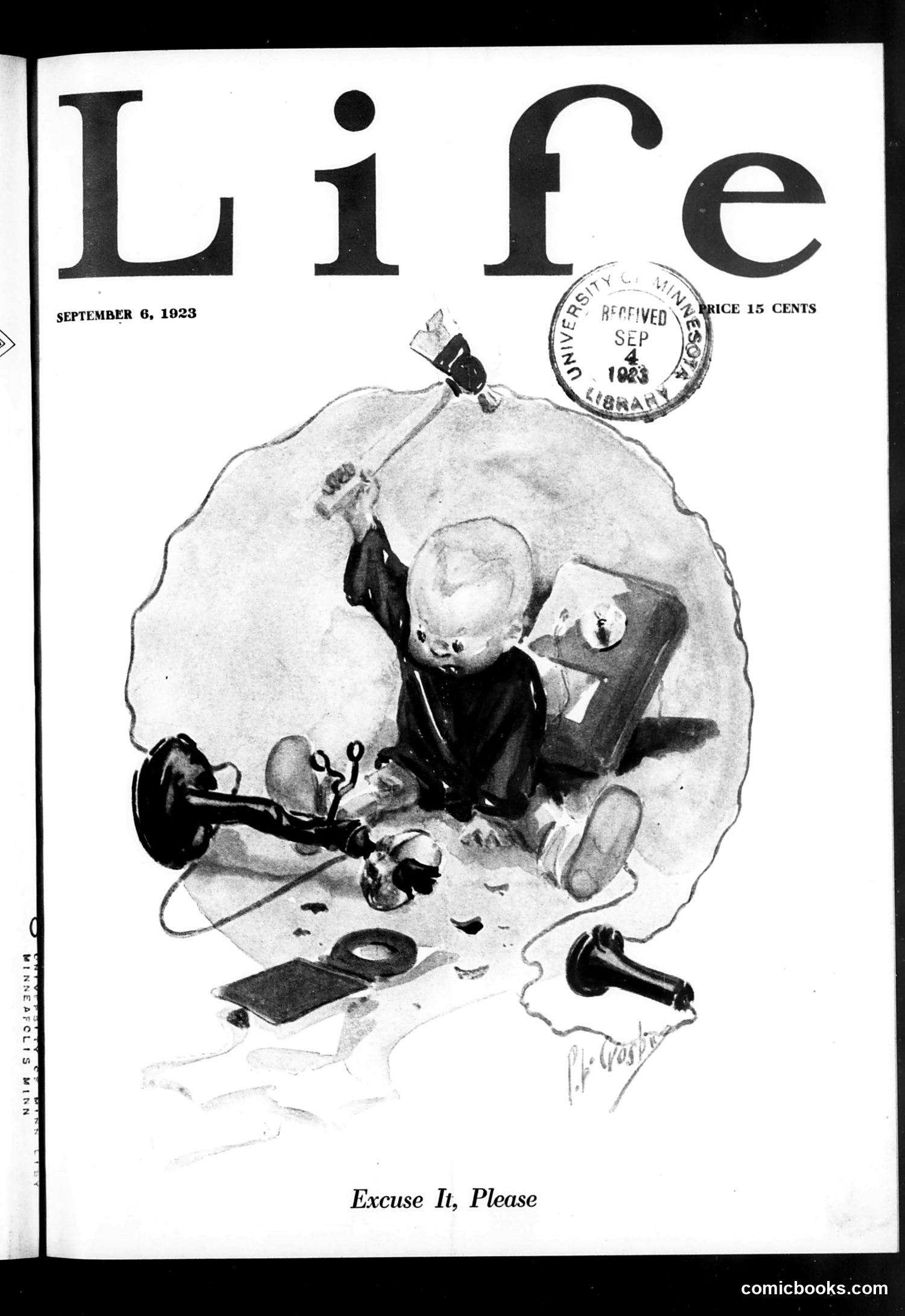
This cover depicts a bald man sitting amid scattered telephone equipment and debris, holding what appears to be a telephone receiver raised in frustration. The caption reads "Excuse It, Please." The cartoon satirizes the frustrations of early telephone service—a common complaint in the 1920s. The cluttered scene with broken or malfunctioning equipment suggests poor phone connections, dropped calls, and operator errors. The man's exasperated gesture and the ironic caption "Excuse It, Please" mock the standard apology telephone companies offered customers experiencing service failures. This reflects contemporary frustration with the telephone infrastructure as it expanded during this era, when service quality and reliability were frequent sources of public complaint and satire.
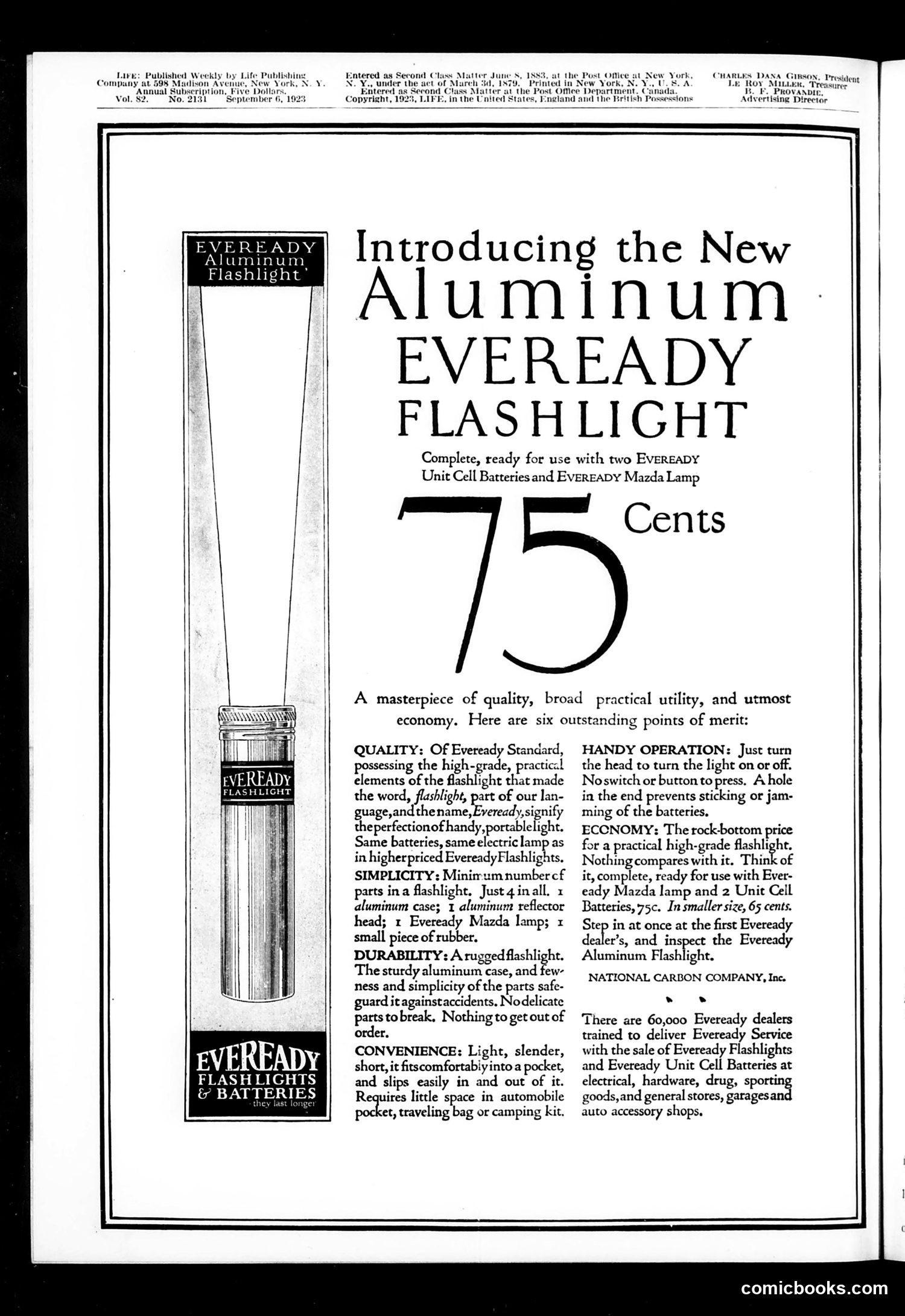
This page is primarily **advertising, not satire or political commentary**. It features a full-page advertisement for the new Eveready Aluminum Flashlight, priced at 75 cents. The ad highlights the product's features: quality construction, simple design (four aluminum parts), durability, convenience, and economy. It emphasizes the flashlight is "complete, ready for use" with two Eveready batteries and a Mazda lamp included. The advertisement targets practical consumers by stressing portability—suitable for automobile pockets, traveling bags, and camping kits. Text mentions 60,000 trained Eveready dealers available for purchase and service. There is **no political cartoon or satire present**—this is purely a commercial product advertisement typical of Life magazine's revenue model during the 1920s.
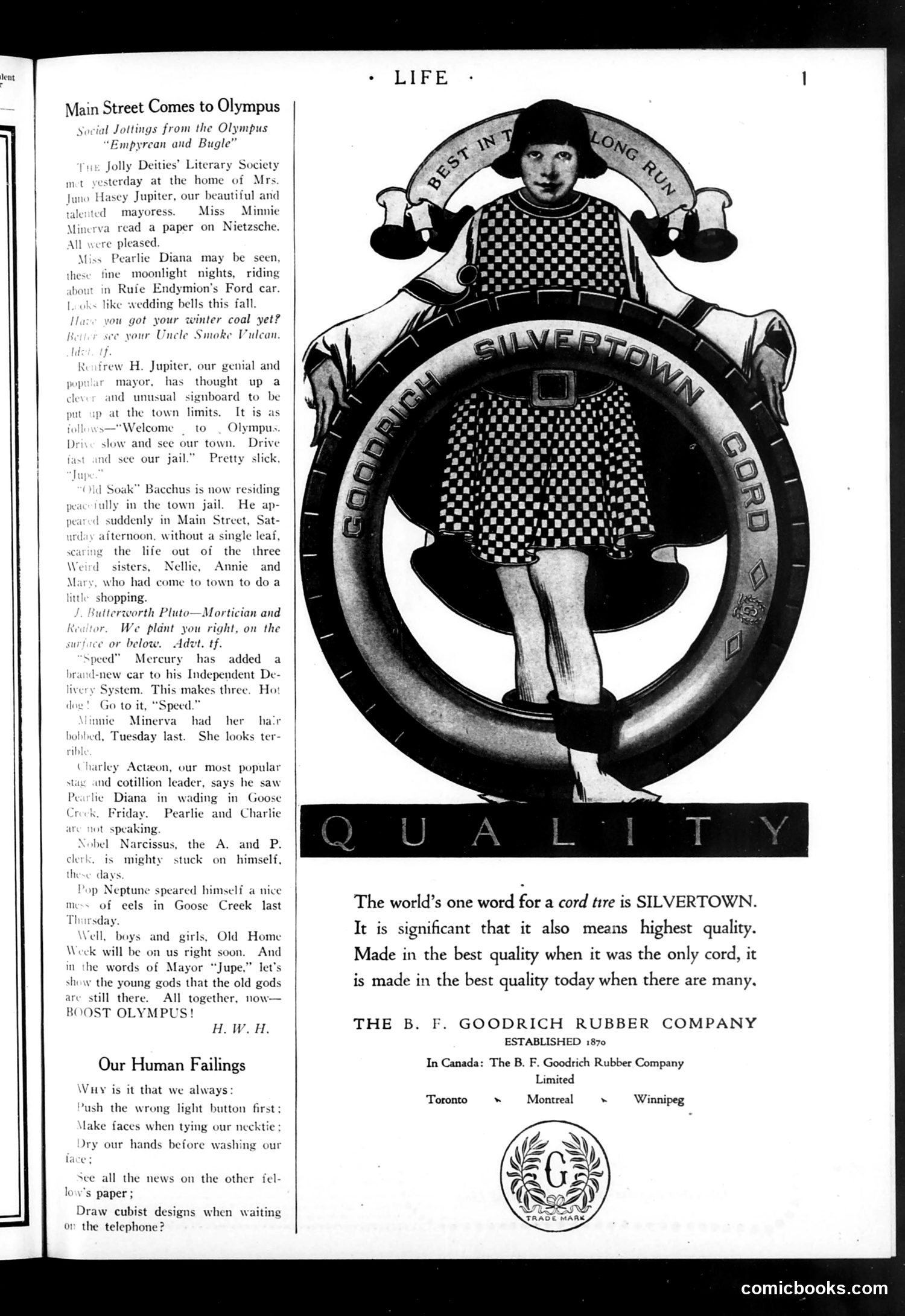
This page is primarily an **advertisement for Silvertown cord tires** by the B.F. Goodrich Rubber Company, disguised as editorial content. The large illustration shows a woman sitting inside an oversized tire, wearing a checkered dress. The tire is labeled "GOODRICH SILVERTOWN CORD." The accompanying text claims that "Silvertown" is "the world's one word for a cord tire" and associates it with "highest quality." This is brand-building messaging—equating the product name with the category itself, a marketing strategy from the early automotive era. The left column contains unrelated social gossip about "Main Street" activities in Olympus, likely filler content typical of Life magazine's satirical format, and a separate essay on "Our Human Failings." The advertisement dominates the page's visual real estate.
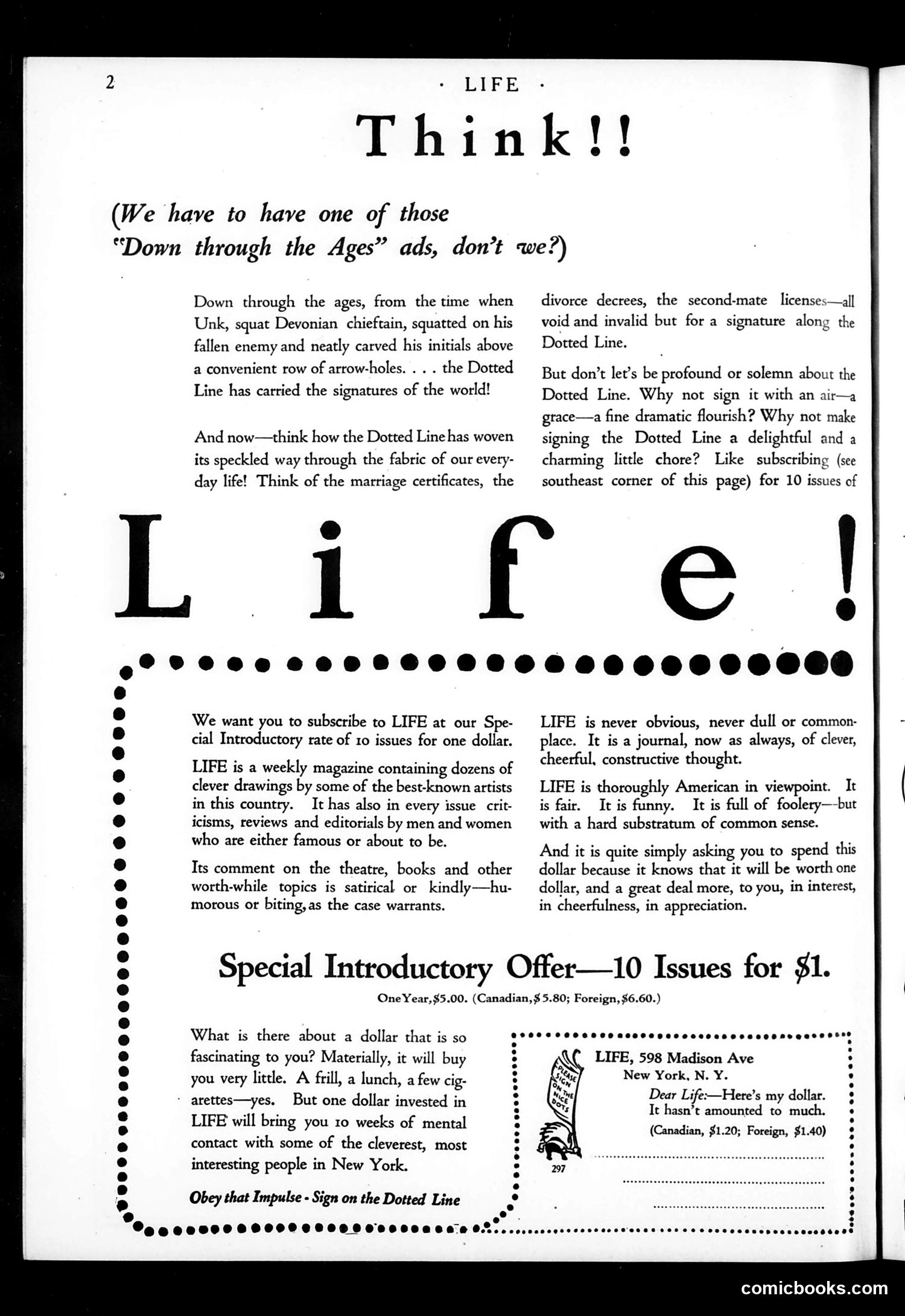
This is primarily a **subscription advertisement** for *Life* magazine, not political satire. The page uses humorous framing to promote subscriptions at 10 issues for $1. The opening section playfully invokes the phrase "Down through the Ages" (a common advertising trope of the era) by referencing the "Dotted Line"—a humorous metaphor for signature lines on historical documents like marriage certificates and divorce decrees. The joke is that signatures on dotted lines have shaped civilization. The advertisement emphasizes *Life's* identity as a weekly satirical magazine featuring drawings, criticism, and commentary on theater, books, and current events. It positions the publication as clever, American, and grounded in "common sense," appealing to readers seeking "cheerful, constructive thought" rather than heavy material.
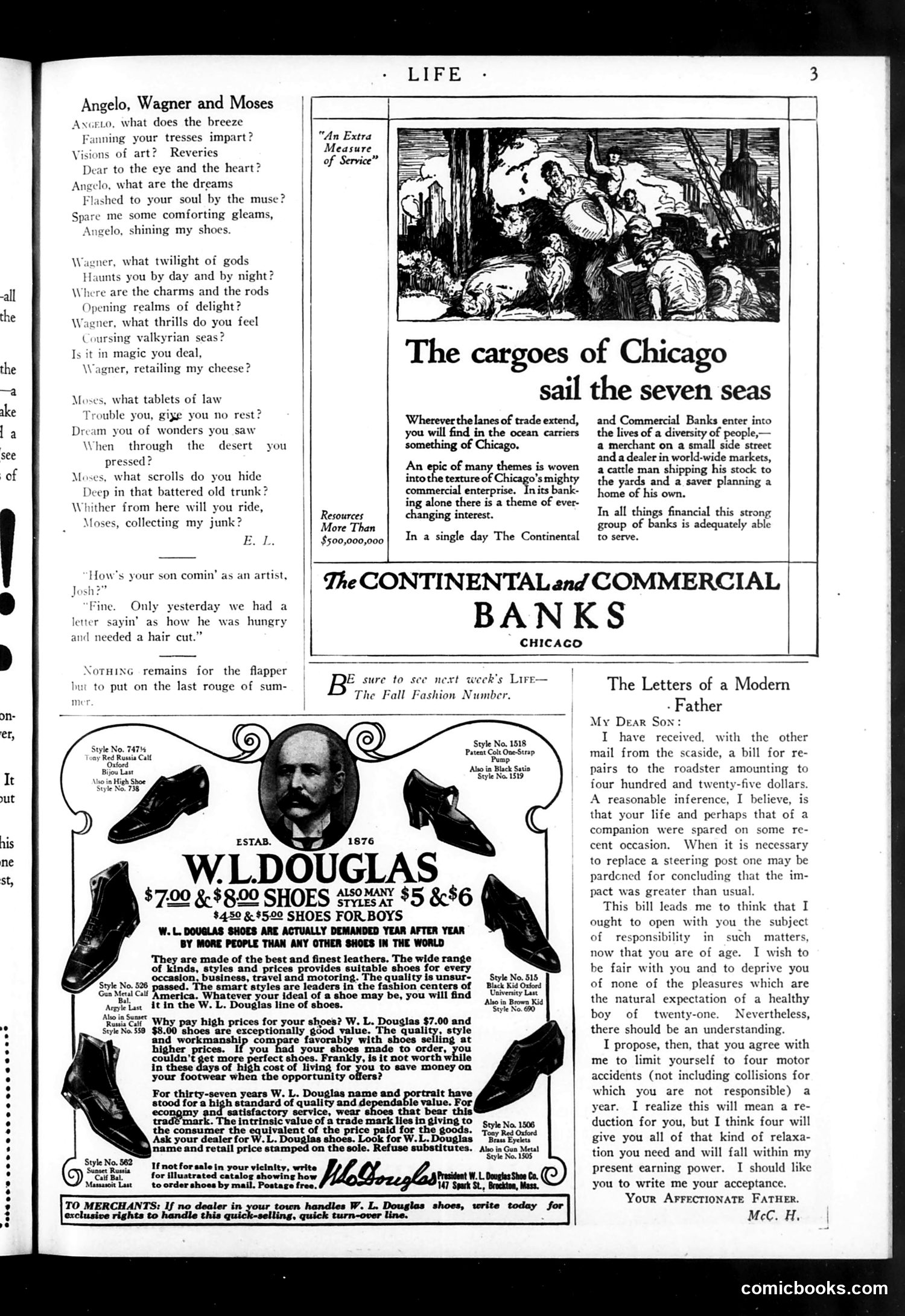
This page is primarily **advertising and literary content** rather than political satire. The top section features a poem titled "Angelo, Wagner and Moses"—apparently contrasting three cultural/artistic figures through questions about their inspirations and contributions to human experience. The main visual element is a **W.L. Douglas shoe advertisement** (established 1876) prominently displaying their $7 and $8 shoes as quality alternatives to more expensive footwear. The ad emphasizes value and craftsmanship, claiming Douglas shoes compare favorably to higher-priced competitors. Additional advertisements include a Continental and Commercial Banks promotion about Chicago's commercial enterprise. The page concludes with "The Letters of a Modern Father," a fictional letter where a father addresses his adult son regarding responsibility and financial prudence—reflecting early 20th-century parental values about adulthood and duty.
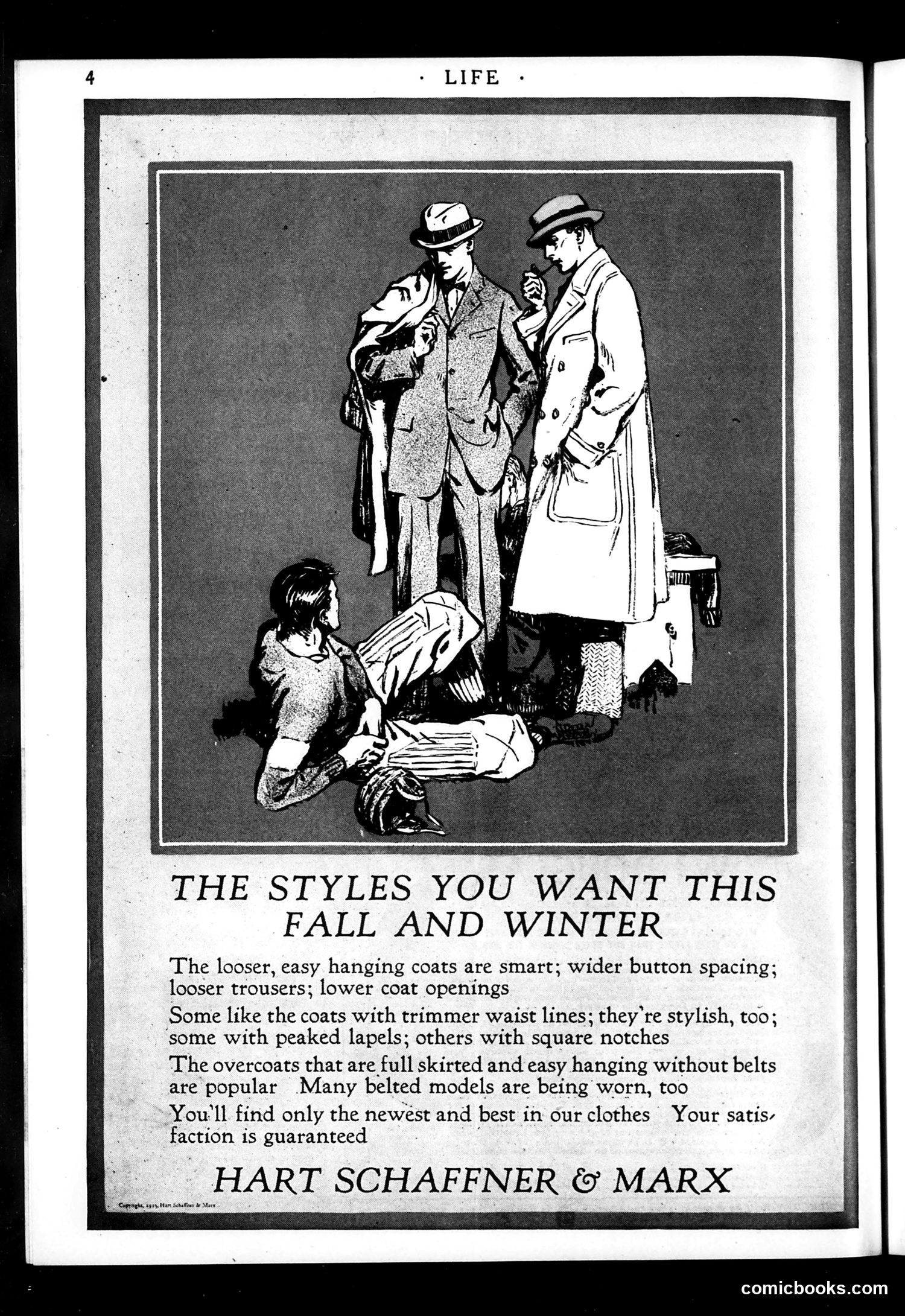
This is a **fashion advertisement, not political satire**. The page shows Hart Schaffner & Marx promoting fall and winter menswear styles circa the 1910s-1920s (based on the typography and clothing silhouettes). The illustration depicts three well-dressed men in suits and overcoats advising two women (one seated, one standing) about current fashion trends. The advertisement emphasizes looser-fitting coats, wider button spacing, lower openings, and optional waist-line trimmers or peaked lapels as desirable styling elements for the season. This is purely commercial content—a department store advertisement promoting men's clothing through an aspirational social scene. There is no political cartoon or satire present on this page.
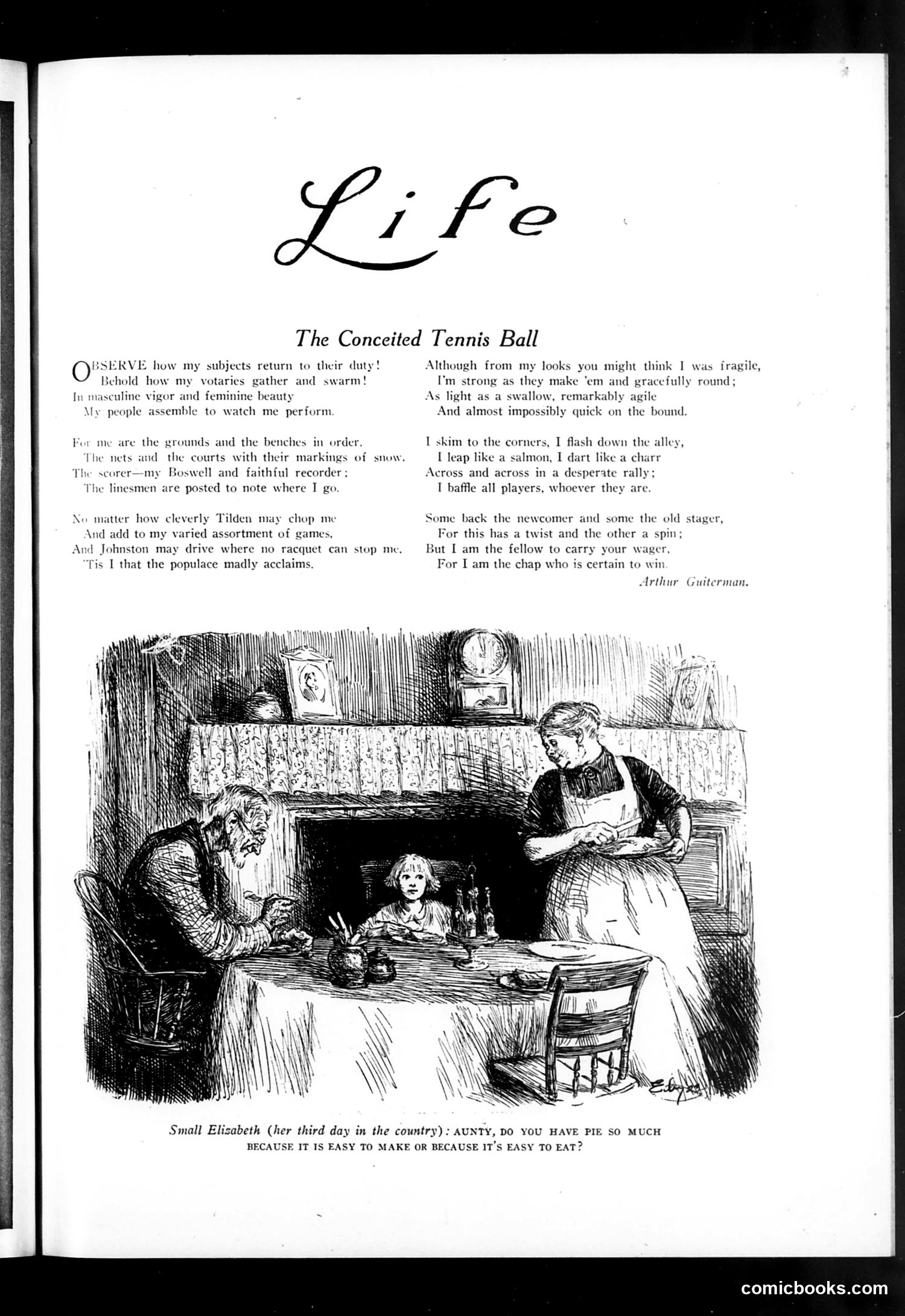
This page contains a poem by Arthur Guiterman personifying a tennis ball's boastful perspective on its athletic prowess. The poem celebrates the ball's speed, agility, and decisive role in determining match outcomes—"I am the chap who is certain to win." The accompanying illustration depicts a domestic kitchen scene where a young girl (identified as "Small Elizabeth") asks her aunt about pie-making. The caption reads: "Aunty, do you have pie so much because it is easy to make or because it's easy to eat?" The page appears to be general entertainment/humor content rather than political satire. It represents *Life* magazine's typical early-20th-century mix of light verse, domestic humor, and pen-and-ink illustrations aimed at middle-class readers.
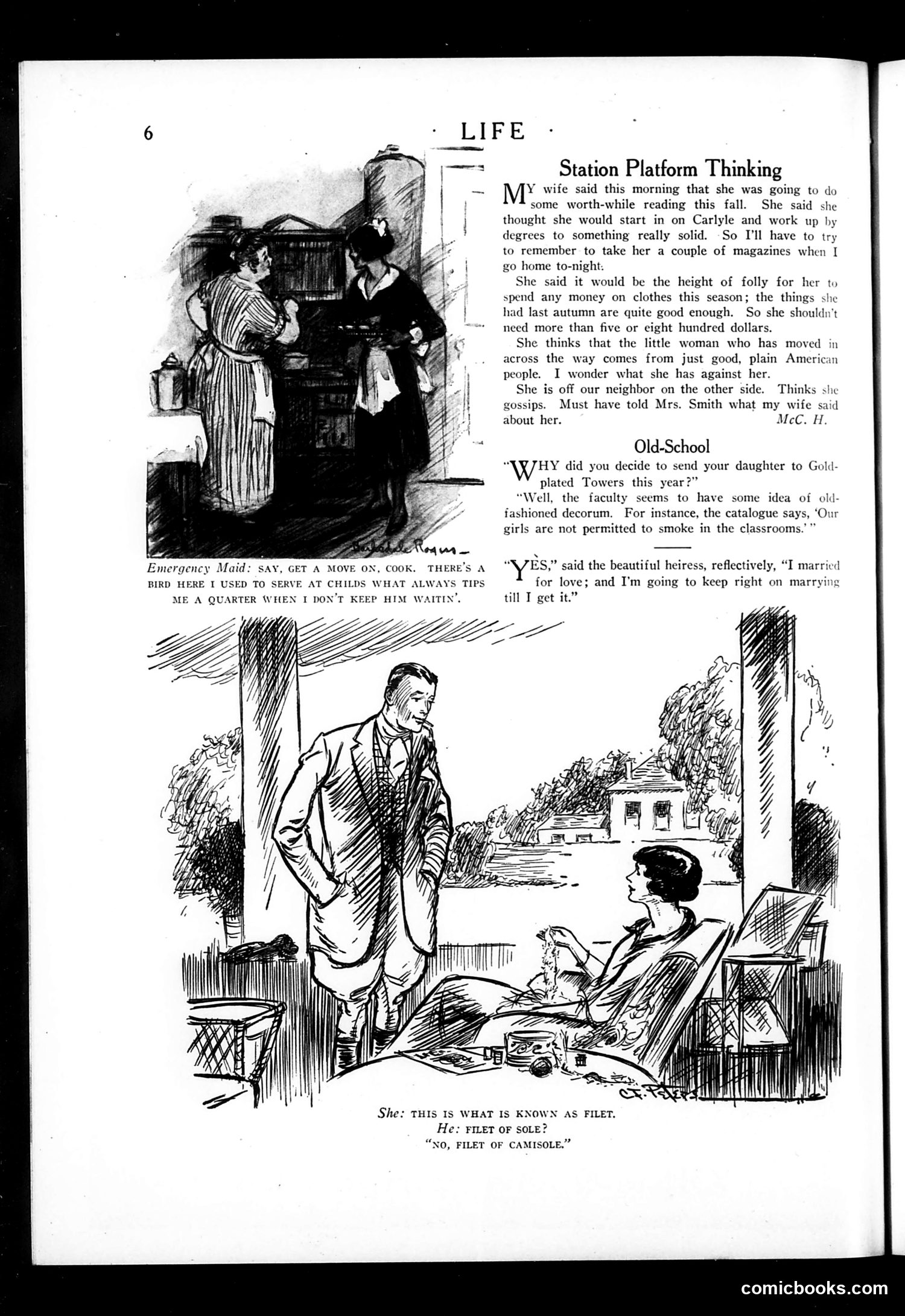
This page contains three satirical pieces about early 20th-century social attitudes: **"Station Platform Thinking"** mocks a husband's casual snobbery toward a working-class neighbor woman while reading on a train platform. The joke: he mindlessly absorbs prejudices without examination. **"Old-School"** features a dialogue about sending a daughter to "Gold-plated Towers" (a finishing school). The satire targets restrictive Victorian conventions—the school forbids girls from smoking in classrooms, yet the "beautiful heiress" declares she'll marry for love and "keep right on marrying till I get it," mocking both outdated rules and women's limited independence. **"Filet of Camisole"** is a visual pun: a man and woman discuss food while she reads, playing on the double meaning of "filet" (meat cut vs. decorative garment). All three lampoon social pretension and changing gender roles of the era.
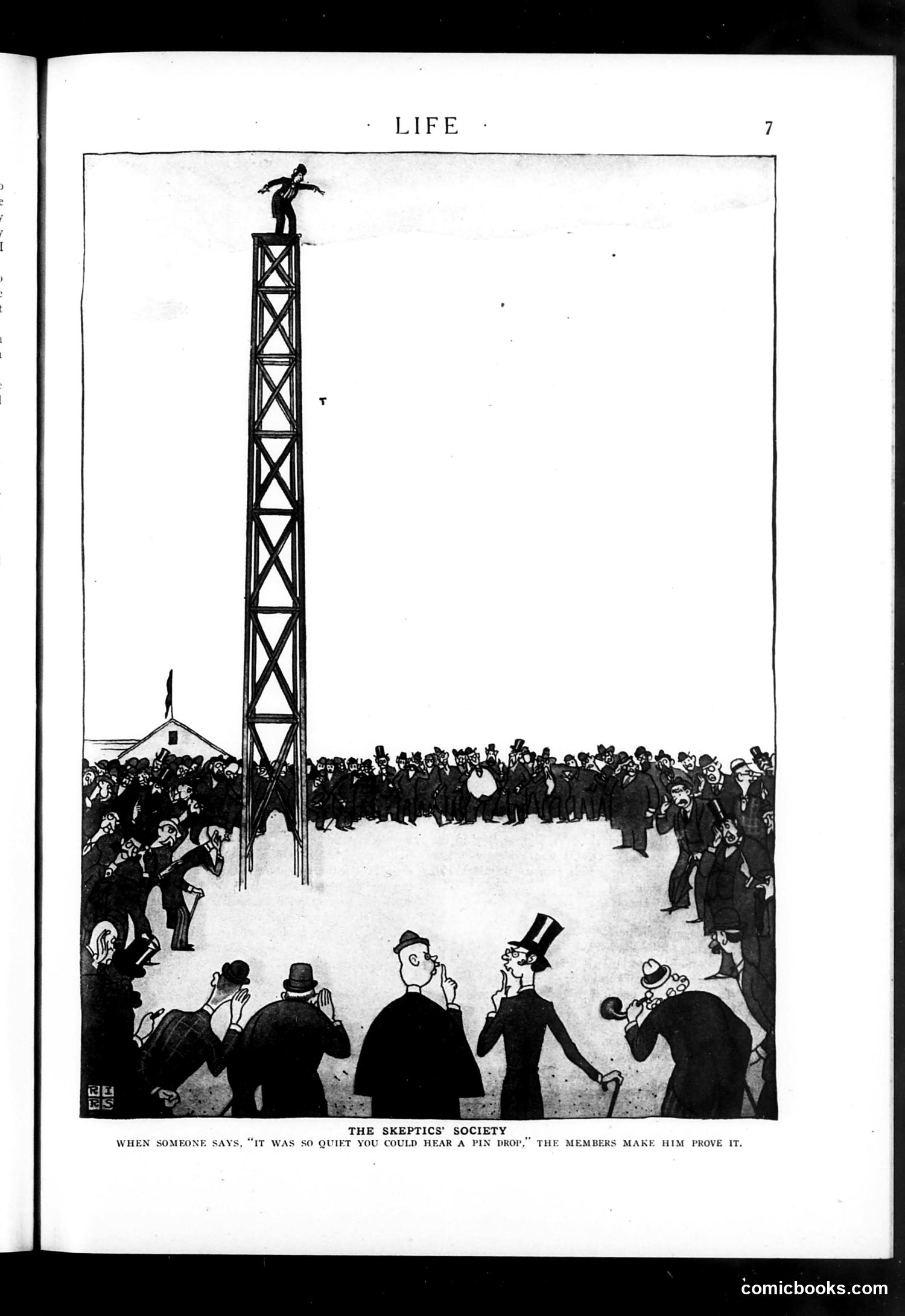
This satirical cartoon depicts a public gathering where a man stands atop an extremely tall, skeletal tower while a crowd watches below. The caption reads: "When someone says, 'It was so quiet you could hear a pin drop,' the members make him prove it." The joke targets the "Skeptics' Society"—a group that demands literal, absurd proof of figurative expressions. The figure at the tower's peak appears positioned to drop a pin for the gathered crowd to hear, illustrating the society's pedantic insistence on proving common idioms through ridiculous demonstration. The cartoon satirizes excessive literalism and the absurdity of demanding physical evidence for everyday metaphorical language. It mocks people who nitpick conversational figures of speech rather than understanding their intended meaning.
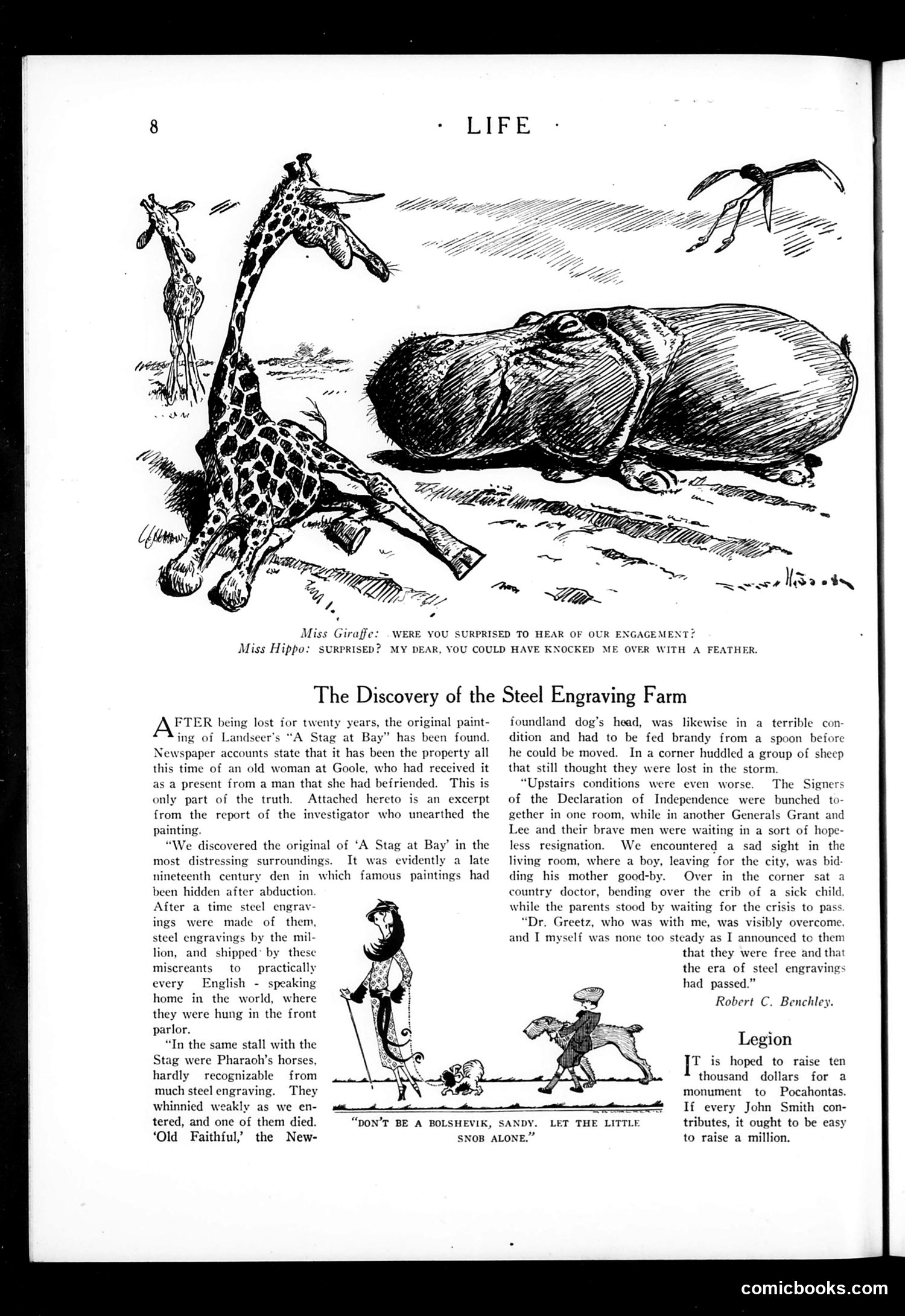
The page contains two distinct pieces of satire: **Top cartoon**: A giraffe and hippopotamus converse about an engagement announcement. The joke relies on the animals' respective physical attributes—the giraffe's long neck and the hippo's bulk—making the hippo's quip that she could knock the giraffe over "with a feather" absurd and humorous. **Main article**: "The Discovery of the Steel Engraving Farm" is a fictional tall tale about finding the original Landseer painting "A Stag at Bay" after twenty years. It satirizes the art world by describing an absurd backstory involving steel engravings mass-produced and distributed globally. The accompanying illustration shows a domestic scene with a Bolshevik reference, mocking both political upheaval and sentimental Victorian imagery. The satire targets pretension in art appreciation and collecting.
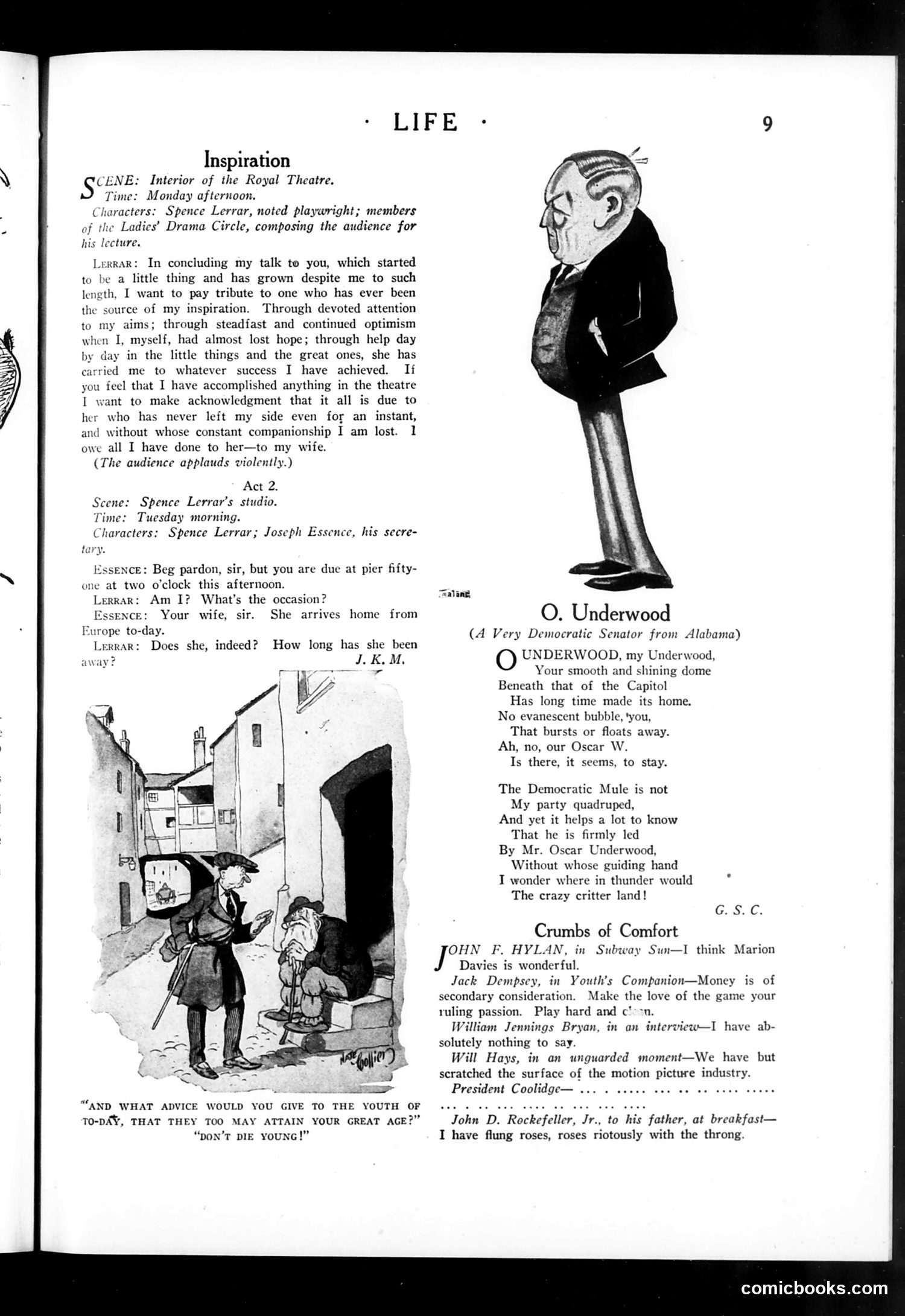
This page features a caricature of **O. Underwood**, identified as "A Very Democratic Senator from Alabama." The exaggerated cartoon depicts him with an elongated, elongated physique—a common satirical technique to mock political figures. The accompanying poem criticizes Underwood as the embodiment of the Democratic Party, suggesting he represents the party's establishment while claiming to be guided by him. The satire questions whether Democratic leadership is genuinely principled or merely self-serving. The lower section, "Crumbs of Comfort," includes brief commentary on various public figures (Hylan, Dempsey, Bryan, Hays, Coolidge, Rockefeller), offering short, pointed observations about their conduct—typical of Life magazine's satirical format mocking politicians and celebrities of the era.
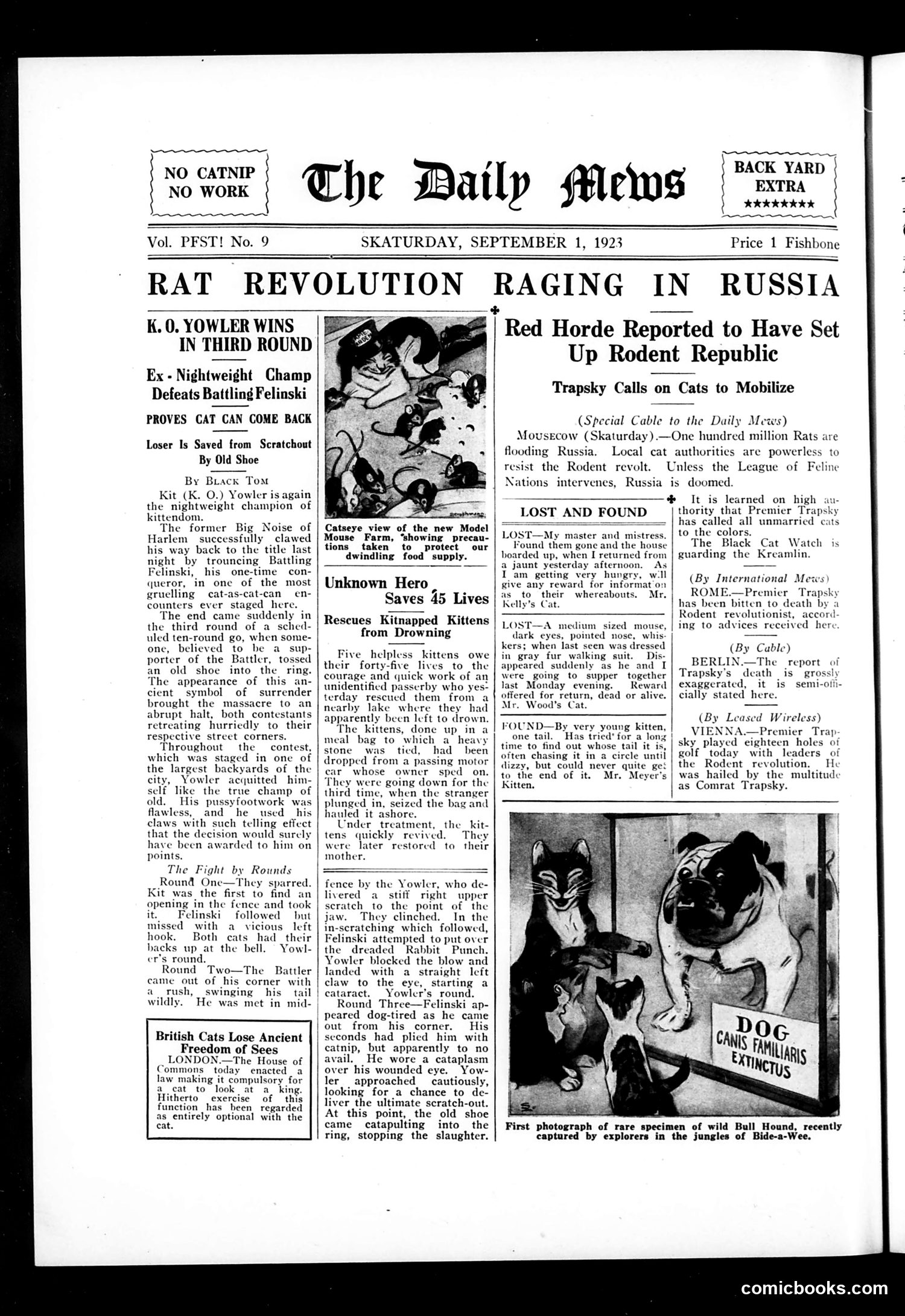
This is a mock newspaper where all headlines and stories concern **cats and dogs** instead of humans. The satire mimics real 1920s news coverage: - "Rat Revolution Raging in Russia" parodies actual Soviet upheaval, reimagined as rodents rebelling - "K.O. Yowler Wins in Third Round" treats a cat boxing match as serious sports journalism - "Red Horde Reported to Have Set Up Rodent Republic" and references to "Premier Trapsky" mock Bolshevik revolutionary language - The "Lost and Found" section lists missing pets - A photo caption identifies a "Bull Hound" specimen as if it were a rare scientific discovery The humor relies on treating animal behavior and pet life with the grave, dramatic tone of actual newspaper reporting about political upheaval and international events—a classic satirical technique mocking both sensationalist journalism and contemporary political anxieties about communism.
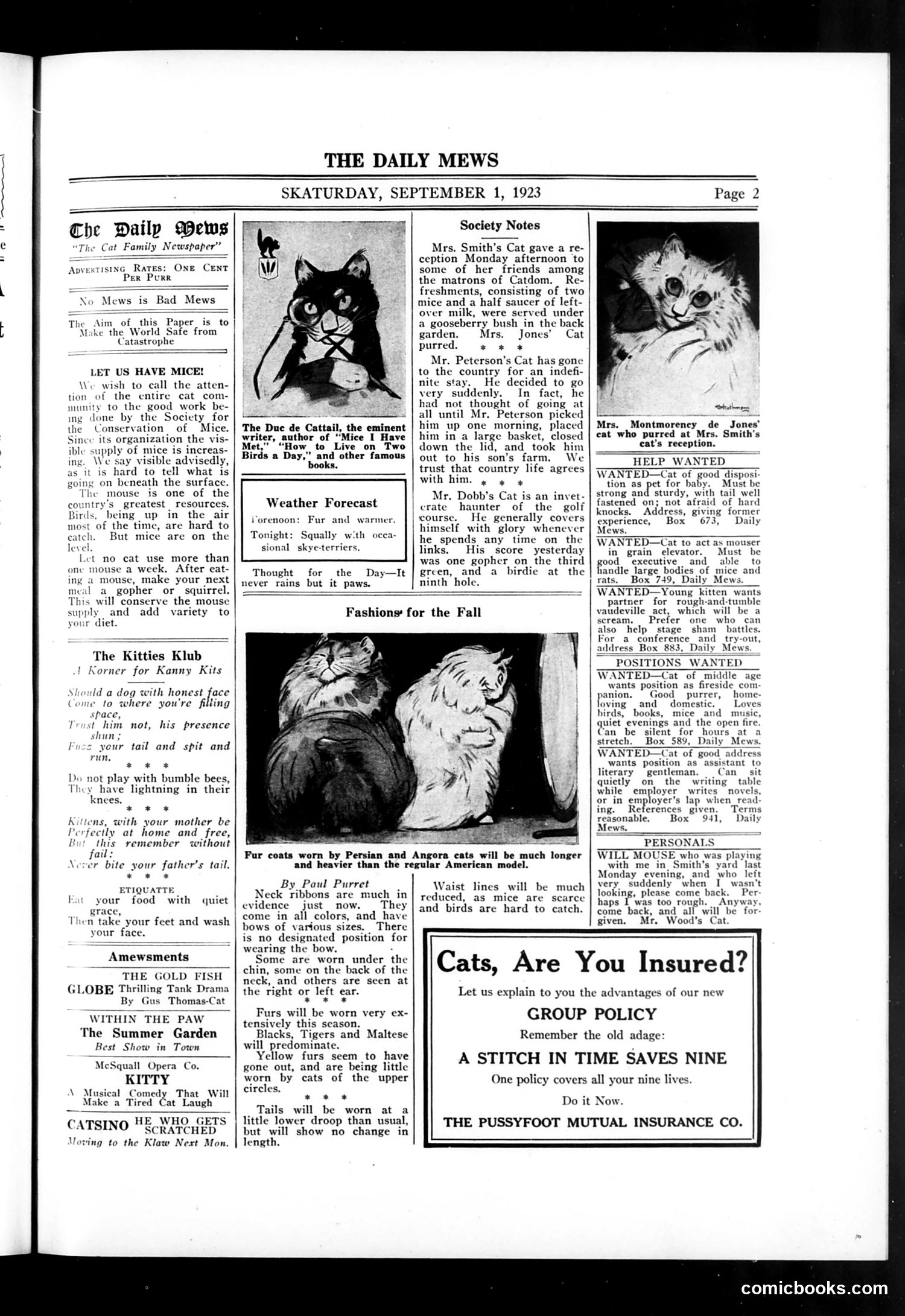
This page is a satirical newspaper parody titled "The Daily Mews"—a pun on "news" and "mews" (cat terminology). The entire publication mimics a human newspaper but reports exclusively on cat and mouse affairs, treating feline society as serious news. Featured articles include: - A society column reporting on Mrs. Smith's cat's reception - Weather forecasts and fashion commentary on cat fur - Advice columns like "The Kitties Club" - Help-wanted ads seeking mice catchers The satire mocks sensationalist newspapers and society journalism of the 1920s by applying these conventions to animals. The joke relies on treating trivial cat activities—fashion, social gatherings, hunting—with the gravity reserved for human affairs, reflecting contemporary American media's obsession with celebrity gossip and lifestyle reporting.
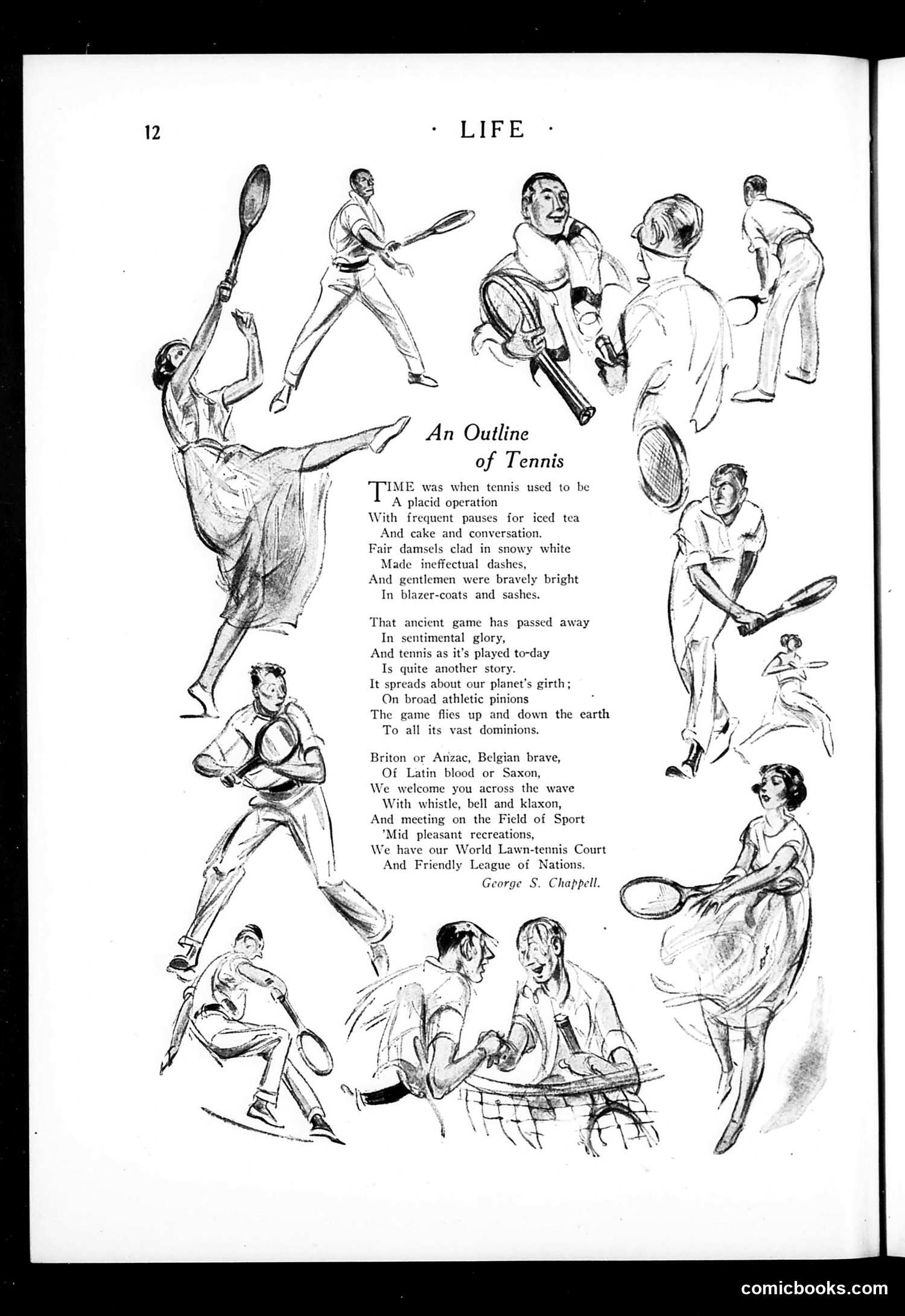
This page presents a poem by George S. Chappell contrasting old and modern tennis. The illustrated sketches show tennis players in action—men and women in athletic poses with rackets. The poem's satire critiques how tennis has evolved from a genteel Victorian pastime ("placid operation / With frequent pauses for iced tea / And cake and conversation") played by leisured aristocrats in formal dress into a modern, internationally competitive sport played with serious athleticism across nations. The final stanza welcomes players from "Briton or Anzac, Belgian brave" to compete on a "World Lawn-tennis Court / And Friendly League of Nations"—referencing post-WWI international cooperation and global athletic competition as a hopeful alternative to conflict. The artwork emphasizes tennis's transformation from drawing-room recreation to vigorous sport.
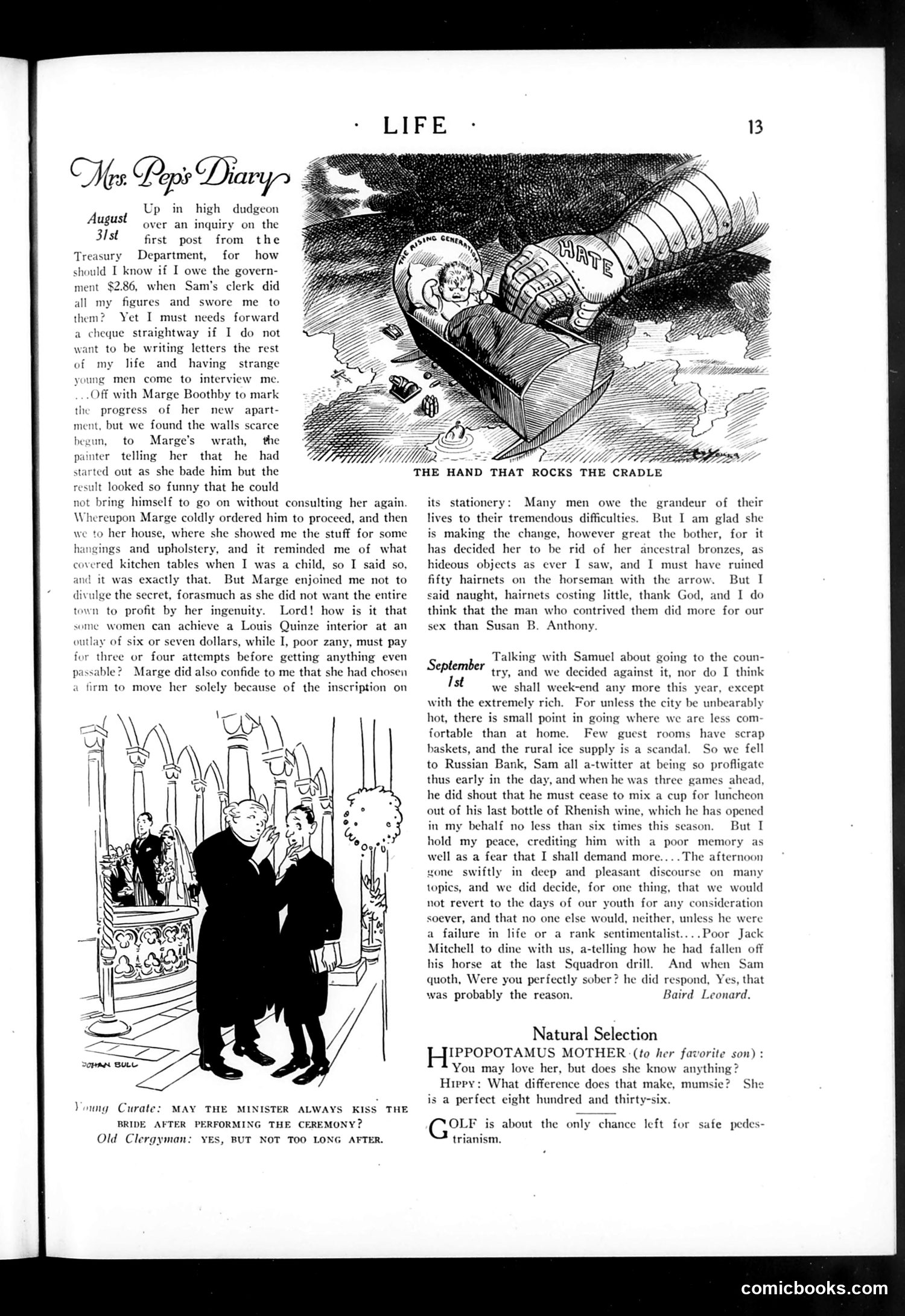
This page from *Life* magazine contains satirical diary entries and illustrations mocking high society and government figures of the era. **Top cartoon** ("The Hand That Rocks the Cradle"): Depicts a woman controlling a man in a boat labeled "Court," suggesting wives' influence over their husbands' public and legal decisions—a commentary on women's behind-the-scenes power despite lacking formal political rights. **Lower cartoon**: Two men in formal dress at what appears to be a wedding ceremony, captioned with a joke about whether a minister should kiss the bride after performing the ceremony. The diary entries satirize bureaucratic incompetence (Treasury Department accounting), interior decoration pretensions among the wealthy, and the tedium of high society social obligations. The overall tone mocks both government inefficiency and the social climbing of the upper classes.
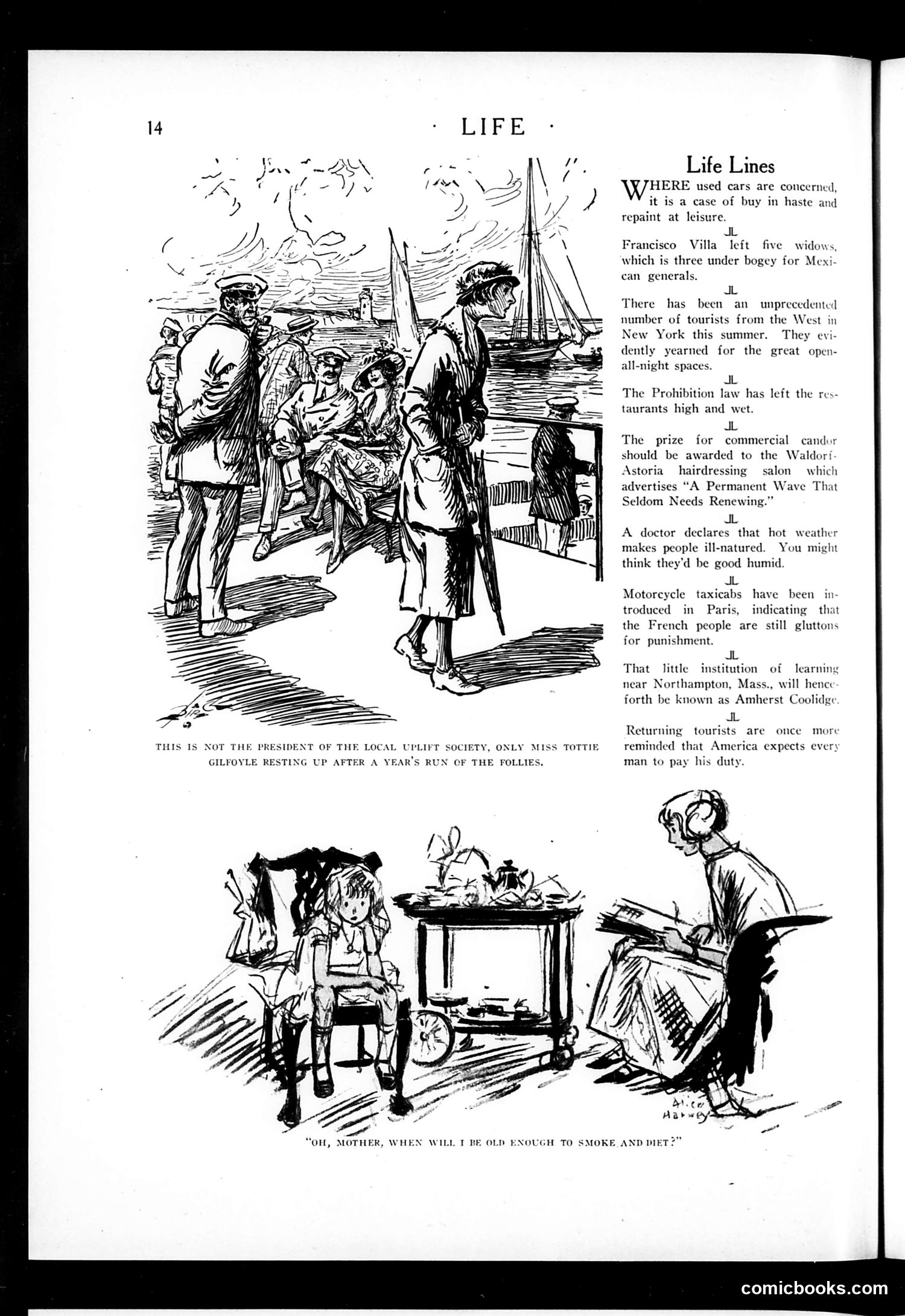
This page contains satirical brief observations and two cartoon illustrations. **Top cartoon**: Shows people at a waterfront with ships. The caption suggests this depicts "Miss Tottie Gilvovle resting up after a year's run of the follies"—likely referencing a theater performer, though the specific reference is unclear to modern readers. **Bottom cartoon**: Shows a child asking "Oh, Mother, when will I be old enough to smoke and bet?" satirizing parental hypocrisy—children observing adults' vices while being denied them. **Text commentary** includes observations on: used car purchases, Francisco Villa's widows, Western tourists in New York, Prohibition's effects on restaurants, a hairdressing salon advertisement, and the introduction of motorcycle taxis in Paris. The tone is typical early-20th-century satirical social commentary on contemporary American life.
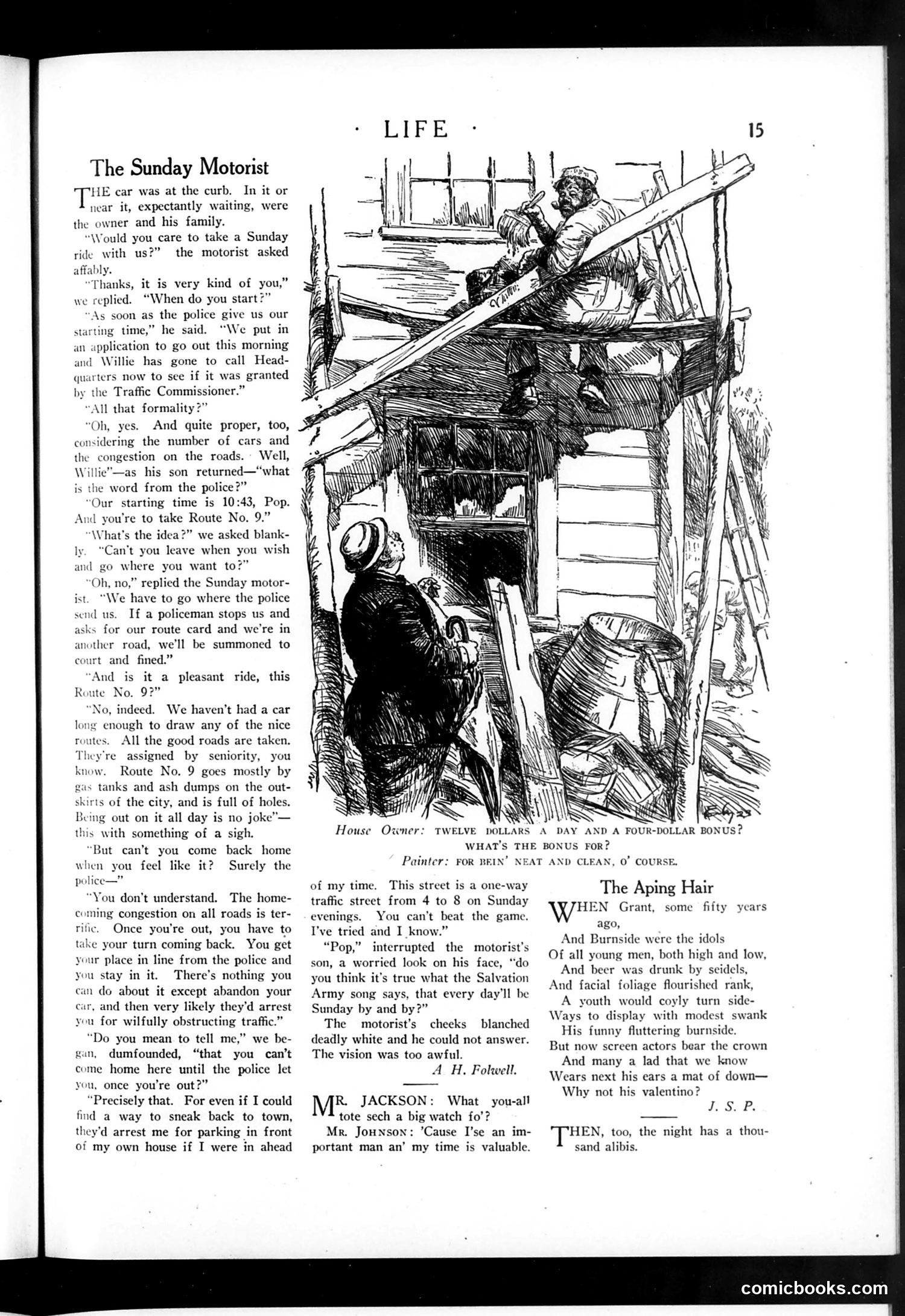
This cartoon satirizes early automotive congestion in cities by imagining an absurdly over-regulated future. A motorist must obtain police permission to take a Sunday drive, receive an assigned starting time (10:43 AM), follow a prescribed route (No. 9—deliberately routed through undesirable areas), and cannot return home until the police grant permission, on pain of arrest. The joke: bureaucratic control has become so suffocating that Sunday leisure driving—once a symbol of freedom—is now micromanaged and miserable. The motorist's son asks if the salvation hymn's promise of "every day'll be Sunday" will come true; the father's horrified silence suggests this dystopia is hell. This reflects genuine 1910s-20s anxiety about automobile congestion overwhelming American cities and the emerging regulatory responses.
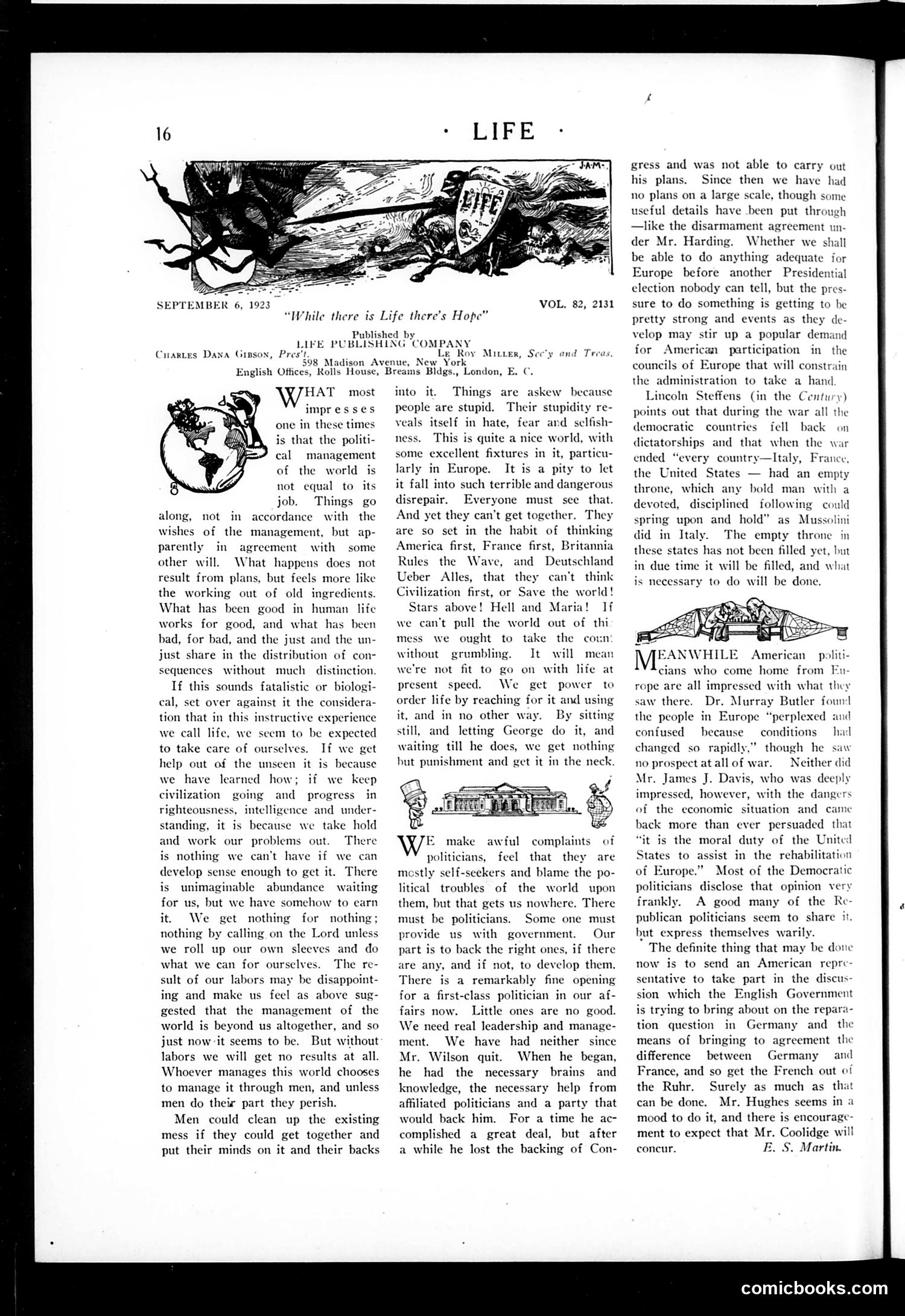
This editorial page by Charles Dana Gibson critiques post-WWI political dysfunction. The main illustration shows **Hope** as a figure being battered or knocked down—likely representing optimism about post-war recovery. Gibson argues that world leaders lack competence to manage affairs properly. He attacks the **selfishness of national interests**: countries prioritize "America first, France first, Britannia Rules the Wave, and Deutschland Ueber Alles" rather than global welfare. He specifically criticizes **President Wilson's loss of congressional backing**, which enabled his domestic and foreign policy failures. Gibson blames ordinary people's stupidity and inability to cooperate, rather than politicians alone. He calls for "real leadership"—a first-class politician who can unite divided nations on rehabilitation (likely meaning European reconstruction and peace-building). The cartoon suggests hope is being crushed by nationalist divisions and political incompetence in the post-war period.
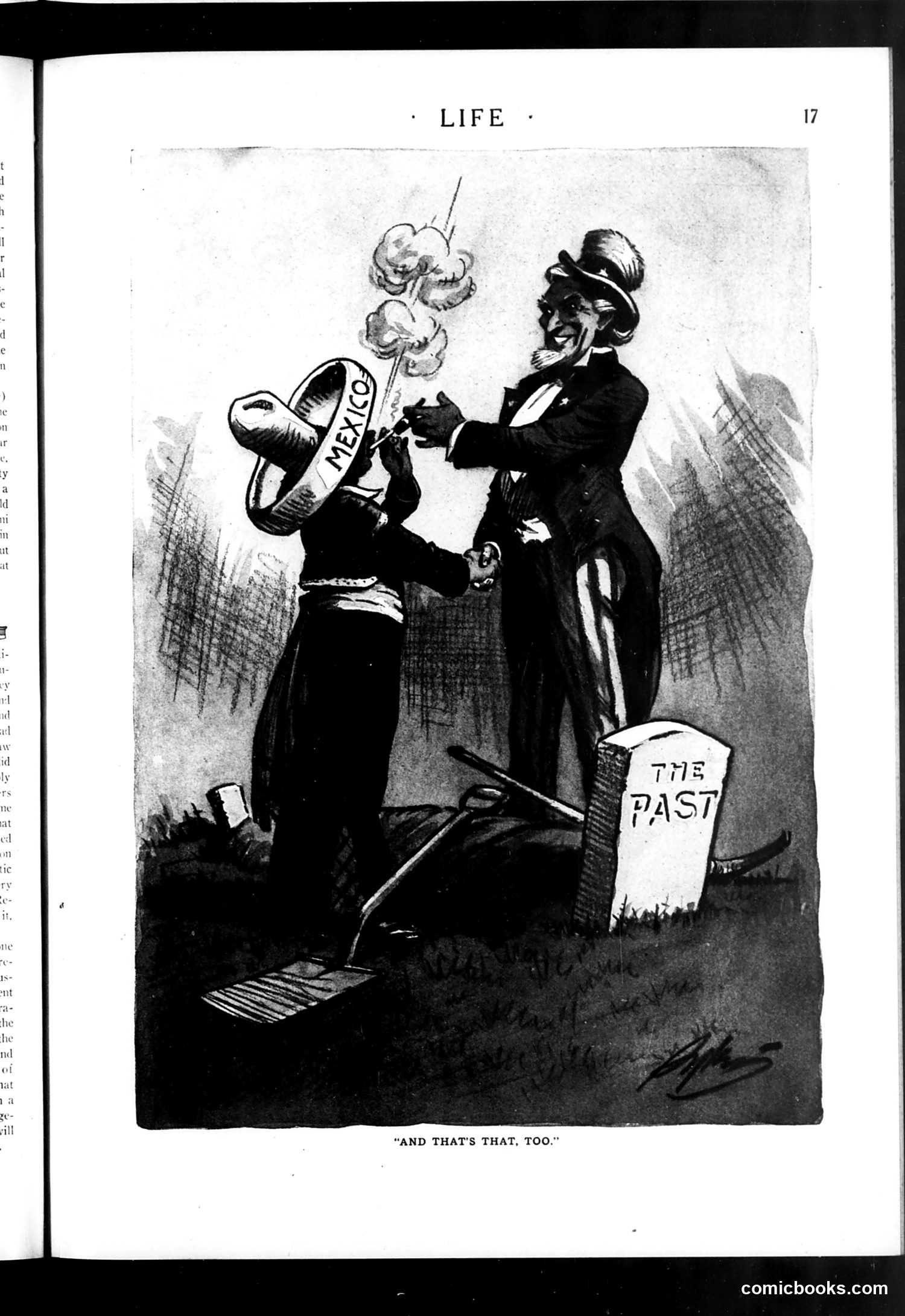
This Life magazine cartoon depicts a well-dressed man in a top hat exhuming or disturbing a grave marked "THE PAST." He's holding up what appears to be a wrapped body or artifact labeled "MEXICO," with explosions or flames erupting from it. The satire likely comments on American intervention in Mexican affairs—a recurring theme in early 20th-century U.S. politics. The gentleman's formal attire suggests diplomatic or governmental authority "digging up" past conflicts or grievances with Mexico, reigniting dormant tensions. The caption "AND THAT'S THAT, TOO" suggests finality or resignation about perpetual U.S.-Mexico relations. The specific historical context—whether referencing the Mexican Revolution, territorial disputes, or diplomatic incidents—remains unclear without the publication date.
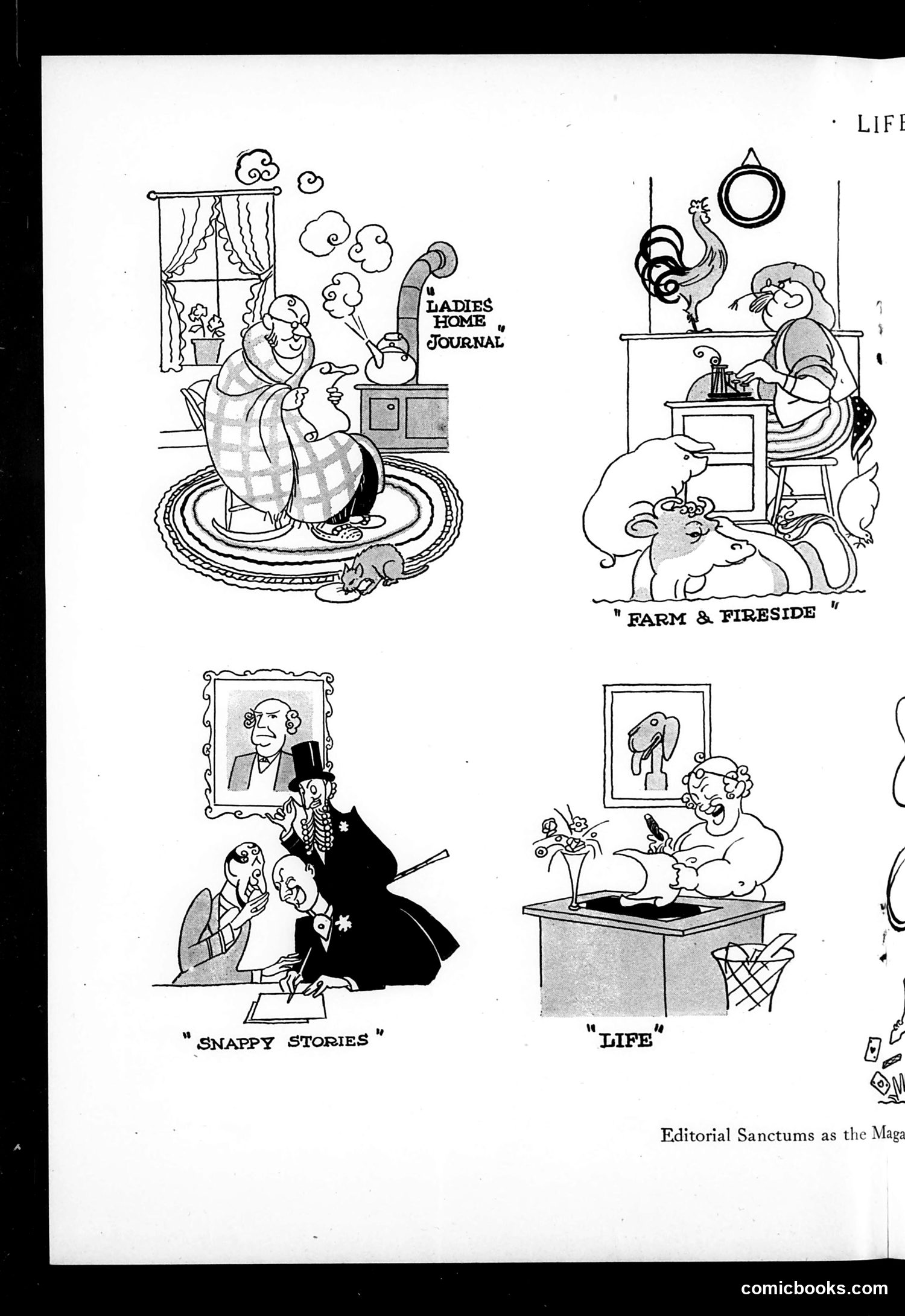
This page displays four cartoon vignettes satirizing different magazine editorial departments and their stereotypical subjects: **Top left**: A domestic scene labeled "Ladies Home Journal" shows a woman surrounded by home décor and flowers—mocking the magazine's focus on homemaking and domestic life. **Top right**: "Farm & Fireside" depicts rural life with someone at a desk and farm animals, satirizing that magazine's agricultural readership. **Bottom left**: "Snappy Stories" shows a formally-dressed man pointing at or instructing others, likely mocking the dramatic melodrama typical of pulp fiction magazines. **Bottom right**: "Life" itself is satirized, showing someone at a desk surrounded by flowers and plants—perhaps poking fun at Life magazine's own editorial pretensions or content. The overall joke appears to be self-aware satire of how different magazines cultivate distinct personas and appeal to specific audiences.
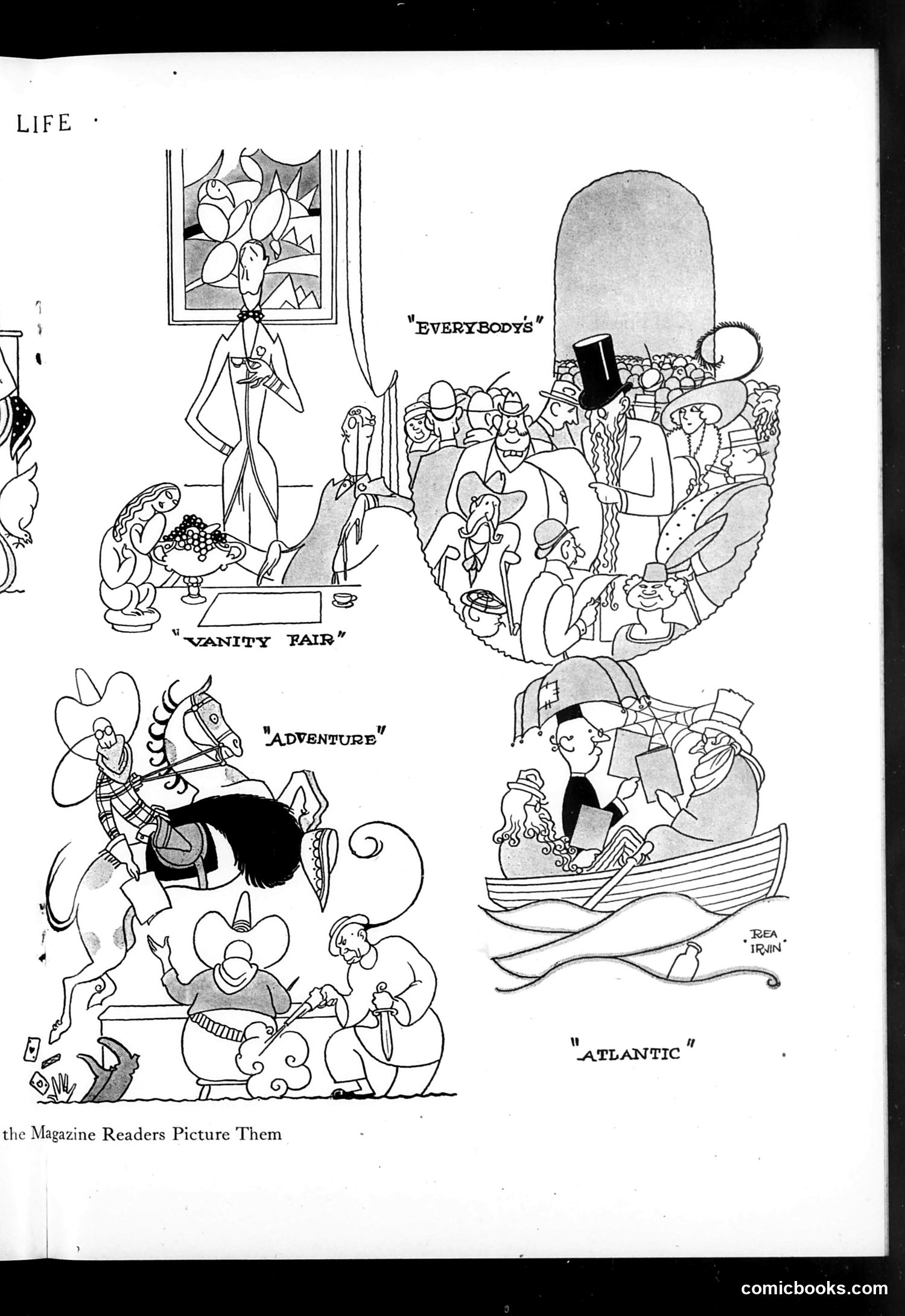
This page presents four labeled vignettes representing different aspects of life, drawn in a satirical cartoon style: **"Vanity Fair"** (upper left): Shows a fashionably dressed woman admiring herself, surrounded by beauty products and vanities—mocking superficial concerns with appearance. **"Everybody's"** (upper right): Depicts a crowded, chaotic gathering under an arch, suggesting mass society or popular culture's indiscriminate appeal. **"Adventure"** (lower left): Features a man on a rearing horse amid tumultuous action, representing excitement and bold exploration. **"Atlantic"** (lower right): Shows figures in a small boat on rough seas, evoking maritime adventure or struggle. The page appears designed as "the Magazine Readers Picture Them"—satirizing different magazine genres and their archetypal themes through exaggerated, humorous illustrations. The exact historical context and target publications remain unclear without additional dating information.
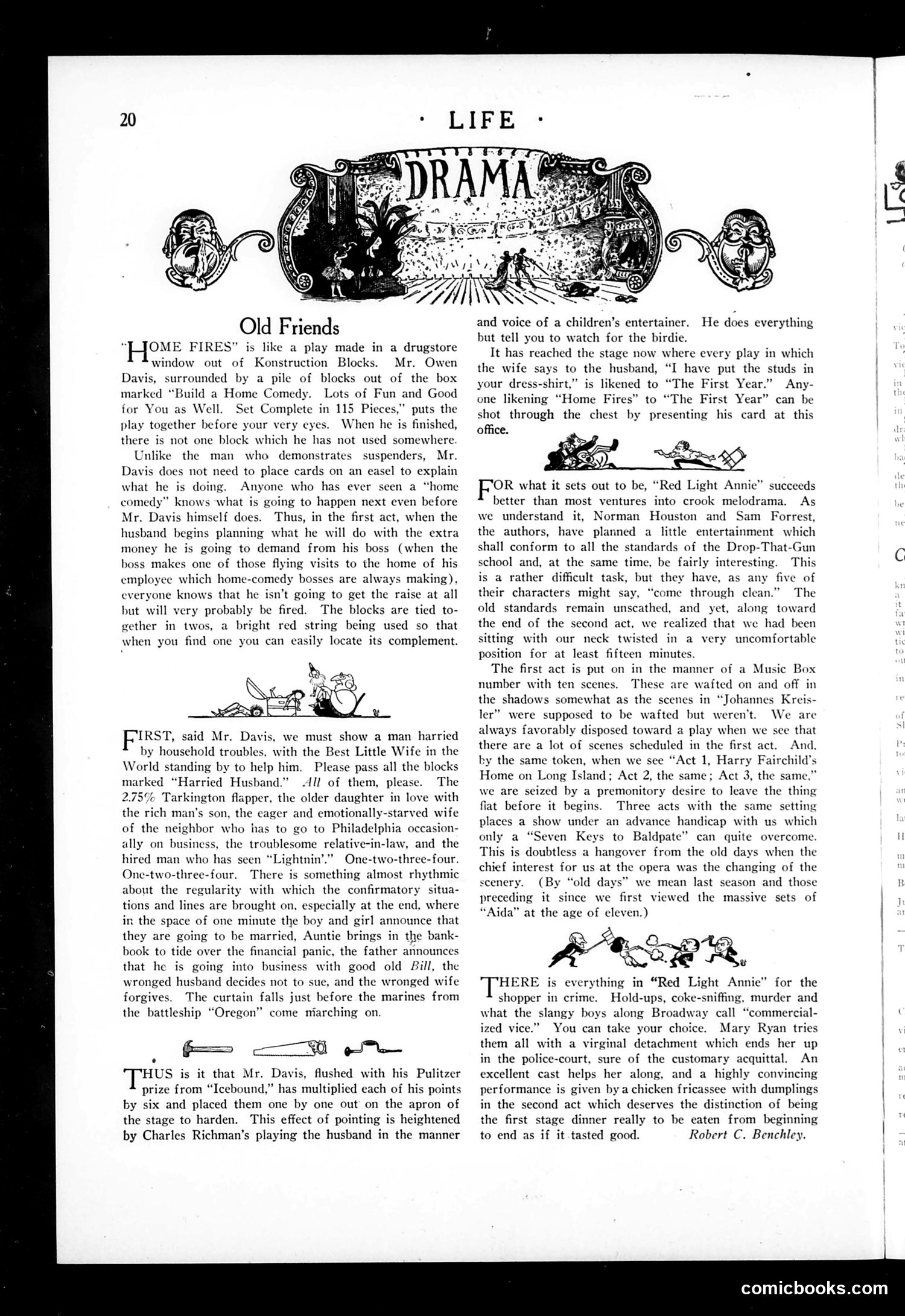
This is a theater review section discussing three plays: "Home Fires," "The First Year," and "Red Light Annie." The page contains small theatrical illustrations rather than political cartoons. The reviews critique contemporary Broadway productions. "Home Fires" is described as a simple "home comedy" featuring Owen Davis's familiar comedic style. "The First Year" is referenced as predictable domestic comedy. "Red Light Annie" receives more detailed analysis—described as a "crook melodrama" with musical-box interludes and dance numbers. The reviews are written by Robert C. Benchley, a well-known theater critic of the era. The page reflects 1920s entertainment culture, satirizing both the formulaic nature of popular theater and audience expectations for predictable comedic and melodramatic plots. The small decorative vignettes illustrate typical dramatic moments from these productions.
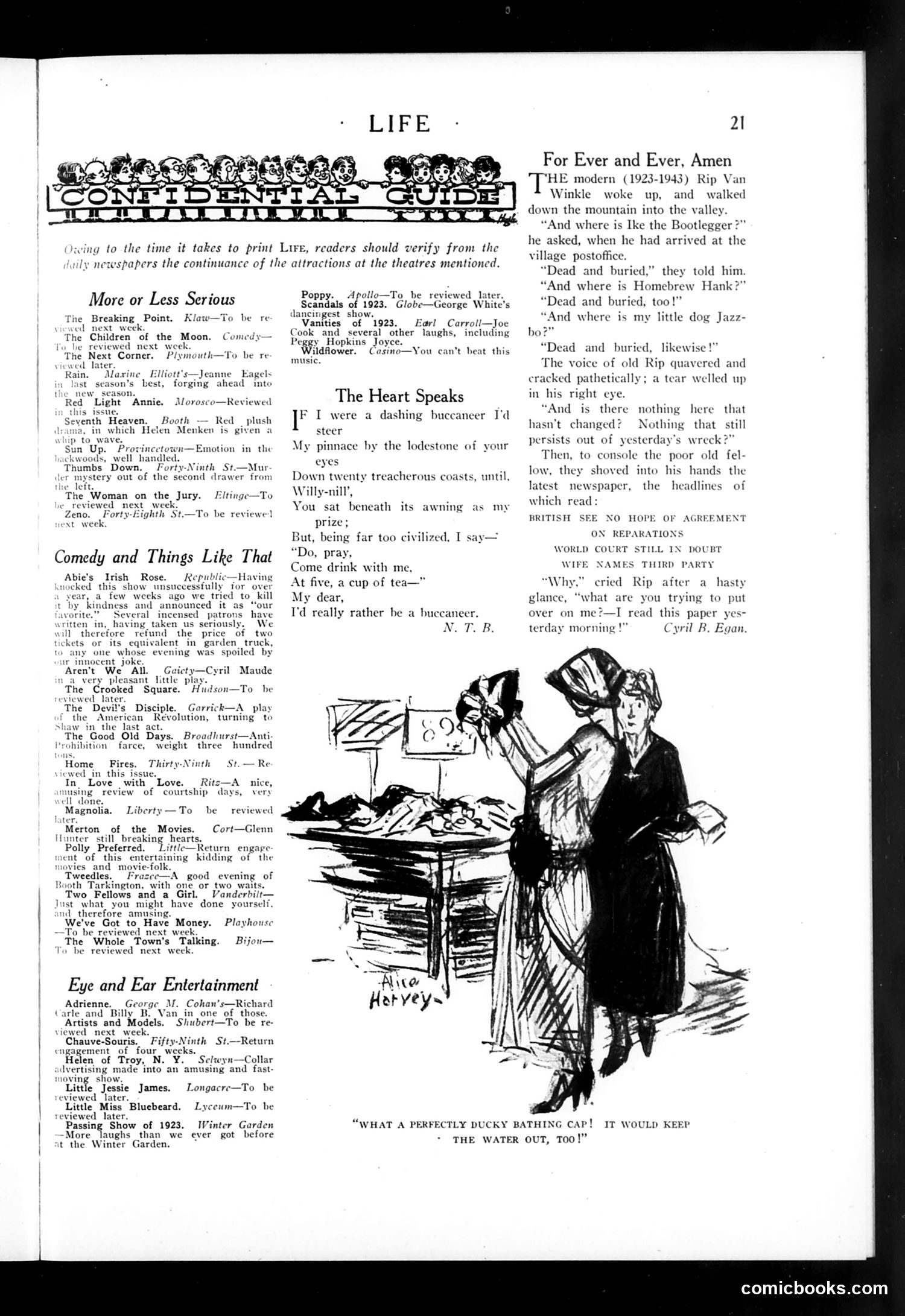
This cartoon illustrates **Prohibition-era disillusionment** (1923). A modern Rip Van Winkle awakens after years asleep to find his valley changed. He asks about familiar figures—"Ike the Bootlegger," "Homebrew Hank," and his "little dog Jazz-by"—only to be told they're "dead and buried." When Rip laments that nothing has changed, the locals hand him a newspaper with headlines about international stalemate: "British see no hope of agreement on reparations," "World Court still in doubt," "Wife names third party." **The satire's point**: Prohibition may have eliminated the colorful bootleggers and home-brewers of the pre-1920 era, but the world's serious problems—war debts, failed international cooperation, marital discord—remain unsolved. The "ducky bathing cap" caption reinforces the absurdity: trivial fashion concerns persist while fundamental issues fester. The cartoon mocks Prohibition's false promise of social reform.
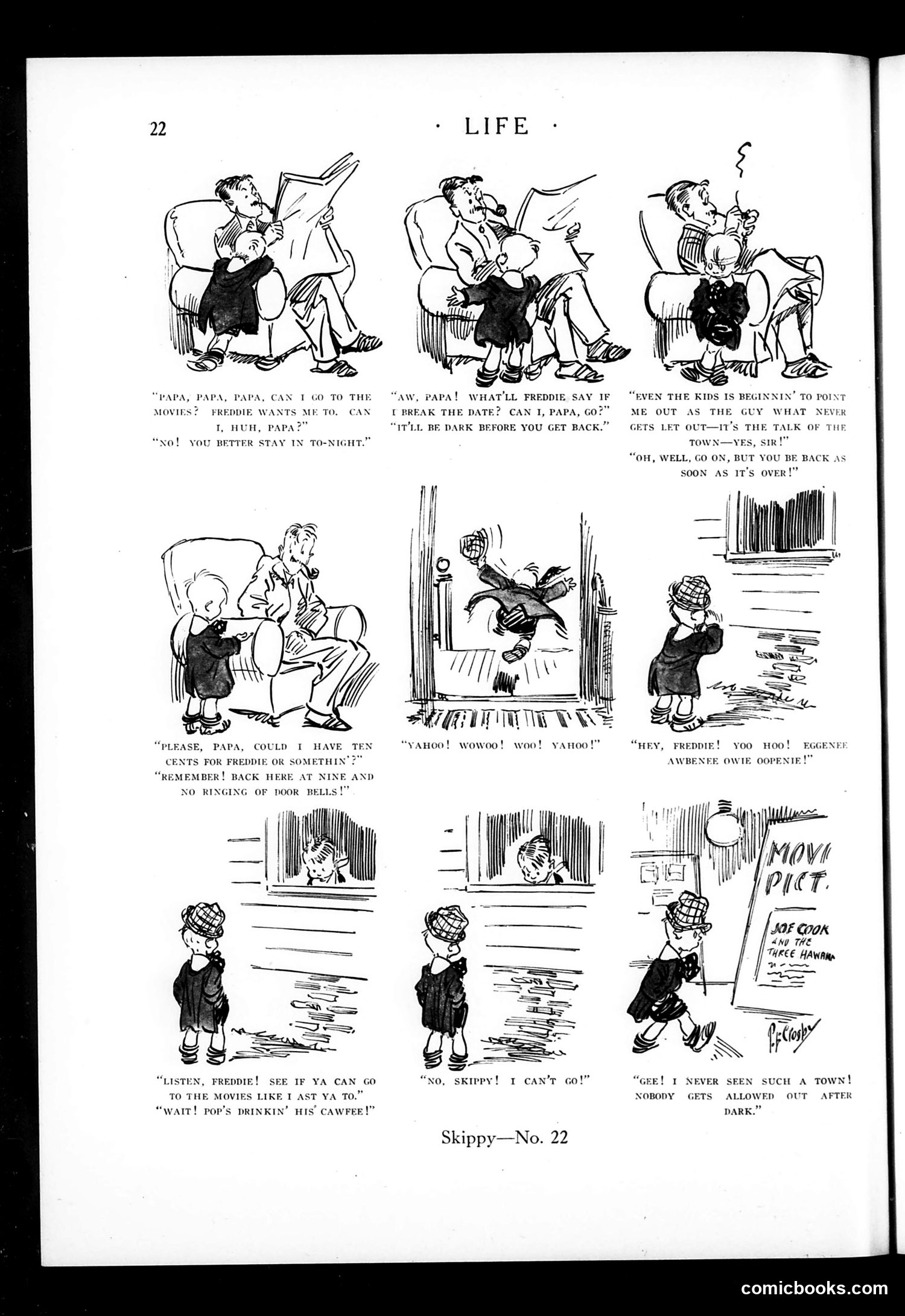
This is a comic strip following a young boy named Skippy who wants to go to the movies with his friend Freddie. The humor centers on generational and parental anxiety themes common to 1920s-30s America. The strip's satire targets overprotective parenting: Skippy's father initially forbids the outing, citing darkness and unspecified dangers. The boy's frustration is evident—he complains that his father's strictness makes him a social outcast ("talk of the town"). The father eventually relents, establishing a curfew. The final panel mocks small-town conservatism: Skippy's amazement that "nobody gets allowed out after dark" suggests exaggerated parental restrictions were widespread concerns of the era. The strip gently ridicules both anxious parents fearful of modern entertainments (movies) and rigid small-town social norms that kept children under tight control. The tone is lighthearted rather than biting political satire—it's domestic humor about the friction between youth seeking independence and parents clinging to old restrictions.
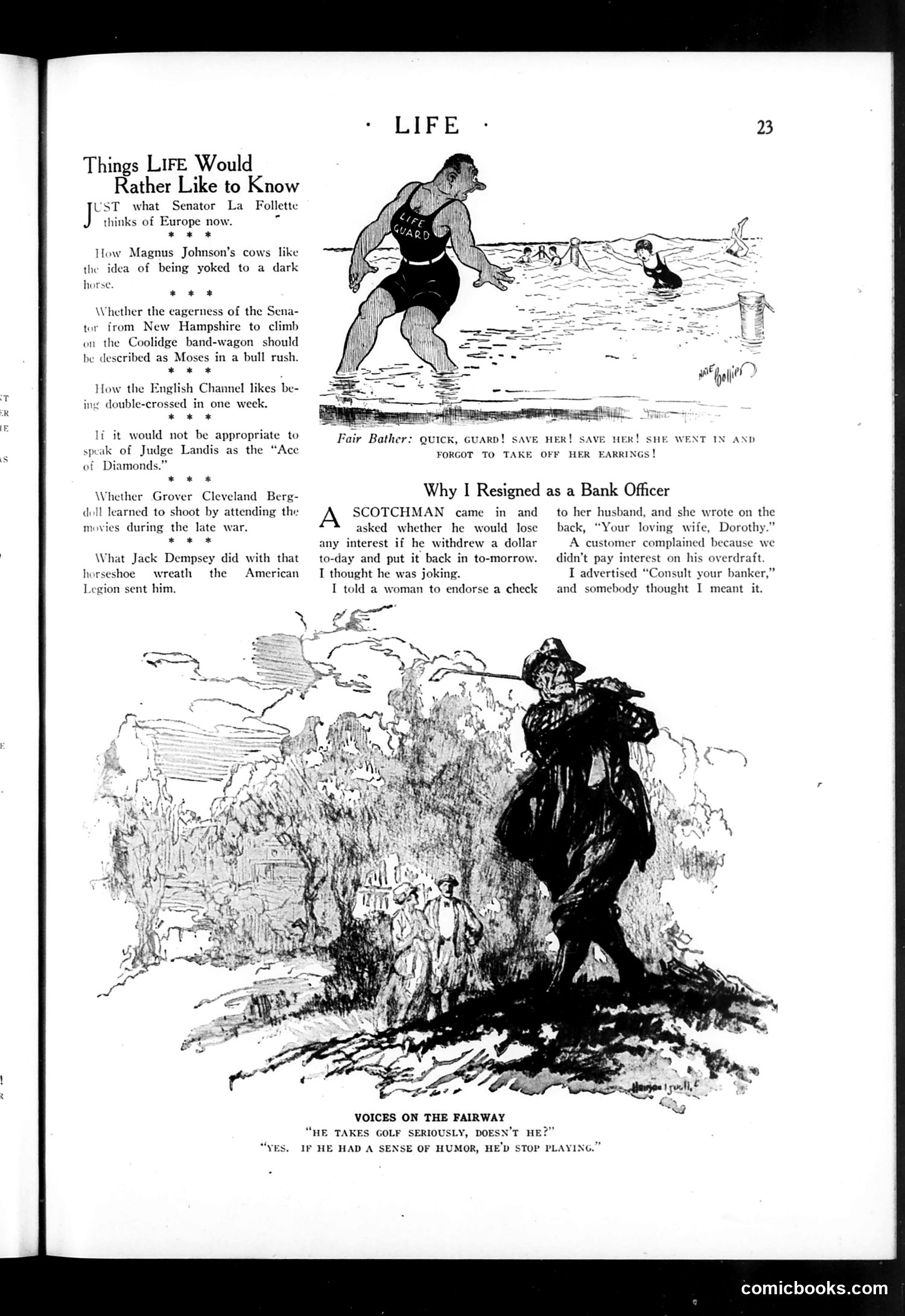
This page contains satirical humor typical of 1920s American Life magazine. **Top Section ("Things LIFE Would Rather Like to Know"):** Mock-serious rhetorical questions about contemporary political figures—Senator La Follette, Magnus Johnson, and others—poking fun at their public positions and contradictions. The humor relies on readers recognizing these figures. **"Fair Bather" Cartoon:** A lifeguard rescues a drowning woman but his first concern is she's lost her earrings—satirizing male priorities and materialism over genuine concern. **"Why I Resigned as a Bank Officer":** Humorous anecdotes about absurd customer behavior: a Scotsman's literal question about daily interest, a wife's domestic endorsement, a customer expecting interest on overdrafts. The satire mocks both banking practices and customer ignorance. **"Voices on the Fairway":** A golf joke suggesting serious golfers lack humor—implying golf obsession is incompatible with levity. The page exemplifies Life's editorial style: topical political satire, gender commentary, and observational humor about contemporary American life and society.
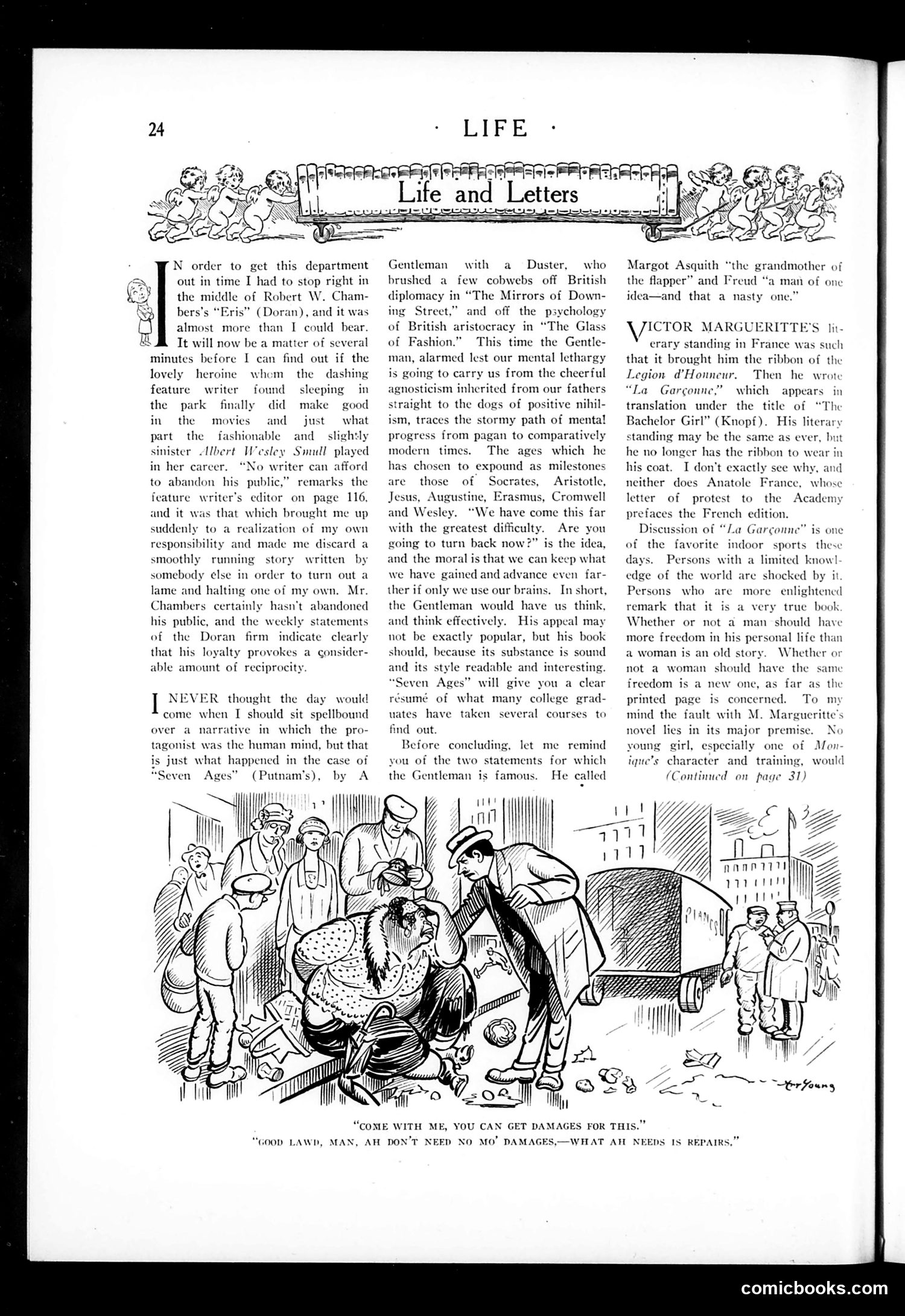
This page contains a literary review column mixed with one cartoon illustration. The main cartoon depicts a street scene where a man with a large basket of eggs or produce is being accosted by another man offering "damages for" broken goods—with the caption suggesting the vendor needs no more damages because everything is already broken. The satire appears to reference the absurdity of claiming compensation for items already in poor condition—a commentary on either insurance fraud, legal disputes, or general human foolishness around liability claims. The text reviews contemporary books, including works by Robert W. Chambers and a Gentleman author discussing mental progress through history (Socrates through Wesley). Notably, the column discusses Victor Margueritte's controversial French novel *La Gargonne* (translated as *The Bachelor Girl*), which apparently caused scandal because it explored female sexual freedom—a "new" freedom debated in print, though male freedom in personal life was historically accepted. The reviews reflect early 20th-century literary culture and contemporary social debates about morality and gender.
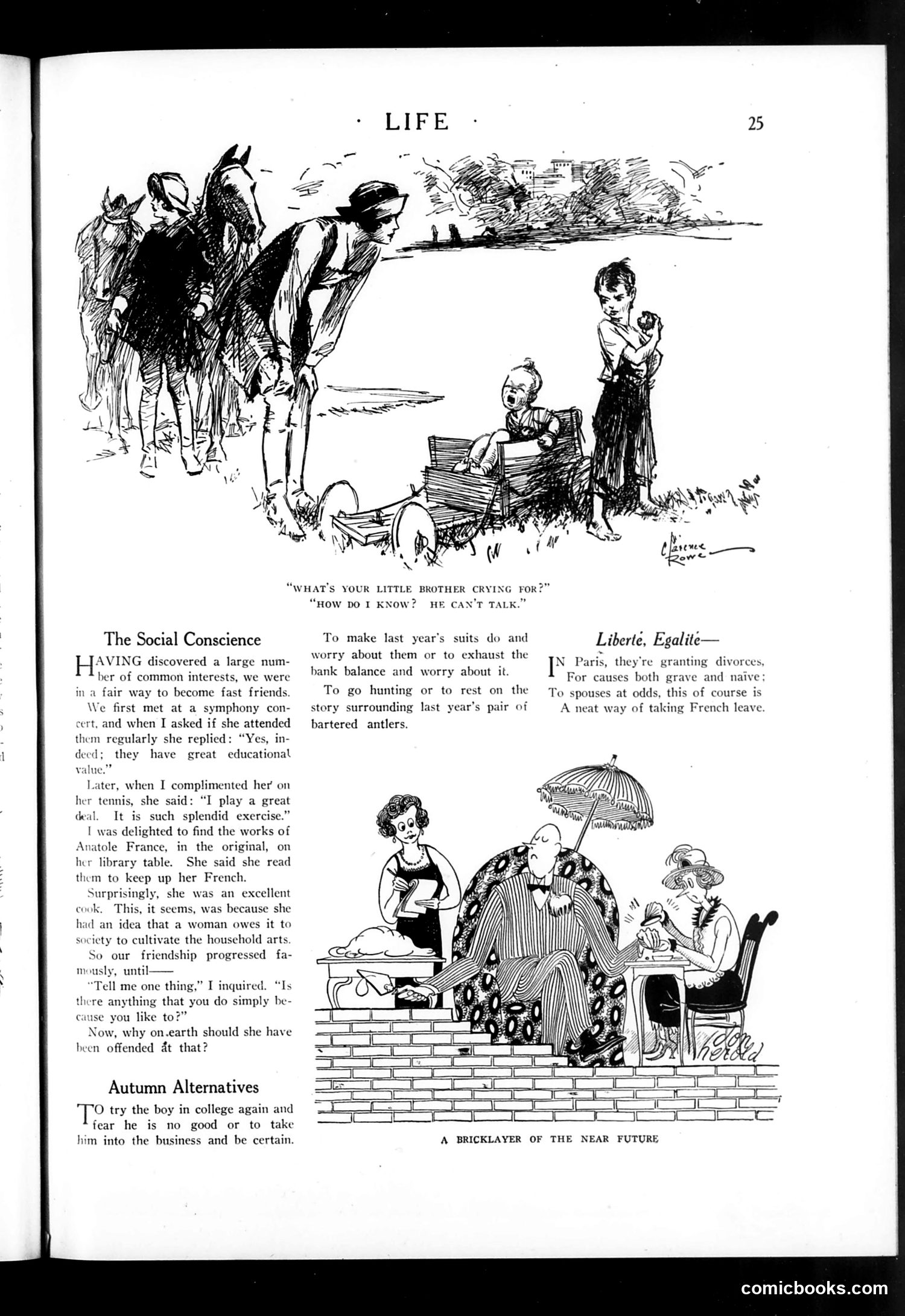
This page contains three satirical pieces mocking early 20th-century attitudes: **"The Social Conscience"** critiques performative intellectualism. A woman justifies every activity—symphony attendance, tennis, reading Anatole France in French, cooking—as serving some higher social purpose rather than personal enjoyment. The narrator's innocent question—whether she does *anything* simply because she likes it—offends her, exposing the absurdity of constantly moralizing one's leisure. **Top cartoon** appears to depict economic anxiety: a well-dressed woman with children asks why the younger child cries; the response "He can't talk" implies he cannot express his distress—likely satirizing adults' obliviousness to children's (or the poor's) actual suffering. **"Liberte, Egalite"** jokes about French divorce laws being a convenient escape ("taking French leave"), sardonically suggesting modern France grants divorces too readily. **"A Bricklayer of the Near Future"** (bottom) shows domestic role reversal—apparently satirizing anxieties about changing gender roles or economic disruption. The overall theme: social hypocrisy, economic uncertainty, and cultural anxiety in the interwar period.
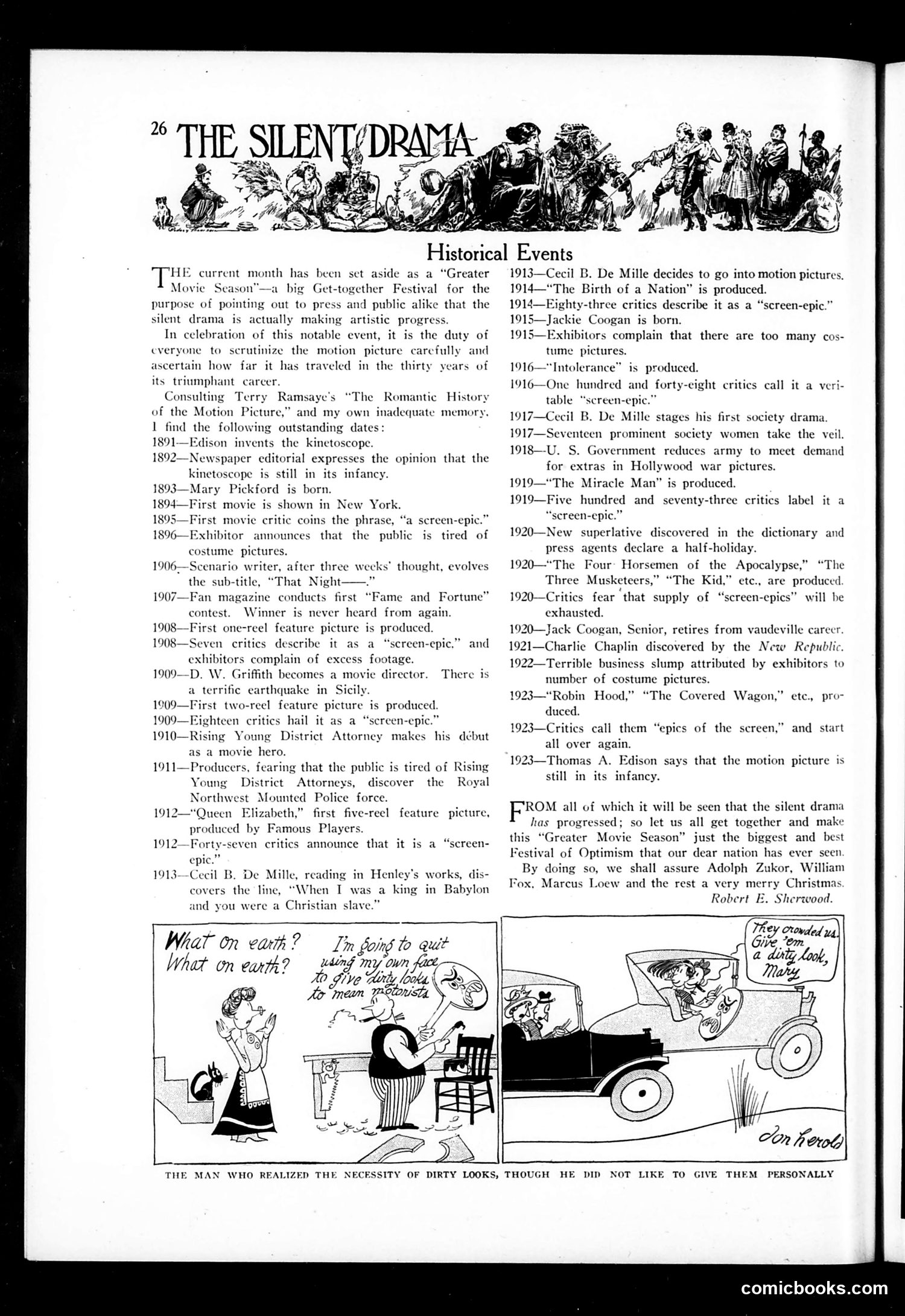
This page celebrates the silent film industry's "Greater Movie Season" through satirical historical timeline and cartoons. **The Timeline's Satire:** The text mockingly traces film history from Edison's 1891 kinetoscope invention through 1923, repeatedly highlighting critics' obsession with coining superlatives. The joke: every few years, critics declare a new film a "screen-epic," yet simultaneously worry the supply will be exhausted or complain about too many costume pictures. Thomas Edison's quote at the end—saying motion pictures are "still in its infancy" in 1923—undercuts the entire progress narrative. **The Cartoons:** Both panels by "Cesare" (likely Cesare Sivieri) show a man who realized the necessity of "dirty looks" but didn't want to give them personally. Left panel: he's distressed while others perform. Right panel: he's happily riding in a car while others in the truck behind look miserable. The caption satirizes how the film industry delegates unpleasant work to others. **Overall Point:** The page gently mocks Hollywood's self-congratulation and critics' breathless hyperbole about artistic progress while acknowledging the industry's genuine growth.
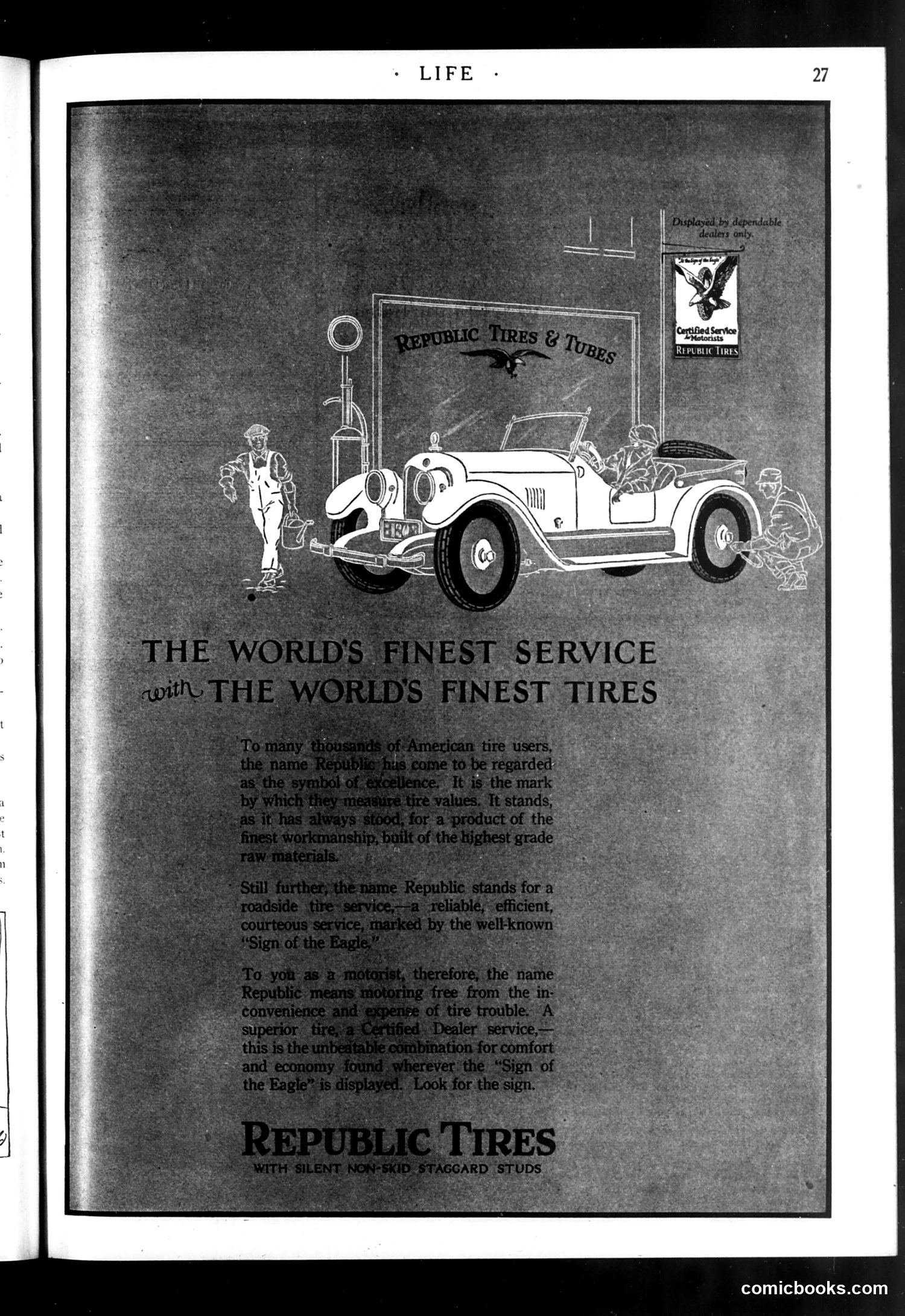
This is a **Republic Tires advertisement**, not satire or political commentary. The page features a 1920s-era roadster automobile at a service station, with the tagline "The World's Finest Service with the World's Finest Tires." The ad emphasizes Republic's brand positioning through the "Sign of the Eagle" (visible in the logo), associating quality manufacturing with reliability. The text promises motorists freedom from "inconvenience and expense of tire trouble" through their dealer network and roadside service. The illustration style is typical Art Deco advertising of the period. There is no political satire present—this is straightforward commercial promotion positioning Republic Tires as a premium product backed by reliable service infrastructure, a significant selling point when automotive travel was still relatively novel for American consumers.
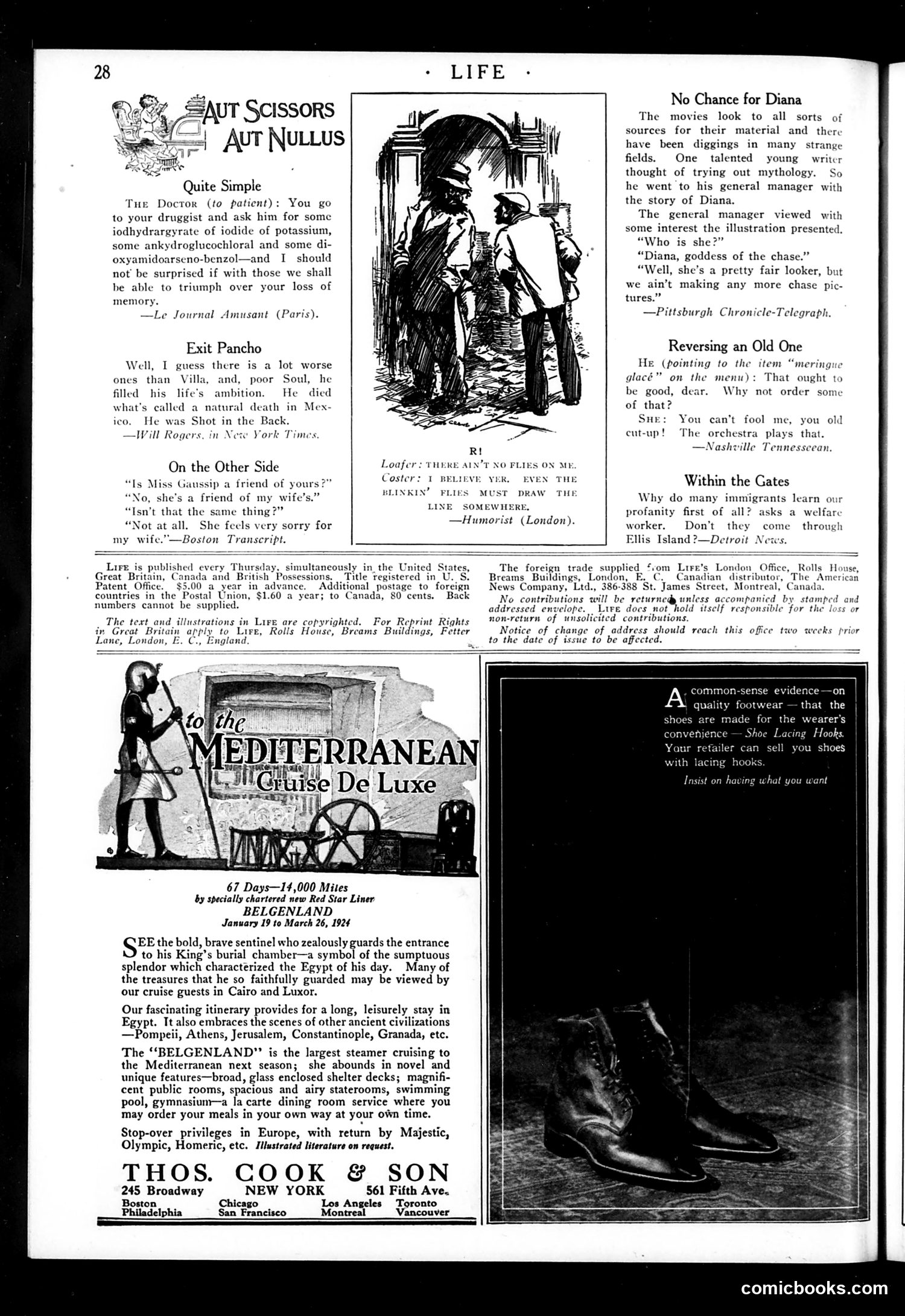
This page contains several brief satirical jokes typical of Life magazine's humor section, plus advertisements. The cartoons mock contemporary absurdities: **"Quite Simple"** ridicules overly complex medical jargon—a doctor prescribes incomprehensibly long chemical names to treat memory loss, satirizing medical pomposity. **"Exit Pancho"** references Pancho Villa's 1923 assassination in Mexico, joking that despite his violent life ambitions, he was ultimately "shot in the back"—a darkly ironic natural death. **"On the Other Side"** plays on the phrase "no flies on me" (meaning clever/sharp), with a loafer denying he's attracted women, claiming the line must be drawn somewhere. **"No Chance for Diana"** mocks Hollywood's mythological aspirations: a studio executive dismisses a Diana goddess story because they've stopped making "chase pictures"—a pun on Diana as goddess of the hunt. **"Within the Gates"** sarcastically asks why immigrants learn profanity first, suggesting Ellis Island's rough environment corrupts newcomers immediately. The page is primarily advertising space for Mediterranean cruises and shoe laces.
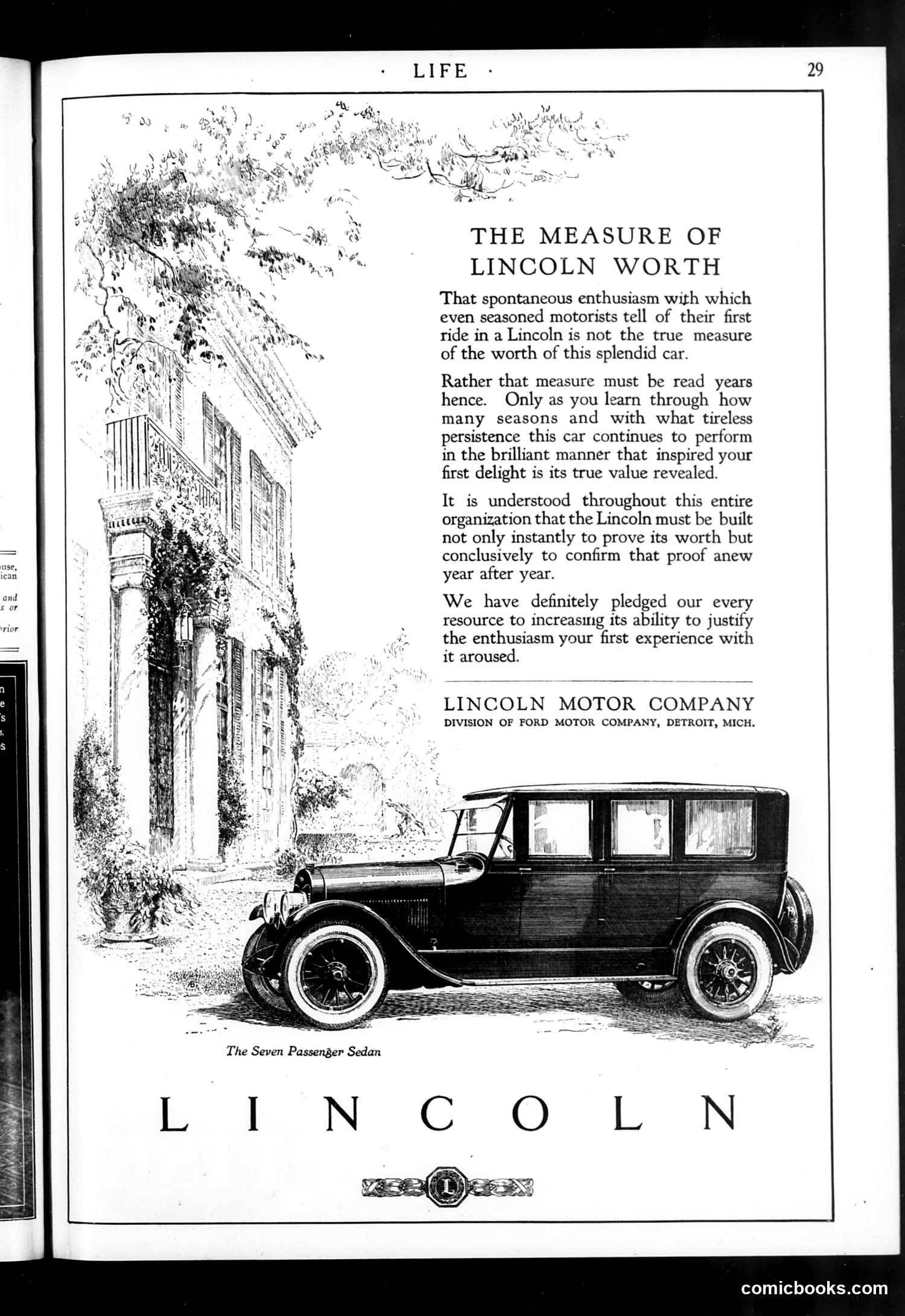
This is a **Lincoln automobile advertisement**, not a political cartoon. The page promotes the Lincoln Seven Passenger Sedan, a luxury car manufactured by Ford Motor Company. The advertisement uses architectural imagery—a classical building with columns—to suggest permanence and enduring quality. The copy argues that a car's true worth isn't measured by initial excitement but by years of reliable performance. The ad appeals to affluent buyers by positioning Lincoln as a vehicle whose value compounds over time through consistent engineering excellence. The tagline emphasizes the company's commitment to repeatedly proving the car's worth "year after year." This represents typical early-20th-century luxury automotive marketing: associating the product with timeless, classical values rather than transient novelty. No satire or political commentary is present.
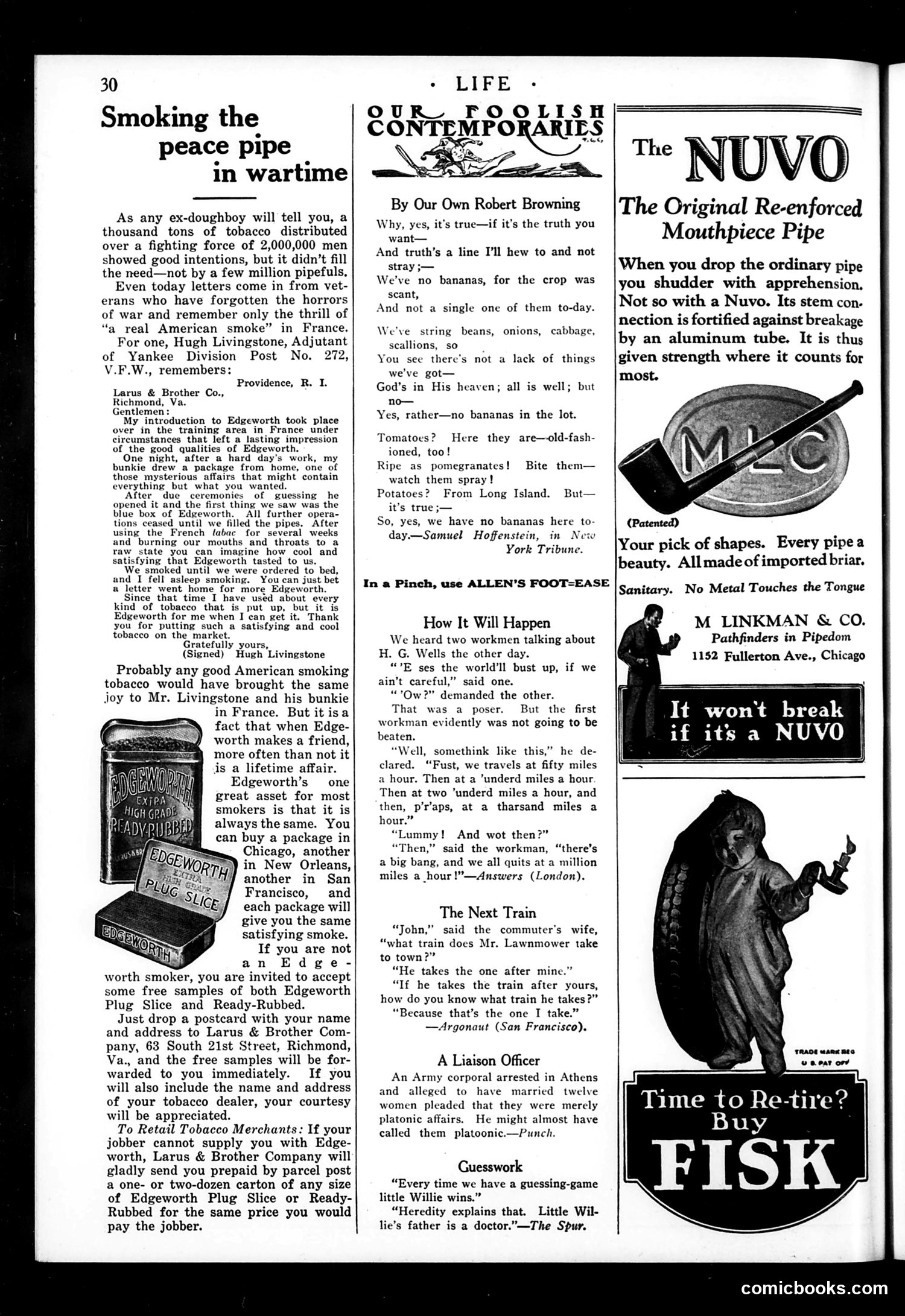
This page combines satirical poetry with tobacco advertising, reflecting WWI-era American culture. **The Satire ("Smoking the Peace Pipe in Wartime"):** Robert Browning's poem ironically catalogs wartime food shortages—"We've no bananas...not a single one of them to-day." The title's reference to a "peace pipe" sardonically contrasts the Native American symbol of peace with ongoing wartime scarcity. The poem acknowledges vegetables *are* available (tomatoes, potatoes from Long Island), but the real deprivation was tobacco. This mocks how American soldiers prioritized cigarettes and pipe tobacco over food during WWI, treating tobacco as essential morale-booster rather than luxury. **The Advertisements:** Testimonials from veterans (like Hugh Livingstone, a WWI doughboy) marketed tobacco brands by emphasizing soldiers' emotional attachment to smoking during combat. Edgeworth and Nuvo pipes capitalized on nostalgia—positioning their products as what real soldiers smoked in France, thereby lending masculine legitimacy to consumer purchases in peacetime. The satire and ads work together: the poem's ironic scarcity validates the advertisements' claims about tobacco's wartime importance.
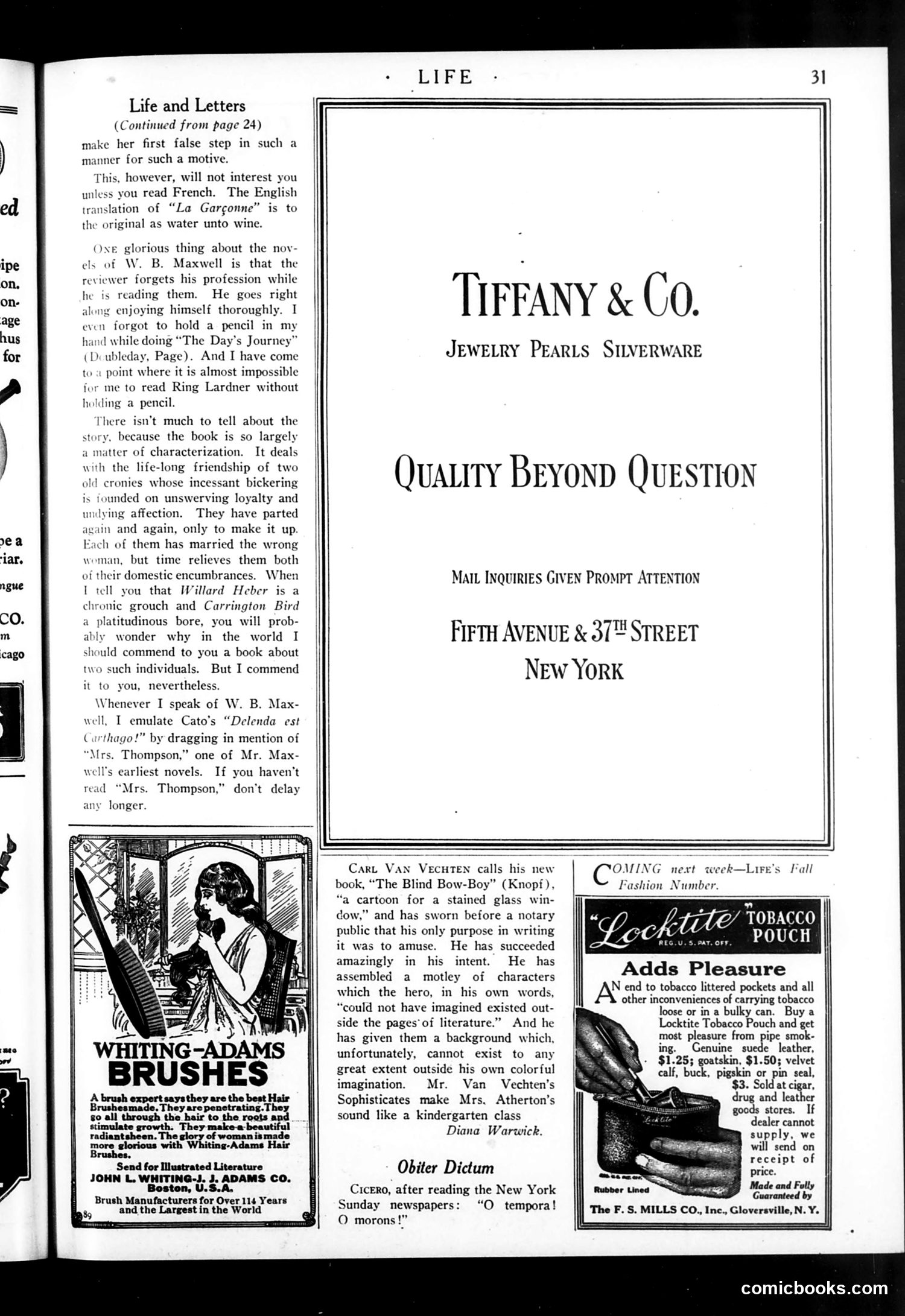
This page is primarily **literary criticism and advertising**, not political satire. The main content is a book review column ("Life and Letters") discussing novels by W.B. Maxwell, Ring Lardner, and Carl Van Vechten's "The Blind Bow-Boy." The one satirical element is the **"Obiter Dictum"** section at bottom, which presents a mock-classical joke: Cicero (the famous Roman orator) commenting on modern New York Sunday newspapers with the Latin phrase "O tempora! O morons!" (playing on the actual Latin phrase "O tempora! O mores!" meaning "O the times! O the customs!"). The joke satirizes **sensationalist newspaper journalism** of the era by suggesting contemporary newspapers have descended into stupidity—worthy only of Cicero's despair. The remainder consists of period **advertisements** for Tiffany & Co., Whiting-Adams brushes, and Locktite tobacco pouches. The page demonstrates Life's mixed format of literary commentary and luxury consumer advertising.
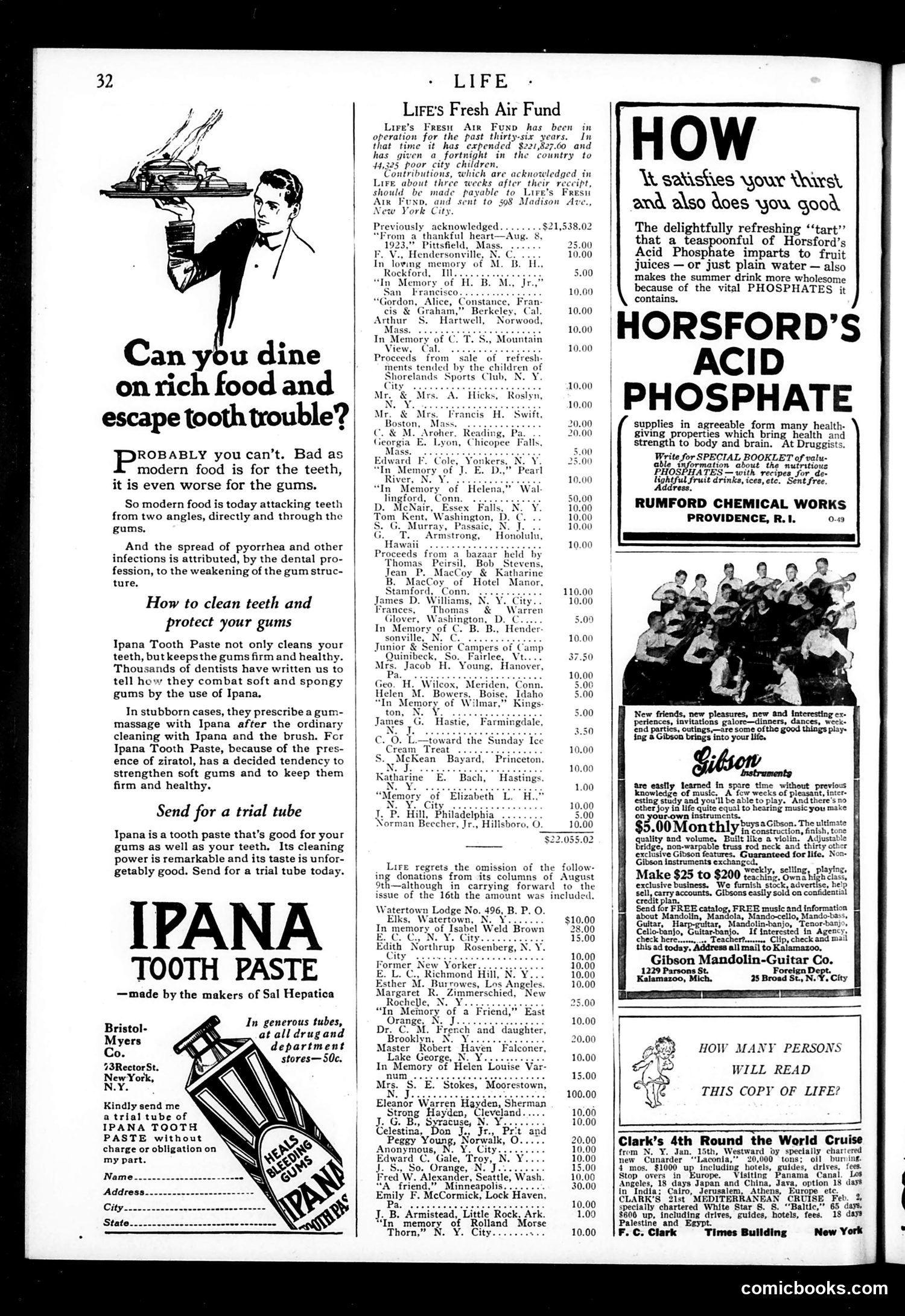
This page is primarily **advertising and charitable notices**, not political satire. The main content includes: 1. **Ipana Tooth Paste advertisement** (left): A vintage dental product ad claiming to prevent gum disease from modern diet. The illustration shows a man dining elegantly—the visual joke being that despite eating "rich food," Ipana will protect your teeth and gums. 2. **Life's Fresh Air Fund notice** (center): A charitable fundraising column listing donors who contributed to send poor city children to the countryside—a genuine philanthropic effort, not satire. 3. **Horsford's Acid Phosphate advertisement** (right): A beverage product claiming health benefits. The Ipana ad's humor is gentle: it acknowledges that modern food damages teeth while promoting a product solution. This reflects early-20th-century anxiety about processed foods and dental health—legitimate concerns of that era. There is no political cartoon or sharp satire on this page; it's a standard magazine layout mixing advertisements with charitable announcements.
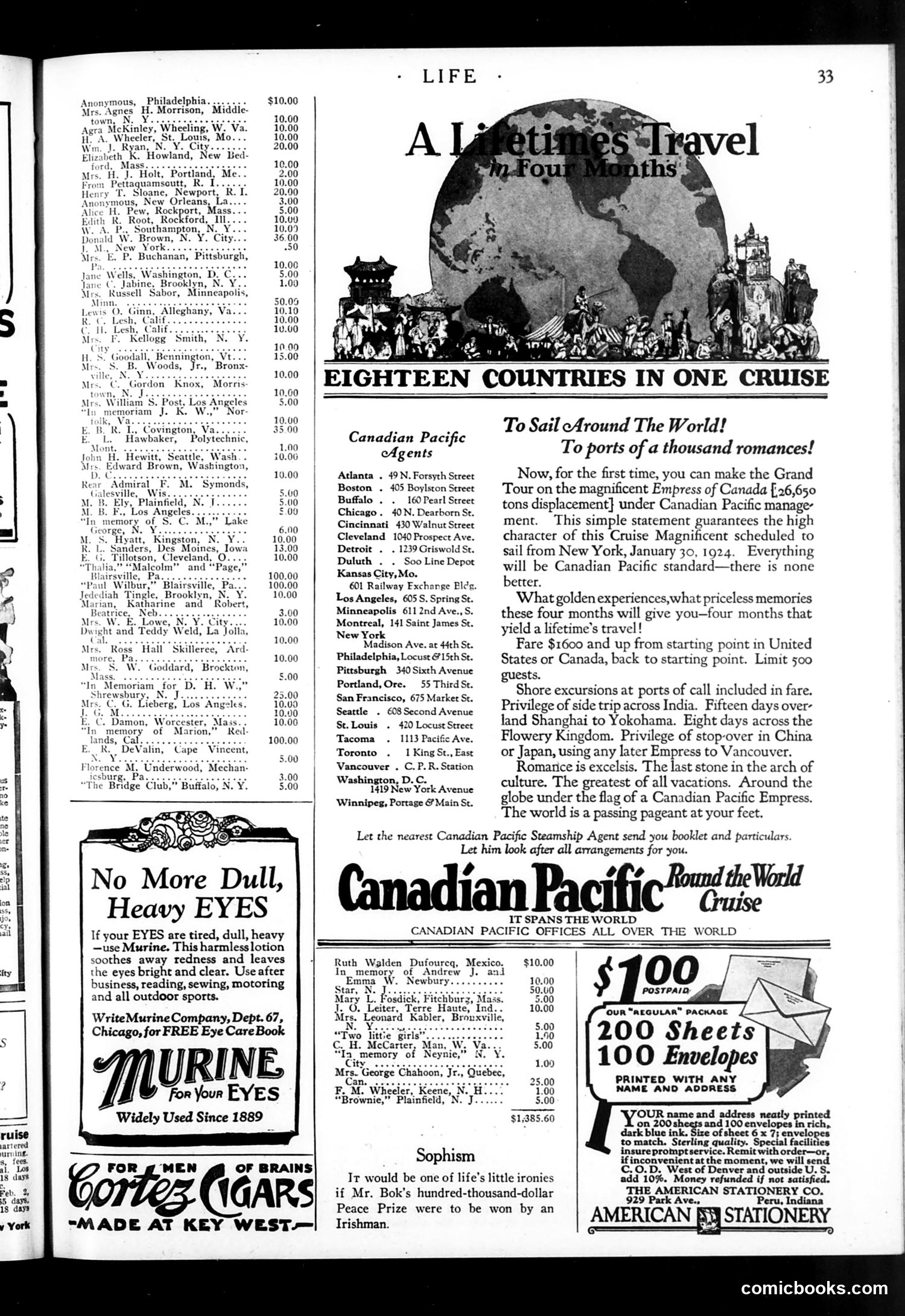
This page is primarily **advertising and donor acknowledgments**, not political satire or editorial cartoons. The dominant content is a **Canadian Pacific cruise advertisement** for the "Empress of Canada," promoting a four-month round-the-world voyage departing January 30, 1924, for $1,600 and up. The ad emphasizes luxury travel to exotic ports ("a thousand romances"), with stops in India, China, and Japan—reflecting the era's fascination with exotic travel and empire. Secondary advertisements include **Murine eye drops** (emphasizing relief from "tired, dull, heavy eyes" from modern activities like "business, reading, sewing, motoring") and **American Stationery Company** promotional materials. The page also contains a **donor roll** listing contributors to Life magazine and an untitled piece titled "Sophism" discussing a hypothetical Irish hundred-dollar Peace Prize winner—likely a brief satirical commentary on Irish-American politics. The overall tone reflects 1920s consumer culture and Life's audience of affluent Americans.
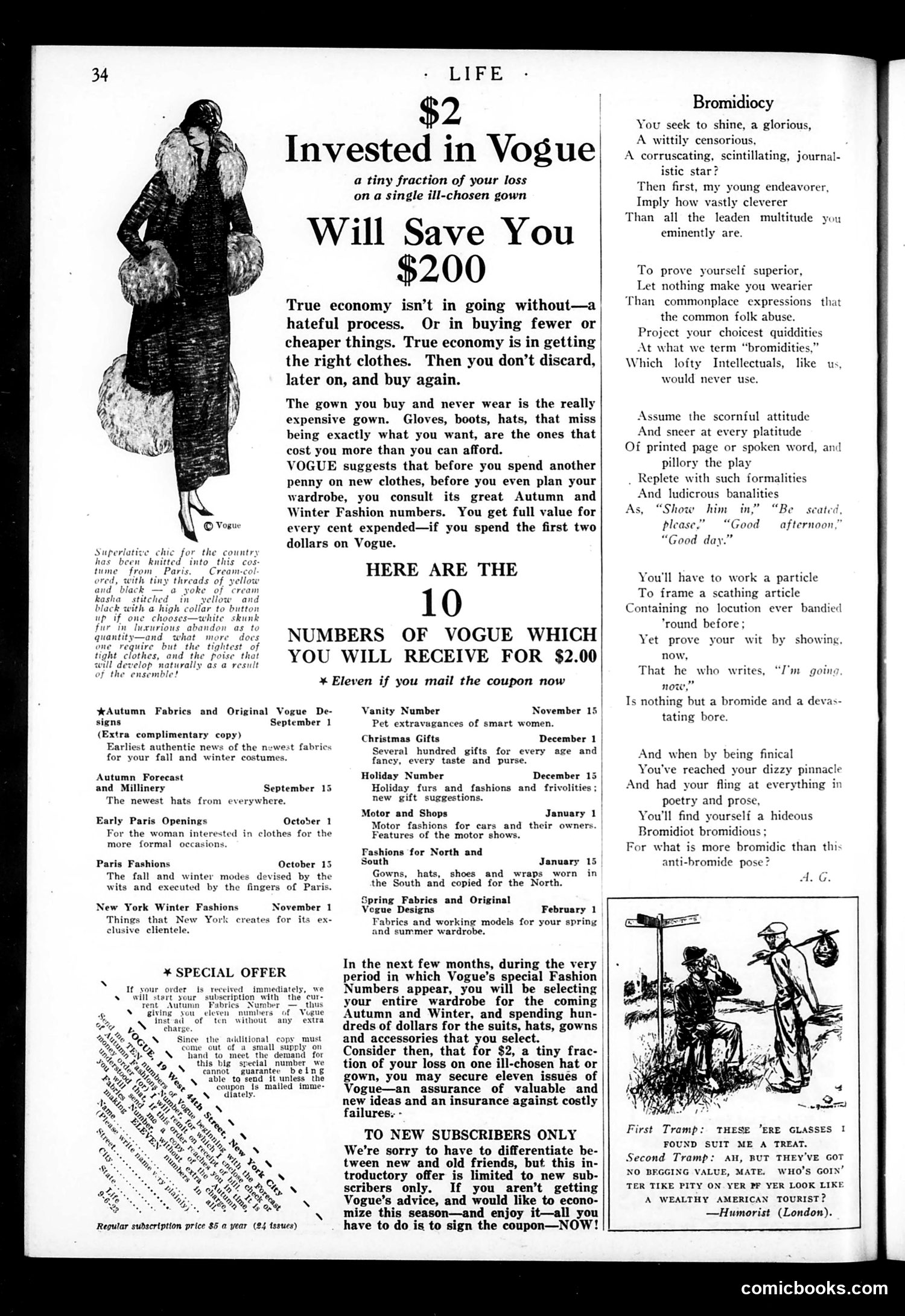
This page combines a Vogue advertisement with satirical commentary on intellectual pretension. The left side promotes a $2 Vogue subscription as fashion "insurance," arguing that buying the right clothes prevents waste—a straightforward pitch targeting women concerned with wardrobe economy. The right column, titled "Bromidiocy," mocks aspiring intellectuals who affect superiority through affected language and dismissive attitudes. It satirizes young people seeking to appear clever by using obscure vocabulary ("scathing article," "bromide"), adopting affected speech patterns ("'I'm going, now'"), and scorning "common folk." The piece ridicules this performative intellectualism as hollow posturing. The bicycling illustration at bottom includes a London humor caption mocking wealthy American tourists for their obvious displays of wealth—another jab at social pretension. The satire contrasts superficial cleverness with authentic substance, suggesting that genuine sophistication requires more than affected speech and snobbery.
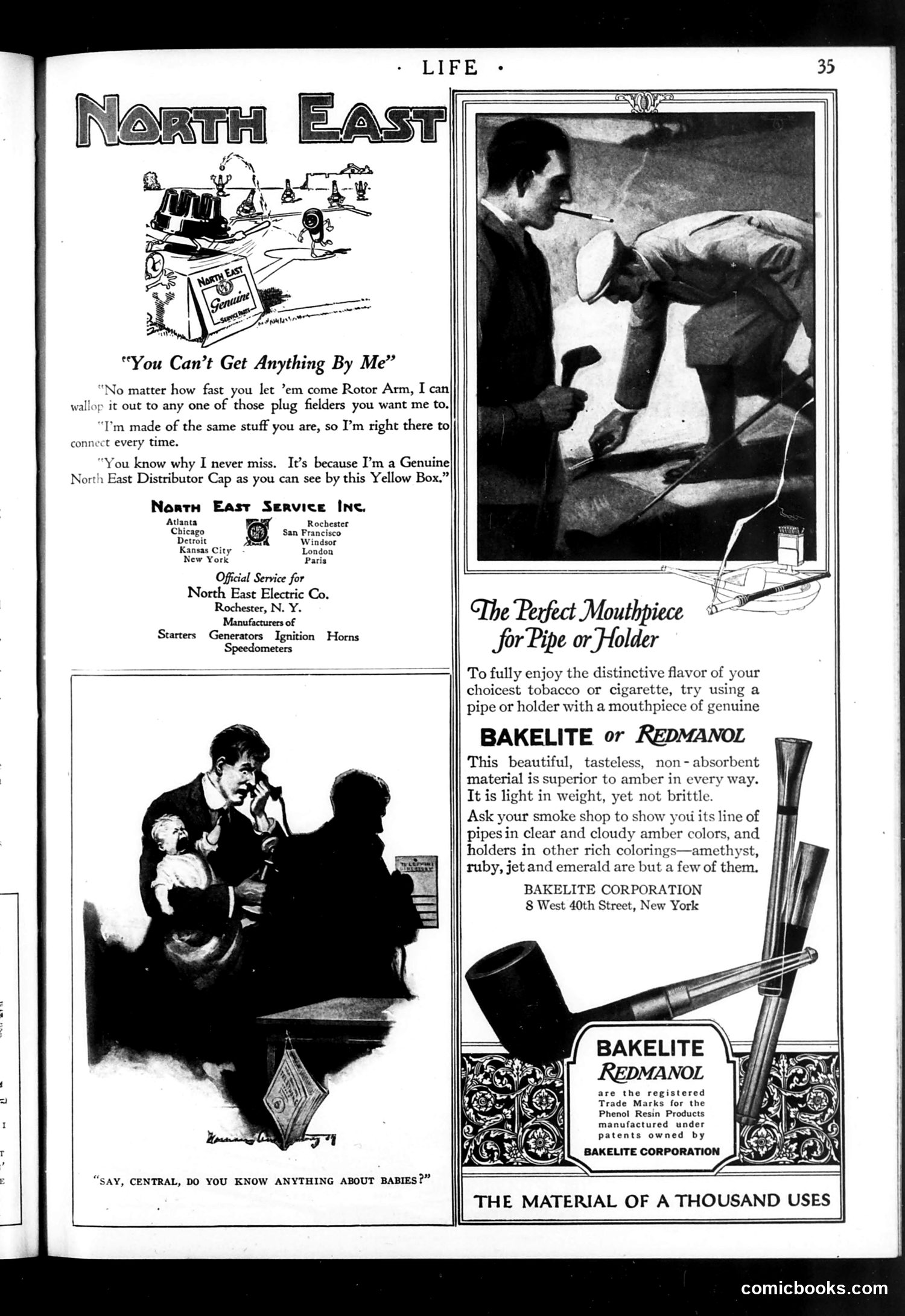
This page is primarily **advertising**, not editorial satire. It contains three distinct ads: 1. **North East Distributor Cap** (top left): A personified auto part boasts it "can't get anything by" mechanics because it's made of quality materials—a straightforward product endorsement using sports/baseball metaphors popular in 1920s advertising. 2. **Bakelite/Redmanol Pipe Mouthpieces** (right side): Promotes synthetic pipe materials as superior to amber, highlighting their tastelessness and durability. Bakelite was a revolutionary early plastic widely marketed as a versatile modern material. 3. **Unidentified cartoon** (bottom left): Captioned "Say, central, do you know anything about babies?"—appears to be a domestic humor sketch, though its advertising purpose is unclear. The page reflects early-20th-century industrial advertising that personified mechanical parts and promoted new synthetic materials as modern improvements over traditional options.
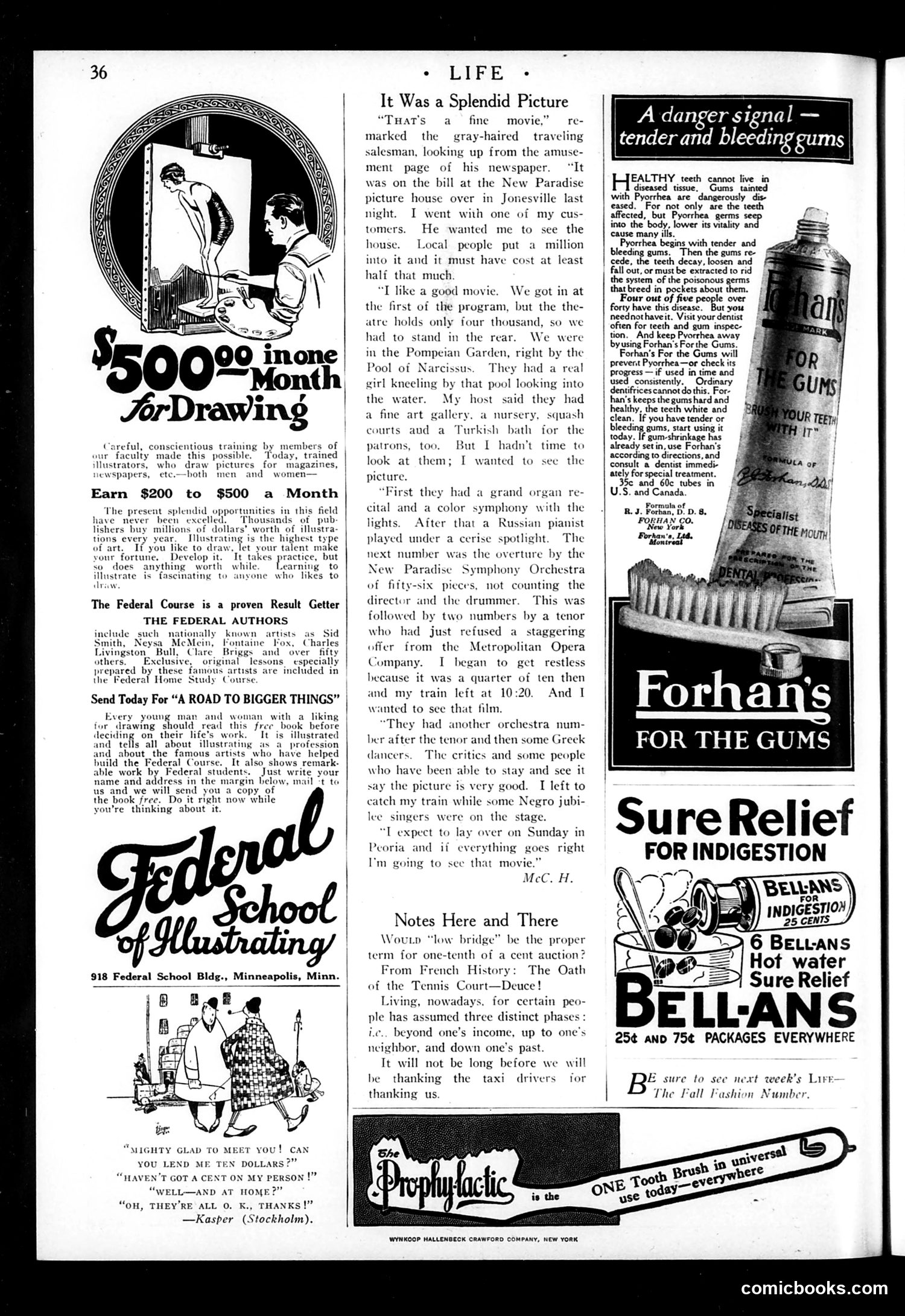
This page primarily contains **advertising for the Federal School of Illustrating** (promising $200-$500/month income) and a satirical **short story titled "It Was a Splendid Picture."** The story satirizes the excessive grandeur of a newly built movie palace called the "New Paradise." A traveling salesman describes visiting a theater with a 4,000-seat capacity, featuring ornate amenities like the "Pompeian Garden," pool, art gallery, nursery, squash courts, and Turkish bath. The joke is that while waiting to see the film, he endures **endless preliminary entertainment**—an organ recital, color symphony, Russian pianist, opera orchestra, tenor singer, Greek dancers—before finally giving up and leaving before the actual movie starts. The satire mocks 1920s movie theater culture, where elaborate architectural and entertainment features became selling points rivaling the films themselves. The irony: a facility built for cinema had become so preoccupied with luxury amenities and extended entertainment that the audience never gets to see the main feature.
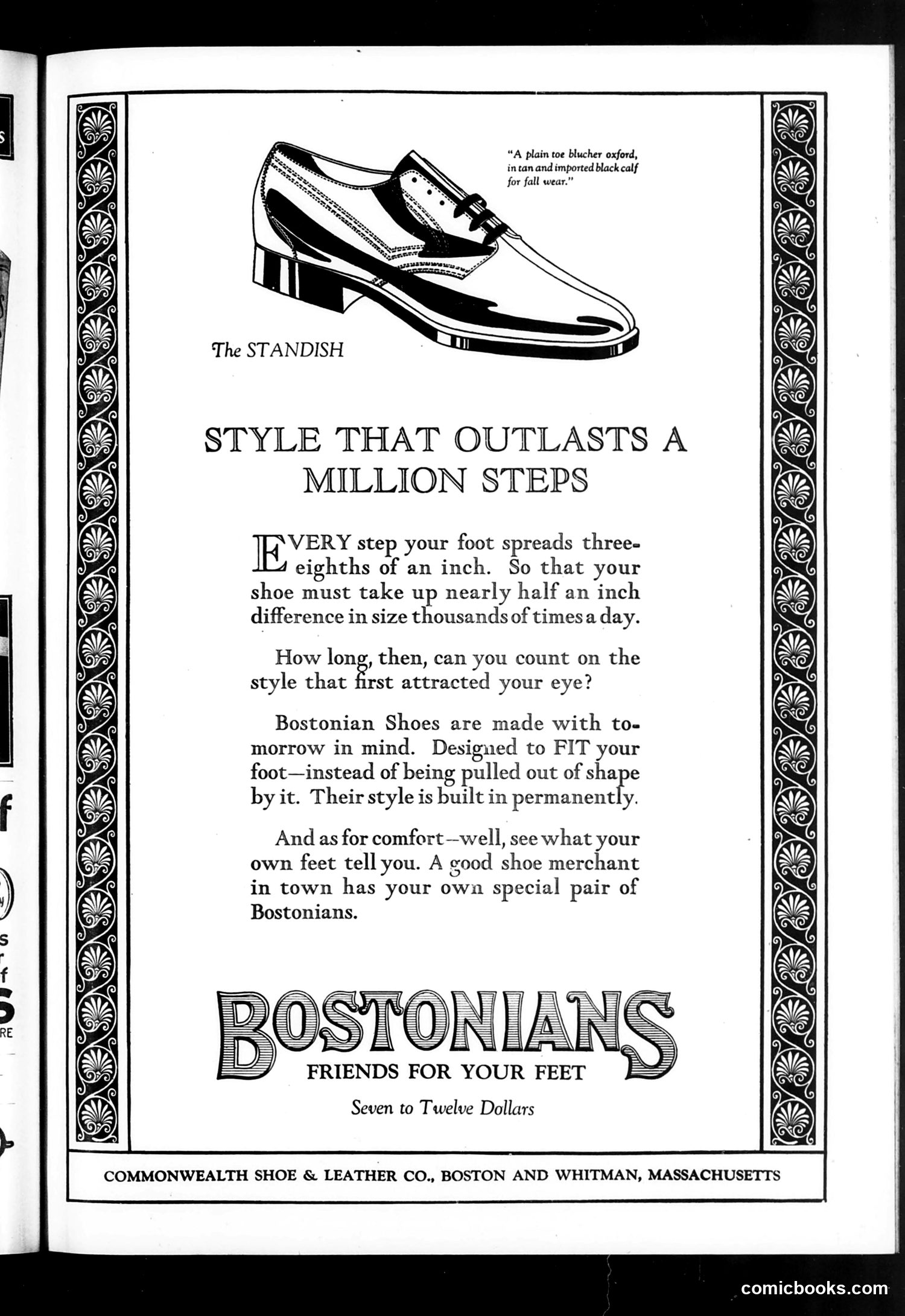
This is **not a cartoon or satire**, but a **vintage advertisement** for Bostonian shoes, likely from the 1920s-1930s based on the design aesthetic and typography. The ad uses a practical, engineering-focused sales pitch targeting male readers: it emphasizes that shoes endure constant stress—feet spreading 3/8 inch per step, repeated thousands of times daily—so a shoe's style must be structurally durable, not merely fashionable. The tagline "Friends for Your Feet" appeals to comfort and longevity. The illustration shows "The Standish," described as a plain-toe blucher oxford in black calf leather—a conservative, professional men's shoe style of that era. The ad's message is essentially: don't buy shoes based on initial appearance; choose ones "designed to FIT your foot" with built-in durability. Priced "Seven to Twelve Dollars," it positioned Bostonians as affordable quality footwear made by Commonwealth Shoe & Leather Co. in Boston and Whitman, Massachusetts.
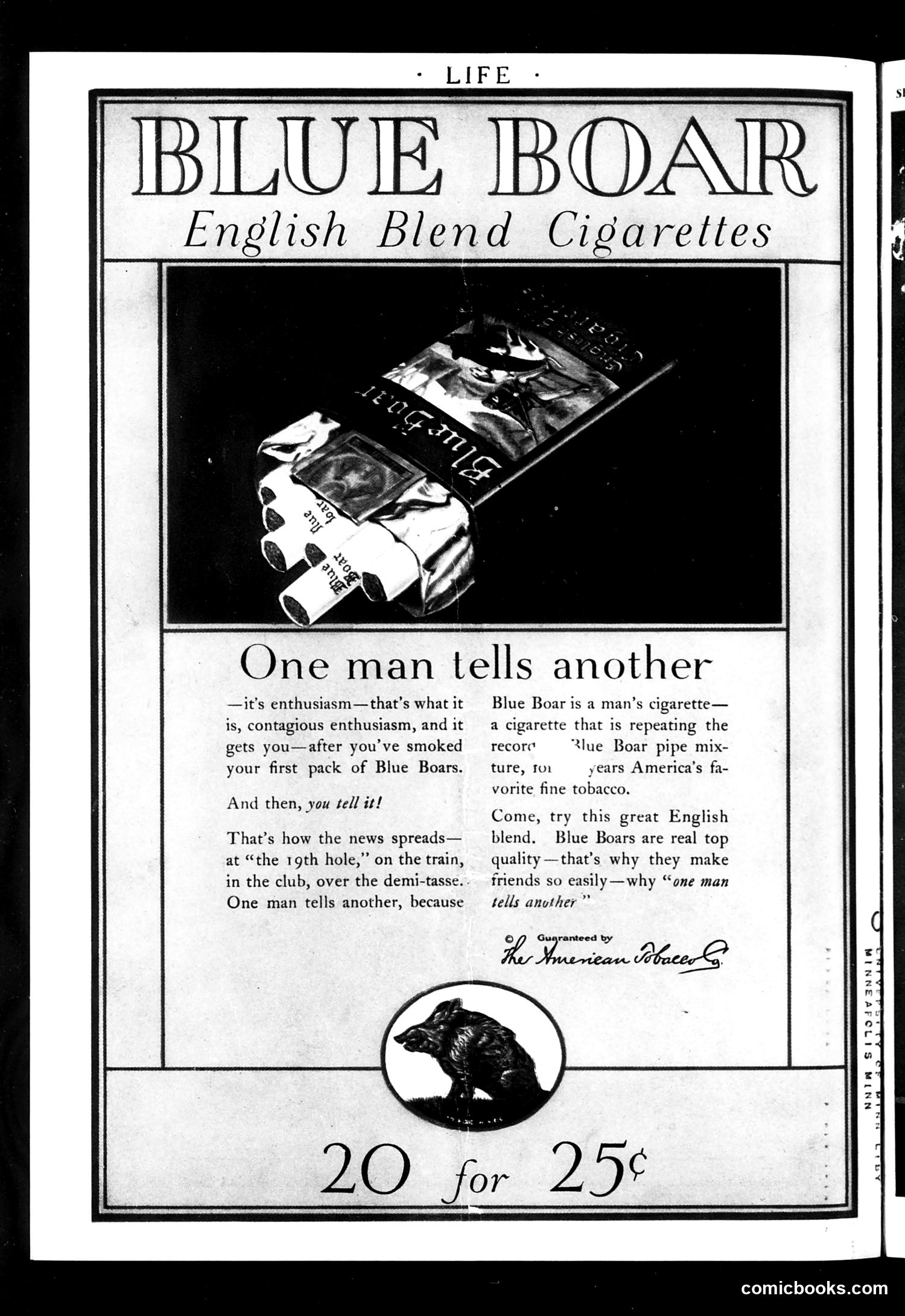
This is a vintage cigarette advertisement, not political satire. It promotes Blue Boar English Blend cigarettes using a viral-marketing concept: "one man tells another." The ad suggests that smoking Blue Boars creates such enthusiasm that satisfied customers naturally spread word-of-mouth recommendations across social settings—golf clubs ("19th hole"), trains, and social gatherings. The blue boar mascot appears at the bottom. The tagline emphasizes quality and masculine appeal ("a man's cigarette"), positioning the product as repeating the success of Blue Boar pipe tobacco. For modern readers: this demonstrates early 20th-century advertising strategy emphasizing peer influence and word-of-mouth before digital marketing. The price ("20 for 25¢") reflects pre-inflation costs. Notably, such direct cigarette advertising would be prohibited in contemporary American media.