
Life, 1923-09-06 · page 26 of 40
Life — September 6, 1923 — page 26: what you’re looking at
What you’re looking at
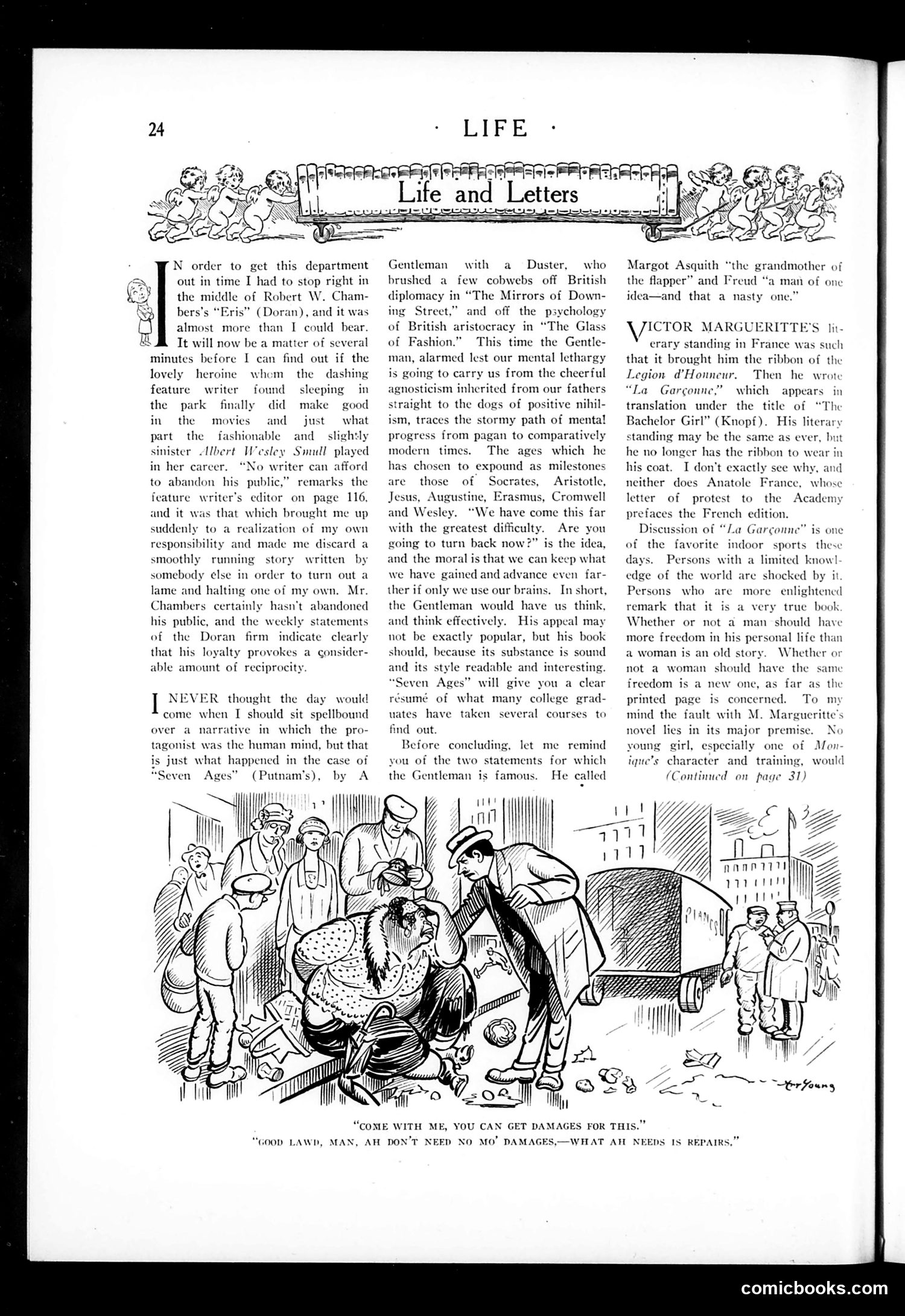
This page contains a literary review column mixed with one cartoon illustration. The main cartoon depicts a street scene where a man with a large basket of eggs or produce is being accosted by another man offering "damages for" broken goods—with the caption suggesting the vendor needs no more damages because everything is already broken. The satire appears to reference the absurdity of claiming compensation for items already in poor condition—a commentary on either insurance fraud, legal disputes, or general human foolishness around liability claims. The text reviews contemporary books, including works by Robert W. Chambers and a Gentleman author discussing mental progress through history (Socrates through Wesley). Notably, the column discusses Victor Margueritte's controversial French novel *La Gargonne* (translated as *The Bachelor Girl*), which apparently caused scandal because it explored female sexual freedom—a "new" freedom debated in print, though male freedom in personal life was historically accepted. The reviews reflect early 20th-century literary culture and contemporary social debates about morality and gender.
📄 Transcribed text from this page (OCR, searchable)
Machine-transcribed from the original scan — historical spelling and the odd misread are preserved.
N order to get this department out in time I had to stop right in the middle of Robert W. Cham- bers’s “Eris” (Doran), and it was almost more than I ¢: It will now be a matter of several NC 8 ald bear. a minutes before I can find out if the love! the feature sleeping in the park make in the just — what part the and. slightly sinister llbert Wesley Smull played “No writer can afford andon his public,” remarks the heroine whom dashing found did and writer finally movies good fashionable in her career, feature writer's editor on page 116, and it was that which brought me up suddenly to a realization of my own responsibility and made me discard a smoothly running story written by somebody ¢lse in order to turn out a lame and halting one of my own. Mr. Chambers certainly hasn't abandoned his public, and the we of the Doran firm that his loyalty provokes a consider- <ly statements indicate clearly able amount of reciprocity. NEVER thought the day would come when I should sit spellbound which the pro- tagonist was the human mind, but that over a narrative in is just what happened in the case of (Putnam's), by A A af BN, Ages” y) “COME WITH M “GOOD LAWD, MAN, AH with a few cobwebs Gentleman Duster, who brushed a off British diplomacy in “The Mirrors of Down- ing Street,” and off the psychology of British aristocracy in “The Glass of This time the Gentle- man, alarmed lest our mental lethargy is going to carry us from the cheerful agnosticism inherited from our fathers traight to the dogs of positive nihil- ism, traces the stormy path of mental progress from pagan to comparatively times. The ages which he has chosen to expound as milestones Aristotle, Erasmus, Cromwell Fashion.” modern are those of Socrates, Jesus, Augustine, and Wesley. “We have come this far with the greatest difficulty. Are you going to turn back now?” is the idea, and the moral is that we can keep what we have gained and adv: ther if only we use our brains. In short, the Gentleman would have us think, and think effectively. His appeal may not be exactly popular, but his book should, becau and its style nce even far- 2 its substance is sound able and interesting. will give you a clear résumé of what many college grad- uates have taken find out. Before concluding, let me remind you of the two statements for which rea en Ag several courses to the Gentleman is famous. He called > os ue! | ni H y Y y YOU CAN GET DAMAG DON’T NEED NO MO’ DAMAG! Margot Asquith “the grandmother of the flapper” and Freud “a man of onc idea—and that a nasty one.” ‘VICTOR MARGUERITTE'S it- erary standing in France was such that it brought him the ribbon of the Then “La Gargonne,” which appears in translation under the title of “T Bachelor Girl” (Knopf). His literary standing may be the sa he no longer has the ribbon to w in actly y, and neither does Anatole whose letter the Academy prefaces the French edition. Legion d’Honncur, he wrot me as ever, but his coat. I don't of protest to Discussion of “La Gargonne” is one the days. edge of the world are shocked by it. Persons who remark that it is a very true book Whether or not a man should have more freedom in his personal life than Whether or not a woman should have the same the my of favorite indoor sports thes Persons with a limited know! are more enlightened a woman is an old story. ireedom is a new one, as fz printed page is concerned. mind the fault with M. 3 novel lies in its major premise. To ‘gucritte’s No young girl, especially one of Mon- ique’s character and training, would (Continued on page 31) nagnnqq raperelepll picbiy Bb Vy “> ai = Ul So tr founy S FOR THIS.” WHAT AH NEEDS IS REPAIRS,” comicbooks.com