
Life, 1923-09-06 · page 18 of 40
Life — September 6, 1923 — page 18: what you’re looking at
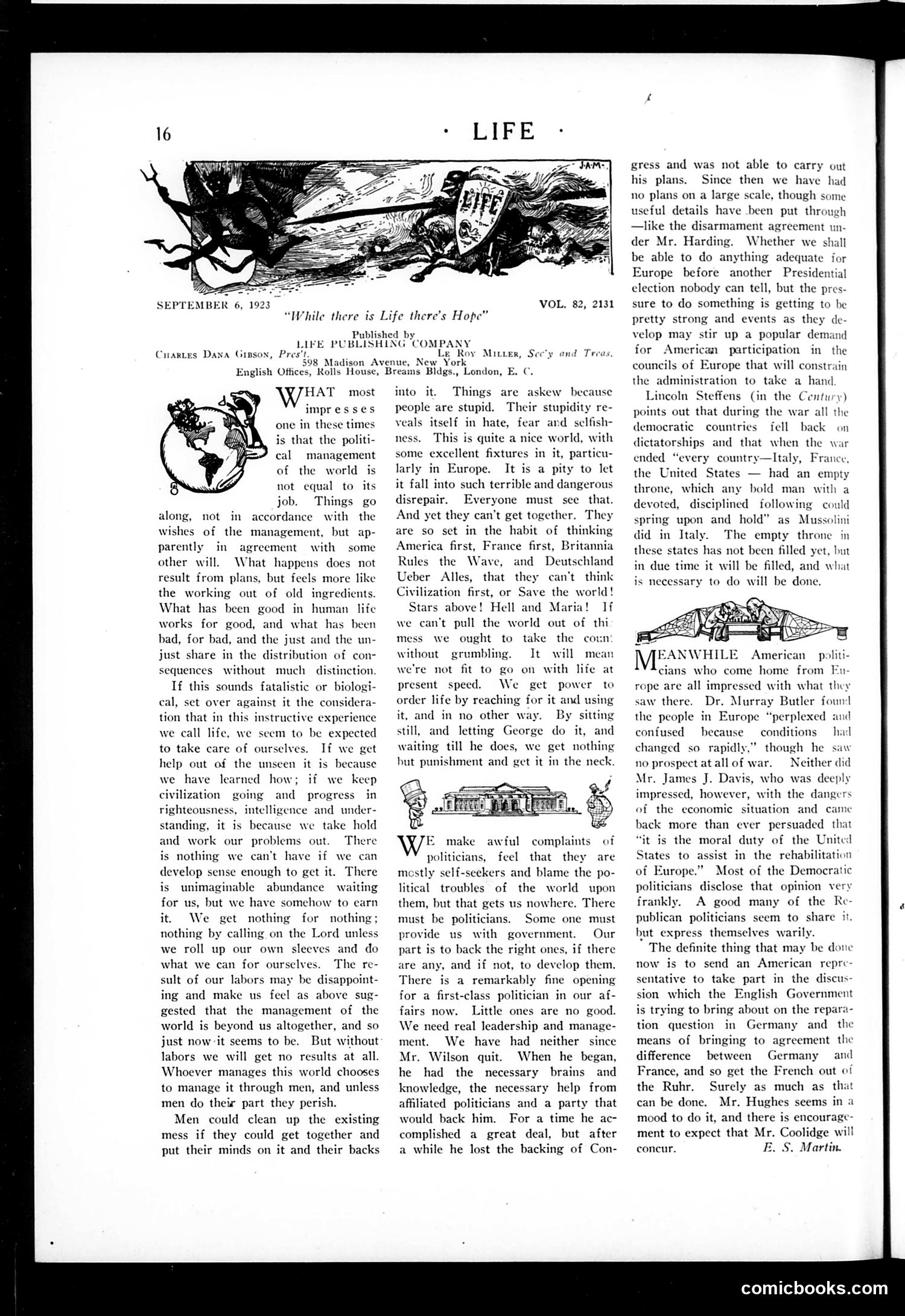
What you’re looking at
This editorial page by Charles Dana Gibson critiques post-WWI political dysfunction. The main illustration shows **Hope** as a figure being battered or knocked down—likely representing optimism about post-war recovery. Gibson argues that world leaders lack competence to manage affairs properly. He attacks the **selfishness of national interests**: countries prioritize "America first, France first, Britannia Rules the Wave, and Deutschland Ueber Alles" rather than global welfare. He specifically criticizes **President Wilson's loss of congressional backing**, which enabled his domestic and foreign policy failures. Gibson blames ordinary people's stupidity and inability to cooperate, rather than politicians alone. He calls for "real leadership"—a first-class politician who can unite divided nations on rehabilitation (likely meaning European reconstruction and peace-building). The cartoon suggests hope is being crushed by nationalist divisions and political incompetence in the post-war period.
📄 Transcribed text from this page (OCR, searchable)
Machine-transcribed from the original scan — historical spelling and the odd misread are preserved.
VOL. 82, 2131 “While there is Life there's Ho, Published by Cuartes Dana Ginson, Pres’ LIFE PUBLISHING COMPANY Li 98 Madison Avenue, New York Roy Mitter, Sec’y and Treas English Offices, Rolls House, Breams Bldgs., London, VY JHAT most impresses one in these times is that the politi- cal management of the not equal to its job. accordance world is Things go with the of the management, but ap- parently in with some other will. What happens does not result from plans, but feels more like the working out of old ingredients. What has been good in human life works for good, and what has been bad, for bad, and the just and the un- just share in the distribution of con- sequences without distinction If this sounds fatalistic or biologi cal, set over against it the considera- tion that in this instructive experience we call life, we seem to be expected to take care of ourselves. If we get help out of the unseen it is because we have learned how; if we keep civilization going and righteousness, intelligence along, not in wishes. agreement much progress in and under- standing, it is because we take hold and work our problems out. There is nothing we can't have if we can develop sense enough to get it. There is unimaginable abundance waiting for us, but we have somehow to earn it. We get nothing for nothing; nothing by calling on the Lord unless we roll up our own sleeves and do what we can for ourselves. The re- sult of our labors may be disappoint- ing and make us feel as above sug- gested that the management of the world is beyond us altogether, and so just now it seems to be. But without labors we will get no results at all. Whoever manages this world chooses to manage it through men, and unless men do their part they perish. Men could clean up the existing mess if they could get together and put their minds on it and their backs into it. Things are askew because people are stupid. Their stupidity re- veals itself in hate, fear and selfish- ness. This is quite a nice world, with some excellent fixtures in it, particu- larly in Europe. It is a pity to let it fall into such terrible and dangerous disrepair. Everyone must see that. And yet they can’t get together. They are so set in the habit of thinking America first, France first, Britannia Rules the Wave, and Deutschland Ueber Alles, that they can't think Civilization first, or Save the world! Stars above! Hell and Maria! If we can't pull the world out of thi mess we ought to take the coun without grumbling. It will mean we're not fit to go on with life at present speed. We get power to order life by reaching for it and using it, and in no other way. By sitting still, and letting George do it, and waiting till he does, we get nothing but punishment and get it in the neck. E make politicians, awful complaints of feel that mostly self-seekers and blame the po- litical troubles of the world upon them, but that gets us nowhere. There must be politicians. Some one must provide us with government. Our part is to back the right ones, if there are an nd if not, to develop them, There is a remarkably fine opening for a first-class pol nin our af- fairs now. Little ones are no good. We need real leadership and manage- ment. We have had neither since Mr. Wilson quit. When he began, he had the necessary brains and knowledge, the necessary help from affiliated politicians and a party that would back him. For a time he ac- complished a great deal, but after a while he lost the backing of Con- they are gress and was not able to carry out his plans. Since then we have had no plans on a large scale, though some useful details have been put through —like the disarmament agreement un- der Mr. Harding. Whether we shall be able to do anything adequate for Europe before another Presidential election nobody can tell, but the pres- sure to do something is getting to be pretty strong and events as they de- velop may stir up a popular demand for American participation in the councils of Europe that will constrain the administration to take a hand Lincoln Steffens (in the Century) points out that during the war all the democratic countries fell back on dictatorships and that when the war ended “every country—Italy, France, the United States — had an empty throne, which any bold man with a devoted, disciplined following could spring upon and hold” as Mussolini did in Italy. The empty throne in these states has not been filled yet, but in due time it will be filled, and what is necessary to do will be done. EANWHILE ans who come home rope are all impressed with what they saw there. Dr. Murray Butler found the people in Europe “perplexed and confused because conditions had changed so rapidly,” though he saw no prospect at all of war. Neither did Mr. James J. Davis, who was deeply impressed, however, with the dangers of the economic American _ politi- from situation and came back more than ever persuaded that “it is the moral duty of the United States to assist in the rehabilitation Most of the Democrat politic disclose that opinion very frankly. A good many of the Re- publican politicians seem to share it. but express themselves waril The definite thing that may be done now is to send an American repre- sentative to take part in the discus- sion which the English Government is trying to bring about on the repar tion question means of bringing to agreement the difference between Germany and France, and so get the French out of the Ruhr. Surely as much as that can be done. Mr. Hughes seems in a mood to do it, and there is encourage- ment to expect that Mr. Coolidge will E. S. Martin. of Europe.” in Germany and the concur. comicbooks.com