
A complete issue · 36 pages · 1923
Life — August 9, 1923
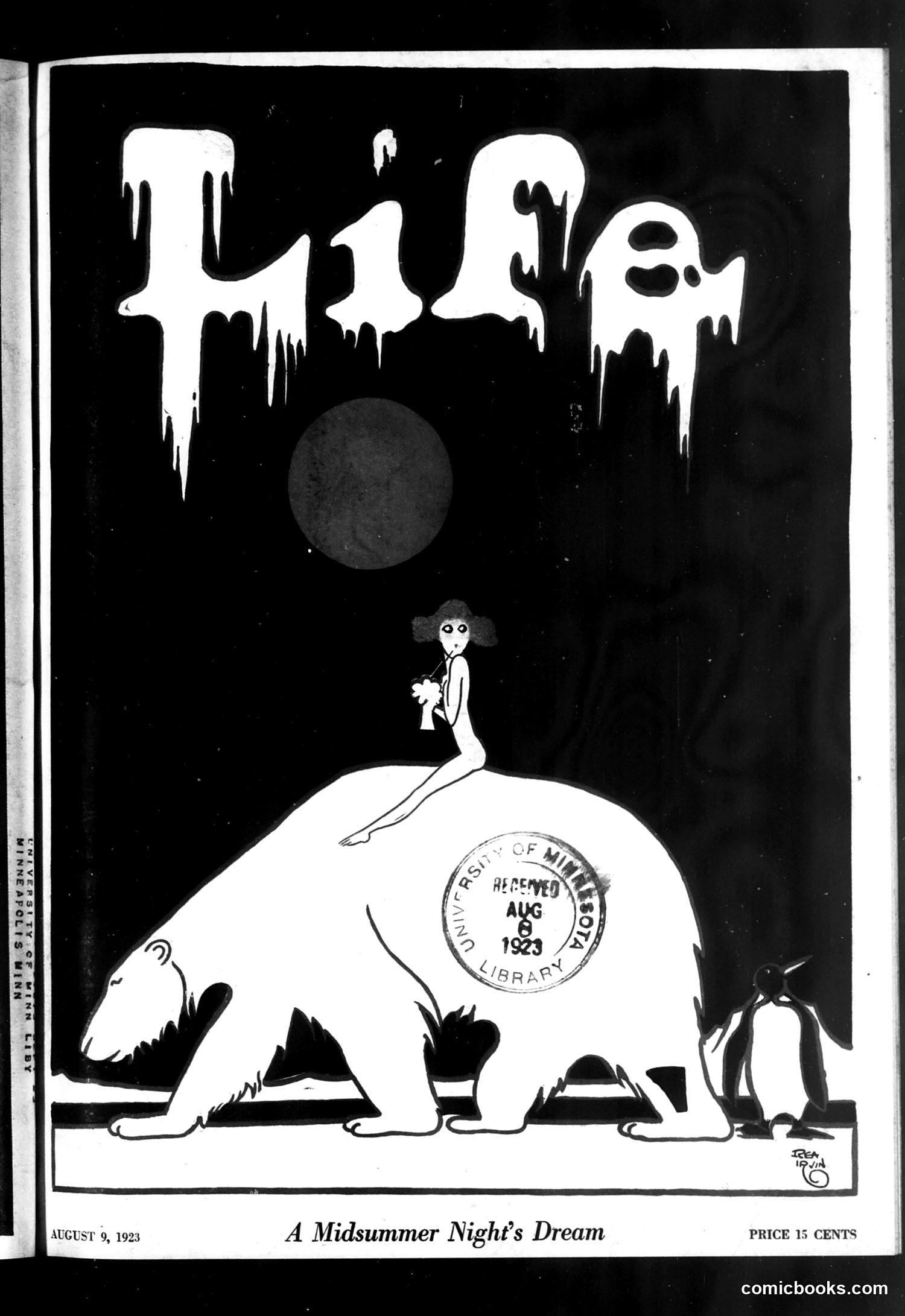
This is a visual pun on Shakespeare's "A Midsummer Night's Dream." The cartoon depicts a woman riding on a polar bear beneath ghostly figures spelling "1924" against a night sky with a full moon. The "1924" likely references the upcoming U.S. presidential election, and the ghosts above suggest political uncertainty or foreboding about the candidates. The polar bear may reference something topical from 1923, though the specific meaning is unclear today. The woman appears to be dreaming or in a fantastical state—consistent with the Shakespeare reference. The overall composition uses the classical play's title as a framework for satirizing contemporary political anxieties about the forthcoming election year.
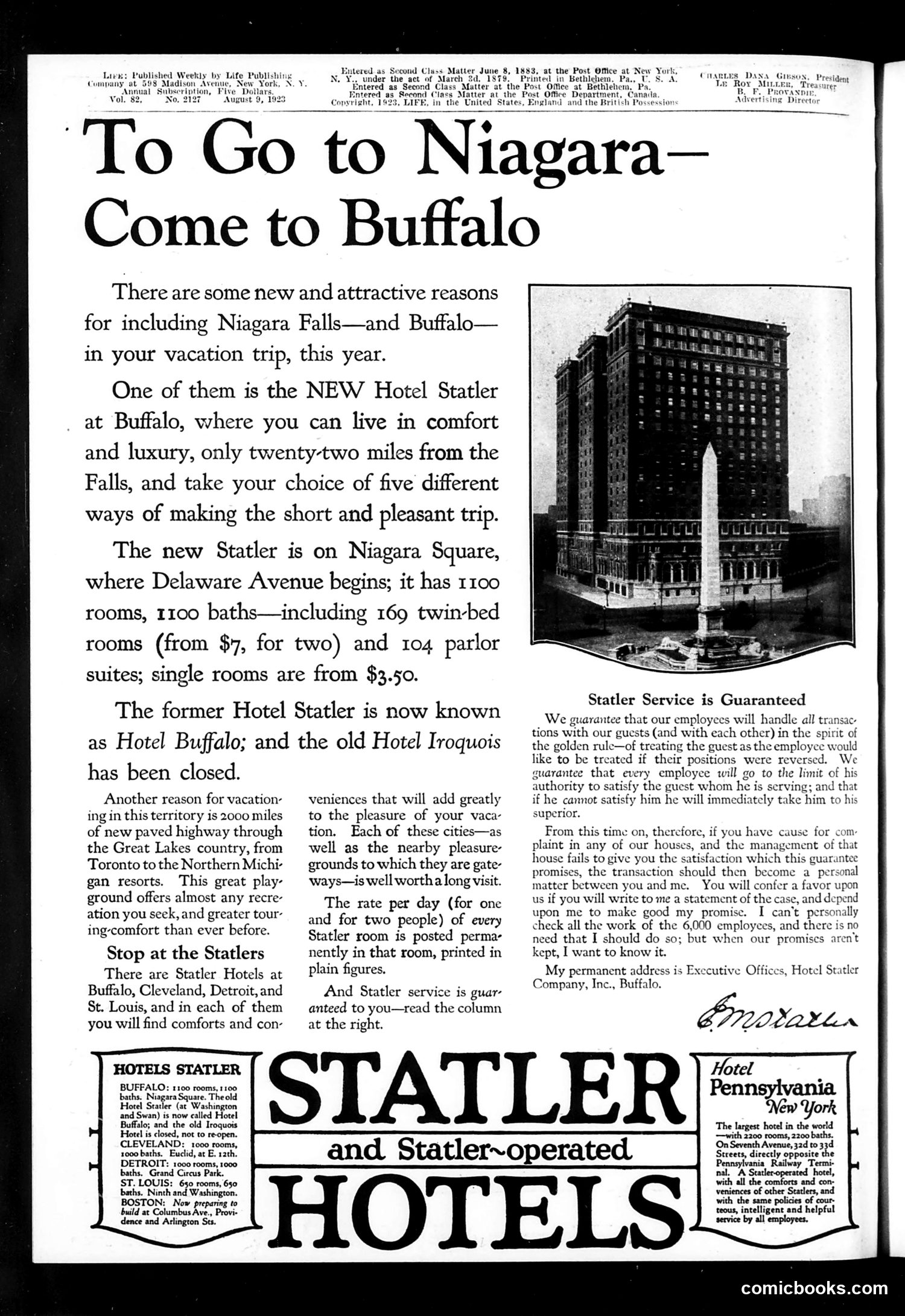
This is primarily **advertising content, not satire or cartoon**. The page promotes the newly opened Hotel Statler in Buffalo, New York, positioned as a stopover en route to Niagara Falls (22 miles away). The advertisement emphasizes luxury amenities—1,100 rooms with bathing facilities, twin-bed rooms from $7, and single rooms from $3.50—along with five transportation options to Niagara Falls. A notable section titled "Statler Service is Guaranteed" outlines the hotel's customer service philosophy, promising attentive staff treatment. The page also mentions other Statler Hotels in Cleveland, Detroit, St. Louis, and the Hotel Pennsylvania in New York. This represents straightforward early-20th-century hospitality marketing rather than satirical commentary.
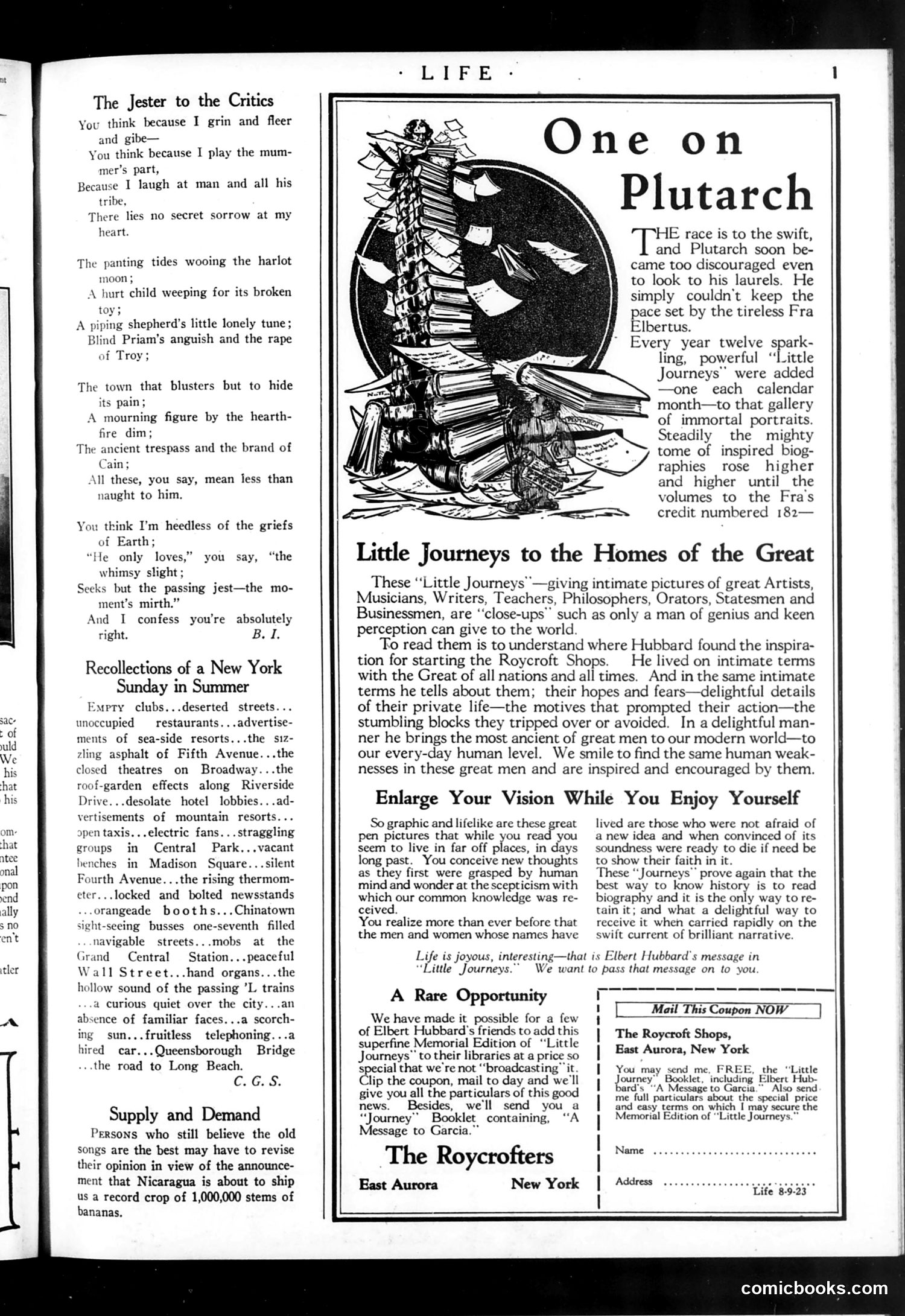
This page is primarily **advertising and literary content** rather than political satire. The left side contains a poem titled "The Jester to the Critics," addressing an unnamed subject who "grins and flees" and "plays the mummer's part"—likely social commentary about public performers or politicians who entertain rather than engage seriously. However, the figure isn't identified visually. The dominant right side promotes **"Little Journeys to the Homes of the Great"** by Elbert Hubbard, a biographical series about famous artists, writers, and philosophers. This is essentially a book advertisement with a coupon. The page offers **no clear political cartoon or specific satirical target**—it's primarily commercial content wrapped around miscellaneous editorial pieces about New York summer life and economic topics.

This is **primarily an advertisement**, not editorial content or satire. It's a Republic Tires ad from the early 20th century featuring a stylized illustration of a car with prominent tire imagery. The ad emphasizes two selling points: quality manufacturing ("Every Republic Tire is made as good as a tire can be") and dealer certification. The "Sign of the Eagle" logo and "Certified Service" branding highlighted at bottom-left represent Republic's attempt to build consumer trust through standardized dealer networks—a significant marketing innovation for the era. The faint caravan illustration at top appears decorative. There is **no political satire or cartoon** on this page; it's straightforward commercial messaging about tire reliability and dealer authentication.
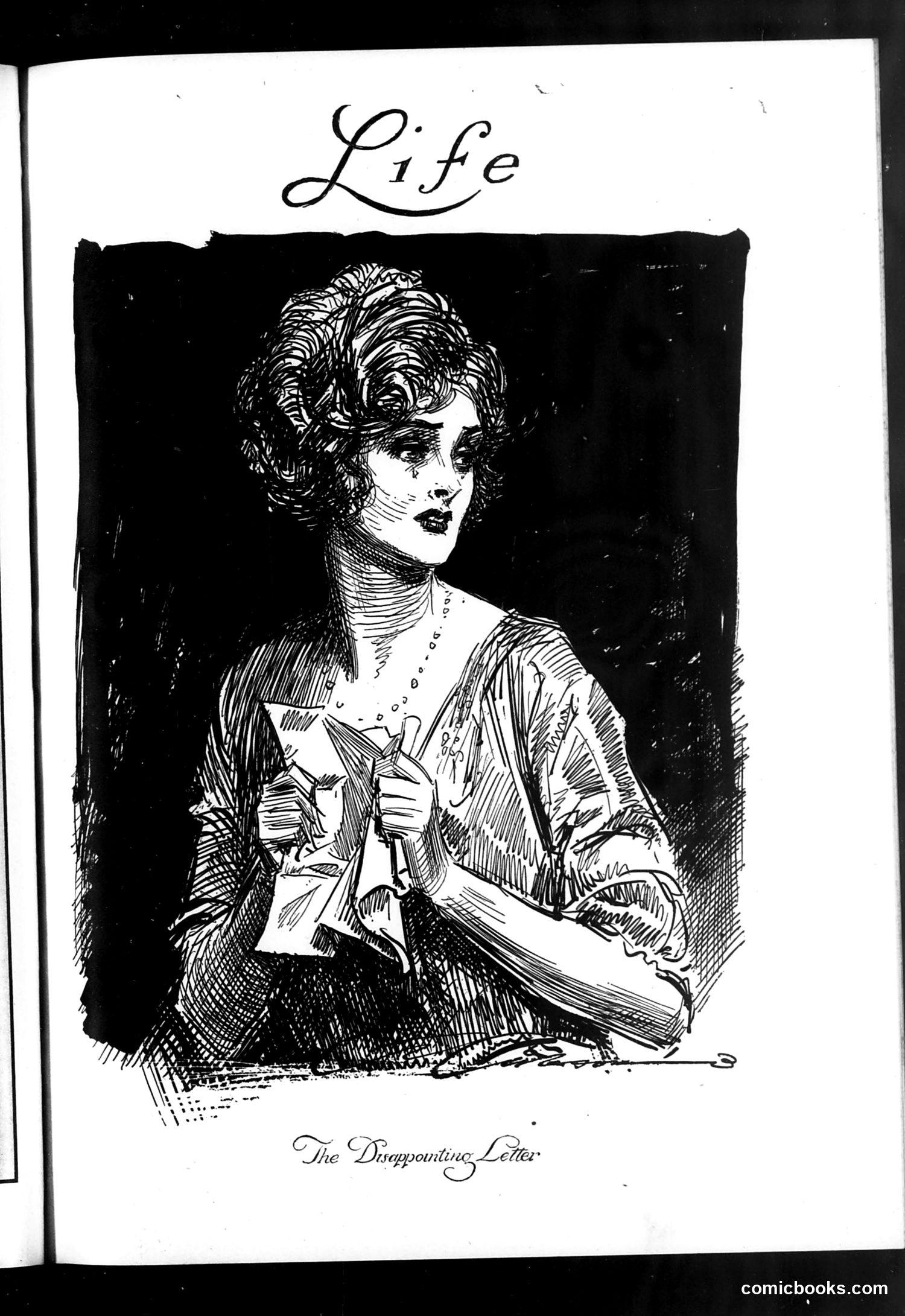
This illustration from *Life* magazine's "Life" section depicts a stylishly dressed woman of the early 20th century examining correspondence. The title "The Disappointing Letter" suggests romantic disappointment—a common satirical theme in *Life*, which frequently mocked courtship rituals and social expectations of the era. The woman's fashionable attire (fitted jacket, elaborate hat, jewelry) and her contemplative pose suggest she's absorbed in reading unwelcome news, likely from a suitor. The satire targets the emotional vulnerabilities of modern women navigating romantic expectations while maintaining social propriety. *Life* magazine regularly used such genteel domestic scenes to gently mock both male and female behavior in contemporary courtship.
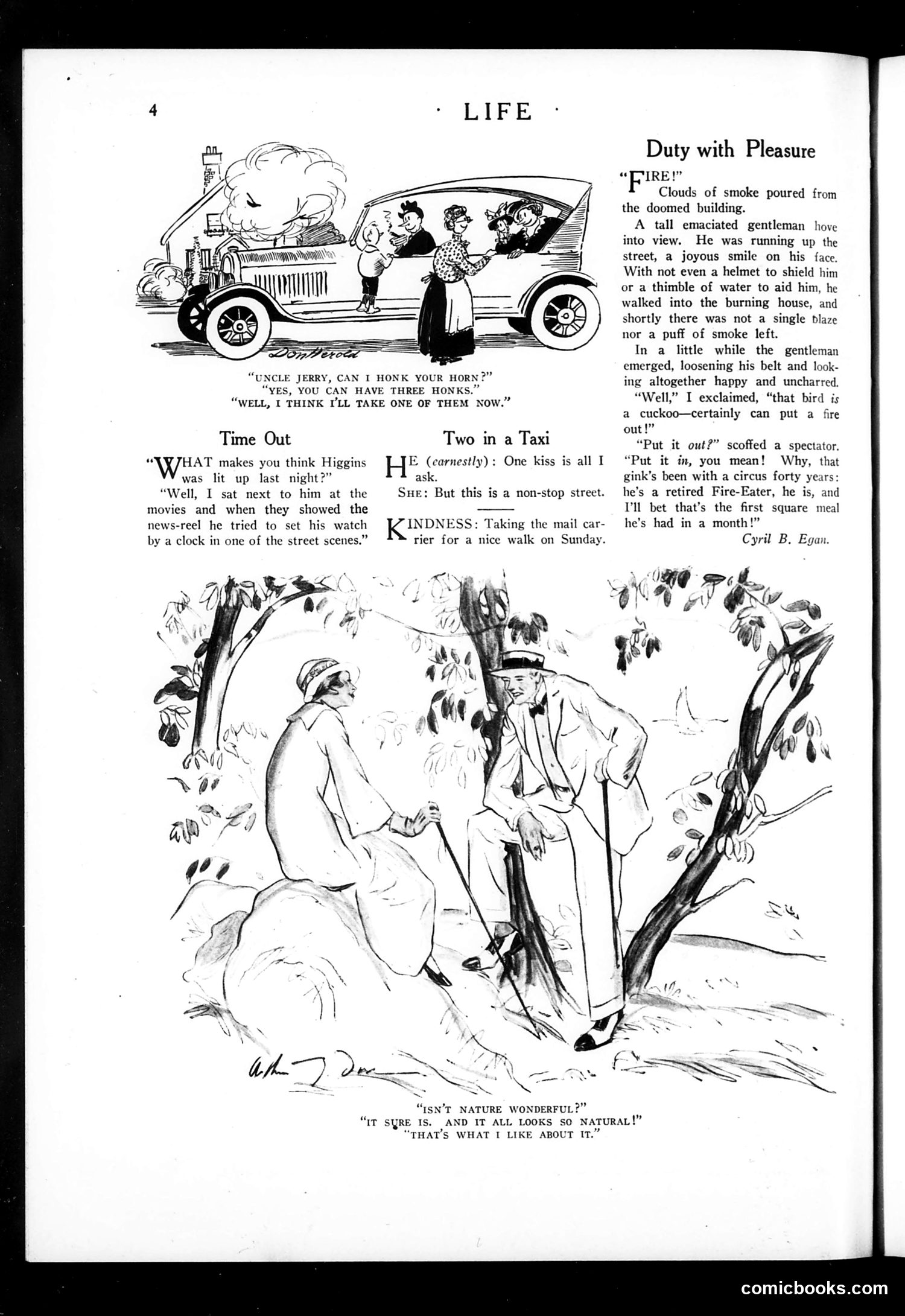
This page contains three humor pieces from early 20th-century Life magazine: **"Duty with Pleasure"** satirizes a firefighter's casual heroism—a tall gentleman walks into a burning building without proper equipment, then emerges unscathed, remarking that a circus performer (a "Fire-Eater") could accomplish the same feat. The joke mocks the gentleman's nonchalance about a genuinely dangerous situation. **"Time Out"** is a brief joke about a man named Higgins staying up late watching movies and street clocks—likely satirizing early cinema's novelty and addictive appeal. **"Two in a Taxi"** presents a couple discussing whether one kiss equals multiple car horns, a flirtation joke referencing automobile culture. The bottom cartoon shows two men outdoors admiring "nature," which "looks so natural"—likely mocking artificial or overly romanticized views of nature.
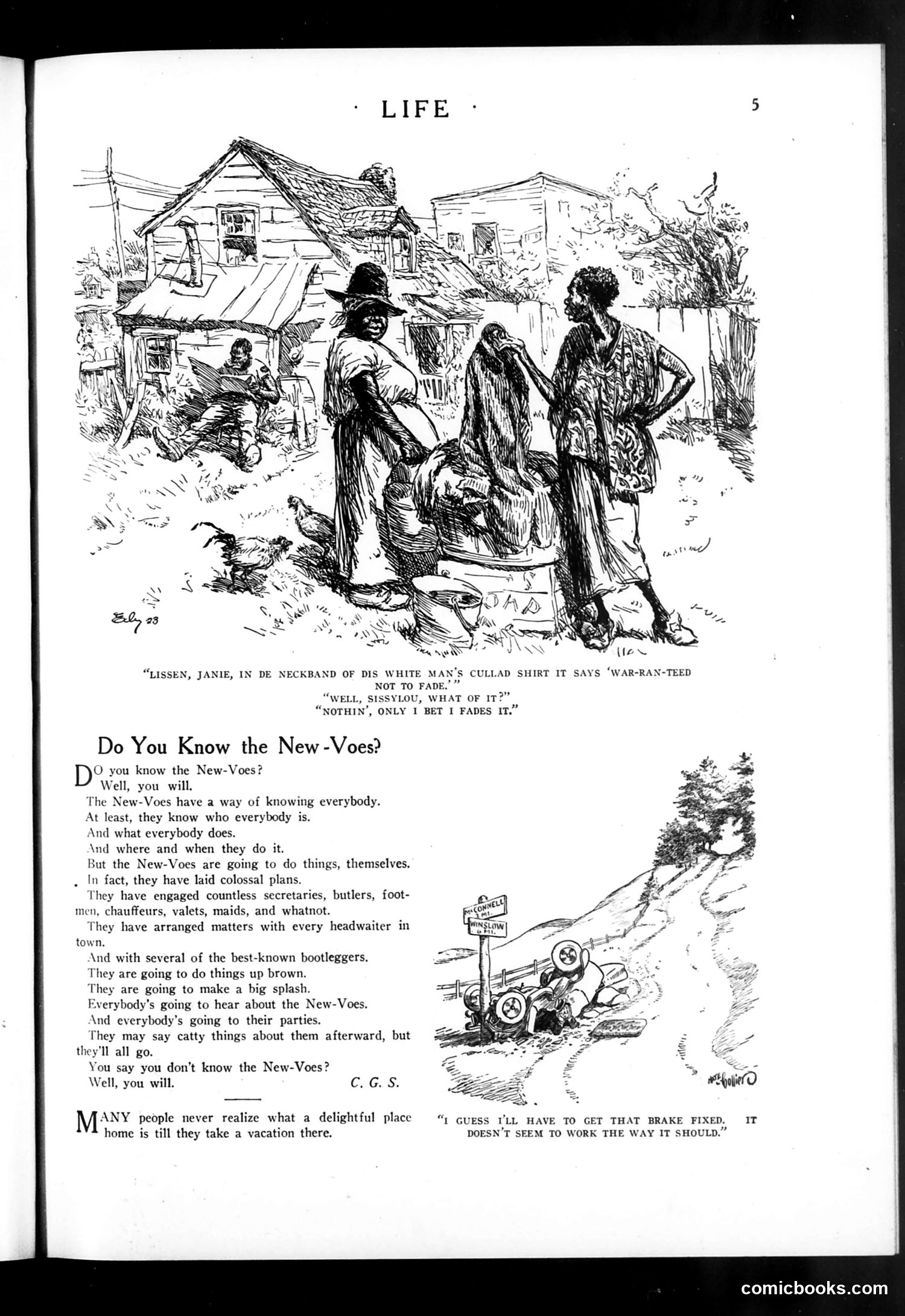
This page contains two distinct pieces: **Top cartoon**: A satirical scene depicting African American figures in a poor rural setting. The caption references a "white man's cullud shirt" and includes dialect speech ("war-ran-teed," "Sissy'lou," "nothin'"). This appears to be racist caricature humor typical of early 20th-century American satirical magazines, mocking Black people through stereotyped language and situations. **"Do You Know the New-Voes?"**: A poem/article about wealthy New Yorkers ("New-Voes") and their social activities, with a separate cartoon of a car accident. The text satirizes the upper class's conspicuous spending, parties, and scandals. The car caption jokes about brake failure. The page juxtaposes working-class racist humor with upper-class social satire—both targeting different audiences for laughs at society's margins and excesses.
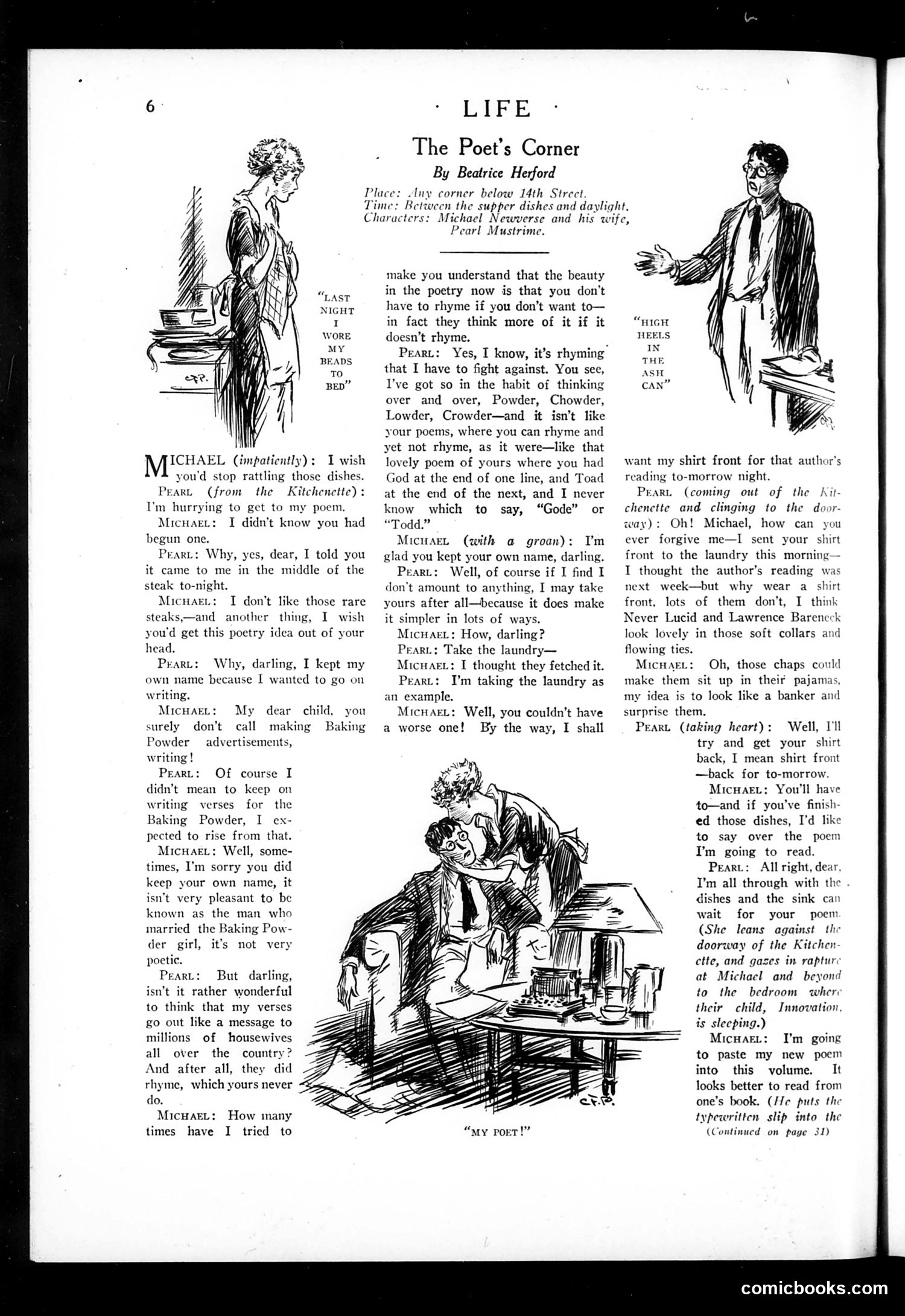
This is a humorous domestic sketch set in a kitchen between supper and daylight. Michael Newverse and his wife Pearl discuss poetry and housework. The satire targets the tension between artistic ambition and domestic drudgery. Pearl is annoyed that Michael writes poetry (specifically verses about "Baking Powder") instead of helping with dishes. She mocks his literary aspirations, suggesting his poems lack quality and reach only housewives. Michael defends poetry's value reaching "millions of housewives all over the country," while Pearl pragmatically insists on household tasks. The humor comes from their clash: she demands his shirt front for laundry and dishes done; he wants to read his new poem. The cartoon satirizes the struggling poet's delusions of grandeur versus the spouse's grounded reality of domestic obligations.
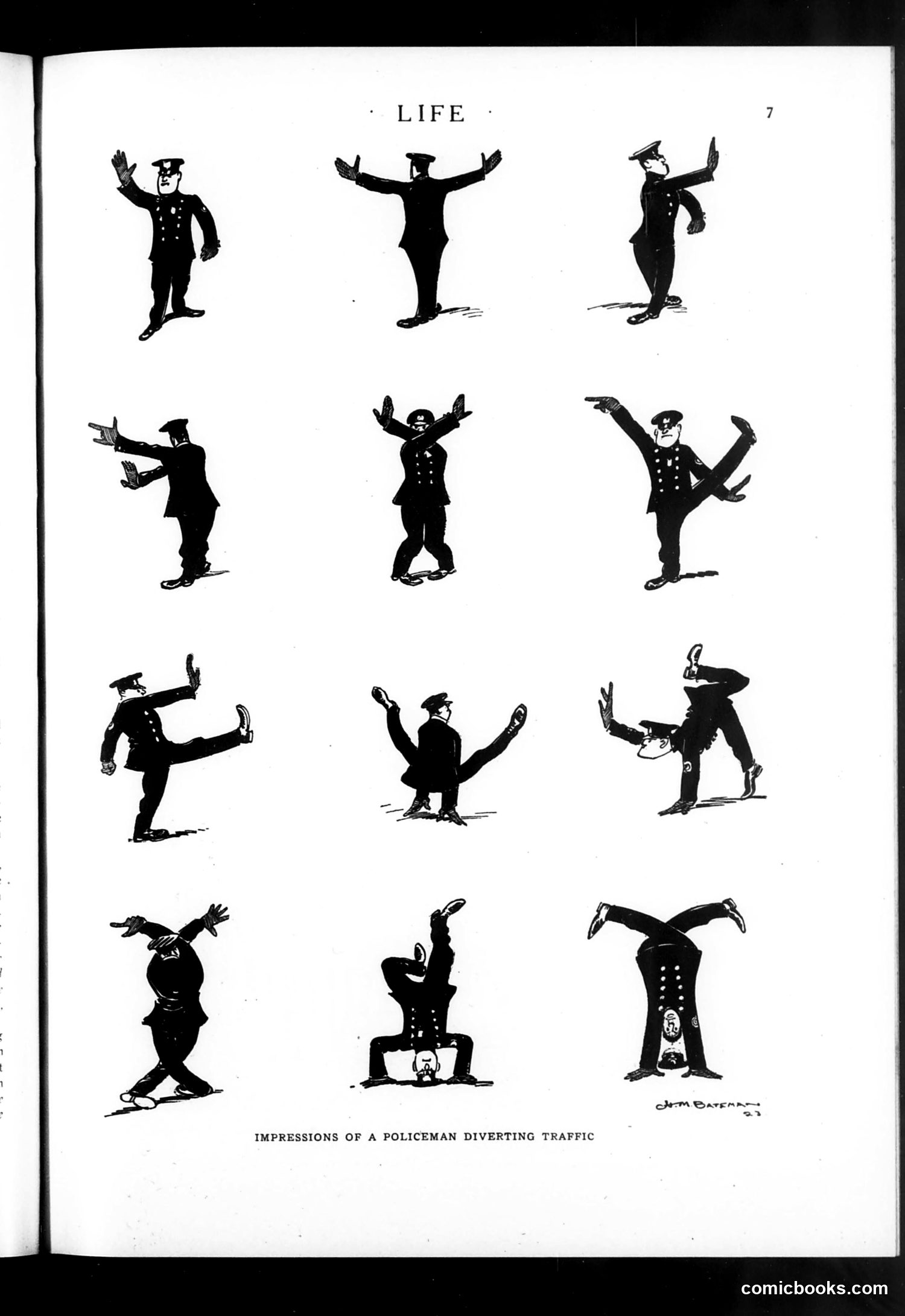
This is a humorous illustration series showing exaggerated physical contortions and gestures. The caption identifies the subject as a policeman directing traffic. The joke relies on visual comedy: rather than depicting realistic traffic control, the artist (Jim Barrera, per the signature) shows a single uniformed officer performing increasingly absurd bodily contortions—handstands, splits, backbends, and impossible poses—as if his body itself were the traffic signal or barrier. This satirizes either the physically demanding nature of traffic police work or, more likely, the theatrical, exaggerated gestures officers made while directing vehicular and pedestrian flow (before electric traffic lights became standard). The humor comes from taking the officer's job literally—his body becoming the instrument of traffic control through increasingly ridiculous acrobatic positions.
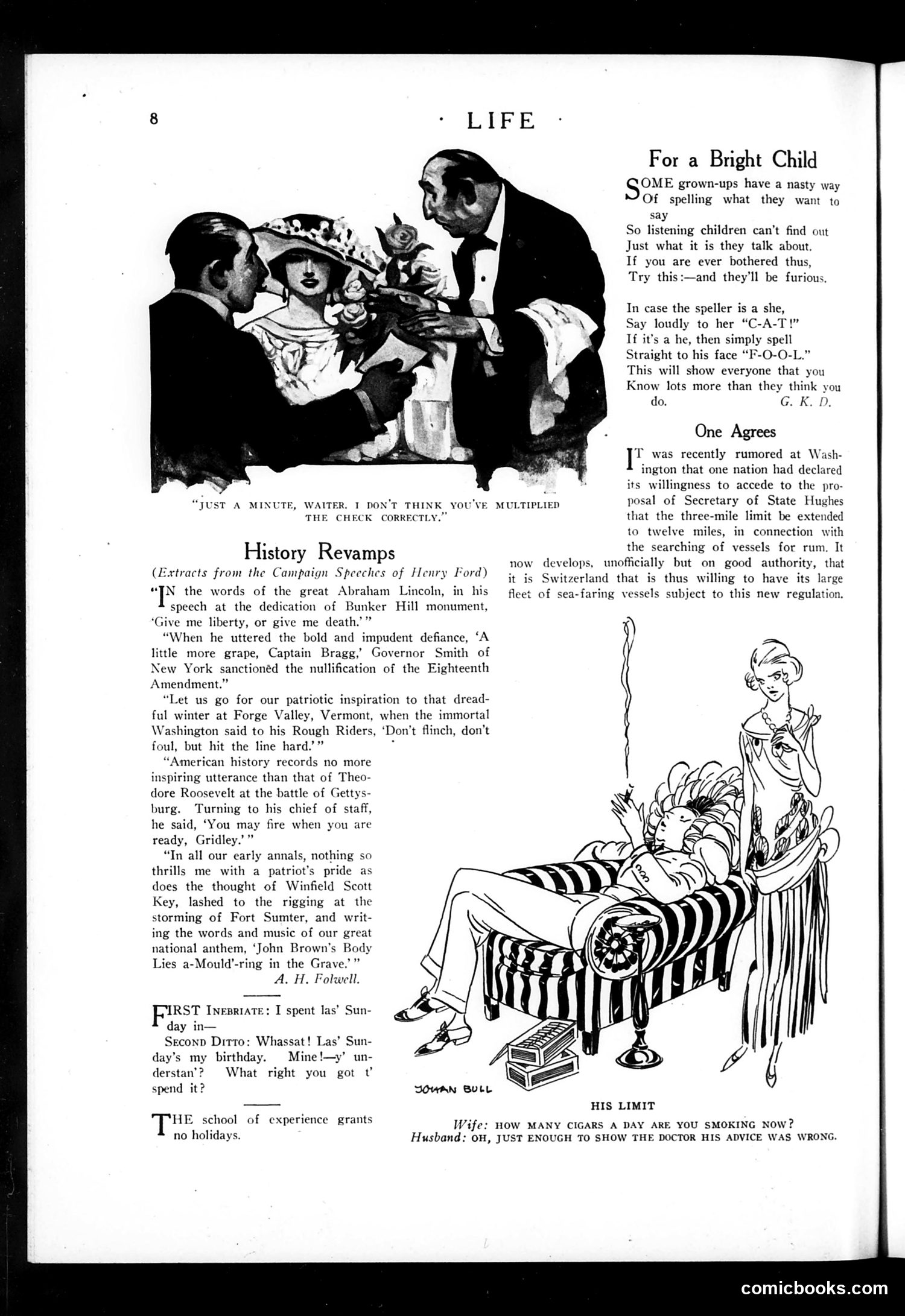
**Top Cartoon:** Shows two men and a woman at a restaurant. The waiter is being corrected about multiplication. The joke plays on mishearing or miscommunication—a common theme in period humor about waiters' competence. **"History Revamps" Section:** Quotes patriotic American historical speeches by Lincoln, Washington, and Theodore Roosevelt, attributing them to Henry Ford. This is satirical commentary on Ford's self-promotion and public prominence in the 1920s. Ford was famous for both industrial achievement and controversial public statements, making him a target for mockery about claiming credit for American ideals. **"His Limit" Cartoon:** Depicts a man smoking excessively while a woman objects. His response—that the doctor advised against it—satirizes husbands ignoring wives' concerns by misrepresenting medical advice. Classic domestic humor about marital conflicts over smoking habits.
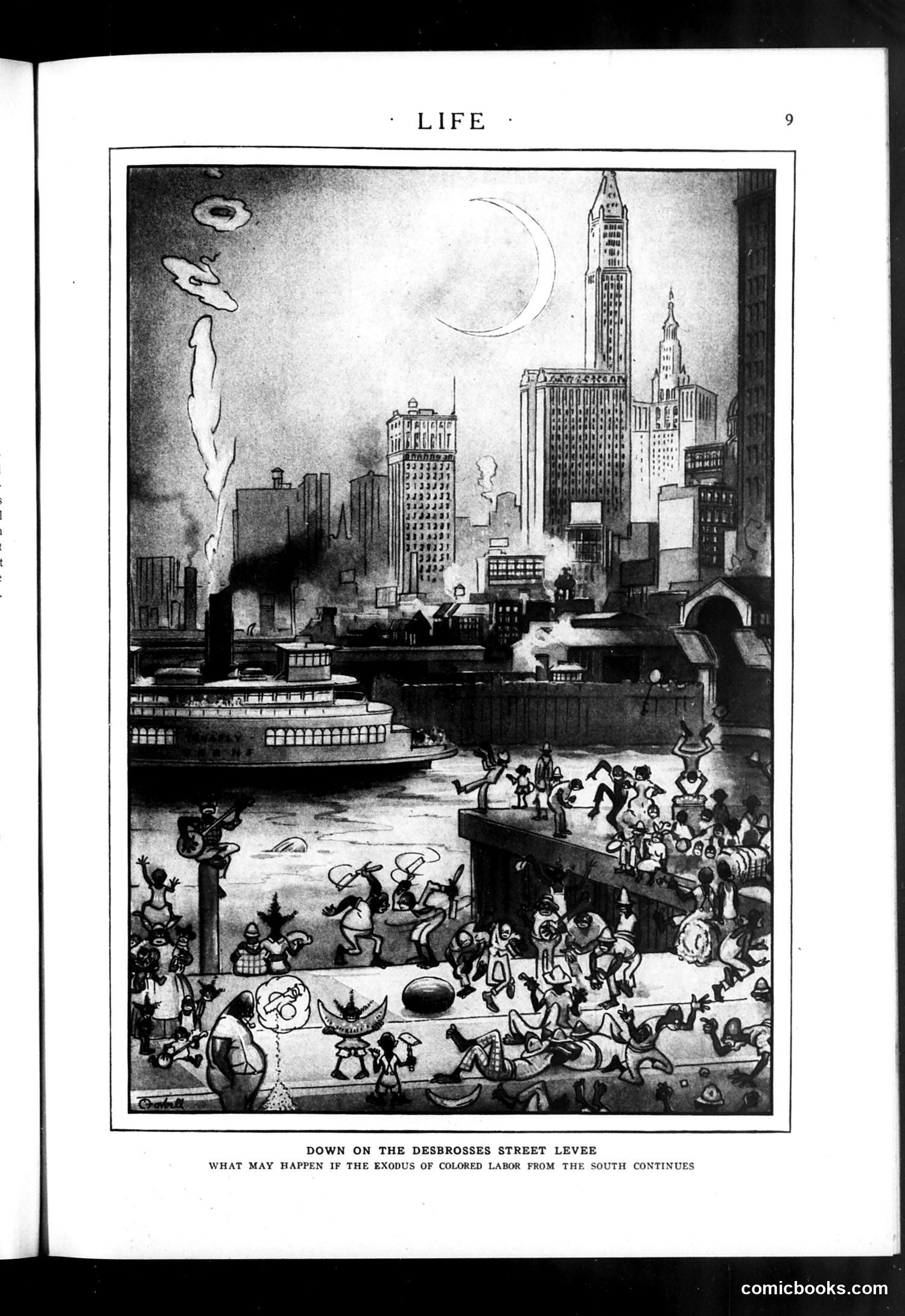
This is a satirical illustration titled "Down on the Desbroses Street Levee: What May Happen if the Exodus of Colored Labor from the South Continues." The cartoon depicts a chaotic waterfront scene with a crowded levee in the foreground and a skyline of industrial buildings and smokestacks behind. The composition suggests anxiety about labor disruption—specifically, the Great Migration of African Americans leaving the South for Northern industrial cities. The satire warns that if Southern Black workers continue departing northward, the Southern economy (represented by the busy riverfront) will descend into disorder and chaos. The crowded, frenetic activity below contrasts with the imposing industrial cityscape above, implying concern about demographic and economic upheaval from labor shortage.
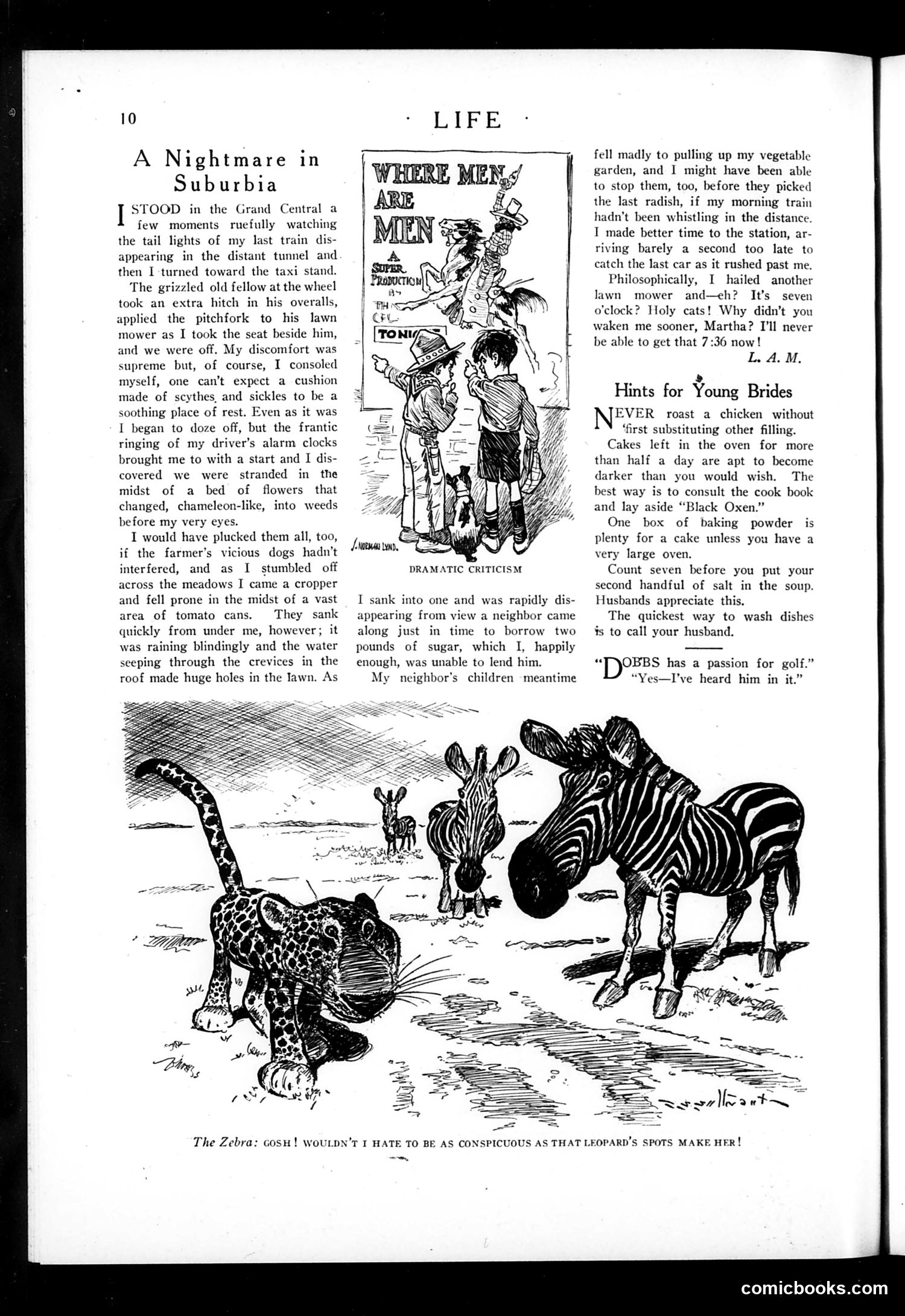
This page contains three distinct pieces: 1. **"A Nightmare in Suburbia"** — A humorous narrative about suburban commuting frustrations (missed trains, garden pests, morning delays). 2. **"Dramatic Criticism"** — A cartoon showing what appears to be a theatrical scene with characters and a sign reading "WHERE MEN ARE MEN," satirizing overly masculine posturing in theater productions. The joke critiques exaggerated masculine performance. 3. **"Hints for Young Brides"** — Domestic advice column offering cooking tips (roasting chicken, salt in soup) and household management. 4. **Bottom illustration** — A whimsical cartoon of animals (leopard, zebras, giraffe) with the zebra's caption: "Gosh! Wouldn't I hate to be as conspicuous as that leopard's spots make her!" — a gentle joke about being visibly different or standing out. The page reflects early-to-mid 20th century magazine humor: domestic satire, theatrical commentary, and animal fables.
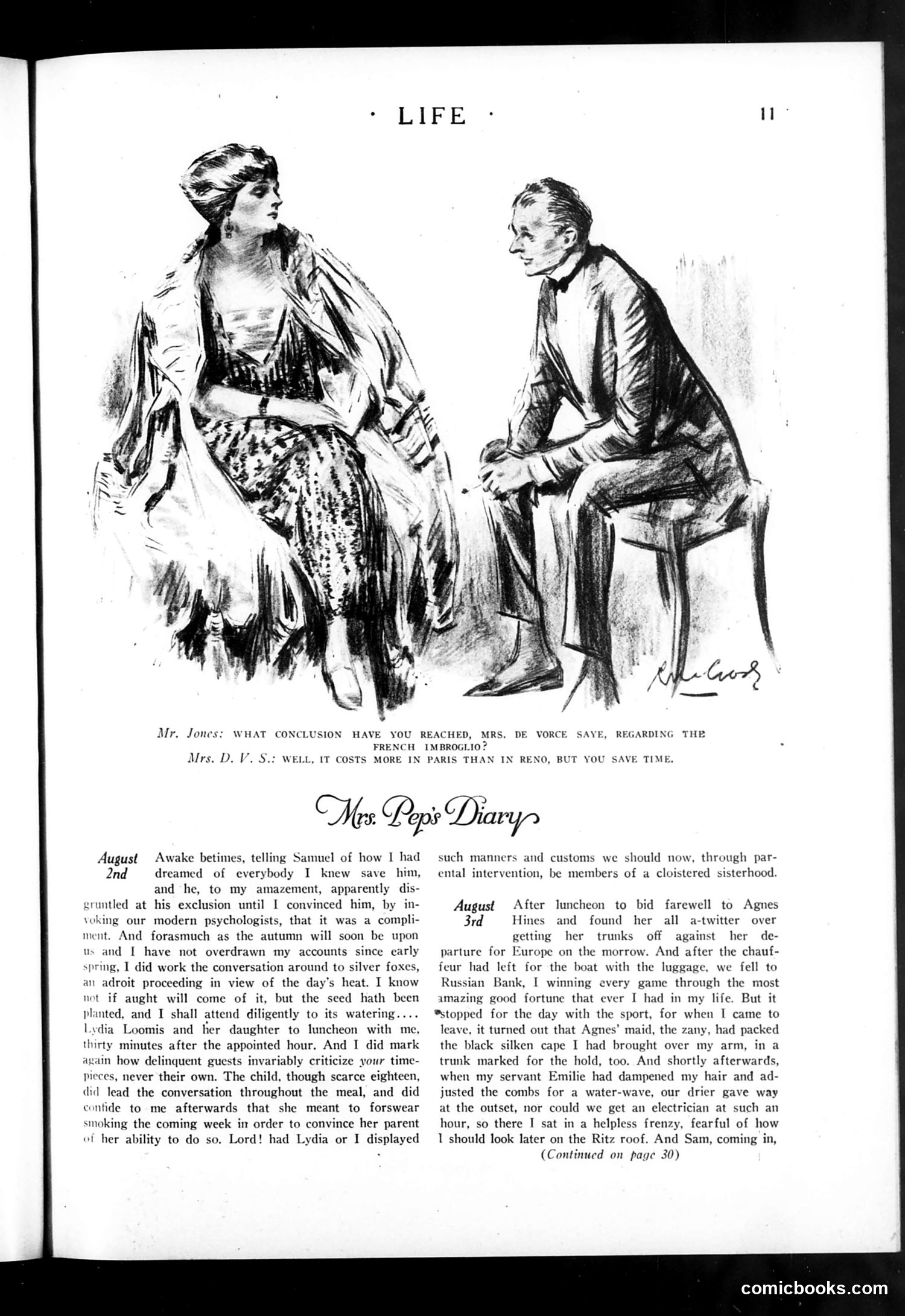
This page from *Life* magazine presents a satirical cartoon and the opening of "Mrs. Pep's Diary," a fictional humor column. **The Cartoon:** The sketch depicts Mr. Jones questioning Mrs. de Vorce about the "French imbrogio" (likely referring to French diplomatic or social affairs). Mrs. de Vorce responds that things cost more in Paris than in Reno, but "you save time"—a joke about divorce proceedings. Reno, Nevada was famous as a divorce destination requiring minimal residency; the quip suggests Paris offers speedier divorces despite higher costs. This satirizes both American attitudes toward French morality and the era's casual approach to divorce tourism. **The Diary Section:** Opens with domestic comedy about entertaining guests and managing household staff, establishing the column's satirical focus on upper-class social conventions and manners.
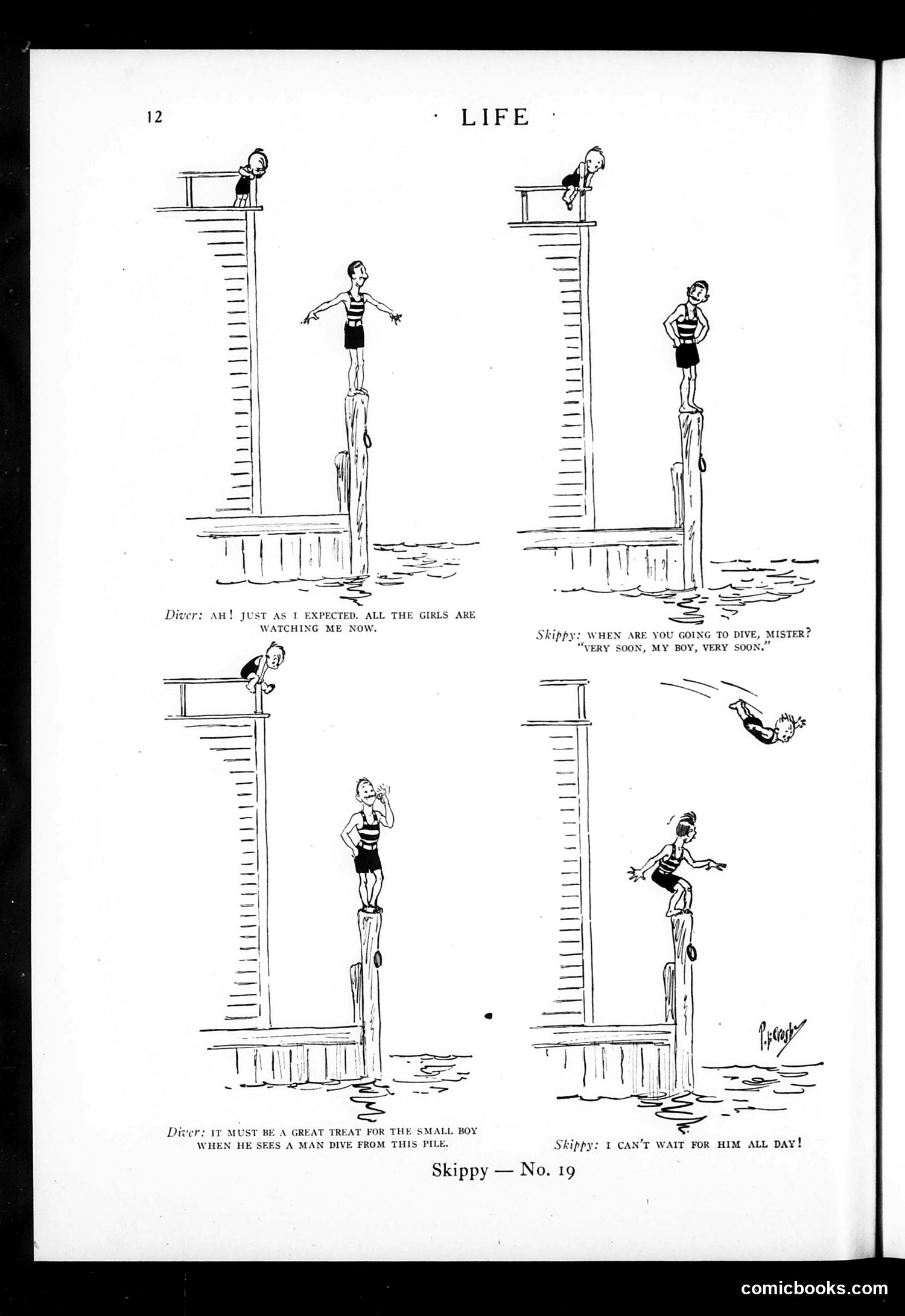
This is a humorous comic strip titled "Skippy—No. 19" depicting a diving scene at what appears to be a public pool or diving platform. The narrative follows a young boy (Skippy) who wants to impress onlookers by diving from an increasingly high platform. A diver at the top confidently announces he'll perform since "all the girls are watching." Skippy eagerly asks when he can dive; the diver promises "very soon." As the strip progresses, Skippy becomes impatient waiting for his turn while the diver repeatedly delays, ultimately performing a dive. The joke satirizes childhood impatience and the gap between adult promises and delivery—a relatable comedic situation requiring no specific historical context beyond understanding early 20th-century pool culture and children's behavior.
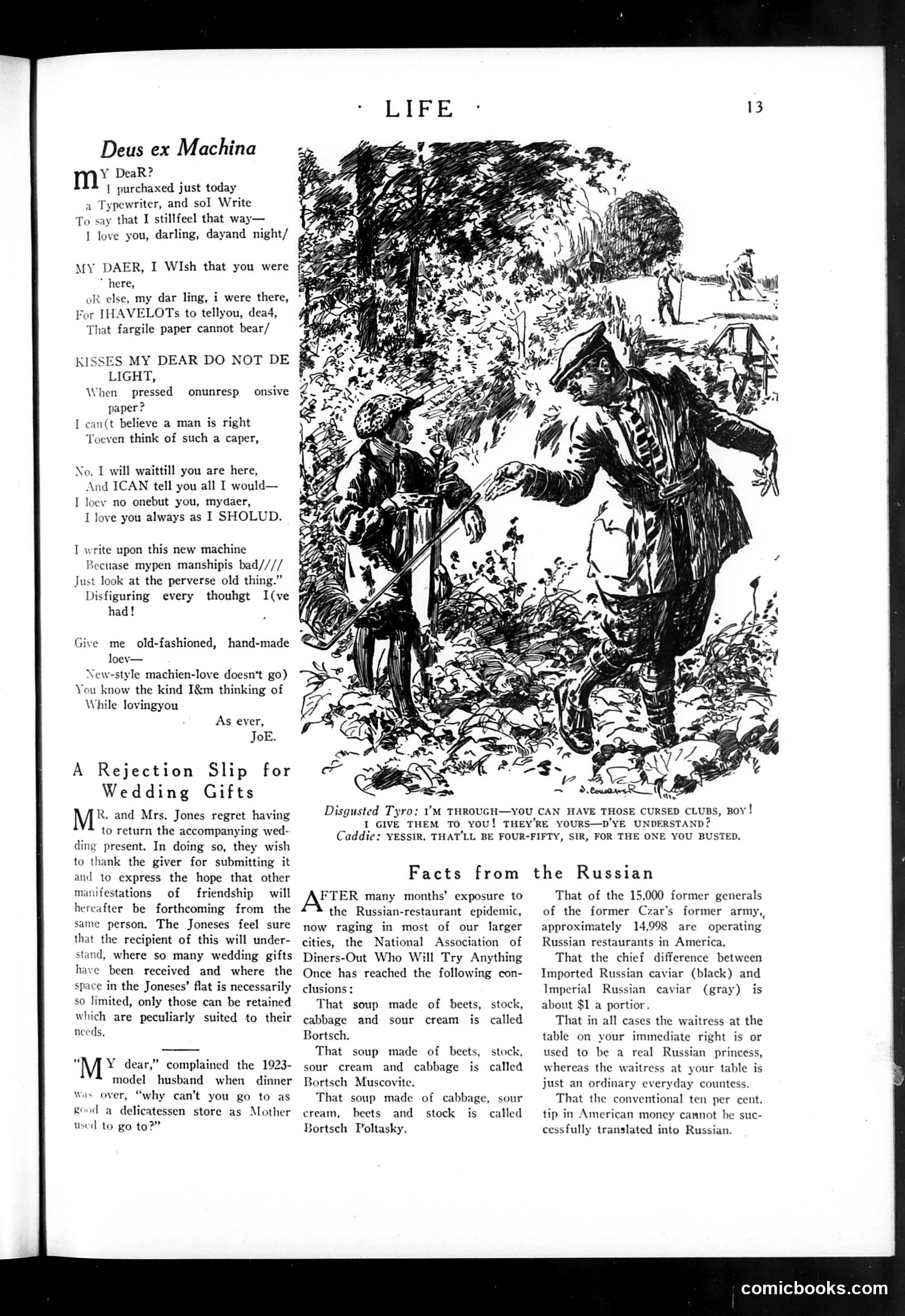
This page contains three distinct sections: 1. **"Deus ex Machina" poem**: A romantic letter written on a typewriter, humorously depicting a man expressing devotion to his absent girlfriend through modern technology rather than in person. 2. **The central illustration**: Shows two figures in period dress (appearing to be 18th or 19th century) in a wooded setting. The caption references "Disgusted Tyro" complaining about romantic dialogue, suggesting this satirizes overwrought or artificial romantic expression in literature or drama. 3. **"Facts from the Russian" section**: Discusses Russian restaurants becoming fashionable in American cities, explaining differences between Imperial Russian caviar and other Russian dishes. This reflects 1920s interest in Russian cuisine following post-Revolution emigration. The overall theme satirizes romantic affectation and contemporary enthusiasm for Russian culture.
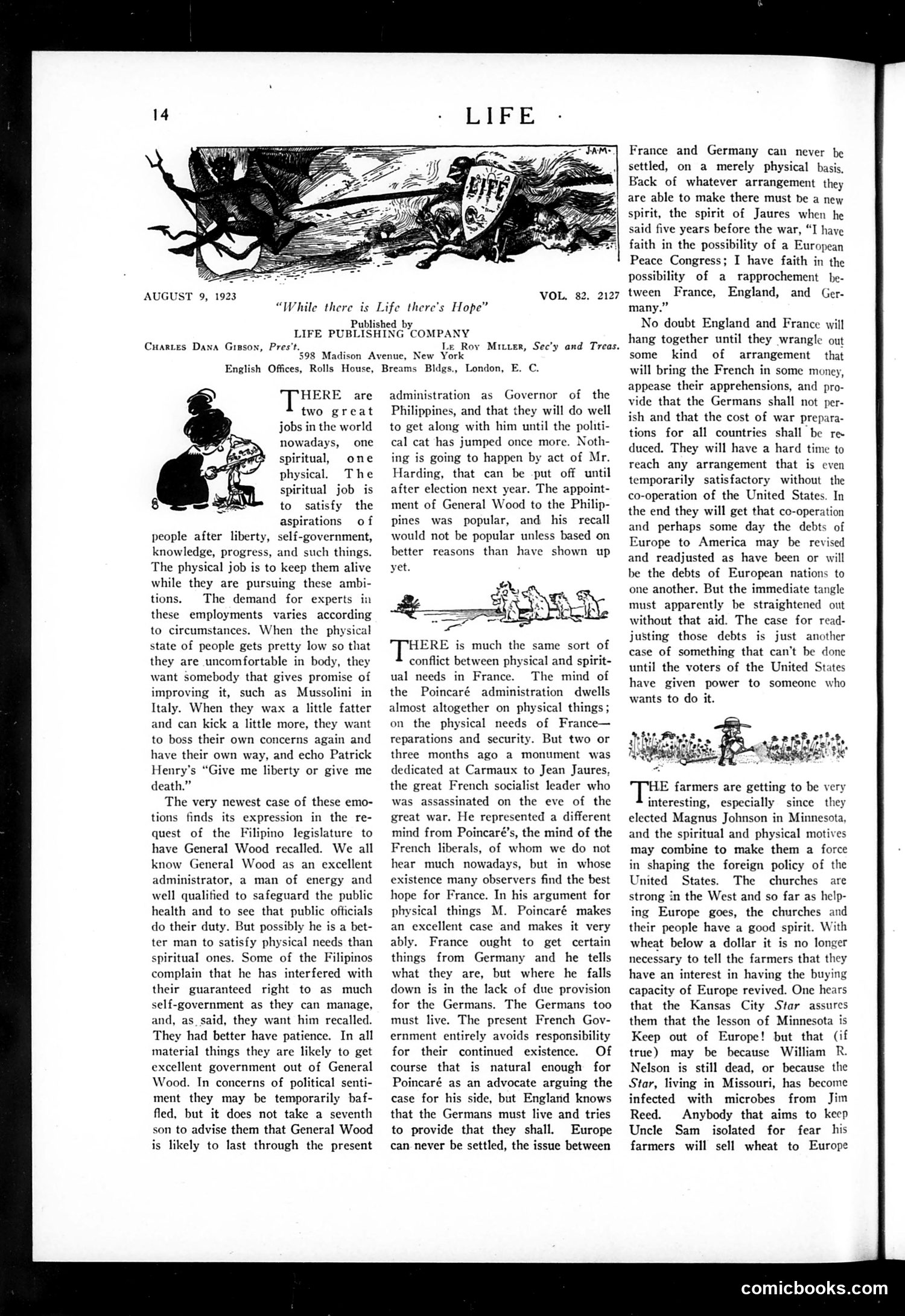
The main cartoon depicts a dead or dying figure labeled "LIFE" amid destruction, symbolizing the struggle for peace in post-World War I Europe. The article discusses tensions between France and Germany, arguing their conflict cannot be resolved through physical force alone but requires spiritual reconciliation—echoing Jean Jaurès, the French socialist leader assassinated before WWI. The piece criticizes General Wood's administration in the Philippines and addresses American farmers' concerns about European debt and wheat exports. It advocates for U.S. involvement in stabilizing Europe economically and spiritually, warning that isolationism ("Keep out of Europe!") won't work. The underlying message: American political and spiritual leadership is necessary for European recovery and global peace.
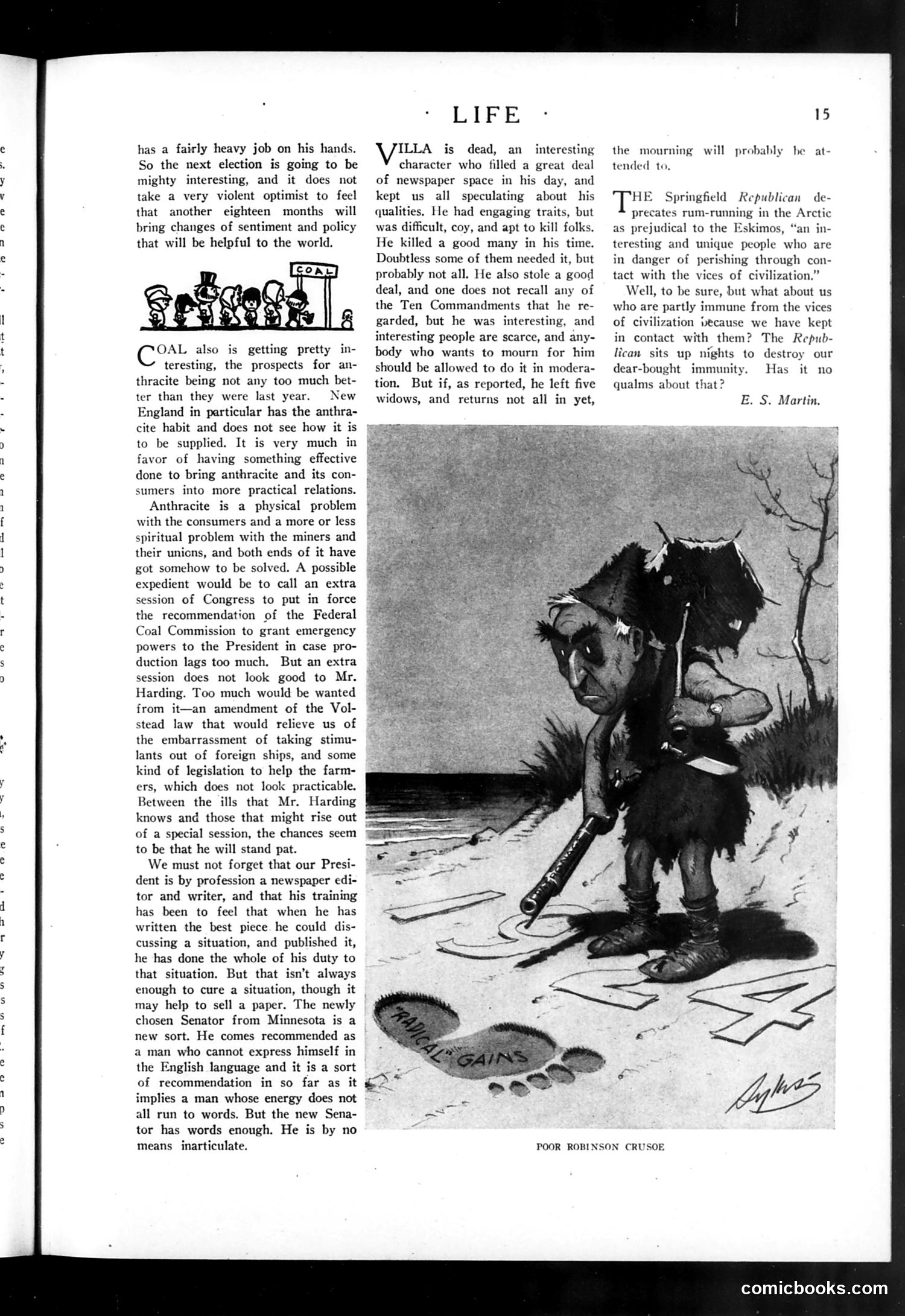
The main cartoon, titled "Poor Robinson Crusoe," depicts a man (likely representing American consumers or the working class) surrounded by bare footprints in sand, stranded and destitute. He appears trapped or overwhelmed. The satire critiques **post-WWI American economic hardship**, specifically the **anthracite coal shortage** discussed in the text. The article explains New England's dependence on anthracite heating fuel and notes supply problems worse than the previous year. The "Robinson Crusoe" reference—a castaway isolated and abandoned—represents ordinary Americans left helpless by coal industry failures and labor disputes between miners' unions and consumers. The cartoon mocks President Harding's passive approach: rather than convening Congress for emergency powers to address production shortfalls (as a Federal Coal Commission recommended), Harding avoids action. The stranded figure symbolizes citizens abandoned to fend for themselves during an energy crisis, while political leaders offer only published rhetoric instead of solutions. The "gains" footprints suggest lost economic progress amid scarcity.
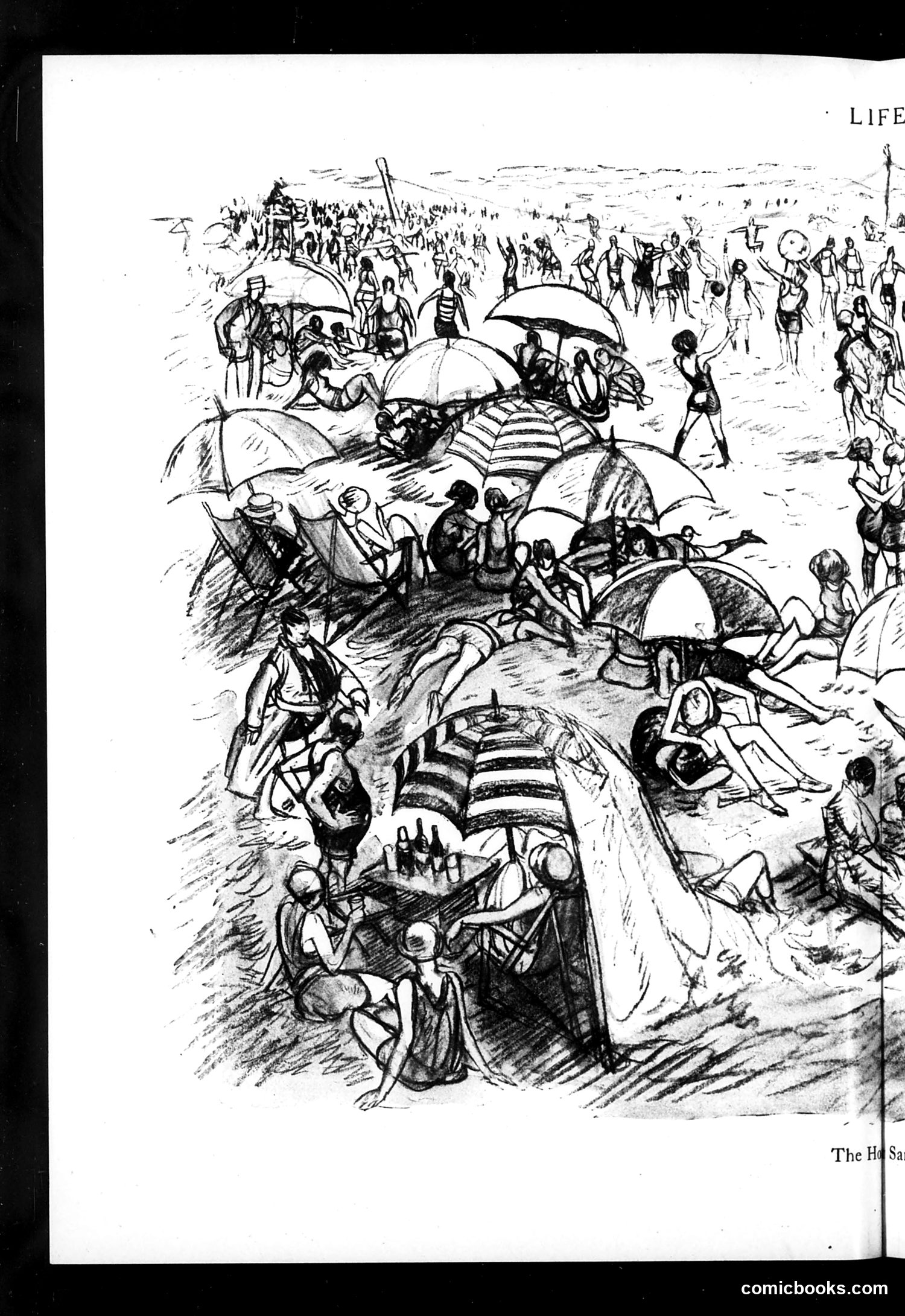
This page from *Life* magazine depicts a crowded beach scene in black-and-white pen illustration. The cartoon satirizes beach culture, showing numerous beachgoers packed together under umbrellas and parasols, swimming, and lounging on the sand. The satire appears to target the commercialization and overcrowding of American beaches—a popular leisure destination. The densely packed composition emphasizes how beaches had become mobbed tourist attractions rather than peaceful retreats. Various social types are visible: fashionable swimmers, families, and idle loungers. The OCR text is largely illegible, preventing identification of specific captions or references. Without clearer text, the precise political or social critique remains unclear, though the overall message critiques mass tourism and beach culture's popularity during what appears to be an early-to-mid 20th century period.
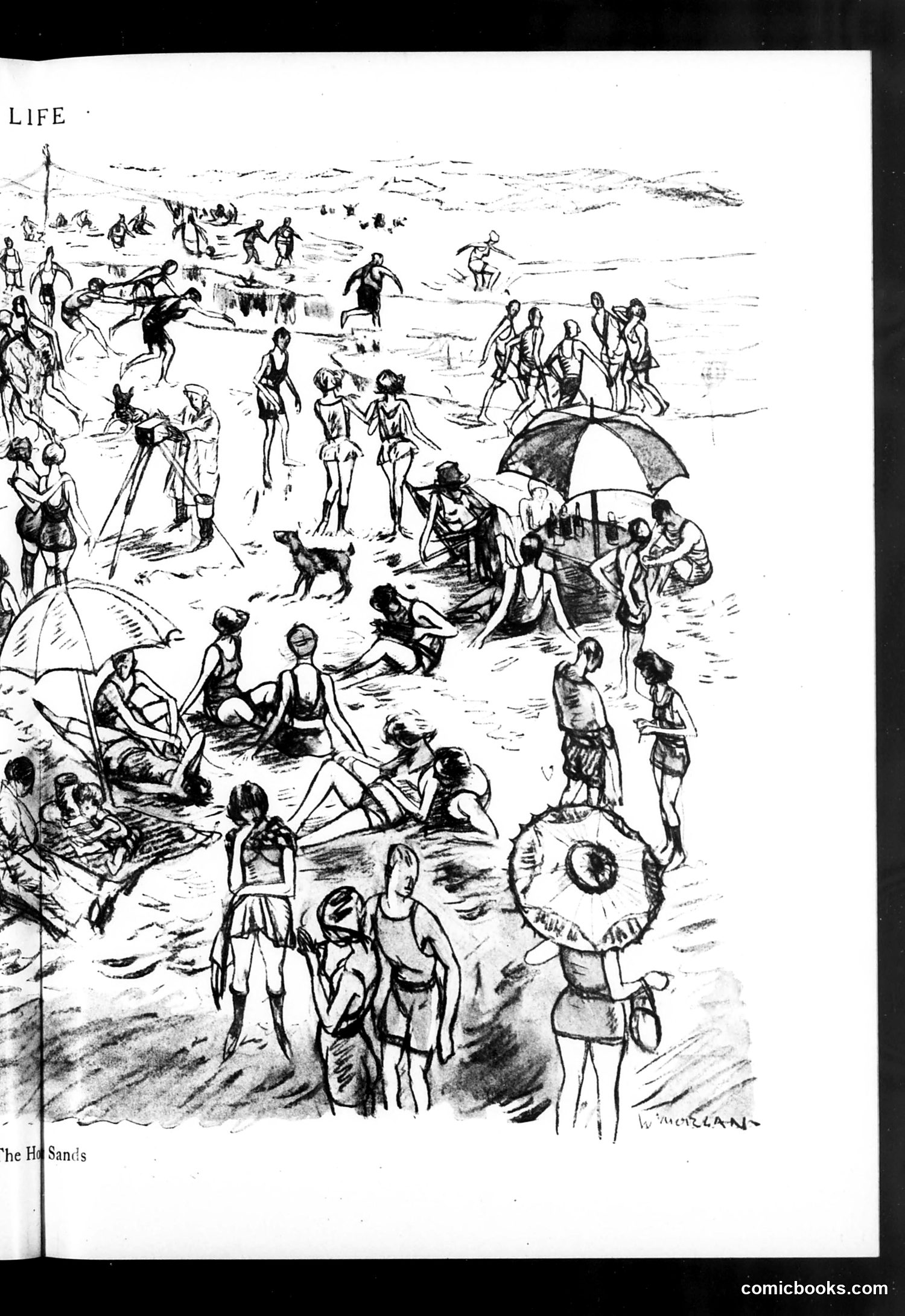
This is a beach scene illustration titled "Life" (visible at top left), depicting a crowded seaside during what appears to be the early-to-mid 20th century. The drawing shows numerous beachgoers engaged in typical leisure activities: swimming, sunbathing under umbrellas, playing with beach balls, and socializing. The satire appears to comment on **modern leisure culture and beach society**—the crowding, the variety of bathing costumes, the social hierarchies visible in groupings, and the performative nature of beach recreation. The artist's signature appears lower right but is partially illegible. Without additional context or caption text beyond "LIFE," the specific satirical target remains somewhat unclear—though it likely critiques either the commercialization of beach culture or social pretension among vacationing Americans.
This page reviews a 1924 fashion show that doubles as theatrical entertainment. The satire targets how Broadway productions, particularly fashion spectacles, recycled tired comedy material under thin pretexts. The main joke: the review notes that while the show credits gowns to their designers (a novelty), the comedy sketches are suspiciously unoriginal—drawn from earlier productions like *Follies of 1923* and *Columbia Burlesque*. The author sarcastically suggests crediting them all to "The Eureka Vegetable Co." (implying they're vegetables/old hat). The sole exception is **Jimmy Hussey**, a Jewish-dialect comedian praised effusively for transforming mediocre material through sheer talent and personality. The irony that Hussey is "Irish" (not Jewish, despite his accent work) adds humorous contradiction. The piece celebrates genuine theatrical artistry while mocking the production's reliance on recycled comedy—a critique of Broadway's formula-driven approach to musical theater in the Jazz Age.
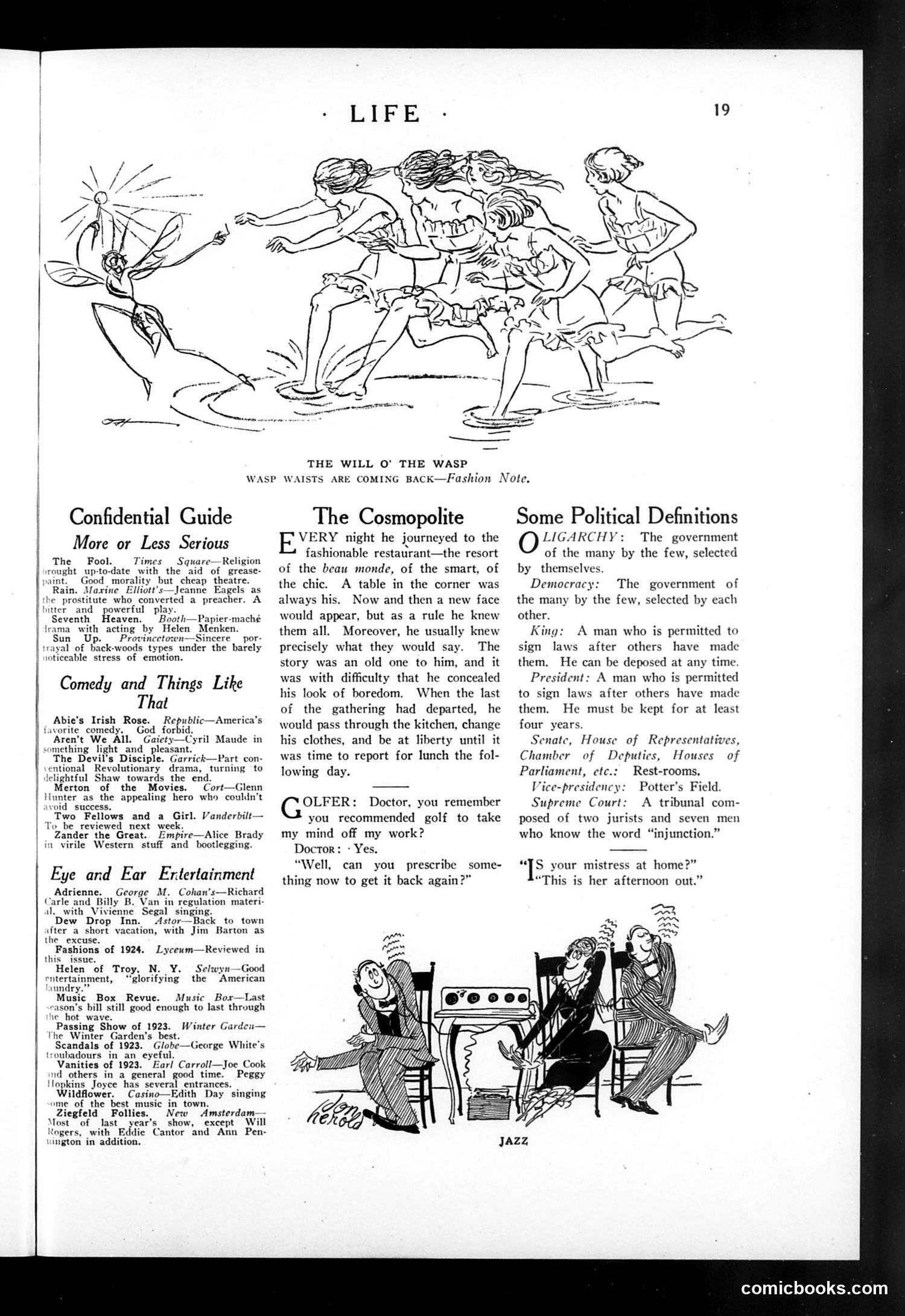
**Top Cartoon - "The Will O' The Wasp":** A satirical drawing shows women chasing a tiny wasp figure. The caption "Wasp Waists Are Coming Back" references the fashion trend of tight corsets that cinch the waist—a jab at women's fashion cycles where uncomfortable styles periodically return despite being abandoned. **Middle Cartoon - "The Cosmopolite":** A brief story mocking a fashionable restaurant regular who frequents the trendy establishment nightly, pretends to enjoy the scene, then returns to mundane work. The satire targets the performative nature of high society and fashionable leisure. **Bottom Cartoon - "Jazz":** Shows people at a piano, likely mocking the era's jazz craze. **"Some Political Definitions":** Cynical one-liners defining government structures—oligarchy vs. democracy as essentially identical, presidents as less disposable than kings, and legislative bodies as mere "rest-rooms." This reflects 1920s American skepticism toward institutional politics. The page satirizes fashion obsessions, leisure culture, and political hypocrisy typical of the Jazz Age.
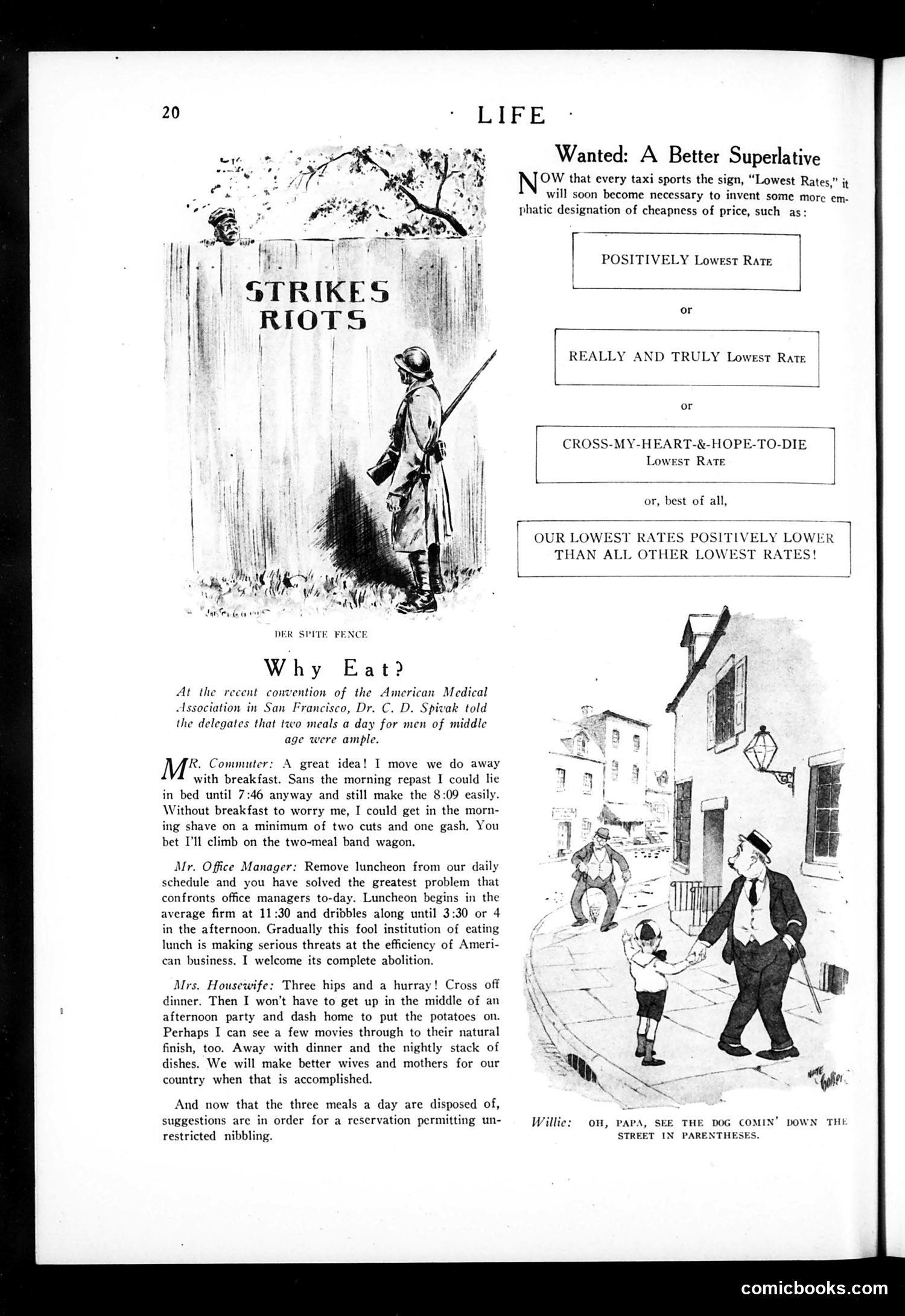
This page satirizes a 1920s medical convention where Dr. Spivak suggested two meals daily suffices for middle-aged men. Life presents three self-interested figures eagerly endorsing meal elimination: - **Mr. Commuter** wants to skip breakfast for extra sleep - **Mr. Office Manager** sees eliminating lunch as solving workplace inefficiency - **Mrs. Housewife** celebrates ditching dinner to attend afternoon parties uninterrupted The satire mocks how each group distorts a medical recommendation to serve personal convenience rather than health. The housewife's comment about becoming "better wives and mothers" particularly highlights the absurdity—abandoning family meals supposedly improves domesticity. The second section jokes about taxi advertising: as "Lowest Rates" becomes ubiquitous, increasingly absurd superlatives are needed to stand out ("Cross-my-heart-&-hope-to-die Lowest Rate"). This mocks commercial hyperbole and competitive pricing claims.
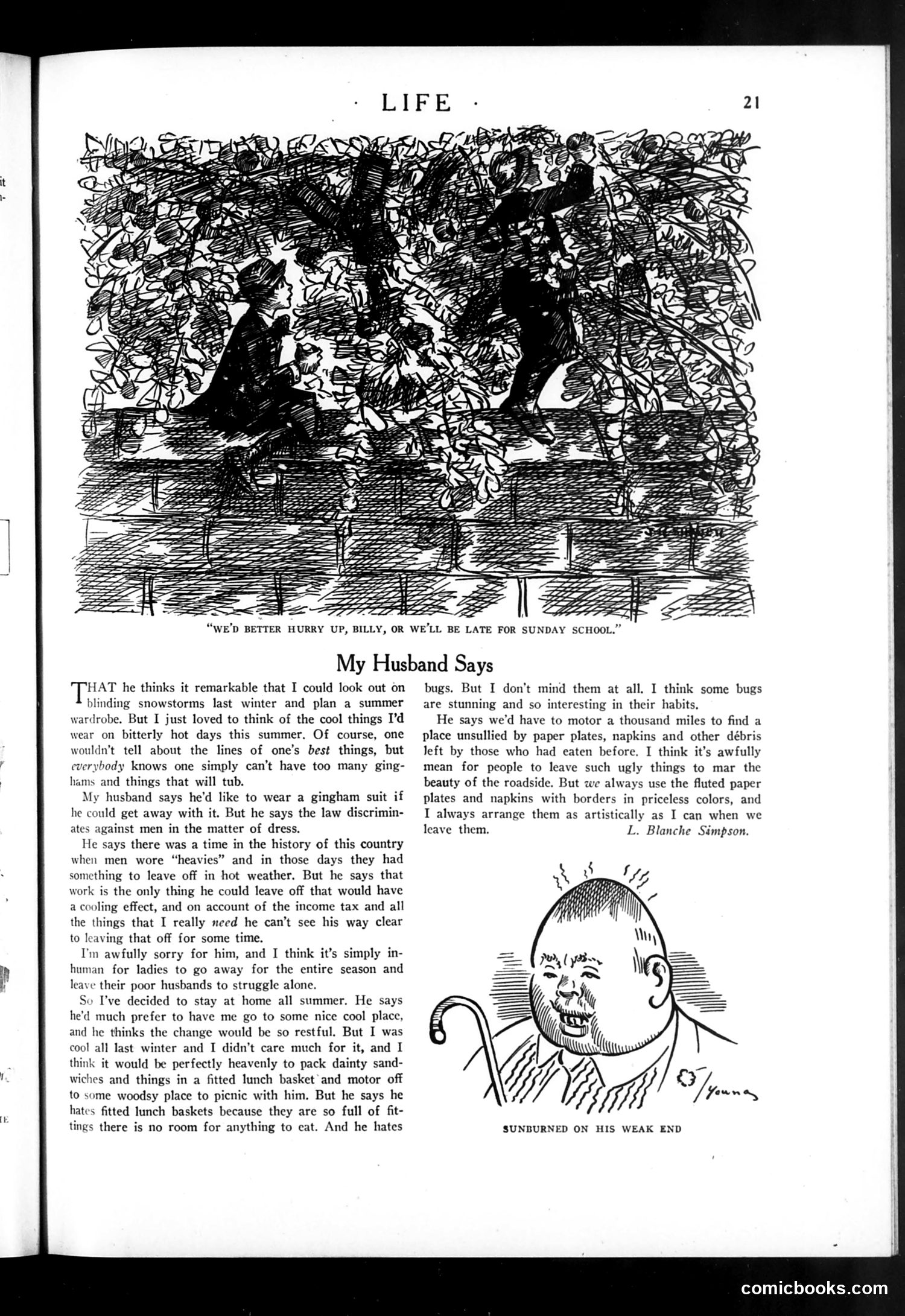
This is a domestic humor column with accompanying cartoons satirizing married life and gender roles in early-to-mid 20th century America. **Top cartoon:** Shows children rushing past ivy-covered fence with caption about hurrying to Sunday school—a gentle joke about childhood reluctance toward religious obligation. **Main column:** Written by L. Blanche Simpson, it humorously portrays a wife's perspective on her husband's complaints. He gripes about dress codes (men can't wear comfortable gingham suits due to social convention), summer heat, income taxes preventing him from taking time off, and her proposed summer picnics with their impracticalities (fitted lunch baskets, bugs, litter on roadsides). **Bottom cartoon:** A caricatured sunburned face labeled "Sunburned on his weak end"—presumably the husband from the column, depicting the physical consequence of his leisure time spent outdoors. The satire gently mocks both spouses: the husband's complaints and social constraints, and the wife's oblivious, cheerful domesticity. It reflects period anxieties about work, income, and marital dynamics.
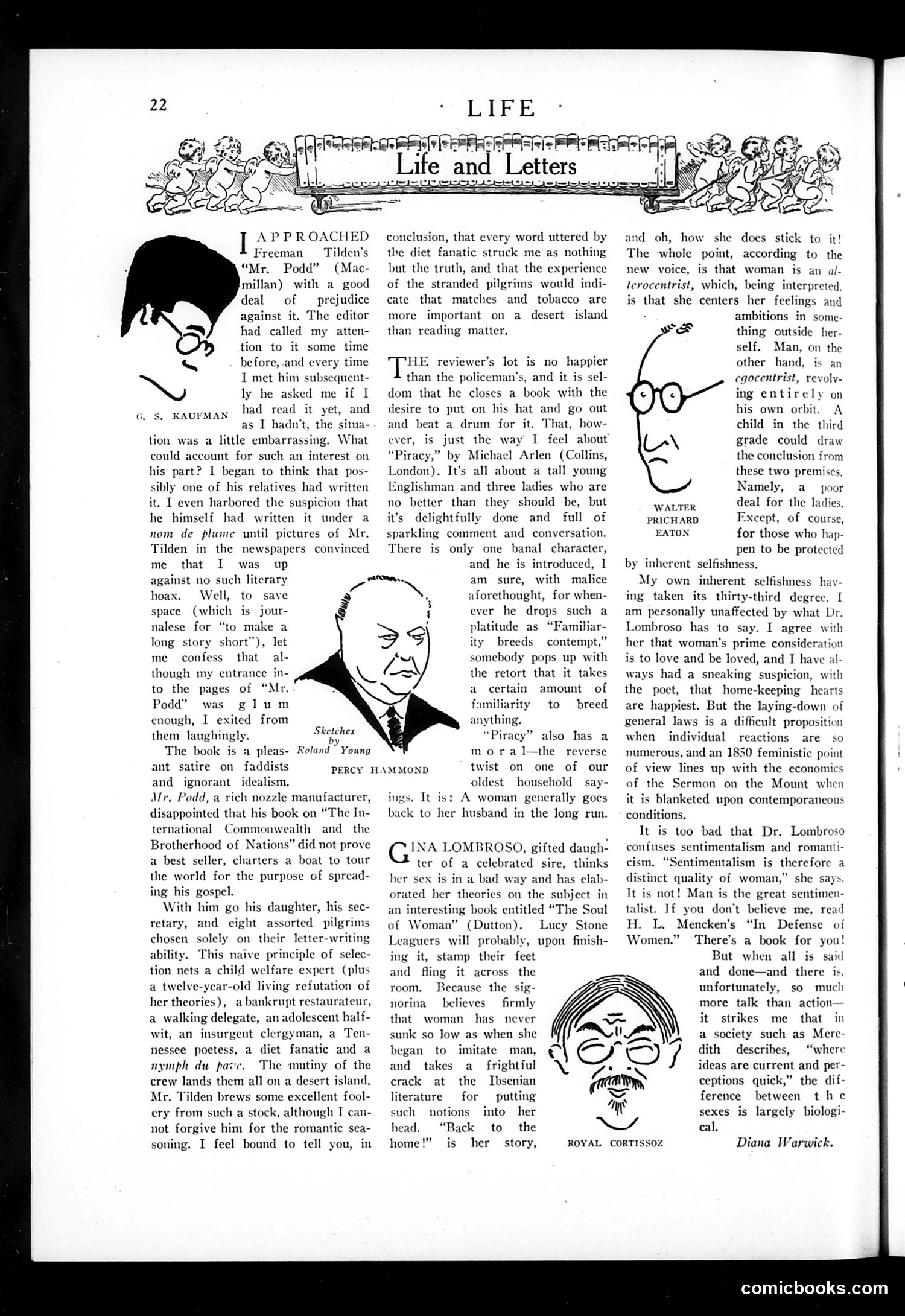
This page features book reviews by prominent critics. The **sketches** (caricatures) identify the reviewers: **Freeman Tilden**, **Percy Hammond**, **Walter Prichard Eaton**, and **Royal Cortissoz** — all recognizable public figures in early 20th-century literary criticism. The reviews satirize contemporary social preoccupations: - **"Mr. Podd"** by Freeman Tilden mocks utopian idealists and faddists (including a "diet fanatic") — a jab at progressive reformers - **"Piracy"** by Michael Arlen is dismissed as romantic pulp with banal moralizing - **"The Soul of Woman"** by Gina Lombroso attacks feminist ideology, particularly the "Ibsenian" movement (women imitating men), advocating instead for traditional domesticity ("Back to the home!") The cartoons use exaggerated features typical of period caricature. The underlying tone is conservative, mocking both naive idealism and emerging women's rights movements as foolish trends.
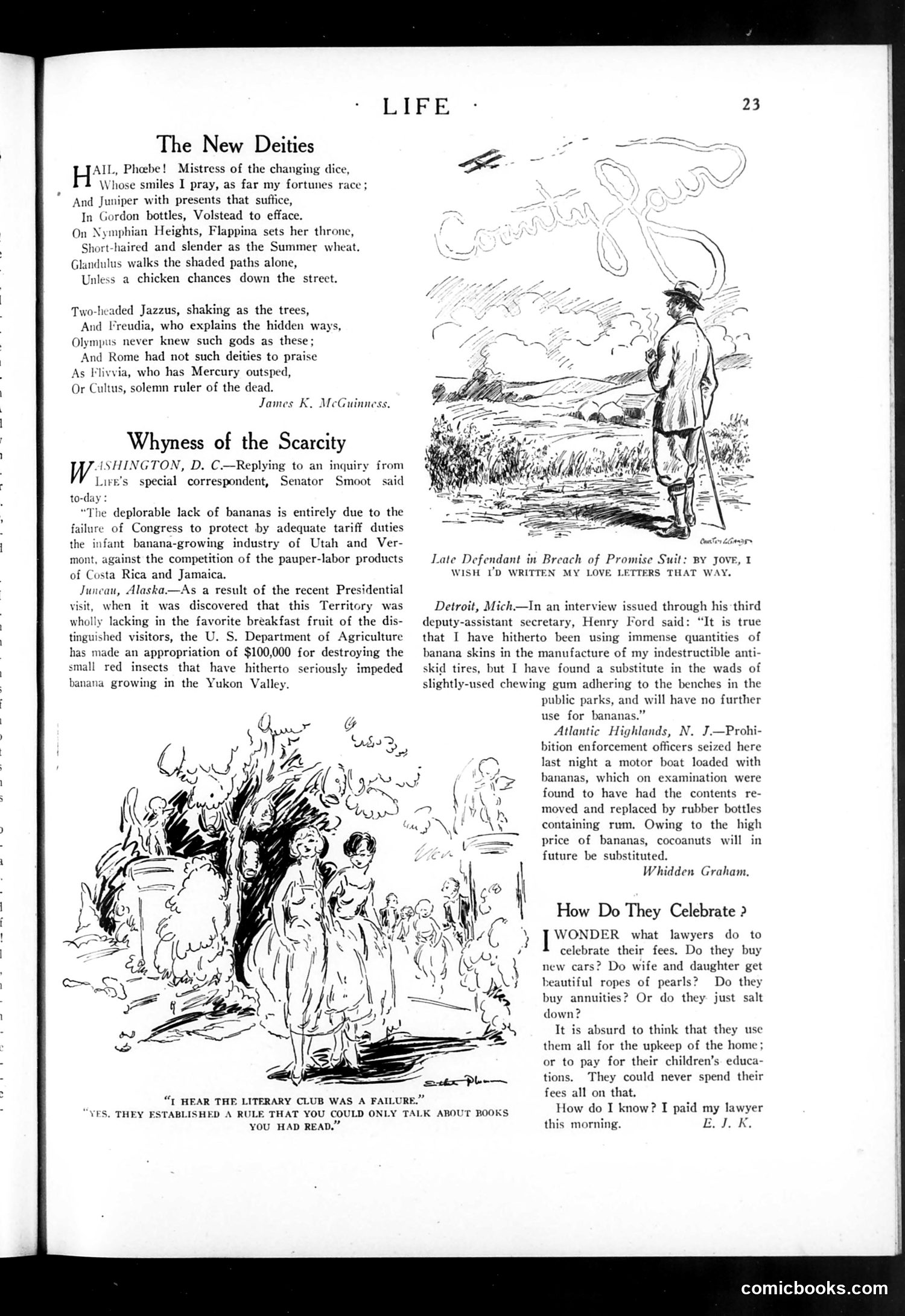
This page satirizes 1920s American culture through interconnected jokes about Prohibition, modern trends, and social absurdities. **"The New Deities"** mocks contemporary obsessions by treating them as gods: "Phebe" (chance/gambling), Volstead (Prohibition's enforcer), "Flappina" (the flapper craze), "Jazzus" (jazz), "Freudia" (Freudian psychology), and "Flivvia" (Ford automobiles). The satire suggests Americans worship modernity rather than traditional values. **"Whyness of the Scarcity"** ridicules Senator Smoot's protectionist tariff arguments by having him absurdly claim Utah and Vermont grow bananas, and reporting the government spent $100,000 fighting insects in the Yukon—obvious nonsense exposing legislative ridiculousness. The **smaller cartoons** mock Prohibition's failure (bananas smuggled as rum containers), Ford's opportunism (using chewing gum scraps), and literary pretension. **"How Do They Celebrate?"** sarcastically questions whether lawyers actually deserve their fees, suggesting they're overpaid. The page collectively critiques 1920s excess, government incompetence, and materialistic values.
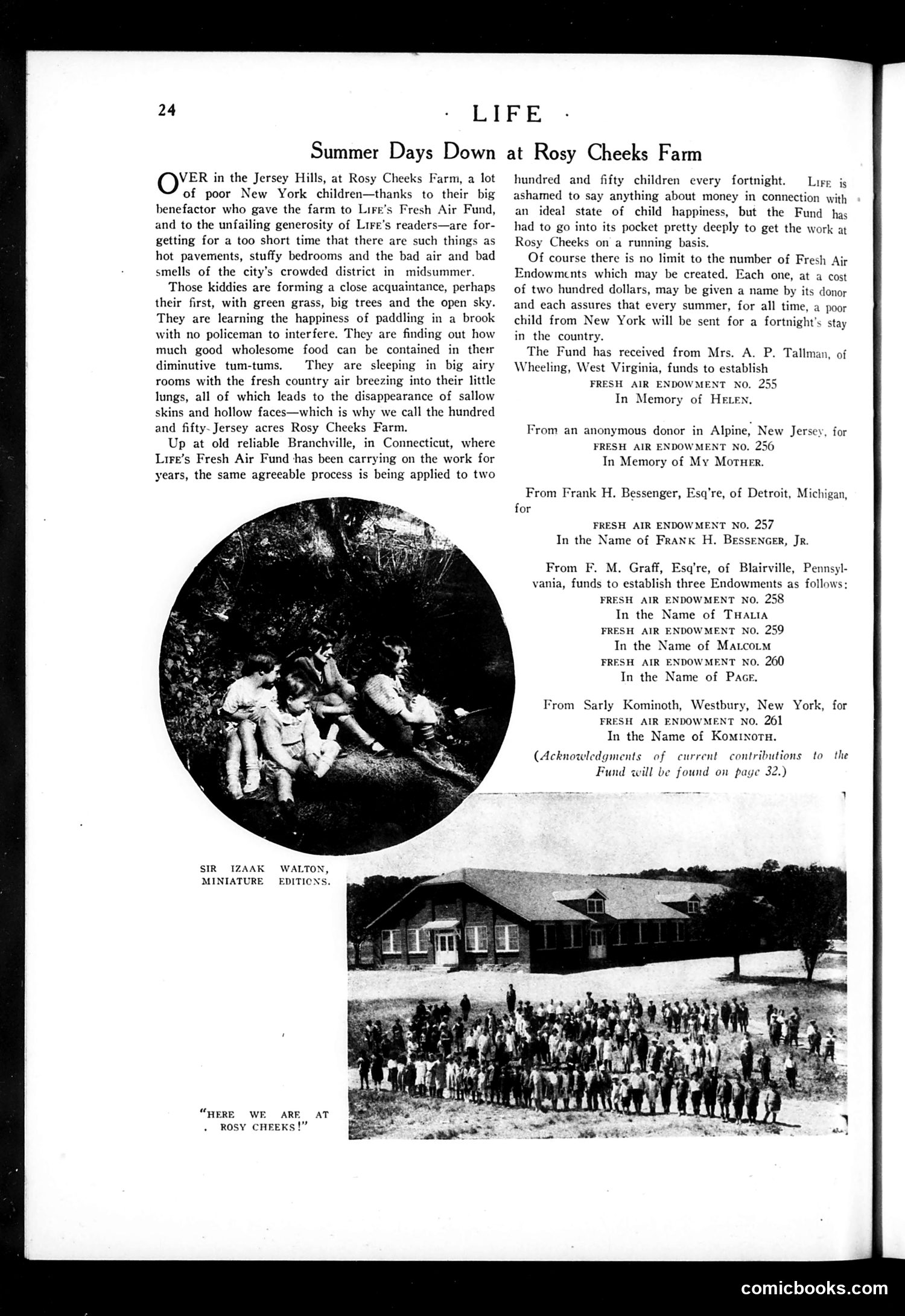
This is not a satirical cartoon but rather a **philanthropic feature** promoting Life magazine's Fresh Air Fund. The page describes a charitable program sending poor urban children from New York City to rural farms (in New Jersey and Connecticut) for summer respite. The two photographs show children experiencing countryside benefits—fresh air, green spaces, and wholesome food—contrasting with crowded city tenement conditions. The reference to "Sir Izaak Walton" (a famous angler) appears to be a whimsical caption. The bulk of the text lists donors who funded "Fresh Air Endowments" at $200 each, naming each gift in memory of deceased relatives or after living family members. This was Life's method of soliciting charitable contributions while publicly acknowledging donors—essentially advertising the charity to encourage further giving. **No satire or political commentary is present**; this is straightforward philanthropic advocacy typical of early-20th-century American magazine fundraising.
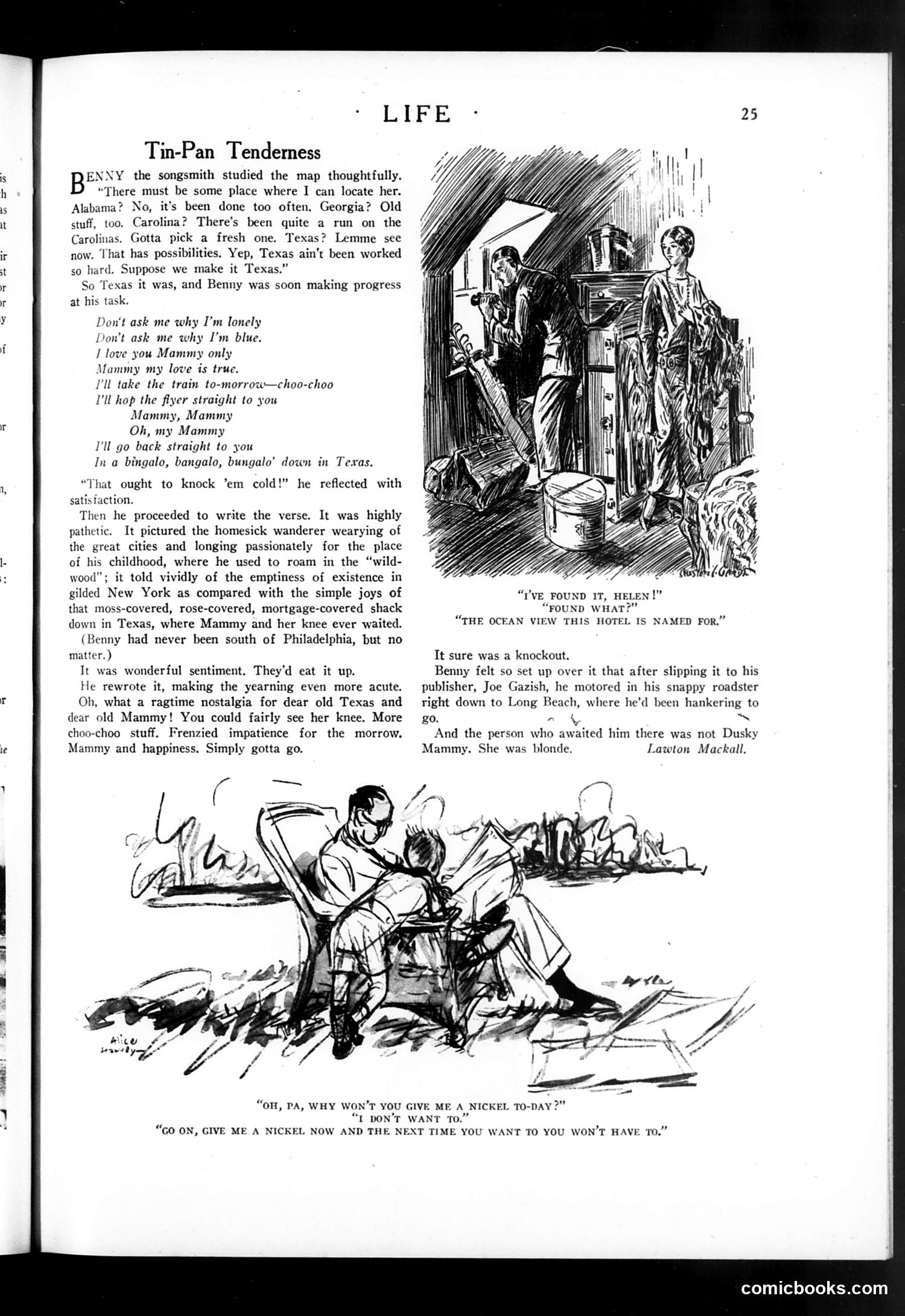
This satirizes popular songwriting in the early 20th century. "Benny the songsmith" cynically manufactures a sentimental hit song about longing for "Mammy" and Texas—deliberately choosing an under-exploited location to seem original. The joke is that he's never been south of Philadelphia, yet writes false nostalgia designed to manipulate audiences emotionally ("They'd eat it up"). The satire targets "Tin Pan Alley" songwriters who churned out formulaic, manipulative tear-jerkers exploiting homesickness and racial stereotypes for profit. The irony: Benny is so pleased with his fake sentiment that he abandons his own publisher to visit Long Beach—only to find his romantic interest is a blonde woman, not the stereotypical "Dusky Mammy" his song romanticizes. The lower cartoon appears unrelated, depicting a child's negotiating tactic with parents over allowance money.
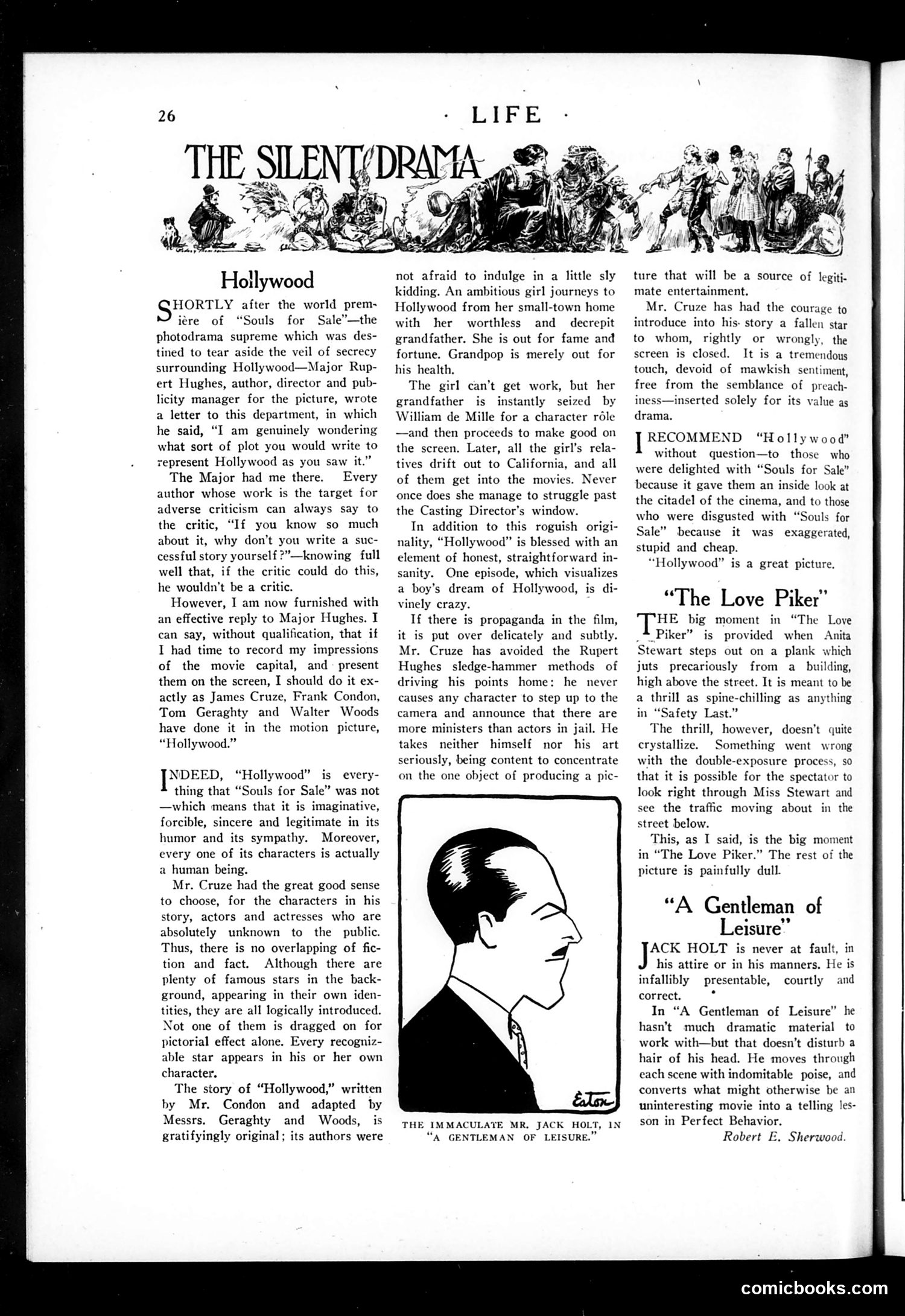
This page reviews three Hollywood films for a 1920s audience. The main critique compares "Hollywood" favorably to "Souls for Sale," praising its use of unknown actors over famous stars, sincere humor, and subtle storytelling. The reviewer appreciates that director James Cruze avoids heavy-handed propaganda—notably, he doesn't have characters lecture audiences about morality (the critic sarcastically mentions not announcing "there are more ministers than actors in jail"). The page also briefly reviews "The Love Piker" (criticized as dull) and praises "A Gentleman of Leisure," featuring Jack Holt (shown in the accompanying portrait sketch), for its polished performance. The central satire targets early Hollywood's tendency toward melodrama and moral preaching in film, favoring instead authentic storytelling and restraint.
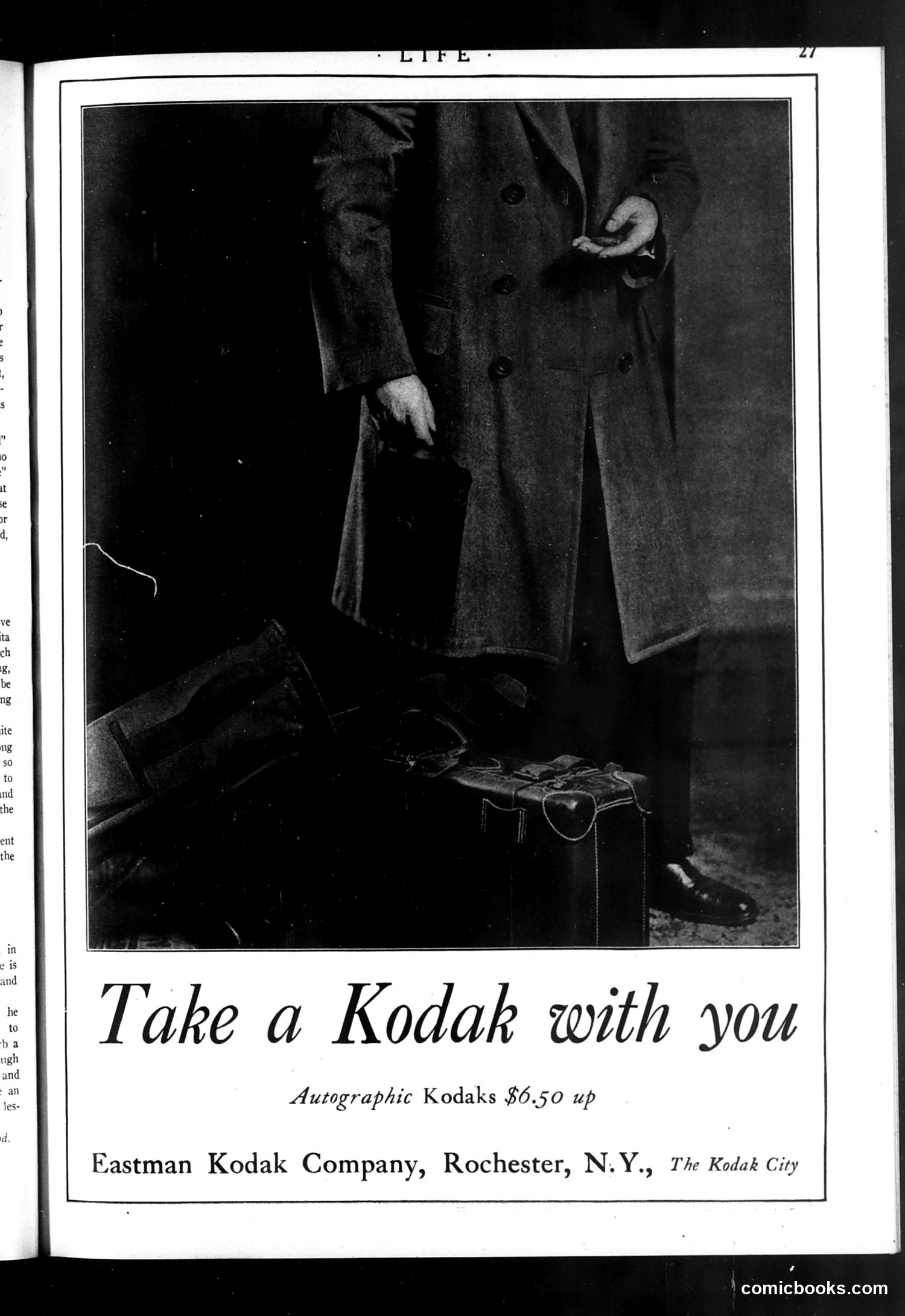
This is a Kodak camera advertisement, not political satire. The image shows a well-dressed man in a coat and hat holding a briefcase, with luggage at his feet, appearing ready to travel. The ad's message is straightforward: travelers should bring a Kodak camera to document their journeys. The "Take a Kodak with you" tagline emphasizes portability and practicality for capturing memories while traveling. The price point ("$6.50 up") for Autographic Kodaks suggests these were relatively accessible consumer cameras. The formal business attire of the figure suggests the advertisement targets middle-class professionals and affluent travelers—people with disposable income for both travel and photography equipment. This appears to be from Life magazine's advertising section rather than editorial content.
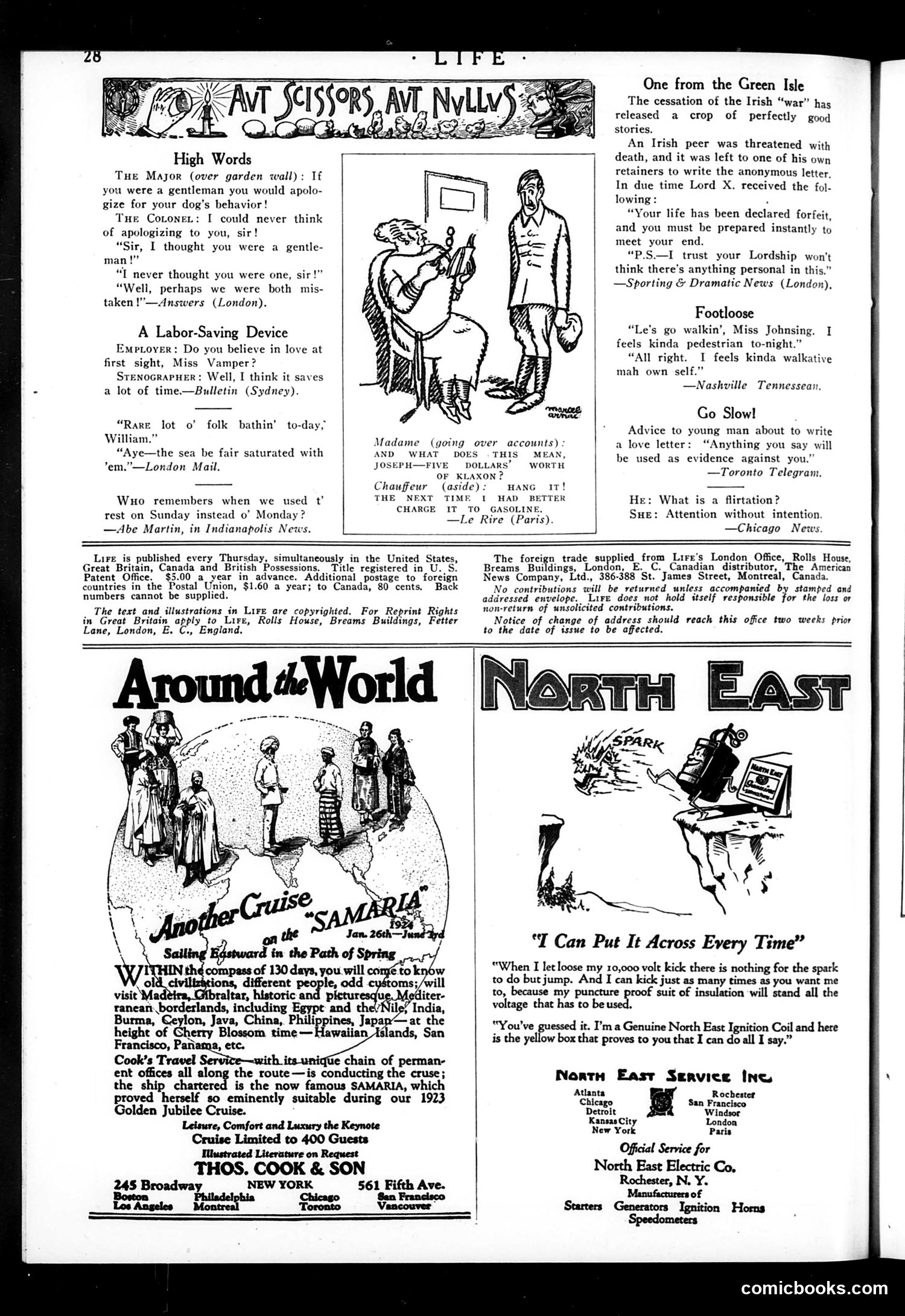
This page is primarily **humor and advertising** from Life magazine's humor section. The upper half contains brief satirical jokes reprinted from various publications: **Key humor items:** - **"High Words"**: A genteel insult exchange between neighbors over a dog—satire of British politeness masking mutual contempt - **"Labor-Saving Device"**: A stenographer claims love-at-first-sight saves time—mocking workplace romance - **"One from the Green Isle"**: An Irish peer receives an anonymous death threat ending with "P.S.—I trust your Lordship won't think there's anything personal"—dark satire on Irish political violence, likely referencing the recent Irish independence conflict ("cessation of the Irish 'war'") Other jokes mock stenographers, chauffeurs, and courting etiquette. **Lower half**: Advertisements for luxury cruise ships and ignition systems—unrelated to political content. The page reflects post-WWI humor focused on class dynamics, workplace relations, and—notably—the recently-ended Irish independence struggle.
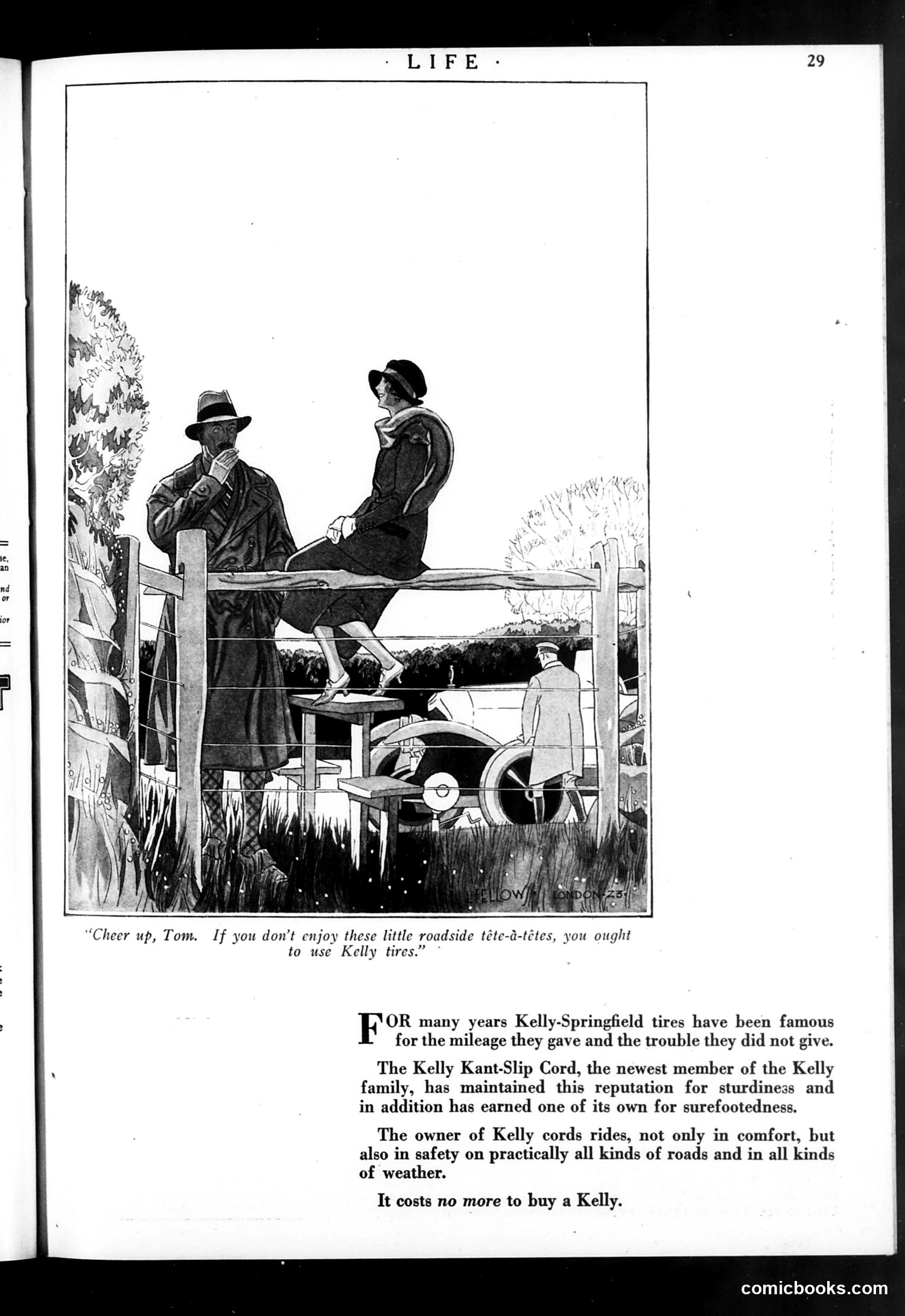
This is a **Kelly-Springfield tire advertisement** disguised as humor, not political satire. The cartoon depicts two well-dressed people at a roadside rest stop with a broken-down car below them. One says to "Tom" that if he doesn't enjoy these roadside encounters (suggesting car trouble), he should buy Kelly tires instead. The joke is straightforward advertising: Kelly tires prevent the mechanical failures that strand motorists at roadsides. The "téte-à-tête" (intimate conversation) reference is a light pun—suggesting that car trouble forces unwanted social situations. The ad copy promises Kelly's "Kant-Slip Cord" tires offer reliability, mileage, and safety in all weather conditions at competitive pricing. This reflects early 20th-century automotive advertising emphasizing tire durability as a key selling point when car travel remained relatively unreliable.
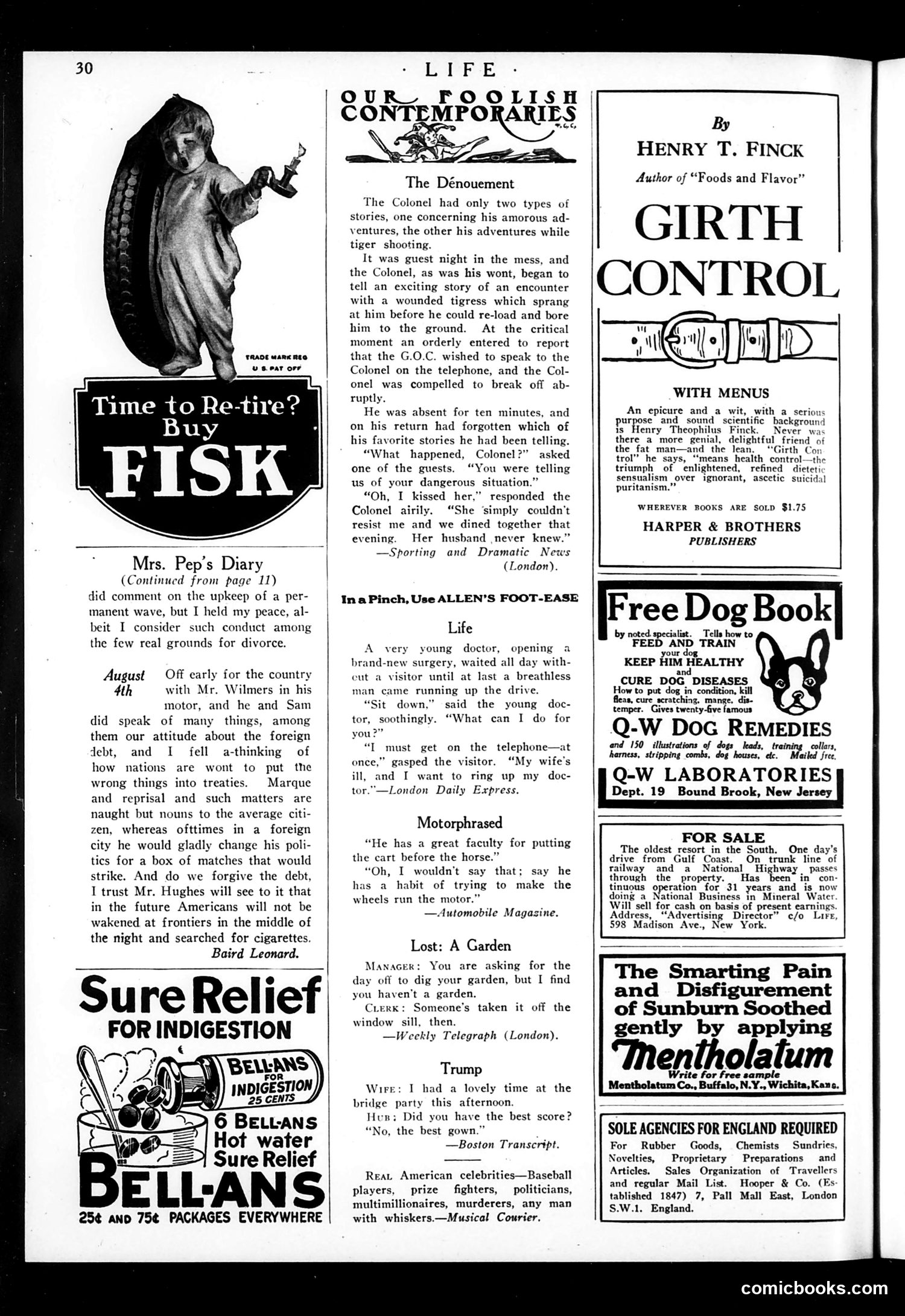
This page is primarily **advertisements and humor columns** rather than political satire. The **"Mrs. Pep's Diary"** column offers social commentary on 1920s concerns: permanent waves, foreign debt policy, and border searches for cigarettes—reflecting post-WWI anxieties about American frontier security and European financial obligations. The **humor sections** (titled "Life," "Denouement," "Motorphrased," etc.) are brief, standalone jokes typical of the era's magazine format—wordplay and situational humor rather than political cartoons. For instance, "Trump" jokes about a woman valuing her gown over bridge-game performance; "Lost: A Garden" punches at absent-mindedness. The **left-side illustration** shows a woman in a bathing suit advertising Fisk tires, using the phrase "Time to Re-tire?"—a visual pun playing on tire wear. The remainder consists of **product advertisements** (Bellans indigestion remedy, menthol products, dog training books) typical of magazine revenue. **No clear political satire is visible on this page.**
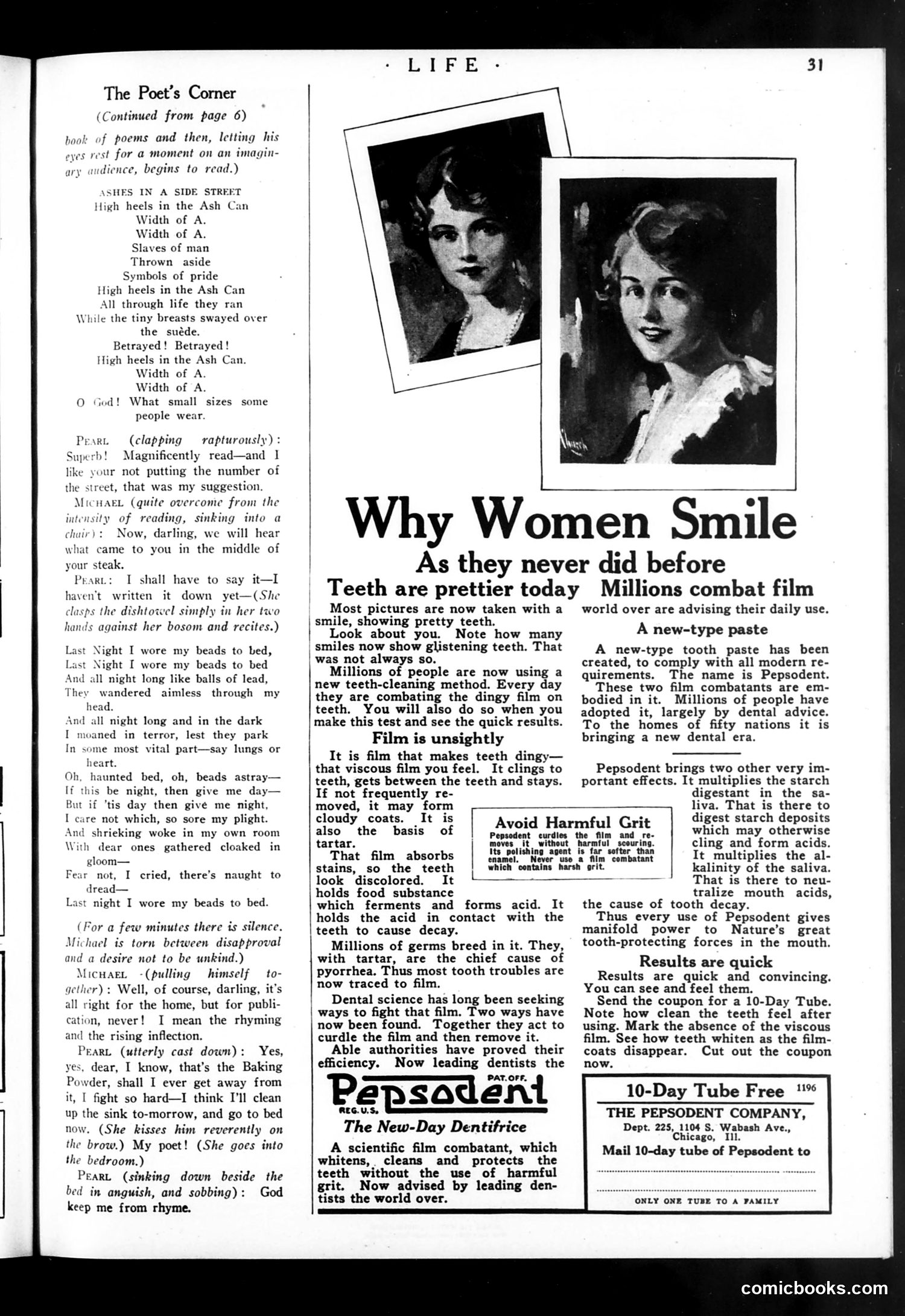
This page contains two distinct elements: a satirical literary sketch and a toothpaste advertisement. **The Poet's Corner sketch** depicts an imaginary poetry reading where characters Michael and Pearl recite pretentious, modernist verse about "ashes," "beads," and existential anguish. The satire targets the self-importance of avant-garde poets and literary circles of the early 20th century—their dramatic delivery, obscure symbolism, and affected earnestness. When Michael becomes "quite overcome" reading about dingy film on teeth mid-poem, the absurdist humor mocks how disconnected such poetry is from ordinary reality. **The Pepsodent advertisement** dominates the right side, promoting a "new-type" toothpaste that combats film buildup on teeth. It emphasizes scientific authority ("dental science"), widespread adoption ("millions"), and visible results. The two portrait photographs of women smiling display the product's promised benefit: gleaming teeth. The page's juxtaposition—high modernist pretension alongside commercial tooth-whitening claims—creates unintentional irony typical of Life's satirical approach to American culture.
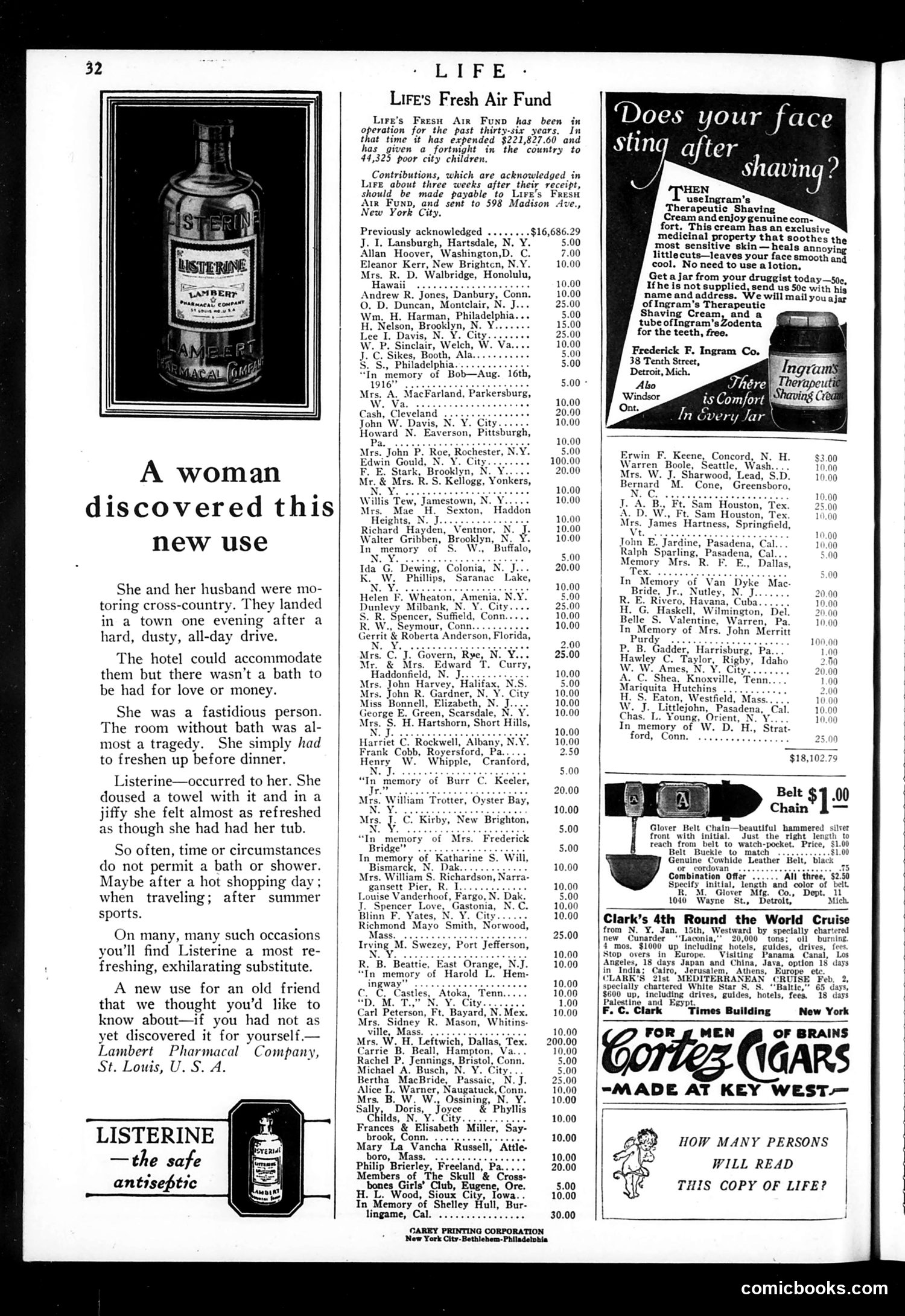
This page is primarily **advertising and donor acknowledgments**, not political satire. The main content includes: 1. **Listerine advertisement** (left): A narrative ad claiming a woman used mouthwash as a substitute for bathing during travel when hotel accommodations lacked bathrooms. This reflects early 20th-century advertising's tendency to promote products for unexpected uses—here suggesting Listerine could replace actual hygiene. 2. **Life's Fresh Air Fund** (center): A legitimate charitable listing acknowledging donations to send poor city children to the countryside for two weeks. This was Life magazine's actual philanthropic initiative. 3. **Ingram's Shaving Cream advertisement** (top right): Standard product promotion. 4. **Cortes Cigars advertisement** (bottom right): Promotional content. The page contains no political cartoons or satirical commentary—it's a typical early-to-mid 20th-century magazine page mixing editorial content with advertising revenue.
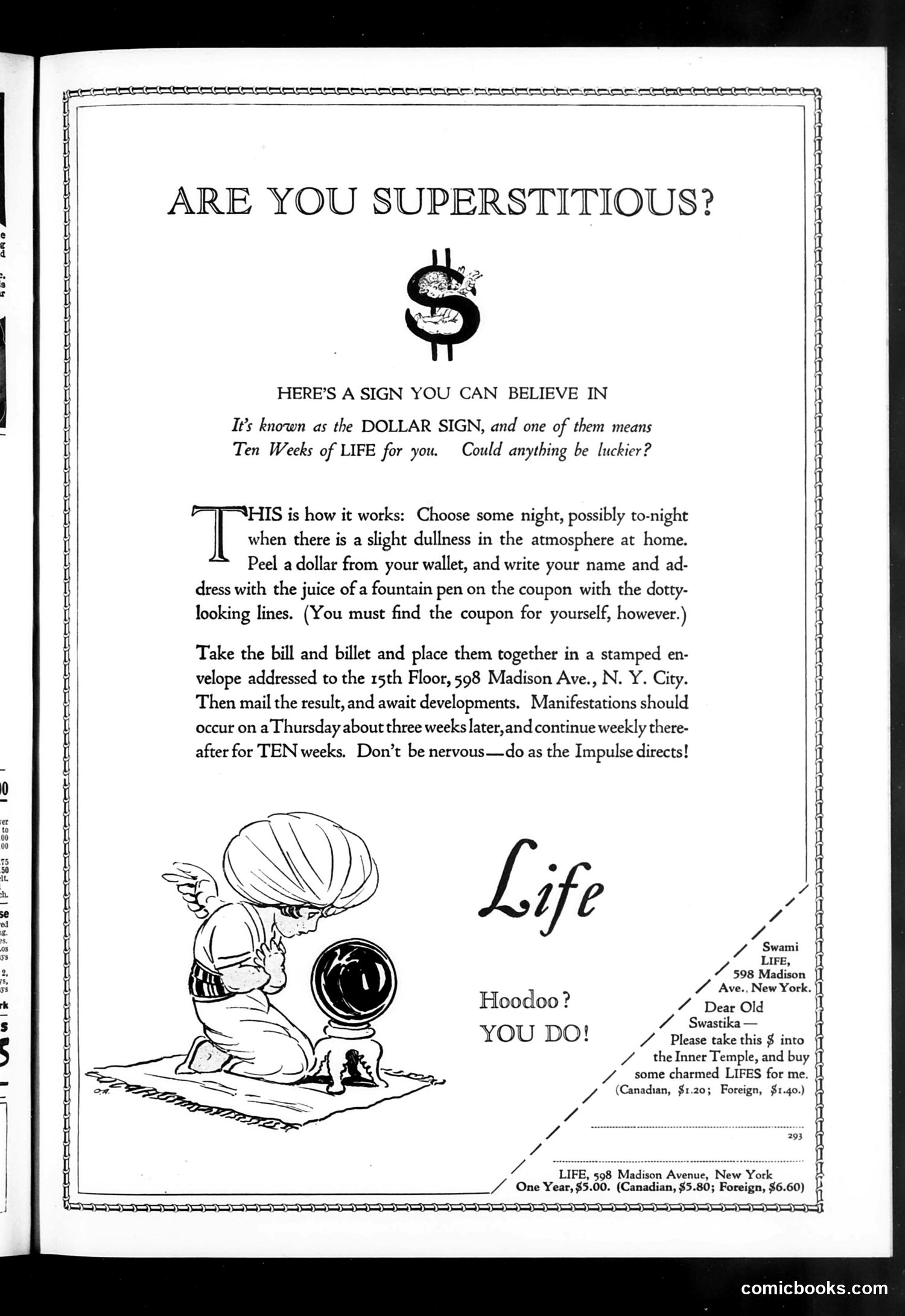
This is a satirical advertisement for *Life* magazine disguised as a superstition-based promotion. The page mocks both superstition and the magazine's own desperation for subscribers. The central joke plays on the "dollar sign" as a lucky symbol—but the actual luck being promised is simply receiving ten weeks of the magazine. Readers are instructed to mail a dollar bill (written on with fountain pen) to the magazine's address, playing into superstitious rituals (choosing the right night, awaiting "manifestations"). The illustration shows a figure performing a "hoodoo" ritual with a crystal ball, satirizing mystical beliefs. A sidebar advertisement for "charmed LIFES" reinforces the mockery, referencing both spiritual practices and the magazine's name. The satire targets gullible readers attracted to superstition while simultaneously poking fun at magazine subscription tactics—essentially equating them with magical thinking. The piece uses period-appropriate references to mysticism and numerology to create humor.
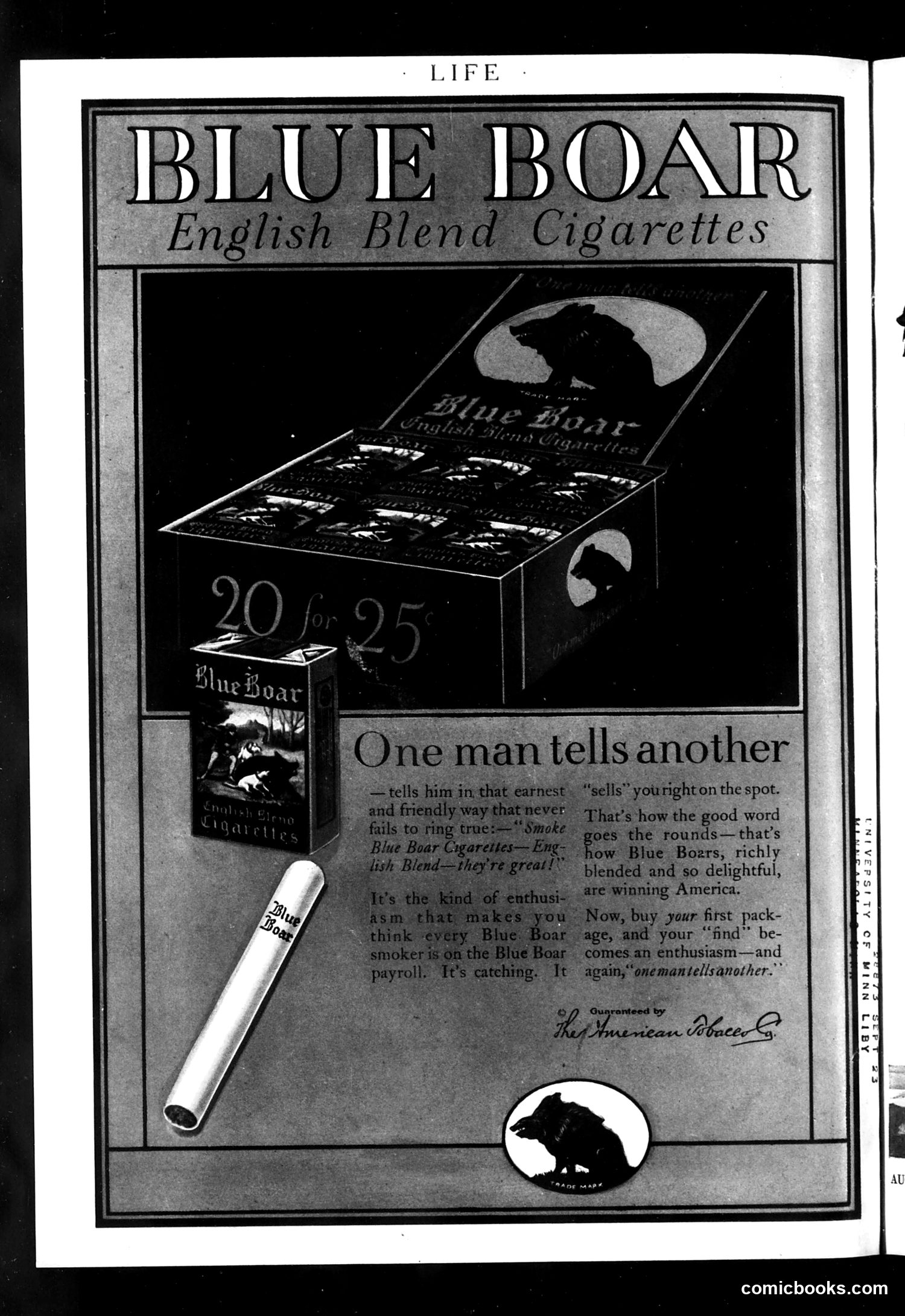
This is a cigarette advertisement, not a political cartoon. It promotes Blue Boar English Blend cigarettes with the slogan "One man tells another." The ad uses a boar (wild pig) as its mascot, depicted in silhouette form. The marketing pitch emphasizes word-of-mouth recommendation—smokers enthusiastically telling friends about the product's quality. The copy stresses the cigarettes are "richly blended and so delightful" and "winning America." A pack costs "20 for 25¢" and is "Guaranteed by the American Tobacco Co." For modern readers, this represents pre-regulation cigarette advertising that openly promoted smoking without health warnings. The emphasis on peer recommendation reflects early 20th-century marketing psychology.