
Life, 1923-08-09 · page 28 of 36
Life — August 9, 1923 — page 28: what you’re looking at
What you’re looking at
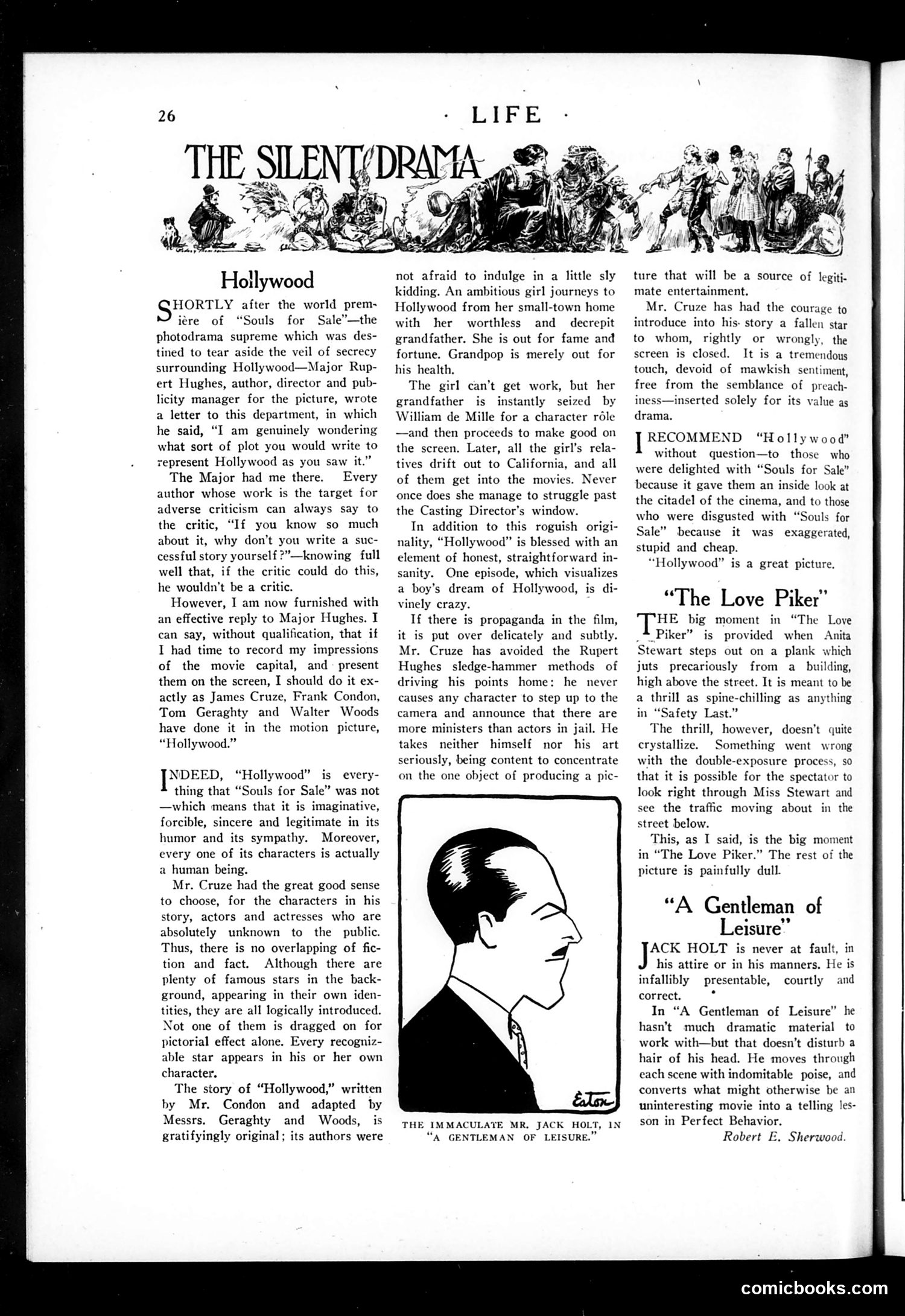
This page reviews three Hollywood films for a 1920s audience. The main critique compares "Hollywood" favorably to "Souls for Sale," praising its use of unknown actors over famous stars, sincere humor, and subtle storytelling. The reviewer appreciates that director James Cruze avoids heavy-handed propaganda—notably, he doesn't have characters lecture audiences about morality (the critic sarcastically mentions not announcing "there are more ministers than actors in jail"). The page also briefly reviews "The Love Piker" (criticized as dull) and praises "A Gentleman of Leisure," featuring Jack Holt (shown in the accompanying portrait sketch), for its polished performance. The central satire targets early Hollywood's tendency toward melodrama and moral preaching in film, favoring instead authentic storytelling and restraint.
📄 Transcribed text from this page (OCR, searchable)
Machine-transcribed from the original scan — historical spelling and the odd misread are preserved.
Hollywood HORTLY after the world prem- igre of “Souls for Sale”’—the photodrama supreme which was des- tined to tear aside the veil of secrecy surrounding Hollywood—Major Rup- ert Hughes, author, director and pub- licity manager for the picture, wrote a letter to this department, in which he said, “I am genuinely wondering what sort of plot you would write to represent Hollywood as you saw it.” The Major had me there. Every author whose work is the target for adverse criticism can always say to the critic, “If you know so much about it, why don’t you write a suc- cessful story yourself ?”—knowing full well that, if the critic could do this, he wouldn't be a critic. However, I am now furnished with an effective reply to Major Hughes. I can say, without qualification, that if I had time to record my impressions of the movie capital, and~ present them on the screen, I should do it ex- actly as James Cruze, Frank Condon, Tom Geraghty and Walter Woods have done it in the motion picture, “Hollywood.” ] NDEED, “Hollywood” is every- thing that “Souls for Sale” was not —which means that it is imaginative, forcible, sincere and legitimate in its humor and its sympathy. Moreover, every one of its characters is actually a human being. Mr. Cruze had the great good sense to choose, for the characters in his story, actors and actresses who are absolutely unknown to the public. Thus, there is no overlapping of fic- tion and fact. Although there are plenty of famous stars in the back- ground, appearing in their own iden- tities, they are all logically introduced. Not one of them is dragged on for pictorial effect alone. Every recogniz- able star appears in his or her own character. The story of “Hollywood,” written by Mr. Condon and adapted by Messrs. Geraghty and Woods, is gratifyingly original; its authors were not afraid to indulge in a little sly kidding. An ambitious girl journeys to Hollywood from her small-town home with her worthless and decrepit grandfather. She is out for fame and fortune. Grandpop is merely out for his health. The girl can’t get work, but her grandfather is instantly seized by William de Mille for a character rdle —and then proceeds to make good on the screen. Later, all the girl’s rela- tives drift out to California, and all of them get into the movies. Never once does she manage to struggle past the Casting Director’s window. In addition to this roguish origi- nality, “Hollywood” is blessed with an element of honest, straightforward in- sanity. One episode, which visualizes a boy’s dream of Hollywood, is di- vinely crazy. If there is propaganda in the film, it is put over delicately and subtly. Mr. Cruze has avoided the Rupert Hughes sledge-hammer methods of driving his points home: he never causes any character to step up to the camera and announce that there are more ministers than actors in jail. He takes neither himself nor his art seriously, being content to concentrate on the one object of producing a pic- THE IMMACULATE MR. JACK HOLT, 1N “A GENTLEMAN OF LEISURE.” ture that will be a source of legiti- mate entertainment. Mr. Cruze has had the courage to introduce into his: story a fallen star to whom, rightly or wrongly, the screen is closed. It is a tremendous touch, devoid of mawkish sentiment, free from the semblance of preach- iness—inserted solely for its value as drama. RECOMMEND “Hollywood” without question—to those who were delighted with “Souls for Sale” because it gave them an inside look at the citadel of the cinema, and to those who were disgusted with “Souls for Sale” because it was exaggerated, stupid and cheap. “Hollywood” is a great picture, “The Love Piker” HE big moment in “The Love _*Piker” is provided when Anita Stewart steps out on a plank which juts precariously from a_ building, high above the street. It is meant to be a thrill as spine-chilling as anything in “Safety Last.” The thrill, however, doesn’t quite crystallize. Something went wrong with the double-exposure process, so that it is possible for the spectator to look right through Miss Stewart and see the traffic moving about in the street below. This, as I said, is the big moment in “The Love Piker.” The rest of the picture is painfully dull. “A Gentleman of : ” Leisure ACK HOLT is never at fault, in his attire or in his manners, He is infallibly presentable, courtly and correct. ° In “A Gentleman of Leisure” he hasn’t much dramatic material to work with—but that doesn’t disturb a hair of his head. He moves through each scene with indomitable poise, and converts what might otherwise be an uninteresting movie into a telling les- son in Perfect Behavior. Robert E, Sherwood. comicbooks.com