
Life, 1923-08-09 · page 16 of 36
Life — August 9, 1923 — page 16: what you’re looking at
What you’re looking at
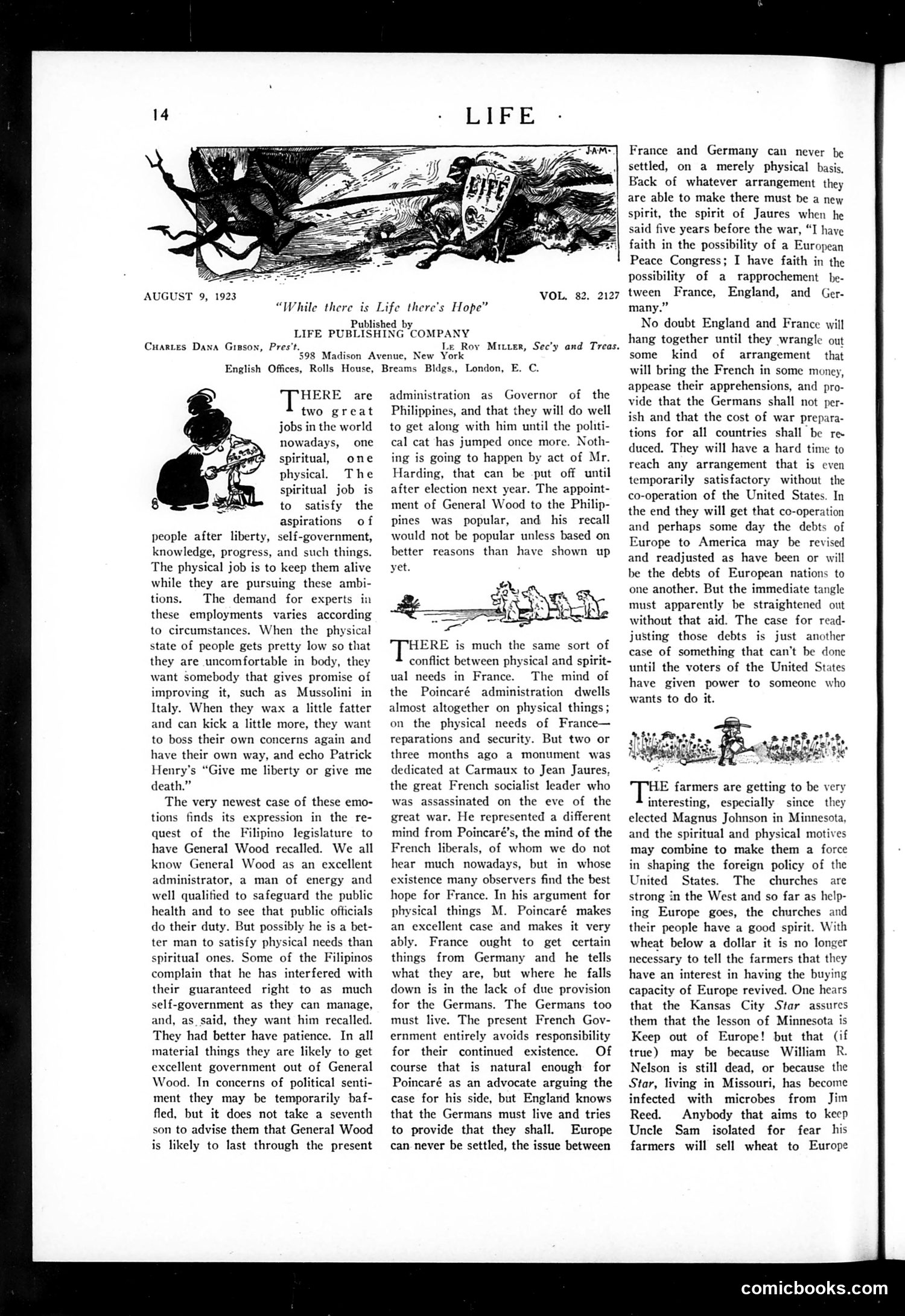
The main cartoon depicts a dead or dying figure labeled "LIFE" amid destruction, symbolizing the struggle for peace in post-World War I Europe. The article discusses tensions between France and Germany, arguing their conflict cannot be resolved through physical force alone but requires spiritual reconciliation—echoing Jean Jaurès, the French socialist leader assassinated before WWI. The piece criticizes General Wood's administration in the Philippines and addresses American farmers' concerns about European debt and wheat exports. It advocates for U.S. involvement in stabilizing Europe economically and spiritually, warning that isolationism ("Keep out of Europe!") won't work. The underlying message: American political and spiritual leadership is necessary for European recovery and global peace.
📄 Transcribed text from this page (OCR, searchable)
Machine-transcribed from the original scan — historical spelling and the odd misread are preserved.
AUGUST 9, 1923 VOL. 82. 2127 “While there is Life there's Hope” Published by LIFE PUBLISHING COMPANY Cuartes Dana Grasox, Pres't. : Rov Mutter, Sec’y and Treas. 5398 Madison Avenue, New York English Offices, Rolls House, Breams Bldgs., London, E. C. HERE are two great jobs in the world nowadays, one spiritual, one physical. The spiritual job is to satisfy the aspirations of people after liberty, self-government, knowledge, progress, and such things. The physical job is to keep them alive while they are pursuing these ambi- tions. The demand for experts in these employments varies according to circumstances. When the physical state of people gets pretty low so that they are uncomfortable in body, they want somebody that gives promise of improving it, such as Mussolini in Italy. When they wax a little fatter and can kick a little more, they want to boss their own concerns again and have their own way, and echo Patrick Henry's “Give me liberty or give me death.” The very newest case of these emo- tions finds its expression in the re- quest of the Filipino legislature to have General Wood recalled. We all know General Wood as an excellent administrator, a man of energy and well qualitied to safeguard the public health and to see that public officials do their duty. But possibly he is a bet- ter man to satisfy physical needs than spiritual ones. Some of the Filipinos complain that he has interfered with their guaranteed right to as much self-government as they can manage, and, as_said, they want him recalled. They had better have patience. In all material things they are likely to get excellent government out of General Wood. In concerns of political senti- ment they may be temporarily baf- fled, but it does not take a seventh son to advise them that General Wood is likely to last through the present administration as Governor of the Philippines, and that they will do well to get along with him until the politi- cal cat has jumped once more. Noth- ing is going to happen by act of Mr. Harding, that can be put off until after election next year. The appoint- ment of General Wood to the Philip- pines was popular, and his recall would not be popular unless based on better reasons than have shown up yet. "THERE is much the same sort of conflict between physical and spirit- ual needs in France. The mind of the Poincaré administration dwells almost altogether on physical things; on the physical needs of France— reparations and security. But two or three months ago a monument was dedicated at Carmaux to Jean Jaures, the great French socialist leader who was assassinated on the eve of the great war. He represented a different mind from Poincaré’s, the mind of the French liberals, of whom we do not hear much nowadays, but in whose existence many observers find the best hope for France. In his argument for physical things M. Poincaré makes an excellent case and makes it very ably. France ought to get certain things from Germany and he tells what they are, but where he falls down is in the lack of due provision for the Germans. The Germans too must live. The present French Gov- ernment entirely avoids responsibility for their continued existence. Of course that is natural enough for Poincaré as an advocate arguing the case for his side, but England knows that the Germans must live and tries to provide that they shall. Europe can never be settled, the issue between France and Germany can never be settled, on a merely physical basis, Back of whatever arrangement they are able to make there must be a new spirit, the spirit of Jaures when he said five years before the war, “I have faith in the possibility of a European Peace Congress; I have faith in the possibility of a rapprochement be- tween France, England, and Ger- many.” No doubt England and France will hang together until they wrangle out some kind of arrangement that will bring the French in some money, appease their apprehensions, and pro- vide that the Germans shall not per- ish and that the cost of war prepara- tions for all countries shall be re duced. They will have a hard time to reach any arrangement that is even temporarily satisfactory without the co-operation of the United States. In the end they will get that co-operation and perhaps some day the debts of Europe to America may be revised and readjusted as have been or will be the debts of European nations to one another. But the immediate tangle must apparently be straightened out without that aid. The case for read- justing those debts is just another case of something that can’t be done until the voters of the United States have given power to someone who wants to do it. gare pelts HE farmers are getting to be very interesting, especially since they elected Magnus Johnson in Minnesota, and the spiritual and physical motives may combine to make them a force in shaping the foreign policy of the United States. The churches are strong in the West and so far as help- ing Europe goes, the churches and their people have a good spirit. With wheat below a dollar it is no longer necessary to tell the farmers that they have an interest in having the buying capacity of Europe revived. One hears that the Kansas City Star assures them that the lesson of Minnesota is Keep out of Europe! but that (if true) may be because William R. Nelson is still dead, or because the Star, living in Missouri, has become infected with microbes from Jim Reed. Anybody that aims to keep Uncle Sam isolated for fear his farmers will sell wheat to Europe comicbooks.com