
Life, 1923-08-09 · page 17 of 36
Life — August 9, 1923 — page 17: what you’re looking at
What you’re looking at
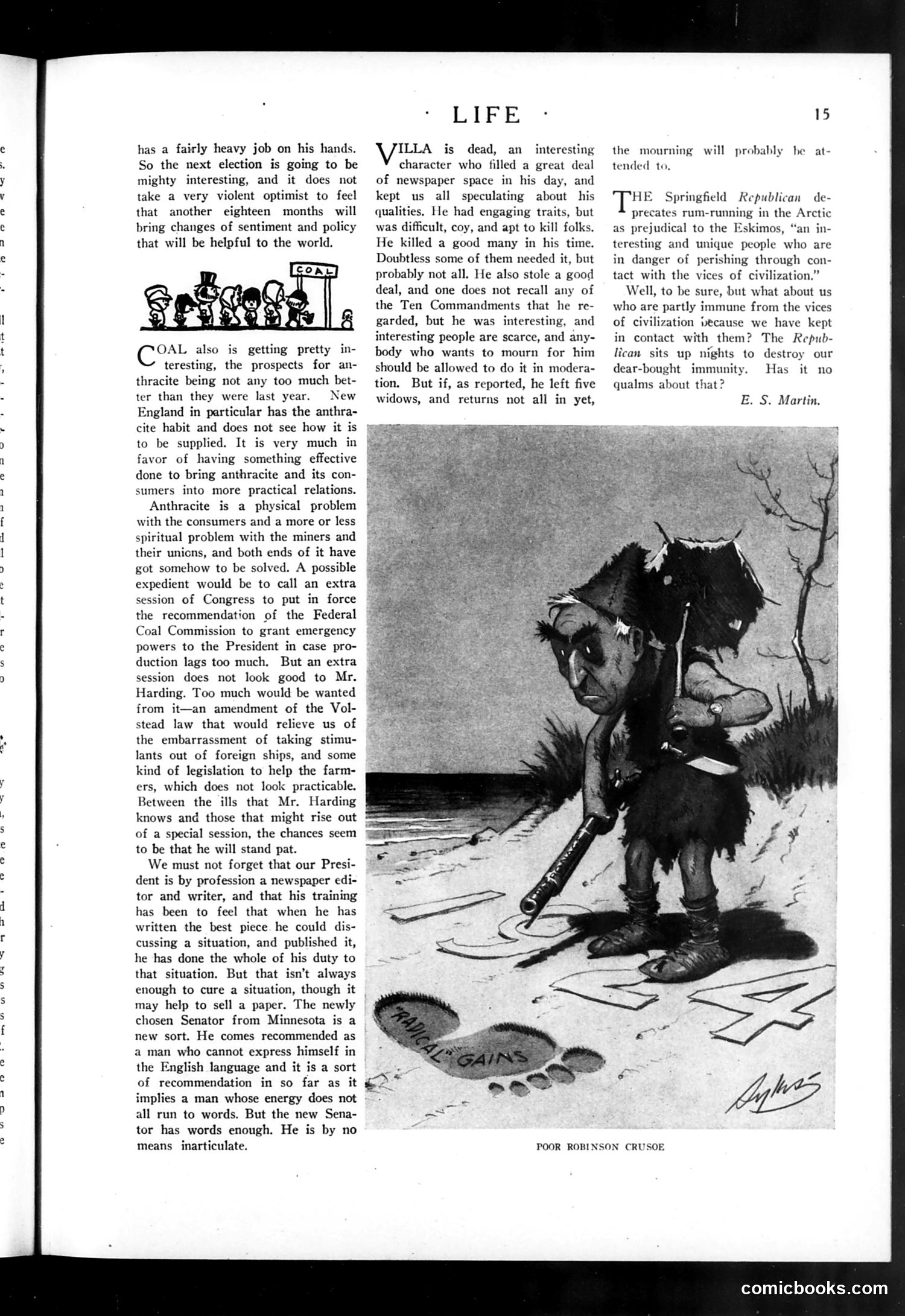
The main cartoon, titled "Poor Robinson Crusoe," depicts a man (likely representing American consumers or the working class) surrounded by bare footprints in sand, stranded and destitute. He appears trapped or overwhelmed. The satire critiques **post-WWI American economic hardship**, specifically the **anthracite coal shortage** discussed in the text. The article explains New England's dependence on anthracite heating fuel and notes supply problems worse than the previous year. The "Robinson Crusoe" reference—a castaway isolated and abandoned—represents ordinary Americans left helpless by coal industry failures and labor disputes between miners' unions and consumers. The cartoon mocks President Harding's passive approach: rather than convening Congress for emergency powers to address production shortfalls (as a Federal Coal Commission recommended), Harding avoids action. The stranded figure symbolizes citizens abandoned to fend for themselves during an energy crisis, while political leaders offer only published rhetoric instead of solutions. The "gains" footprints suggest lost economic progress amid scarcity.
📄 Transcribed text from this page (OCR, searchable)
Machine-transcribed from the original scan — historical spelling and the odd misread are preserved.
has a fairly heavy job on his hands. So the next election is going to be mighty interesting, and it does not take a very violent optimist to feel that another eighteen months will bring changes of sentiment and policy that will be helpful to the world. OAL also is getting pretty in- teresting, the prospects for an- thracite being not any too much bet- ter than they were last year. New England in particular has the anthra- cite habit and does not see how it is to be supplied. It is very much in favor of having something effective done to bring anthracite and its con- sumers into more practical relations. Anthracite is a physical problem with the consumers and a more or less spiritual problem with the miners and their unicns, and both ends of it have got somehow to be solved. A possible expedient would be to call an extra session of Congress to put in force the recommendation of the Federal Coal Commission to grant emergency powers to the President in case pro- duction lags too much, But an extra session does not look good to Mr. Harding. Too much would be wanted from it—an amendment of the Vol- stead law that would relieve us of the embarrassment of taking stimu- lants out of foreign ships, and some kind of legislation to help the farm- ers, which does not look practicable. Between the ills that Mr. Harding knows and those that might rise out * of a special session, the chances seem to be that he will stand pat. We must not forget that our Presi- dent is by profession a newspaper edi- tor and writer, and that his training has been to feel that when he has written the best piece. he could dis- cussing a situation, and published it, he has done the whole of his duty to that situation. But that isn’t always enough to cure a situation, though it may help to sell a paper. The newly chosen Senator from Minnesota is a new sort. He comes recommended as a man who cannot express himself in the English language and it is a sort of recommendation in so far as it implies a man whose energy does not all run to words. But the new Sena- tor has words enough. He is by no means inarticulate. LIFE ILLA is dead, an_ interesting character who filled a great deal of newspaper space in his day, and kept us all speculating about his qualities. He had engaging traits, but was difficult, coy, and apt to kill folks. He killed a good many in his time. Doubtless some of them needed it, but probably not all. He also stole a good deal, and one does not recall any of the Ten Commandments that he re- garded, but he was interesting, and interesting people are scarce, and any- body who wants to mourn for him should be allowed to do it in modera- tion, But if, as reported, he left five widows, and returns not ali in yet, the mourning will tended to, probably he HE Springfield Republican de- precates rum-running in the Arctic as prejudical to the Eskimos, “an in- teresting and unique people who are in danger of perishing through con- tact with the vices of civilization.” Well, to be sure, but what about us who are partly immune from the vices of civilization because we have kept in contact with them? The Repub- lican sits up nights to destroy our dear-bought immunity. Has it no qualms about that? E. S. Martin. POOR ROBINSON CRUSOE comicbooks.com