
Life, 1923-08-09 · page 24 of 36
Life — August 9, 1923 — page 24: what you’re looking at
What you’re looking at
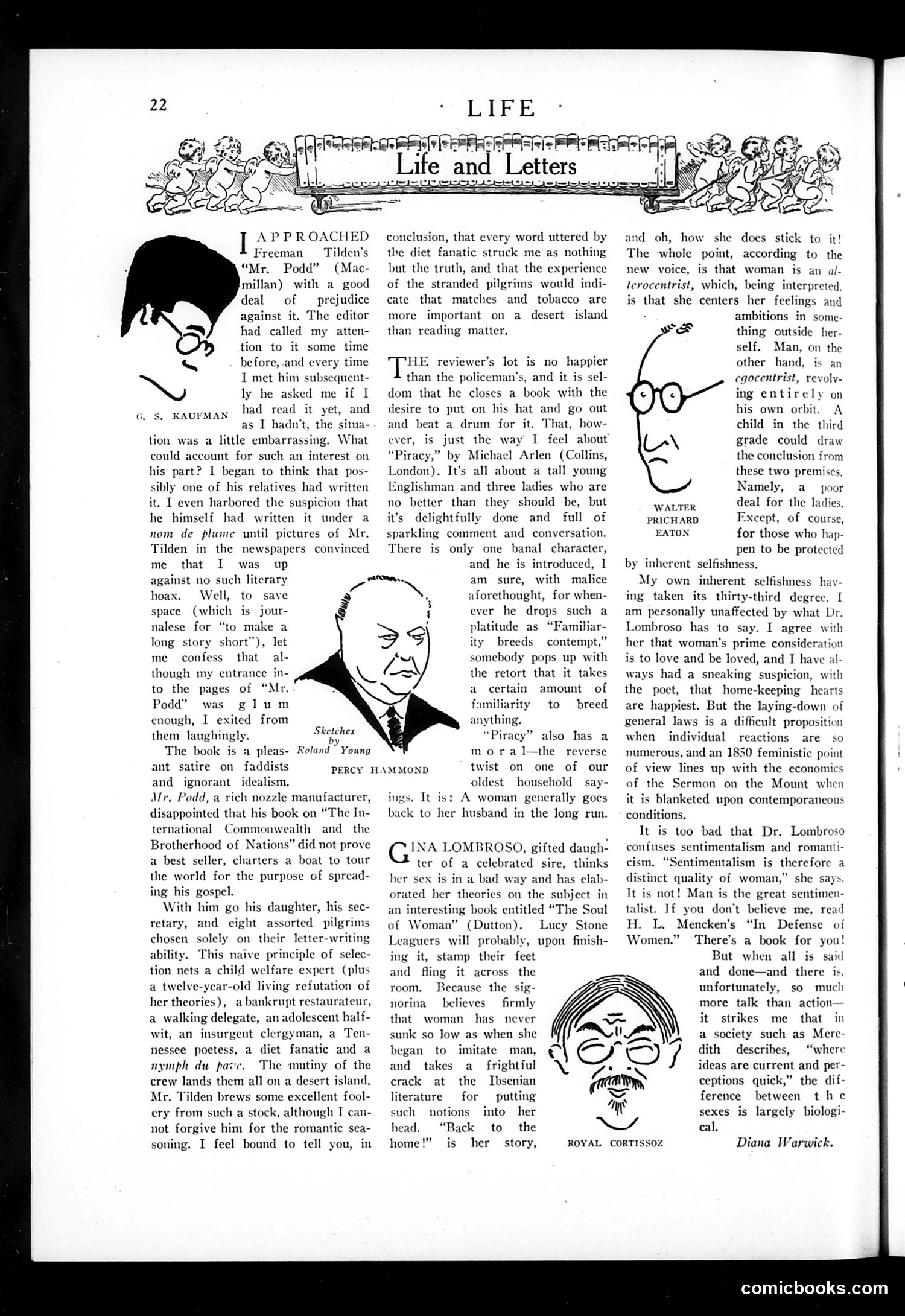
This page features book reviews by prominent critics. The **sketches** (caricatures) identify the reviewers: **Freeman Tilden**, **Percy Hammond**, **Walter Prichard Eaton**, and **Royal Cortissoz** — all recognizable public figures in early 20th-century literary criticism. The reviews satirize contemporary social preoccupations: - **"Mr. Podd"** by Freeman Tilden mocks utopian idealists and faddists (including a "diet fanatic") — a jab at progressive reformers - **"Piracy"** by Michael Arlen is dismissed as romantic pulp with banal moralizing - **"The Soul of Woman"** by Gina Lombroso attacks feminist ideology, particularly the "Ibsenian" movement (women imitating men), advocating instead for traditional domesticity ("Back to the home!") The cartoons use exaggerated features typical of period caricature. The underlying tone is conservative, mocking both naive idealism and emerging women's rights movements as foolish trends.
📄 Transcribed text from this page (OCR, searchable)
Machine-transcribed from the original scan — historical spelling and the odd misread are preserved.
APPROACHED Freeman __ Tilden’s “Mr. Podd” (Mac- millan) with a good deal of prejudice against it. The editor had called my atten- tion to it some time before, and every time I met him subsequent- ly he asked me if I had read it yet, and as I hadn't, the situa- tion was a little embarrassing. What could account for such an interest on his part? I began to think that pos- sibly one of his relatives had written it. I even harbored the suspicion that he himself had written it under a nom de plume until pictures of Mr. Tilden in the newspapers convinced me that I was up against no such literary hoax. Well, to space (which is jour- nalese for “to make a long story short”), let me confess that al- though my entrance in- to the pages of “Mr. Podd” glum enough, I exited from them laughingly. The book is a pleas- ant satire on faddists and ignorant idealism, Mr, Podd, a rich nozzle manufacturer, disappointed that his book on “The In- ternational Commonwealth and the Brotherhood of Nations” did not prove a best seller, charters a boat to tour the world for the purpose of spread- ing his gospel. With him go his daughter, his sec- retary, and eight assorted pilgrims chosen solely on their letter-writing ability. This naive principle of selec- tion nets a child welfare expert (plus a twelve-year-old living refutation of her theories), a bankrupt restaurateur, a walking delegate, an adolescent half- wit, an insurgent clergyman, a Ten- nessee poetess, a diet fanatic and a nymph du pave. The mutiny of the crew lands them all on a desert island. Mr. Tilden brews some excellent fool- ery from such a stock, although I can- not forgive him for the romantic sea- soning. I feel bound to tell you, in Ss No KAUFMAN save was Sketches Roland ~ "Young PERCY HAMMOND conclusion, that every word uttered by the diet fanatic struck me as nothing but the truth, and that the experience of the stranded pilgrims would indi- cate that matches and tobacco are more important on a desert island than reading matter. HE rev r’s lot is no happier than the policeman’s, and it is sel- dom that he closes a book with the desire to put on his hat and go out and beat a drum for it. That, how- is just the I feel about “Piracy,” by Michael Arlen (Collins, London). It’s all about a tall young Englishman and three ladies who are no better than they should be, but it’s delightfully done and full of sparkling comment and conversation. There is only one banal character, and he is introduced, I am sure, with malice aforethought, for when- ever he drops such a platitude as “Familiar- ity breeds contempt,” somebody pops up with the retort that it takes amount of breed ever, a certain familiarity to anything. “Piracy” also has a mora I—the reverse twist on one of our household say- It is: A woman generally goes back to her husband in the long run. GC! oldest ings. ‘A LOMBROSO, gifted daugh- ter of a celebrated sire, thinks her sex is in a bad way and has elab- orated her theories on the subject in an interesting book entitled “The Soul of Woman” (Dutton). Lucy Stone Leaguers will probably, upon finish- ing it, stamp their feet and fling it across the room. Because the sig- norina believes firmly that has never sunk so low as when she began to imitate man, and takes a frightful crack at the Ibsenian literature for putting such notions into her head. “Back to the home!” is her story, woman ROYAL CORTISSOZ and oh, how she does stick to it! The whole point, according to the new voice, is that woman is an al- terocentrist, which, being interpreted, is that she centers her feelings and : ambitions in some- OF thing outside her- self. Man, on the other is an egocentrist, revoly- ing entirely on his own orbit. A child in the third grade could draw the conclusion from these two premises, Namely, a poor deal for the ladies, Except, of course, for those who hap- pen to be protected by inherent selfishne: My own inherent selfishness hav- ing taken its thirty-third degree, I am personally unaffected by what Dr. Lombroso has to say. I agree with her that woman's prime consideration is to love and be loved, and I have al- ways had a sneaking suspicion, with the poet, that home-keeping hearts are happiest. But the laying-down of general laws is a difficult proposition when individual reactions are so numerous, and an 1850 feministic point of view lines up with the economics of the Sermon on the Mount when it is blanketed upon contemporaneous conditions, It is too bad that Dr. Lombroso confuses sentimentalism and romanti- cism. “Sentimentalism is therefore a distinct quality of woman,” she says. It is not! Man is the great sentimen- talist. If you don’t believe me, read H. L. Mencken's “In Defense of Women.” There’s a book for you! But when all is said and done—and there is, unfortunately, so much more talk than action— it strikes me that in a society such as Mere- dith describes, “where ideas are current and per- ceptions quick,” the dif- ference between t hc sexes is largely biologi- cal. hand, LA\ _— WALTER PRICHARD EATON Diana Warwick. comicbooks.com