
Life, 1923-08-09 · page 20 of 36
Life — August 9, 1923 — page 20: what you’re looking at
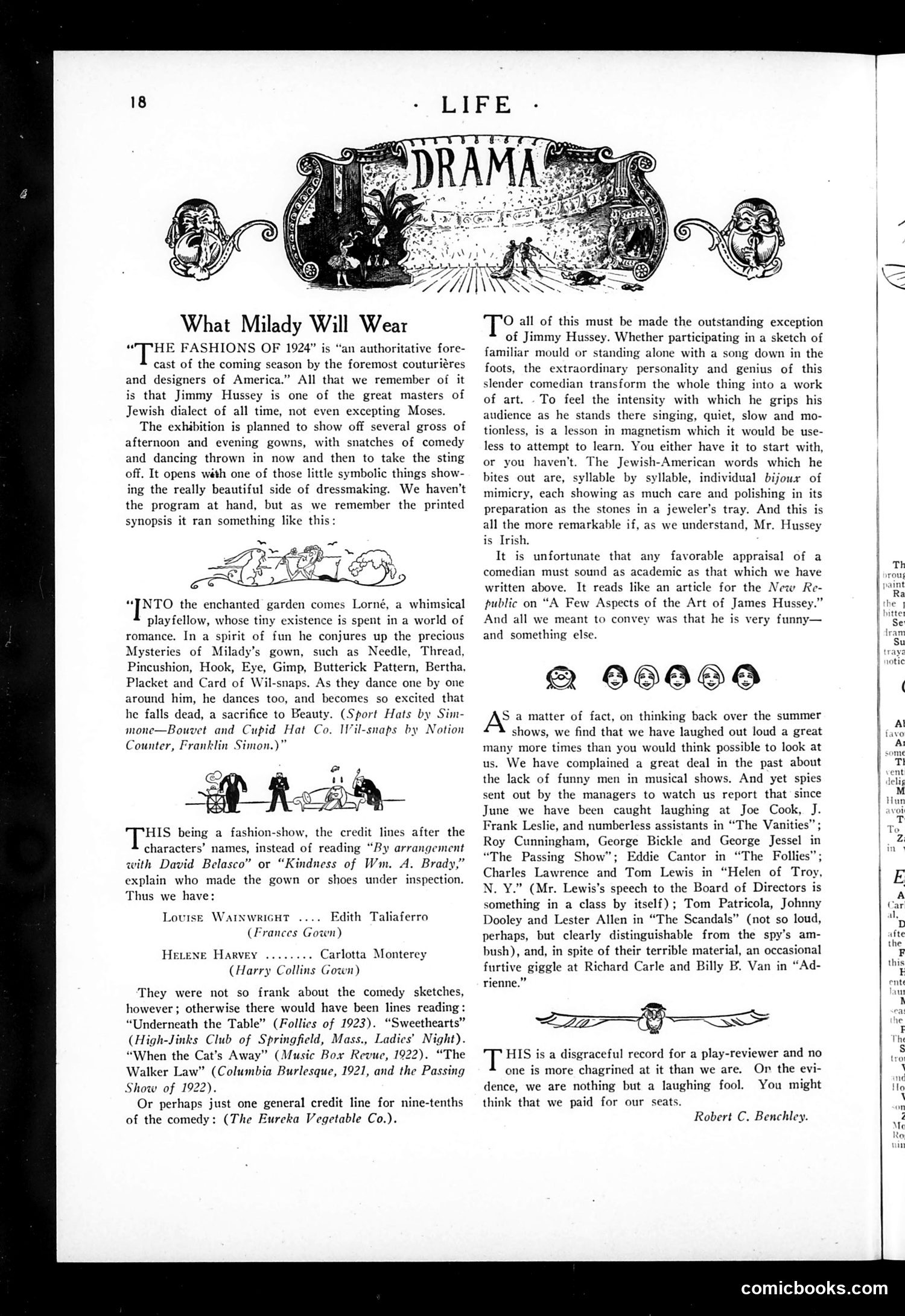
What you’re looking at
This page reviews a 1924 fashion show that doubles as theatrical entertainment. The satire targets how Broadway productions, particularly fashion spectacles, recycled tired comedy material under thin pretexts. The main joke: the review notes that while the show credits gowns to their designers (a novelty), the comedy sketches are suspiciously unoriginal—drawn from earlier productions like *Follies of 1923* and *Columbia Burlesque*. The author sarcastically suggests crediting them all to "The Eureka Vegetable Co." (implying they're vegetables/old hat). The sole exception is **Jimmy Hussey**, a Jewish-dialect comedian praised effusively for transforming mediocre material through sheer talent and personality. The irony that Hussey is "Irish" (not Jewish, despite his accent work) adds humorous contradiction. The piece celebrates genuine theatrical artistry while mocking the production's reliance on recycled comedy—a critique of Broadway's formula-driven approach to musical theater in the Jazz Age.
📄 Transcribed text from this page (OCR, searchable)
Machine-transcribed from the original scan — historical spelling and the odd misread are preserved.
What Milady Will Wear “THE FASHIONS OF 1924” is “an authoritative fore- cast of the coming season by the foremost couturiéres and designers of America.” All that we remember of it is that Jimmy Hussey is one of the great masters of Jewish dialect of all time, not even excepting Moses. The exhibition is planned to show off several gross of afternoon and evening gowns, with snatches of comedy and dancing thrown in now and then to take the sting off. It opens wéth one of those little symbolic things show- ing the really beautiful side of dressmaking. We haven't the program at hand, but as we remember the printed synopsis it ran something like this: “INTO the enchanted garden comes Lorné, a whimsical playfellow, whose tiny existence is spent in a world of romance. In a spirit of fun he conjures up the precious Mysteries of Milady’s gown, such as Needle, Thread, Pincushion, Hook, Eye, Gimp, Butterick Pattern, Bertha, Placket and Card of Wil-snaps. As they dance one by one around him, he dances too, and becomes so excited that he falls dead, a sacrifice to Beauty. (Sport Hats by Sim- mone—Bouvet and Cupid Hat Co. Iil-snaps by Notion Counter, Franklin Simon.)” HIS being a fashion-show, the credit lines after the characters’ names, instead of reading “By arrangement with David Belasco” or “Kindness of Wm. A. Brady,” explain who made the gown or shoes under inspection. Thus we have: & Watnwricut .... Edith Taliaferro (Frances Gown) Lou .++. Carlotta Monterey Collins Gown) HELENE Harvey (Harry They were not so frank about the comedy sketches, however ; otherwise there would have been lines reading: “Underneath the Table” (Follies of 1923). “Sweethearts” (High-Jinks Club of Springfield, Mass., Ladies’ Night). “When the Cat’s Away” (Music Box Revue, 1922). “The Walker Law” (Columbia Burlesque, 1921, and the Passing Show of 1922) Or perhaps just one general credit line for nine-tenths of the comedy: (The Eureka Vegetable Co.). 'O all of this must be made the outstanding exception of Jimmy Hussey. Whether participating in a sketch of familiar mould or standing alone with a song down in the foots, the extraordinary personality and genius of this slender comedian transform the whole thing into a work of art. . To feel the intensity with which he grips his audience as he stands there singing, quiet, slow and mo- tionless, is a lesson in magnetism which it would be use- less to attempt to learn. You either have it to start with, or you haven't. The Jewish-American words which he bites out are, syllable by syllable, individual bijourx of mimicry, each showing as much care and polishing in its preparation as the stones in a jeweler’s tray. And this is all the more remarkable if, as we understand, Mr. Hussey is Irish. It is unfortunate that any favorable appraisal of a comedian must sound as academic as that which we have written above. It reads like an article for the New Re- public on “A Few Aspects of the Art of James Hussey.” And all we meant to convey was that he is very funny— and something else. 2 X& a matter of fact, on thinking back over the summer shows, we find that we have laughed out loud a great many more times than you would think possible to look at us. We have complained a great deal in the past about the lack of funny men in musical shows. And yet spies sent out by the managers to watch us report that since June we have been caught laughing at Joe Cook, J. Frank Leslie, and numberless assistants in “The Vanities” ; Roy Cunningham, George Bickle and George Jessel in “The Passing Show”; Eddie Cantor in “The Follies Charles Lawrence and Tom Lewis in “Helen of Troy, N. Y.” (Mr. Lewis’s speech to the Board of Directors is something in a class by itself); Tom Patricola, Johnny Dooley and Lester Allen in “The Scandals” (not so loud, perhaps, but clearly distinguishable from the spy’s am- bush), and, in spite of their terrible material, an occasional furtive giggle at Richard Carle and Billy B. Van in “Ad- rienne.” aa > HIS is a disgraceful record for a play-reviewer and no one is more chagrined at it than we are. Or the evi- dence, we are nothing but a laughing fool. You might think that we paid for our seats. Robert C. Benchley. comicbooks.com { Han voi UT | 2