
Life, 1923-08-09 · page 27 of 36
Life — August 9, 1923 — page 27: what you’re looking at
What you’re looking at
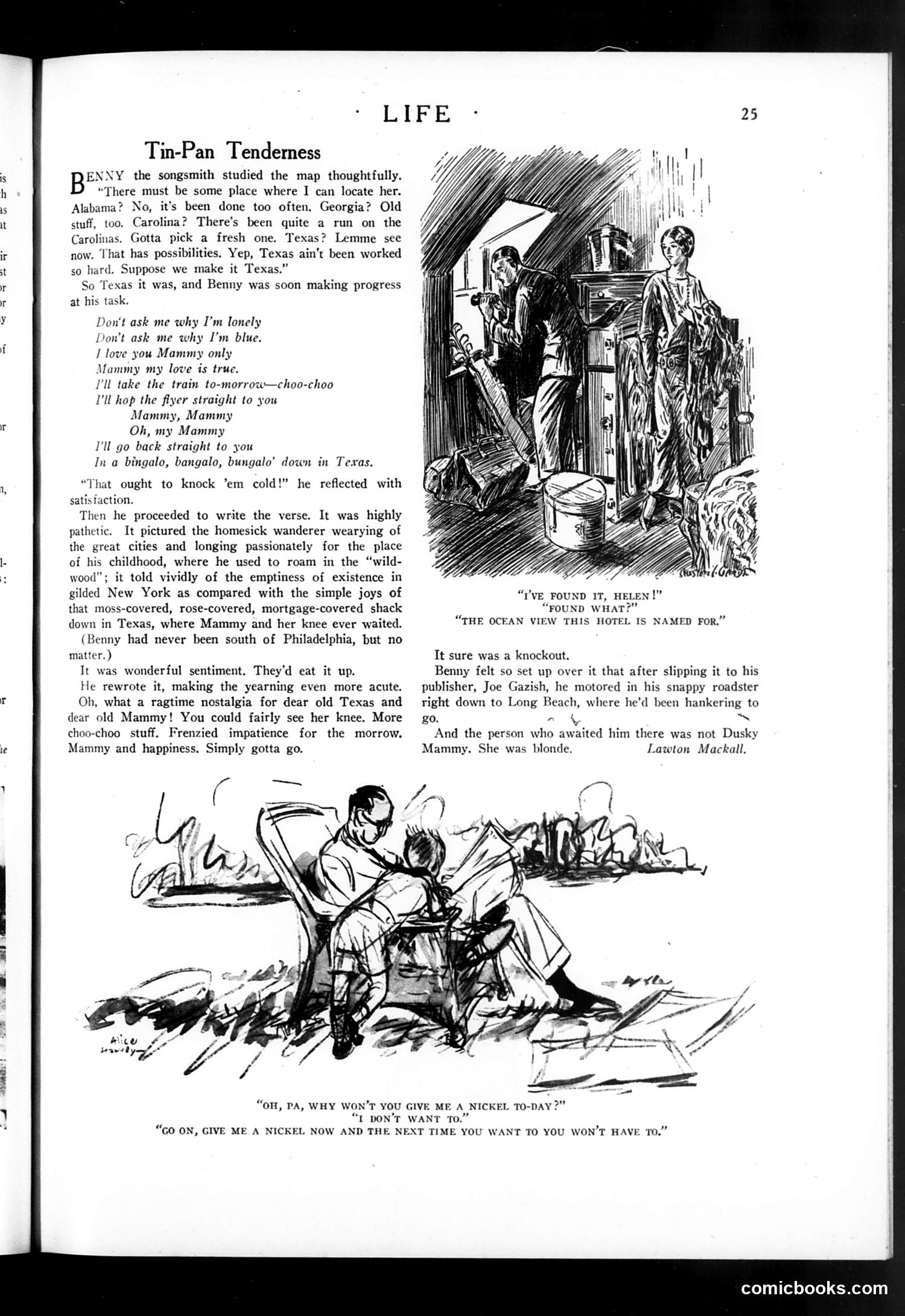
This satirizes popular songwriting in the early 20th century. "Benny the songsmith" cynically manufactures a sentimental hit song about longing for "Mammy" and Texas—deliberately choosing an under-exploited location to seem original. The joke is that he's never been south of Philadelphia, yet writes false nostalgia designed to manipulate audiences emotionally ("They'd eat it up"). The satire targets "Tin Pan Alley" songwriters who churned out formulaic, manipulative tear-jerkers exploiting homesickness and racial stereotypes for profit. The irony: Benny is so pleased with his fake sentiment that he abandons his own publisher to visit Long Beach—only to find his romantic interest is a blonde woman, not the stereotypical "Dusky Mammy" his song romanticizes. The lower cartoon appears unrelated, depicting a child's negotiating tactic with parents over allowance money.
📄 Transcribed text from this page (OCR, searchable)
Machine-transcribed from the original scan — historical spelling and the odd misread are preserved.
Tin-Pan Tenderness Bee the songsmith studied the map thoughtfully. “There must be some place where I can locate her. Alabama? No, it’s been done too often. Georgia? Old stuff, too. Carolina? There’s been quite a run on the Carolinas. Gotta pick a fresh one. Texas? Lemme see now. That has possibilities. Yep, Texas ain’t been worked so hard. Suppose we make it Texas.” So Texas it was, and Benny was soon making progress at his task. Don't ask me why I’m lonely Don't ask me why I’m blue. J love you Mammy only Mammy my love is true. I'll take the train to-morrow—choo-choo I'll hop the flyer straight to you Mammy, Mammy Oh, my Mammy I'll go back straight to you In a bingalo, bangalo, bungalo’ down in Texas. “That ought to knock ’em cold!” he reflected with satisfaction. Then he proceeded to write the verse. It was highly pathetic. It pictured the homesick wanderer wearying of the great cities and longing passionately for the place of his childhood, where he used to roam in the “wild- wood”; it told vividly of the emptiness of existence in gilded New York as compared with the simple joys of that moss-covered, rose-covered, mortgage-covered shack down in Texas, where Mammy and her knee ever waited. (Benny had never been south of Philadelphia, but no matter.) It was wonderful sentiment. They'd eat it up. He rewrote it, making the yearning even more acute. Oh, what a ragtime nostalgia for dear old Texas and dear old Mammy! You could fairly see her knee. More choo-choo stuff. Frenzied impatience for the morrow. Mammy and happiness. Simply gotta go. “1'VE FOUND IT, HELEN!” “FOUND WHAT?” “THE OCEAN VIEW THIS HOTEL IS NAMED FOR.” It sure was a knockout. Benny felt so set up over it that after slipping it to his publisher, Joe Gazish, he motored in his snappy roadster right down to Long Beach, where he’d been hankering to go. - © i’ And the person who awaited him there was not Dusky Mammy. She was blonde. Lawton Mackall. “OH, PA, WHY WON’T YOU GIVE ME A NICKEL TO-DAY “I DON’T WANT TO.” “GO ON, GIVE ME A NICKEL NOW AND THE NEXT TIME YOU WANT TO YOU WON’T HAVE TO.” comicbooks.com