
A complete issue · 44 pages · 1923
Life — June 7, 1923
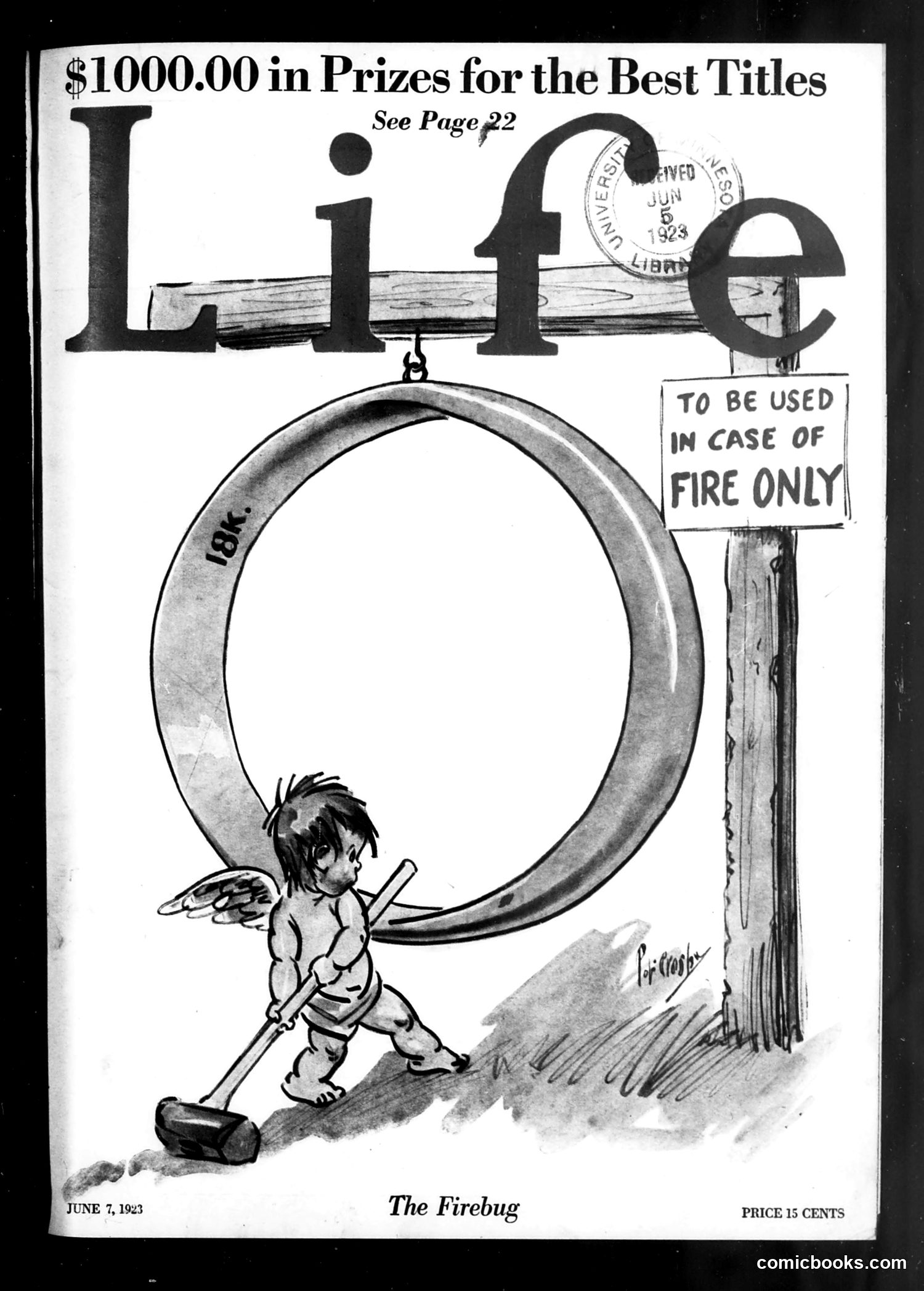
This satirical cover plays on the word "Life" through visual pun. The letters L-i-f-e are arranged with a large life preserver (marked "life") hanging below, labeled "TO BE USED IN CASE OF FIRE ONLY." A cherub-like "firebug" character—wings, muscular child figure—wields an axe or sledgehammer, appearing to break the life preserver. The joke appears to be that fires destroy life preservers, making them useless. Alternatively, it suggests that firebugs (arsonists) render safety equipment pointless. The title "The Firebug" confirms the theme. This is titled content rather than political commentary. The $1000 prize announcement references a contest for best titles (referenced on page 22), suggesting readers were invited to submit alternative clever titles for this image.
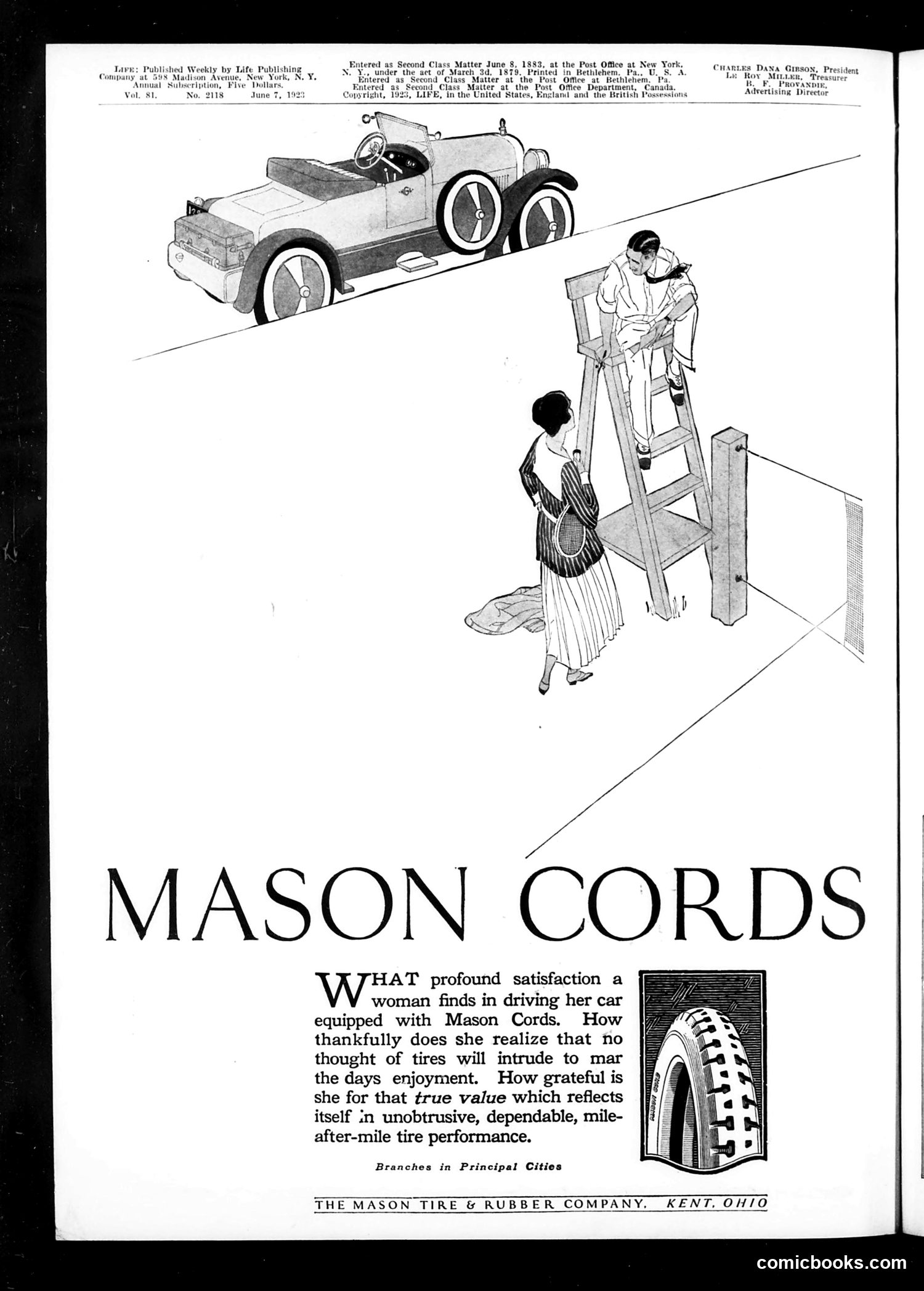
This is a **product advertisement**, not political satire. It promotes Mason Cords tires, manufactured by The Mason Tire & Rubber Company in Kent, Ohio. The illustration depicts a 1920s scene: a woman in period dress stands near a ladder while a man works on an automobile above. The ad appeals to female drivers by emphasizing that Mason Cords tires provide reliable, worry-free driving performance—specifically, that drivers won't experience tire failures disrupting their enjoyment. The targeted messaging to women reflects the 1920s context when automobile ownership and driving were becoming more accessible to females. The advertisement uses gender-specific language ("a woman finds") to market dependable tire quality as particularly valuable for this emerging demographic of consumers.
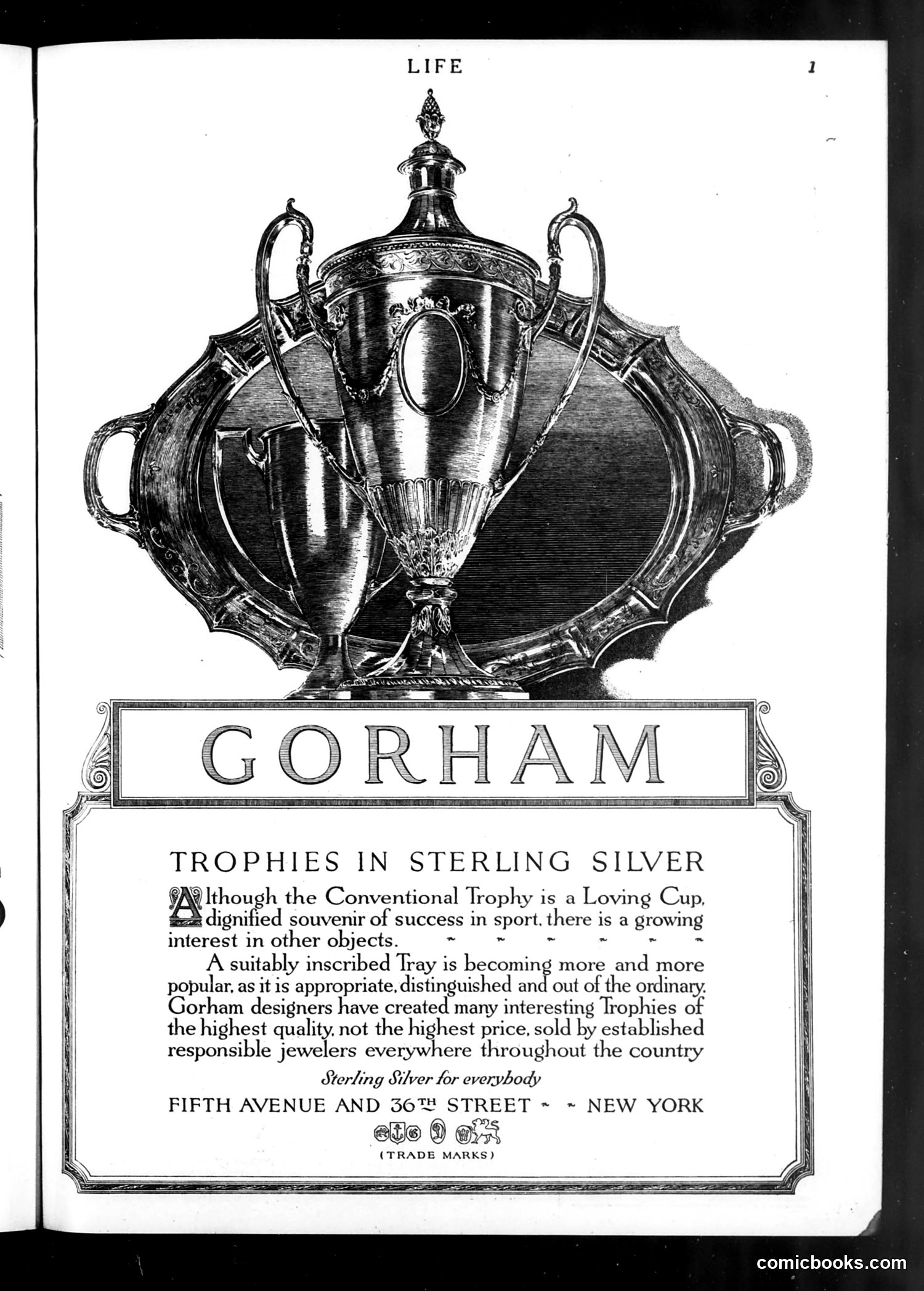
This page is **not a cartoon or satirical content** — it's a **full-page advertisement** for Gorham, a sterling silver manufacturer based in New York. The ad promotes Gorham's trophy designs, featuring an ornate image of a large decorative silver cup with handles and a domed lid. The text argues that while loving cups remain traditional trophies in sports, inscribed trays are becoming increasingly popular as more refined and distinguished alternatives. Gorham positions itself as a high-quality jeweler creating "trophies of the highest quality" for clients nationwide. The page is purely commercial advertising, with no political satire or social commentary intended.
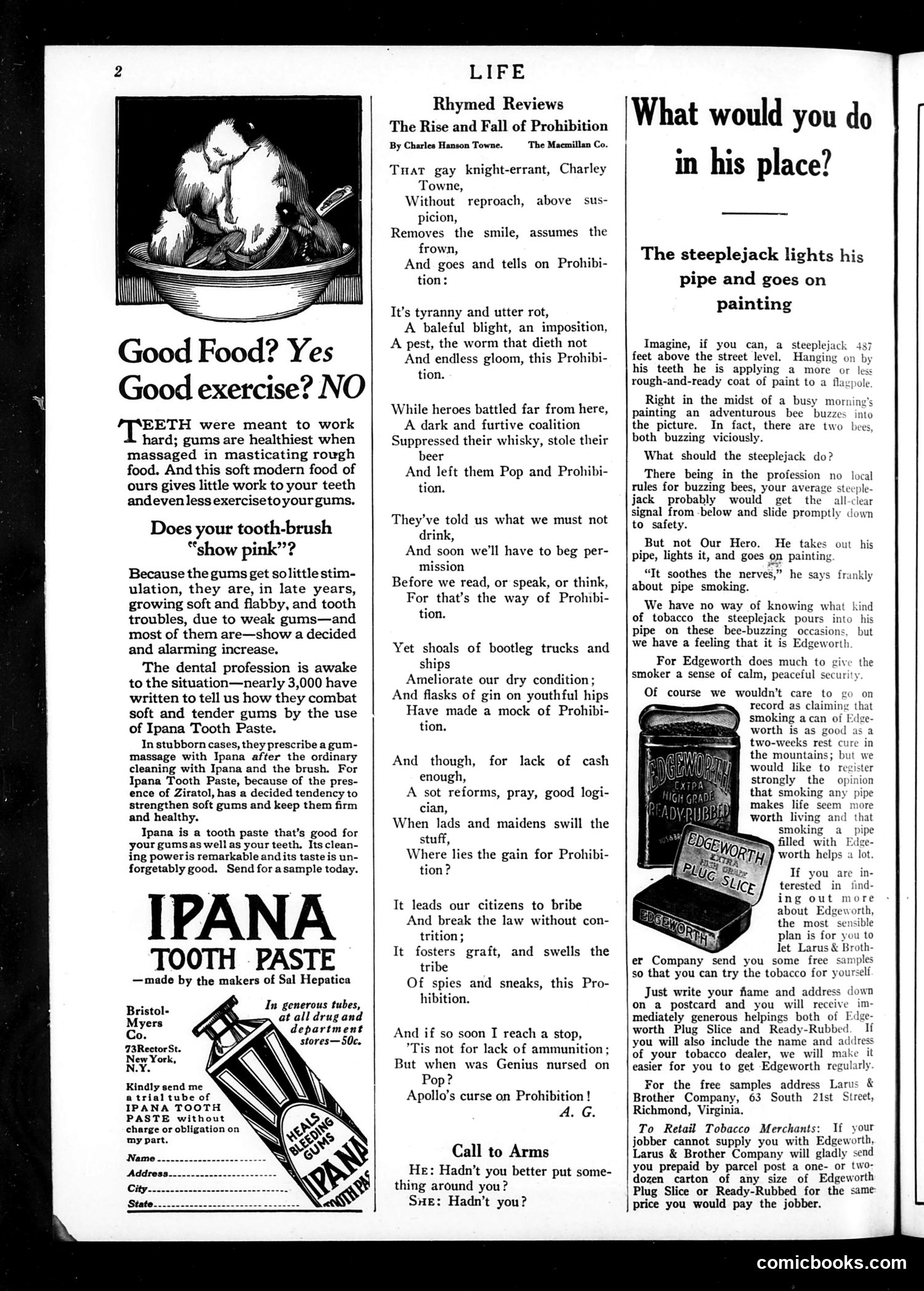
This page contains primarily **advertisements and product promotions** rather than political satire. The left side features an **Ipana Tooth Paste ad** addressing dental health concerns, noting that weak gums cause tooth problems—a common early 20th-century advertising anxiety. The copy claims the product strengthens gums through massage action. The main content is a **book review** of Charles Hanson Towne's "The Rise and Fall of Prohibition," using humorous verse to critique Prohibition-era policies. The satire mocks the law's failures: bootlegging, bribery, and youth misbehavior flourished despite the ban. The right side advertises **Edgeworth Plug Slice tobacco**, featuring a steeplejack painter smoking peacefully—ironically positioned opposite Prohibition critique, suggesting smoking remained socially acceptable while alcohol was banned.
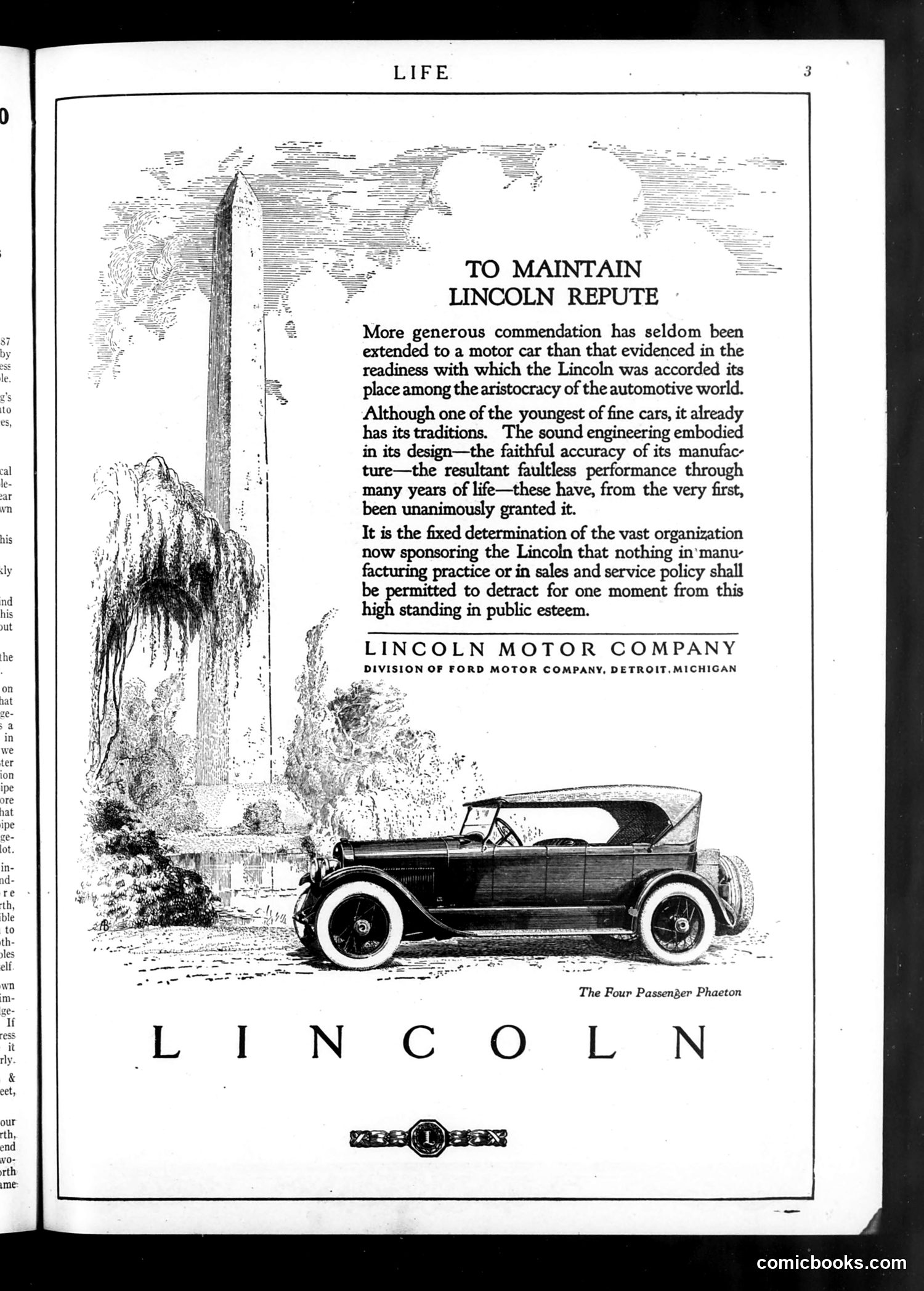
This is **not a political cartoon or satire**—it's a **straightforward automobile advertisement** for the Lincoln Motor Company (a Ford division). The page features the Lincoln "Four Passenger Phaeton" car positioned beneath an illustration of the Lincoln Memorial monument in Washington, D.C. The ad copy emphasizes Lincoln's reputation for quality engineering, manufacturing precision, and consistent performance over many years. The company pledges that nothing in their manufacturing or sales practices will damage Lincoln's "high standing in public esteem." This is a prestige advertisement leveraging both the national monument's name and associations with quality and permanence to market a luxury vehicle to affluent American readers of *Life* magazine.
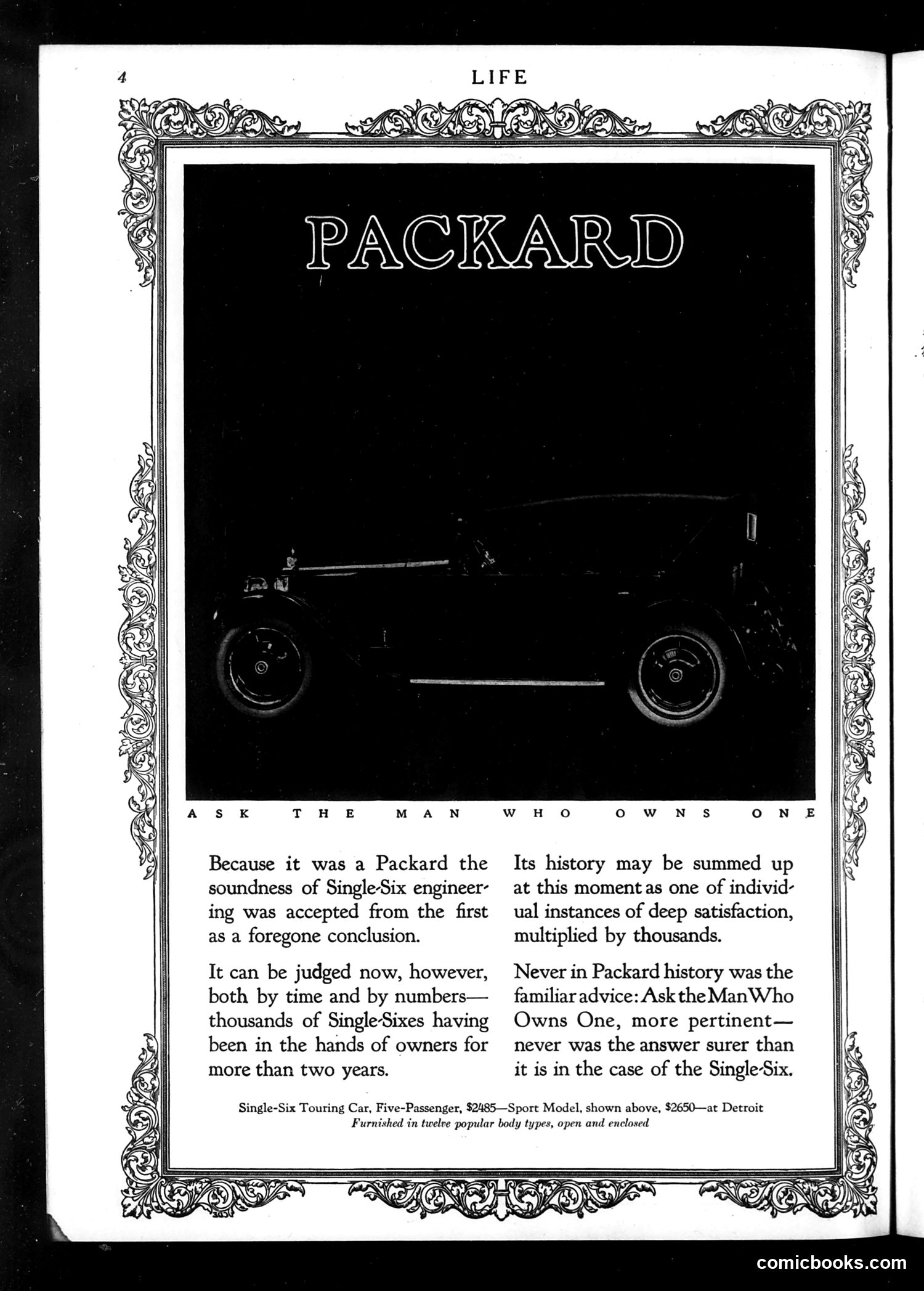
This is a **Packard automobile advertisement**, not a political cartoon. The page features a side-profile photograph of a Packard Single-Six touring car against a black background, framed in an ornate decorative border typical of early 20th-century magazine design. The text employs the advertising slogan "Ask the Man Who Owns One" to build credibility. It claims that thousands of Single-Six owners have confirmed the car's quality through personal experience over two years, positioning ownership as evidence of superiority. The advertisement emphasizes reliability and customer satisfaction rather than making specific technical claims, using social proof as its primary sales strategy.
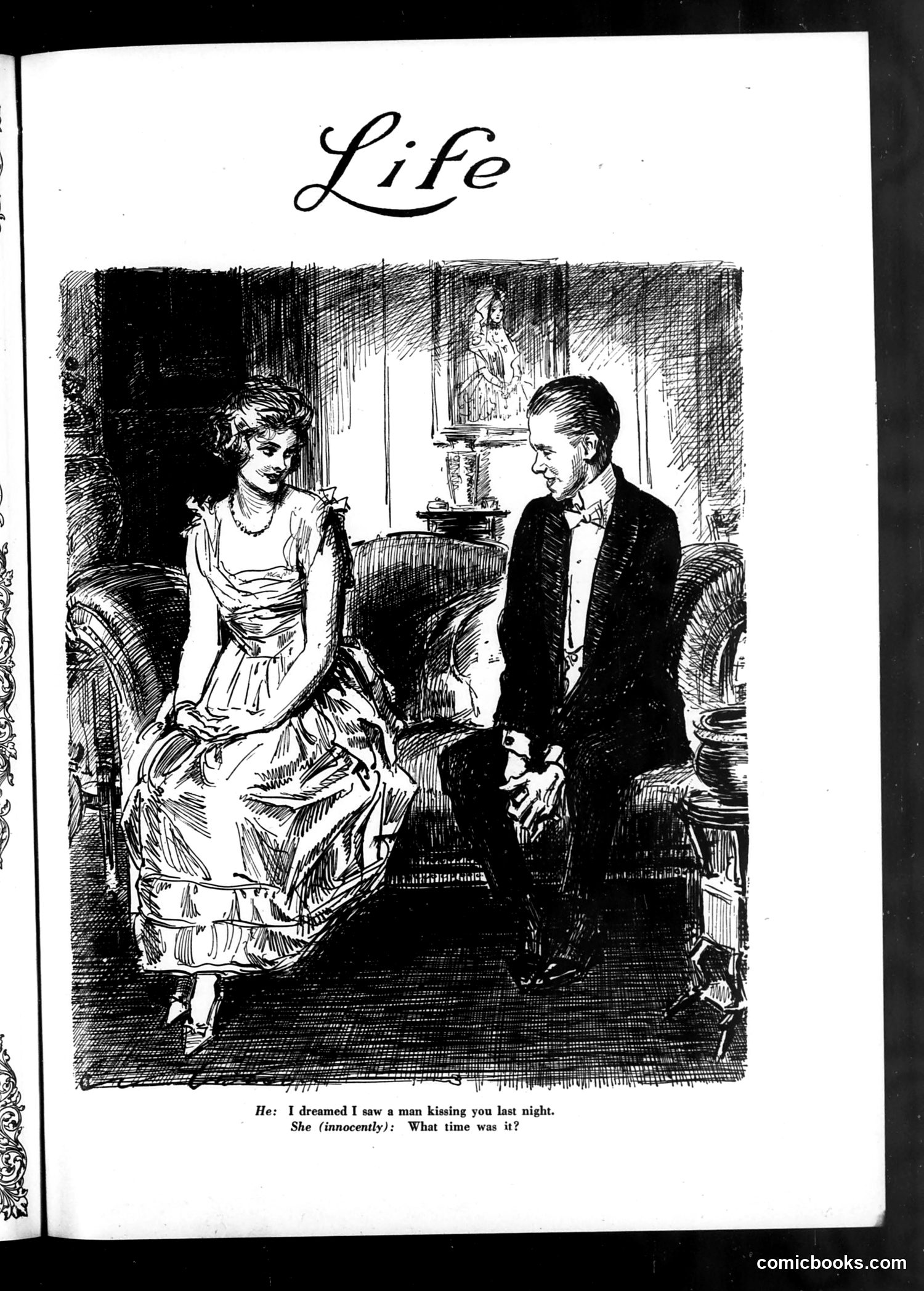
This is a single-panel cartoon titled "Life" depicting a domestic scene between a married couple in an elegant interior. The man tells the woman he dreamed he saw a man kissing her the previous night. She responds innocently by asking "What time was it?" The humor hinges on her suspicious reply—her immediate question about the *time* rather than denial suggests either she's deflecting, or the joke implies she's admitting to infidelity while playing dumb about details. It's a classic early 20th-century marital humor format: the witty riposte that exposes hidden wrongdoing or suggests marital discord beneath polite surfaces. The cartoon satirizes domestic life through suggestive wordplay rather than political commentary.
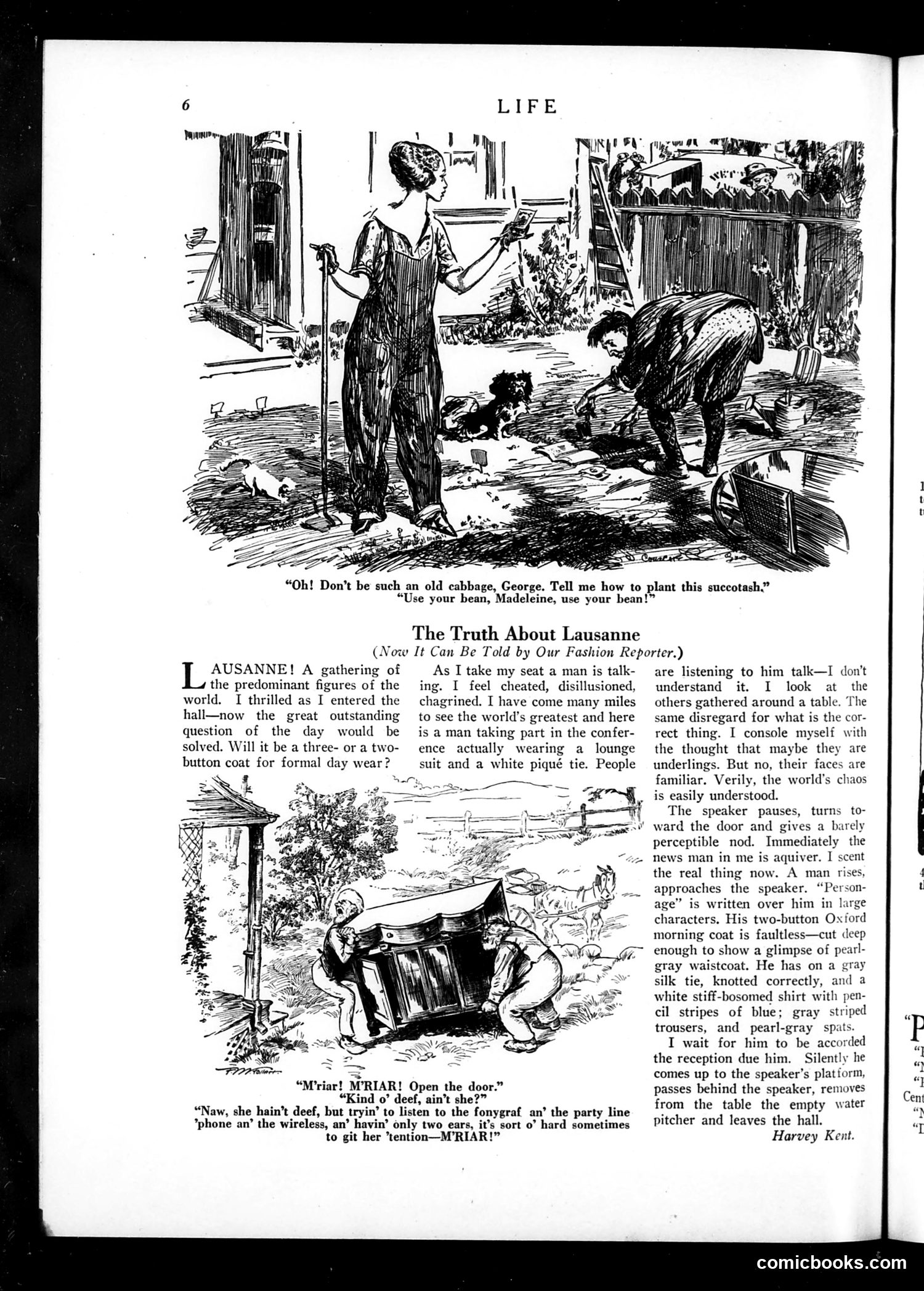
This page contains two cartoons satirizing early 20th-century fashion and social pretension. The top cartoon mocks gardening advice between social classes—a woman in fashionable dress instructs a working-class man on planting, using pretentious terminology ("succotash") while he responds practically ("use your bean"). The bottom section, "The Truth About Lausanne," appears to satirize a high-society conference or gathering. The accompanying illustration shows people in formal attire in rural/rustic settings, creating humor through the contrast. The text describes attendees' fashionable dress codes and social posturing, suggesting the event's emphasis on appearance over substance. The final illustration depicts someone arriving in elaborate formal wear to this gathering, highlighting the absurdity of maintaining strict fashion conventions in incongruous settings. Both pieces mock upper-class pretension and disconnection from practical reality.
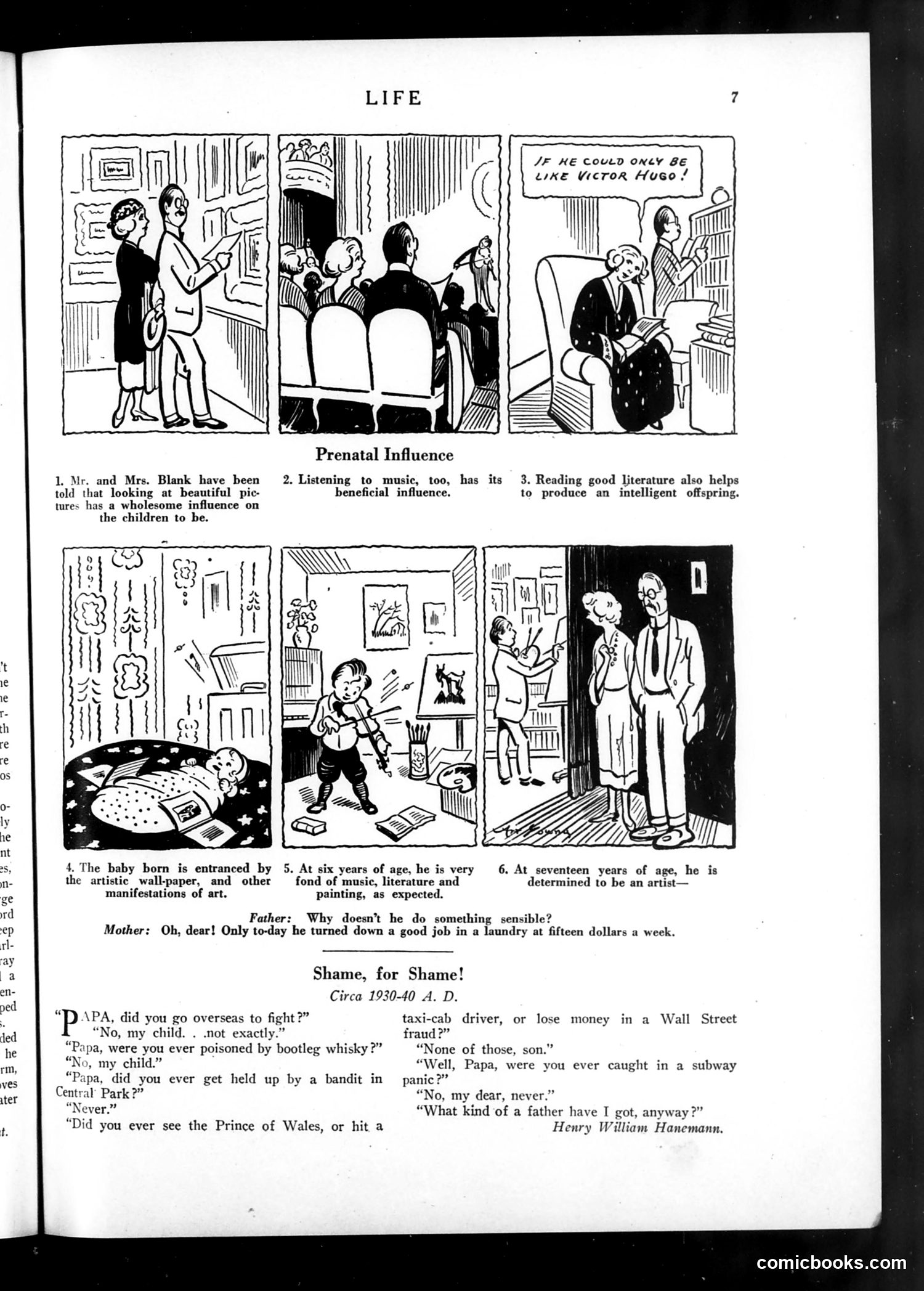
This page presents two satirical pieces from Life magazine (circa 1930-40). **"Prenatal Influence"** mocks the pseudoscientific belief that pregnant women's experiences shape their unborn children's talents. The comic shows parents exposing themselves to art, music, and literature expecting gifted offspring. The punchline: their teenage son becomes an artist, but abandons it for a laundry job at fifteen dollars weekly—disappointing their cultured pretensions. **"Shame, for Shame!"** uses Henry William Hanemann's quote to satirize parental hypocrisy. A father boasts he's never engaged in crime or vice, yet his son questions what kind of "father" this makes him—suggesting the father's respectable mediocrity is itself a failure. The humor lies in inverting expectations: virtue becomes inadequacy. Both pieces critique middle-class values and generational disappointment.
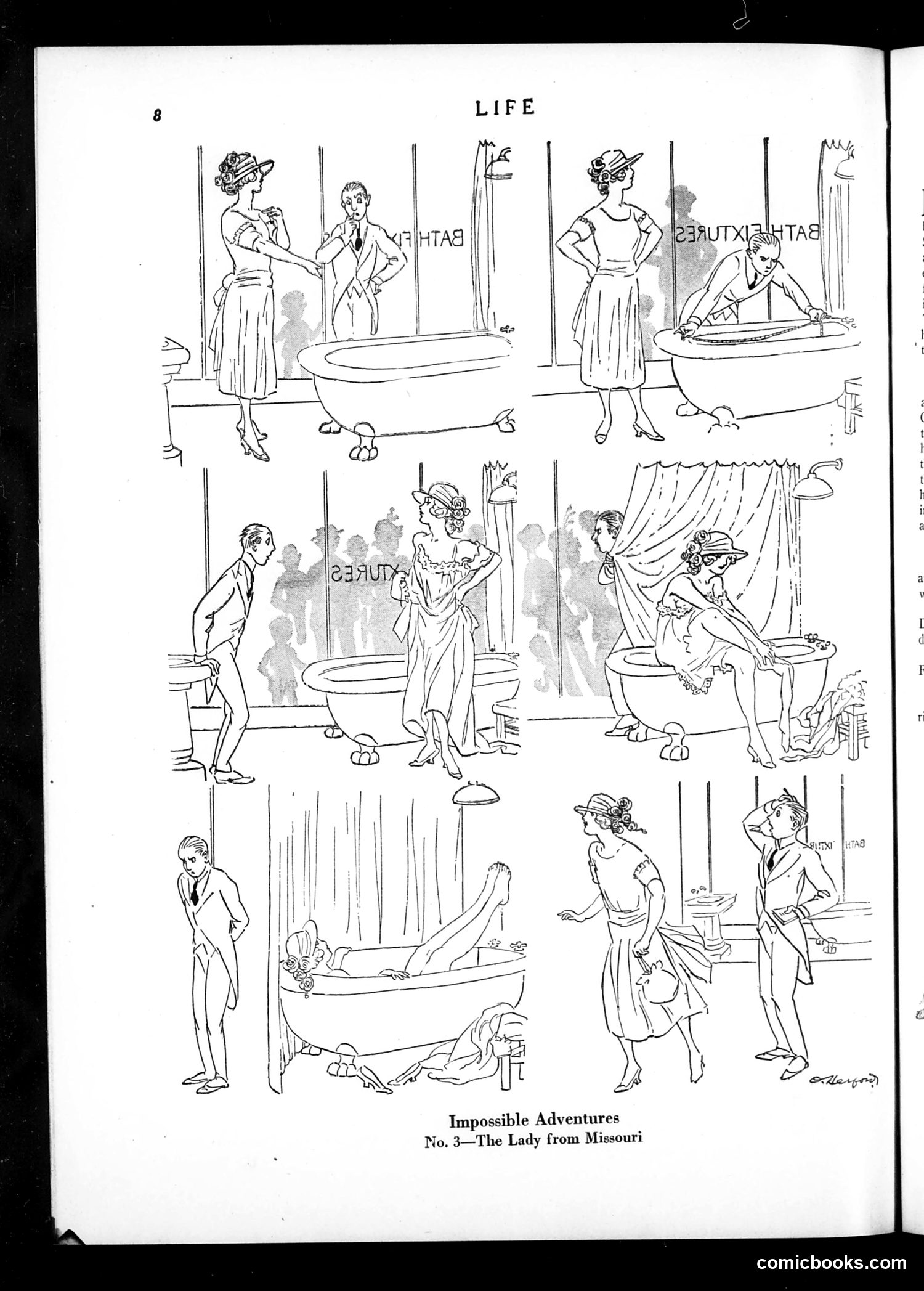
This is a humorous comic strip depicting a woman's various misadventures in a bathroom setting. The title references "The Lady from Missouri," likely alluding to a specific cultural figure or stereotype of the era, though the exact reference is unclear without additional context. The strip shows a series of increasingly absurd bathroom scenarios: the woman bathing in various positions, interacting with a man (possibly a servant or attendant), and finding herself in physically impossible or undignified situations. The humor appears satirical—poking fun at either the pretensions of a particular type of woman, bathroom etiquette, or perhaps contemporary scandals. The "impossible adventures" framing suggests the strip is mock-serious, treating mundane bathroom activities as dramatic episodes worthy of serialization.
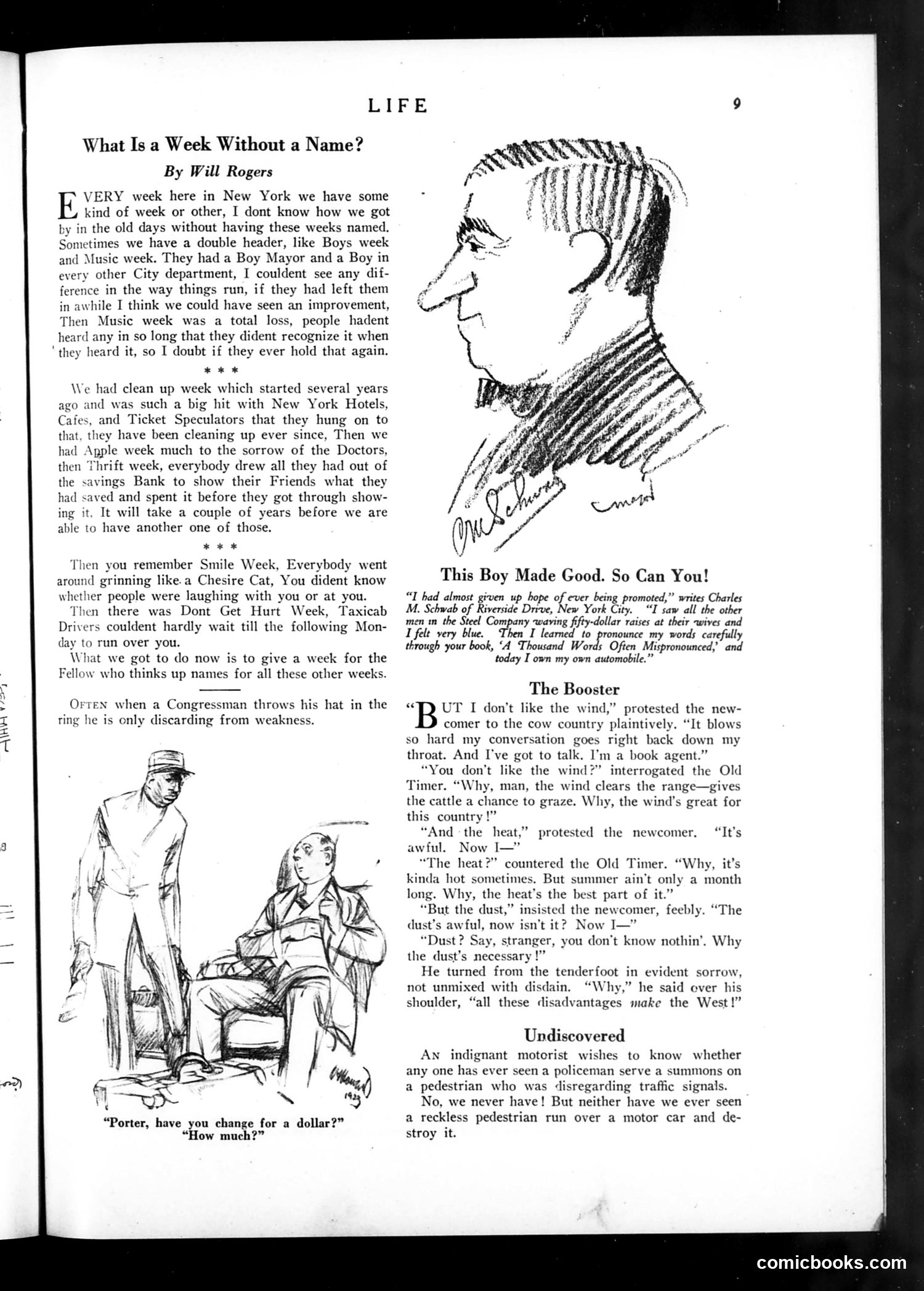
This page contains three satirical pieces by Will Rogers commenting on New York City life and American culture. **"What Is a Week Without a Name?"** mocks the proliferation of themed weeks (Boys Week, Music Week, etc.), suggesting they've become meaningless marketing exercises that don't actually improve city services. **"This Boy Made Good, So Can You!"** features a sketch of a successful man, with a testimonial about self-improvement through reading. **"The Booster"** presents a dialogue between an Old Timer and a newcomer arguing about the West's climate. The newcomer defensively promotes hardship as character-building, while the Old Timer pragmatically notes that dust and heat are simply unavoidable facts—satirizing boosterism and forced optimism about frontier life. **"Undiscovered"** briefly notes the irony that police never manage traffic violations fairly.
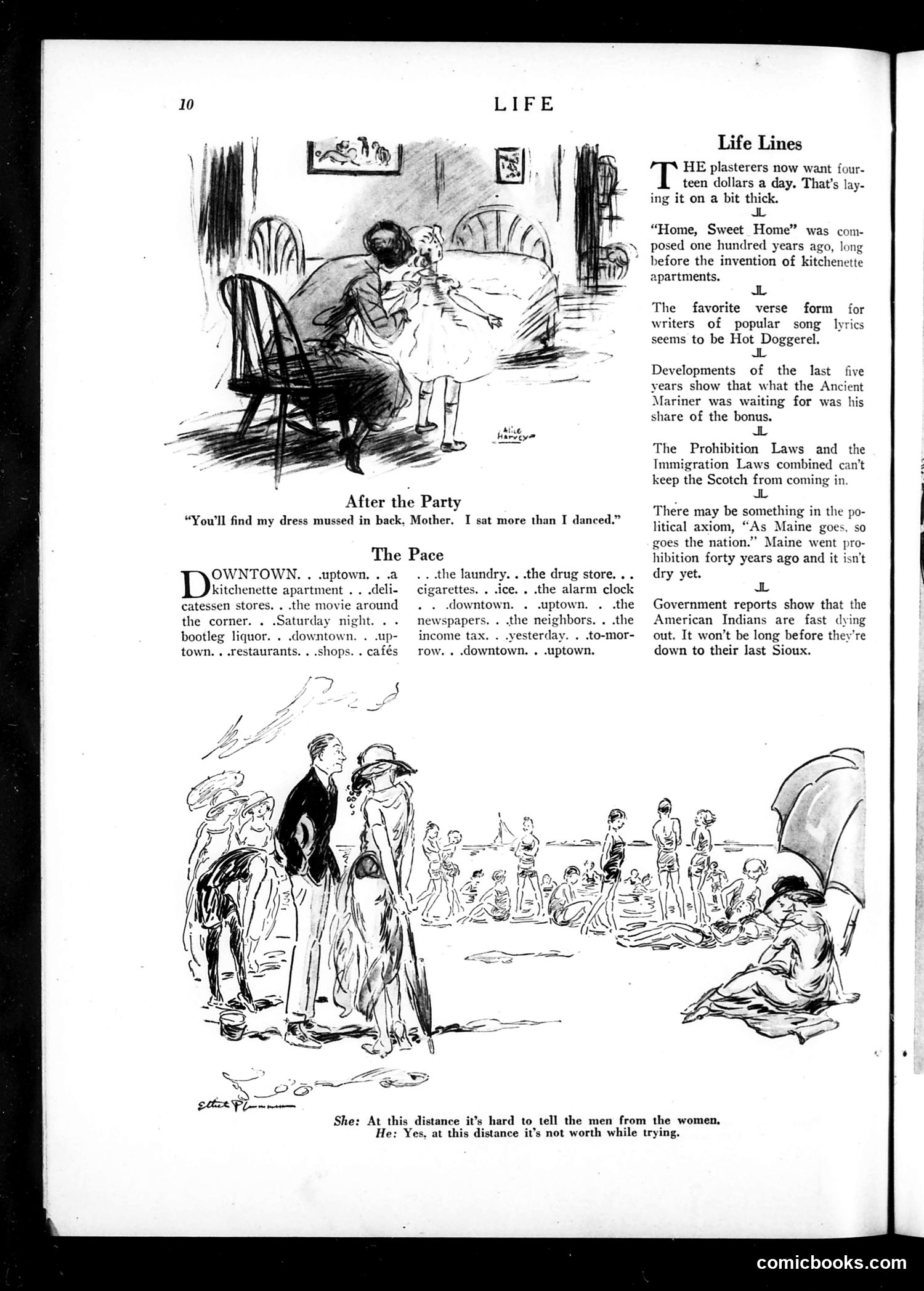
This page contains two satirical cartoons and social commentary from what appears to be the 1920s-1930s era. **"After the Party"** depicts a woman exhausted in bed, claiming she "sat more than I danced"—satirizing modern women's social behavior at parties. **"The Pace"** is a rapid-fire list of downtown urban locations (laundries, drug stores, apartments, restaurants, shops) representing the frenetic, commercialized pace of city life. **The beach cartoon** shows well-dressed men struggling to distinguish men from women at distance, with the punchline about gender visibility—likely satirizing 1920s fashion trends where women's clothing became less distinctly feminine. The accompanying "Life Lines" section contains brief social commentary on topics like plasterers' wages, "Home Sweet Home" nostalgia, and American Indian population decline—typical of the magazine's satirical social observations.
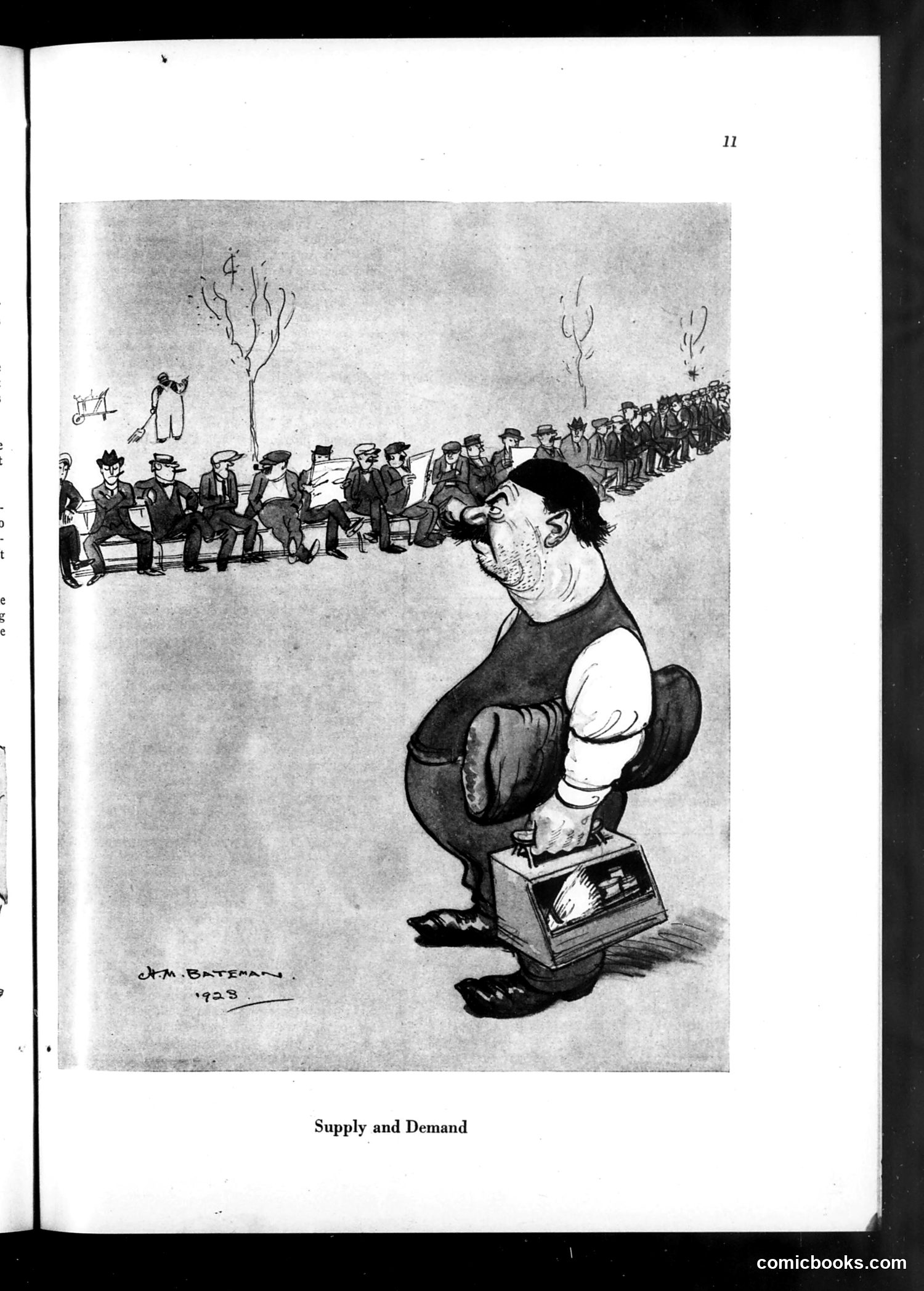
This 1928 political cartoon by Cesare Maccari satirizes economic inequality during the pre-Depression era. The grotesquely caricatured figure in the foreground—bloated and prosperous—stands on a soapbox labeled with what appears to be financial or commercial symbols, representing wealthy industrialists or speculators. He confronts a long line of ordinary citizens waiting in the background, suggesting working people seeking employment or resources. The title "Supply and Demand" ironically references economic theory. The cartoon critiques how laissez-faire capitalism creates vast disparities: while the wealthy grow fat from market forces, ordinary people must queue and wait. The barren trees and sparse landscape reinforce themes of scarcity and deprivation for most, despite apparent abundance for the few—a prescient commentary on wealth concentration that would become catastrophically relevant with the 1929 stock market crash.
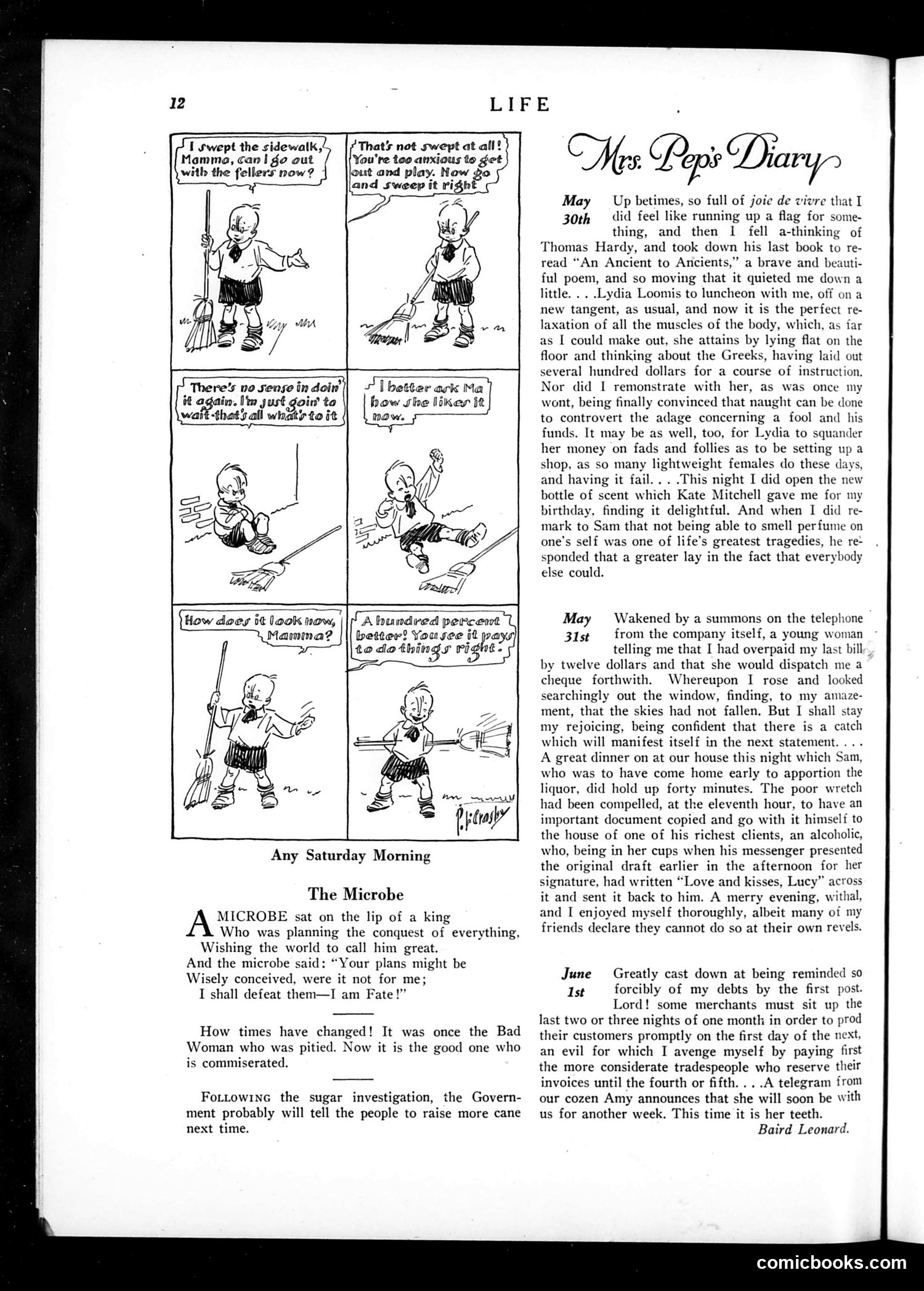
The left side features a comic strip titled "Any Saturday Morning" showing a small child negotiating with a parent about sweeping the sidewalk. The child proposes alternatives and eventually complains that sweeping is pointless—a relatable domestic comedy about childhood resistance to chores. Below is "The Microbe," a brief satirical poem about a microbe advising a king that his conquest plans will fail due to the microbe's interference. The poem concludes with social commentary: "It was once the Bad Woman who was pitied. Now it is the good one who is commiserated." The right side contains "Mrs. Pep's Diary," a society gossip column dated May 30–June 1st, documenting the author's social activities, financial anxieties, and observations about upper-class life—typical early 20th-century satirical commentary on wealth and vanity.
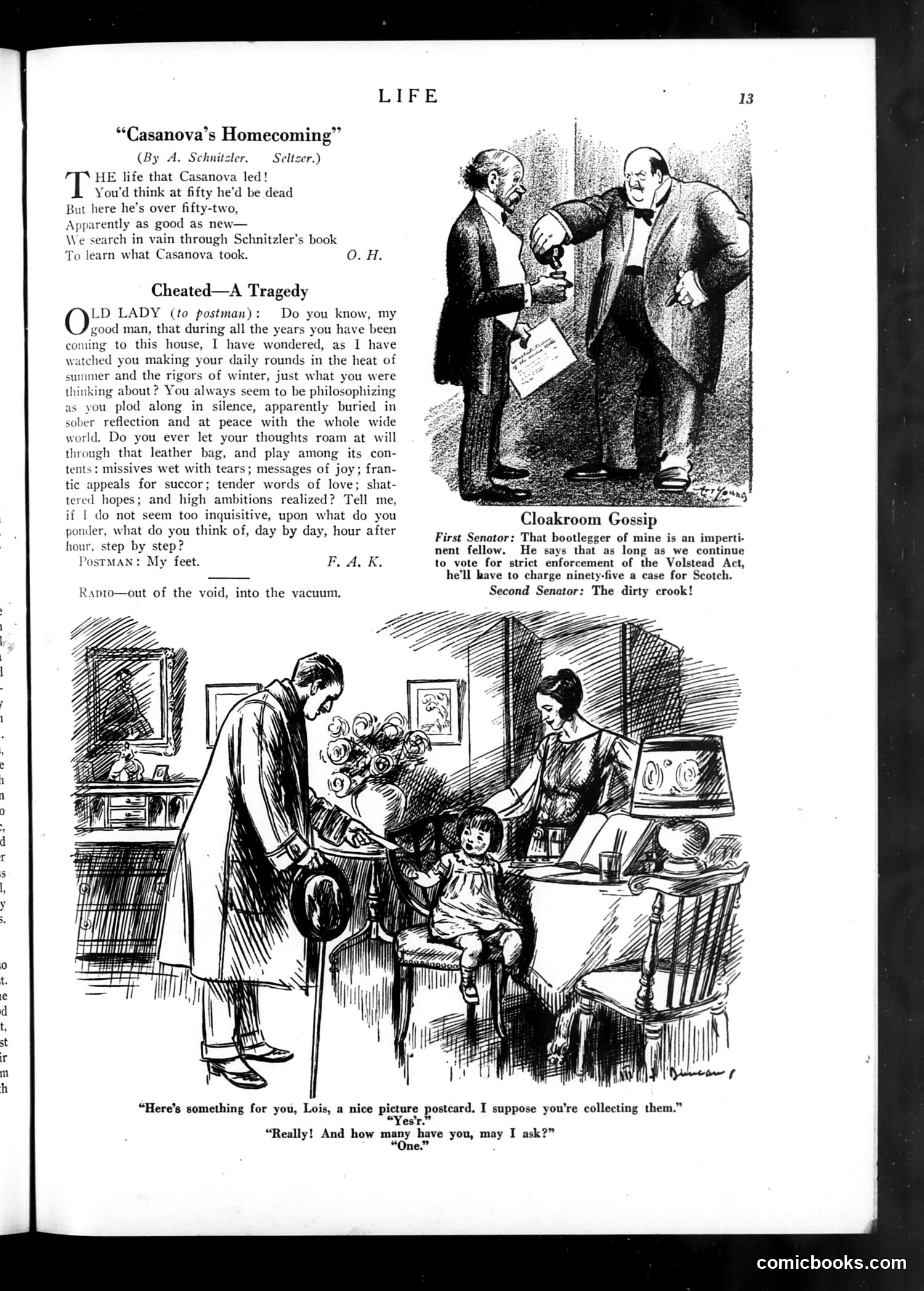
This page contains three separate humor pieces: 1. **"Casanova's Homecoming"** — A brief poetic quip suggesting the historical libertine Casanova has returned, apparently "over fifty" but still vital, prompting readers to consult Schnitzler's book about him. 2. **"Cheated—A Tragedy"** — A dialogue between an old lady and postman exploring her philosophical musings about his daily mail deliveries, which she imagines contain emotional content (love letters, appeals, condolences). The postman's reply—"My feet"—deflates her romantic notions with mundane reality. 3. **"Cloakroom Gossip"** — Two senators discuss a bootlegger's voting record during Prohibition; the second calls him a "dirty crook." 4. **Lower cartoon** — A man gives his daughter a picture postcard; she owns only one, revealing modest means or collecting just begun.
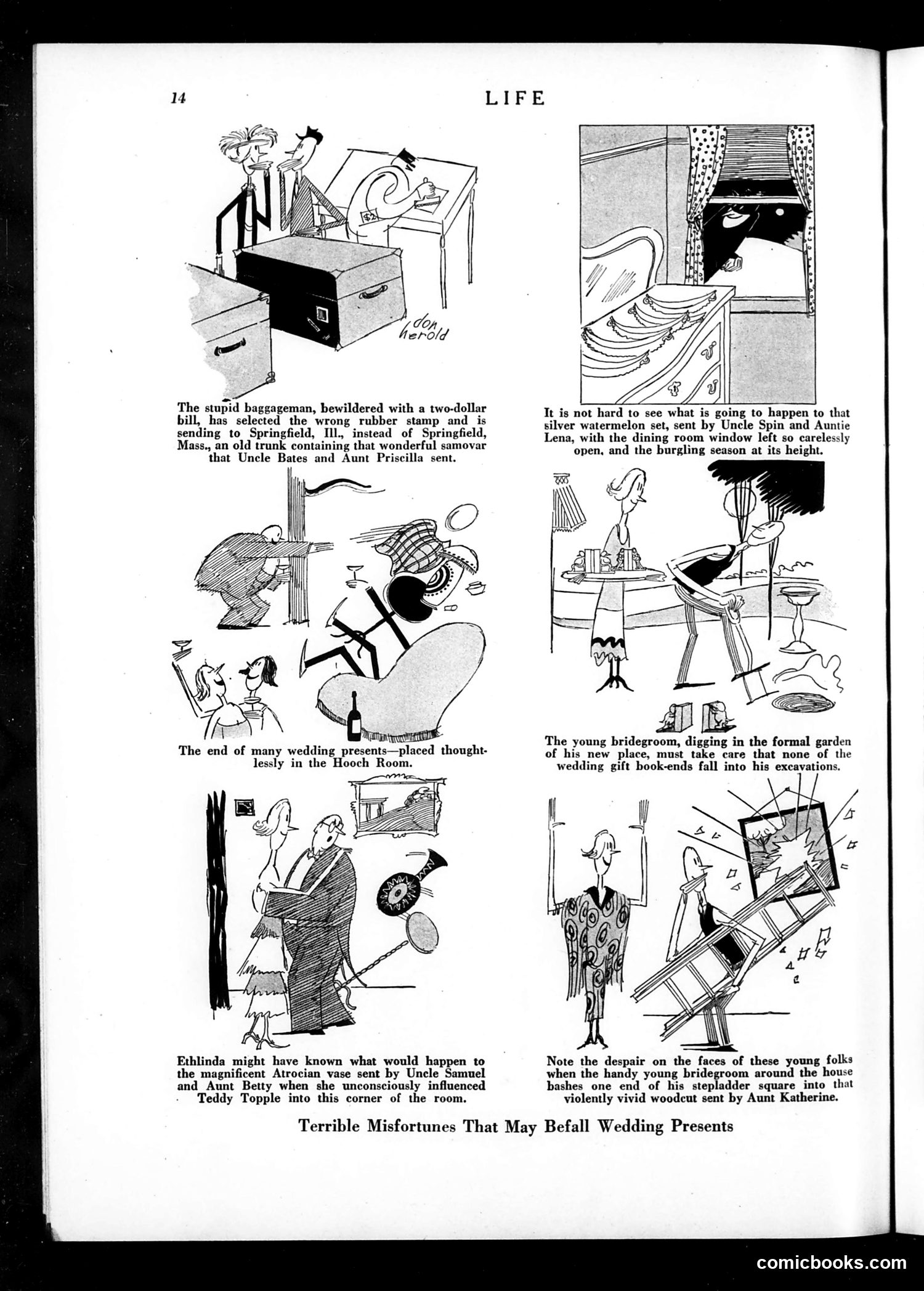
This page from *Life* magazine presents six humorous cartoons about the mishaps that can happen to wedding gifts. Each scenario depicts a different domestic disaster: 1. A baggage handler sends a trunk to the wrong city 2. A silver watermelon set gets destroyed when left near an open window during burglary season 3. Wedding presents get broken during drunken revelry at a reception 4. A bridegroom damages gift boxes while digging in his garden 5. An African vase gets destroyed by someone's hat 6. A wooden staircase is damaged by a careless guest The satire mocks the anxiety newlyweds experience protecting expensive gifts and the various ways domestic life can damage even the most precious presents. It's gentle humor about the impracticality of formal gift-giving and home management.
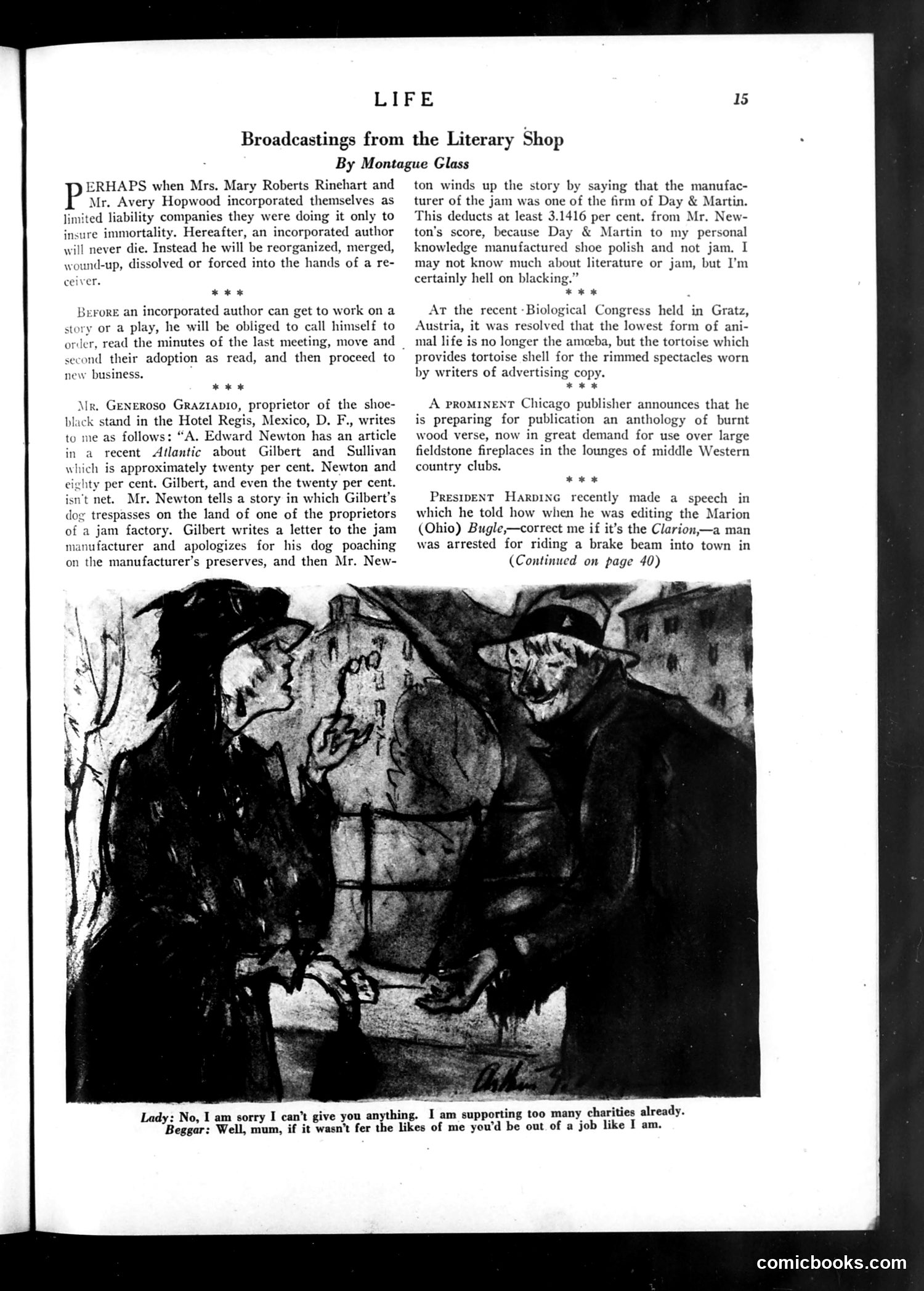
This satirical column by Montague Glass mocks contemporary literary and cultural trends through humorous anecdotes and observations. **Main targets:** 1. **Authors incorporating as businesses**: Glass jokes that writers like Mary Roberts Rinehart and Avery Hopwood formed limited-liability companies, satirizing both their pursuit of immortality and the absurdity of treating creative work as mere corporate machinery requiring board meetings. 2. **The bottom cartoon**: A beggar's witty retort to a wealthy lady. He argues that her charitable donations maintain jobs for people like him—a clever inversion suggesting the wealthy *need* the poor to justify their philanthropy and social standing. 3. **Literary criticism**: Glass mocks A. Edward Newton's Atlantic article about Gilbert and Sullivan, via a Mexico City shoeshine operator's letter. The joke: Newton credits Day & Martin (shoe polish makers) in his story, but the correspondent—an expert in shoe polish—knows Day & Martin made polish, not jam, undermining Newton's literary authority. The overall theme: intellectual pretension and the gap between appearance and reality in American cultural life.
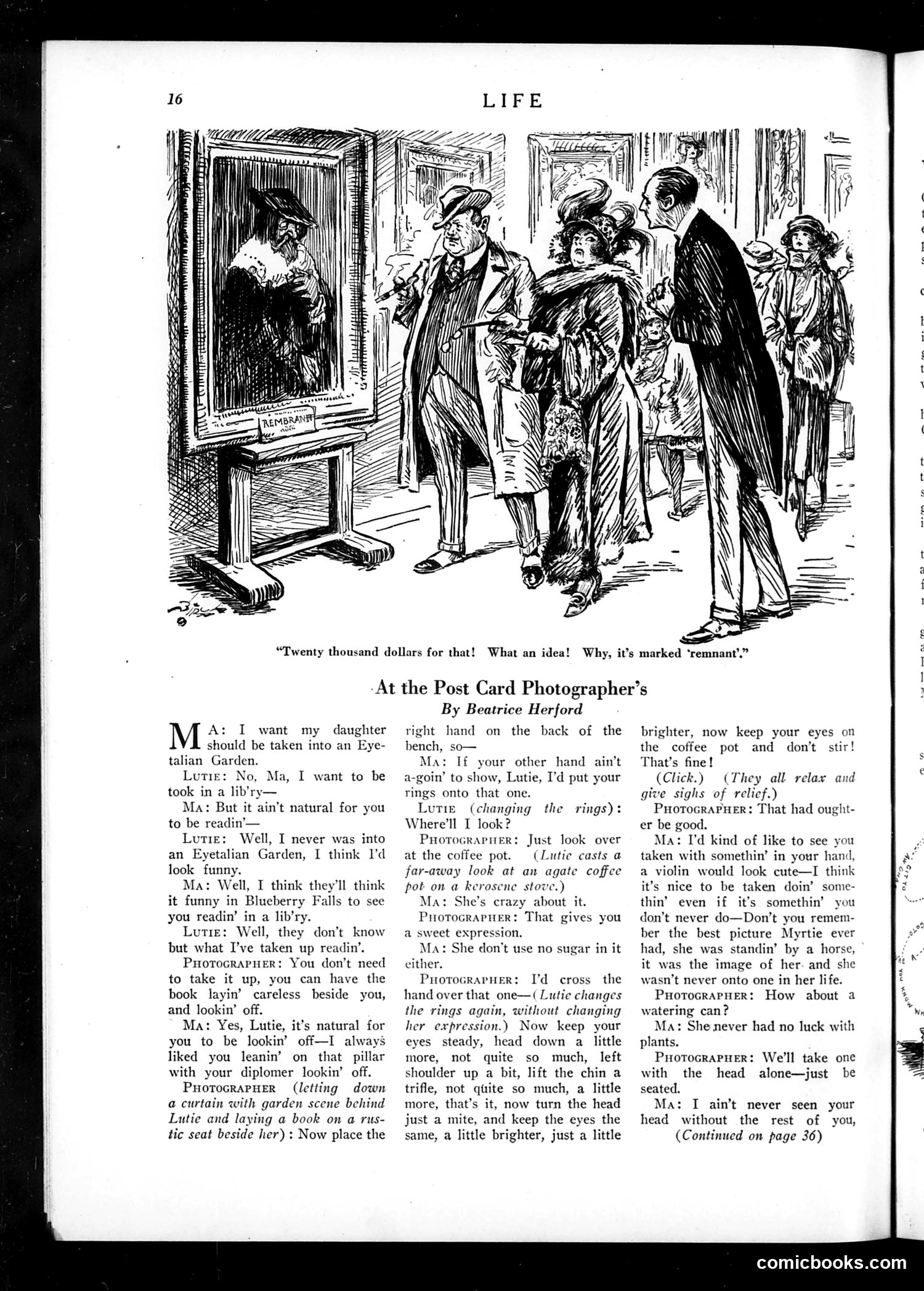
This comic sketch satirizes the vanity and pretension of early 20th-century portrait photography. A working-class mother (Ma) and daughter (Lutie) visit a photographer to create posed postcard portraits—cheap mass-produced photos meant to impress friends back home in "Blueberry Falls." The humor lies in the gap between authentic identity and staged appearance. Ma insists Lutie pose reading in an Italian Garden setting (to appear cultured), though Lutie has never actually read. The photographer endlessly adjusts Lutie's position, rings, and expression for artificial "naturalness." Ma later suggests false props—a violin Lutie doesn't play, a horse she's never touched—because the "best picture" of their friend Myrtie showed her doing things she never actually did. The satire targets both the photography industry's manipulation and the subjects' eager complicity in self-deception for social status.
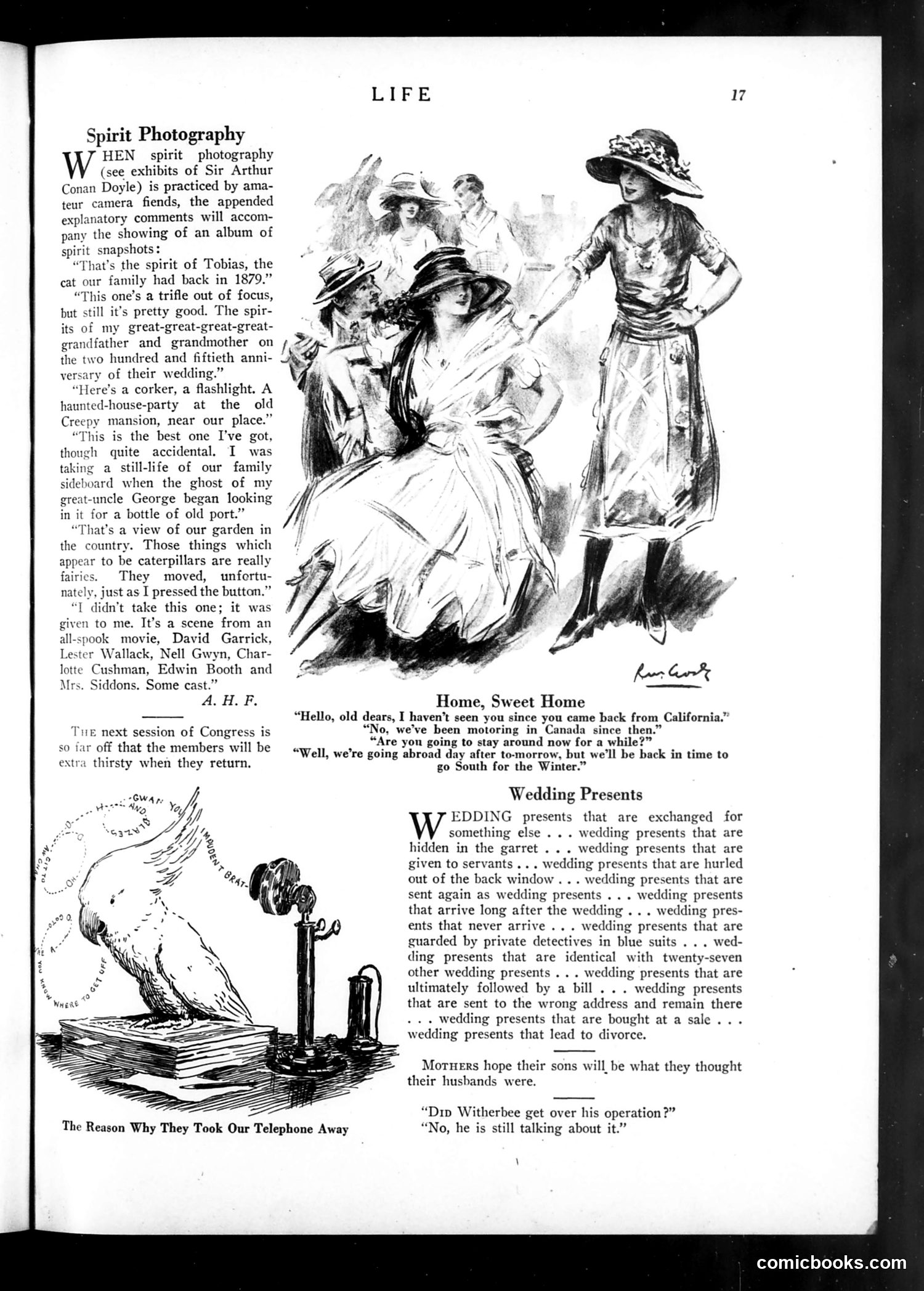
This page satirizes the early 20th-century fad of "spirit photography," referencing Sir Arthur Conan Doyle's public advocacy for the practice. The humor mocks amateur photographers who claimed their images captured ghosts and supernatural phenomena. The main cartoon shows people examining supposed "spirit photographs," with absurd captions explaining ghostly images—a cat from 1879, ancestors, haunted mansion parties, and a great-uncle's spirit seeking port. The joke exposes how believers rationalized obvious photographic flaws (blur, accidents, double-exposures) as genuine supernatural evidence. Below, brief social comedies target wealthy leisure culture: couples perpetually traveling (California, Canada, abroad, "South for the Winter") and the awkwardness of wedding gifts—exchanged, regifted, lost, identical, or eventually causing divorce. The cartoon "The Reason Why They Took Our Telephone Away" shows a man talking excessively about his surgery—satirizing post-operative bore behavior.
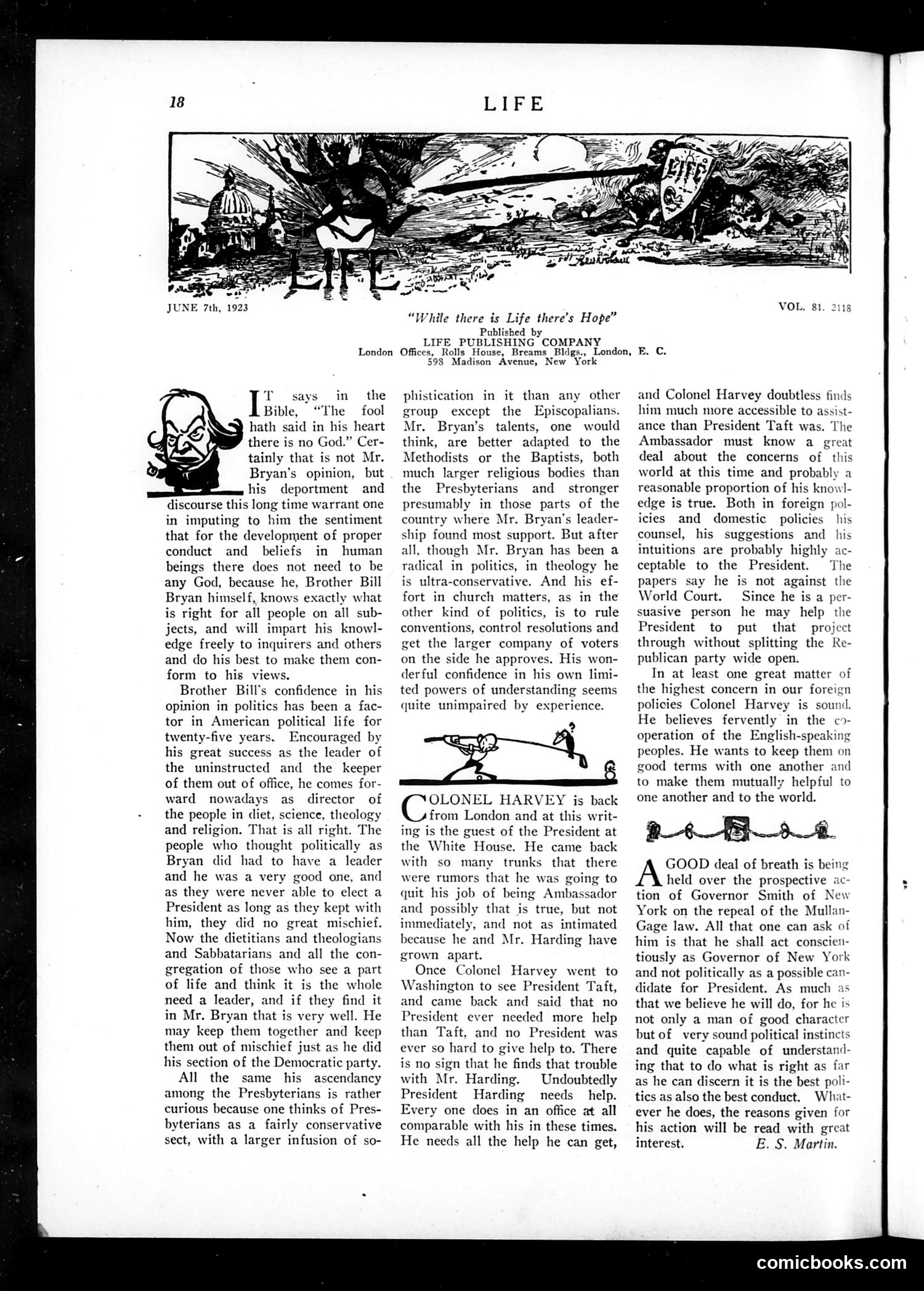
This page contains satirical editorial commentary on two American political figures: **William Jennings Bryan** (identified as "Brother Bill"): The text mocks Bryan's confident assertion of moral authority across multiple domains—politics, diet, science, and theology—despite limited expertise. The satire notes his quarter-century influence over "the uninstructed" in Democratic politics, and finds it curious that Presbyterians (typically sophisticated and conservative) follow him rather than Methodists or Baptists. The underlying critique: Bryan wields influence through certainty and crowd control rather than genuine understanding. **Colonel Harvey**: Recently returned from his ambassadorial post in London, Harvey is visiting President Harding at the White House. The commentary compares him favorably to his previous relationship with President Taft—whom Harvey found difficult to advise—suggesting Harvey finds Harding more receptive to counsel and assistance. The page's overall tone treats both figures with sardonic criticism of their political influence and motivations.
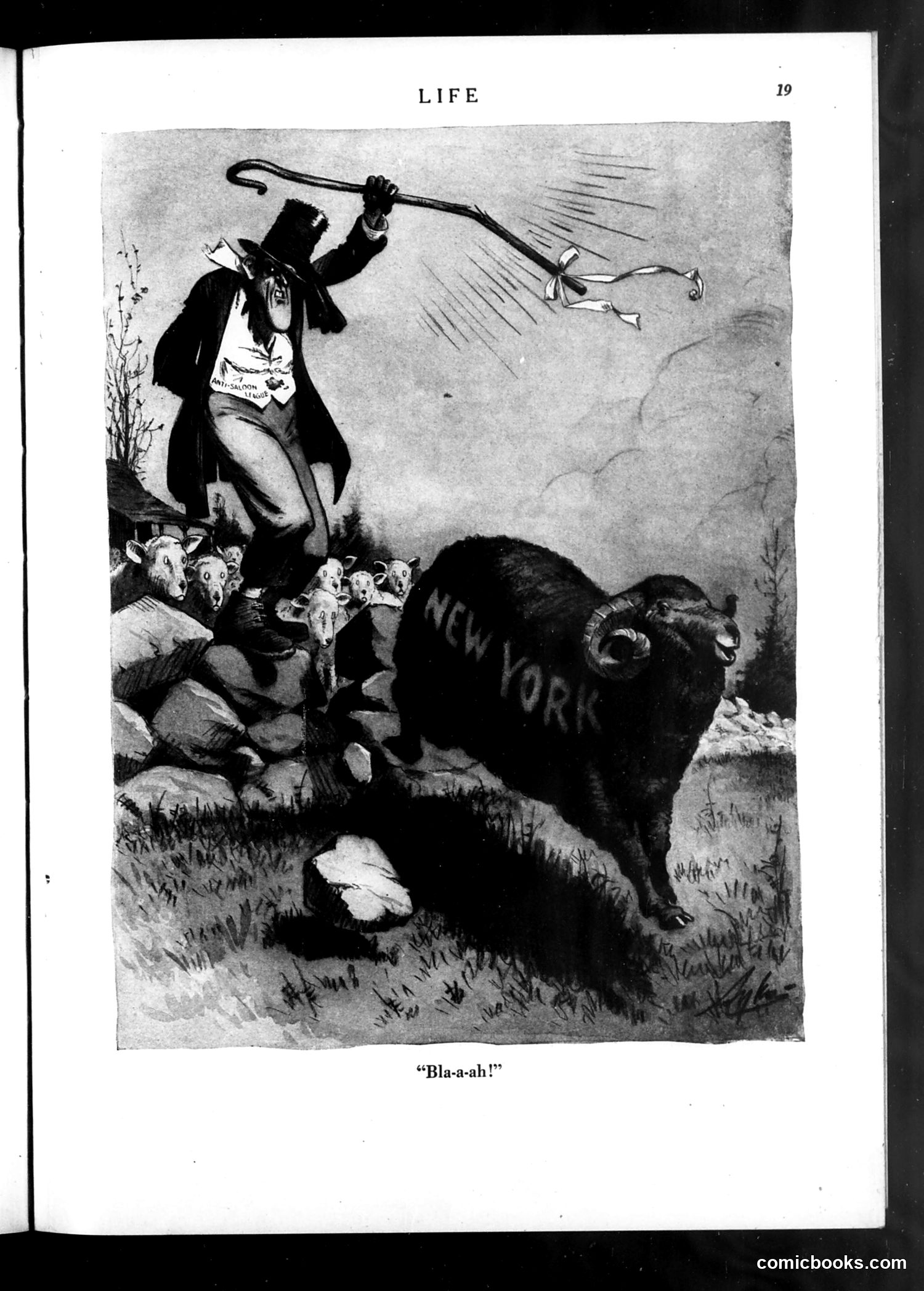
This satirical illustration depicts a man in formal attire (top hat, coat) wielding a cane or stick against a large goat labeled "NEW YORK." The goat appears defiant, surrounded by smaller figures (possibly representing citizens or interests). The cartoon uses the goat as a metaphor for New York City or its government, suggesting obstinacy or unruliness. The well-dressed man represents authority attempting to control or discipline the city. The "Bla-a-ah!" caption mimics the goat's dismissive bleating sound, implying the goat—and by extension, New York—refuses to be controlled and mocks attempts at authority. This likely comments on municipal governance or political conflicts in New York during the publication period, though the specific historical context remains unclear without knowing the exact date.
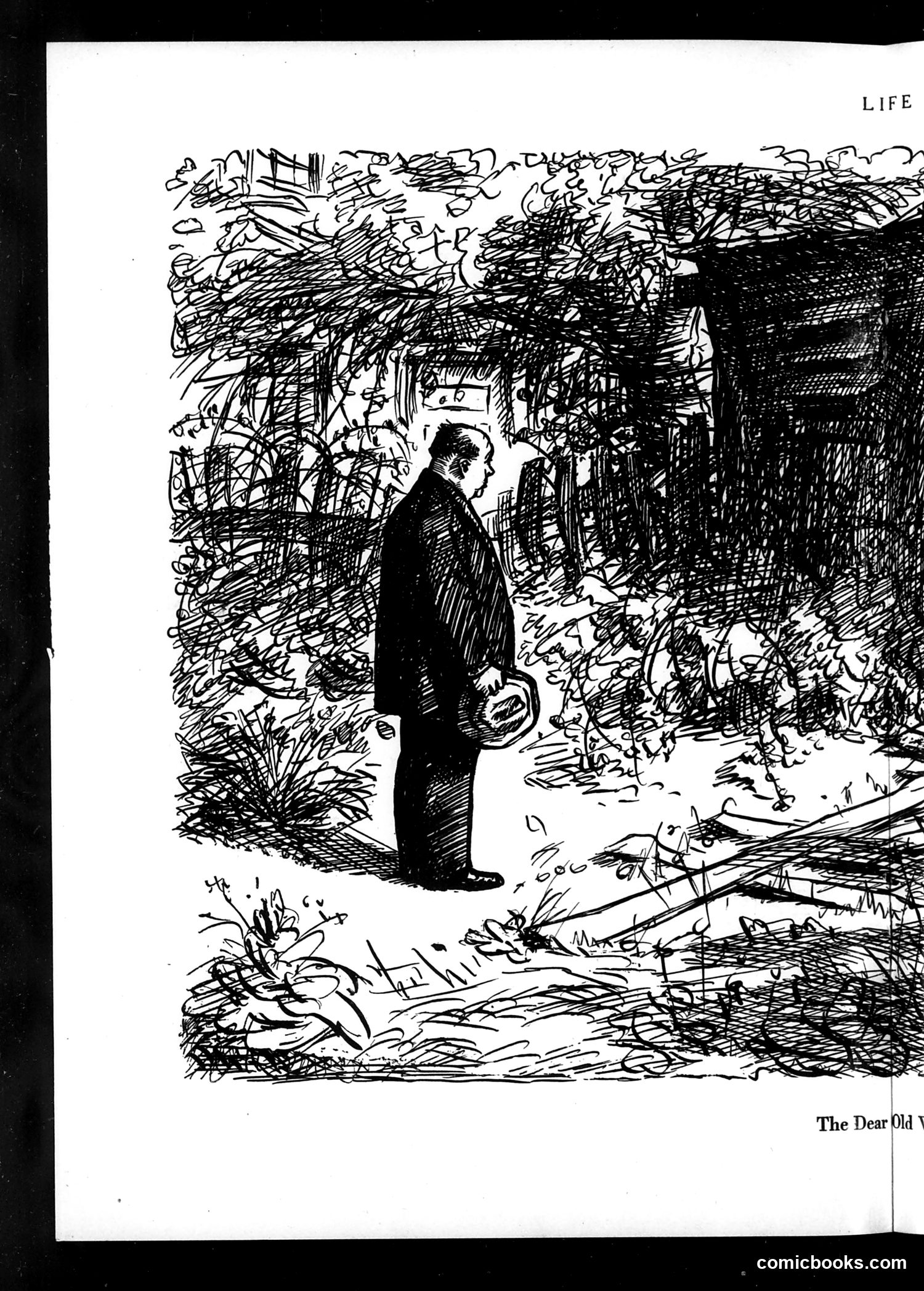
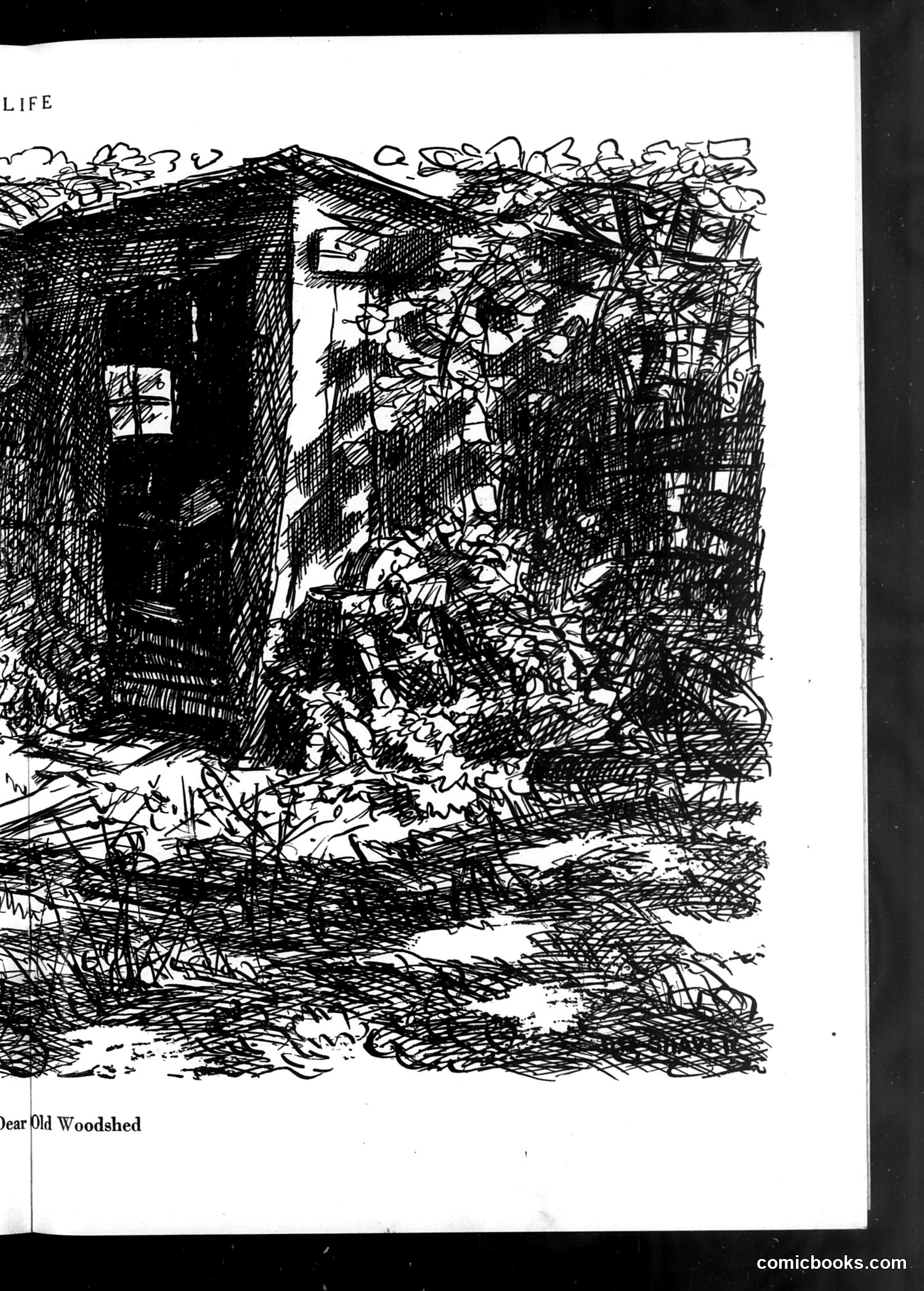
This is a sketch from *Life* magazine showing a dilapidated wooden structure—a shed or barn in severe disrepair. The building is heavily cross-hatched with loose, chaotic linework, depicting deteriorating walls, a sagging roof, and overgrown vegetation. The artistic style emphasizes decay and neglect. The caption "Dear Old Woodshed" suggests nostalgia, but the image contradicts this sentiment—the structure is decrepit rather than charming. This likely satirizes sentimentalizing rural or rustic American life while ignoring actual poverty and poor living conditions. The contrast between the fond title and the grim visual reality creates the satirical point: romanticizing agrarian America while overlooking its harsh realities.
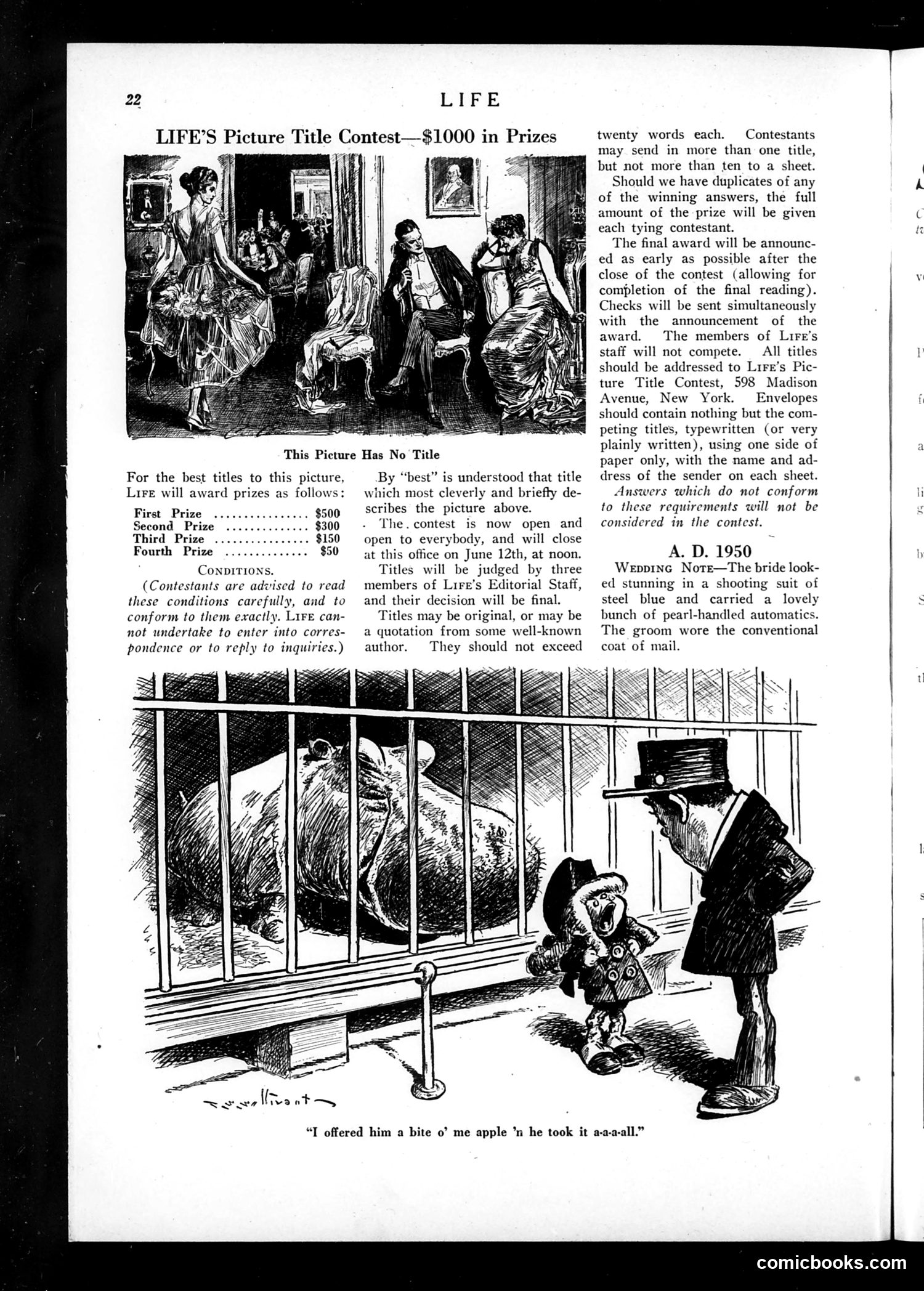
This page features **Life's Picture Title Contest**, offering $1,000 in prizes for readers to submit clever captions for an untitled illustration showing a formal Victorian-era social gathering. The main cartoon depicts an elegantly dressed man and woman at what appears to be a zoo or animal enclosure, with the woman offering the man an apple. His exaggerated response—"I offered him a bite o' me apple 'n he took it a-a-a-all"—suggests the man ate the entire apple greedily in one gulp, playing on his voracious appetite or poor manners. The "A. D. 1950" wedding note below is satirical commentary on modern women's liberation, humorously contrasting a bride's shooting suit and pearl-handled automatics with a groom's "coat of mail"—suggesting women had become armed warriors while men were defensively armored. This reflects 1950s anxieties about changing gender roles post-WWII.
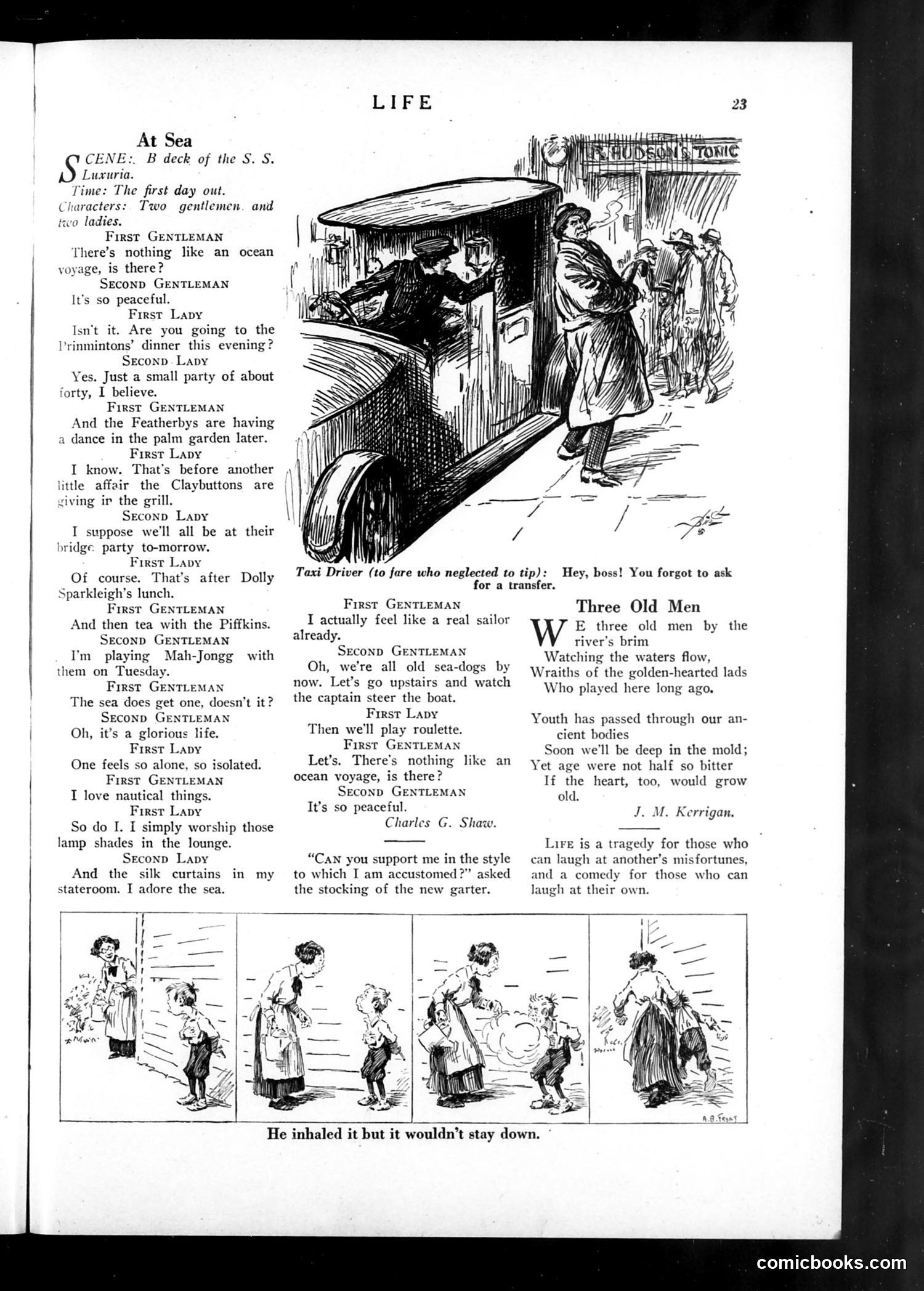
This is a satirical dialogue mocking wealthy passengers aboard an ocean liner (S.S. Luxuria) who claim to seek peaceful solitude at sea, yet remain trapped in their own social whirlwind. The humor lies in the contradiction: as they wax poetic about ocean voyages being peaceful and isolated, they simultaneously catalog an exhausting schedule of dinner parties, dances, lunches, bridge games, and Mah-Jongg—all happening aboard the same ship. The characters express love for "nautical things" while actually admiring lamp shades and silk curtains, revealing their focus is entirely on luxury trappings rather than genuine nautical experience. The repeated refrain "There's nothing like an ocean voyage, is there?" becomes ironic—the voyage provides no escape from their relentless social obligations. The humor targets upper-class pretension and the inability of the wealthy to actually disconnect or experience authenticity, even when removed from ordinary society.
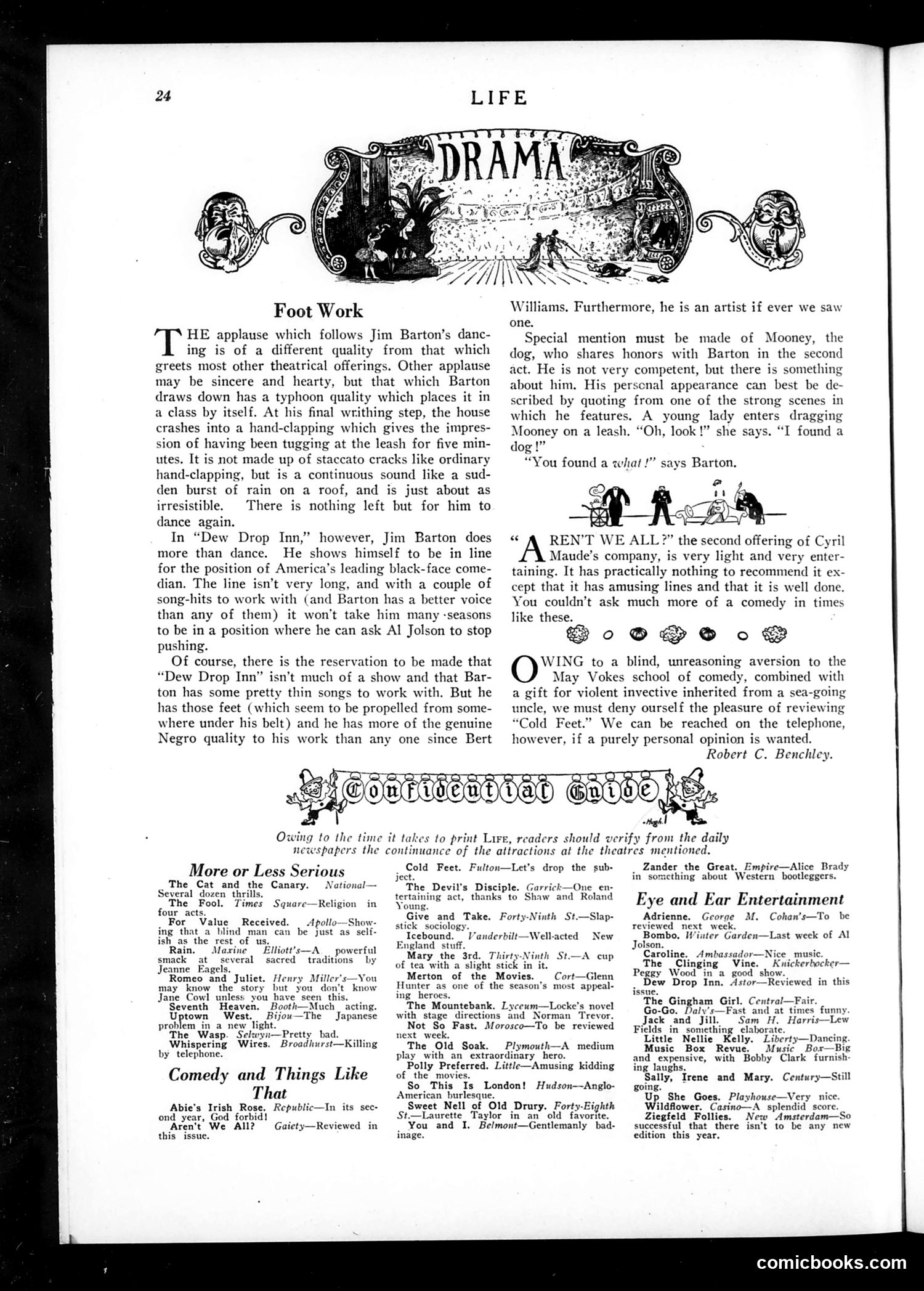
This is a theater review section from Life magazine's "Drama" department, circa early 1920s. The main article praises Jim Barton, a Black-face comedian and dancer, comparing his applause to a "typhoon" and suggesting he could rival Al Jolson as "America's leading black-face comedian." The text uses period-appropriate but now-offensive language ("Negro quality," blackface references) reflecting entertainment practices of that era. Barton is praised for his dancing skill and authenticity, with special mention of a dog named Mooney who performs in the show. Below are brief capsule reviews of other theatrical offerings—some praised, others dismissed ("In its second year, God forbid!" for Abie's Irish Rose). Critic Robert C. Benchley humorously refuses to review "Cold Feet," citing his temperament. The page illustrates early 20th-century American theater culture and the prevalence of blackface performance, which audiences then considered legitimate entertainment.
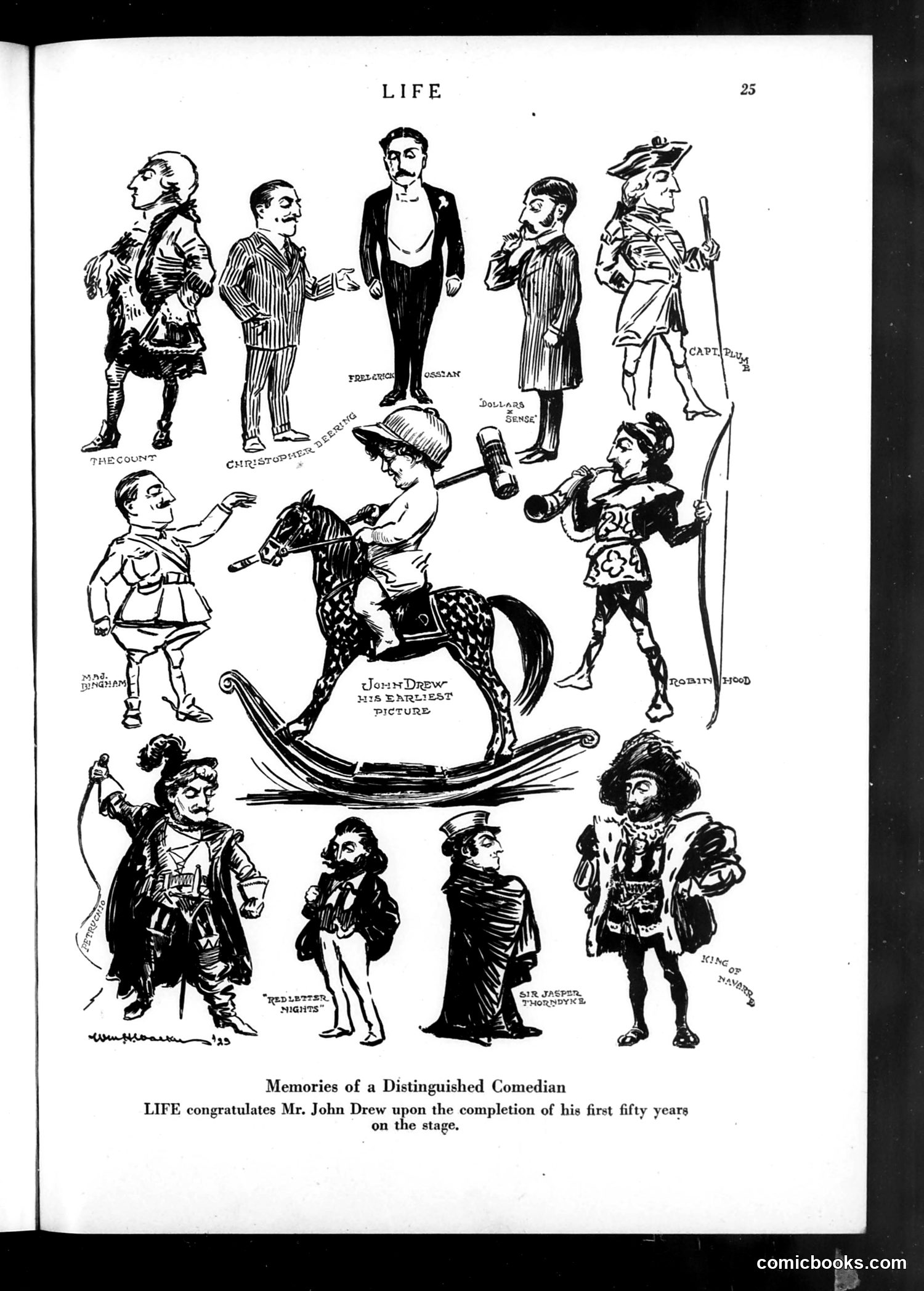
This is a celebratory illustration honoring actor **John Drew** on his 50-year theatrical career. The page displays characters from various theatrical roles he performed, arranged around a central rocking horse labeled "John Drew's Earliest Picture." The labeled characters include "The Count," "Christopher," "Follower Gorman," "Dollars and Sense," "Captain," "Robin Hood," "Red Letter Nights," and "Sir Jasper Thorndyke"—representing Drew's diverse stage roles across decades. The satire is gentle: rather than mocking Drew, *Life* magazine celebrates his longevity and range by presenting his character gallery. The rocking horse suggests both childhood innocence and the cyclical nature of theater. This is a tribute to an elder statesman of American comedy whose career spanned multiple generations, showcasing how successfully he'd entertained audiences across many different theatrical productions.
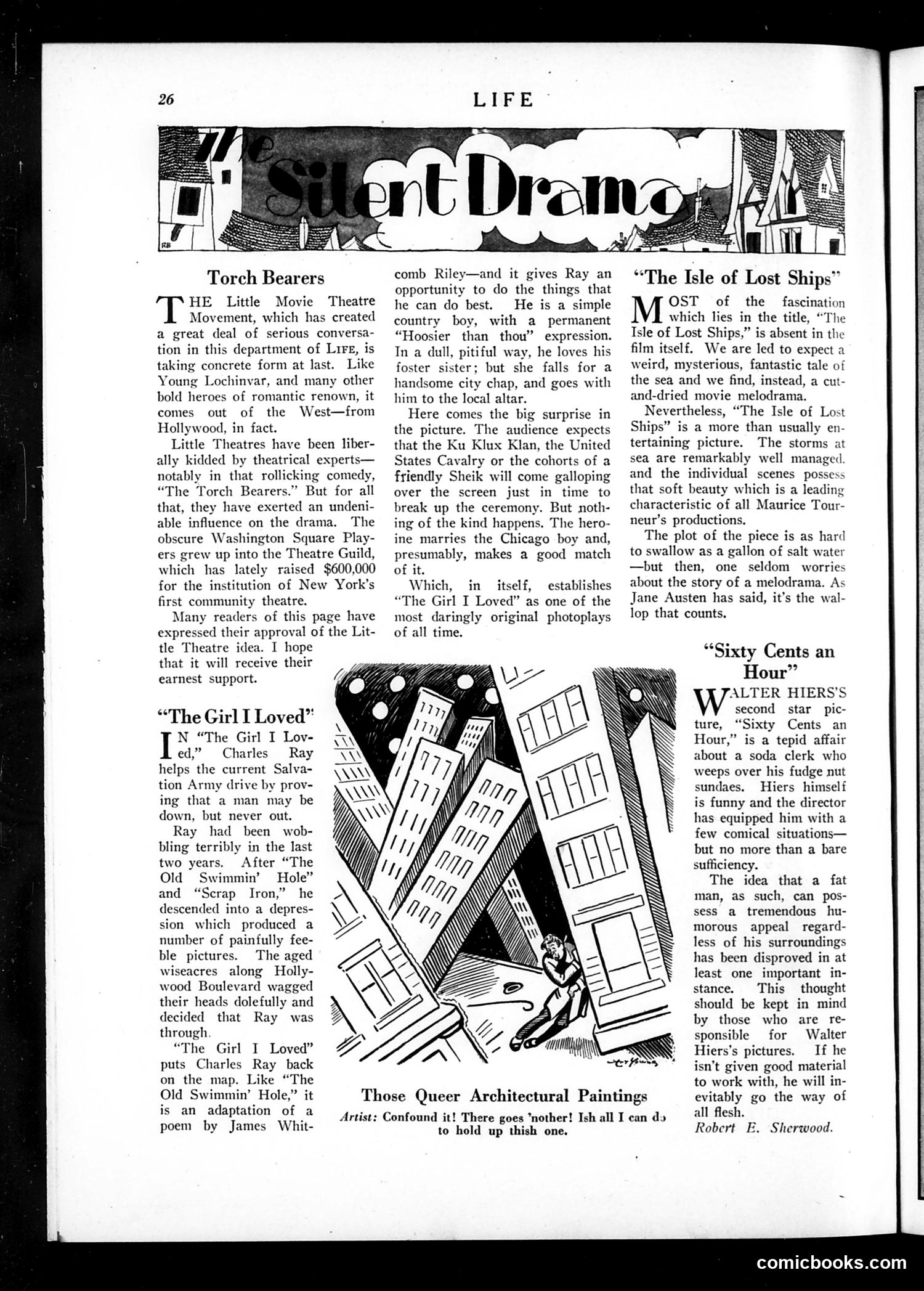
This page reviews four early 1920s silent films. The main cartoon depicts an intoxicated artist struggling to hold up falling buildings—a visual joke about poorly constructed or implausible movie sets. The reviews discuss: 1. **"The Girl I Loved"** (Charles Ray)—praised for reviving Ray's flagging career by returning to his strength: playing simple, sentimental Hoosier characters. The reviewer sarcastically notes the film's "daringly original" plot twist: the heroine actually *marries* the city boy without dramatic intervention (no Ku Klux Klan or cavalry rescue). 2. **"The Isle of Lost Ships"**—criticized as disappointing despite its intriguing title, though praised for realistic ocean storm scenes. 3. **"Sixty Cents an Hour"** (Walter Hiers)—a tepid comedy about a soda clerk. The critic argues that fat comedians cannot rely on appearance alone; without quality material, even funny performers will fail. The reviews reflect 1920s film criticism standards and contemporary concerns about actor careers and material quality.
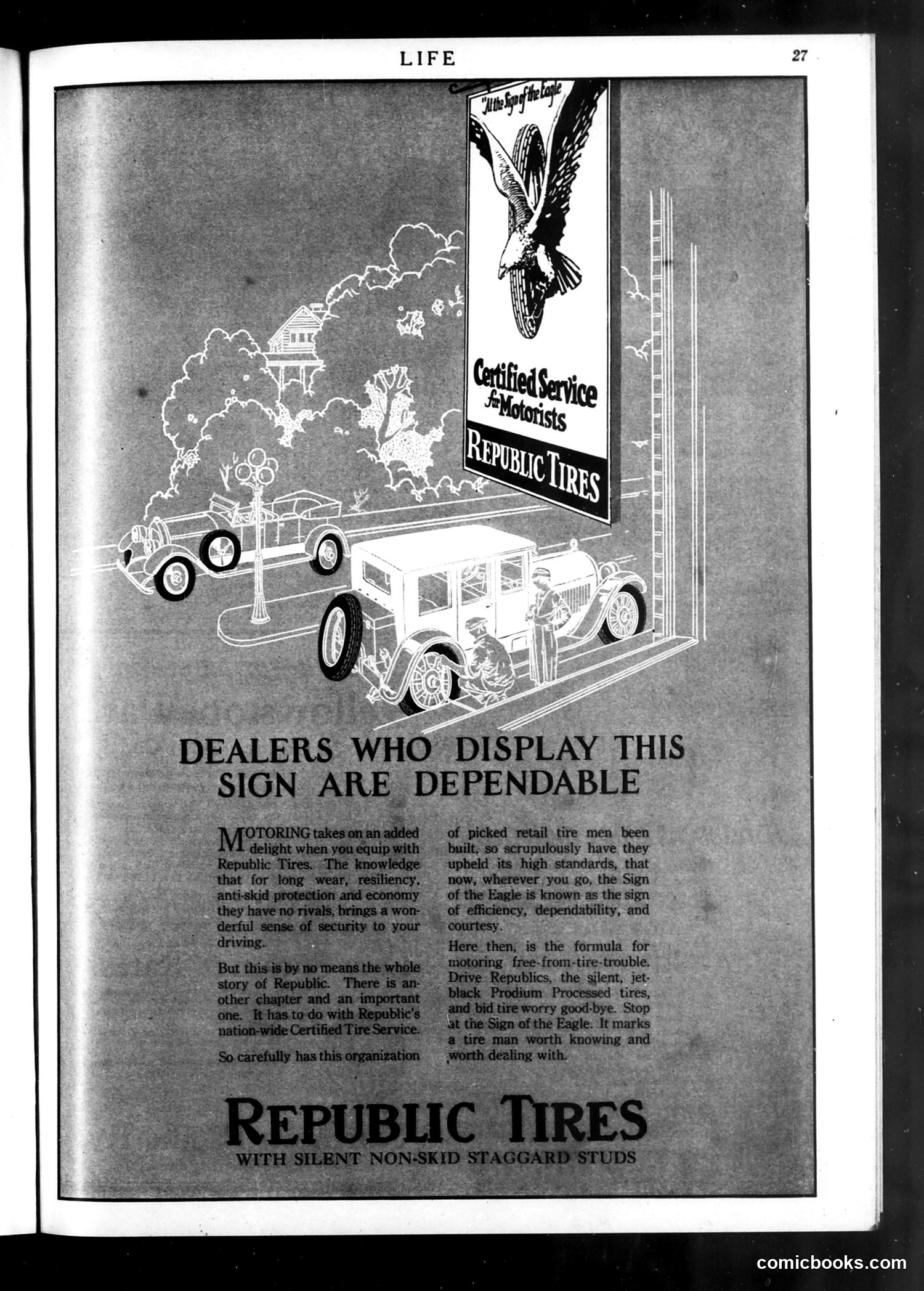
This is a **Republic Tires advertisement**, not a satirical cartoon. The page features an illustration of 1920s automobiles beneath a large billboard advertising "Certified Service for Motorists" with an eagle logo. The ad's headline—"Dealers Who Display This Sign Are Dependable"—uses the eagle emblem as a certification mark. The text emphasizes Republic's "nation-wide Certified Tire Service," positioning tire dealers displaying the sign as trustworthy and reliable. There is no political satire here. This is straightforward commercial advertising leveraging patriotic imagery (the eagle) to build consumer confidence in tire quality and dealer reliability during an era when automotive safety was a growing concern.
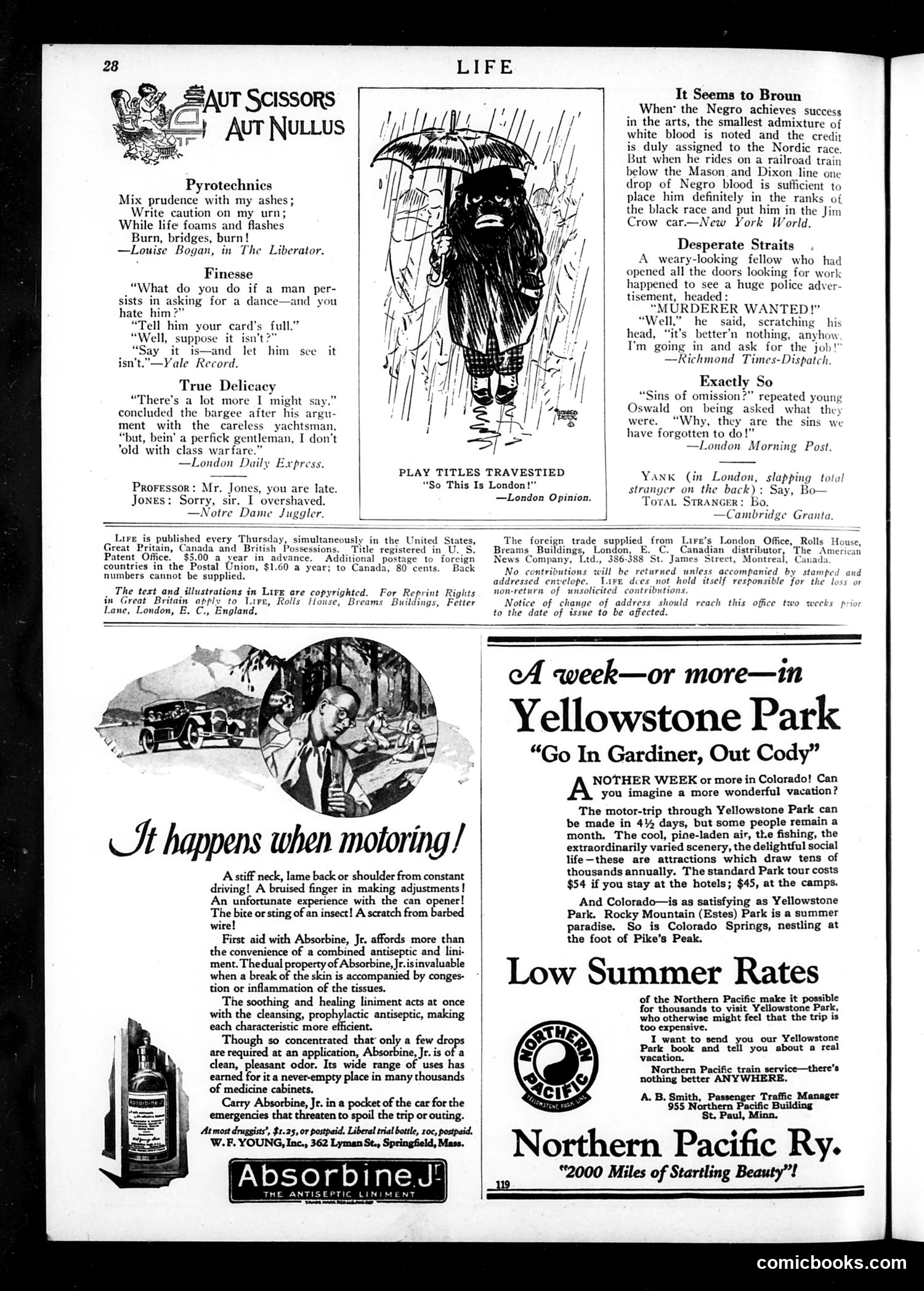
This page features several satirical short pieces typical of Life's style. Most notably, the **cartoon about the Black traveler in rain** illustrates systemic racial hypocrisy: the accompanying text points out that when African Americans succeed artistically, white ancestry is credited, yet a single drop of Black blood relegates someone to Jim Crow segregation on trains below the Mason-Dixon line—an absurd contradiction in American racial classification. Other brief satirical items mock social etiquette (a woman lying about her dance card to refuse an unwanted partner), workplace desperation (a jobless man considering applying to become a murderer), and class differences (an American tourist in London). These represent typical Life magazine humor: witty observations on everyday social hypocrisy and absurdity targeting middle-class readers. The page also contains period advertising for Absorbine Jr. liniment and Northern Pacific Railway tourism.
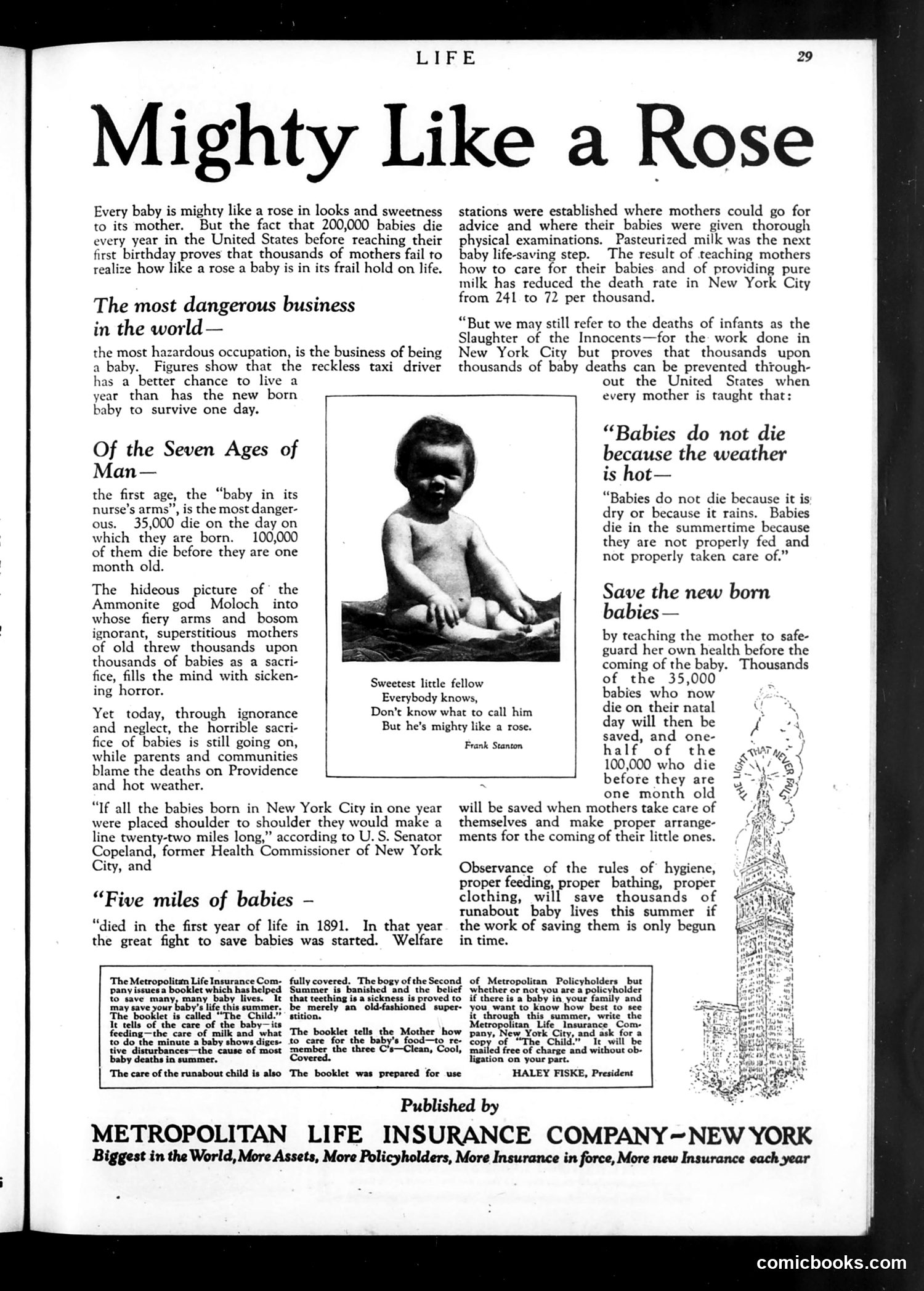
This Life magazine page is a public health advocacy piece—not satire—sponsored by Metropolitan Life Insurance Company. It addresses America's staggering infant mortality crisis: 200,000 babies died annually in the United States before their first birthday. The article makes a stark comparison: being a newborn was statistically more dangerous than being a reckless taxi driver. It cites horrifying statistics (35,000 infants died on their birth day alone in 1891) and compares preventable deaths to ancient child sacrifice to the god Moloch. The central argument: babies don't die from weather or divine providence, but from ignorance and poor care. Solutions included pasteurized milk, maternal education, and hygiene instruction. The poem accompanying the baby photo emphasizes maternal love despite fragility. This represents Progressive Era public health reformism, where insurance companies and civic institutions promoted scientific motherhood and medical intervention to reduce preventable deaths.
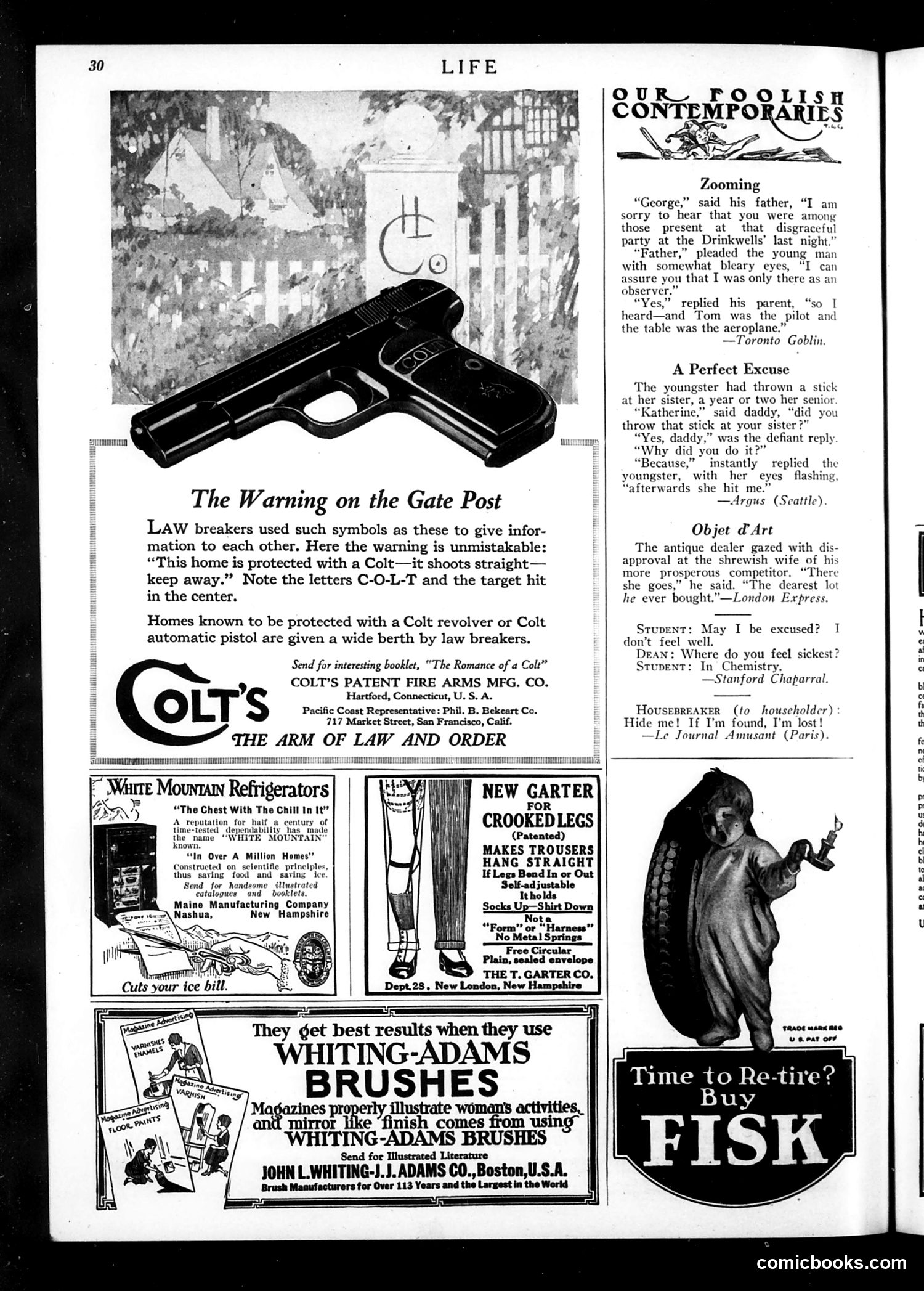
This page mixes humor columns with period advertisements. The main satirical content includes: **"Zooming"**: A father scolds his son for attending a wild party at the Drinkwells', but the boy claims he was merely observing. The father replies he'd heard otherwise—that "Tom was the pilot and the table was the aeroplane," mocking the young man's drunken state by suggesting he imagined flying. The joke references the era's fascination with aviation and young men's excessive drinking culture. **"A Perfect Excuse"**: A child admits throwing a stick at her sister but justifies it because the sister hit her afterward—a child's illogical defense of misbehavior. **"The Warning on the Gate Post"**: The large advertisement for Colt revolvers uses a criminal-code symbol (C-O-L T with a target) that burglars supposedly used to mark homes they'd rob. Colt exploits this by claiming their guns protect homes—a pragmatic marketing appeal to homeowners' security fears during an era of property crime. The remaining content is advertising for refrigerators, trouser garters, and brushes.
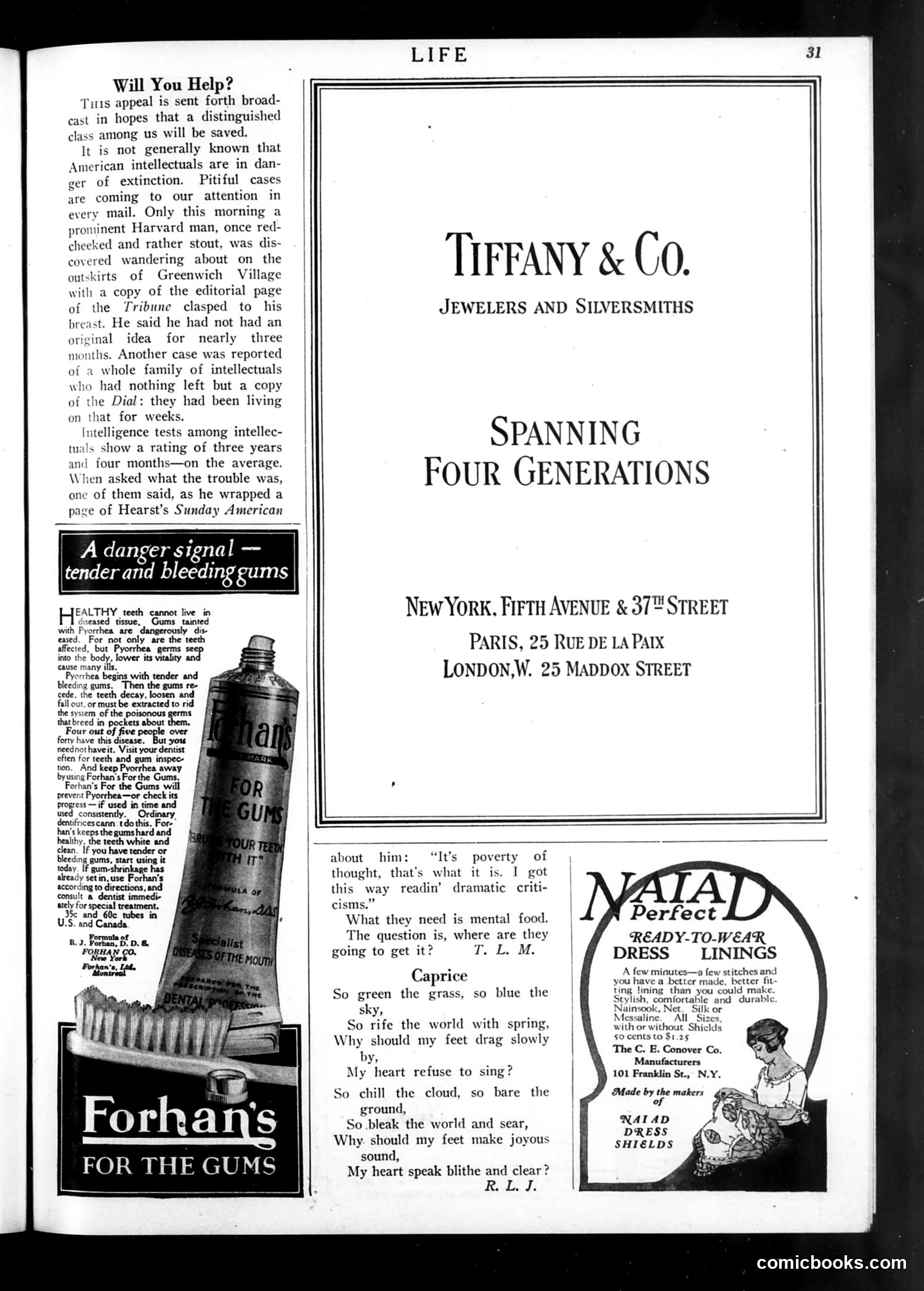
This page satirizes the perceived decline of American intellectuals through a mock "distress appeal." The humor centers on intellectuals in Greenwich Village (the bohemian artistic enclave) who are supposedly starving—literally surviving on newspaper editorial pages and copies of *The Dial* (a prestigious literary journal). The satire suggests that intellectuals are intellectually malnourished despite consuming high-minded reading material. When asked about their crisis, one attributes it to "poverty of thought" from reading dramatic criticisms—implying that engagement with arts criticism creates mental emptiness rather than nourishment. The accompanying poem titled "Caprice" appears to exemplify the pretentious, emotionally overwrought output these struggling intellectuals produce. The page is otherwise dominated by advertisements (Tiffany & Co., Forhan's toothpaste, dress linings), which ironically juxtapose commercial materialism against the idealistic poverty of the intellectual class being mocked.
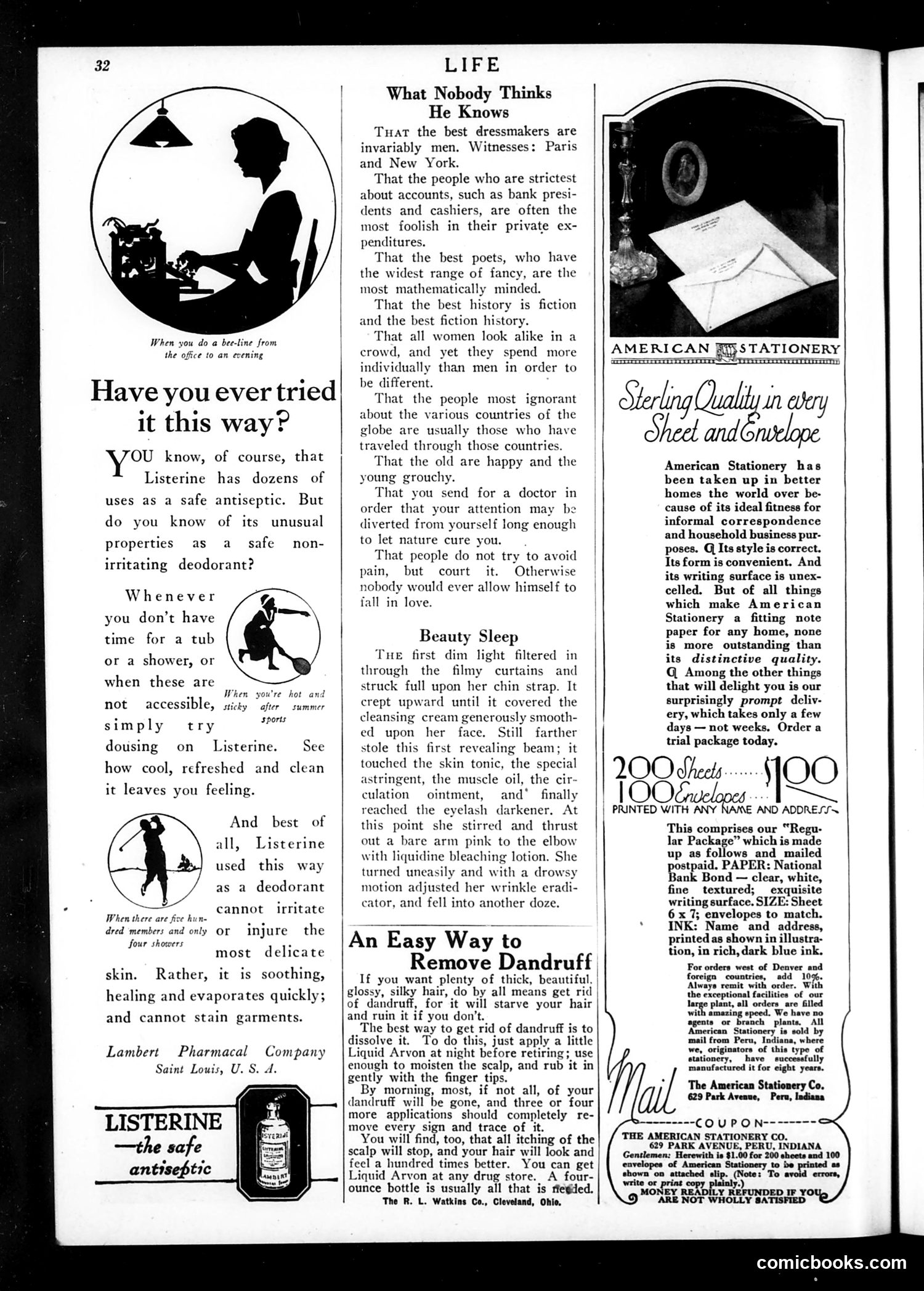
This page combines satirical commentary with period advertisements, typical of 1920s Life magazine. **"What Nobody Thinks He Knows"** is a satirical column listing counterintuitive social observations—the best dressmakers are men (Paris/New York fashion centers), strict accountants are foolish with money, mathematically-minded poets have wide imagination, and so forth. It's gentle social satire mocking human contradictions and pretensions. **"Beauty Sleep"** humorously mocks women's elaborate nighttime beauty routines, cataloging the various creams, tonics, oils, and treatments applied before bed—suggesting women's beauty work is constant and exhausting, even during sleep. The advertisements (Listerine, American Stationery, dandruff treatment) promote products as modern solutions to social anxieties—hygiene, appearance, correspondence propriety. The cartoon's silhouette shows someone at an office desk with a hanging lamp, illustrating the opening line about rushing from office to evening activities—likely suggesting people use Listerine as a quick freshen-up when proper bathing isn't available. The overall tone reflects 1920s concerns with efficiency, appearance, and modern convenience.
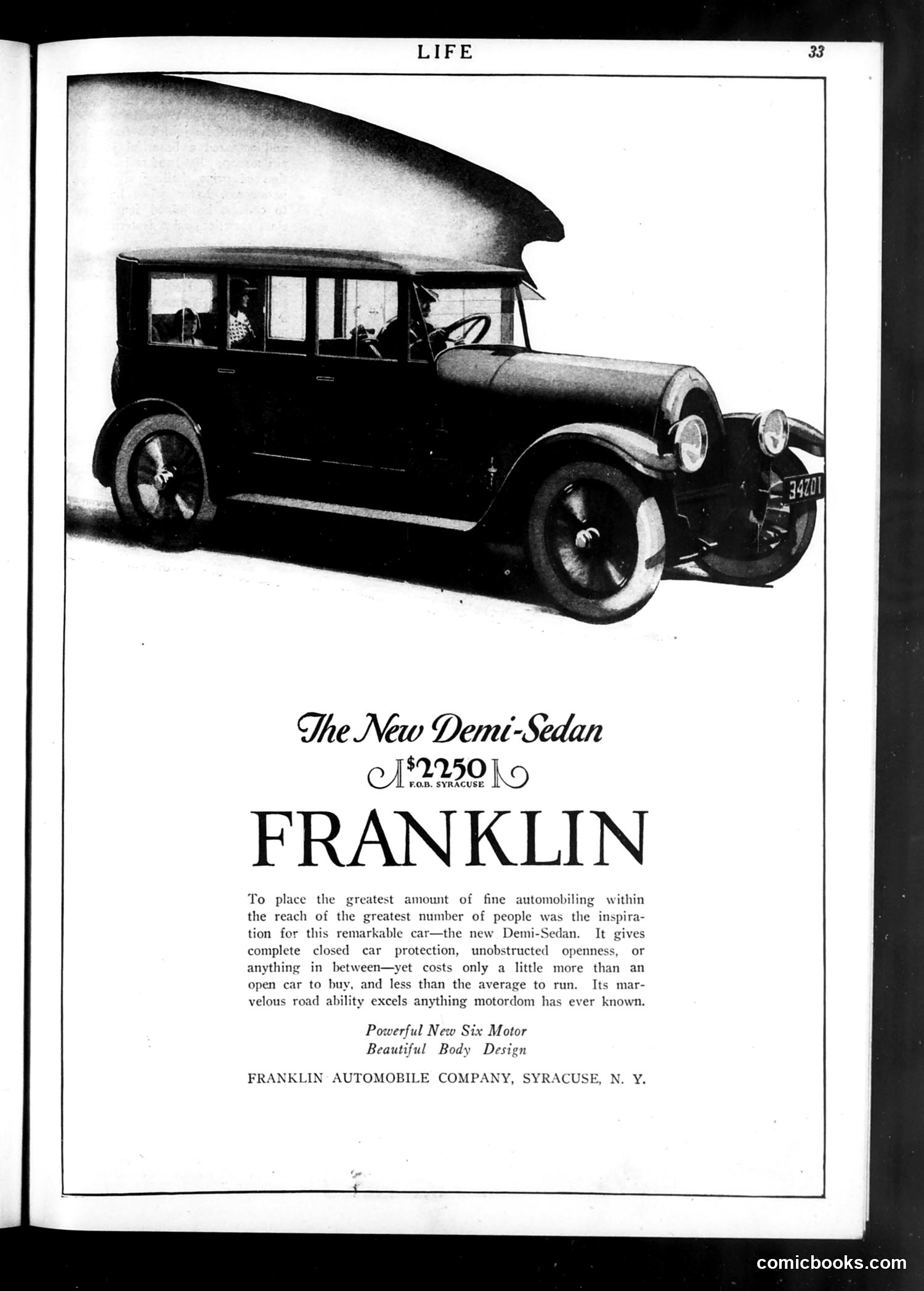
This is a straightforward **automobile advertisement**, not political satire or a cartoon. It promotes the Franklin Demi-Sedan, priced at $2,250 (f.o.b. Syracuse), manufactured by the Franklin Automobile Company in Syracuse, New York. The ad emphasizes the car's hybrid design—offering "complete closed car protection" with "unobstructed openness," positioning it as an affordable middle option between open and fully enclosed vehicles. It highlights the "Powerful New Six Motor" and "Beautiful Body Design" while claiming superior "road ability." This represents early 1920s automotive marketing, when closed cars were still relatively new and premium. The Franklin was a real manufacturer known for air-cooled engines and quality vehicles, targeting middle-class buyers seeking luxury features at accessible prices. There is no satirical content here—it's period advertising from *Life* magazine's commercial pages.
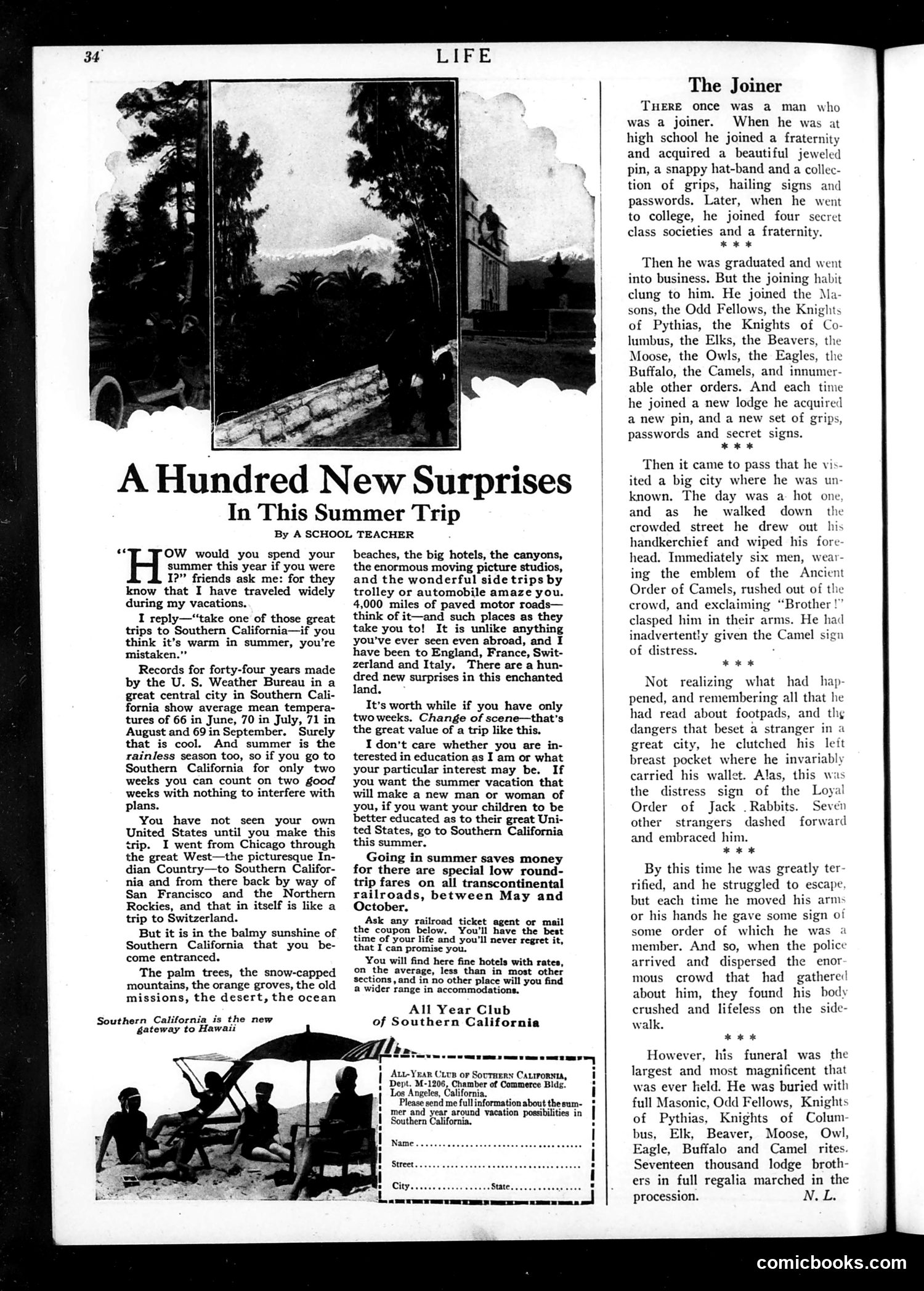
This story satirizes early 20th-century American men's compulsive joining of fraternal organizations. The protagonist accumulates memberships across his lifetime—from high school fraternities through college secret societies, then into adult orders: Masons, Odd Fellows, Knights of Pythias, Elks, Moose, Eagles, Buffalo, and more. Each membership requires purchasing pins, learning secret handshakes and passwords—accumulating fraternal paraphernalia obsessively. The joke builds when he visits an unfamiliar city and is ambushed by members of the "Ancient Order of Camels," who rush him, embrace him, and clasp his left breast pocket where his wallet sits. The satire mocks how these organizations, though claiming brotherhood and civic virtue, reduce members to interchangeable participants recognizing each other by visible symbols. His funeral becomes the ultimate punchline: seventeen thousand lodge brothers march in full regalia—suggesting his identity was consumed entirely by organizational membership rather than individual accomplishment.
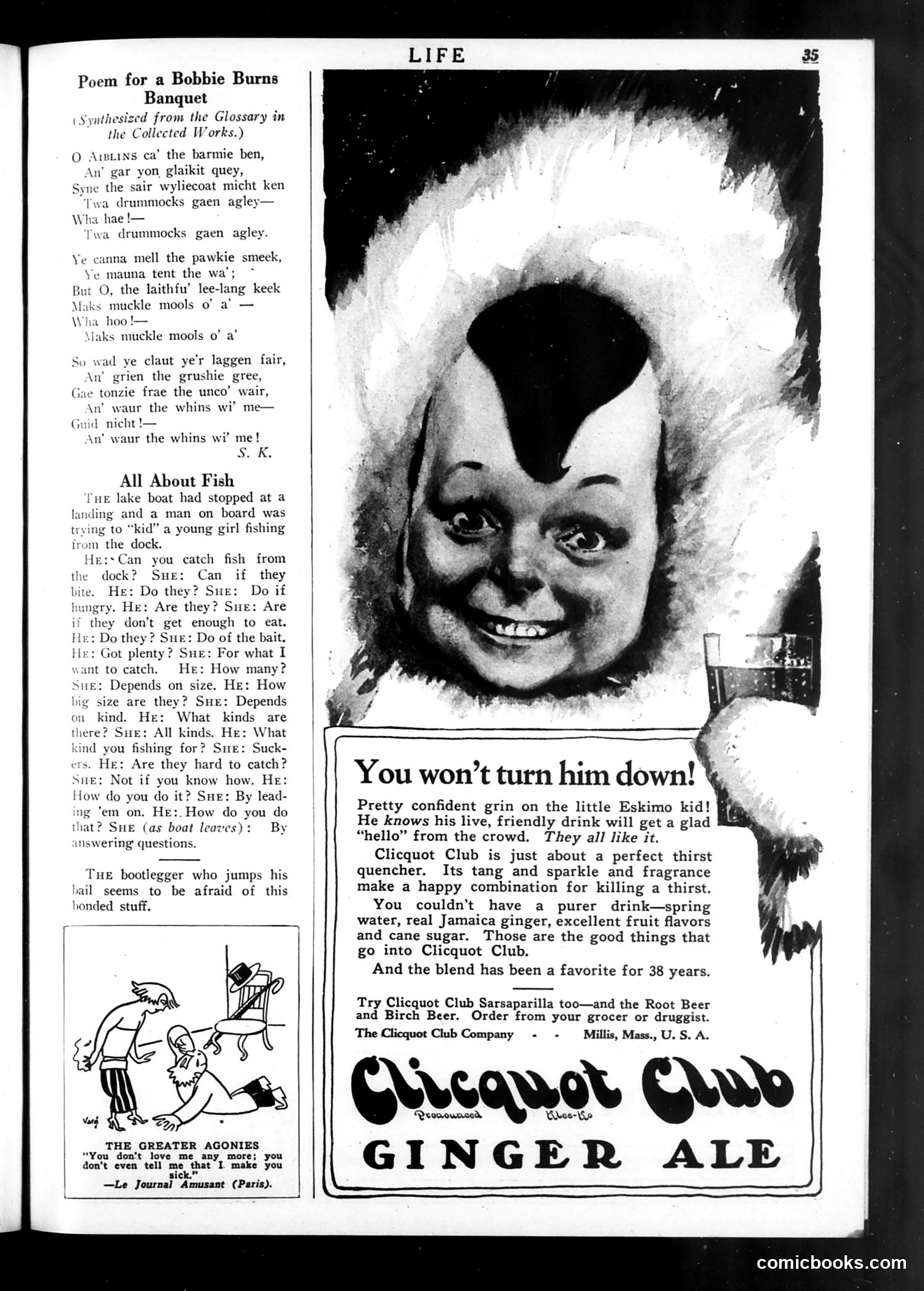
This page contains three distinct elements: **"Poem for a Bobbie Burns Banquet"**: A humorous pastiche written in Scottish dialect, synthesizing obscure words from Robert Burns's collected works. It's essentially nonsense verse—a joke about how Burns's vocabulary is so archaic and dense that random combinations sound authentically Burnsian. **"All About Fish"**: A flirtatious dialogue between a man and girl fishing from a dock. The humor relies on double entendre—his innocent questions about fish are met with her suggestive responses about "leading 'em on," implying romantic/seduction tactics. **"The Greater Agonies" cartoon**: A single-panel joke showing a dejected man, with a caption from *Le Journal Amusant* (Paris) where a woman complains her boyfriend no longer loves her—he doesn't even tell her she makes him sick. The satire targets romantic relationships' decline into indifference. **Clicquot Club Advertisement**: The dominant element is a full-page ad for ginger ale, featuring a smiling Inuit child and marketing copy emphasizing the drink's purity and 38-year popularity.
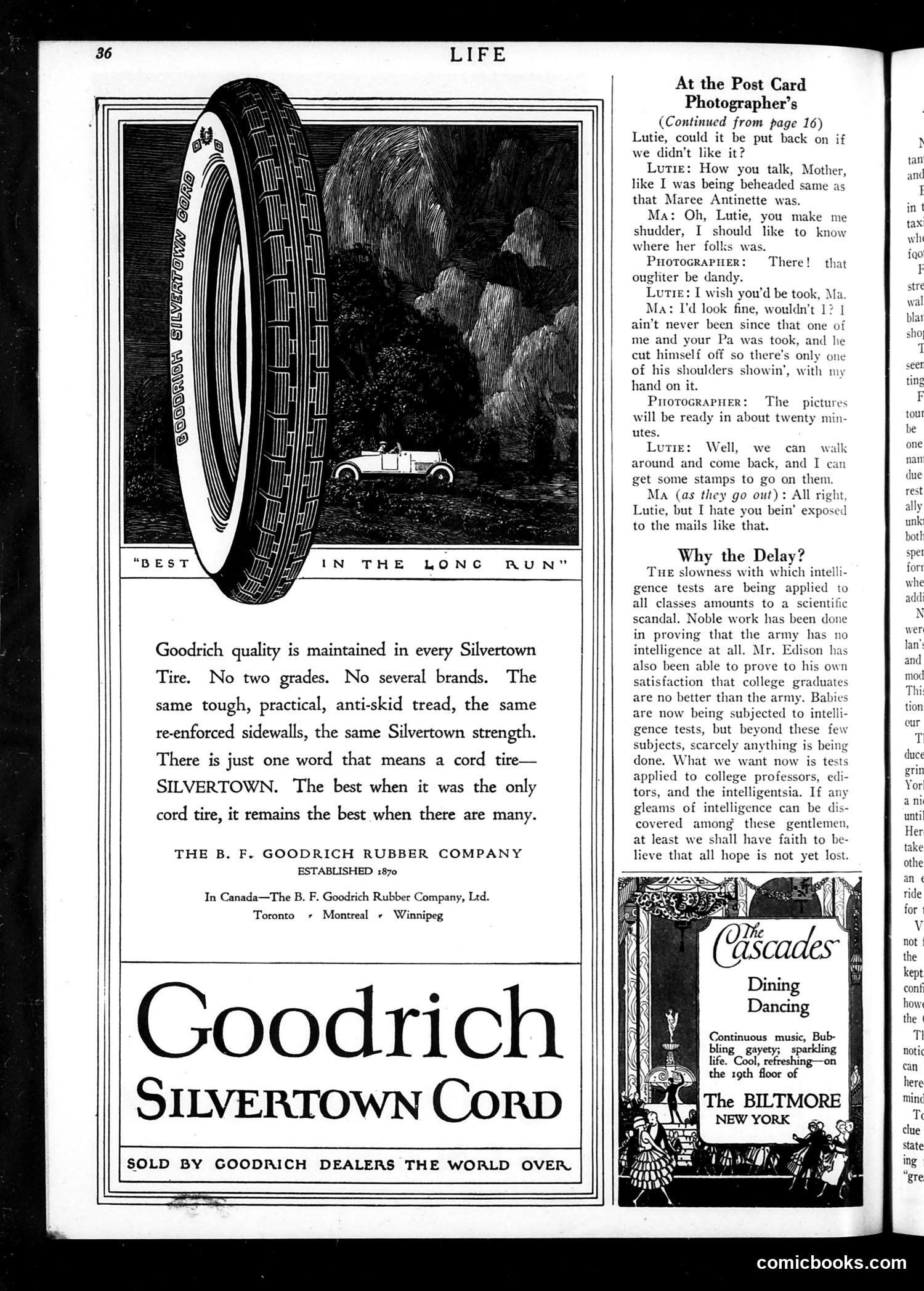
This page contains a satirical dialogue between a photographer and two working-class clients (a mother and daughter named Ma and Lutie). The humor derives from their malapropisms and social anxieties: Lutie compares a photographer's pose adjustment to beheading Marie Antoinette; Ma worries about a photo where her husband "cut himself off" (appears cropped); both fret over mailing photographs, with Ma expressing irrational concern about mail exposure. The satire gently mocks rural/immigrant Americans' unfamiliarity with modern technology and their grammatical errors ("bein' exposed"), while the photographer remains patient and professional. The page also contains a substantial Goodrich Silvertown tire advertisement and an unrelated editorial titled "Why the Delay?" discussing intelligence testing in the military and colleges.
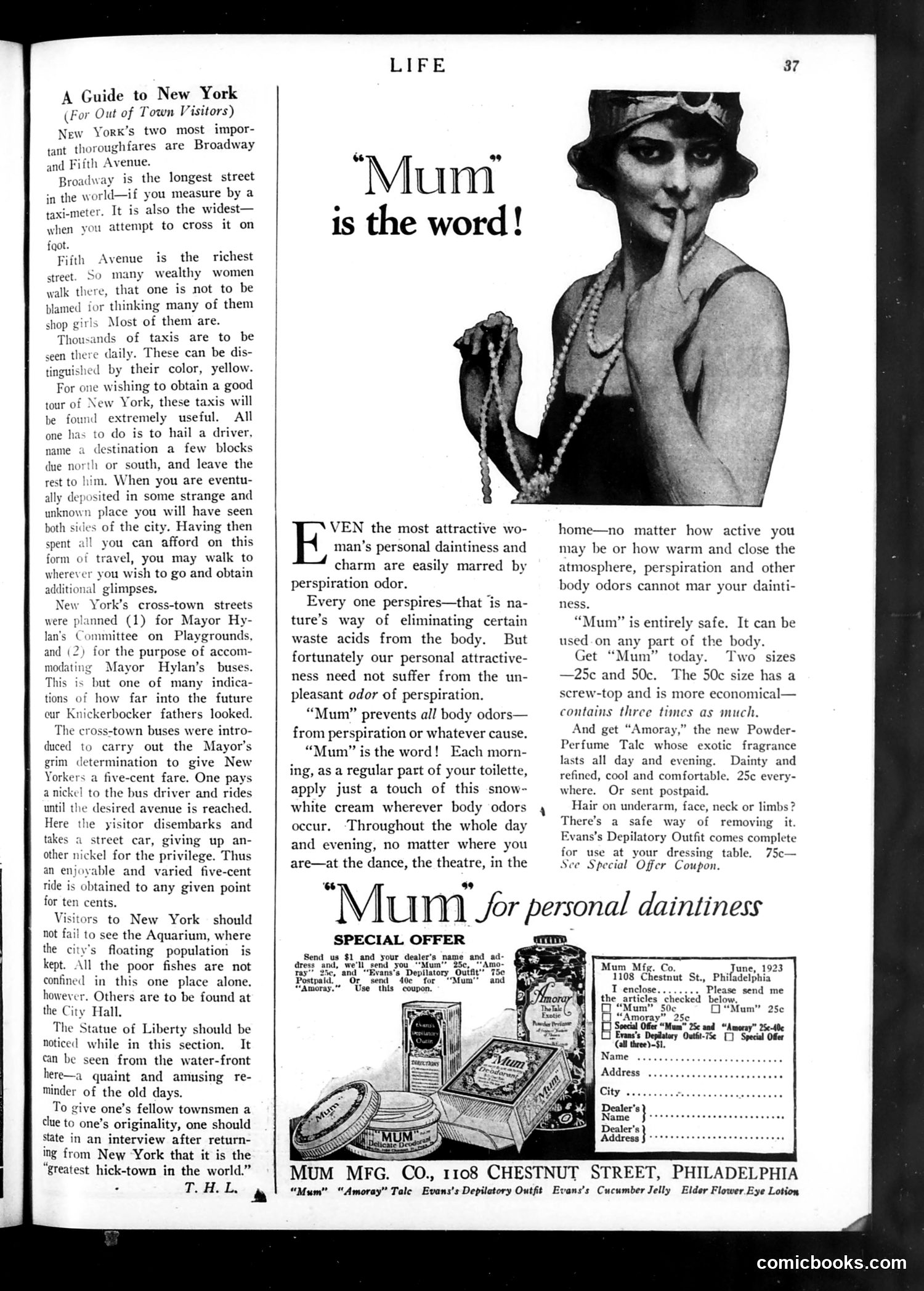
This page combines satirical commentary on New York City with a full-page advertisement for "Mum," an early deodorant product. The left column humorously guides out-of-town visitors through NYC's quirks: Broadway's length (measured by expensive taxi rides), Fifth Avenue's wealthy shoppers, and the city's confusing transit system where a "five-cent" journey costs ten cents. The satire culminates in the joke that New York is "the greatest hick-town in the world." The right side shifts to advertising, featuring a woman applying deodorant cream. The copy addresses women's anxieties about perspiration odor ruining their "personal daintiness" and charm—a social concern particularly marketed to women in the 1920s. The ad also promotes "Amoray" powder-perfume and Evans's depilatory outfit, reflecting period obsessions with feminine hygiene and hair removal. The juxtaposition of cynical urban satire with earnest beauty-product marketing is typical of *Life* magazine's approach.
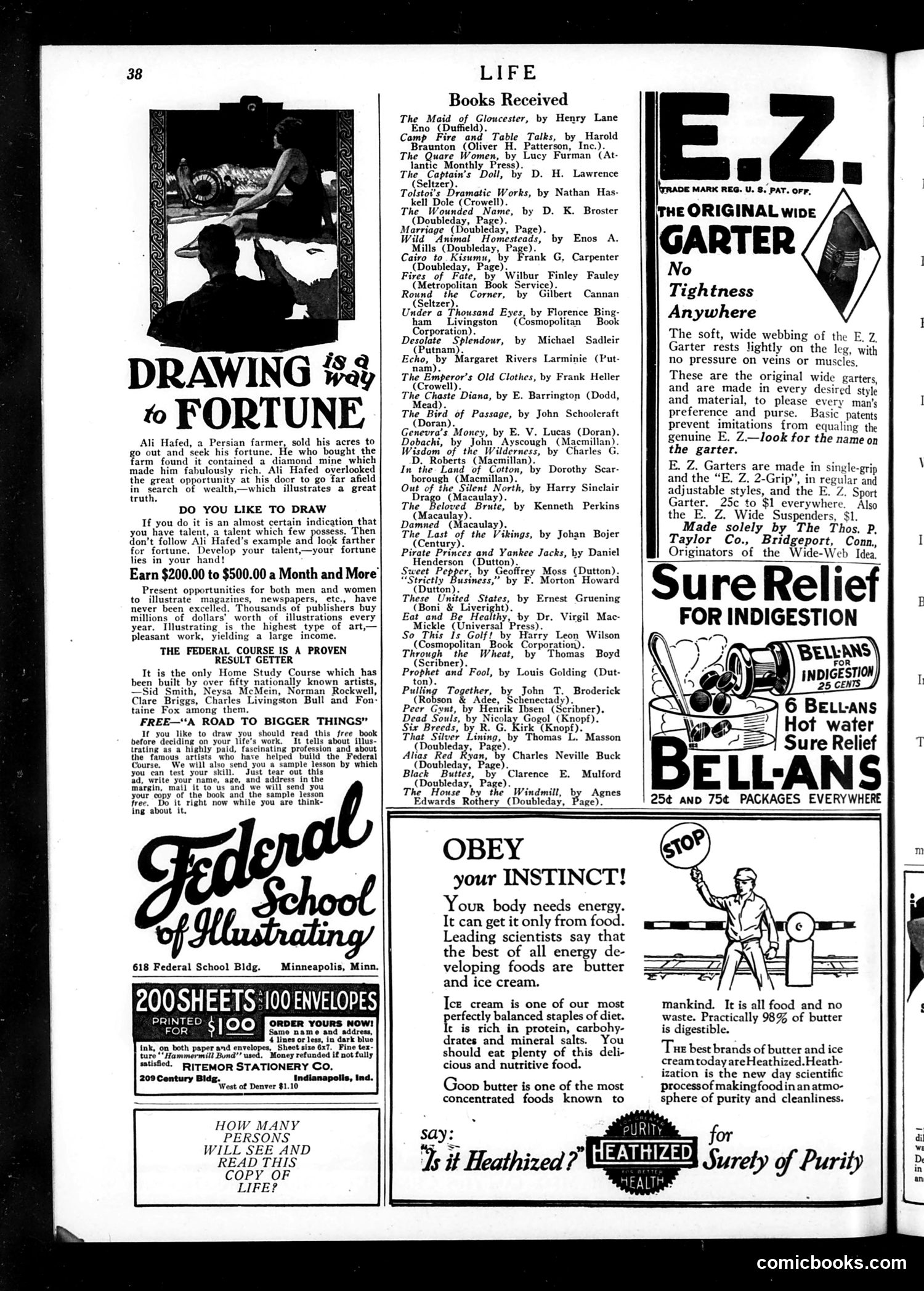
This page is primarily **advertising and book listings**, not political satire. The main content is a recruitment ad for the Federal School of Illustrating, which uses the parable of Ali Hafed (a Persian farmer who abandons his profitable land seeking fortune elsewhere, only to miss a diamond mine on his own property) as a metaphor: don't overlook your natural talent for drawing—develop it instead of seeking opportunities elsewhere. The ad promises $200-$500/month income and claims endorsement from famous illustrators like Norman Rockwell and Clare Briggs. The page also features: - A "Books Received" section listing new publications - Advertisements for E.Z. Garters, Bellans indigestion remedy, and "Heathized" butter/ice cream - A simple instructional cartoon about nutrition ("Obey Your Instinct") There is **no political cartoon or satire** on this page—it's a typical magazine layout mixing educational recruitment advertising with consumer product ads and book notices.
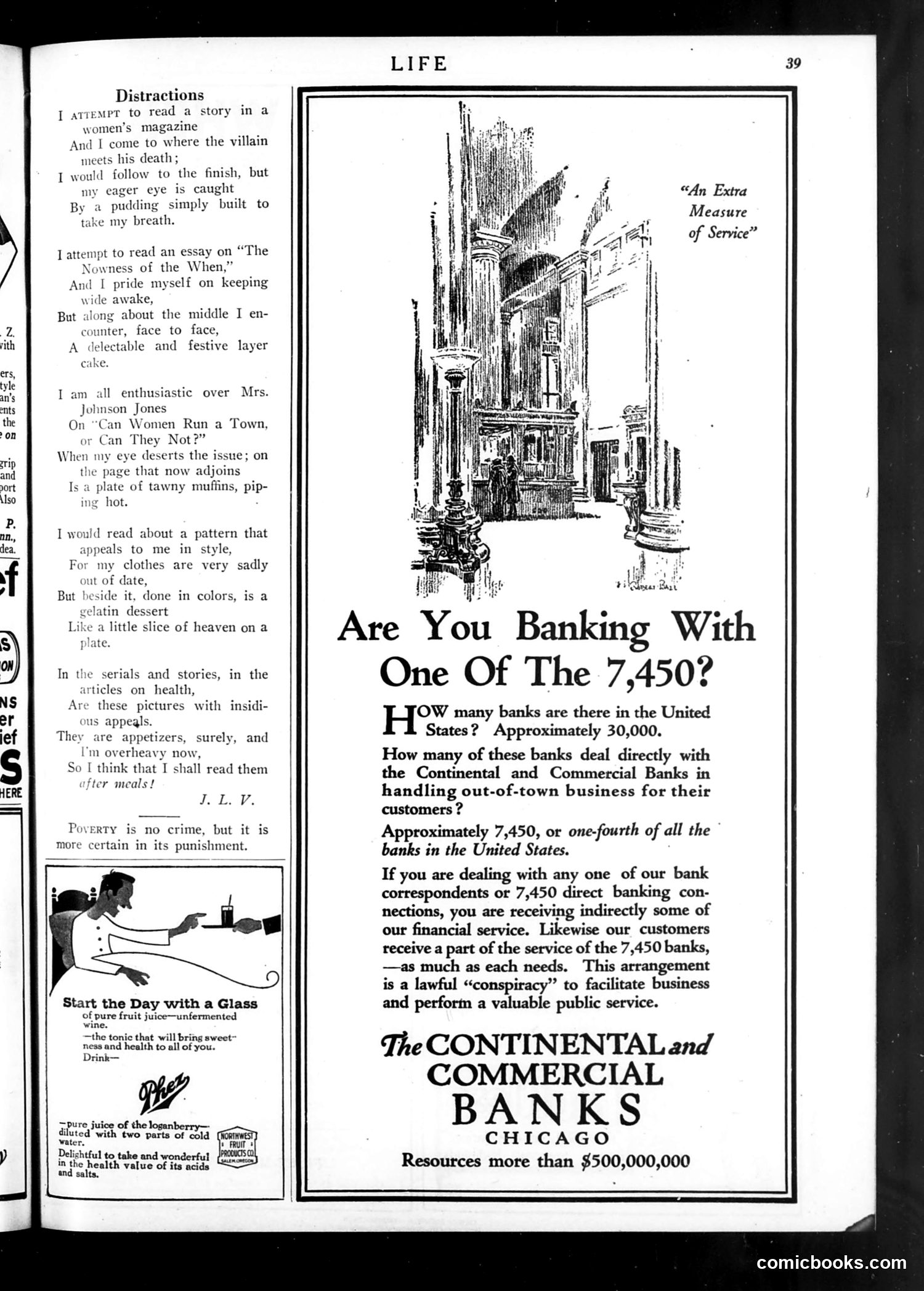
**Left Side - "Distractions" Poem:** A humorous poem about reading magazines while distracted by food advertisements. The speaker attempts to read serious articles and stories but keeps having their attention diverted by illustrated recipes—puddings, muffins, desserts—appearing adjacent to the text. The joke satirizes magazine layout design: advertisers strategically place appetizing food imagery alongside editorial content, sabotaging readers' concentration. The final line quips that they'll read the articles "after meals" once satisfied. **Right Side - Continental and Commercial Banks Advertisement:** A straightforward banking advertisement (not satire). It boasts the bank's network of 7,450 correspondent banks—approximately one-fourth of all U.S. banks—handling out-of-town business. The ad uses the word "conspiracy" ironically to describe this legal arrangement as facilitating commerce. The sketch shows a grand bank building interior. **Overall:** This page demonstrates Life's mixed format of satirical poetry and commercial advertising, with the poem's theme ironically echoing the ad-driven distractions it critiques.
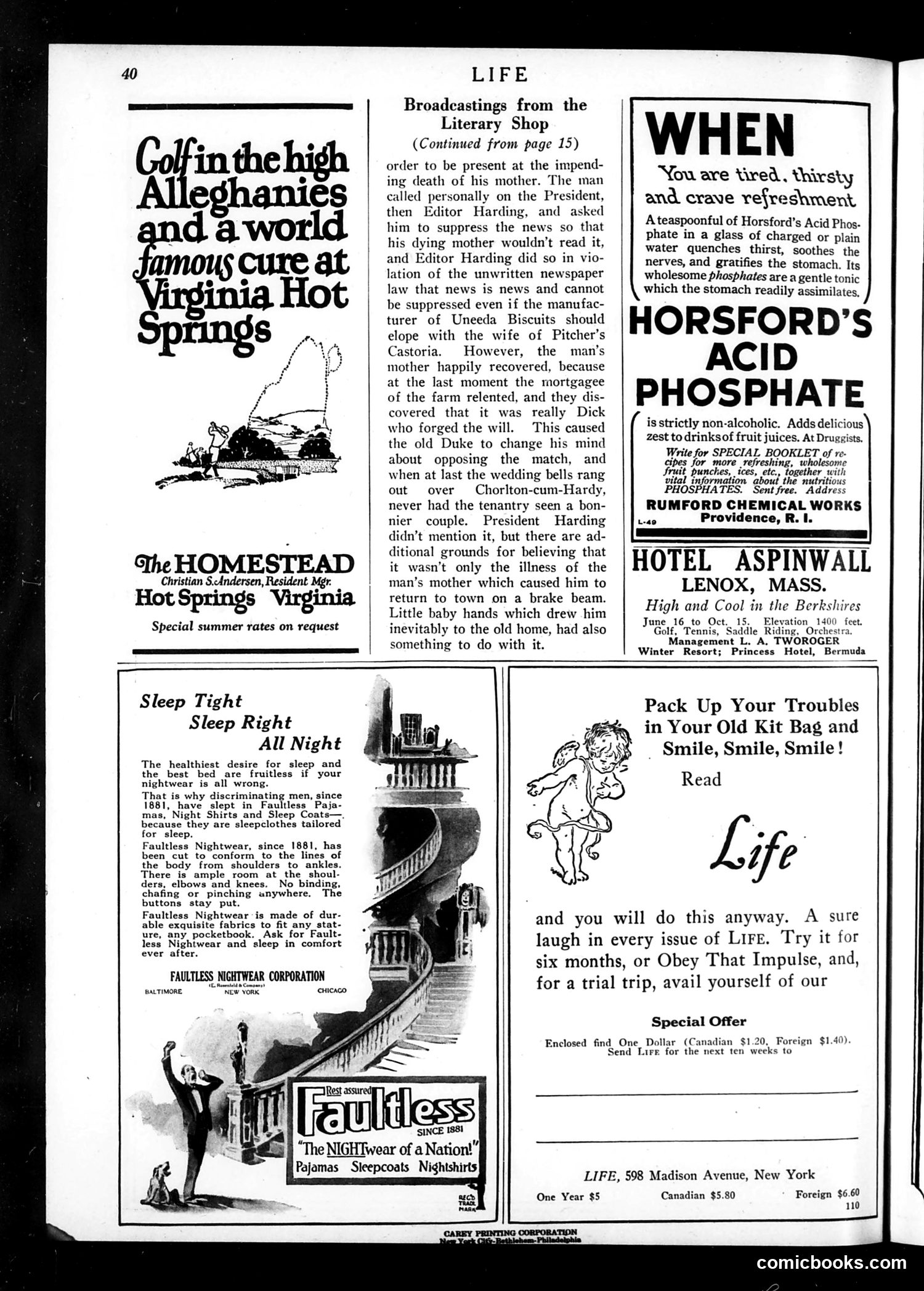
This page is primarily **advertisements** interspersed with a continuation of a serialized story from Life's "Literary Shop" column. The story excerpt satirizes melodramatic fiction tropes—involving a dying mother, a forged will, a mortgage crisis, and a class-barrier romance. It mentions President **Harding** (Warren G. Harding, president 1921-1923) as a character who suppresses newspaper stories, likely satirizing both his actual presidency and the absurdity of the plot itself. The reference to "Uneeda Biscuits" and "Pitcher's Castoria" are brand names used humorously as measurements of fictional cliché. The advertisements promote patent medicines (Horsford's Acid Phosphate), resort hotels, and nightwear. A Life magazine subscription ad uses the phrase "Pack Up Your Troubles in Your Old Kit Bag"—a World War I song reference—to encourage subscriptions by promising humor and entertainment. The page reflects early 1920s consumer culture and Life's dual role as both satirical publication and advertising vehicle.
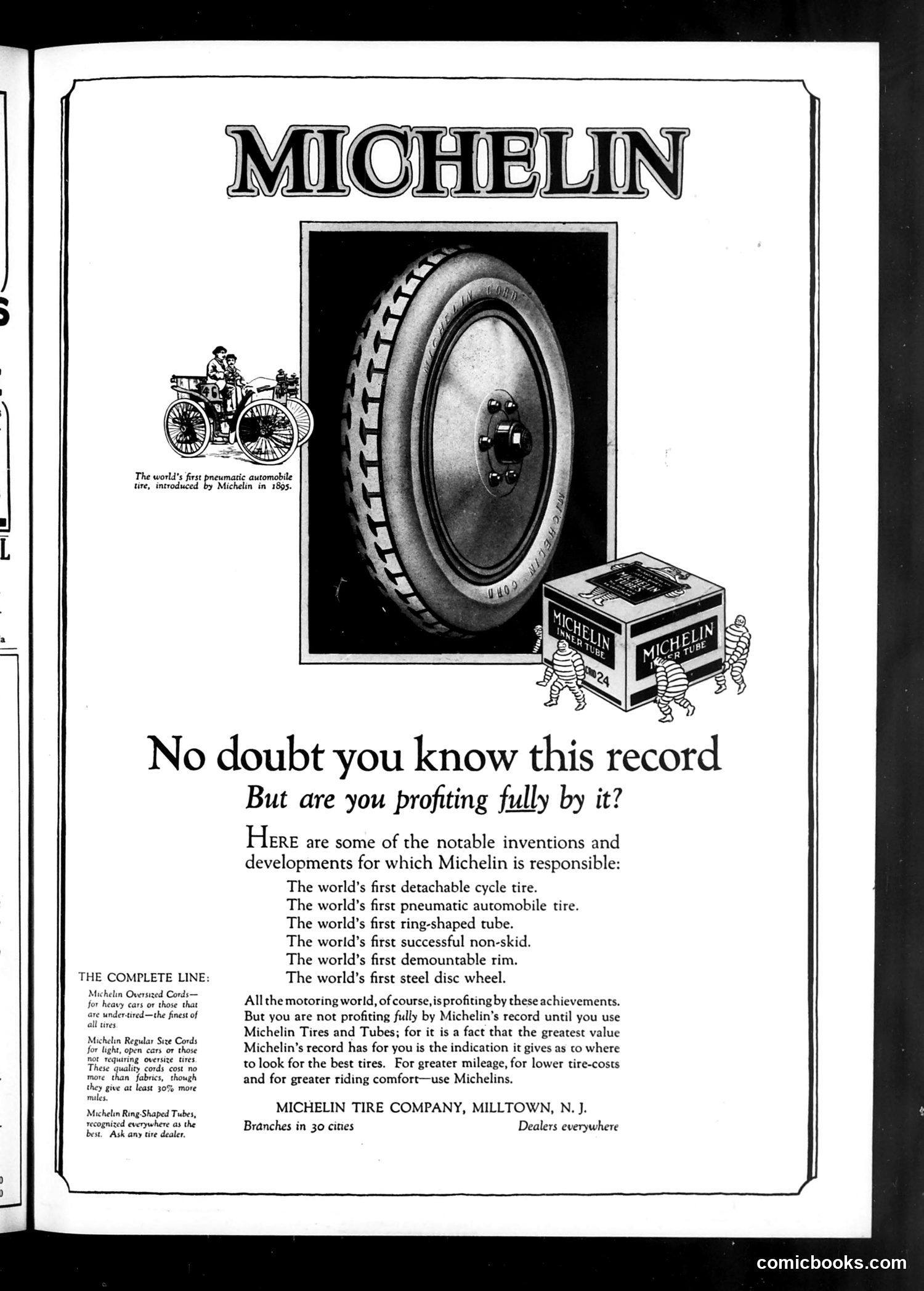
This is primarily a **product advertisement**, not satire or political commentary. Michelin presents itself as an industry innovator, listing genuine historical achievements: inventing pneumatic (air-filled) tires for bicycles and automobiles, non-skid treads, and removable rims. The rhetorical strategy is direct: "No doubt you know this record / But are you profiting fully by it?" This challenges readers to recognize Michelin's dominance while asking whether they're actually *using* Michelin products rather than competitors'. The page includes promotional copy for Michelin's product line (oversized cords, regular cords, ring-shaped tubes) and notes the company has 30 branches nationwide. The small illustration of an early automobile emphasizes Michelin's historical role in motorization. There is **no cartoon or satire here**—it's straightforward early 20th-century advertising leveraging brand prestige and innovation to drive sales.
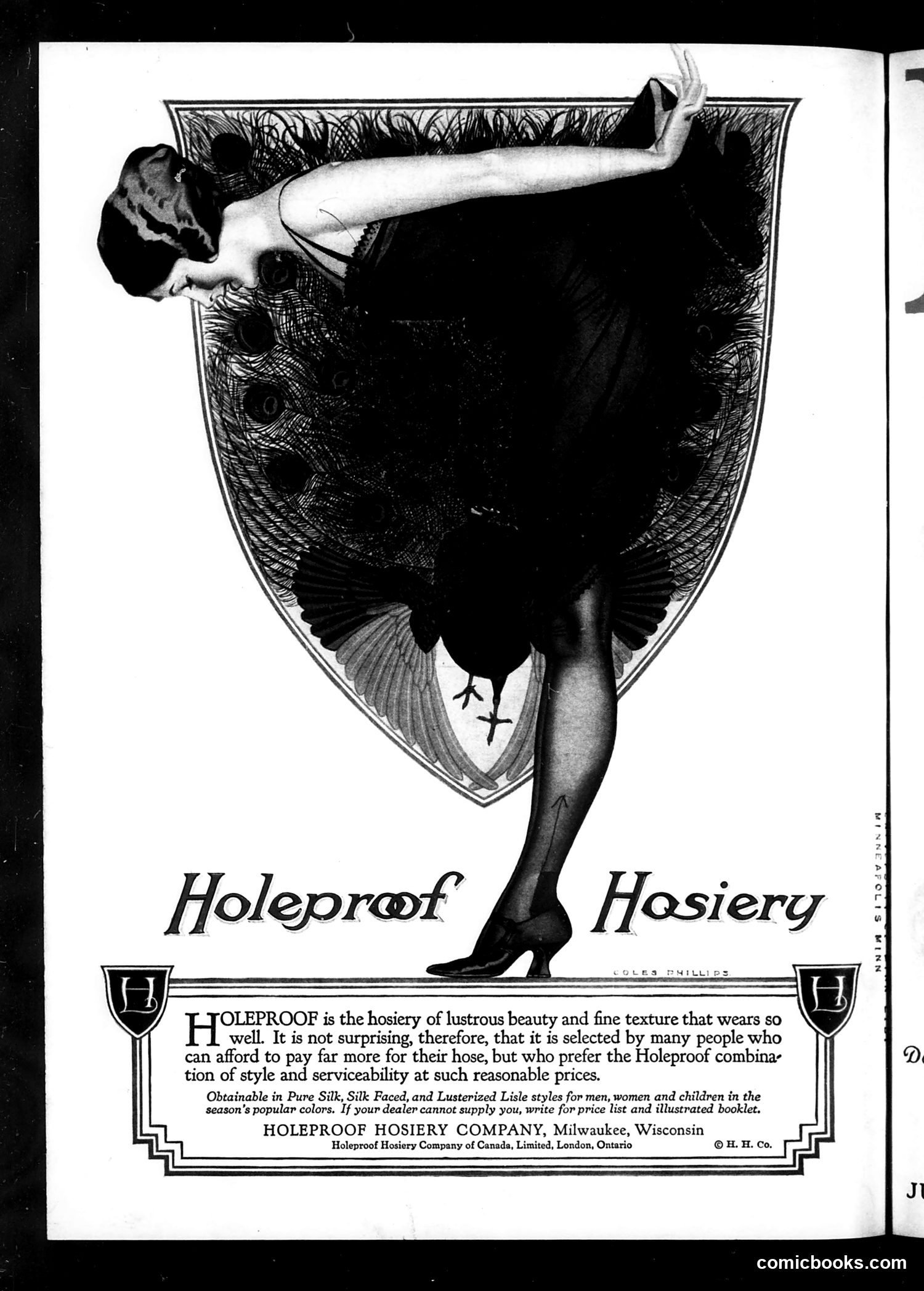
This is a **product advertisement**, not political satire. It promotes Holeproof brand hosiery (socks and stockings) through a stylized illustration of a woman in 1920s fashion holding up a large shield-shaped design featuring a bird with spread wings. The visual pun is the advertisement's core appeal: the shield contains an elaborate bird illustration, playing on the brand name "**Holeproof**"—the bird's wings suggest durability and the absence of holes. The woman's pose, with extended leg showcasing the hosiery product, was typical of Art Deco advertising aesthetics of the era. The text emphasizes that despite being affordable ("reasonable prices"), Holeproof offers quality comparable to much more expensive alternatives, combining "style and serviceability." The ad notes availability in silk and lisle materials for all family members in popular colors. This reflects early-20th-century consumer marketing strategies targeting middle-class buyers seeking value-for-money branded goods.