
Life, 1923-06-07 · page 28 of 44
Life — June 7, 1923 — page 28: what you’re looking at
What you’re looking at
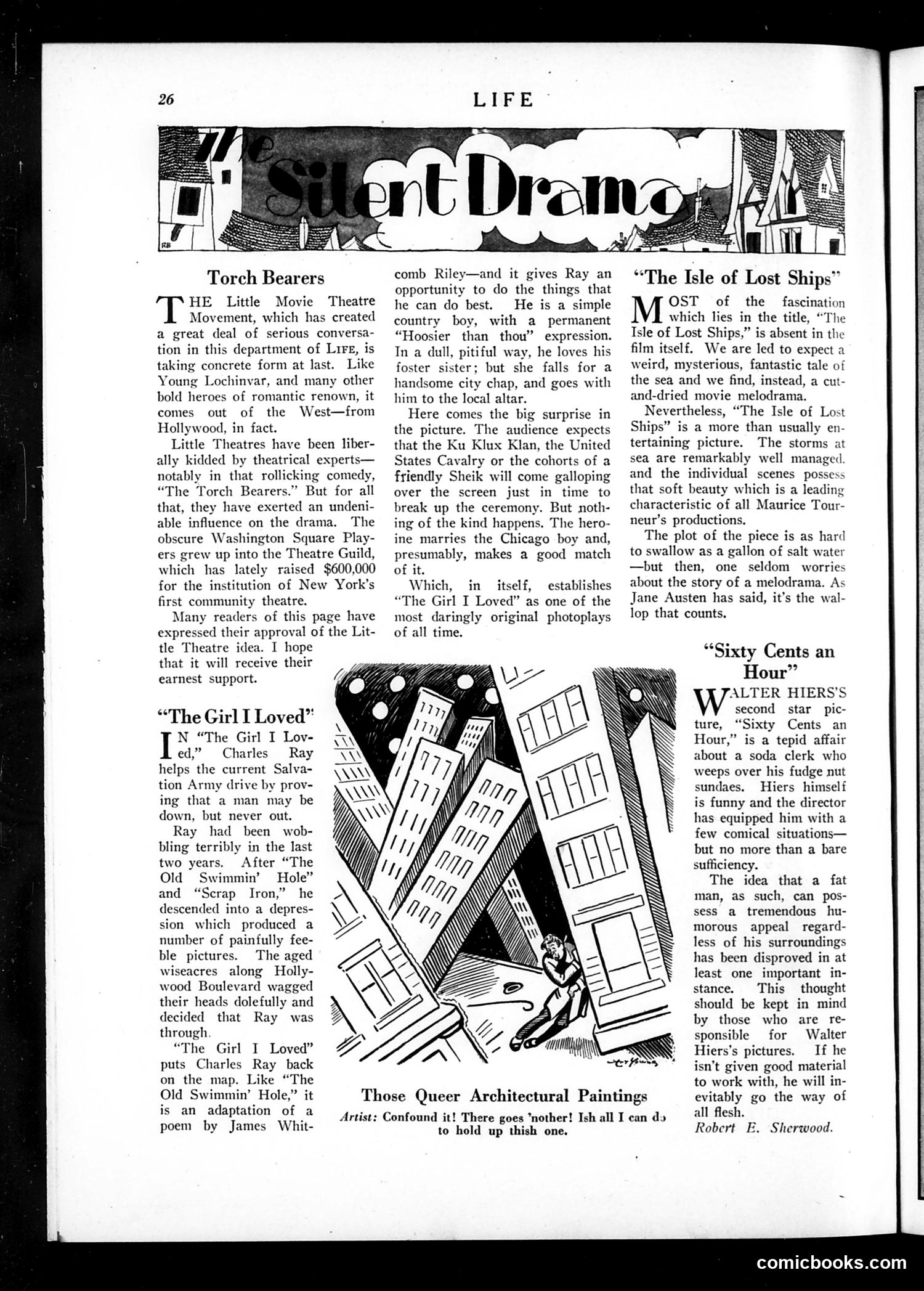
This page reviews four early 1920s silent films. The main cartoon depicts an intoxicated artist struggling to hold up falling buildings—a visual joke about poorly constructed or implausible movie sets. The reviews discuss: 1. **"The Girl I Loved"** (Charles Ray)—praised for reviving Ray's flagging career by returning to his strength: playing simple, sentimental Hoosier characters. The reviewer sarcastically notes the film's "daringly original" plot twist: the heroine actually *marries* the city boy without dramatic intervention (no Ku Klux Klan or cavalry rescue). 2. **"The Isle of Lost Ships"**—criticized as disappointing despite its intriguing title, though praised for realistic ocean storm scenes. 3. **"Sixty Cents an Hour"** (Walter Hiers)—a tepid comedy about a soda clerk. The critic argues that fat comedians cannot rely on appearance alone; without quality material, even funny performers will fail. The reviews reflect 1920s film criticism standards and contemporary concerns about actor careers and material quality.
📄 Transcribed text from this page (OCR, searchable)
Machine-transcribed from the original scan — historical spelling and the odd misread are preserved.
Torch Bearers HE Little Movie Theatre Movement, which has created a great deal of serious conversa- tion in this department of Lire, is taking concrete form at last. Like Young Lochinvar, and many other bold heroes of romantic renown, it comes out of the West—from Hollywood, in fact. Little Theatres have been liber- ally kidded by theatrical experts— notably in that rollicking comedy, “The Torch Bearers.” But for all that, they have exerted an undeni- able influence on the drama. The obscure Washington Square Play- ers grew up into the Theatre Guild, which has lately raised $600,000 for the institution of New York’s first community theatre. Many readers of this page have expressed their approval of the Lit- tle Theatre idea. I hope that it will receive their earnest support. “The Girl I Loved” N “The Girl I Lov- ed,” Charles Ray helps the current Salva- tion Army drive by prov- ing that a man may be down, but never out. Ray had been wob- bling terribly in the last two years. After “The Old Swimmin’ Hole” and “Scrap Iron,” he descended into a depres- sion which produced a number of painfully fee- ble pictures. The aged wiseacres along Holly- wood Boulevard wagged their heads dolefully and decided that Ray was through “The Girl I Loved” puts Charles Ray back on the map. Like “The Old Swimmin’ Hole,” it is an adaptation of a poem by James Whit- comb Riley—and it gives Ray an opportunity to do the things that he can do best. He is a simple country boy, with a permanent “Hoosier than thou” expression. In a dull, pitiful way, he loves his foster sister; but she falls for a handsome city chap, and goes with him to the local altar. Here comes the big surprise in the picture. The audience expects that the Ku Klux Klan, the United States Cavalry or the cohorts of a friendly Sheik will come galloping over the screen just in time to break up the ceremony. But noth- ing of the kind happens. The hero- ine marries the Chicago boy and, presumably, makes a good match of it. Which, in itself, establishes “The Girl I Loved” as one of the most daringly original photoplays of all time. Those Queer Architectural Paintings Artist: Confound it! There goes ‘nother! Ish all I can dy to hold up thish one. “The Isle of Lost Ships” OST of the fascination which lies in the title, “The Isle of Lost Ships,” is absent in the film itself. We are led to expect a weird, mysterious, fantastic tale of the sea and we find, instead, a cut- and-dried movie melodrama. Nevertheless, “The Isle of Lost Ships” is a more than usually en- tertaining picture. The storms at sea are remarkably well managed. and the individual scenes poss that soft beauty which is a leading characteristic of all Maurice Tour- neur’s productions. The plot of the piece is as hard to swallow as a gallon of salt water —but then, one seldom worries about the story of a melodrama. As Jane Austen has said, it’s the wal- lop that counts. “Sixty Cents an Hour” ‘ALTER HIERS'S second star pic- ture, “Sixty Cents an Hour,” is a tepid affair about a soda clerk who weeps over his fudge nut sundaes, Hiers himself is funny and the director has equipped him with a few comical situations— but no more than a bare sufficiency. The idea that a fat man, as such, can pos- sess a tremendous hu- morous appeal regard- less of his surroundings has been disproved in at least one important in- stance. This thought should be kept in mind by those who are re- sponsible for Walter Hiers’s pictures. If he isn’t given good material to work with, he will in- evitably go the way of all flesh. Robert E, Sherwood. comicbooks.com