
A complete issue · 46 pages · 1923
Life — May 17, 1923
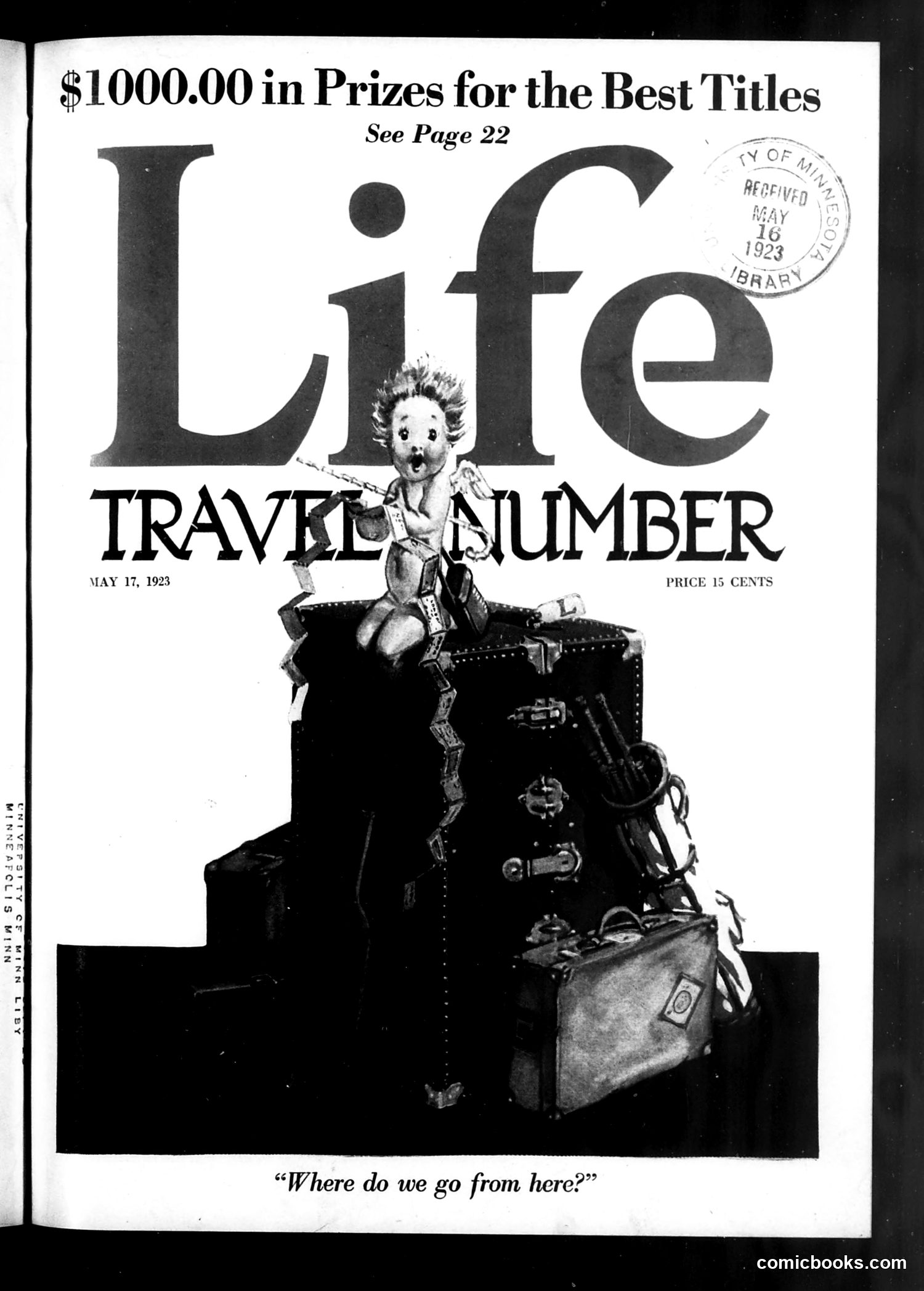
This is the cover of Life's "Travel Number" special issue. The central image shows a caricatured figure sitting atop an overstuffed steamer trunk surrounded by luggage and travel gear, appearing disheveled with wild hair and an exaggerated expression. The figure asks "Where do we go from here?" — likely satirizing the post-World War I travel boom and the somewhat chaotic nature of leisure travel in the 1920s. The character appears to embody the bewildered tourist overwhelmed by trip planning and baggage. This reflects the era's growing automobile culture and vacation trends, while gently mocking travelers' tendency toward over-packing and confusion about destinations. The "Travel Number" format suggests the issue contains articles about popular travel destinations and advice for American tourists during this period of expanding recreational travel.
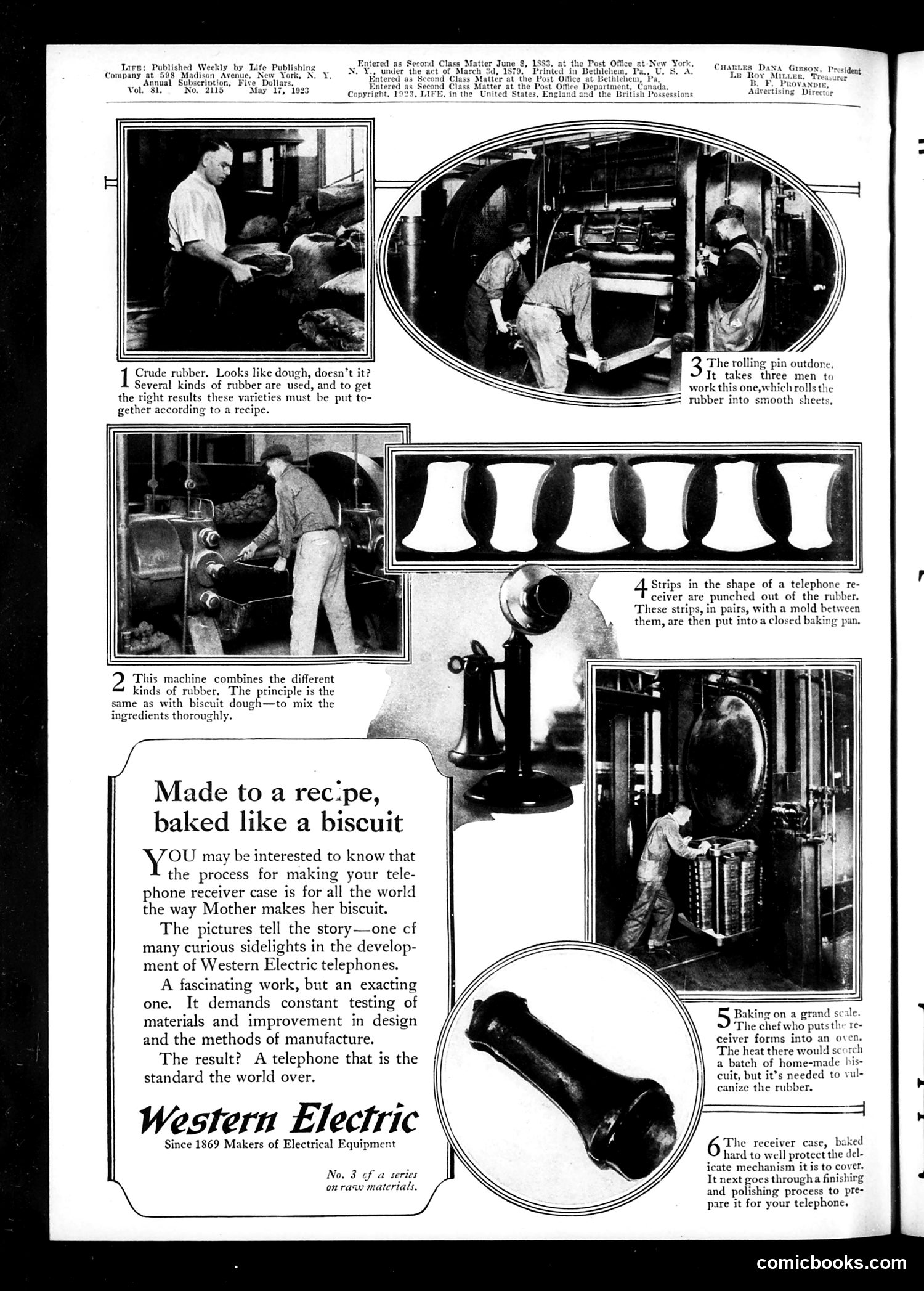
This page is **not a political cartoon or satire**—it's a straightforward **advertisement and industrial feature article** for Western Electric. The content explains how telephone receiver cases are manufactured, presented as a "curious sidelight" in industrial production. Six numbered photographs show the manufacturing process: mixing rubber compounds, operating machinery that combines materials, rolling sheets, shaping strips in molds, baking components, and final finishing. The headline playfully compares the process to baking biscuits—the receiver case is "made to a recipe, baked like a biscuit"—but this is purely illustrative advertising language, not satire. **No political references, caricatures, or satirical commentary are present.** This represents Life magazine's common practice of publishing advertiser-sponsored industrial features alongside entertainment content.
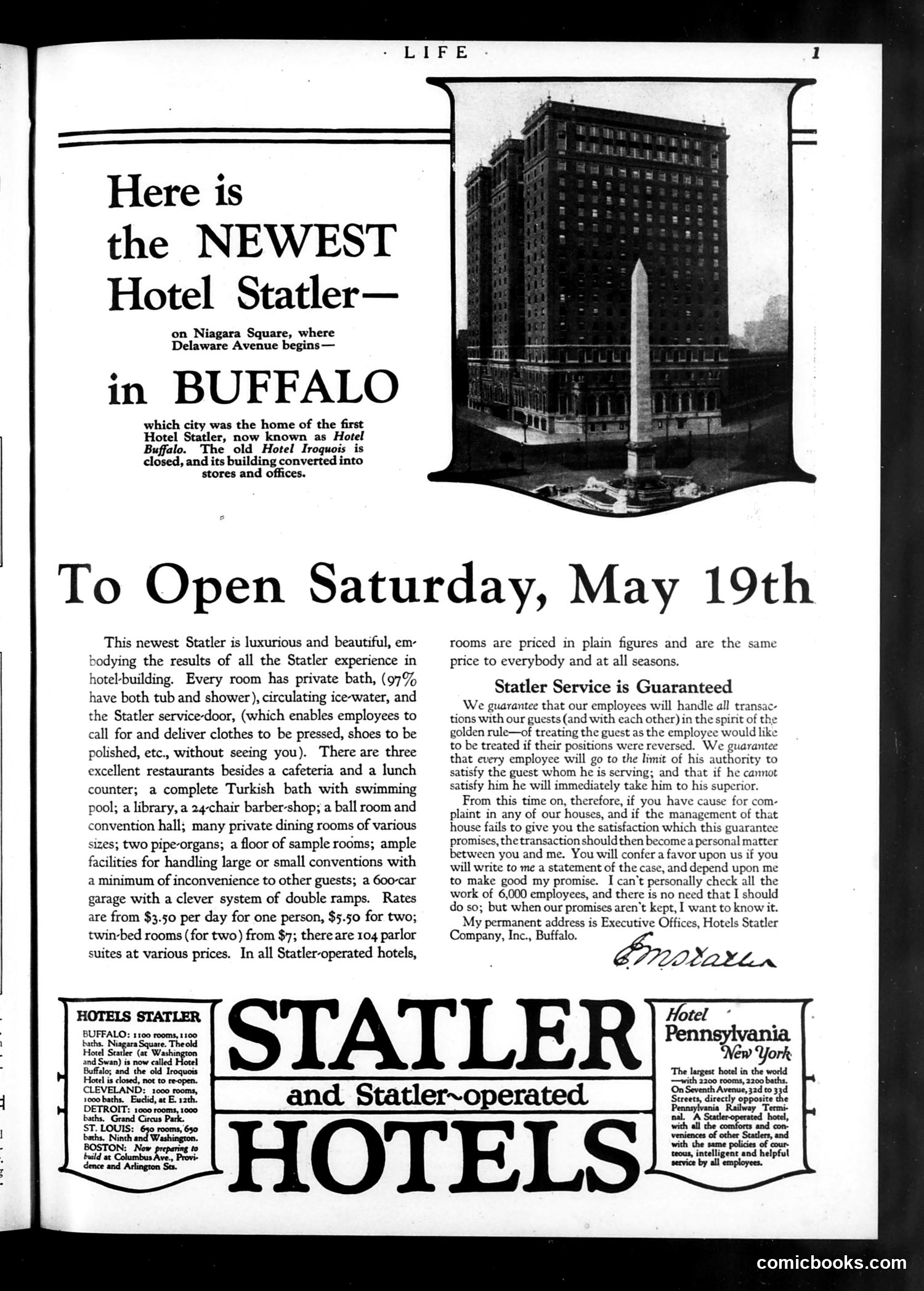
This is **not a political cartoon or satire page**, but rather a straightforward **hotel advertisement** from Life magazine. The page announces the opening of a new Hotel Statler in Buffalo on Saturday, May 19th. The image shows a tall, modern multi-story hotel building. The text describes standard hotel amenities: private bathrooms, restaurants, Turkish bath, library, dining rooms, and parking. The only notable element is the "Statler Service is Guaranteed" section, which presents the hotel's customer service philosophy—a commitment to employee training and guest satisfaction that reflects early 20th-century business practices. This appears to be a paid advertisement, not editorial content. There is no satire or political reference intended. The page simply promotes the hotel's facilities and opening to Life's readers.
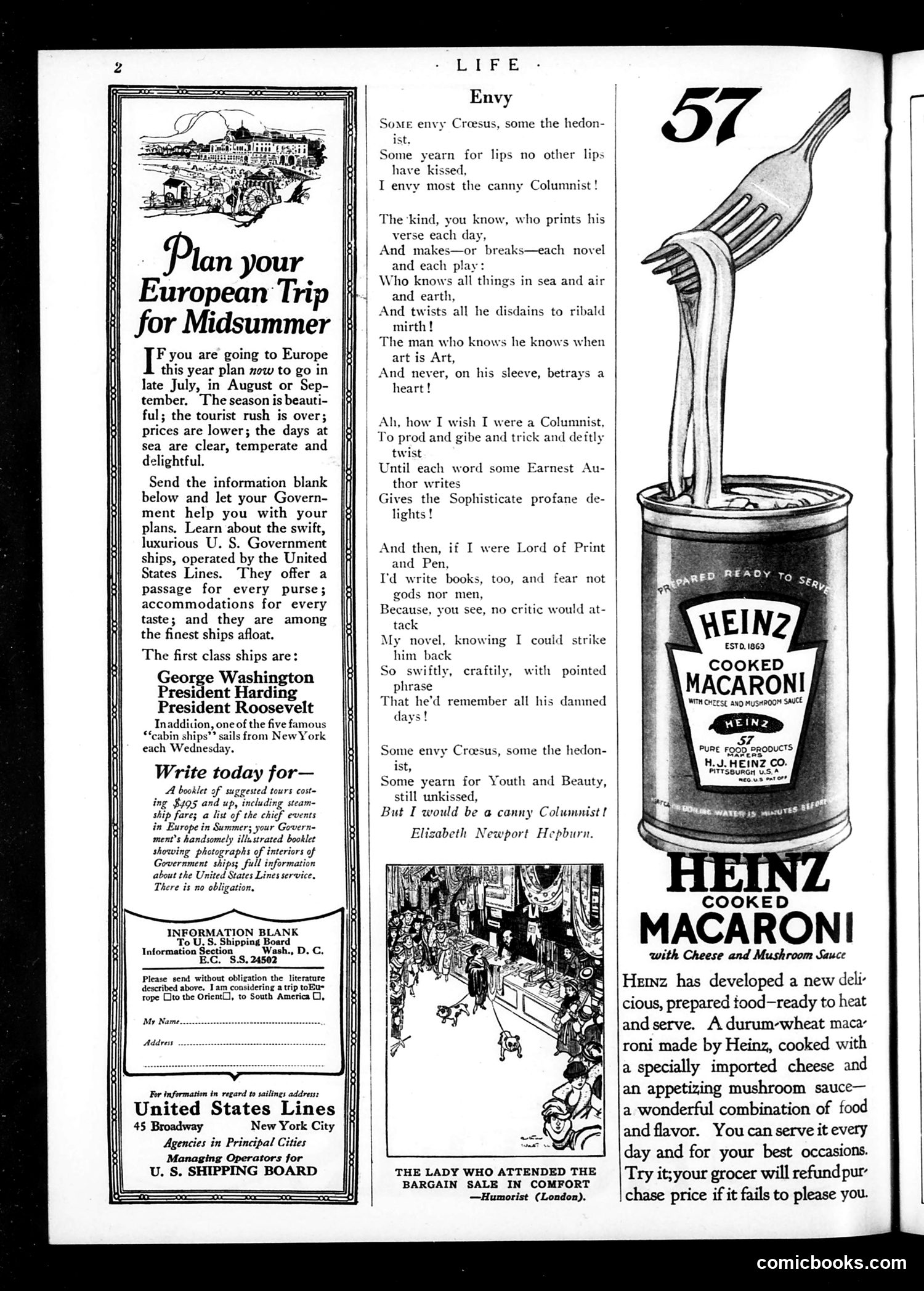
This page contains a poem titled "Envy" by Elizabeth Newport Hepburn, which satirizes the writer's jealousy of newspaper columnists. The poem expresses frustration that columnists enjoy wide readership and influence—they "print verse each day," know about "sea and air and earth," and face no critical attacks because readers fear their power. The speaker fantasizes about becoming a columnist to write books and essays without fear of criticism. The satire mocks both the envy itself and the perceived invulnerability of popular newspaper columnists of the era. The page's left side advertises European travel via U.S. Government ships; the right features a Heinz Cooked Macaroni advertisement. The poem's social commentary reflects early 20th-century anxieties about mass media influence and literary gatekeeping.
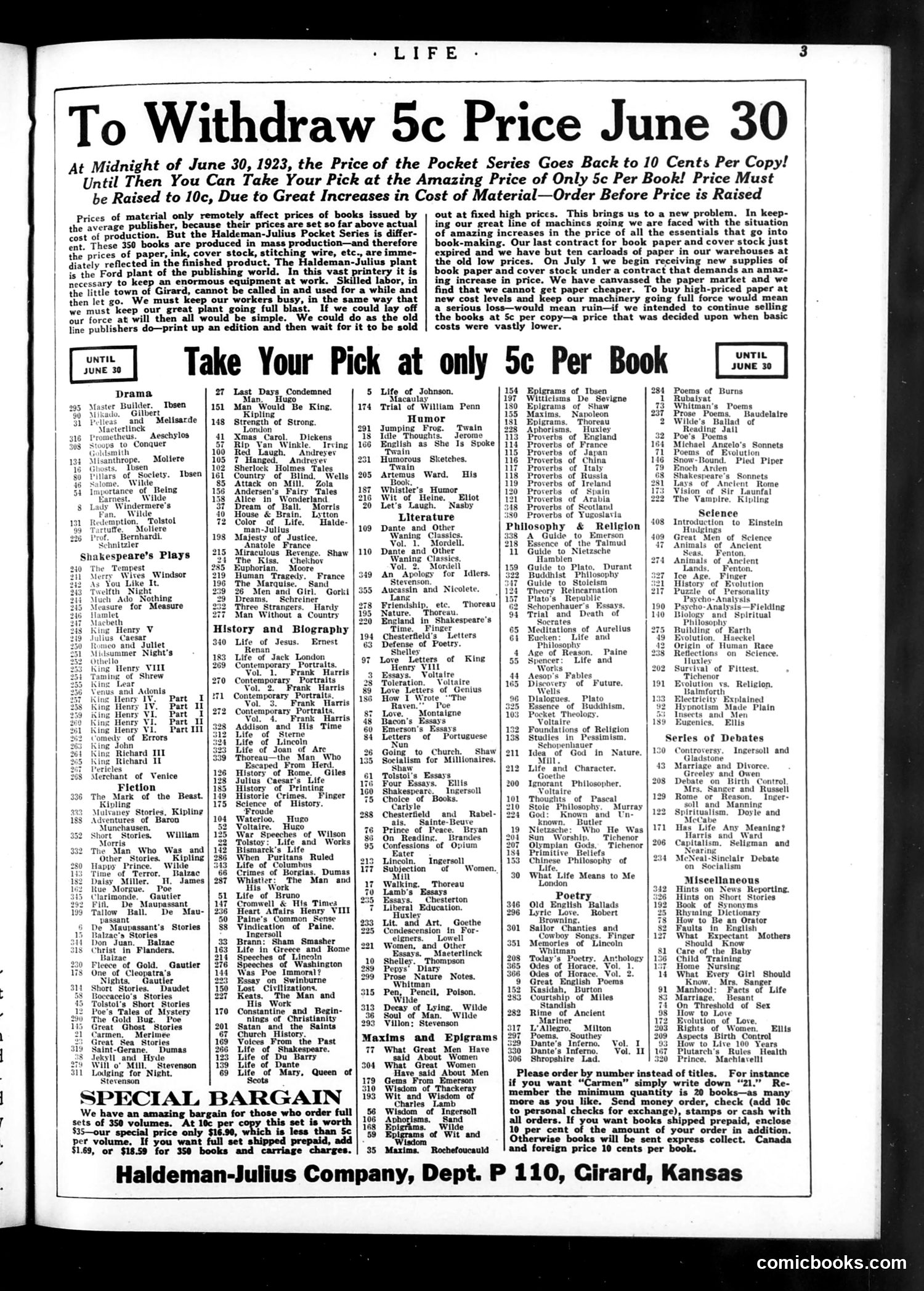
This page is **entirely advertising**, not satirical content. It's a book catalog from the Haldeman-Julius Company announcing a price withdrawal: their Pocket Series books will cease selling at 5¢ per copy on June 30, 1923, and return to 10¢ due to rising material costs. The text explains economic pressures—increased paper and printing expenses—forcing the price increase. The bulk of the page lists hundreds of available titles across categories: Drama, Fiction, History, Science, Philosophy, and Miscellaneous, allowing customers to "take your pick" at the final 5¢ price before the deadline. There is no political cartoon or satire here—just a commercial notice that happens to appear in *Life* magazine's advertising pages.
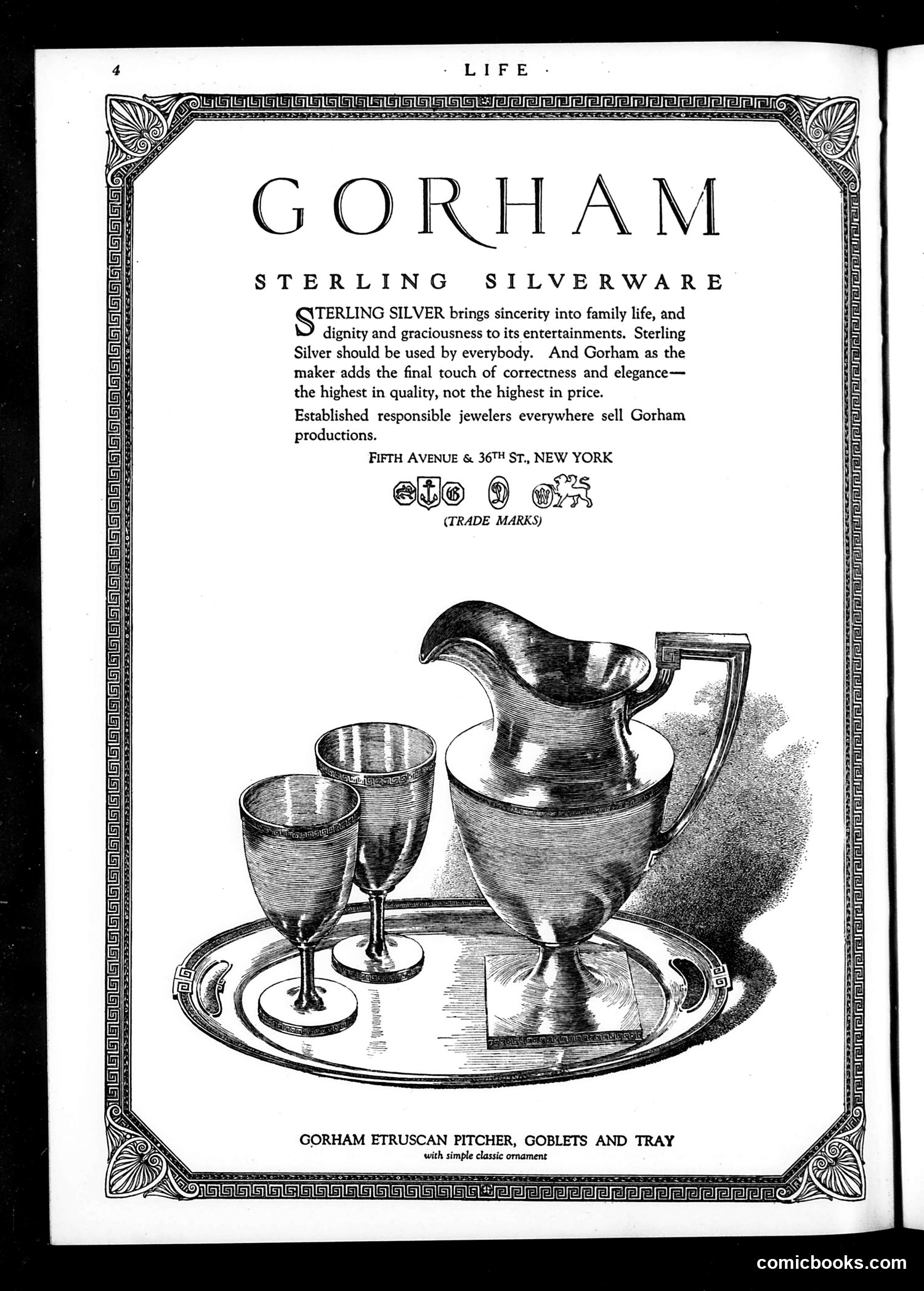
This page is **not a cartoon or satirical content**—it's a **sterling silverware advertisement** for Gorham, a major American jewelry and silverware manufacturer based in New York. The ad emphasizes that sterling silver brings "sincerity into family life, and dignity and graceousness to its entertainments." It promotes Gorham as offering "the highest in quality, not the highest in price." The image shows an elegant Etruscan-style pitcher, two goblets, and a serving tray—examples of Gorham's product line. The decorative Greek-key border and classical design reinforce the ad's message of timeless elegance and quality craftsmanship. This represents typical early-20th-century aspirational advertising targeting middle and upper-class households.
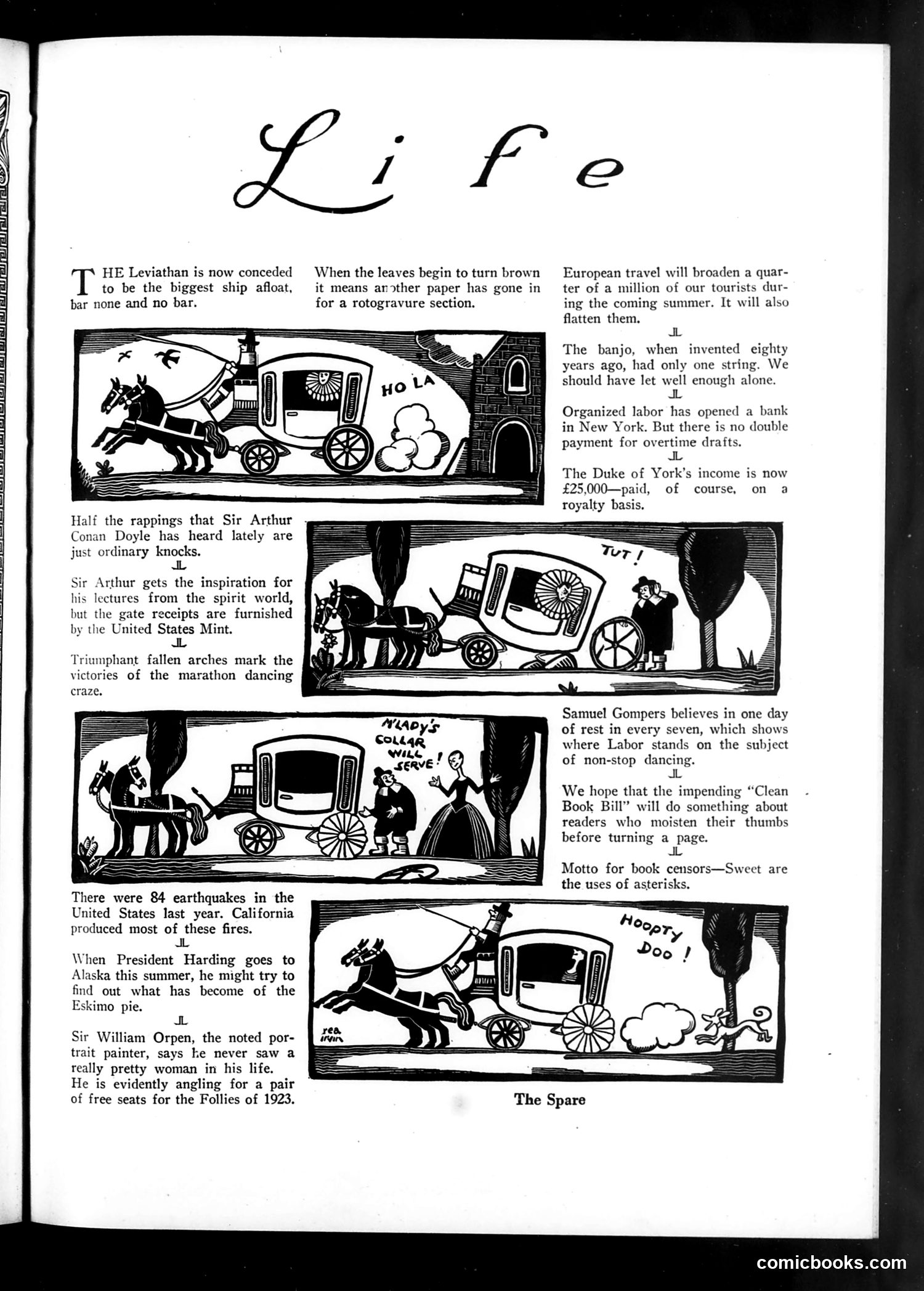
This page from *Life* magazine presents a series of four comic panels featuring a horse-drawn carriage labeled "HOLA," "TUT I," "MARRY'S COLLEGE," and "HOPPY DOO!" The cartoons satirize contemporary trends through surreal imagery—each panel shows the carriage in increasingly absurd situations. The accompanying text snippets mock various 1920s fads and personalities: Sir Arthur Conan Doyle's spiritualism, marathon dancing crazes, labor organizing, and the Duke of York's income. References to President Harding, Sir William Orpen (portrait painter), and Samuel Gompers (labor leader) suggest topical satire of the period's social movements and celebrity culture. The overall effect ridicules modern obsessions through whimsical, exaggerated cartoon vignettes.
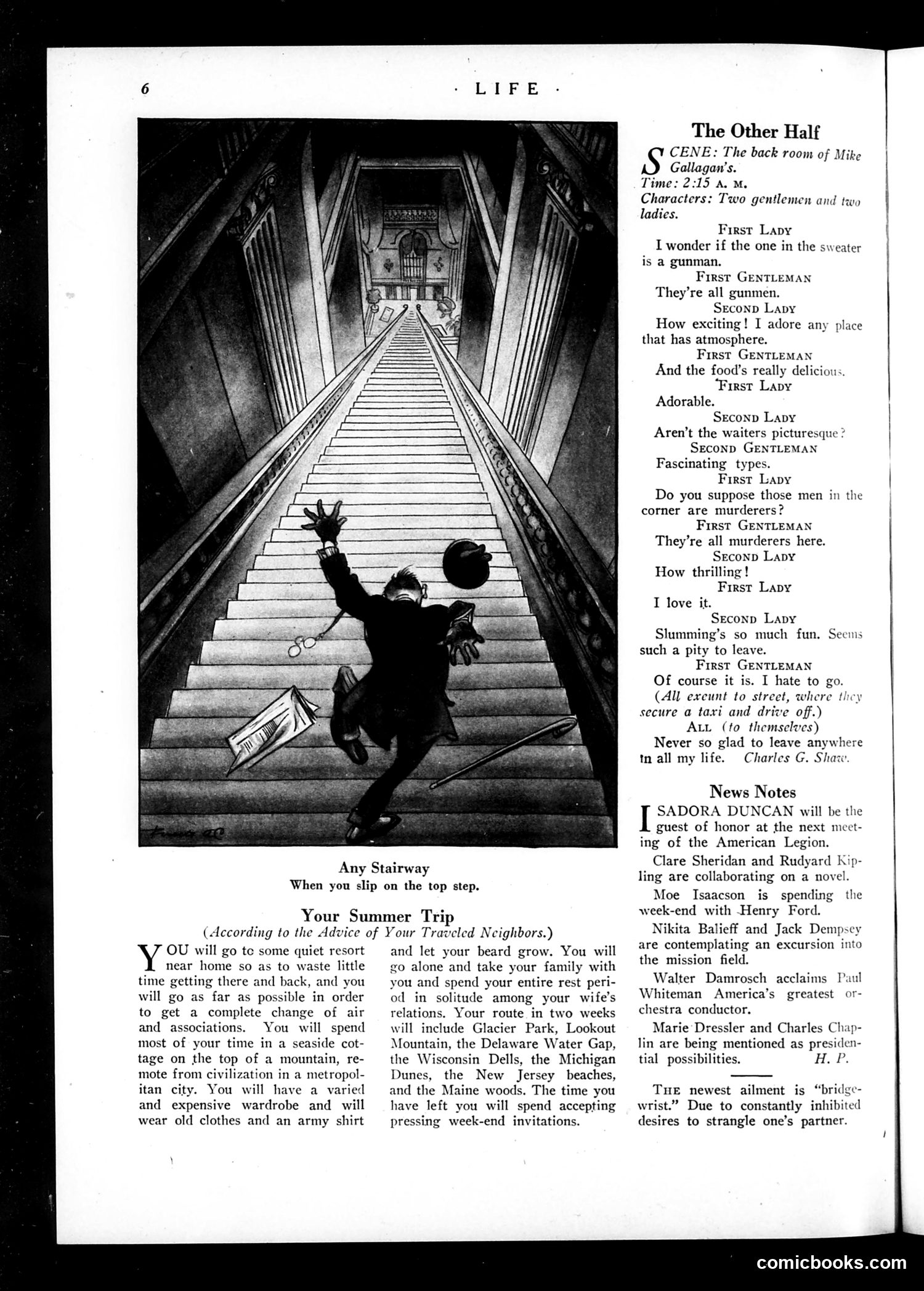
This page contains two distinct pieces of satirical content: 1. **"Any Stairway" (cartoon)**: A humorous illustration showing a man falling down stairs with his belongings scattered. The caption "When you slip on the top step" is a visual joke about the consequences of accidents on staircases—literally depicting what happens when one loses footing. 2. **"Your Summer Trip"**: A satirical advice column mocking travelers' expectations. It humorously describes the reality of summer vacations—crowded resorts, uncomfortable clothing, expensive wardrobes, and tedious social obligations—contrasting sharply with the idealized fantasy travelers imagine. The tone is cynical about the actual experience versus the marketed promise. **"The Other Half"**: A dramatic scene-setting piece featuring dialogue between society figures at "Mike Gallagon's" discussing the venue's "atmosphere" and waiters, with hints of criminal underworld references ("murderers here").
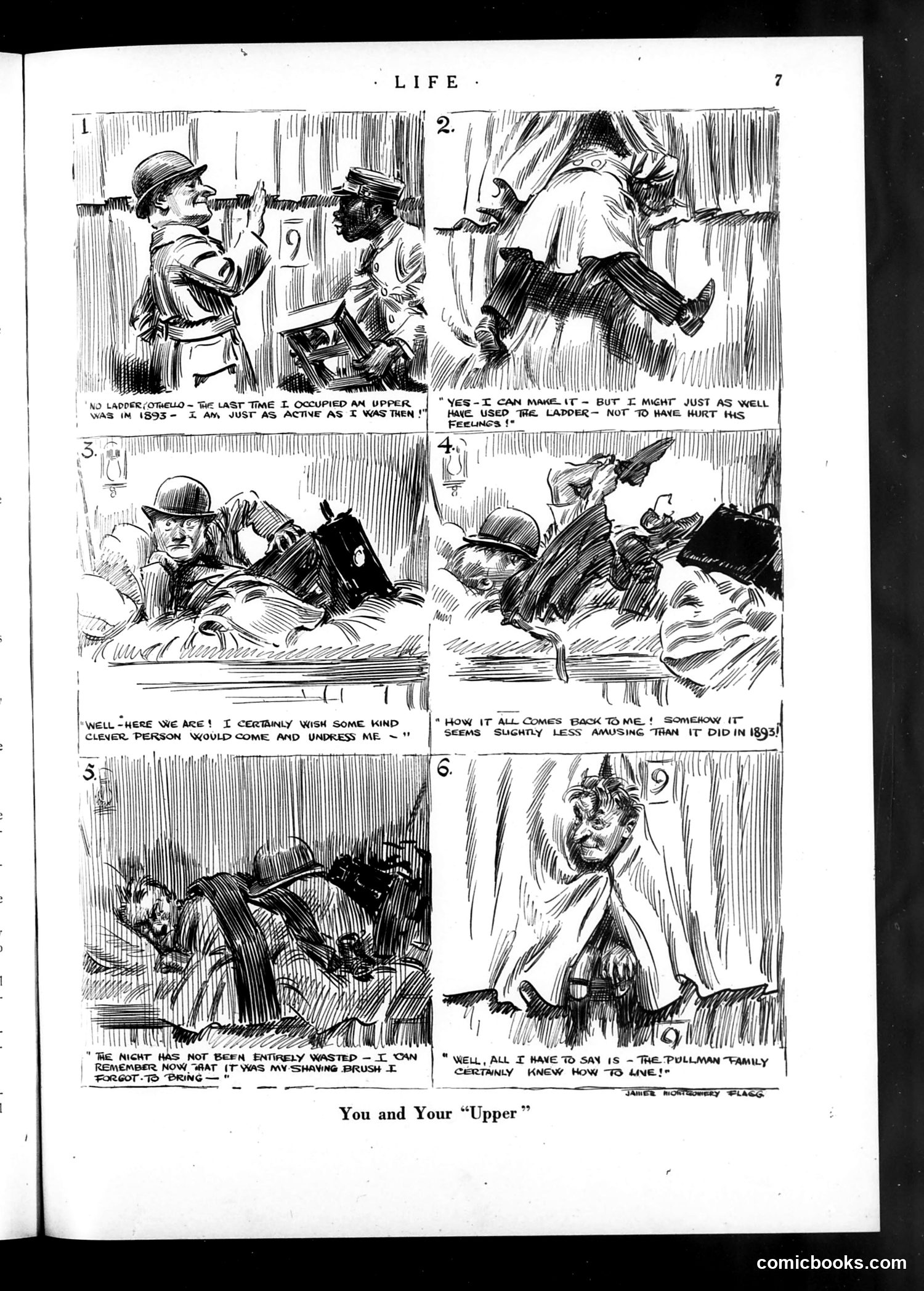
This six-panel comic satirizes the frustrations of maintaining a formal appearance. The protagonist, a man in a bowler hat, struggles with his detachable collar—a common men's fashion element of the early 20th century. Panel 1 references "1893" when he last wore an upper collar. Panels 3-4 show him stuck in mud, wishing for help undressing. Panel 5 humorously notes his shaving brush is "entirely wasted" on the filthy situation. Panel 6 concludes with him claiming to have mastered the art of dressing properly. The satire targets the impracticality and pretension of formal Victorian/Edwardian menswear—specifically the detachable "upper" (dress shirt front)—when confronted with real-world messiness and inconvenience.
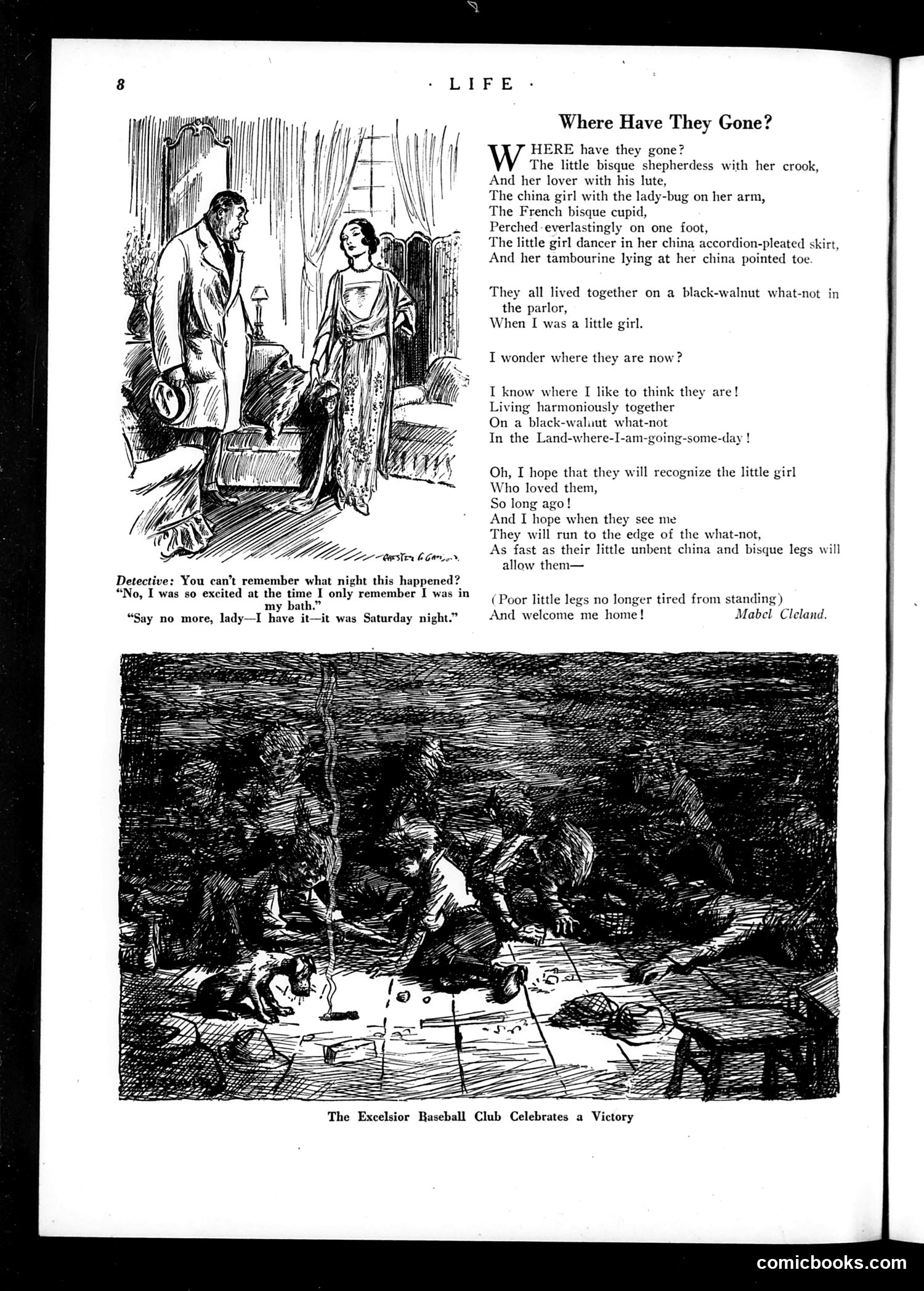
This page contains two distinct items: **Upper section:** A poem titled "Where Have They Gone?" by Mabel Cleland, accompanied by an illustration showing a detective questioning a woman about childhood toys that have disappeared. The poem nostalgically recalls porcelain dolls and bisque figurines the speaker owned as a child, wondering where they are now and hoping to be reunited with them. This appears to be sentimental verse rather than political satire. **Lower section:** An illustration captioned "The Excelsior Baseball Club Celebrates a Victory," depicting what appears to be a celebratory scene with multiple figures in a dark, crowded setting. Without clearer detail or additional context, the specific satirical point remains unclear, though it likely comments on amateur baseball culture or club celebrations of the era.
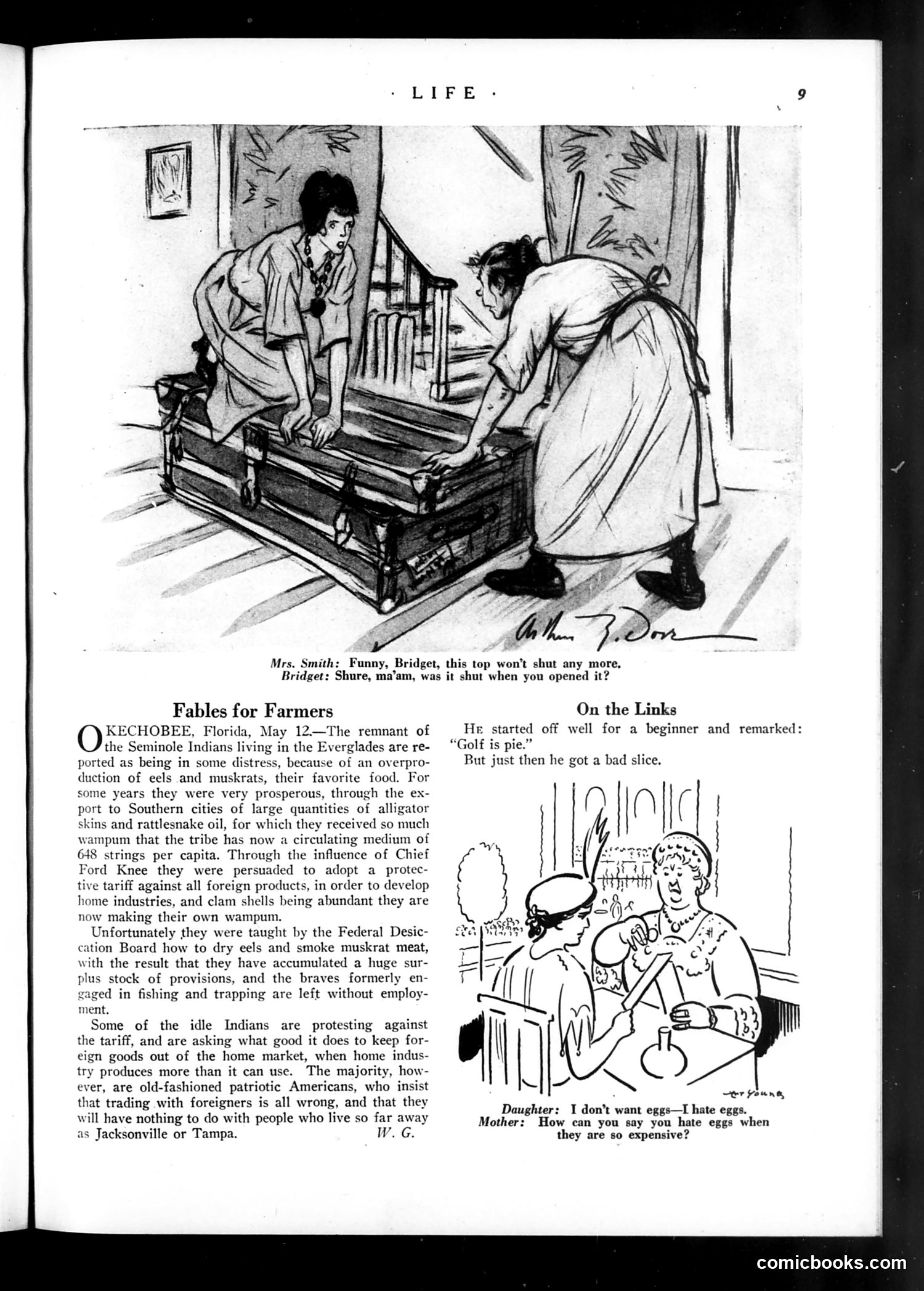
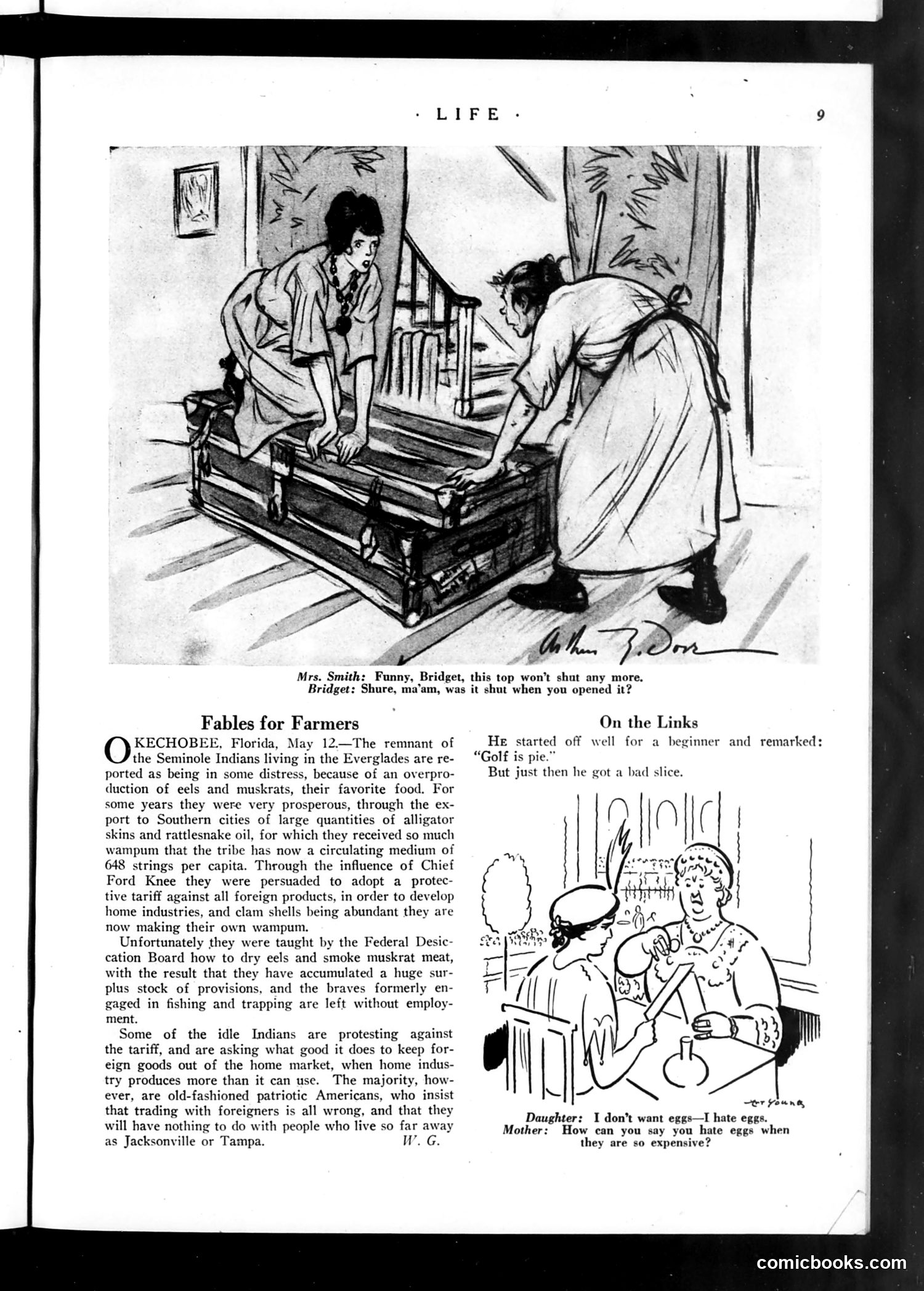
**Top Cartoon:** A domestic humor sketch showing two women with a baby crib. Mrs. Smith complains the crib top won't close; Bridget (the servant) asks if it shut when opened. This is a simple joke about poor mechanical design or user error—typical early 20th-century domestic comedy. **"Fables for Farmers":** A serious article from Okeechobee, Florida, discussing Seminole Indians' economic distress. They formerly prospered exporting alligator skins and oil to Southern cities, but Federal regulations forced them to stockpile provisions they can't sell, creating unemployment. **"On the Links":** A golf humor cartoon showing a daughter rejecting eggs because they're expensive, while her mother questions the logic. It's a joke about cost-of-living complaints.
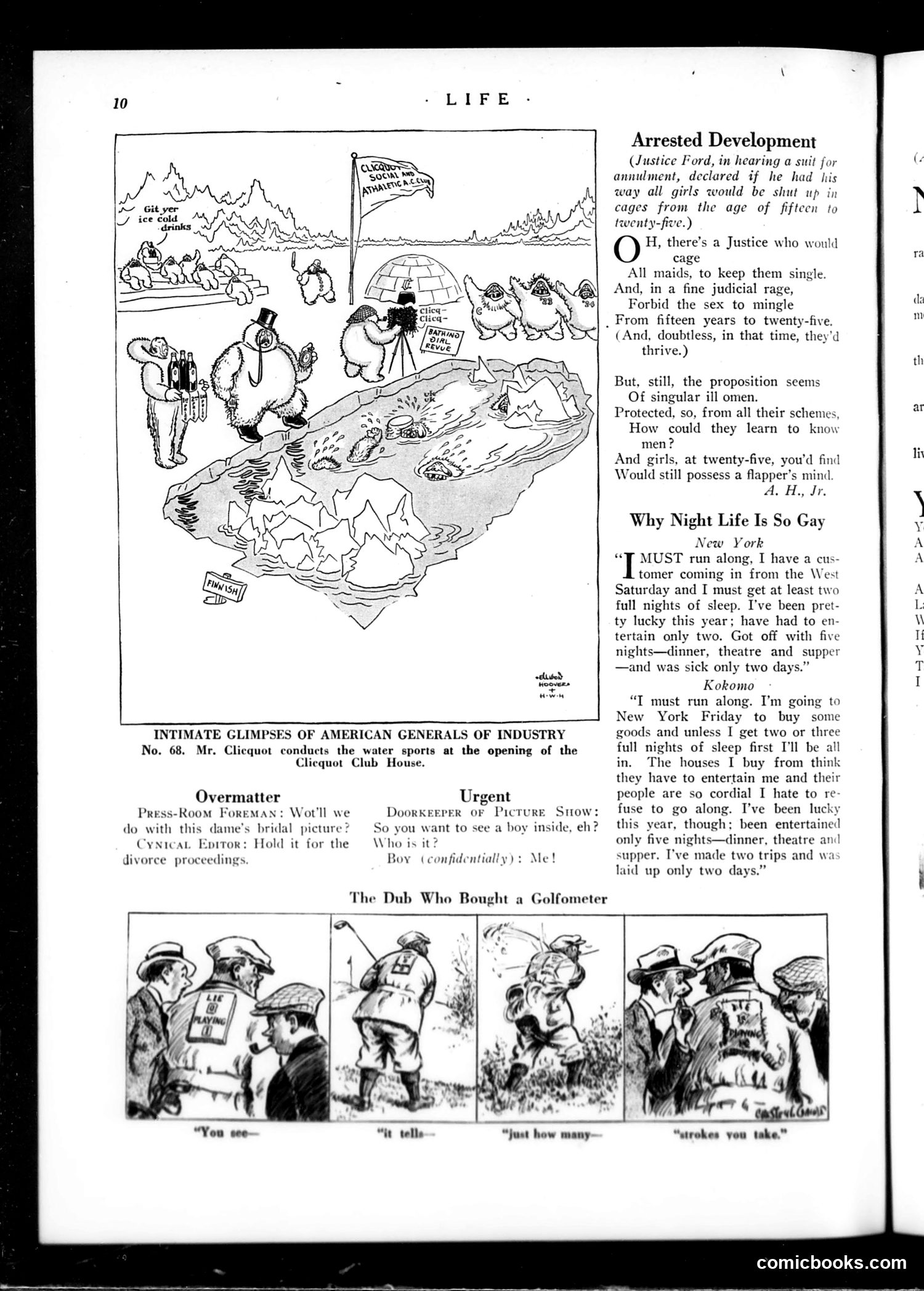
This page contains three distinct satirical pieces: 1. **"Intimate Glimpses of American Generals of Industry"** (top cartoon): A chaotic beach scene mocking wealthy industrialists at leisure, with exaggerated figures suggesting excess and lack of restraint. 2. **"Arrested Development"** (poem): Social satire about a Justice considering caging girls until age twenty-five to prevent unmarried pregnancy—mockingly proposing this as protection from "singular ill omen." 3. **"Why Night Life Is So Gay"** (anecdotes): Two New Yorkers humorously explaining their exhaustion from nightlife obligations, highlighting the social pressure to constantly entertain and be entertained. 4. **"The Dub Who Bought a Golfometer"** (comic strip): A satirical sequence showing a pretentious golfer using a device to measure his game, likely mocking new gadgetry and status-seeking among wealthy sportsmen. The page collectively satirizes wealth, social pretension, and modern leisure culture.
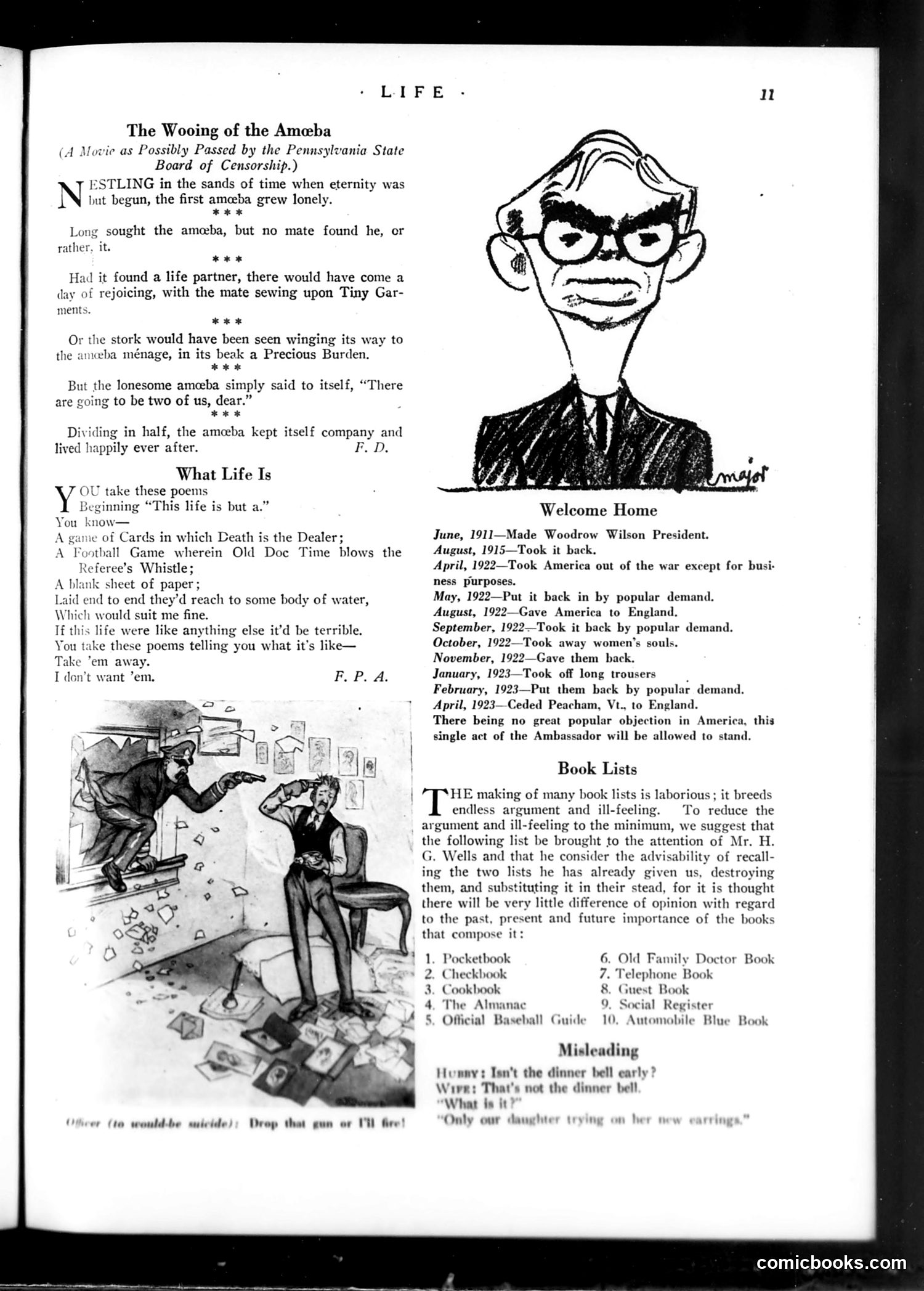
This page contains satirical poetry and humor rather than political cartoons. "The Wooing of the Amoeba" is a whimsical poem about a lonely amoeba that reproduces asexually—the joke being it becomes "two of us" rather than finding a mate. "What Life Is" lists absurdist life definitions (death as card dealer, football games, etc.), typical of the magazine's humorous style. The illustrated cartoon shows a man surrounded by scattered papers and objects, apparently in chaos—likely depicting domestic disorder or life's complications, though the specific reference is unclear. "Welcome Home" appears to be a timeline of Woodrow Wilson's presidency (1911-1923), cataloging policy reversals and public demands. The page emphasizes Life's satirical approach to modern life, politics, and social absurdities through humor rather than direct commentary.
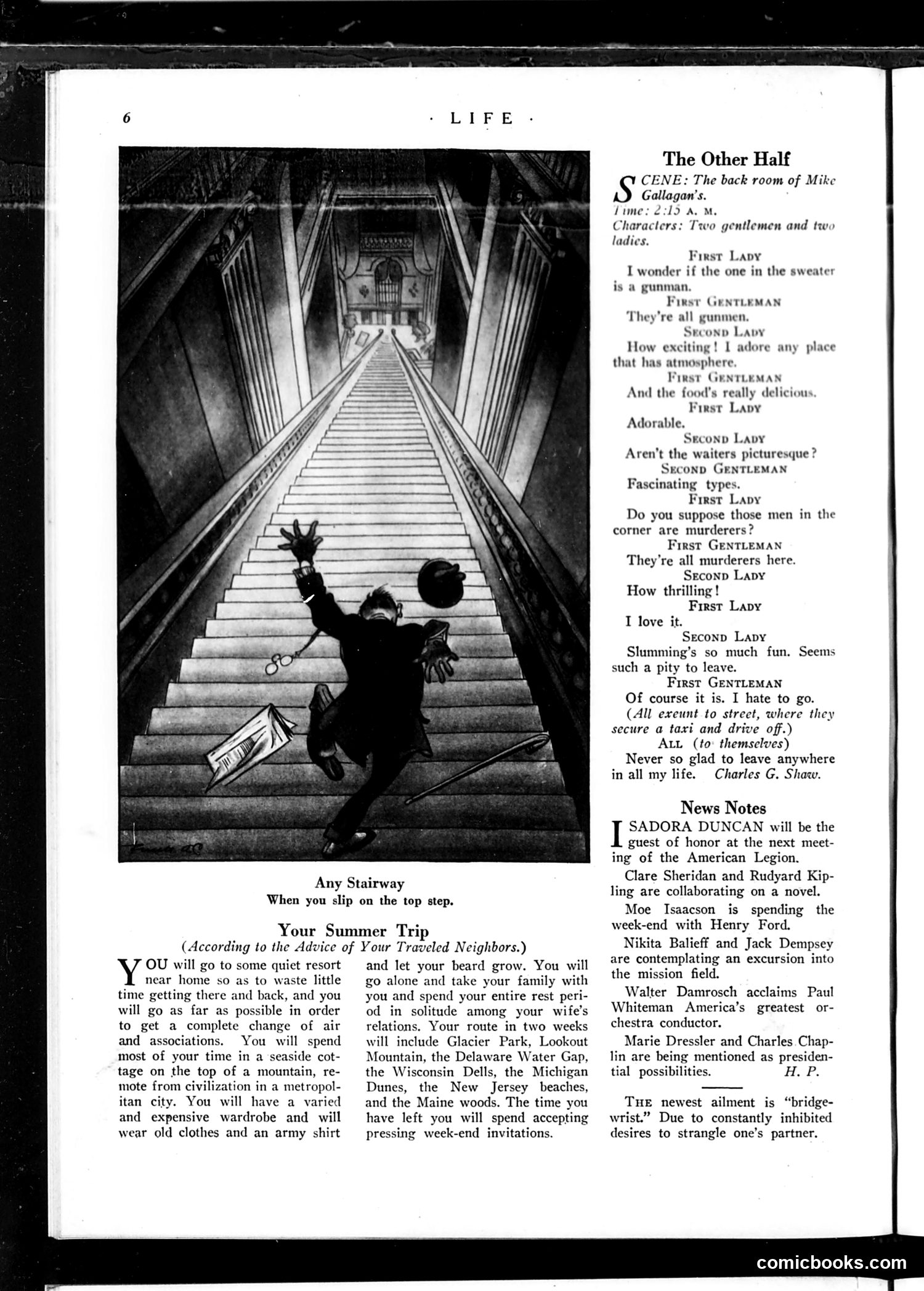
This illustration depicts a man tumbling down a long staircase—a visual gag about the hazards of losing one's footing. The caption "Any Stairway / When you slip on the top step" presents the joke straightforwardly: the dramatic fall illustrated shows the comedic exaggeration of what happens from a simple misstep. The cartoon relies on physical humor rather than political satire. The stark black-and-white photograph emphasizes the vertiginous perspective down the stairs, making the accident appear catastrophic—typical of Life magazine's visual comedy style of the era. The accompanying text discusses summer vacation planning, unrelated to the cartoon itself. This appears to be general entertainment humor aimed at the magazine's middle-class readership.
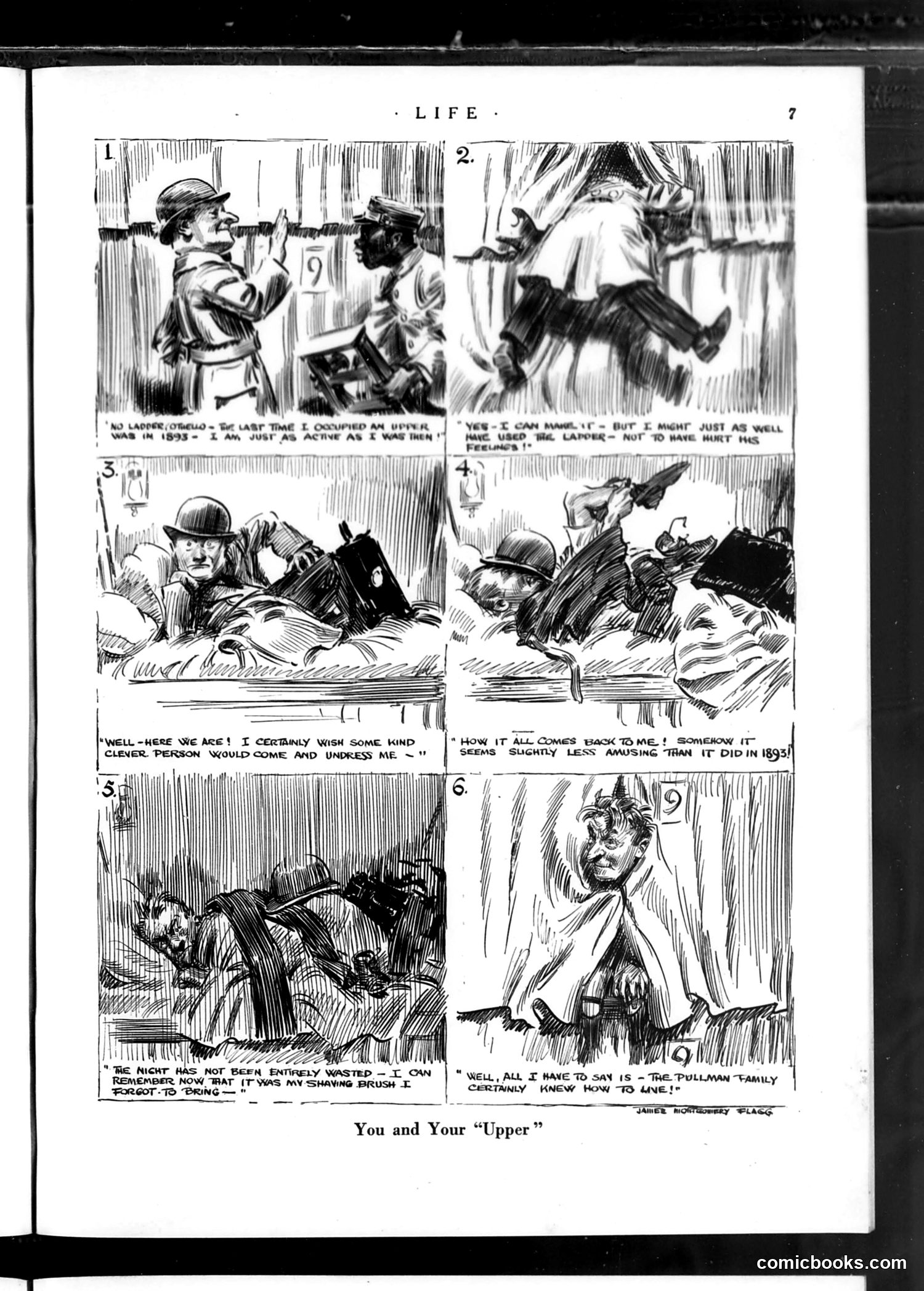
This six-panel comic satirizes class pretension and social climbing. The narrative follows a working-class man who discovers an old ladder in his possession, suggesting it belonged to someone from "1893." He jokes about using it to climb socially ("undress me"). The humor revolves around the absurdity of inherited class markers—the ladder becomes a metaphor for social aspiration. The final panels show the man's domestic life, with references to a "Pullman family" (likely referencing wealthy Pullman railroad magnates) and the ironic suggestion that even humble possessions carry pretentious associations. The satire targets how ordinary people adopt or cling to symbols of upper-class status, mocking both the poor's social ambitions and the upper class's presumed superiority.
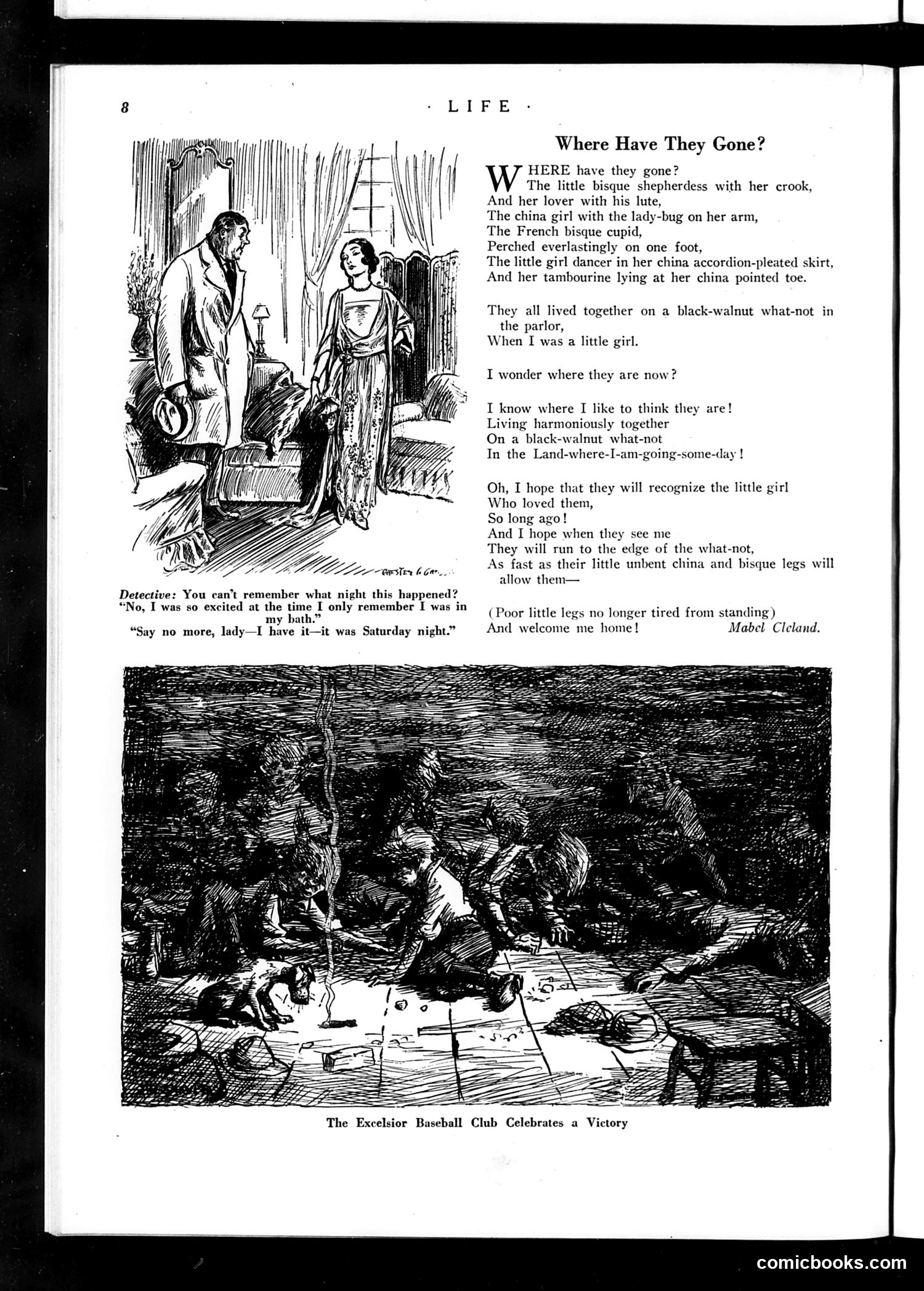
This page features a sentimental poem by Mabel Cleland about cherished childhood toys—a bisque shepherdess, lute player, china girl, French cupid, dancer, and tambourine—that once lived together on a parlor whatnot (a decorative shelf). The upper illustration shows two adults in an interior, likely depicting the nostalgic memory. The lower illustration, titled "The Excelsior Baseball Club Celebrates a Victory," depicts what appears to be a children's baseball team celebration, though the specific historical reference is unclear from the image alone. The page mixes genteel nostalgia with humor about childhood play and memory—typical of Life's blend of sentimental and humorous content.
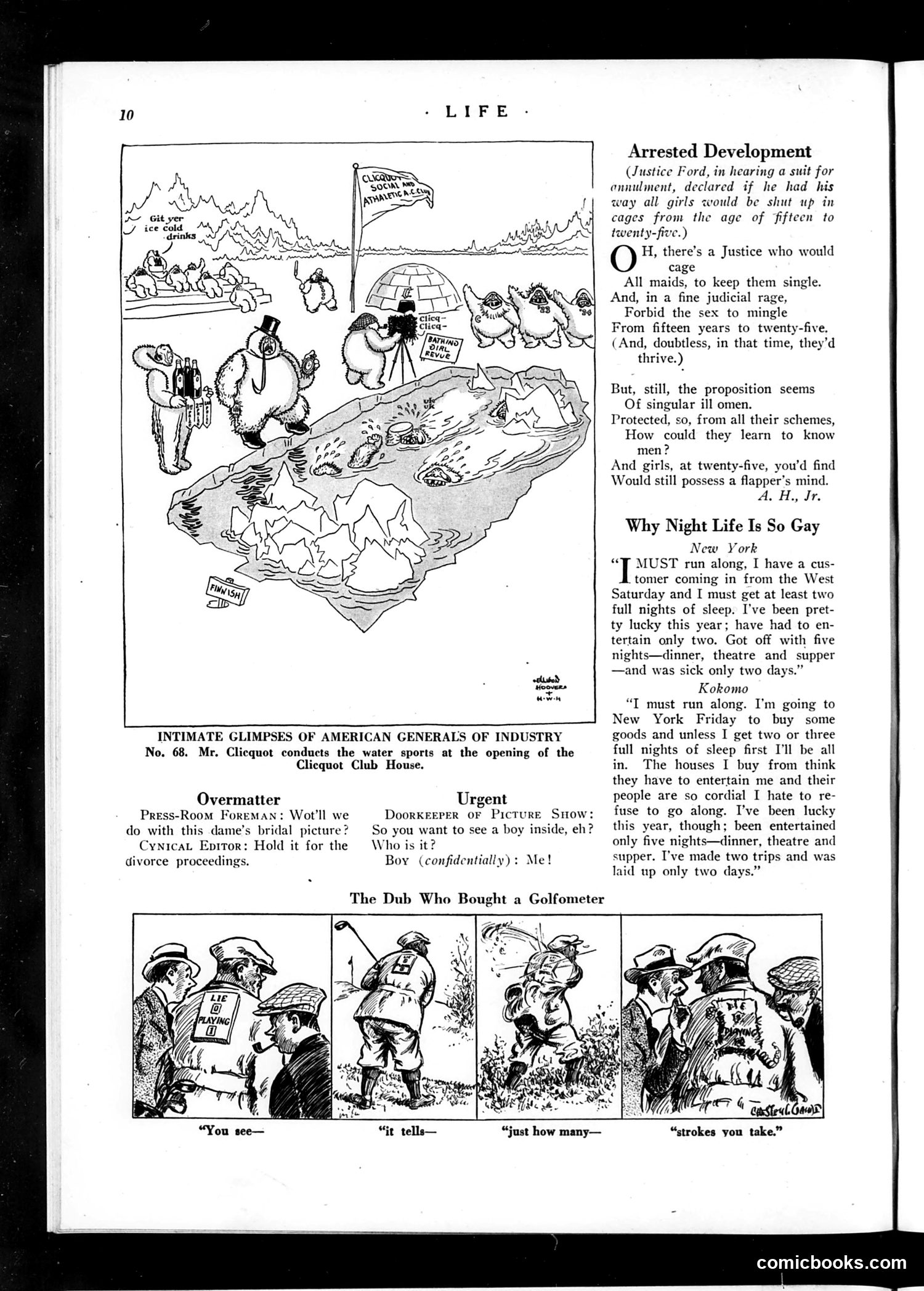
This page contains multiple satirical pieces mocking early 20th-century social attitudes: **"Arrested Development"** mocks Justice Ford's proposal to cage girls aged 15-25 to prevent courtship. The satire argues this would backfire—sheltered women would remain immature ("flapper's mind") and unable to understand men, defeating the purpose of maintaining virtue. **"Why Night Life Is So Gay"** presents ironic monologues from businessmen boasting about exhaustion from mandatory social entertaining. The humor derives from their treating sleep deprivation as a status symbol—proof they're important enough that suppliers must wine and dine them. **Bottom section** includes brief comedic exchanges: a cynical editor suggesting holding a bride's photo for divorce proceedings, and "The Dub Who Bought a Golfometer," a four-panel comic about a man misusing a golf-measuring device. **"Intimate Glimpses of American Generals of Industry"** (caption only visible) appears to satirize wealthy industrialists at leisure. The overall tone criticizes gender attitudes, corporate excess, and materialism.
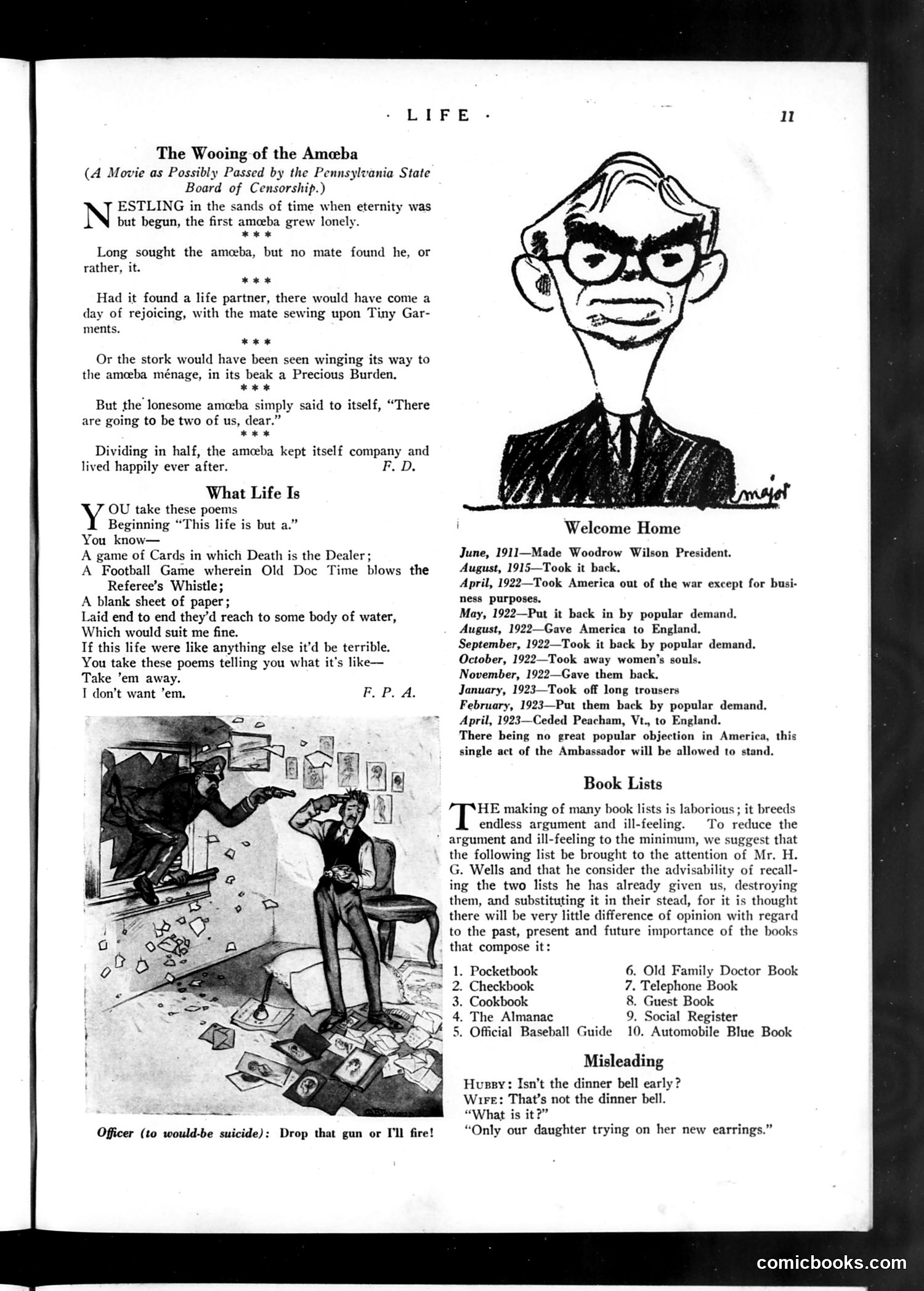
This page satirizes **censorship and social hypocrisy** in early 1920s America. "The Wooing of the Amoeba" mocks the Pennsylvania State Board of Censorship by presenting an absurdly innocent biological narrative—an amoeba reproducing asexually—yet framing it as a movie that would need censorship approval. The joke: even this clinical origin story gets subjected to moralistic scrutiny. The accompanying "Welcome Home" piece parodies **political inconsistency**, showing Woodrow Wilson's administration constantly reversing course on America's involvement in WWI and post-war policy (1911-1923), with women's rights similarly flip-flopping. The satire critiques how public opinion whipsaws policymakers. The cartoon below depicts a **suicide intervention**, with an officer threatening force to prevent self-harm—darkly comedic commentary on desperation and authority's crude responses. Together, the page attacks institutional censorship, political vacillation, and social contradictions defining the post-war era.
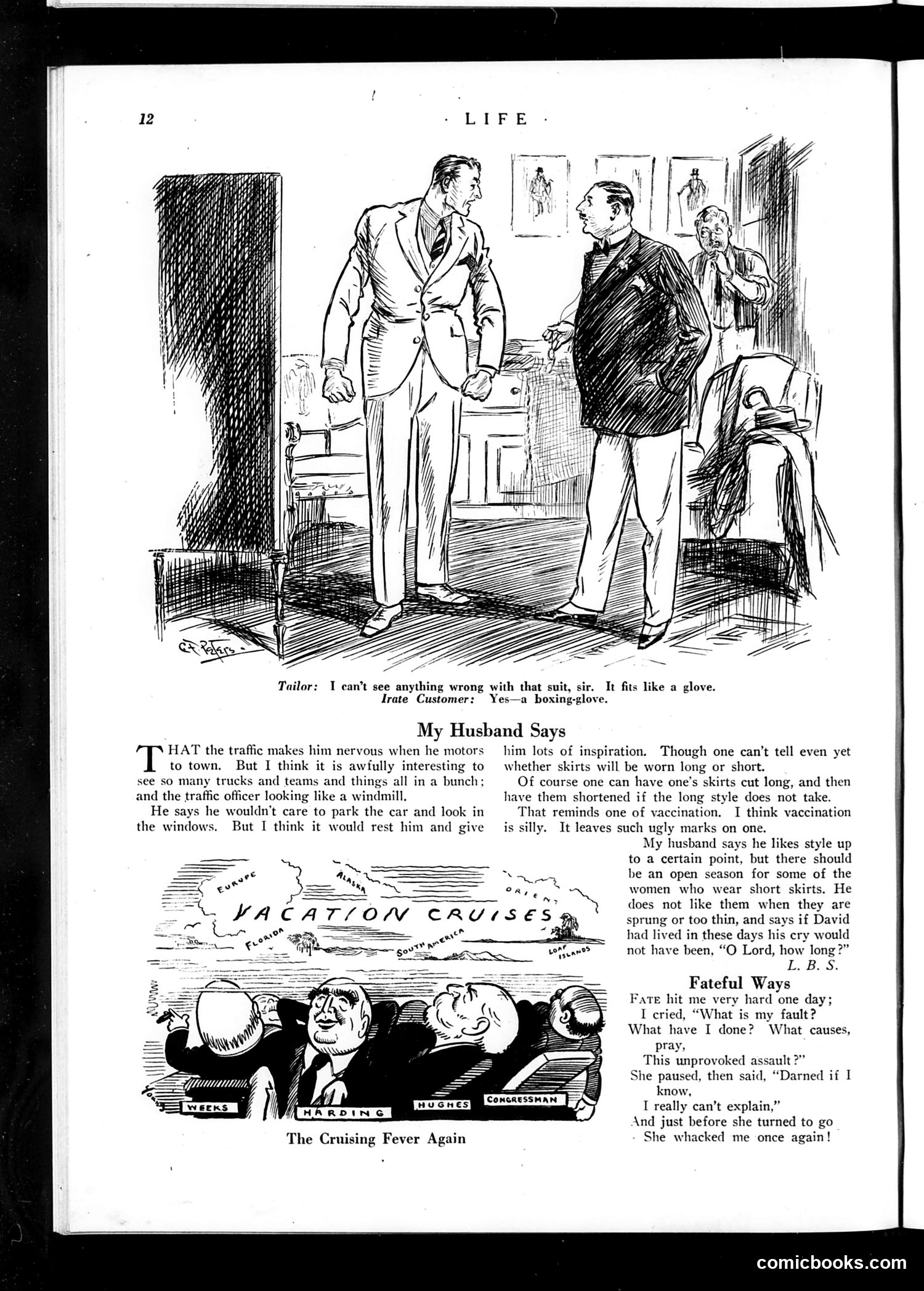
**Top Cartoon:** A tailor assures a customer his suit "fits like a glove," but the irate customer retorts it fits like a "boxing-glove"—meaning the suit is too tight and awkwardly puffy, making the wearer look absurd or overly bulky. This is a straightforward joke about poor tailoring. **"My Husband Says":** A humorous domestic column where a wife discusses her husband's opinions on urban driving, fashion trends (particularly skirt length), and other modern concerns. The tone is gently satirical about married life and spousal disagreements—he finds traffic anxiety-inducing; she finds it fascinating. The mention of vaccination scars and David (biblical reference) adds period-appropriate absurdist humor. **"Vacation Cruises" and "The Cruising Fever Again":** Features caricatured politicians (likely Weeks, Harding, Hughes, and a Congressman, based on labels), apparently commenting on cruise vacations—likely satirizing politicians' leisure habits or travel during a particular political moment. **"Fateful Ways":** A brief comic verse about random misfortune, where Fate cannot even explain her cruelty—dark humor about life's inexplicable hardships.
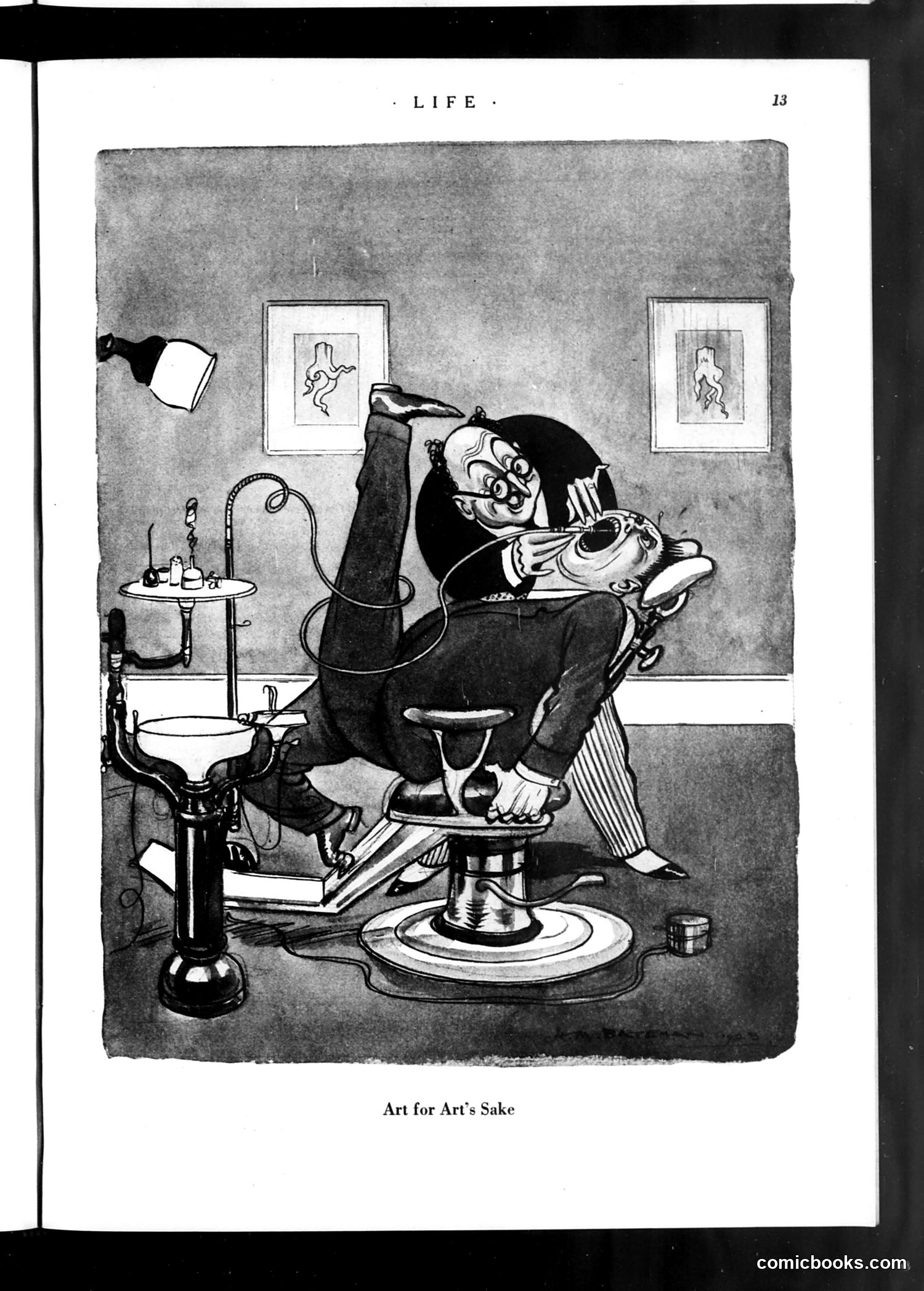
This satirical cartoon depicts a caricatured dentist in his office, reclining in an exaggerated pose in the dental chair rather than a patient. The figure appears to be an artistic or bohemian type—suggested by the aesthetic prints on the wall and the overall composition—rather than a medical professional. The satire likely mocks the phrase "art for art's sake," a late 19th/early 20th-century aesthetic philosophy emphasizing art's value independent of practical purpose. By placing this pretentious figure in a dentist's chair amid clinical equipment, Life suggests the absurdity of pursuing art divorced from utility or profession. The joke criticizes impractical artistic affectation, implying such idealism is self-indulgent or ridiculous when confronted with real-world professional responsibilities.
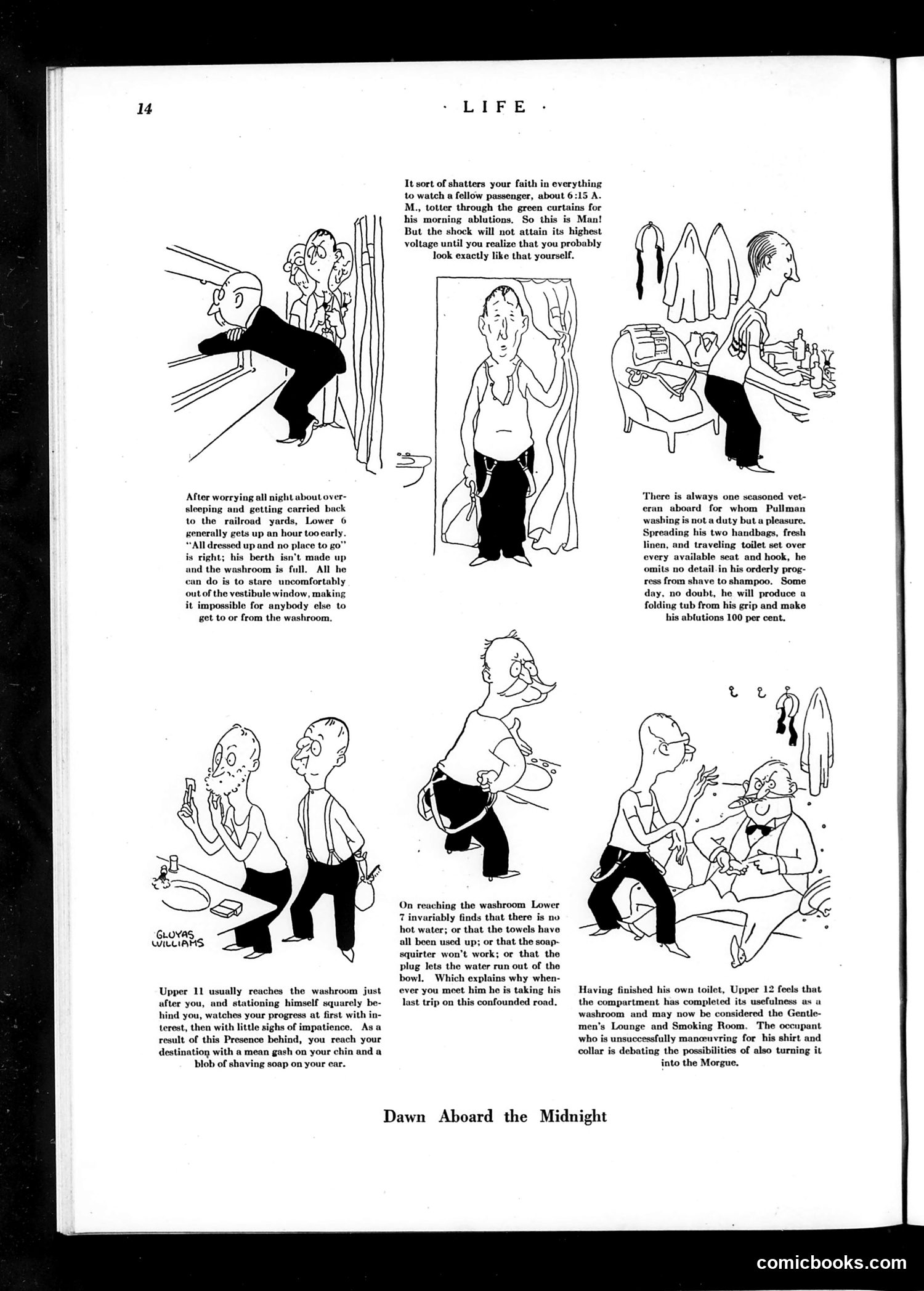
This page satirizes the chaotic morning routine aboard a Pullman train car, depicting different passenger "types" and their bathroom habits. The humor contrasts idealized notions of modern travel with uncomfortable realities. **Key figures/situations:** - **Lower 6**: Gets up too early from anxiety, then awkwardly blocks the washroom - **Upper 11**: Stands impatiently behind you while shaving, making you nervous and clumsy - **The shabby fellow at 6:15 AM**: Represents the disappointing reality that even refined people look disheveled before morning grooming - **The "seasoned veteran"**: Obsessively organized, spreading belongings everywhere - **Upper 12**: Treats the washroom as a personal lounge after finishing The satire mocks the indignity of shared Pullman car facilities—malfunctioning equipment, no hot water, towel shortages—and how close quarters strip away social pretense. The final caption, "Dawn Aboard the Midnight," suggests the irony of travelers' expectations versus unglamorous reality.
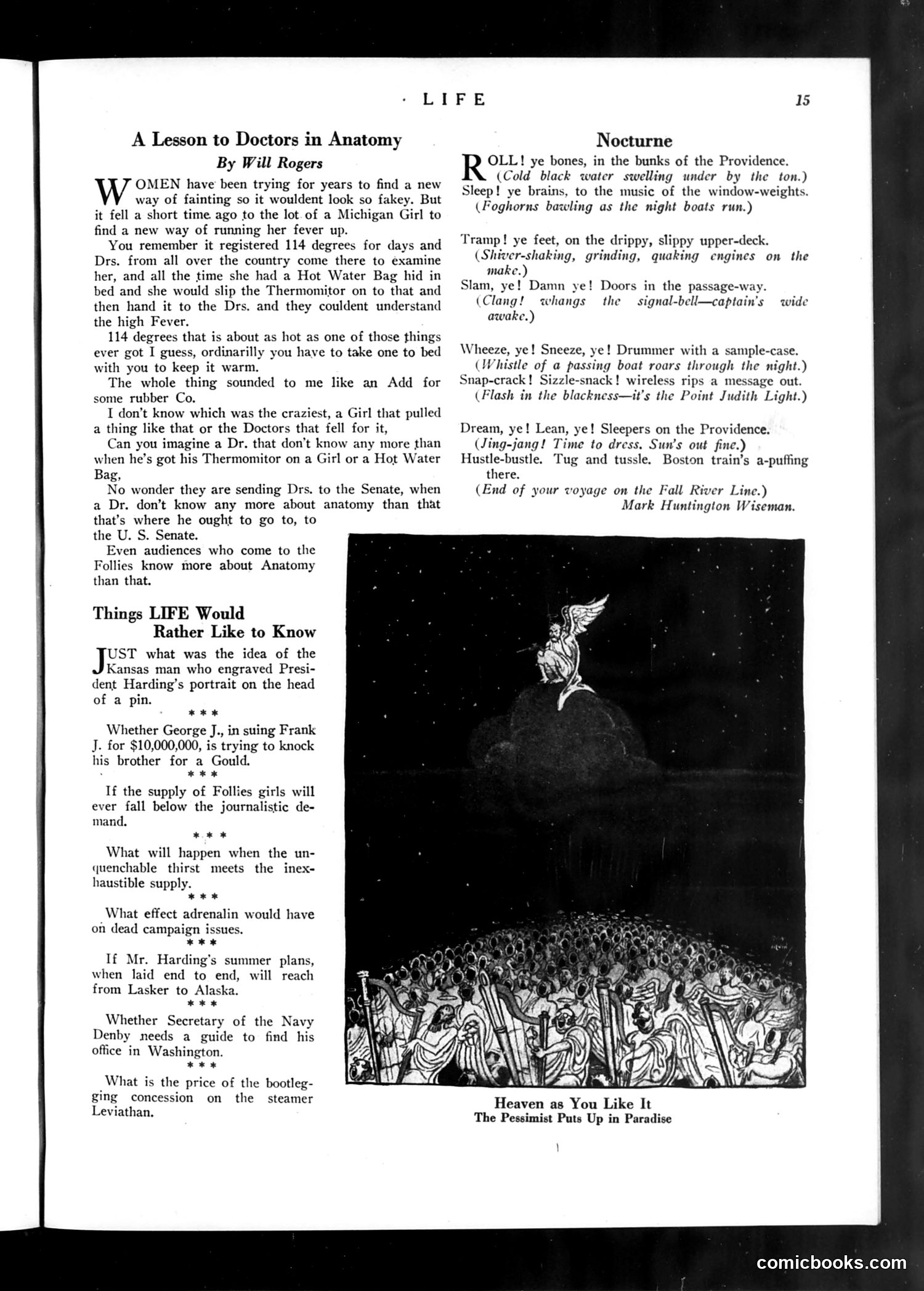
This page contains two distinct pieces of satirical content: **"A Lesson to Doctors in Anatomy" by Will Rogers** mocks medical professionals through a true incident: a Michigan girl fooled doctors by placing a hot water bottle under her bedding, then placing a thermometer on it to fake a 114-degree fever. Rogers uses this to satirize doctors' incompetence, suggesting they know less about human anatomy than chorus girls from the Follies. The final jab—wondering why doctors are being sent to the Senate—implies politicians are equally clueless. **"Things LIFE Would Rather Like to Know"** lists satirical questions about current events: Harding's presidency and travel plans, naval secretary Denby's organizational abilities, and bootlegging on ships—all poking fun at government inefficiency and Prohibition-era corruption. **"Nocturne"** is an atmospheric poem about a steamship (the Providence) and Fall River Line, with onomatopoetic descriptions of shipboard sounds and activities. The page represents early 1920s American satire targeting government incompetence and social absurdities.
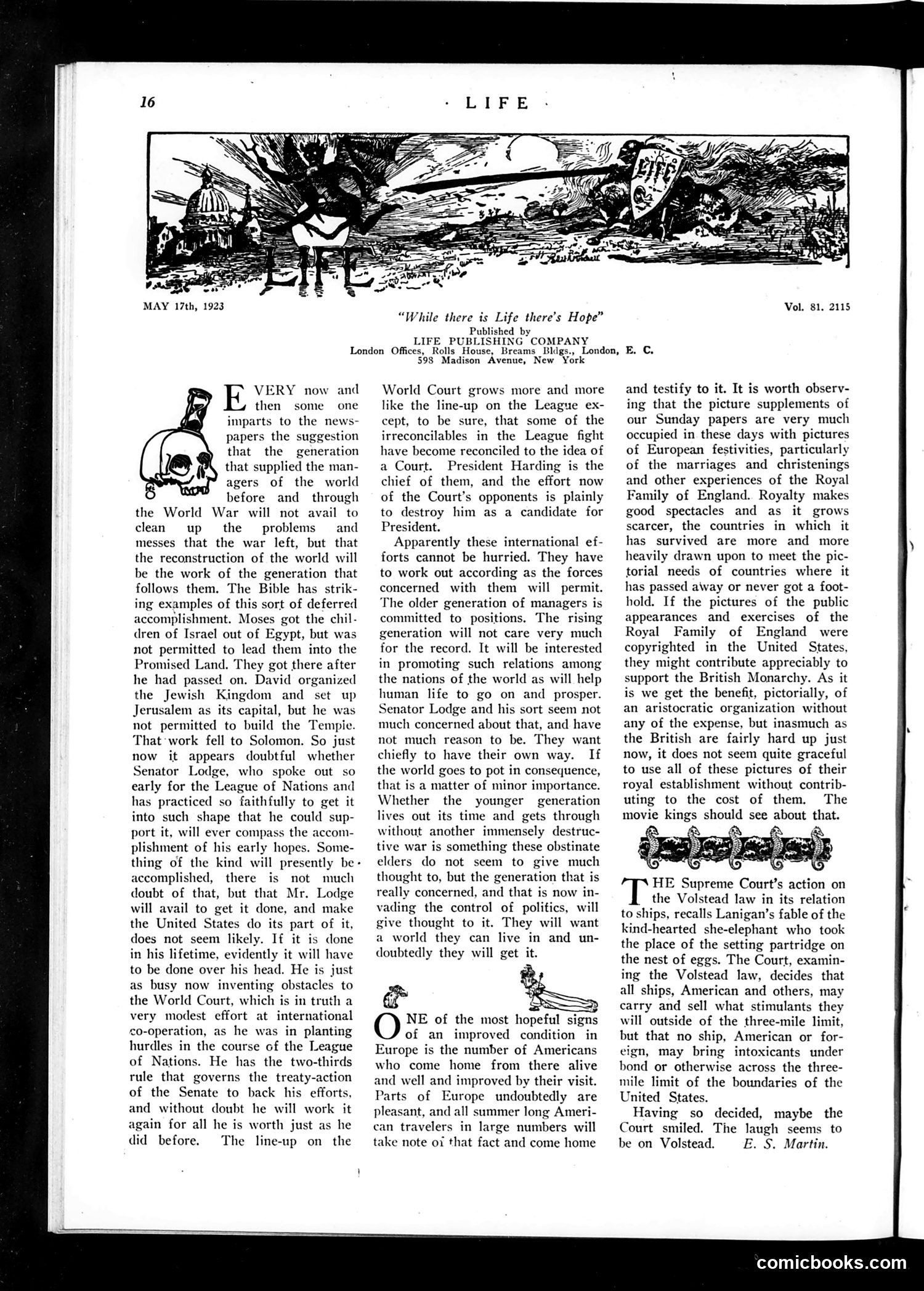
This editorial page critiques **Senator Henry Cabot Lodge**, the influential Republican who opposed American participation in the League of Nations. The writer compares Lodge to Biblical figures like Moses and David—leaders who initiated great works but were denied completion, suggesting Lodge will similarly fail to achieve his goals. The satire's core argument: Lodge obstructs international cooperation (first the League of Nations, now the World Court) through procedural tactics like the Senate's two-thirds treaty rule. The piece suggests his opposition is partisan rather than principled—he allegedly aims to destroy President Harding as a presidential candidate. The writer expresses hope that the younger generation, unconcerned with Lodge's political record, will pursue genuine international cooperation to prevent future wars. The final paragraph shifts to Americans touring Europe—implying their positive reports contrast with Lodge's negativity about international engagement. The cartoons (unclear in detail here) likely caricature Lodge's obstruction of these peace mechanisms.
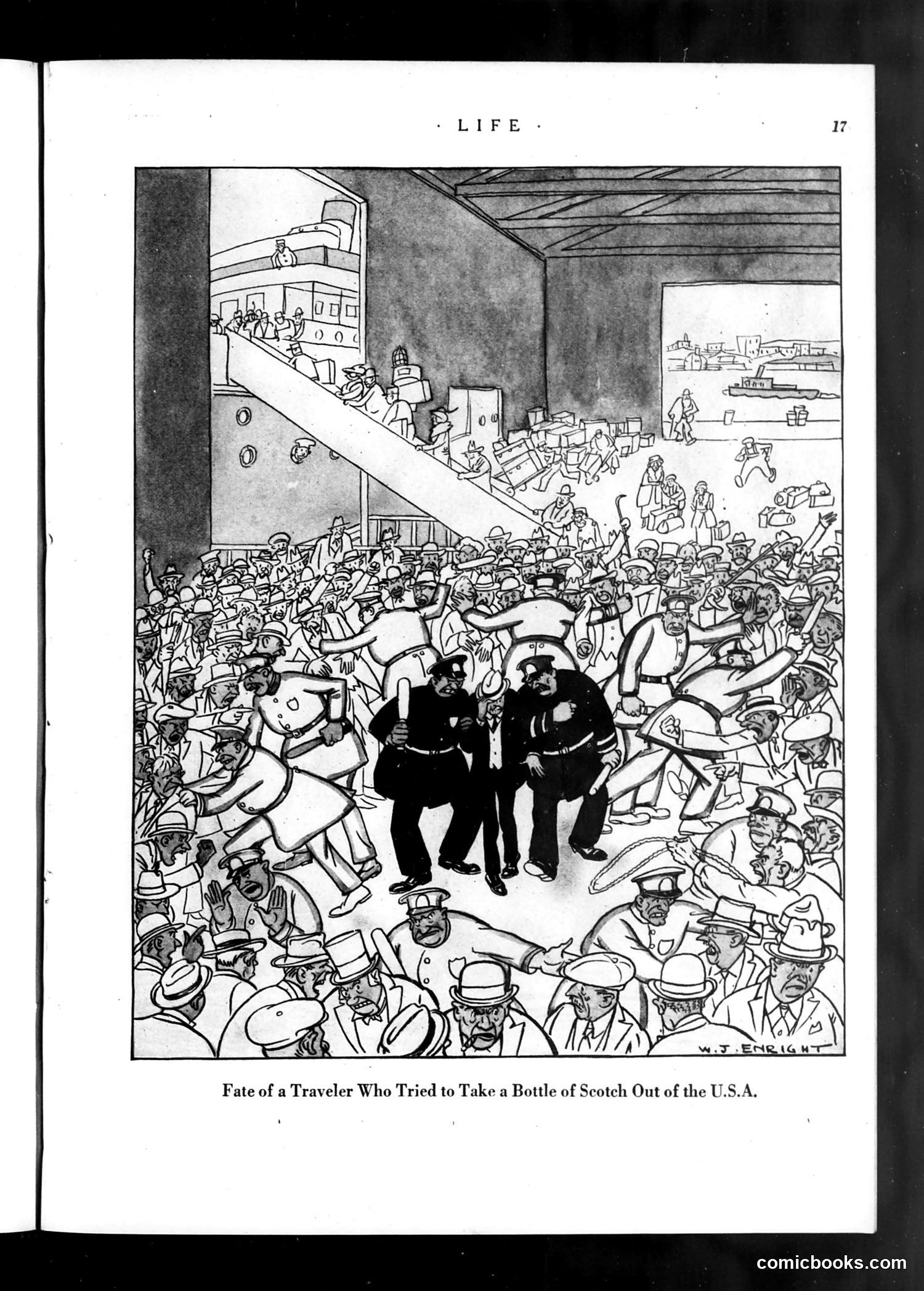
This cartoon satirizes American Prohibition-era customs enforcement. The caption describes a traveler attempting to smuggle Scottish whisky out of the United States—a crime under Prohibition laws (1920-1933). The scene shows a chaotic dock with a large ship and crowds of people. Two dark-suited figures (likely customs officials or law enforcement) stand prominently in the center, surrounded by a densely packed crowd of ordinary people. The "fate" referenced in the caption appears to be that the traveler has been caught and is now mobbed by citizens or authorities. The joke likely satirizes either the overzealousness of Prohibition enforcement or the absurdity of attempting to break the law so blatantly. The massive crowd suggests the serious consequences faced by smugglers during this period.
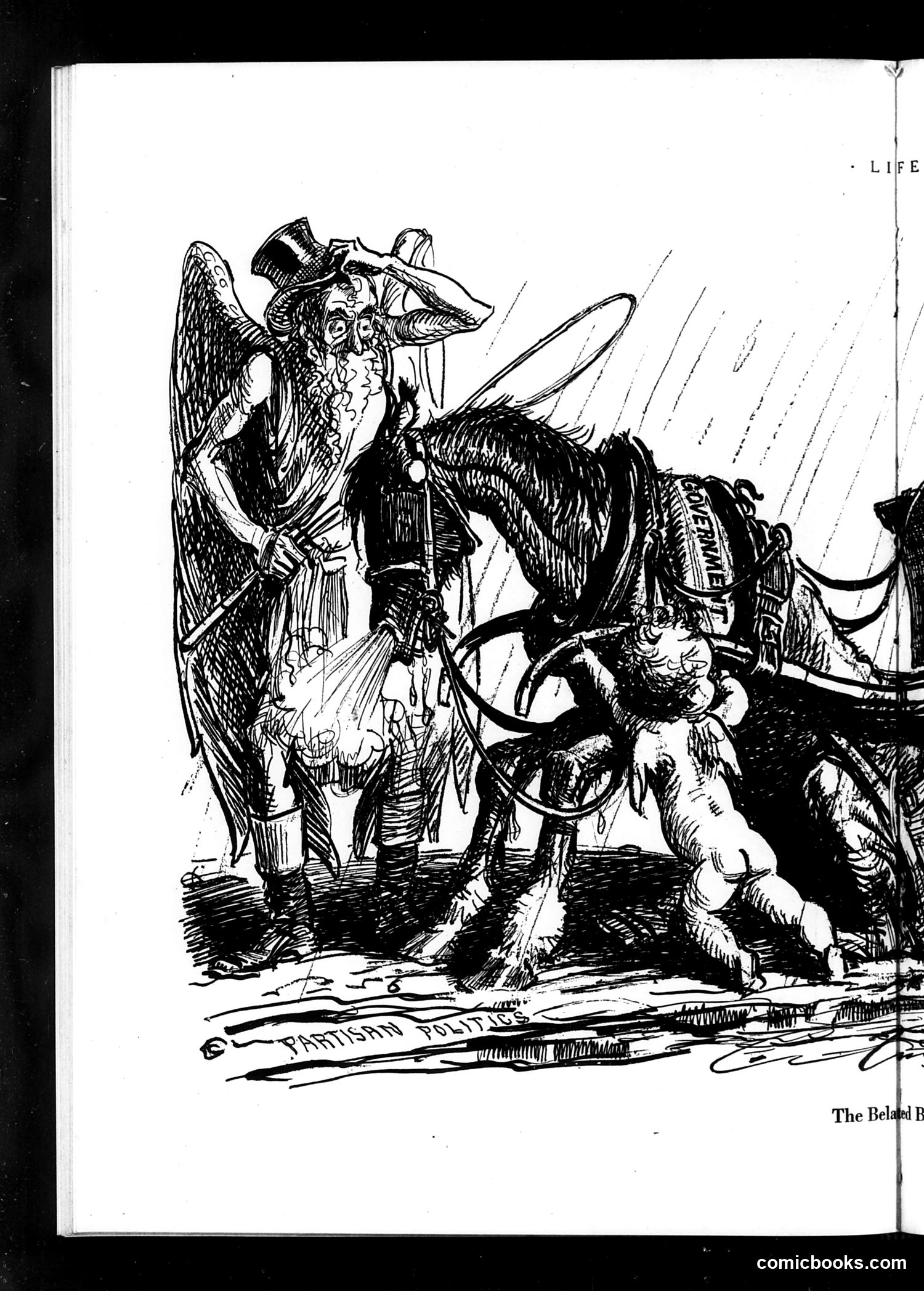
This appears to be a satirical cartoon from *Life* magazine featuring an allegorical figure—likely representing "Britannia" or British power, identifiable by the classical winged figure and trident—interacting with horses and what appears to be political machinery or conflict. The text fragment "British Politics" is visible at the bottom, and the title appears to reference something "Belated" (incomplete in the OCR). The cartoon seems to satirize British political processes or international relations, using the classical female figure as a symbol of Britain itself. Without the complete caption and publication date, the specific political event being mocked remains unclear, though the style suggests late 19th or early 20th-century political commentary typical of *Life's* satirical approach to current events.
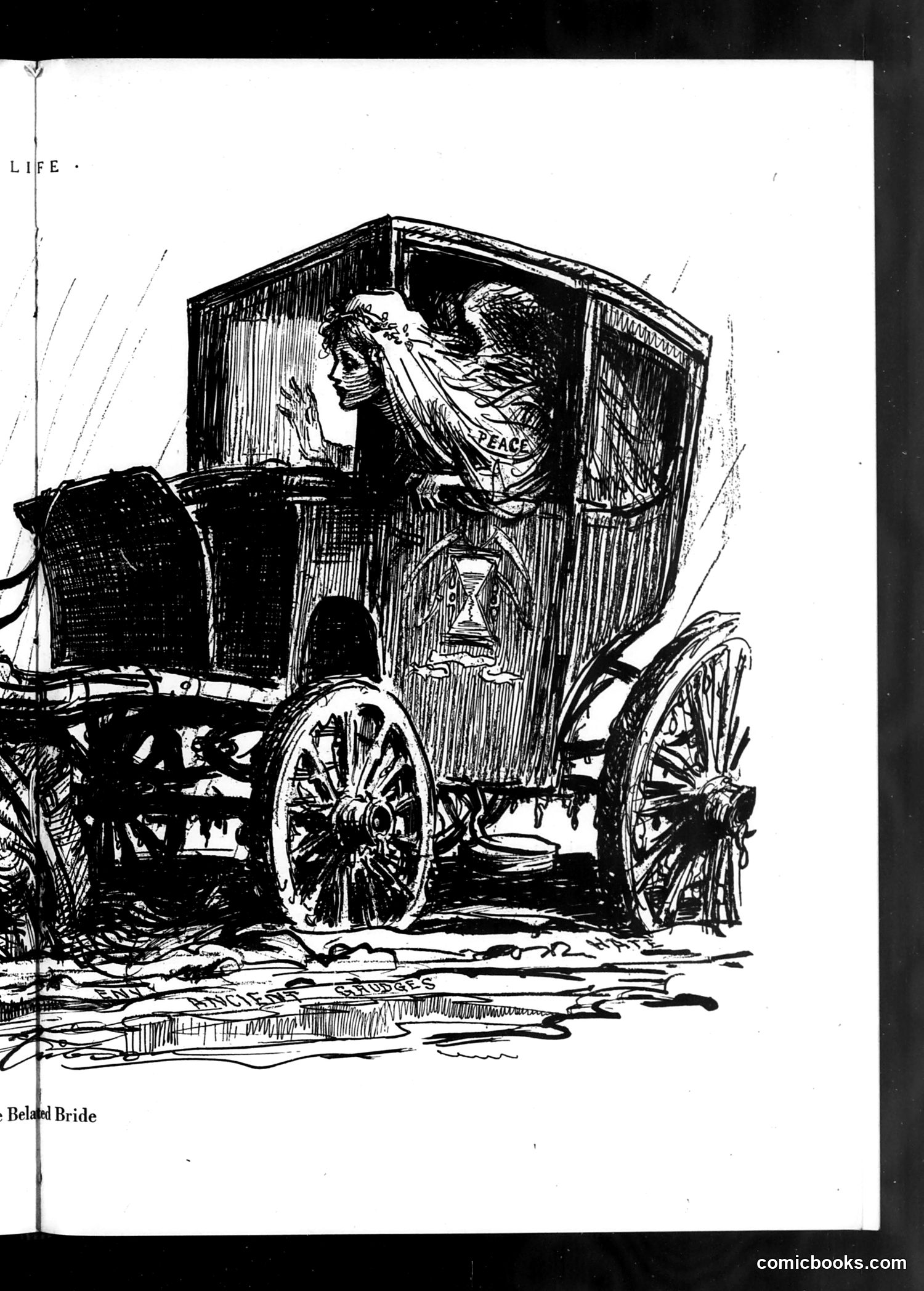
This ink illustration depicts an ornate horse-drawn carriage with decorative panels showing a winged female figure (likely representing Liberty or Victory). An hourglass is visible on the carriage door, symbolizing the passage of time. The carriage appears weathered and worn, suggesting age or delay. The title "Belated Bride" suggests the satire concerns a wedding that has been postponed or delayed. The hourglass reinforces this theme of time passing. Without additional context about the specific publication date, the exact political or social reference remains unclear—it could reference a delayed marriage, postponed legislation, or a delayed promised outcome. The worn carriage might suggest something long-promised has finally arrived, though tardily or in diminished condition.
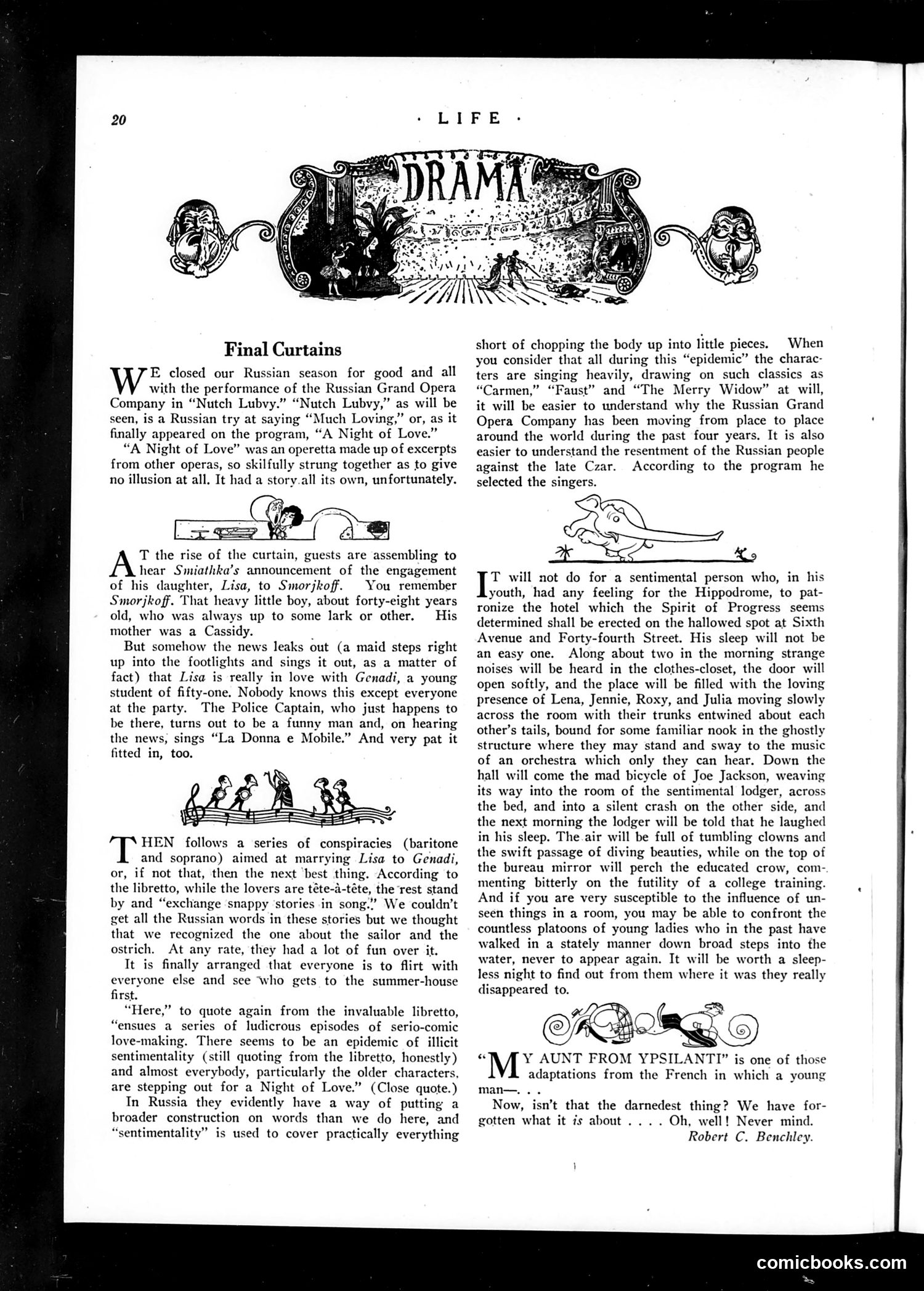
This page reviews the Russian Grand Opera Company's production of "A Night of Love" (a Russian attempt at "Much Loving"), a poorly-constructed operetta stitched from excerpts of famous operas like *Carmen*, *Faust*, and *The Merry Widow*. The satire mocks the production's absurd plot—involving a love triangle where a young student pursues an older man's daughter—and its chaotic staging where characters constantly break into unrelated operatic numbers. The author ridicules how Russians apparently use "sentimentality" to justify practically any behavior short of violence, and suggests the opera's poor quality reflects badly on Czarist Russia itself, joking that the late Czar "selected the singers." The piece employs witty sarcasm throughout, suggesting the touring company's constant relocation around the world stems from audiences' justified resentment of the production's quality.
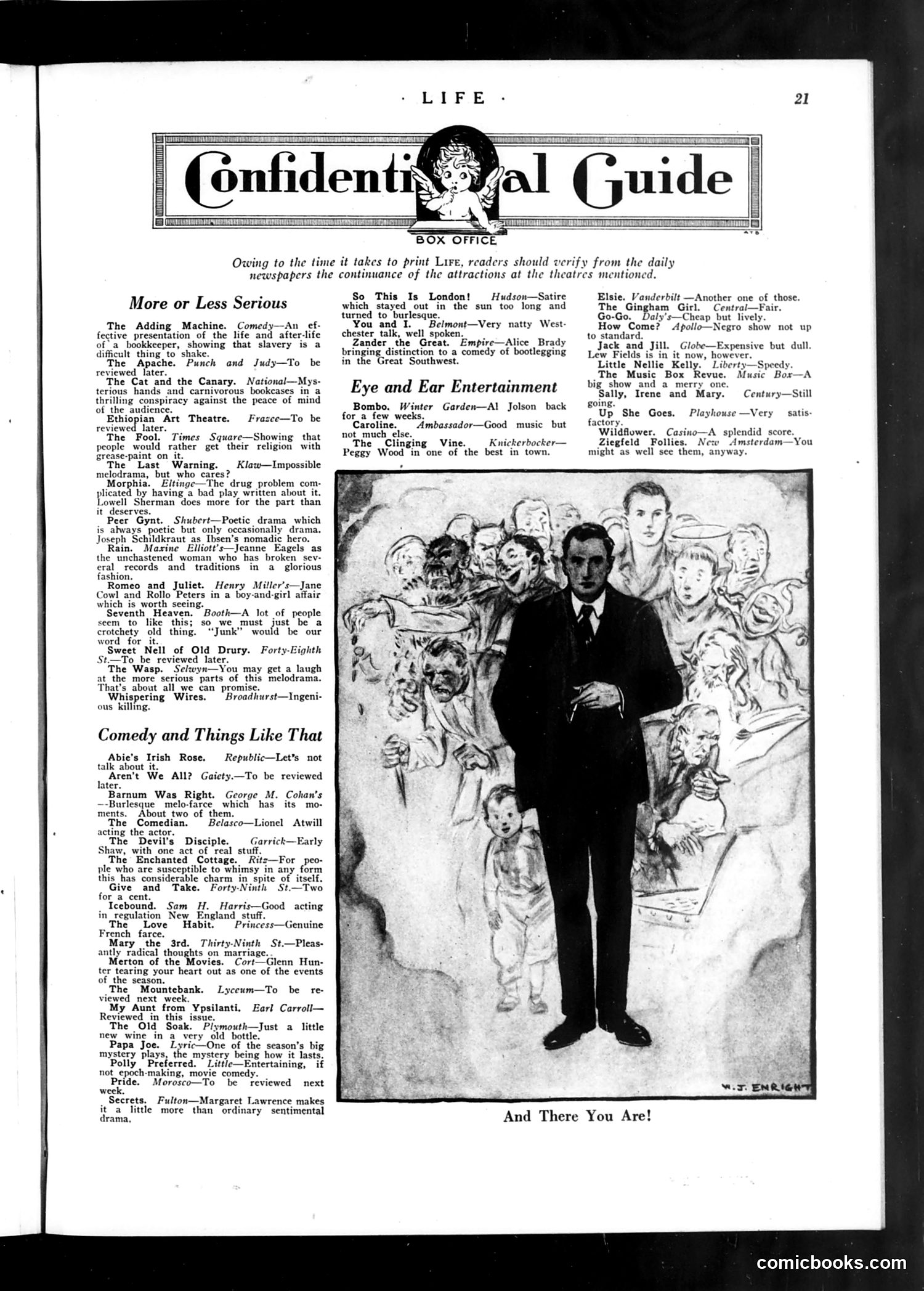
This page presents a "Confidential Guide" to Broadway theatrical attractions, likely from the early 1920s. Rather than containing political cartoons, it features theater reviews organized by tone and genre. The single illustration shows a well-dressed man in formal attire surrounded by caricatured theatrical characters and figures, captioned "And There You Are!" This appears to be satirizing the theatrical scene itself—the crowded, chaotic nature of Broadway productions and the diverse cast of characters populating them. The text categorizes current shows into sections: "More or Less Serious," "Comedy and Things Like That," and "Eye and Ear Entertainment," offering brief, witty critiques. The tone is irreverent and dismissive toward many productions, suggesting Life's editorial stance was one of sophisticated skepticism toward popular entertainment. The page functions primarily as entertainment journalism rather than political satire.
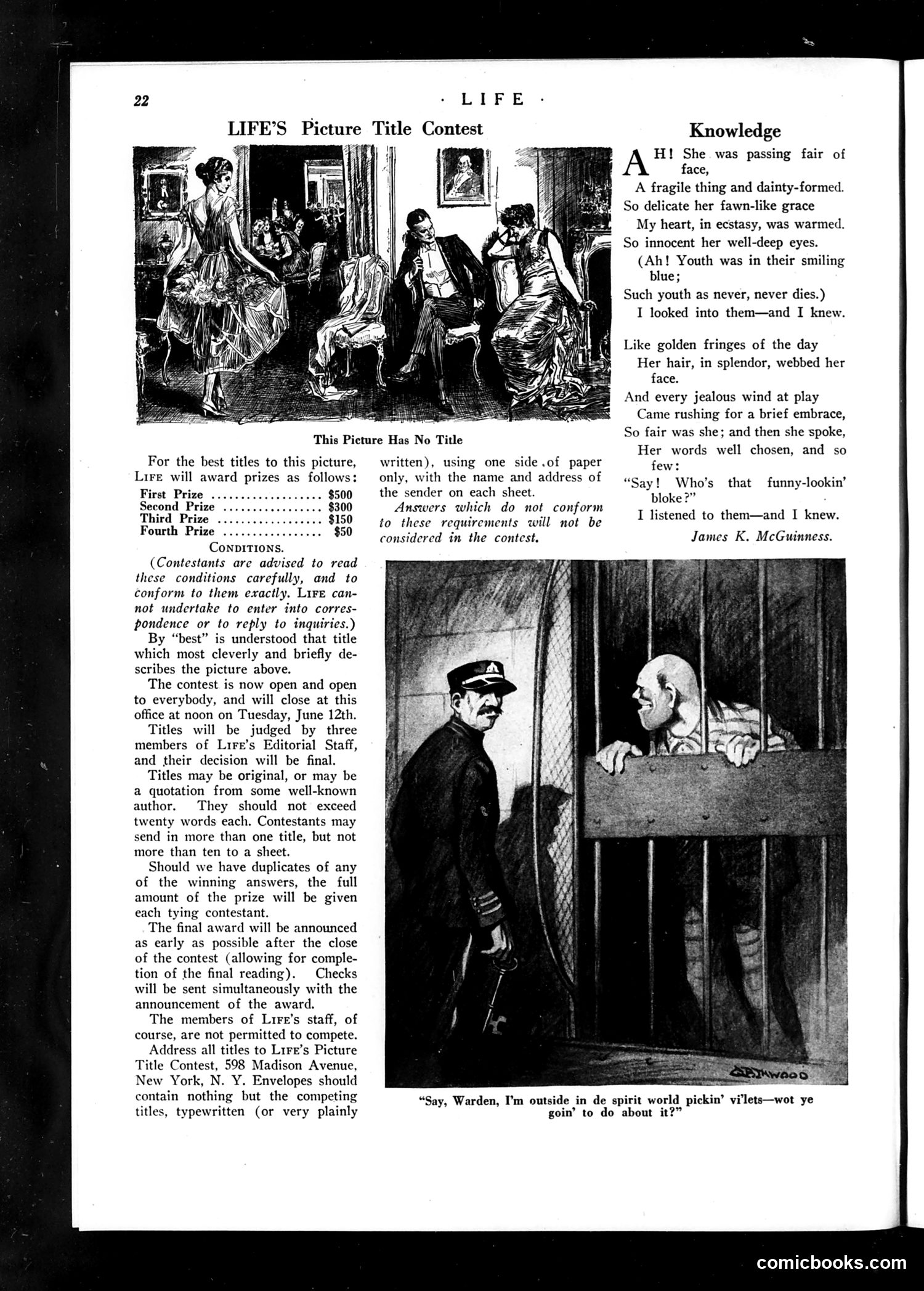
This page features **Life's Picture Title Contest**, a reader-participation feature where subscribers submit creative captions for untitled illustrations. The top image shows an elegant social gathering—a Victorian or Edwardian parlor scene with well-dressed guests. Below is an unrelated cartoon showing two men at what appears to be a prison or institutional window. One figure (likely an inmate) claims to be spiritually "outside pickin' vi'lets" while physically confined, asking the warden what he'll do about it. The dialect ("de," "vi'lets," "wot ye") suggests working-class speech, and the joke plays on the tension between physical imprisonment and claimed spiritual freedom—a commentary on either spiritualism's popularity or prisoners' defiant attitudes. The page also includes a romantic poem titled "Knowledge" by James K. McGuinness, unrelated to either cartoon.
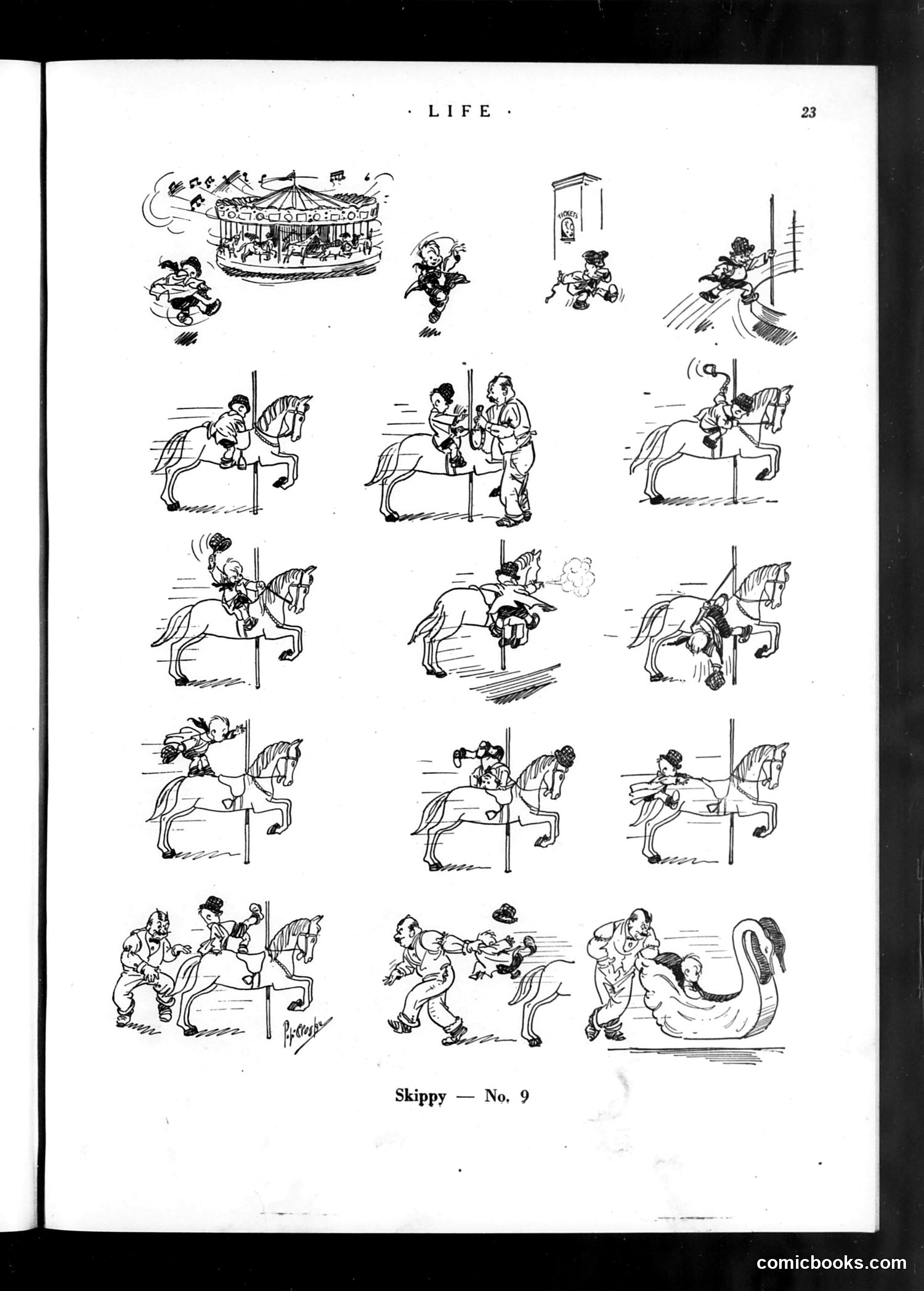
This page features "Skippy," a comic strip depicting a child character's misadventures involving a jumping rope or skipping activity. The sequential panels show the progression of what appears to be a rope-jumping game at a carnival or fairground—evidenced by the carousel visible at the top of the page. The humor derives from physical comedy: the child attempts various rope-jumping techniques, encounters difficulties with coordination or the rope itself, and experiences typical childhood stumbles and falls. The strip uses simple line drawings to capture exaggerated movement and slapstick situations. "Skippy" was a popular American comic strip of the early-to-mid twentieth century focused on childhood escapades rather than political satire, making this a straightforward entertainment piece for Life magazine's readers.
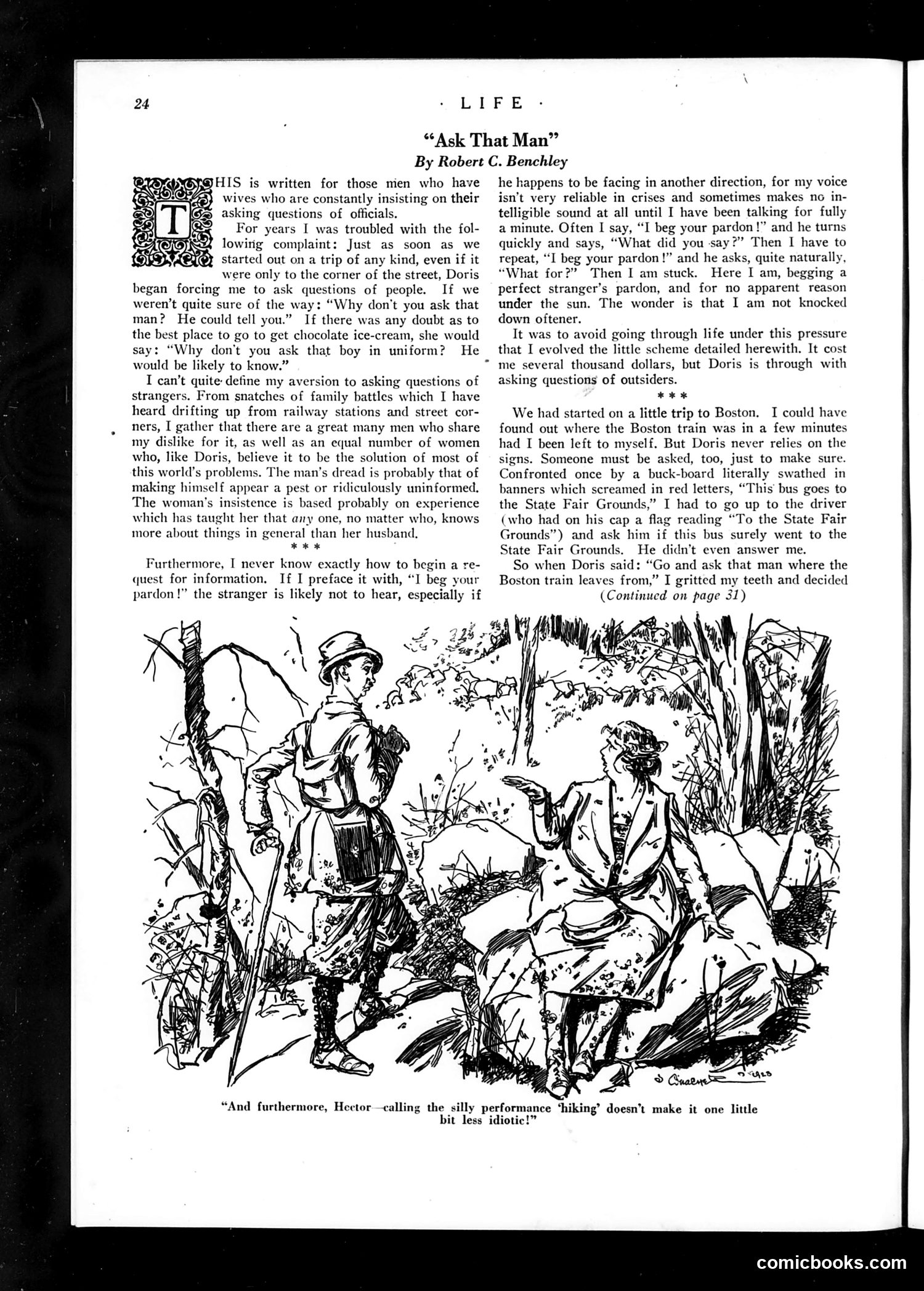
This is a humorous essay satirizing a common marital dynamic: wives who constantly insist their husbands ask strangers for directions or information, versus husbands' reluctance to do so. The author describes his wife Doris's persistent demands that he seek help from anyone nearby—shopkeepers, uniformed workers, random pedestrians. Benchley explores male anxiety about appearing incompetent or bothersome by approaching strangers. He notes the irony of his apologetic opening ("I beg your pardon!") confusing people about why he's apologizing. The essay culminates in his decision to devise an elaborate, expensive scheme to stop Doris from asking questions of outsiders—though details are withheld until the continuation. The accompanying cartoon depicts two hikers, with one (presumably female) criticizing the activity, illustrating the broader theme of spousal disagreements about practical matters and appearances. This reflects early-20th-century gender stereotypes about masculine pride, domestic friction, and differing approaches to problem-solving.
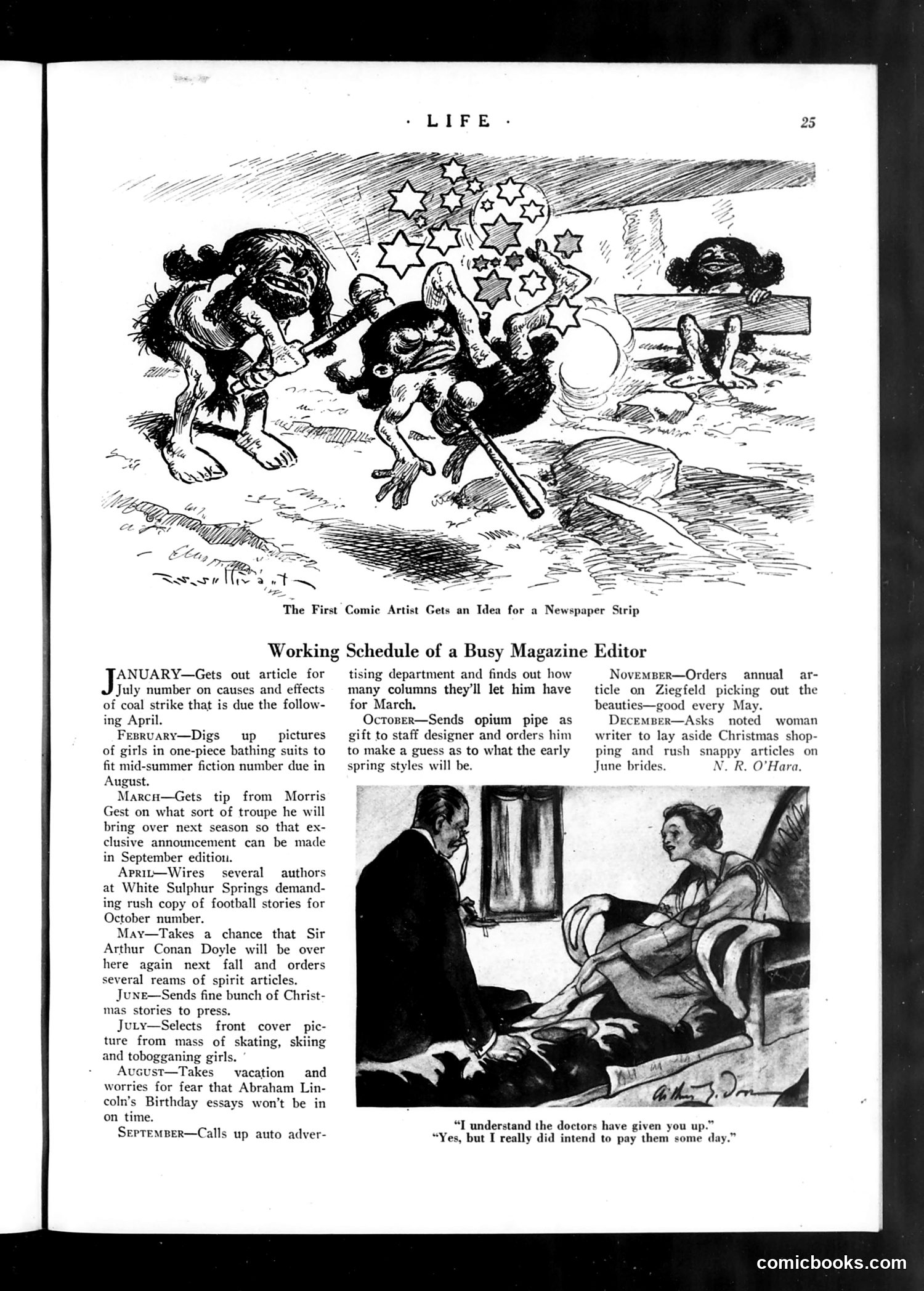
The top cartoon shows anthropomorphic apes/primates creating a newspaper comic strip—satirizing the origin of comic art as primitive or unsophisticated. The main content is a humorous month-by-month schedule showing the chaotic, absurd workflow of a magazine editor. The joke is the massive disconnect between when articles are assigned and when they're actually needed: articles for April's coal strike are assigned in January; Christmas stories go to press in June; Abraham Lincoln's Birthday essays are due in August but the editor worries in August they won't arrive on time. The schedule mocks editorial incompetence and the magazine industry's impossible planning cycles. The lower cartoon shows a patient in bed with a creditor/doctor, joking that although doctors have "given up" on his recovery, he still intends to pay them eventually—dark humor about unpaid medical debts and false promises. All three pieces satirize American professional life: artistic pretension, editorial chaos, and financial irresponsibility.
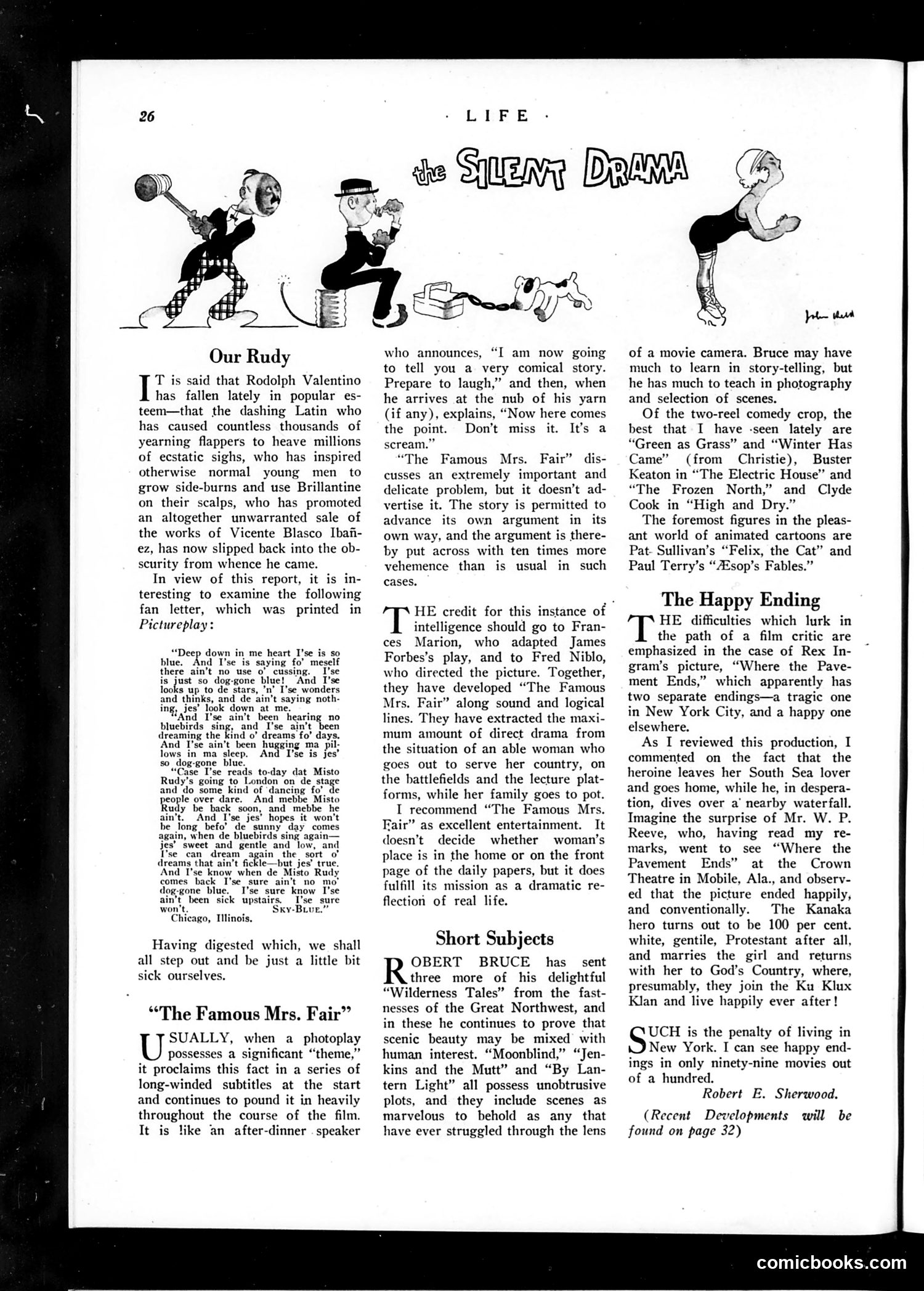
This page from Life magazine (undated but early 1920s based on references) satirizes Hollywood celebrity culture and film criticism. **"Our Rudy"** mocks Rudolph Valentino's fading popularity. The excerpt presents a fan letter written in exaggerated dialect ("dog-gone blue," "Misto Rudy") expressing heartbreak over Valentino's planned move to London. Life's editors ridicule both the overwrought fan devotion and Valentino's declining star power—once he inspired "yearning flappers" and sales of Spanish literature, but now faces obscurity. **"The Famous Mrs. Fair"** praises a film tackling women's wartime service and domestic sacrifice without heavy-handed messaging. The critic applauds screenwriter Frances Marion and director Fred Niblo for letting the drama speak naturally rather than didactically explaining themes like some "after-dinner speaker." The cartoons at top illustrate the silent film medium's physical comedy and melodrama conventions—exaggerated body language compensating for lack of dialogue.
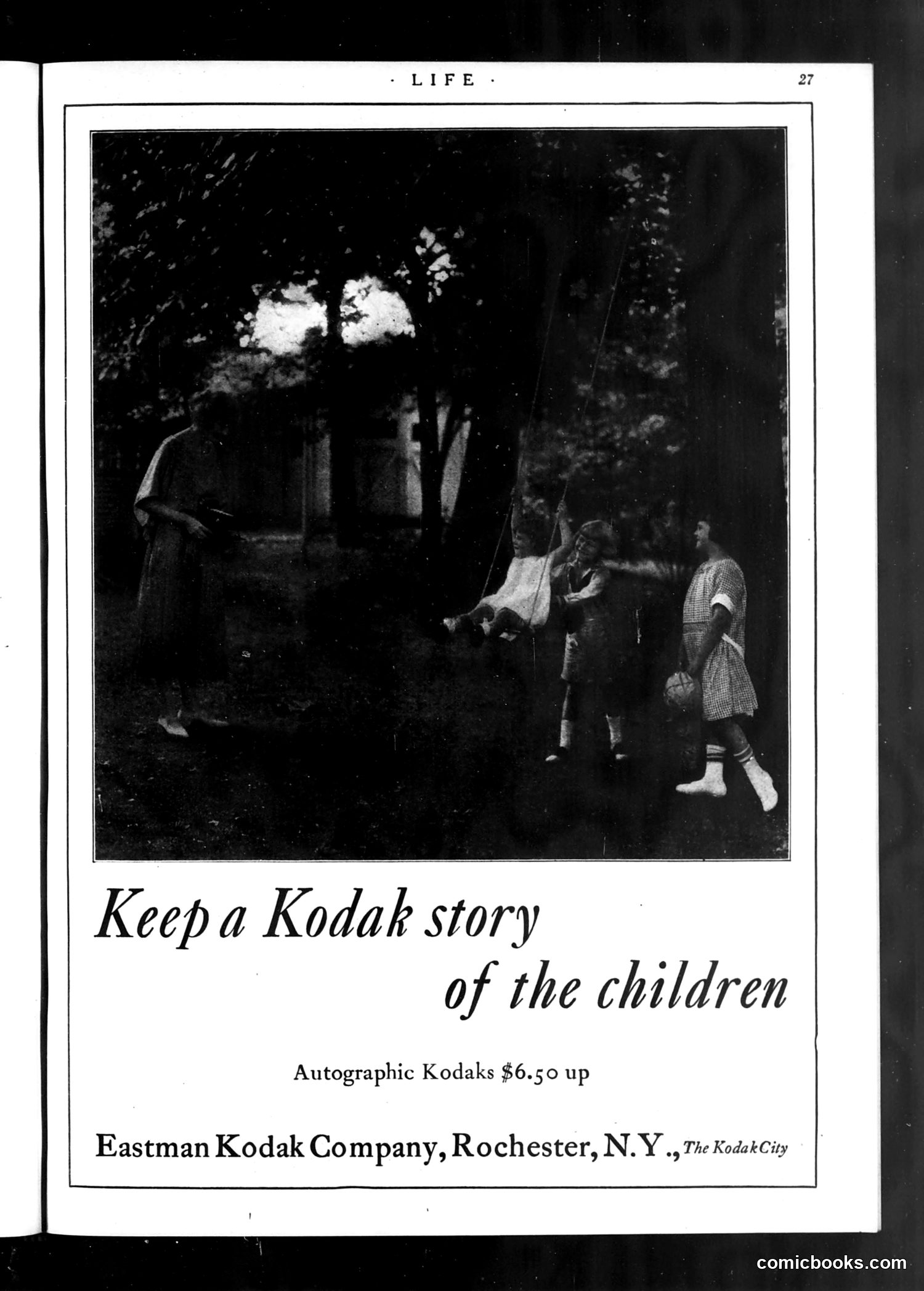
This is a Kodak advertisement, not political satire. The image shows an adult and two children in a nighttime outdoor scene, apparently illuminated by flash photography or light. The ad's message is straightforward marketing: parents should use Kodak cameras to preserve memories of their children. "Keep a Kodak story of the children" urges families to document domestic moments. The photograph itself demonstrates the camera's capability to capture scenes, likely highlighting Kodak's autographic models priced at $6.50 and up. This represents early-twentieth-century consumer advertising targeting middle-class families, emphasizing photography's role in preserving family life and childhood moments.
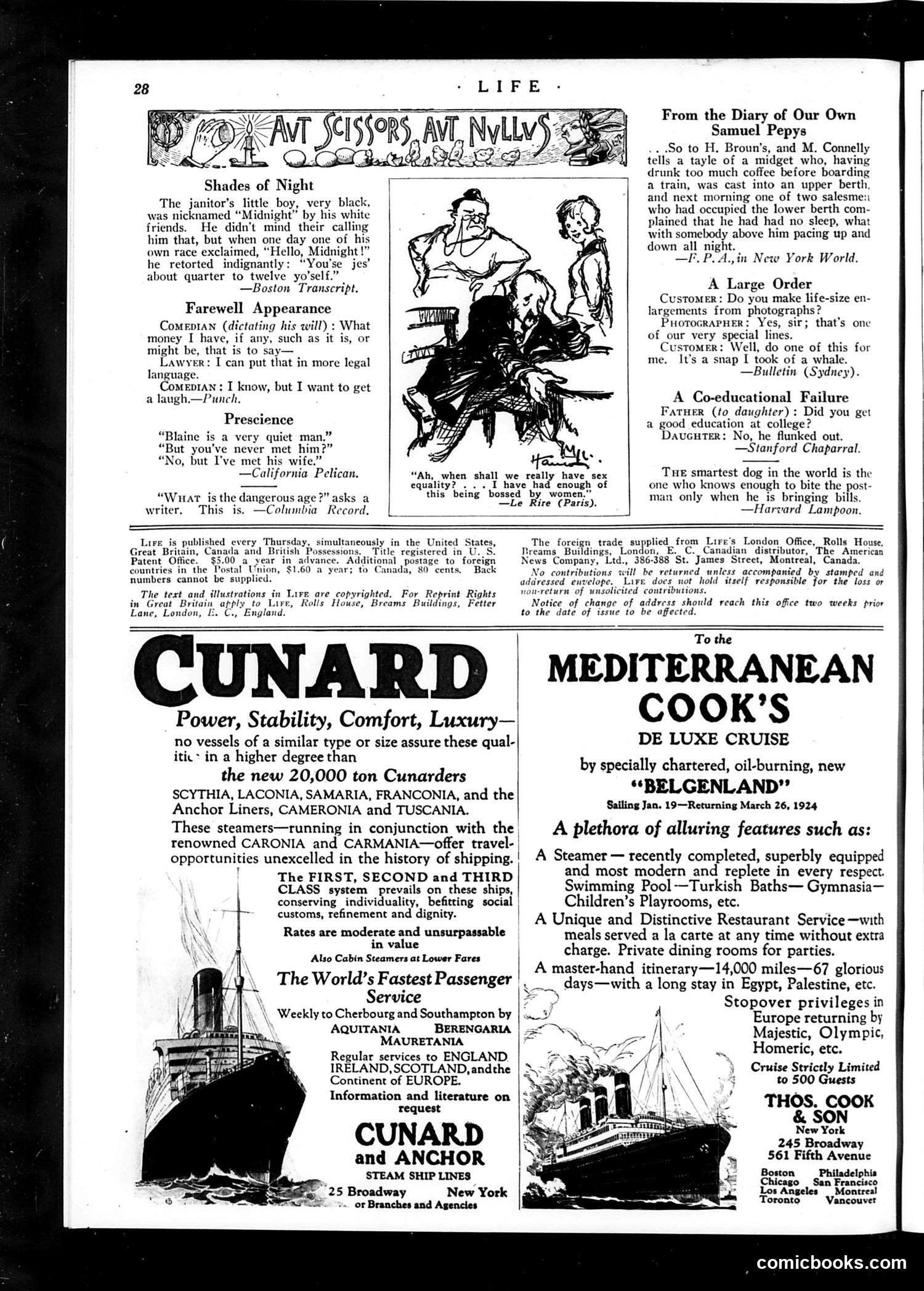
This page contains **short humorous anecdotes** rather than political cartoons. The jokes reflect early 20th-century social attitudes: **"Shades of Night"**: A racist anecdote where a Black janitor's son, nicknamed "Midnight," retorts to another Black person by insulting their complexion—humor based on colorism and racial mockery. **"Farewell Appearance"**: A comedian dictating his will prioritizes getting a laugh over legal language—satirizing performers' obsession with entertainment. **"Prescience"**: Unclear reference to someone named Blaine (possibly political), discussing when "equality" will arrive while women "boss" men—reflects anxiety about women's increasing social power post-suffrage (1920). **"A Co-educational Failure"**: A father learns his daughter's college boyfriend flunked out—humor implying she attended college seeking romance rather than education. The page is otherwise **dominated by cruise ship and steamship advertisements** (Cunard, Mediterranean Cook's tours), reflecting the era's luxury travel marketing.
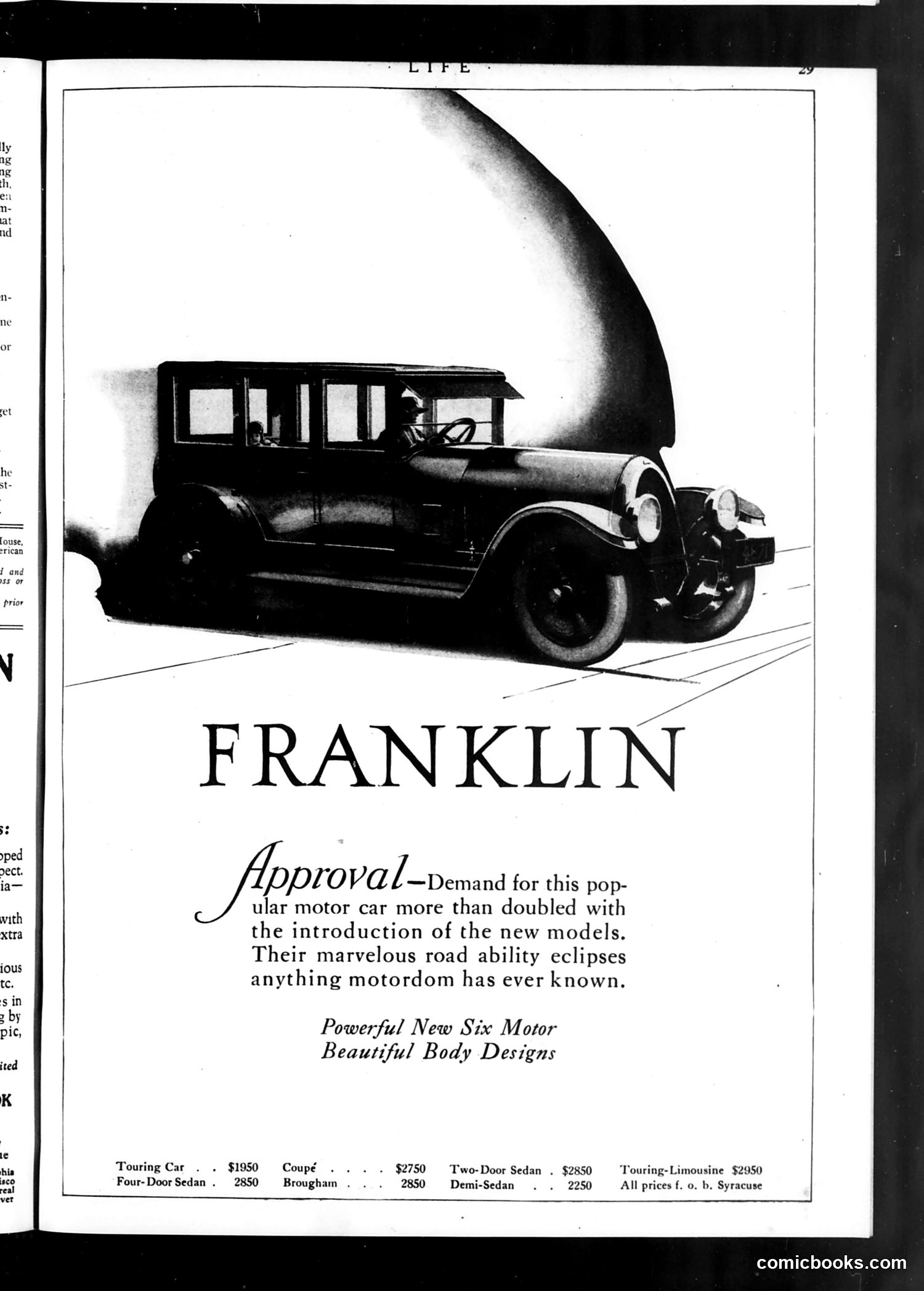
This is **not a cartoon or satire**—it's a straightforward commercial advertisement for Franklin automobiles, appearing in *Life* magazine (which published both humor and ads). The page promotes Franklin's new car models, emphasizing their "Powerful New Six Motor" and "Beautiful Body Designs." The dramatic illustration shows a sedan with an oversized engine looming behind it, visually emphasizing mechanical power. The copy claims demand for Franklin cars "more than doubled" with these new models, boasting superior "road ability." Various models are listed with prices ranging from $2,250 to $2,950 (substantial sums in the 1920s era this appears from). All prices are listed as "f.o.b. Syracuse," indicating Franklin's manufacturing location. This represents typical 1920s automotive advertising—promotional rather than satirical.
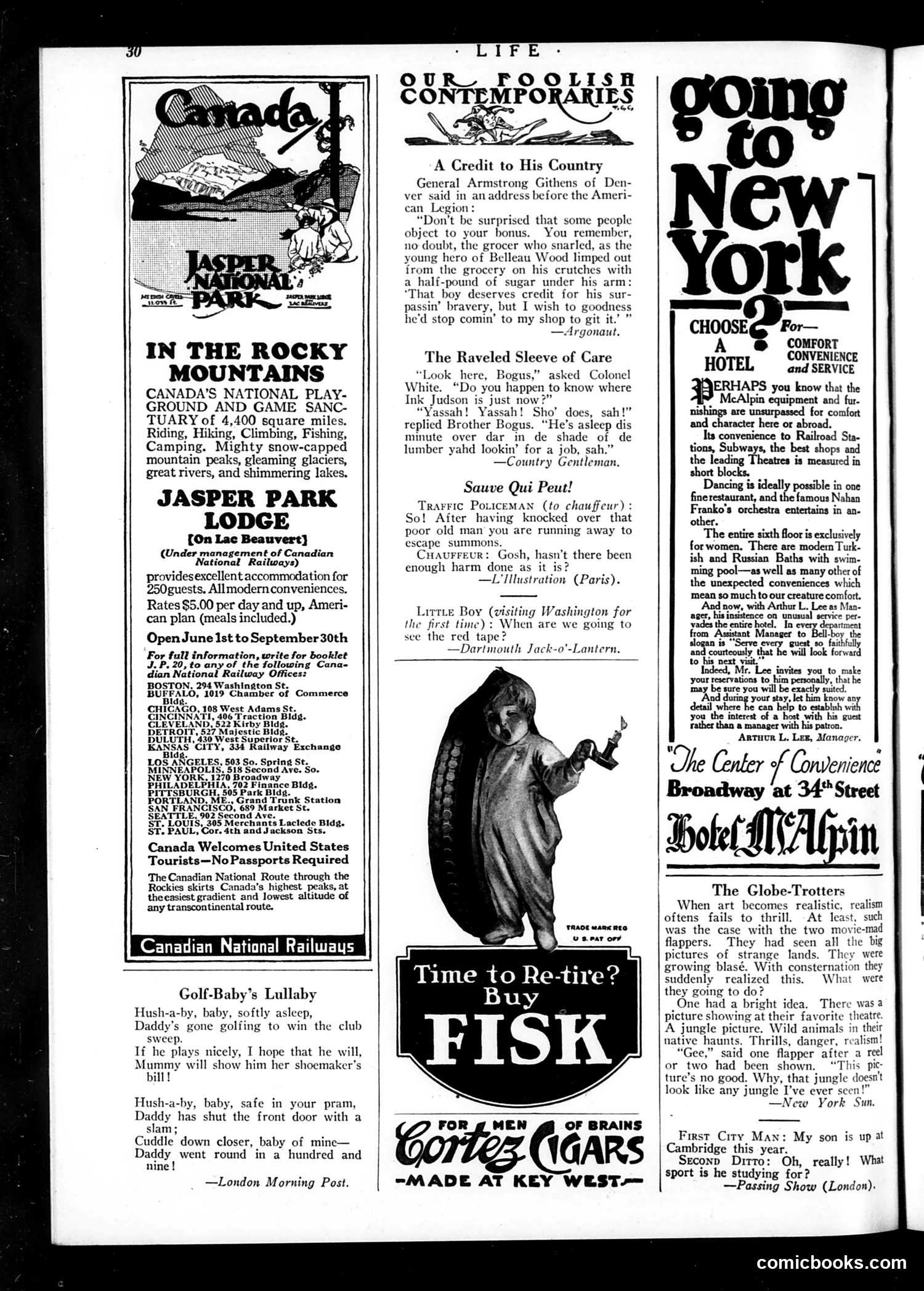
This page is predominantly **advertising and humor pieces** rather than political cartoons. **Main Content:** - **Jasper Park Lodge advertisement**: Promotes Canada's Rocky Mountain resort, emphasizing natural beauty and accessibility via Canadian National Railways - **Hotel McAlpin ad**: NYC hotel promoting comfort and convenience - **Cortez Cigars ad**: "For Men of Brains" advertisement **Humor Pieces (brief anecdotes):** - "A Credit to His Country": Satirizes ingratitude—a WWI veteran with crutches is resented by a grocer despite his "bravery" - "The Raveled Sleeve of Care": Humorous dialogue about a man sleeping in a lumber yard looking for work - "Golf-Baby's Lullaby": Satirizes husbands' golf obsession, with wives' frustrated perspective - Various short jokes about traffic accidents, bureaucratic "red tape," and similar domestic/social observations The satire targets **post-WWI attitudes** (veteran neglect), **1920s consumer culture**, and **marital friction**—typical Life magazine humor of this era.
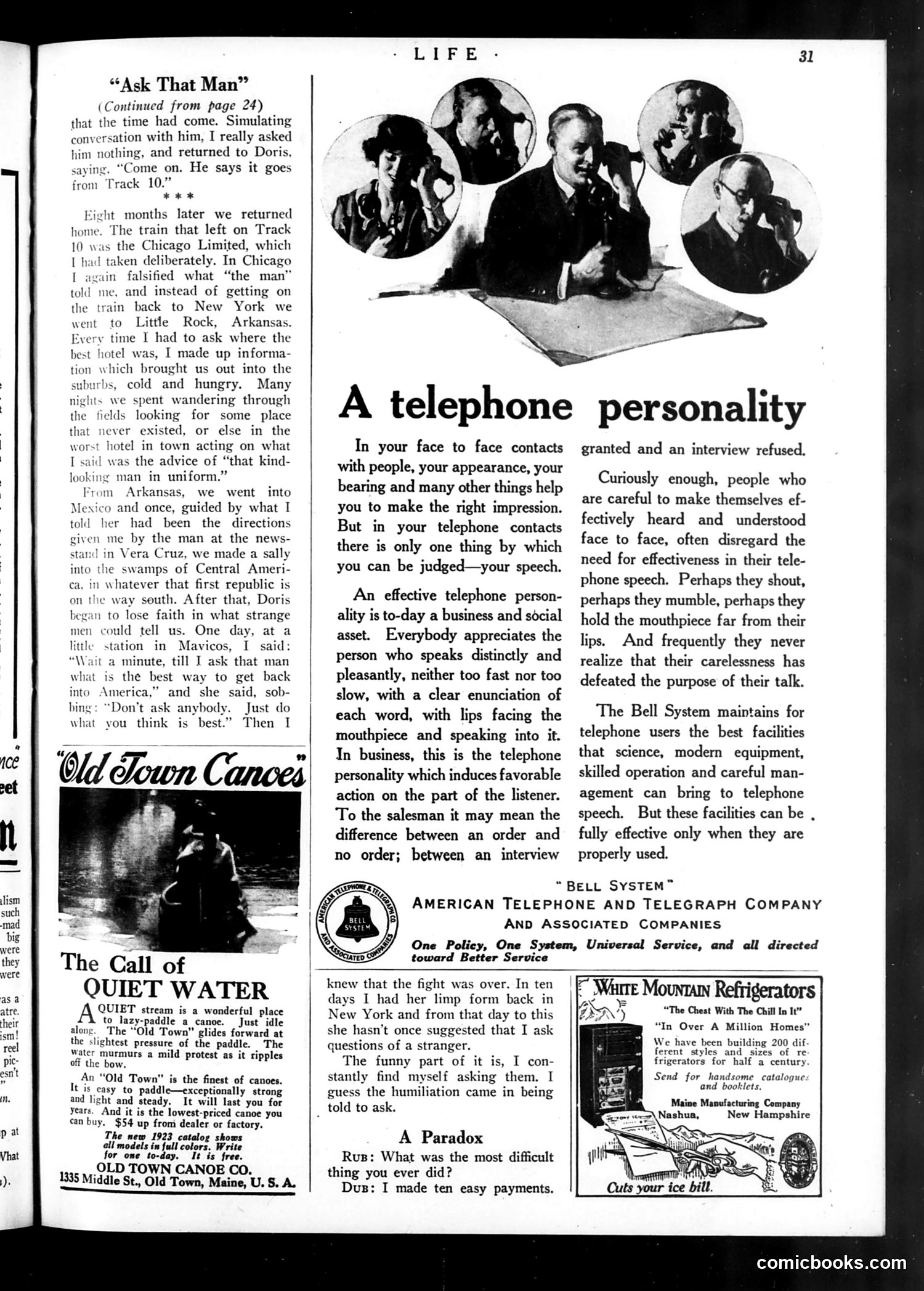
This page contains two distinct items: **"Ask That Man" (humor article):** A comedic anecdote about a man who deliberately asks a stranger at a train station for directions, then intentionally gives his companion wrong information based on those directions. The joke escalates as they end up lost in Arkansas, Mexico, and Central America. The humor derives from the protagonist's deliberate misuse of a stranger's advice—the punchline being that his companion finally loses faith and tells him to stop asking anyone and trust his own judgment instead. **"A Telephone Personality" (Bell System advertisement):** An earnest advertisement for proper telephone etiquette. It argues that unlike face-to-face meetings where appearance matters, telephone communication depends solely on speech quality. The ad promotes clear, distinct, pleasant speech as a business asset, advocating proper microphone positioning and enunciation. It's positioned as promoting Bell System's superior telephone infrastructure, though it ultimately credits user behavior as equally important.
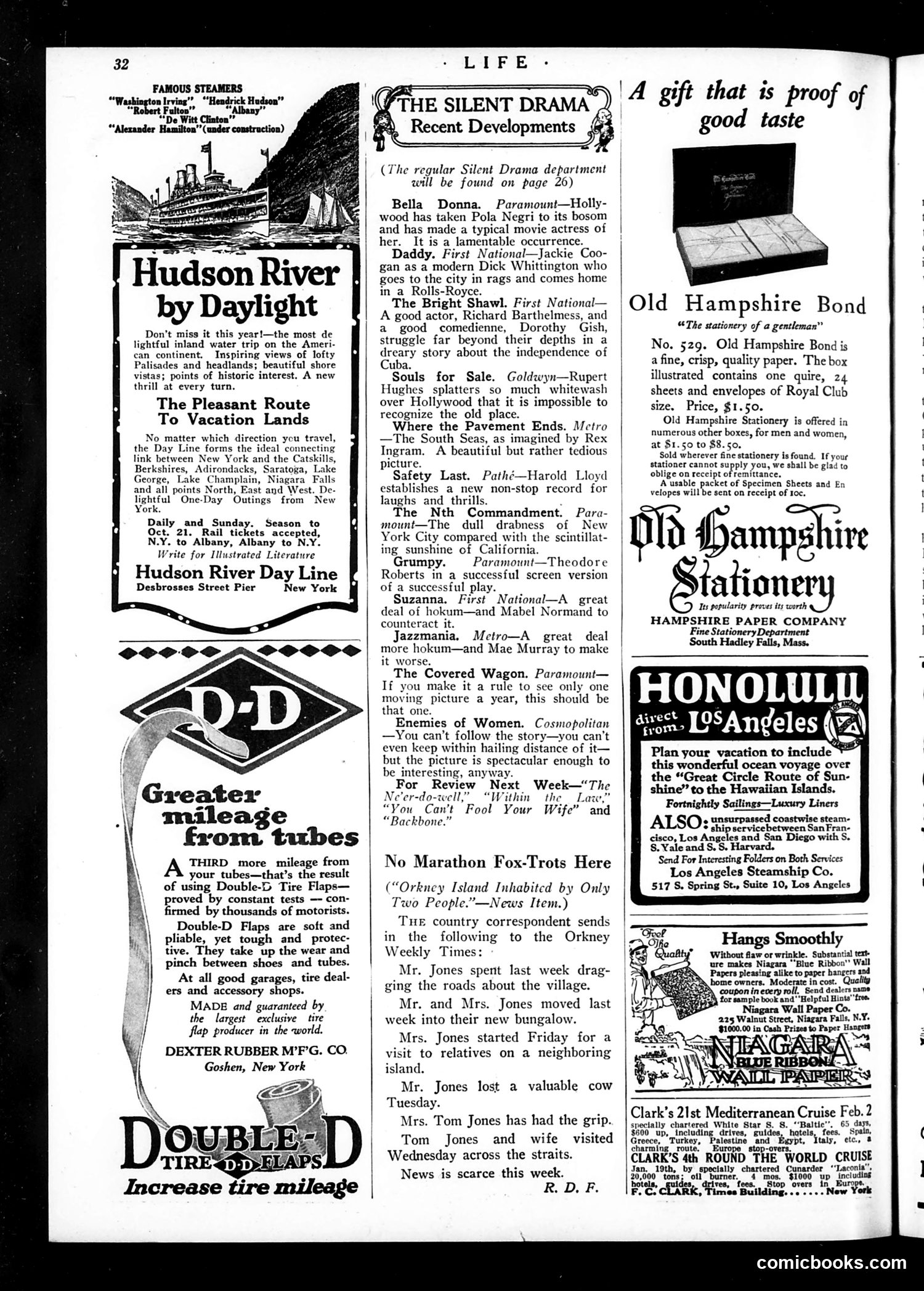
This page is **primarily advertising** with a small editorial section. The main content includes: **Advertisements:** - Hudson River Day Line (travel) - Double-D Tire Flaps (automotive) - Old Hampshire Bond stationery - Honolulu steamship cruises - Niagara Wall Paper - Clark's Mediterranean Cruise **Editorial Content:** The "Silent Drama" section reviews recent films with **satirical commentary**. Notable examples: - *Bella Donna*: Dismisses Pola Negri's Hollywood casting as "lamentable" - *Souls for Sale*: Sarcastically describes Rupert Hughes applying excessive "whitewash" to cover Hollywood's true nature - *The Covered Wagon*: Highest praise—worth seeing annually - *Enemies of Women*: Admits the plot is incomprehensible but notes it's "spectacular enough" to entertain anyway The humor mocks both Hollywood's pretensions and audiences' tolerance for style over substance. **"No Marathon Fox-Trots Here"** is a brief comic anecdote about an Orkney island correspondent reporting minimal newsworthy events—gentle satire on rural monotony.
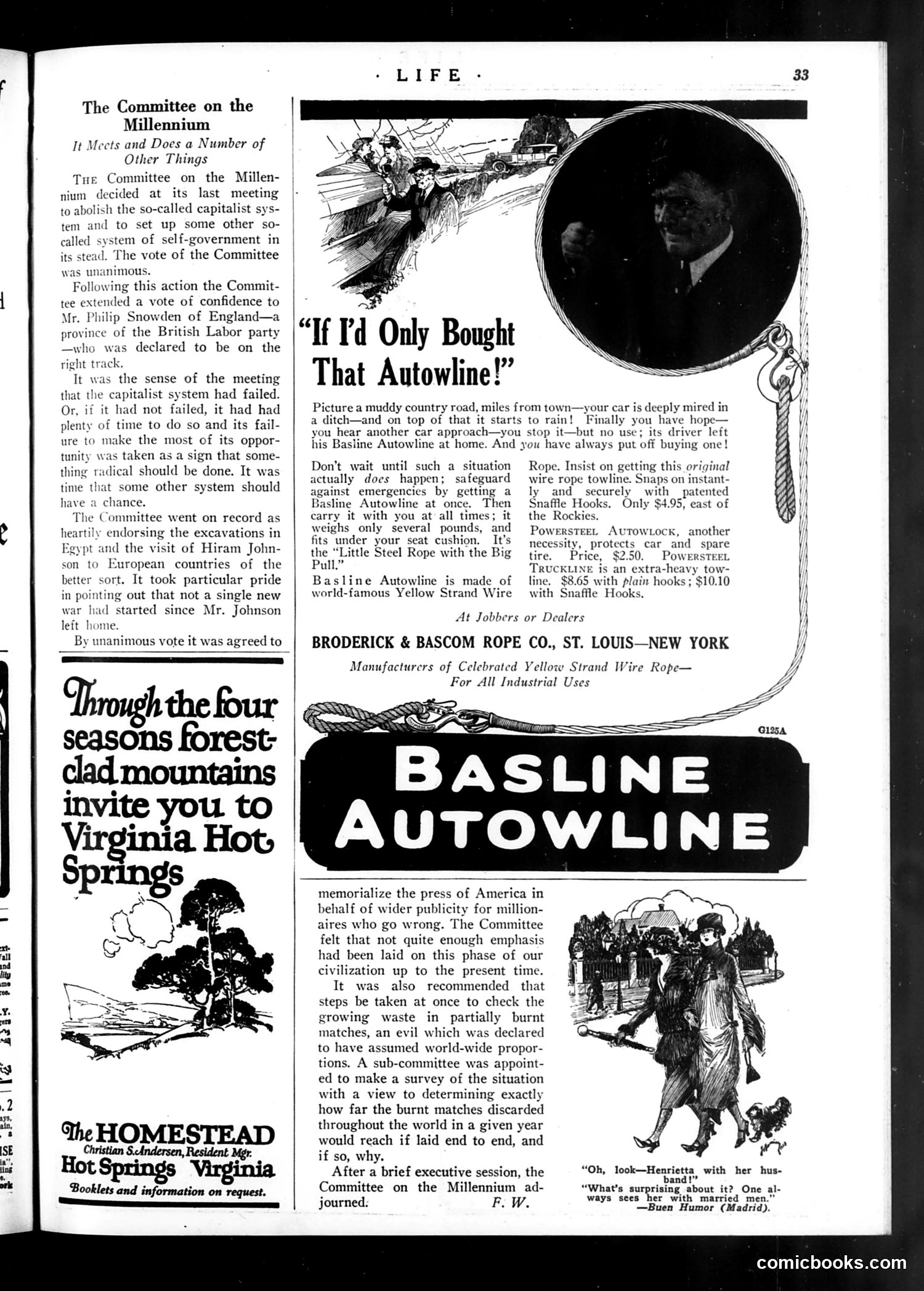
This is political satire mocking radical reformers and their impractical idealism. The fictional "Committee on the Millennium" votes unanimously to abolish capitalism and replace it with undefined "self-government"—a jab at socialist and labor movements gaining traction in the 1920s. The joke escalates absurdly: the committee endorses British Labor politician Philip Snowden, celebrates that no new wars started since Hiram Johnson (a U.S. Senator) left home, and proposes spending resources surveying burnt matches worldwide. Life magazine ridicules the reformers as simultaneously radical (wanting to overturn capitalism) and trivial (obsessing over minor waste). The satire suggests their grand revolutionary rhetoric masks either naïveté or comic incompetence—they can't seriously accomplish fundamental change, so they distract themselves with nonsense. The rest of the page contains automobile rope advertisements, unrelated to the satire.
This page consists entirely of period advertisements (no political cartoons). The content includes: **Travel Ads:** - Northern Pacific Railway promotes Pacific Northwest coastal destinations (Seaside, Oregon; beach towns in Washington) as affordable vacation spots, emphasizing natural beauty. - Denver Tourist Bureau advertises Colorado mountain trips via the Northern Pacific Railway, highlighting national parks and scenic drives. **Product Ads:** - ED. Pinaud's Lilac Talc, a French fragrance product, shown with an ornate window image suggesting luxury. - Life magazine itself, using the tagline "When All the World Laughs / The Perfection of Humanity Will Have Been Reached," positioning the publication as an educational, humorous read for intelligent readers. **Context for Modern Readers:** This appears to be from the 1920s-30s era, when rail travel dominated leisure tourism and French fragrances signified sophistication. The ads target middle-to-upper-class readers planning vacations or seeking luxury goods—typical Life magazine audience.
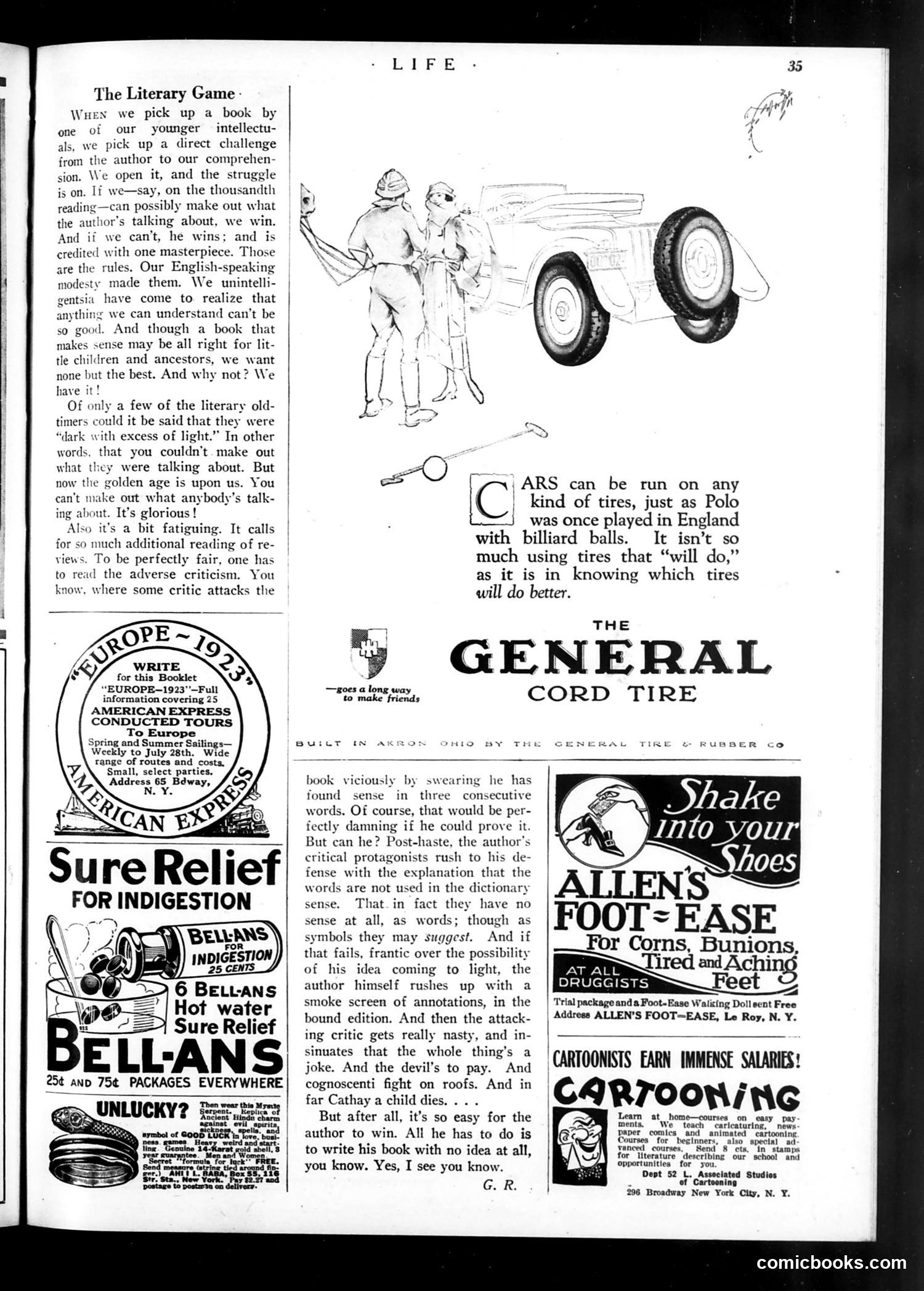
This essay satirizes modernist literature's deliberate obscurity. The author mocks the 1920s literary establishment's assumption that incomprehensible writing signals genius, while clarity suggests mediocrity. The joke: readers struggle through obtuse books by "younger intellectuals," and if they *can't* understand it, the author wins and earns "masterpiece" status. The critic's defense against attacks becomes absurdly circular—claiming obscure words have symbolic rather than dictionary meaning, then adding defensive annotations to the published edition. The piece attacks the pretentiousness of treating unintelligibility as literary merit. It's a broadside against the intellectual snobbery of 1920s avant-garde literature, suggesting authors deliberately obscure meaning to appear profound. The final line—"it's so easy for the author to win"—delivers the sting: success requires only confusing readers, not actually writing well. This reflects genuine 1920s frustration with modernist complexity (Joyce, Pound, etc.).
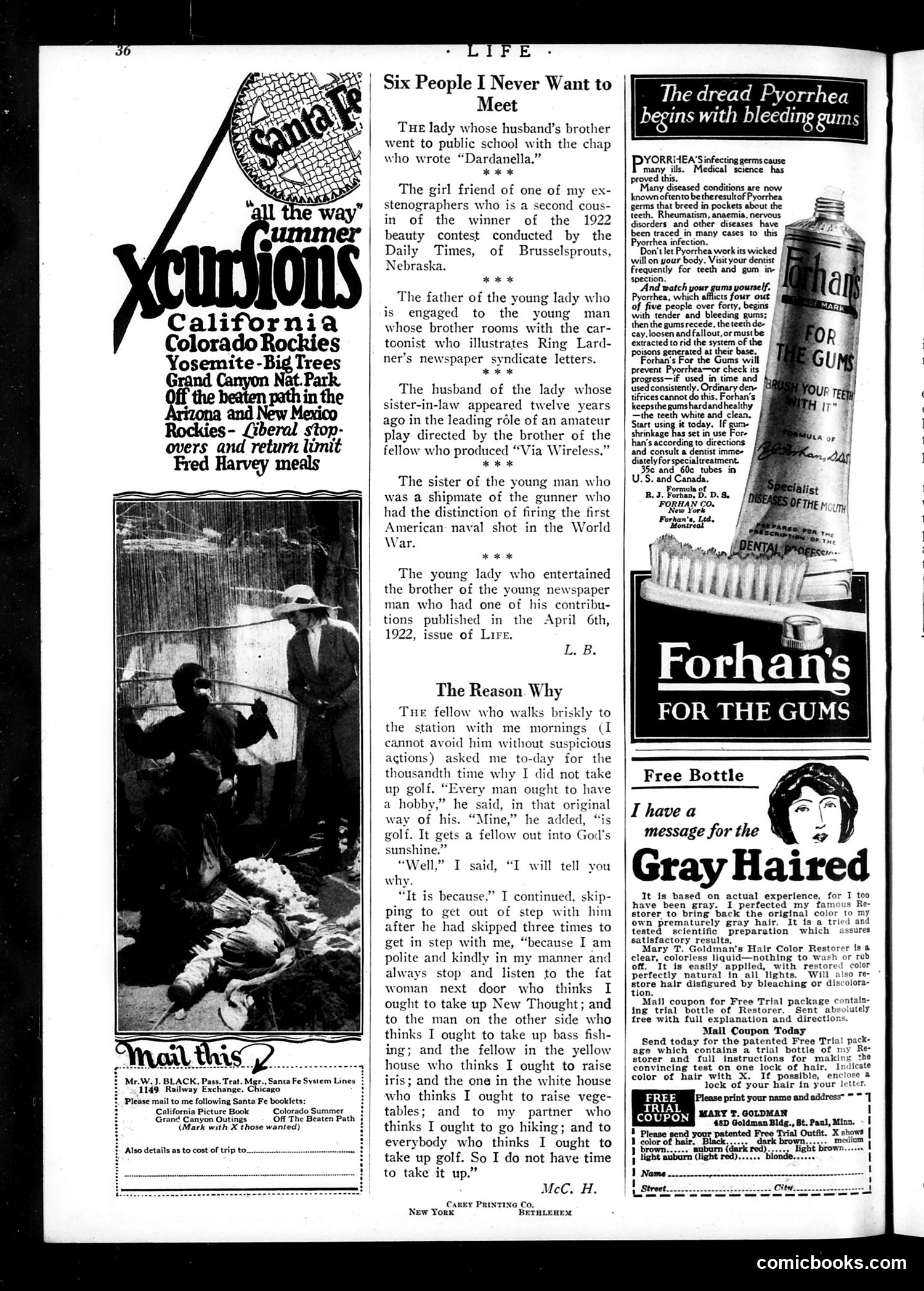
This satirical column mocks the absurdity of social connection through tenuous chains of acquaintance. Each of six people is defined solely by their indirect relationship to someone notable—a person who knew someone who knew someone else. For example, the first is "the lady whose husband's brother went to public school with the chap who wrote 'Dardanella'" (a popular 1918 song). The humor lies in how modern society fixates on degrees of separation from the famous or culturally relevant, as if these gossamer connections confer actual importance or interest. The column ridicules the pretentiousness of name-dropping and social climbing based on increasingly absurd chains of connection—the farther removed, the more ridiculous the claim to notability becomes. The accompanying article "The Reason Why" uses similar satirical logic: a man avoids golf because he cannot escape people demanding he take up their hobbies, creating an endless parade of obligations that leaves no time for actual leisure.
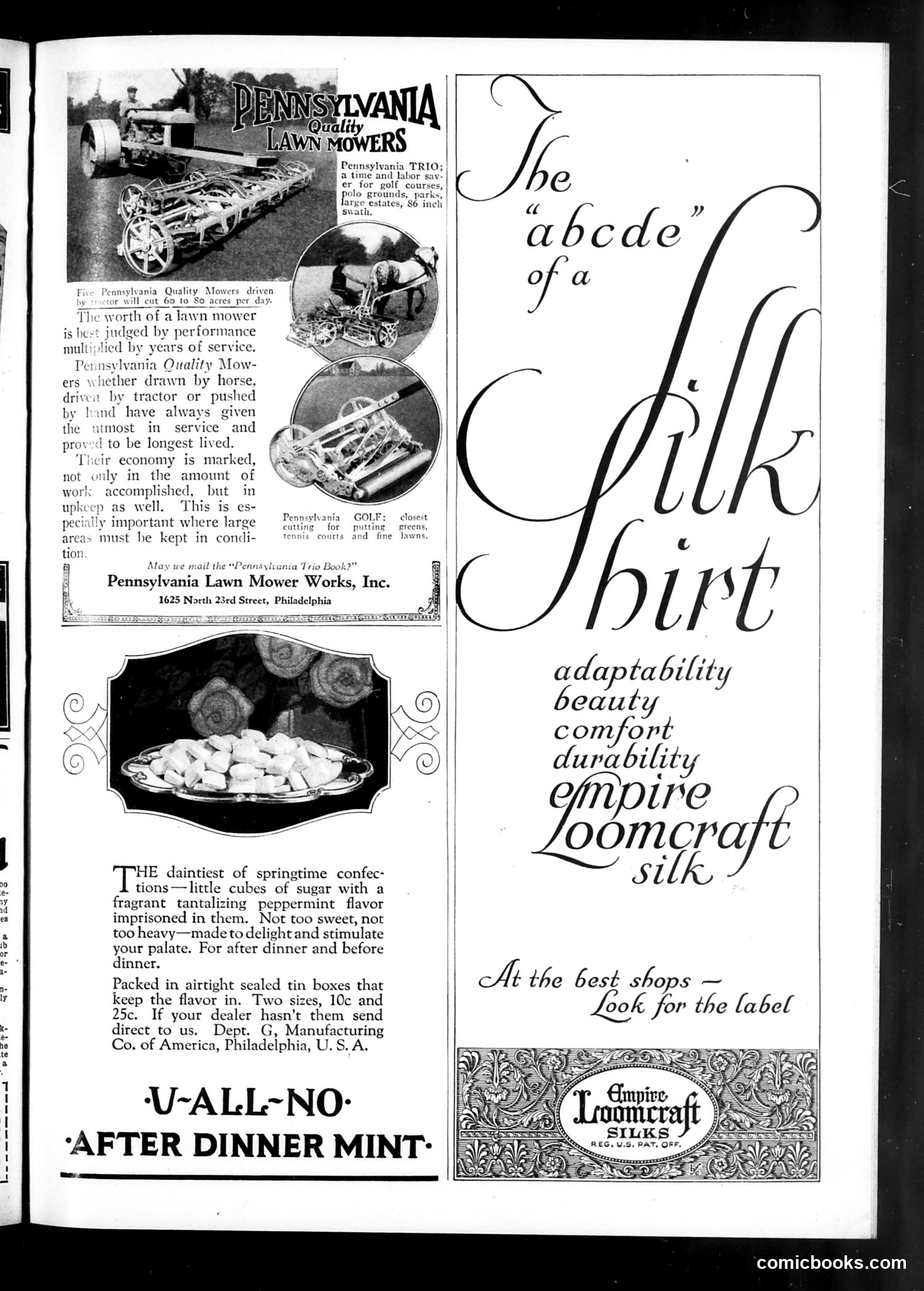
This page contains **advertisements, not political cartoons or satire**. It's a commercial advertising spread from an early 20th-century American magazine. The page features three product advertisements: 1. **Pennsylvania Lawn Mowers** — promoting their durability and efficiency for golf courses and estates 2. **U-All-No After Dinner Mints** — candy confections marketed as digestive aids for after meals 3. **Empire Loomcraft Silk** — textile fabric advertised through an ornamental "abcde of a Silk Shirt" typography layout The decorative typography and illustrated product images are typical advertising design of the era. There is **no satire, political commentary, or caricature** present—this is straightforward commercial promotion aimed at middle-to-upper-class consumers. The page demonstrates how Life magazine generated revenue through full-page advertisements alongside editorial content.
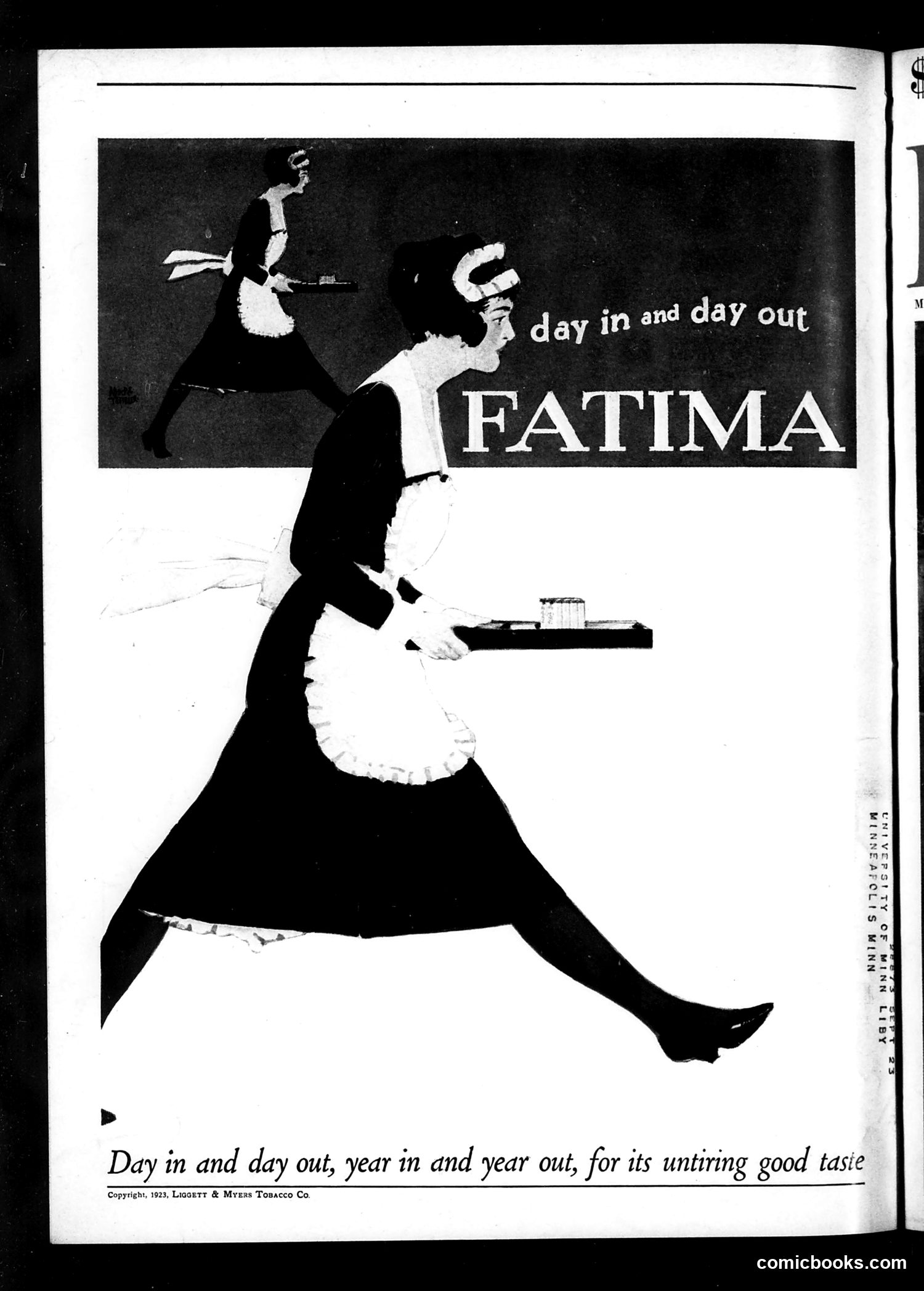
This is a cigarette advertisement for Fatima brand, not political satire. The image shows a stylized maid or servant figure in motion, carrying a serving tray. The tagline "day in and day out" emphasizes the product's reliability and consistent quality. The advertisement uses the figure of a domestic worker to suggest that Fatima cigarettes are as dependable and ever-present as household service—a common advertising strategy of the 1920s. The dynamic pose conveys energy and continuous service. The "Fatima" brand name and the servant imagery reflect early 20th-century marketing conventions, though modern viewers would find the racial and class stereotyping in the imagery problematic. Copyright 1923, Liggett & Myers Tobacco Co.