
Life, 1923-05-17 · page 32 of 46
Life — May 17, 1923 — page 32: what you’re looking at
What you’re looking at
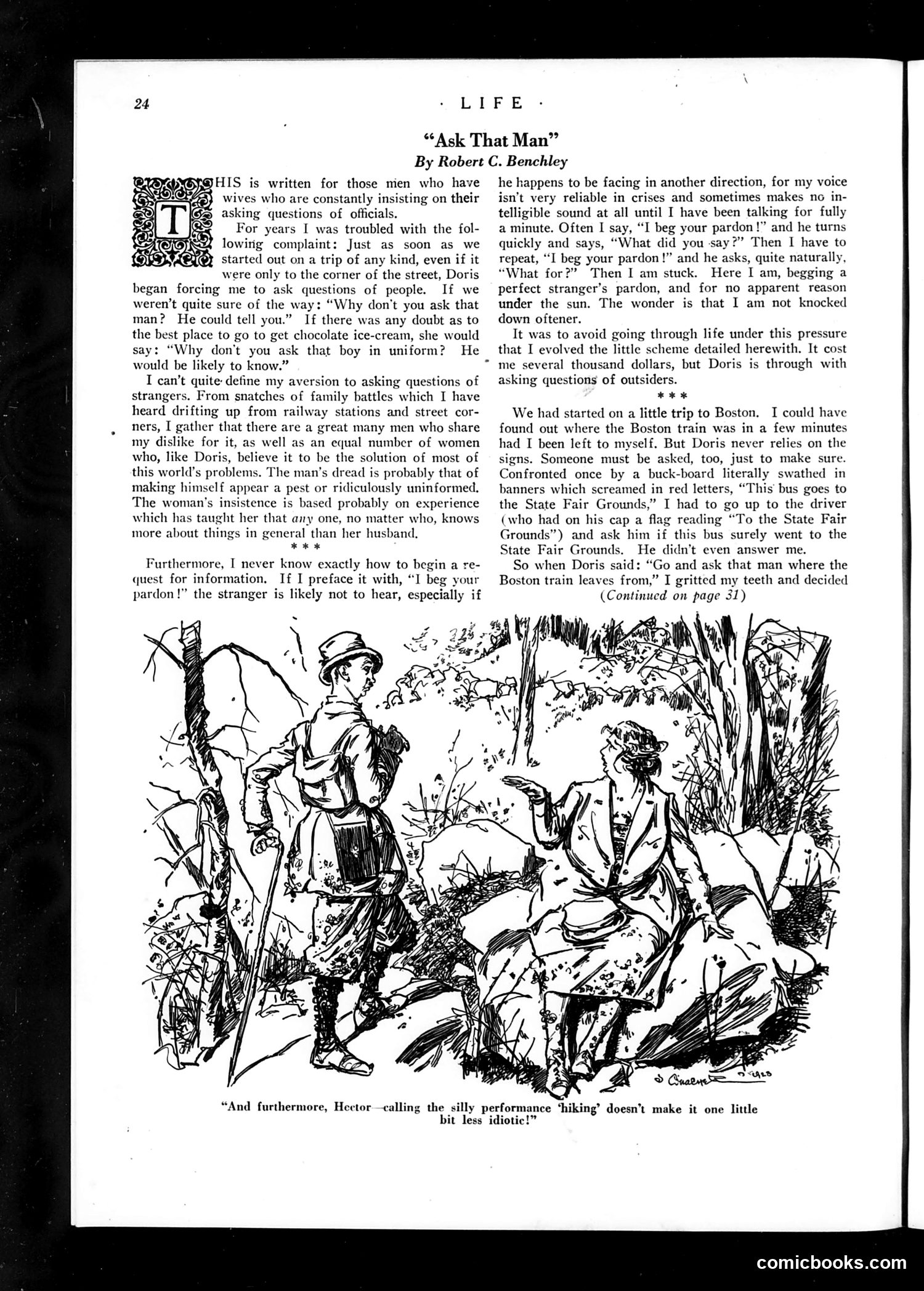
This is a humorous essay satirizing a common marital dynamic: wives who constantly insist their husbands ask strangers for directions or information, versus husbands' reluctance to do so. The author describes his wife Doris's persistent demands that he seek help from anyone nearby—shopkeepers, uniformed workers, random pedestrians. Benchley explores male anxiety about appearing incompetent or bothersome by approaching strangers. He notes the irony of his apologetic opening ("I beg your pardon!") confusing people about why he's apologizing. The essay culminates in his decision to devise an elaborate, expensive scheme to stop Doris from asking questions of outsiders—though details are withheld until the continuation. The accompanying cartoon depicts two hikers, with one (presumably female) criticizing the activity, illustrating the broader theme of spousal disagreements about practical matters and appearances. This reflects early-20th-century gender stereotypes about masculine pride, domestic friction, and differing approaches to problem-solving.
📄 Transcribed text from this page (OCR, searchable)
Machine-transcribed from the original scan — historical spelling and the odd misread are preserved.
LIFE “Ask That Man” By Robert C. Benchley S@HIS is written for those mien who have wives who are constantly insisting on their ise asking questions of officials. (st For years I was troubled with the fol- lowirig complaint: Just as soon as we were only to the corner of the street, Doris began forcing me to ask questions of people. If we weren’t quite sure of the way: “Why don't you ask that man? He could tell you.” If there was any doubt as to the best place to go to get chocolate ice-cream, she would say: “Why don’t you ask that boy in uniform? He would be likely to know.” I can’t quite: define my aversion to asking questions of strangers. From snatches of family battles which I have heard drifting up from railway stations and street cor- ners, I gather that there are a great many men who share my dislike for it, as well as an equal number of women who, like Doris, believe it to be the solution of most of this world’s problems. The man’s dread is probably that of making himself appear a pest or ridiculously uninformed. The woman's insistence is based probably on experience which has taught her that any one, no matter who, knows more about things in general than her husband, * KK Furthermore, I never know exactly how to begin a re- quest for information, If I preface it with, “I beg your pardon!” the stranger is likely not to hear, especially if he happens to be facing in another direction, for my voice isn’t very reliable in crises and sometimes makes no in- telligible sound at all until I have been talking for fully a minute. Often I say, “I beg your pardon!” and he turns quickly and says, “What did you say?” Then I have to repeat, “I beg your pardon!” and he asks, quite naturally, “What for?” Then I am stuck. Here I am, begging a perfect stranger’s pardon, and for no apparent reason under the sun. The wonder is that I am not knocked down oftener. It was to avoid going through life under this pressure that I evolved the little scheme detailed herewith. It cost me several thousand dollars, but Doris is through with asking questions of outsiders. ex We had started on a little trip to Boston. I could have found out where the Boston train was in a few minutes had I been left to myself. But Doris never relies on the signs. Someone must be asked, too, just to make sure. Confronted once by a buck-board literally swathed in banners which screamed in red letters, “This bus goes to the State Fair Grounds,” I had to go up to the driver (who had on his cap a flag reading “To the State Fair Grounds”) and ask him if this bus surely went to the State Fair Grounds. He didn’t even answer me. So when Doris said: “Go and ask that man where the Boston train leaves from,” I gritted my teeth and decided (Continued on page 31) “And furthermore, Hector —calling the silly performance ‘hiking’ doesn’t make it one little bit less idiotic!” comicbooks.com