
Life, 1923-05-17 · page 24 of 46
Life — May 17, 1923 — page 24: what you’re looking at
What you’re looking at
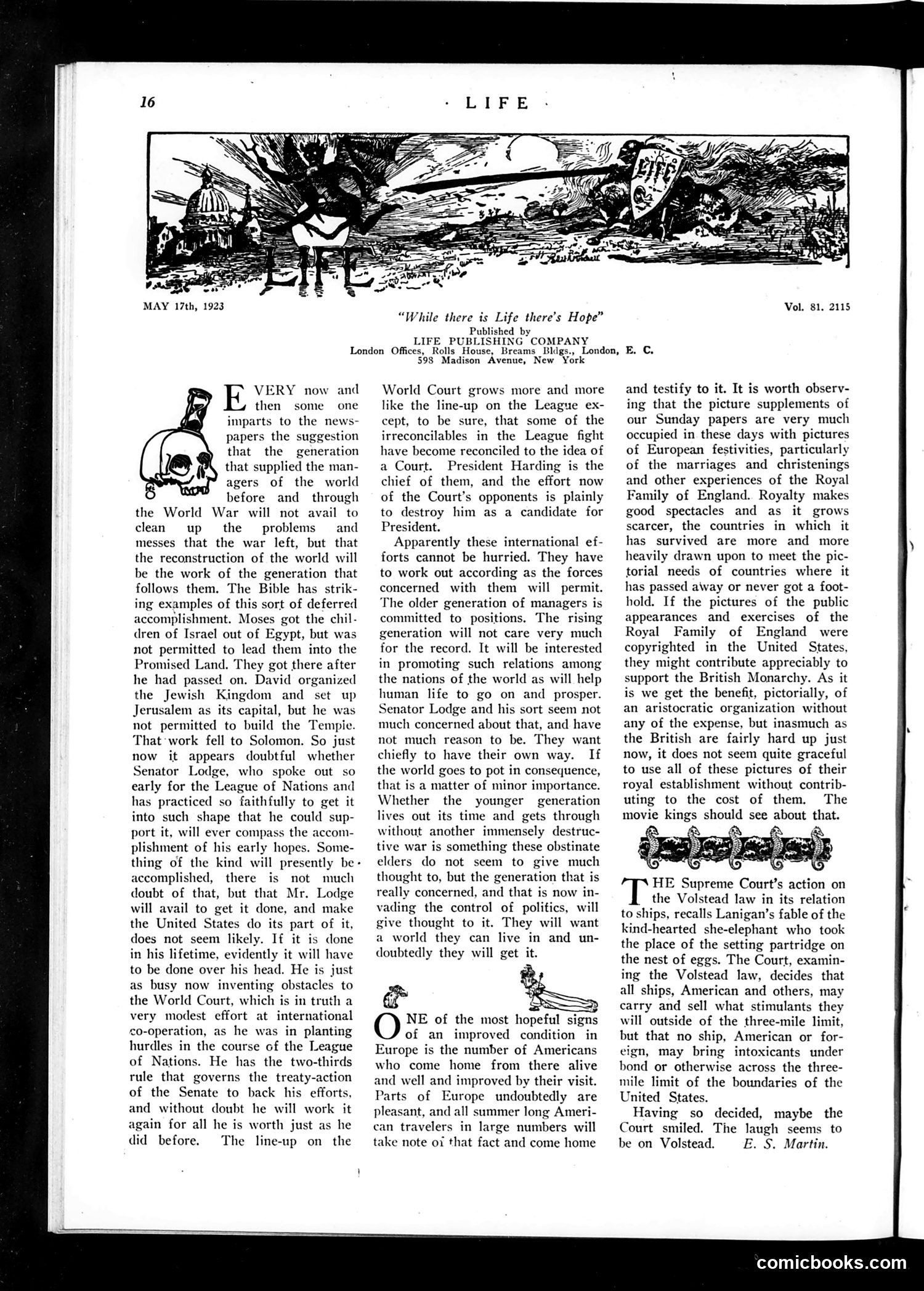
This editorial page critiques **Senator Henry Cabot Lodge**, the influential Republican who opposed American participation in the League of Nations. The writer compares Lodge to Biblical figures like Moses and David—leaders who initiated great works but were denied completion, suggesting Lodge will similarly fail to achieve his goals. The satire's core argument: Lodge obstructs international cooperation (first the League of Nations, now the World Court) through procedural tactics like the Senate's two-thirds treaty rule. The piece suggests his opposition is partisan rather than principled—he allegedly aims to destroy President Harding as a presidential candidate. The writer expresses hope that the younger generation, unconcerned with Lodge's political record, will pursue genuine international cooperation to prevent future wars. The final paragraph shifts to Americans touring Europe—implying their positive reports contrast with Lodge's negativity about international engagement. The cartoons (unclear in detail here) likely caricature Lodge's obstruction of these peace mechanisms.
📄 Transcribed text from this page (OCR, searchable)
Machine-transcribed from the original scan — historical spelling and the odd misread are preserved.
MAY 17th, 1923 Pul d by LIFE PUBLISHING COMPANY Vol. 81. 2115 London Offices, Rolls House, Breams Bligs., London, E, C. VERY now and then some one imparts to the news- papers the suggestion that the generation that supplied the man- agers of the world before and through the World War will not avail to clean up the problems and messes that the war left, but that the reconstruction of the world will be the work of the generation that follows them. The Bible has strik- ing examples of this sort of deferred accomplishment. Moses got the chil- dren of Israel out of Egypt, but was not permitted to lead them into the Promised Land. They got there after he had passed on. David organized the Jew Kingdom and set up Jerusalem as its capital, but he was not permitted to build the Tempie. That ‘work fell to Solomon. So just now it appears doubtful whether Senator Lodge, who spoke out so early for the League of Nations and has practiced so faithfully to get it into such shape that he could sup- port it, will ever compass th plishment of his early hopes thing of the kind will pr accomplished, there is not much doubt of that, but that Mr. Lodge will avail to get it done, and make the United States do its part of it, does not seem likely. If it is done in his lifetime, evidently it will have to be done over his head. He is just as busy now inventing obstacles to the World Court, which is in truth a very modest effort at international co-operation, as he was in planting hurdles in the course of the League of Nations. He has the two-thirds rule that governs the treaty-action of the Senate to back his efforts, and without doubt he will work it again for all he is worth just as he did before. The line-up on the 598 Madison Avenue, New York World Court grows more and more like the line-up on the League ex- cept, to be sure, that some of the irreconcilables in the League fight have become reconciled to the idea of a Court. President Harding is the chief of them, and the effort now of the Court’s opponents is plainly to destroy him as a candidate for President. Apparently these international ef- forts cannot be hurried. They have to work out according as the forces concerned with them will permit. The older generation of managers is committed to positions. The rising generation will not care very much for the record. It will be interested in promoting such relations among the nations of the world as will help human life to go on and prosper. Senator Lodge and his sort seem not much concerned about that, and have not much reason to be. They want chiefly to have their own way. If the world goes to pot in consequence, that is a matter of minor importance. Whether the younger generation lives out its time and gets through without another immensely destruc- tive war is something these obstinate elders do not seem to give much thought to, but the generation that is really concerned, and that is now in- vading the control of politics, will give thought to it. They will want a world they can live in and un- doubtedly they will get it. & — NE of the most hopeful signs of an improved condition in Europe is the number of Americans who come home from there alive and well and improved by their visit. Parts of Europe undoubtedly are pleasant, and all summer long Ameri- can travelers in large numbers will take note oi that fact and come home and testify to it. It is worth observ- ing that the picture supplements of our Sunday papers are very much occupied in these days with pictures of European festivities, particularly of the marriages and christenings and other experiences of the Royal Family of England. Royalty makes good spectacles and as it grows scarcer, the countries in which it has survived are more and more heavily drawn upon to meet the pic- torial needs of countries where it has passed away or never got a foot- hold. If the pictures of the public appearances and exercises of the Royal Family of England were copyrighted in the United States, they might contribute appreciably to support the British Monarchy. As it is we get the benefit, pictorially, of an aristocratic organization without any of the expense, but inasmuch as the British are fairly hard up just now, it does not seem quite graceful to use all of these pictures of their royal establishment without contrib- uting to the cost of them. The movie kings should see about that. HE Supreme Court’s action on the Volstead law in its relation to ships, recalls Lanigan’s fable of the kind-hearted she-elephant who took the place of the setting partridge on the nest of eggs. The Court, examin- ing the Volstead law, decides that all ships, American and others, may carry and sell what stimulants they will outside of the three-mile limit, but that no ship, American or for- eign, may bring intoxicants under bond or otherwise across the three- mile limit of the boundaries of the United States. Having so decided, maybe the Court smiled. The laugh seems to be on Volstead. E. S. Martin. comicbooks.com