
Life, 1923-05-17 · page 34 of 46
Life — May 17, 1923 — page 34: what you’re looking at
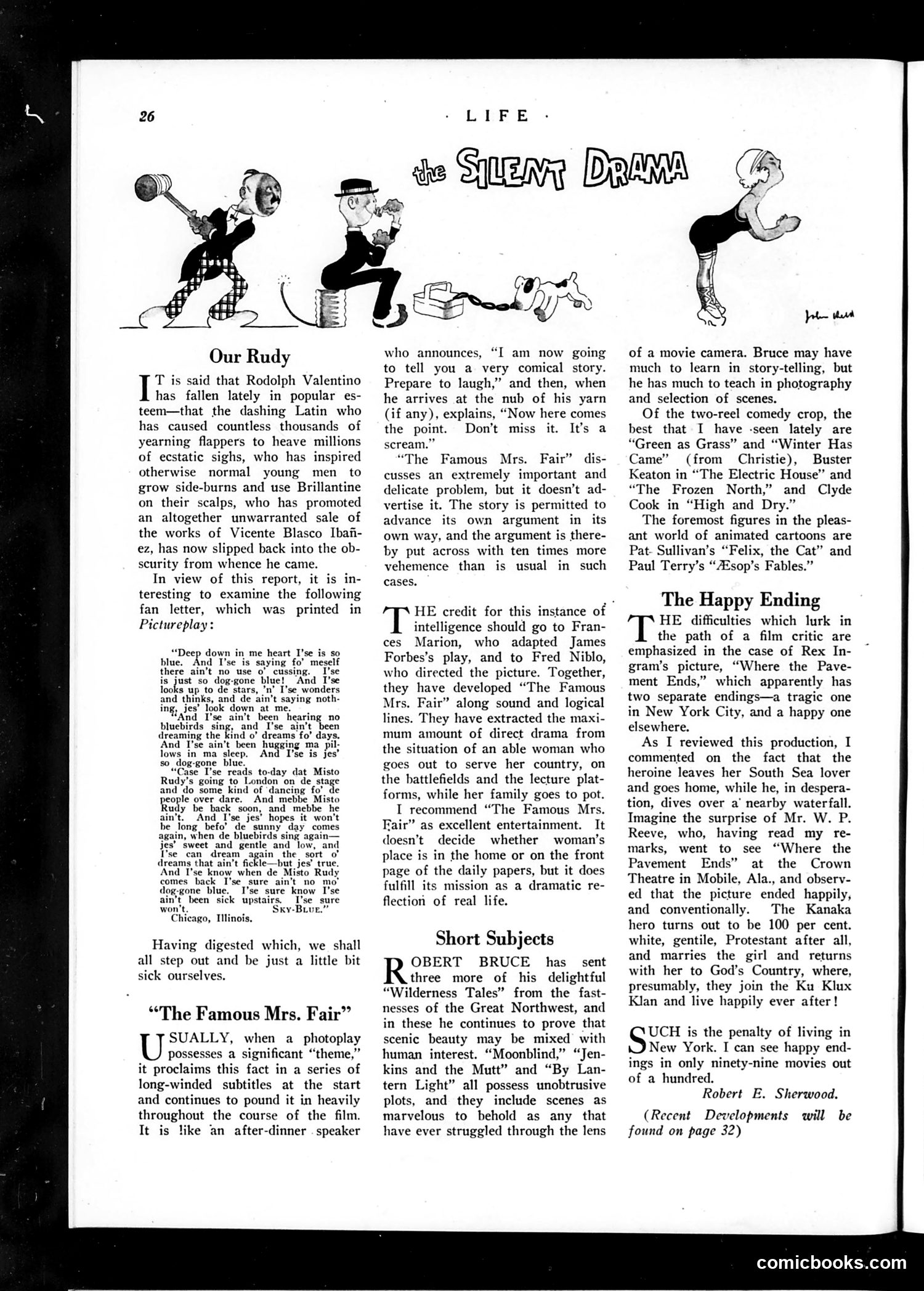
What you’re looking at
This page from Life magazine (undated but early 1920s based on references) satirizes Hollywood celebrity culture and film criticism. **"Our Rudy"** mocks Rudolph Valentino's fading popularity. The excerpt presents a fan letter written in exaggerated dialect ("dog-gone blue," "Misto Rudy") expressing heartbreak over Valentino's planned move to London. Life's editors ridicule both the overwrought fan devotion and Valentino's declining star power—once he inspired "yearning flappers" and sales of Spanish literature, but now faces obscurity. **"The Famous Mrs. Fair"** praises a film tackling women's wartime service and domestic sacrifice without heavy-handed messaging. The critic applauds screenwriter Frances Marion and director Fred Niblo for letting the drama speak naturally rather than didactically explaining themes like some "after-dinner speaker." The cartoons at top illustrate the silent film medium's physical comedy and melodrama conventions—exaggerated body language compensating for lack of dialogue.
📄 Transcribed text from this page (OCR, searchable)
Machine-transcribed from the original scan — historical spelling and the odd misread are preserved.
Ort Our Rudy T is said that Rodolph Valentino has fallen lately in popular es- teem—that the dashing Latin who has caused countless thousands of yearning flappers to heave millions of ecstatic sighs, who has inspired otherwise normal young men to grow side-burns and use Brillantine on their scalps, who has promoted an altogether unwarranted sale of the works of Vicente Blasco Ibafi- ez, has now slipped back into the ob- scurity from whence he came. In view of this report, it is in- teresting to examine the following fan letter, which was printed in Pictureplay: “Deep down in me heart I’se is so blue. “And Tse is saying fo’ meself there ain’t no use o’ cussing. I’se is just so dog-gone blue! And T’se looks up to de stars, ’n’ I’se. wonders and thinks, and de ain’t saying noth- ing, eg Ipok down at me, I’se ain't been hearing no blucbieds | sin and T'se ain't been dreaming the kind o° dreams fo’ days. And I’se ain’t been hugging ma pil: lows in ma sleep. And I’se is jes so dog-gone blue. “Case I’se reads to-day dat Misto Rudy’s going to London on de stage and do some, kind of ‘dancing fo’ de weeps over dare. And mebbe Misto udy be back soon, and mebbe he ain’t. And I’se jes’ hopes it won't be long befo’ de sunny day comes again, when de bluebirds sing again— jes’ sweet and gentle and low, and Tse can dream again the sort oO dreams that ain’t fickle—but jes’ true. And T’se know when de Misto Rudy comes back I’se sure ain't no mo" dog-gone blue. I’se sure know I’se ain't been sick upstairs. I’se sure won't. Sky-Buue.” Chicago, Mlinois. Having digested which, we shall all step out and be just a little bit sick ourselves. “The Famous Mrs. Fair” SUALLY, when a _ photoplay possesses a significant “theme,” it proclaims this fact in a series of long-winded subtitles at the start and continues to pound it in heavily throughout the course of the film. It is like an after-dinner . speaker who announces, “I am now going to tell you a very comical story. Prepare to laugh,” and then, when he arrives at the nub of his yarn (if any), explains, “Now here comes the point. Don’t miss it. It’s a scream.” “The Famous Mrs. Fair” dis- cusses an extremely important and delicate problem, but it doesn’t ad- vertise it. The story is permitted to advance its own argument in its own way, and the argument is there- by put across with ten times more vehemence than is usual in such cases. HE credit for this instance of intelligence should go to Fran- ces Marion, who adapted James Forbes’s play, and to Fred Niblo, who directed the picture. Together, they have developed “The Famous Mrs. Fair” along sound and logical lines. They have extracted the maxi- mum amount of direct drama from the situation of an able woman who goes out to serve her country, on the battlefields and the lecture plat- forms, while her family goes to pot. I recommend “The Famous Mrs. Fair” as excellent entertainment. It doesn’t decide whether woman's place is in the home or on the front page of the daily papers, but it does fulfill its mission as a dramatic re- flection of real life. Short Subjects OBERT BRUCE has sent three more of his delightful “Wilderness Tales” from the fast- nesses of the Great Northwest, and in these he continues to prove that scenic beauty may be mixed with human interest. “Moonblind,” “Jen- kins and the Mutt” and “By Lan- tern Light” all possess unobtrusive plots, and they include scenes as marvelous to behold as any that have ever struggled through the lens i of a movie camera. Bruce may have much to learn in story-telling, but he has much to teach in photography and selection of scenes. Of the two-reel comedy crop, the best that I have -seen lately are “Green as Grass” and “Winter Has Came” (from Christie), Buster Keaton in “The Electric House’ and “The Frozen North,” and Clyde Cook in “High and Dry.” The foremost figures in the pleas- ant world of animated cartoons are Pat- Sullivan’s “Felix, the Cat” and Paul Terry’s “‘ZEsop’s Fables.” The Happy Ending HE difficulties which lurk in the path of a film critic are emphasized in the case of Rex In- gram’s picture, “Where the Pave- ment Ends,” which apparently has two separate endings—a tragic one in New York City, and a happy one elsewhere. As I reviewed this production, I commented on the fact that the heroine leaves her South Sea lover and goes home, while he, in despera- tion, dives over a’ nearby waterfall. Imagine the surprise of Mr. W. P. Reeve, who, having read my re- marks, went to see “Where the Pavement Ends” at the Crown Theatre in Mobile, Ala., and observ- ed that the picture ended happily, and conventionally. The Kanaka hero turns out to be 100 per cent. white, gentile, Protestant after all, and marries the girl and returns with her to God’s Country, where, presumably, they join the Ku Klux Klan and live happily ever after! UCH is the penalty of living in New York. I can see happy end- ings in only ninety-nine movies out of a hundred. Robert E. Sherwood. (Recent Developments will be found on page 32) comicbooks.com