
Life, 1923-05-17 · page 28 of 46
Life — May 17, 1923 — page 28: what you’re looking at
What you’re looking at
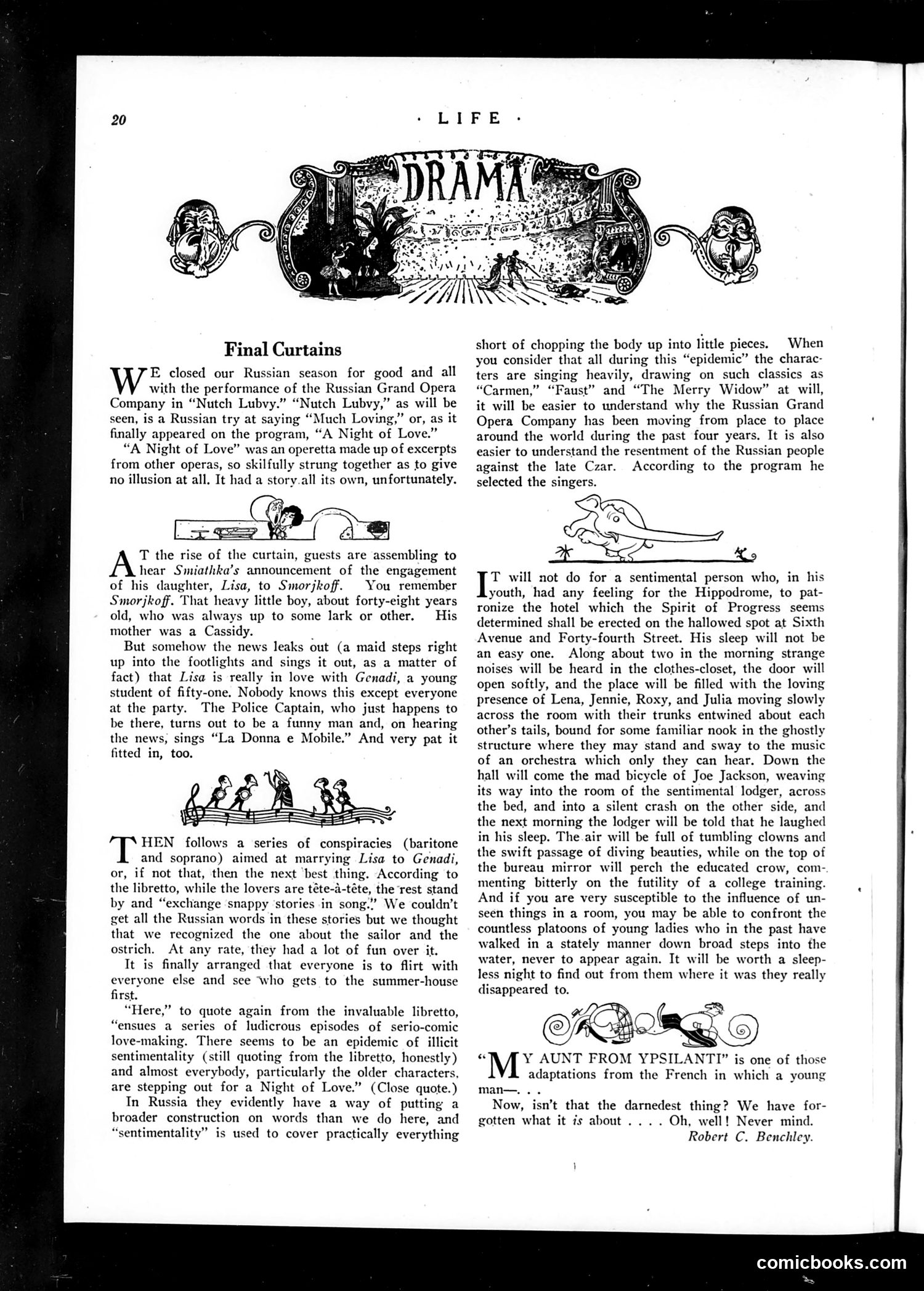
This page reviews the Russian Grand Opera Company's production of "A Night of Love" (a Russian attempt at "Much Loving"), a poorly-constructed operetta stitched from excerpts of famous operas like *Carmen*, *Faust*, and *The Merry Widow*. The satire mocks the production's absurd plot—involving a love triangle where a young student pursues an older man's daughter—and its chaotic staging where characters constantly break into unrelated operatic numbers. The author ridicules how Russians apparently use "sentimentality" to justify practically any behavior short of violence, and suggests the opera's poor quality reflects badly on Czarist Russia itself, joking that the late Czar "selected the singers." The piece employs witty sarcasm throughout, suggesting the touring company's constant relocation around the world stems from audiences' justified resentment of the production's quality.
📄 Transcribed text from this page (OCR, searchable)
Machine-transcribed from the original scan — historical spelling and the odd misread are preserved.
Final Curtains E closed our Russian season for good and all with the performance of the Russian Grand Opera Company in “Nutch Lubvy.” “Nutch Lubvy,” as will be seen, is a Russian try at saying “Much Loving,” or, as it finally appeared on the program, “A Night of Love.” “A Night of Love” was an operetta made up of excerpts from other operas, so skilfully strung together as to give no illusion at all. It had a story.all its own, unfortunately. T the rise of the curtain, guests are assembling to hear Smiathka’s announcement of the engagement of his daughter, Lisa, to Smorjkoff. You remember Smorjkoff. at heavy little boy, about forty-eight years old, who was alw: up to some lark or other. His mother was a Cassidy. . But somehow the news leaks out (a maid steps right up into the footlights and sings it out, as a matter of fact) that Lisa is really in love with Genadi, a young student of fifty-one. Nobody knows this except everyone at the party. The Police Captain, who just happens to be there, turns out to be a funny man and, on hearing the news, sings “La Donna e Mobile.” And very pat it fitted in, too. HEN follows a series of conspiracies (baritone and soprano) aimed at marrying Lisa to Genadi, or, if not that, then the next best thing. According to the libretto, while the lovers are téte-a-téte, the rest stand by and “exchange snappy ‘stories in song.” We couldn’t get all the Russian words in these stories but we thought that we recognized the one about the sailor and the ostrich. At any rate, they had a lot of fun over it. It is finally arranged that everyone is to flirt with everyone else and see Who gets to the summer-house first. “Here,” to quote again from the invaluable libretto, “ensues a series of ludicrous episodes of serio-comic love-making. There seems to be an epidemic of illicit sentimentality (still quoting from the libretto, honestly) and almost everybody, particularly the older characters, are stepping out for a Night of Love.” (Close quote.) In Russia they evidently have a way of putting a broader construction on words than we do here, and “sentimentality” is used to cover practically everything short of chopping the body up into little pieces. When you consider that all during this “epidemic” the charac- ters are singing heavily, drawing on such classics as “Carmen,” “Faust” and “The Merry Widow” at will, it will be easier to understand why the Russian Grand Opera Company has been moving from place to place around the world during the past four years. It is also easier to understand the resentment of the Russian people against the late Czar. According to the program he selected the singers. a Ay as T will not do for a sentimental person who, in his youth, had any feeling for the Hippodrome, to pat- ronize the hotel which the Spirit of Progress seems determined shall be erected on the hallowed spot at Sixth Avenue and Forty-fourth Street. His sleep will not be an easy one. Along about two in the morning strange noises will be heard in the clothes-closet, the door will open softly, and the place will be filled with the loving presence of Lena, Jennie, Roxy, and Julia moving slowly across the room with their trunks entwined about each other’s tails, bound for some familiar nook in the ghostly structure where they may stand and sway to the music of an orchestra which only they can hear. Down the hall will come the mad bicycle of Joe Jackson, weaving its way into the room of the sentimental lodger, across the bed, and into a silent crash on the other side, and the next morning the lodger will be told that he laughed in his sleep. The air will be full of tumbling clowns and the swift passage of diving beauties, while on the top of the bureau mirror will perch the educated crow, com- menting bitterly on the futility of a college training. And if you are very susceptible to the influence of un- seen things in a room, you may be able to confront the countless platoons of young ladies who in the past have walked in a stately manner down broad steps into the water, never to appear again. It will be worth a sleep- less night to find out from them where it was they really disappeared to. « Y AUNT FROM YPSILANTI” is one of those adaptations from the French in which a young man—. . . Now, isn’t that the darnedest thing? We have for- gotten what it is about... . Oh, well! Never mind. Robert C. Benchley. comicbooks.com