
A complete issue · 36 pages · 1923
Life — April 19, 1923
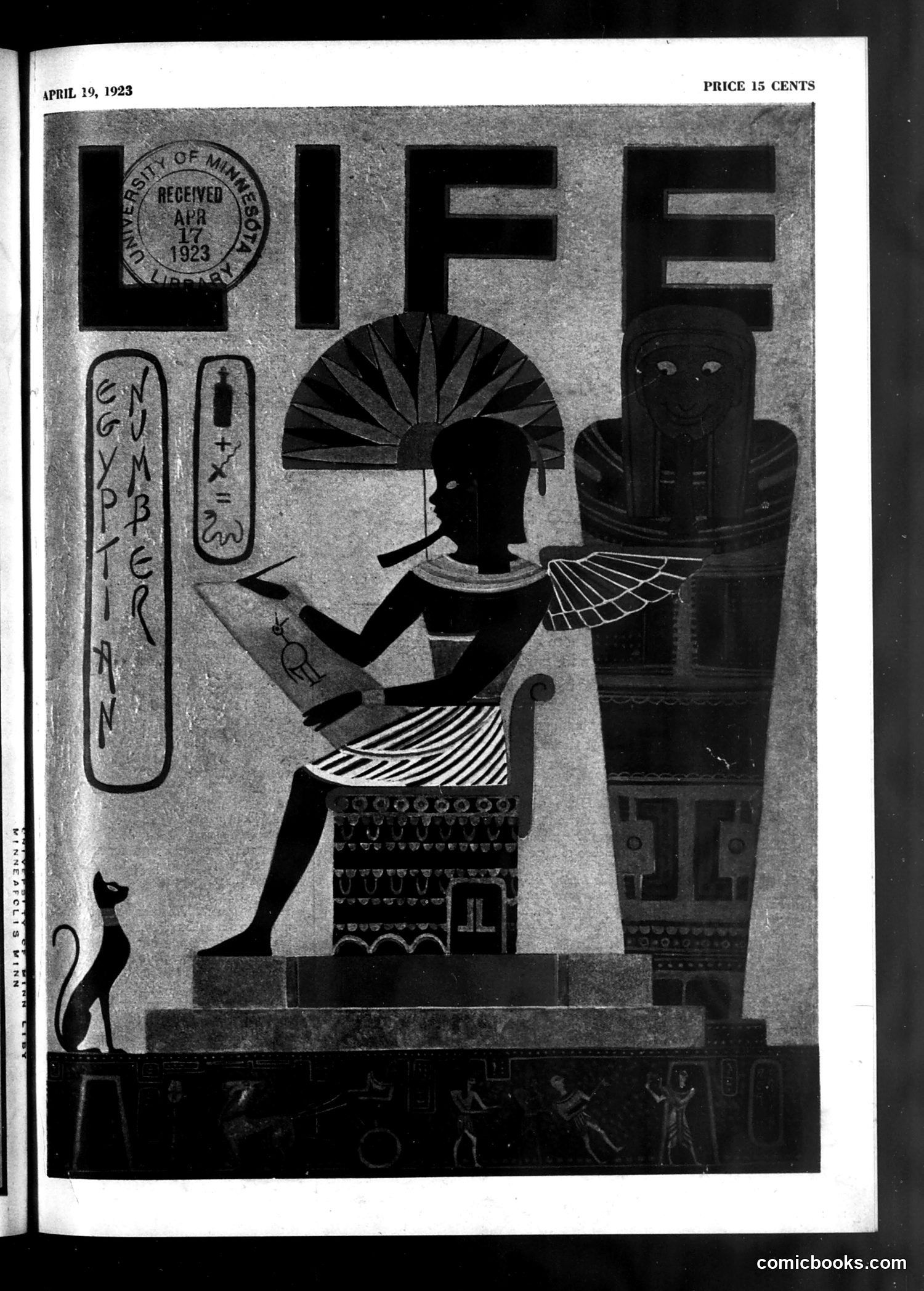
This cover depicts an Egyptian-themed illustration, likely referencing the widespread "Egyptomania" that gripped American popular culture following the 1922 discovery of Tutankhamun's tomb. The central figure appears to be a stylized Egyptian woman in classical pose, flanked by hieroglyphic cartouches and Egyptian statuary. The satire appears to mock the American obsession with Egyptian aesthetics and antiquity that flooded fashion, theater, and design following King Tut's discovery. The exaggerated, romanticized portrayal suggests Life magazine was poking fun at how American culture enthusiastically appropriated and simplified Egyptian imagery for commercial entertainment. The "Life" masthead and price (15 cents) confirms this as the magazine's cover, representing a period when exotic ancient cultures became fashionable American entertainment trends.
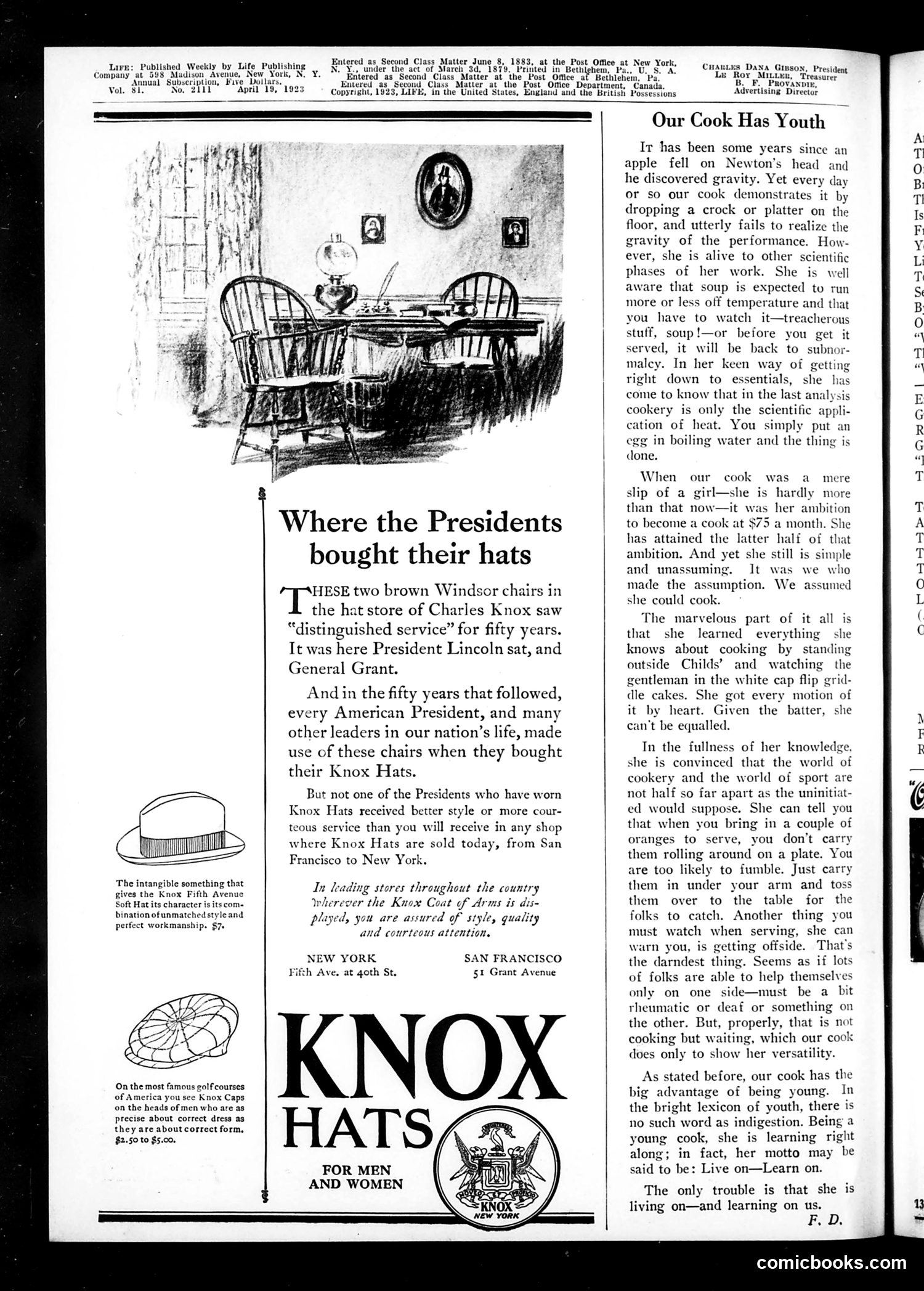
This page contains two distinct elements: **Left side:** A Knox Hats advertisement featuring a sketch of a dining room with two Windsor chairs. The ad claims these chairs belonged to Charles Knox's hat shop and were used by Presidents Lincoln and Grant, plus "every American President" for fifty years afterward. It's a credibility appeal using presidential association—whether accurate or exaggerated is unclear. **Right side:** An essay titled "Our Cook Has Youth" praising a young cook's competence and scientific approach to cooking. The piece celebrates her learning ability and lack of "indigestion" (presumably meaning she hasn't absorbed cynicism). It's gentle domestic humor about youth's advantages in practical skills. Neither contains overt political satire. The page blends advertising with lifestyle commentary typical of 1920s *Life* magazine.
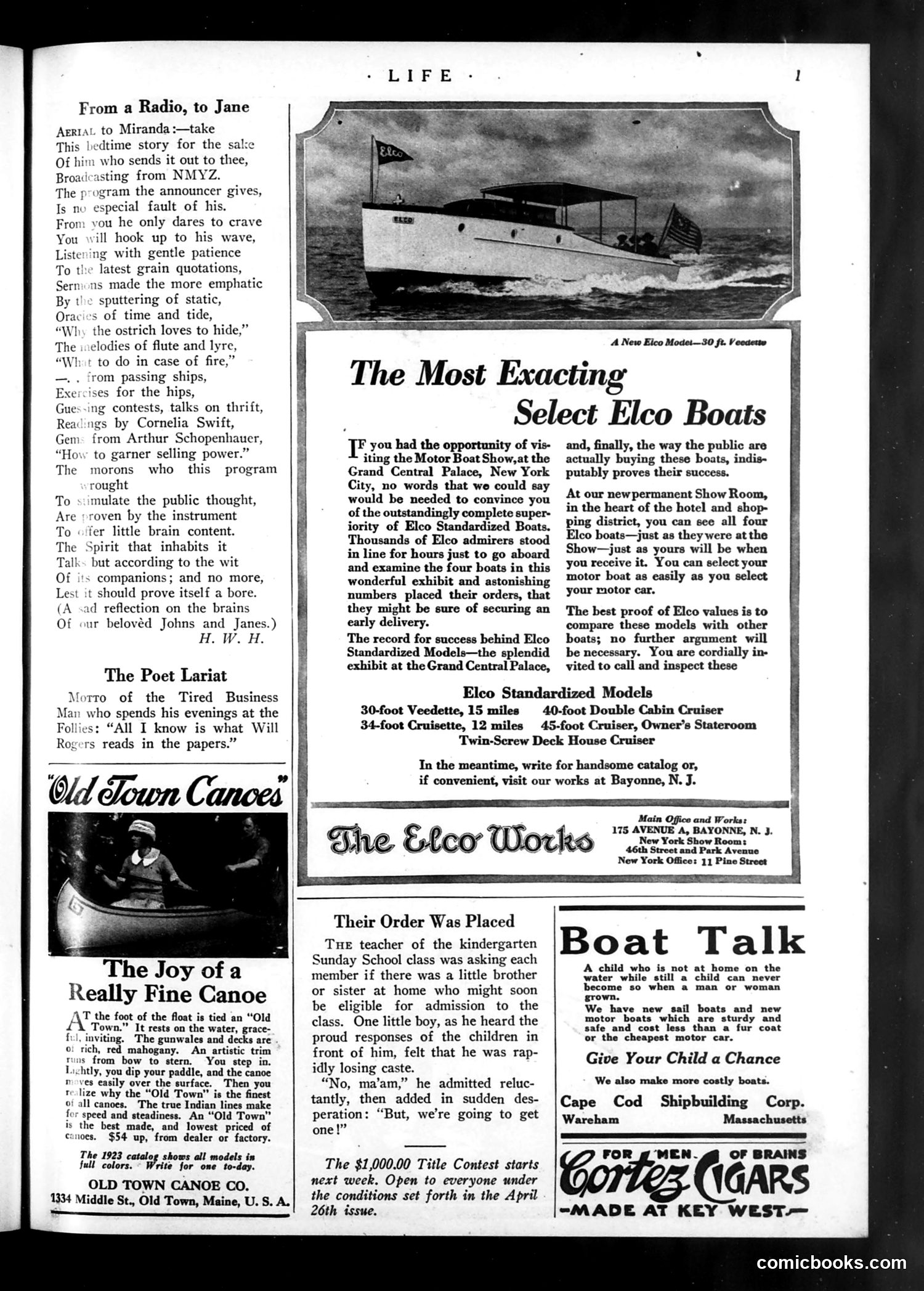
This page is primarily **advertising and entertainment content**, not political satire. The dominant feature is a large ad for Elco Standardized Boats, promoting their Motor Boat Show exhibit at the Grand Central Palace in New York City. The ad highlights four boat models and encourages readers to visit their Bayonne, New Jersey works. The page also includes lighter content: a poem titled "The Poet Lariat" about tired businessmen, an ad for Old Town Canoes featuring an image of someone paddling, and a brief humorous anecdote called "Boat Talk" about kindergarteners discussing motor boats. The bottom promotes a Correz Cigars contest and Cape Cod Shipbuilding Company boats. There is **no political cartoon** on this page—it's essentially a commercial and lifestyle section.
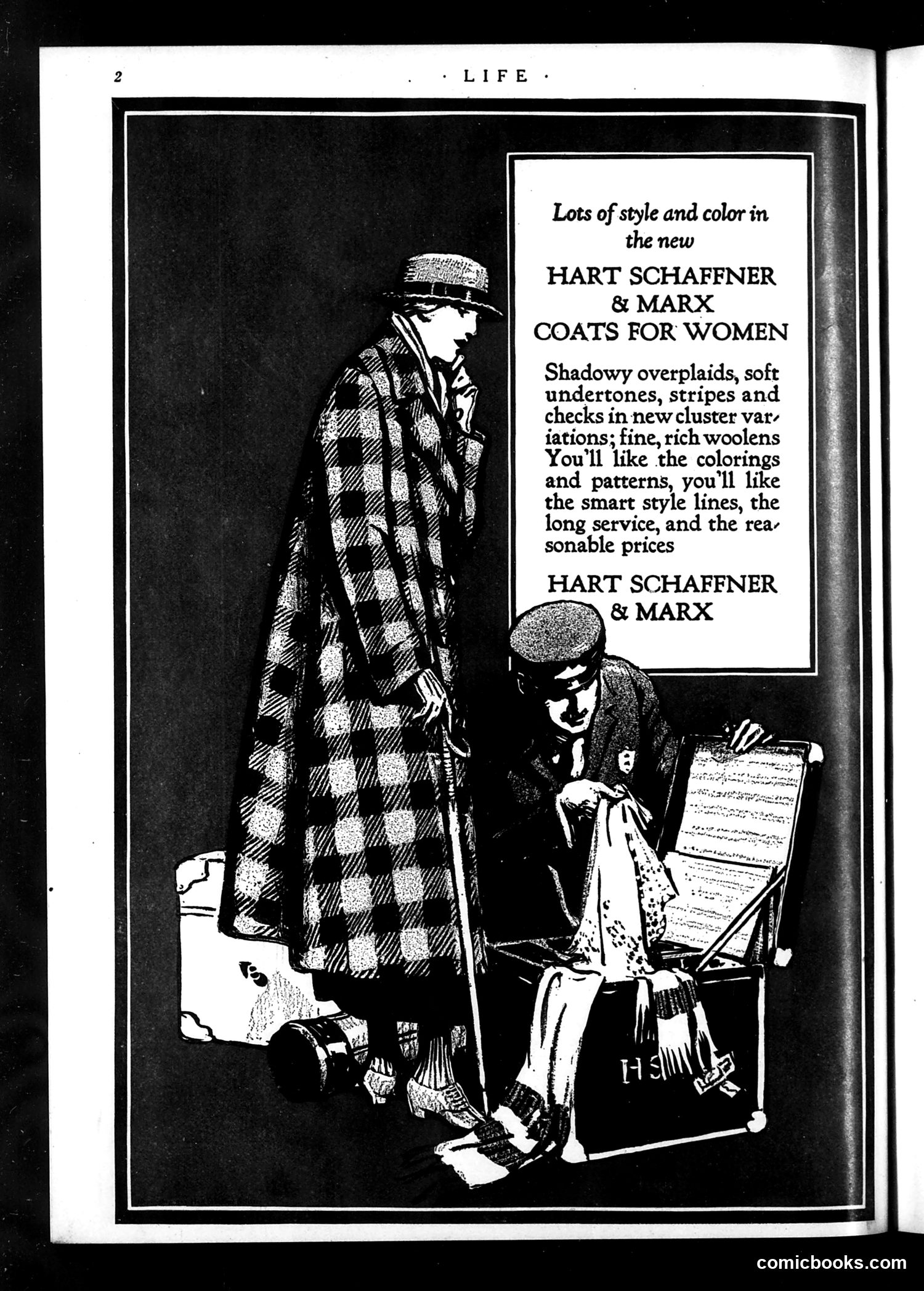
This page is primarily a **commercial advertisement** for Hart Schaffner & Marx women's coats, not political satire. The illustration shows two figures examining coat samples: a well-dressed woman in a patterned coat and hat, and what appears to be a salesman or fashion consultant holding fabric swatches. The ad emphasizes the brand's "style and color" options—featuring "shadowy overplaids, soft undertones, stripes and checks" in "fine, rich woolens." The marketing appeal targets quality-conscious female consumers by highlighting "smart style lines," "long service," and "reasonable prices." This represents typical early-20th-century fashion advertising in *Life* magazine, using an illustration to showcase both the product and the aspirational lifestyle it represents.
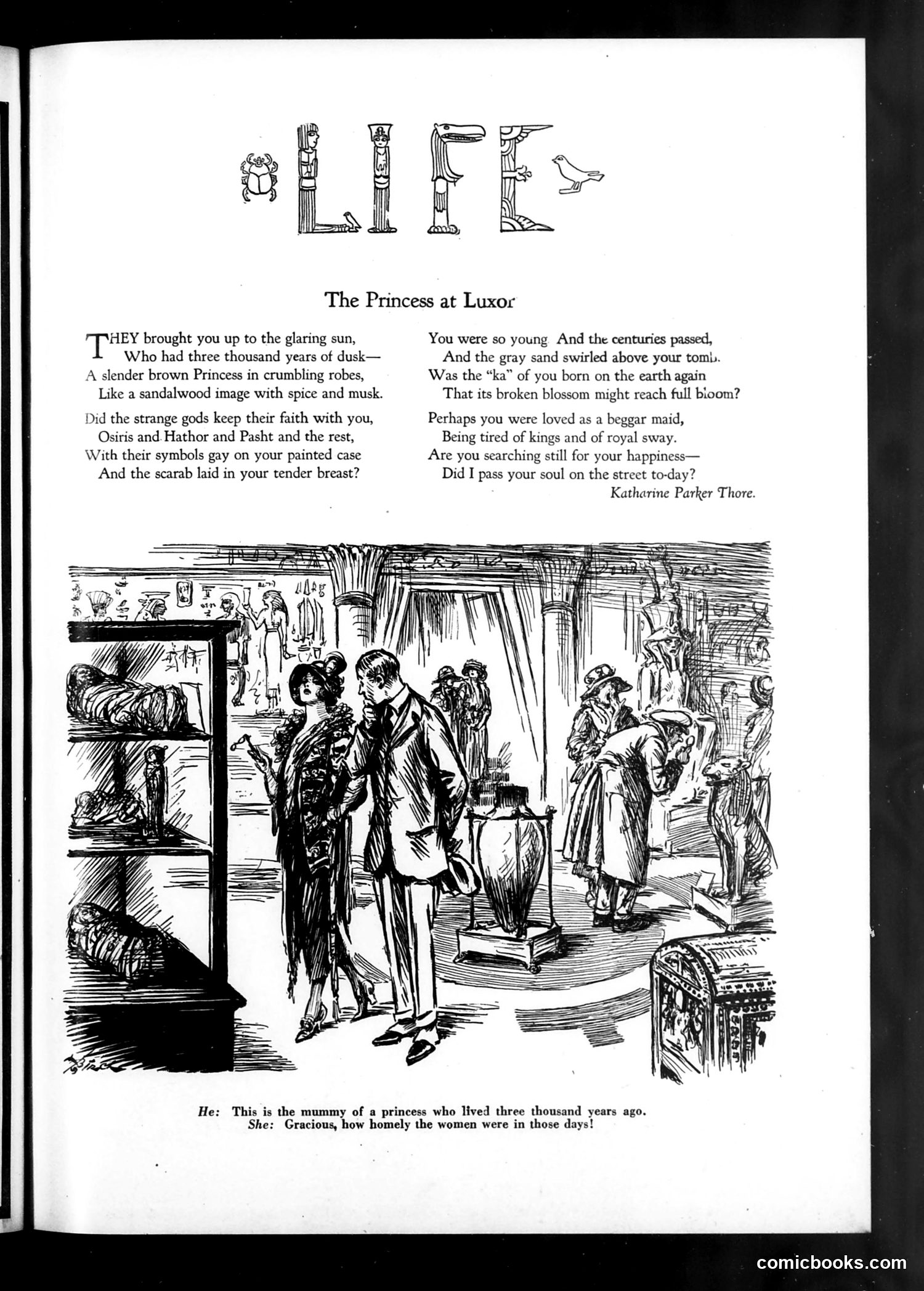
This page features a poem by Katharine Parker Thorc about an Egyptian princess, accompanied by a satirical illustration of a museum scene. The cartoon depicts visitors viewing a mummy at what appears to be a luxury museum or exhibition space, likely referencing Luxor in Egypt. The satire hinges on the dialogue at bottom: a man observes it's a princess from 3,000 years ago, while a woman responds nostalgically that "women were more homely in those days"—a dig at modern women's vanity and beauty standards. The poem itself romanticizes the dead princess's life and spiritual journey. The piece combines fin-de-siècle fascination with Egyptology and mummy exhibitions (popular tourist attractions) with commentary on gender, mortality, and changing social values.
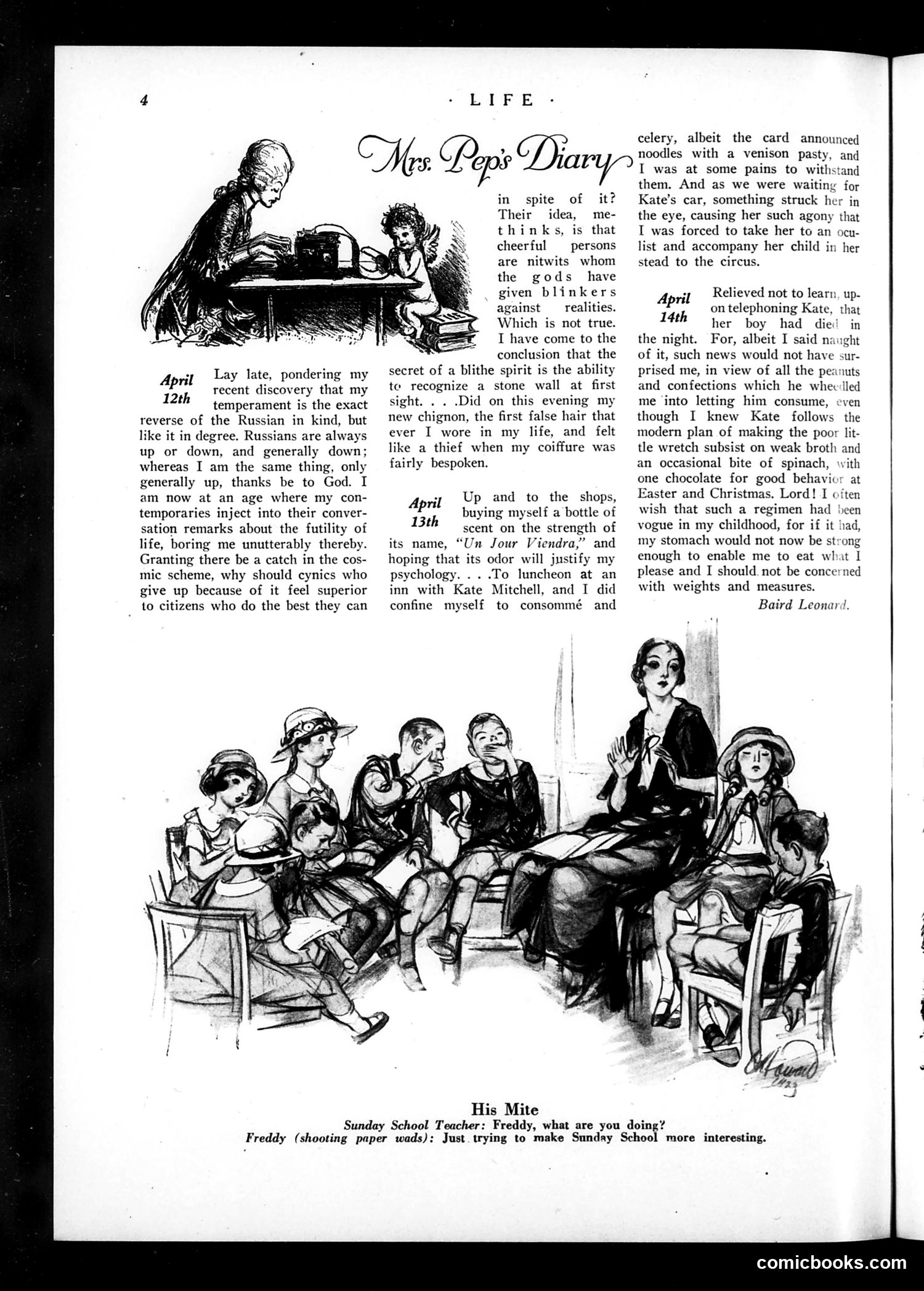
This page contains a serialized diary column with two cartoon illustrations. The main content satirizes upper-middle-class domestic life through entries dated April 12th and 14th, mocking the author's pretensions about temperament, fashion choices ("Un Jour Viendra" perfume), and child-rearing philosophies. The lower cartoon titled "His Mite" shows a Sunday school scene where a teacher asks a student named Freddy what he's doing; Freddy responds he's "trying to make Sunday School more interesting" while appearing to throw paper wads. The humor targets both parental self-delusion and childhood misbehavior—the ironic gap between adult aspirations and reality. The satire is genteel rather than hard-hitting, typical of Life magazine's comedy aimed at educated, middle-class readers.
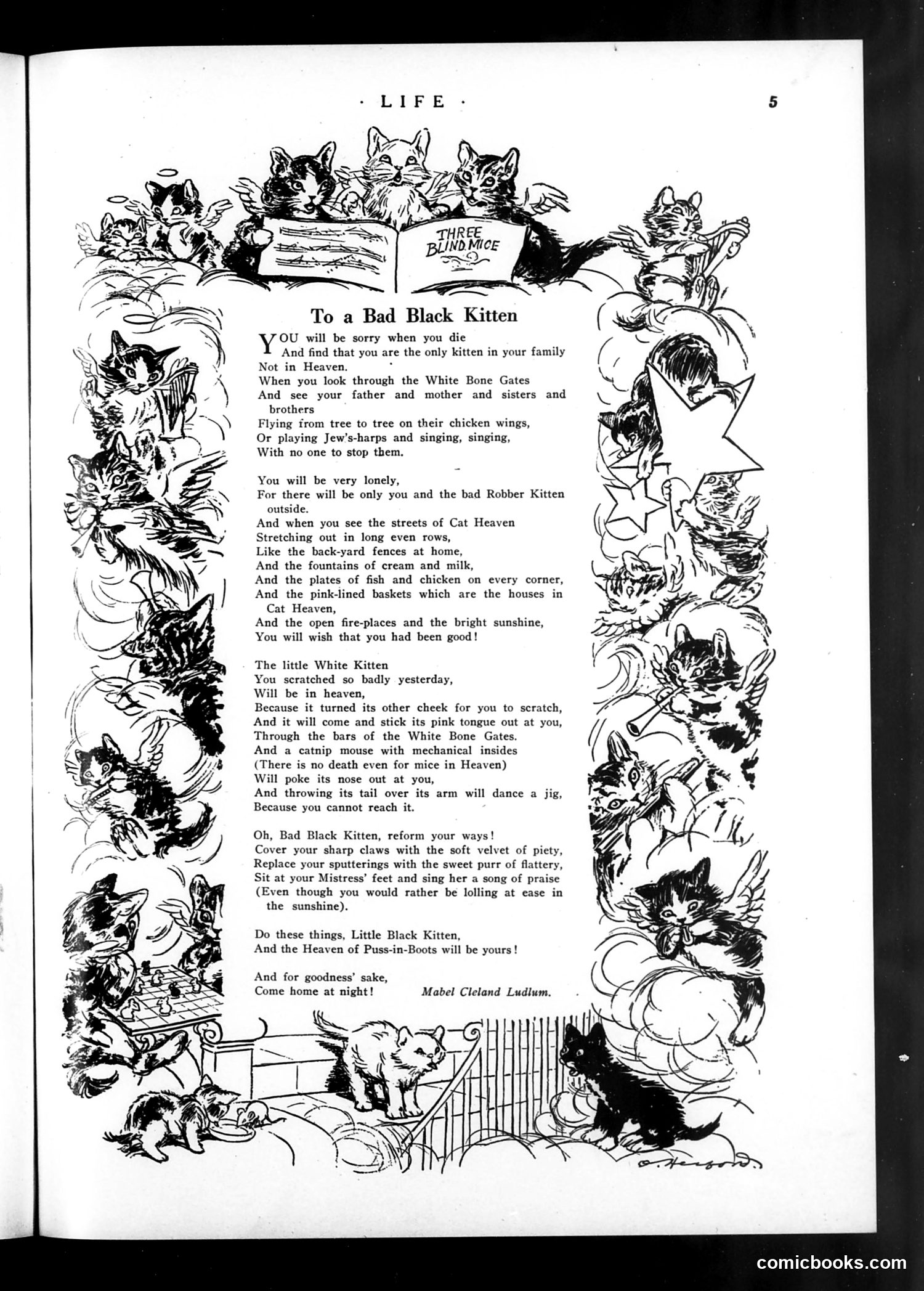
This is a moralistic poem by Mabel Cleland Ludlum, illustrated with whimsical cat drawings. It's a satirical sermon addressed to a misbehaving black kitten, threatening heavenly consequences for bad behavior. The poem contrasts "Cat Heaven" (featuring cream, milk, fish, and pink-lidded basket-houses) with exclusion from paradise. It references specific misdeeds—scratching a "little White Kitten" and general mischief—as reasons the kitten will be separated from family "when you die." The humor lies in applying Victorian moral rhetoric (sin, punishment, redemption) to a cat's petty crimes. By treating feline behavior with religious seriousness, the poem gently mocks both contemporary moralizing and the era's concern with proper conduct and "reform."
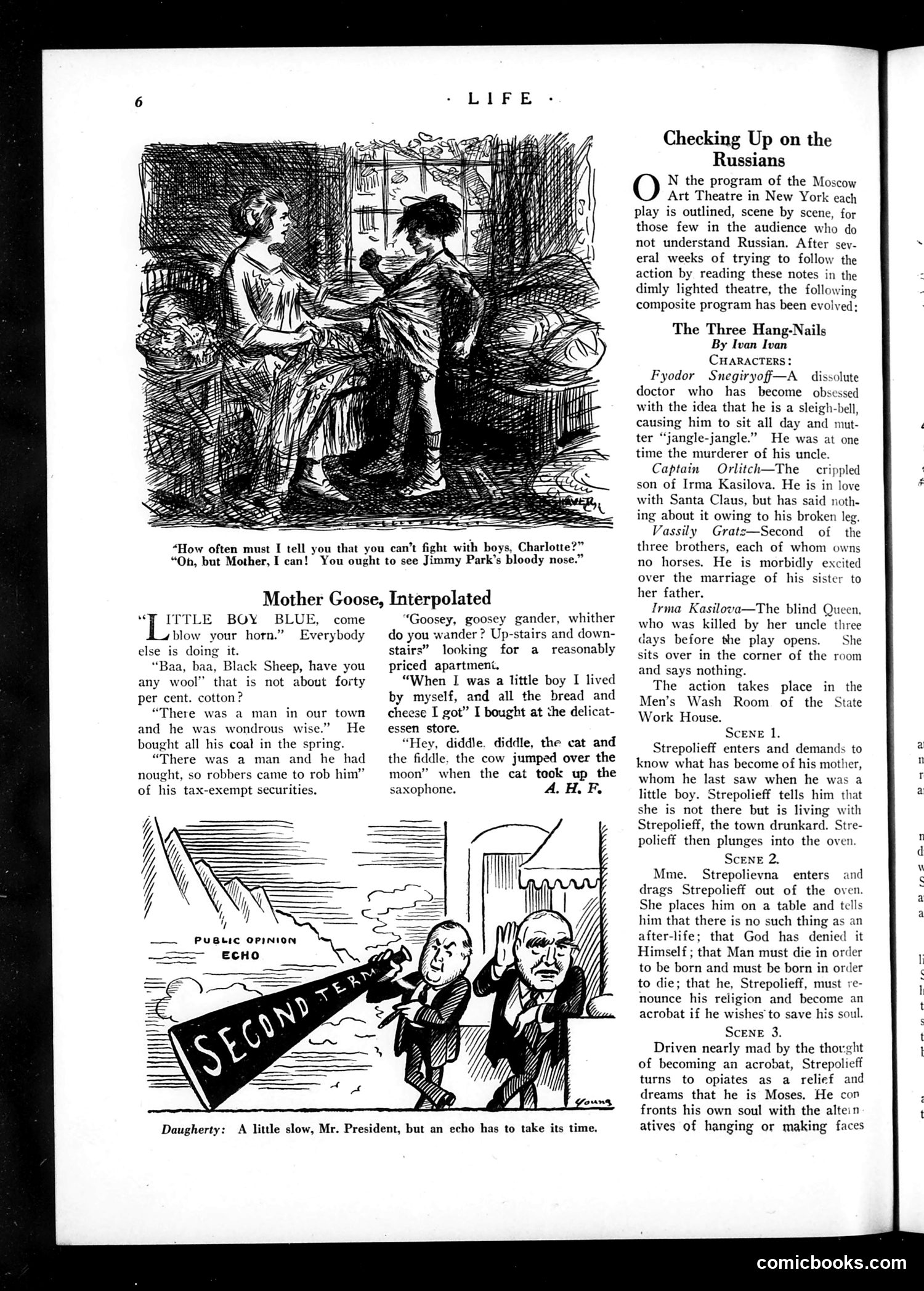
This page contains two distinct elements: **"Mother Goose, Interpolated"** is a humorous piece that inserts contemporary cynicism into the nursery rhyme "Little Boy Blue." The original's innocent lyrics are disrupted with modern observations—a man "wondrous wise" who bought stock in a spring becomes a con artist; a jumping cow becomes a saxophone-playing cat. The satire mocks both 1920s consumerism and get-rich-quick schemes. **"Public Opinion Echo"** (lower cartoon) depicts two men operating a megaphone labeled "SECOND TEAM," with the caption suggesting they're merely echoing the President's ideas slowly. This appears to satirize government spokesmen or media figures as unoriginal repeaters rather than independent voices—a critique of political messaging and institutional conformity during this era.
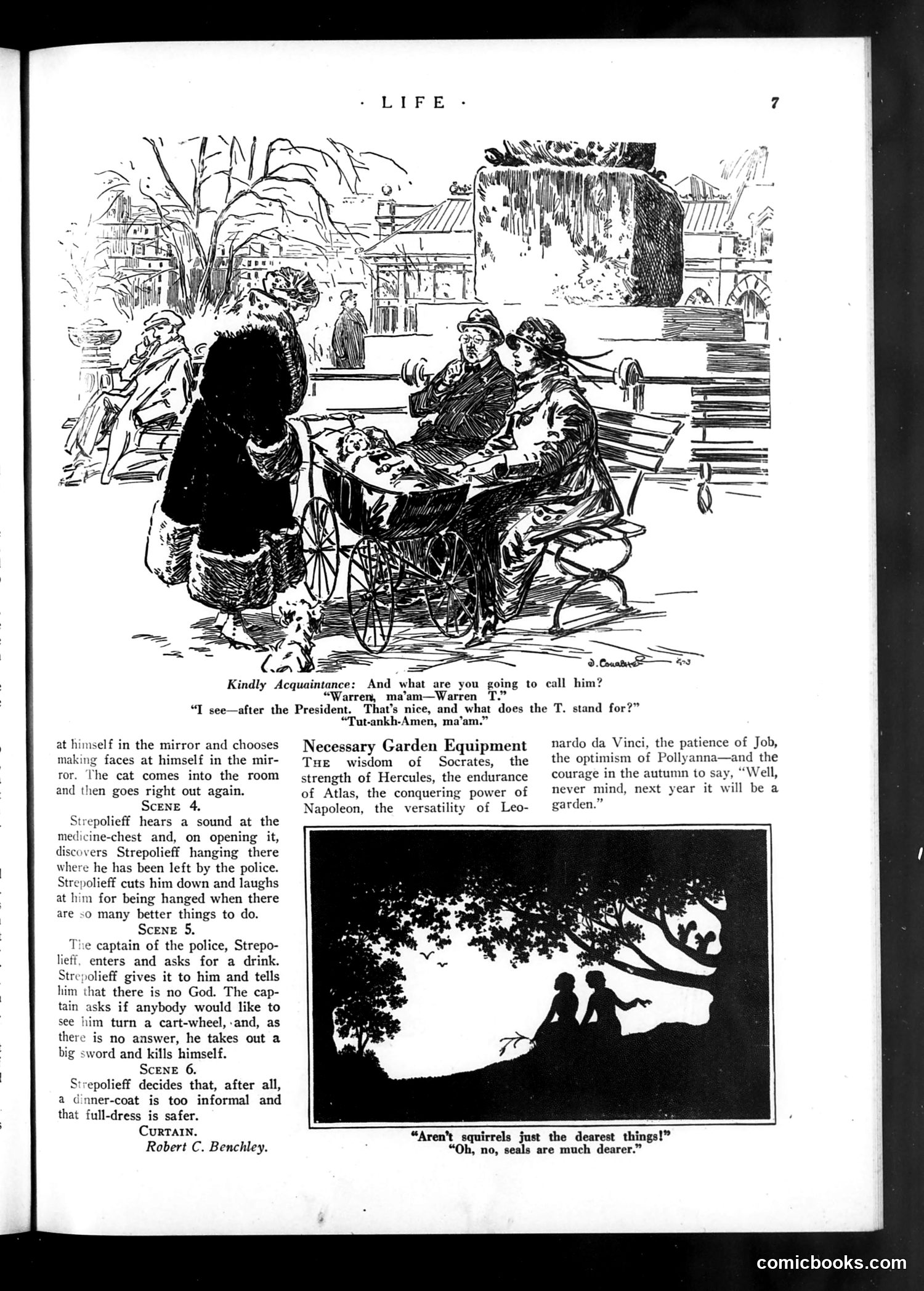
The main illustration depicts a scene of "Kindly Acquaintance" in what appears to be a public park or garden. A woman with a baby carriage is being approached by two men who inquire about the baby's name. The dialogue reveals satire about presidential naming: when asked the child's name, the mother responds "Warren, ma'am," and when pressed about what the "T" stands for, she replies "Tutankh-Amen, ma'am." This references Warren G. Harding (president 1921-1923) and mocks the contemporary fascination with Egyptian archaeology, particularly King Tutankhamun's tomb discovery in 1922. The joke satirizes how popular culture crazes influence even naming conventions. The page also contains unrelated text about gardening and a separate illustration about animal preferences (squirrels versus seals).
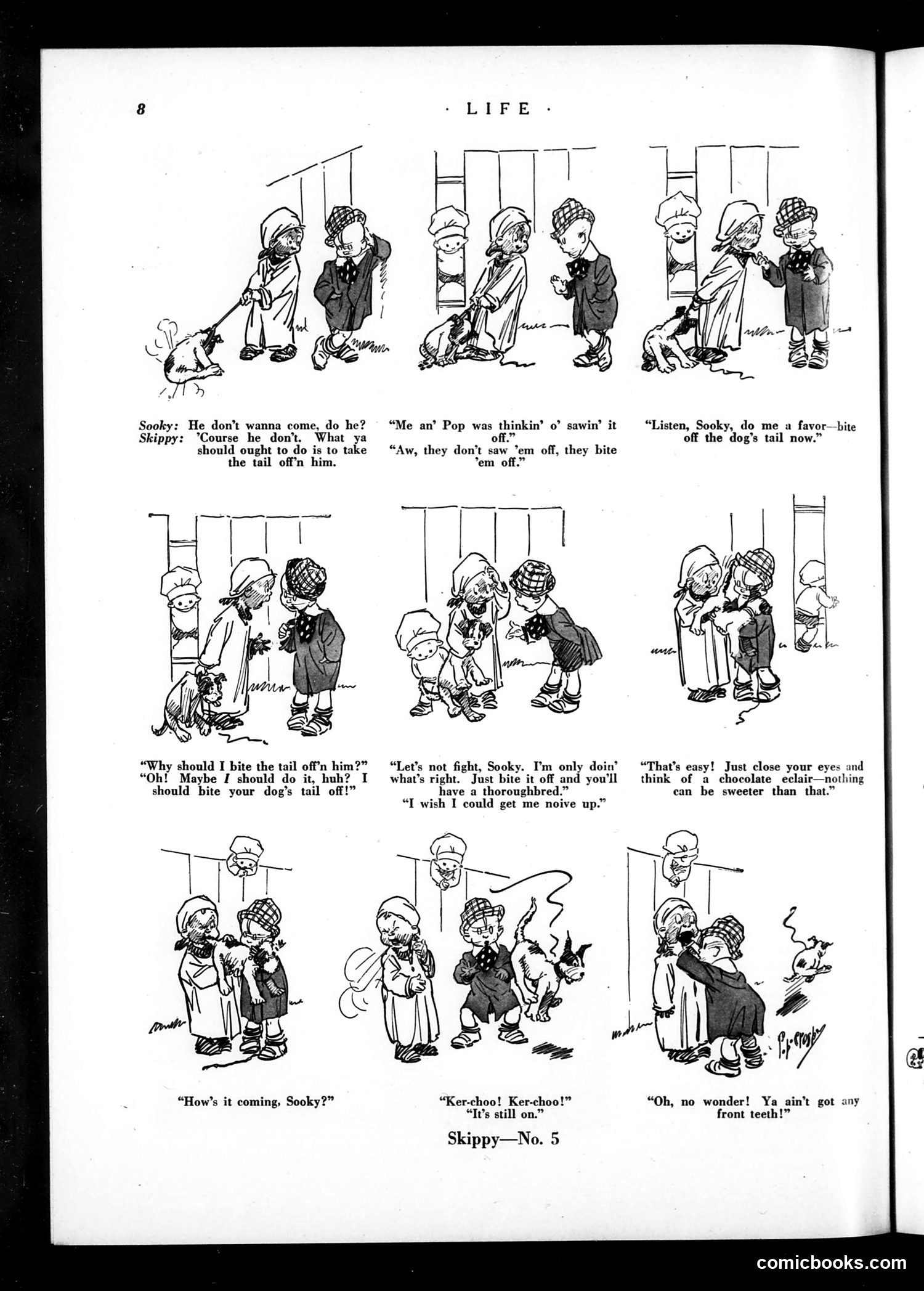
This is a children's comic strip about a boy named Skippy and his dog Sooky. The humor centers on a simple moral lesson: children trying to convince the dog to bite someone's tail by promising reward ("chocolate eclairs"). The strip satirizes childhood logic and peer pressure—Skippy and his friend attempt to manipulate Sooky into misbehaving through incentives. When the dog finally does bite, it's presented as a comeuppance: "Ya ain't got any front teeth!" This reflects early 20th-century comics' focus on innocent, slapstick humor rather than political satire. The joke targets children's flawed reasoning and the predictable consequences of mischief, making it educational entertainment typical of *Life* magazine's family-friendly content.
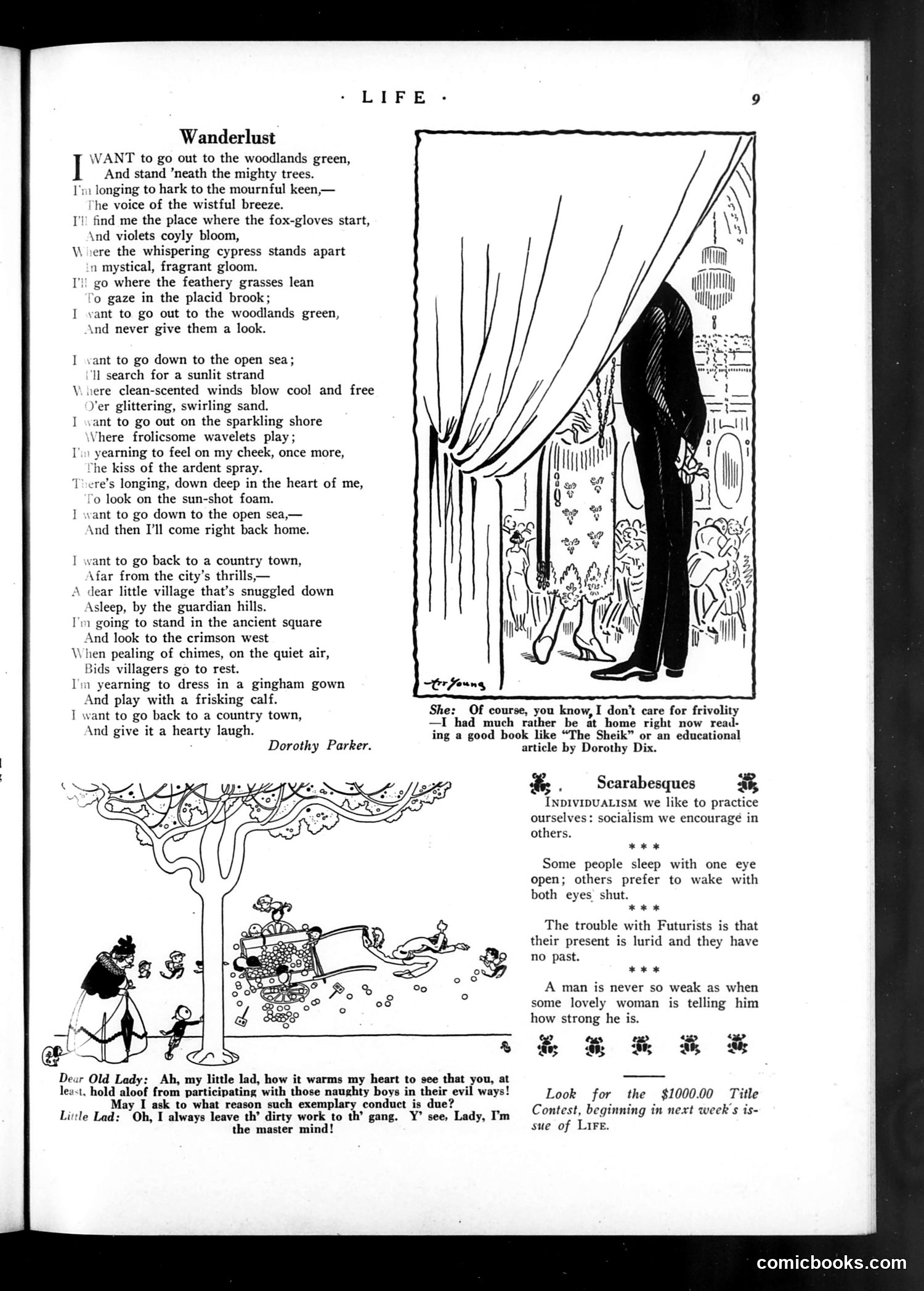
This page features Dorothy Parker's poem "Wanderlust," expressing romantic yearning to escape to nature and distant places, before ultimately returning home—a common literary theme of the era. The accompanying cartoon depicts a fashionably dressed woman (in a long black coat) speaking to what appears to be a man partially hidden behind a curtain or drape. Her caption indicates she'd rather stay home reading "The Sheik" (a popular 1921 novel) or educational articles by Dorothy Dix than engage in social activities. The "Scarabesque" section below contains brief satirical observations on socialism, Futurism, and gender dynamics. The bottom cartoon shows domestic/generational conflict between an old lady and a young boy. The overall page juxtaposes romantic escapism with domestic reality and social commentary typical of Life's satirical approach.
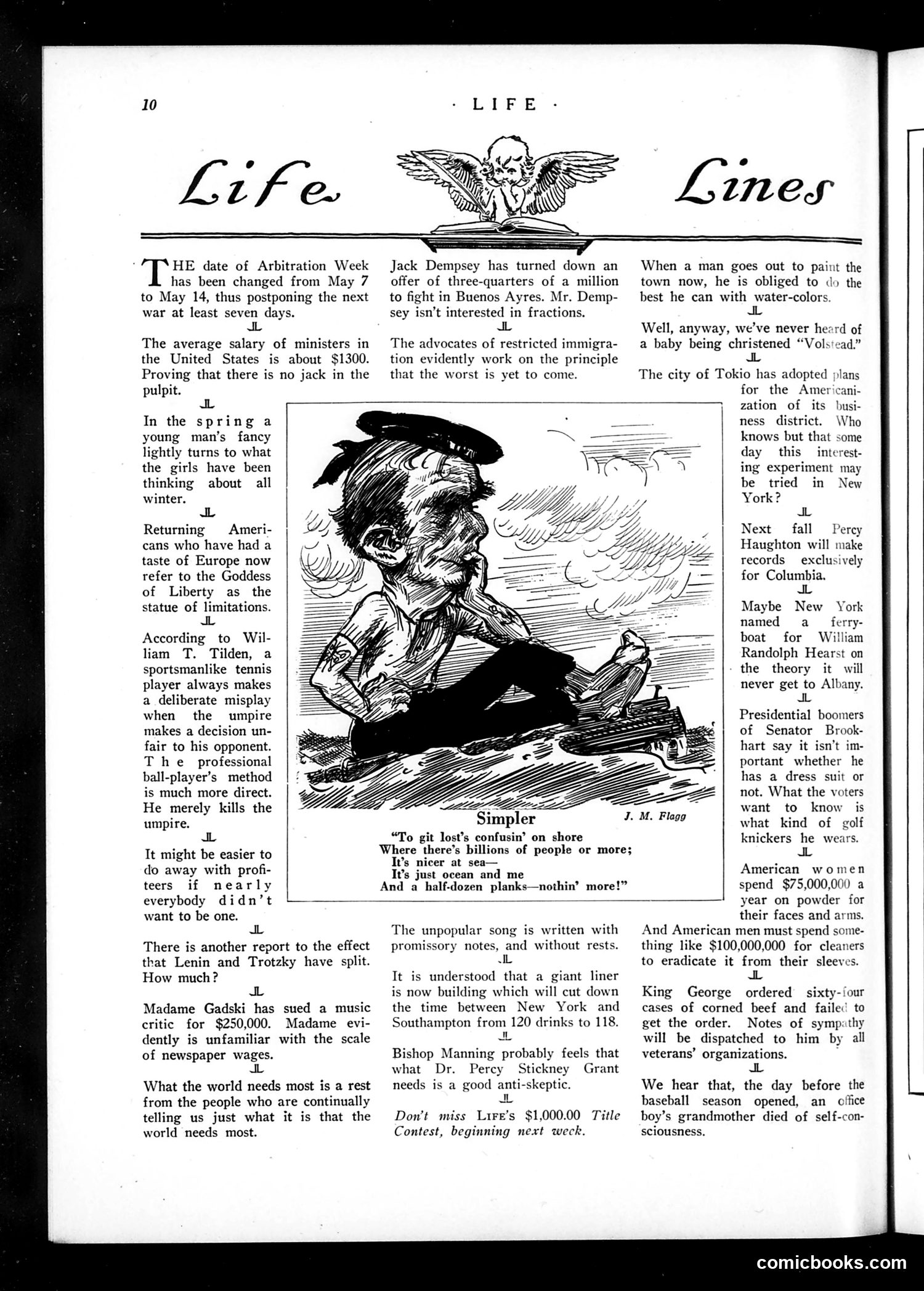
**The Figure & Context:** The cartoon depicts a man smoking a pipe, labeled "Simpler" by artist J.M. Flagg. The caption quotes him saying he wants an ocean "where there's billions of people or more" and "a half-dozen planks—nothin' more!" **The Satire:** This appears to be political commentary on overcrowding and resource scarcity. The figure represents someone advocating for a drastically simplified life—stripping away civilization to bare essentials. The joke satirizes utopian or primitivist thinking that ignores practical realities. By contrasting his desire for fewer people with his acceptance of massive crowds, the cartoon mocks the contradiction in such idealistic philosophy. **Historical Context:** Published during the 1920s, this likely responds to contemporary debates about immigration, overpopulation, and industrial society's problems.
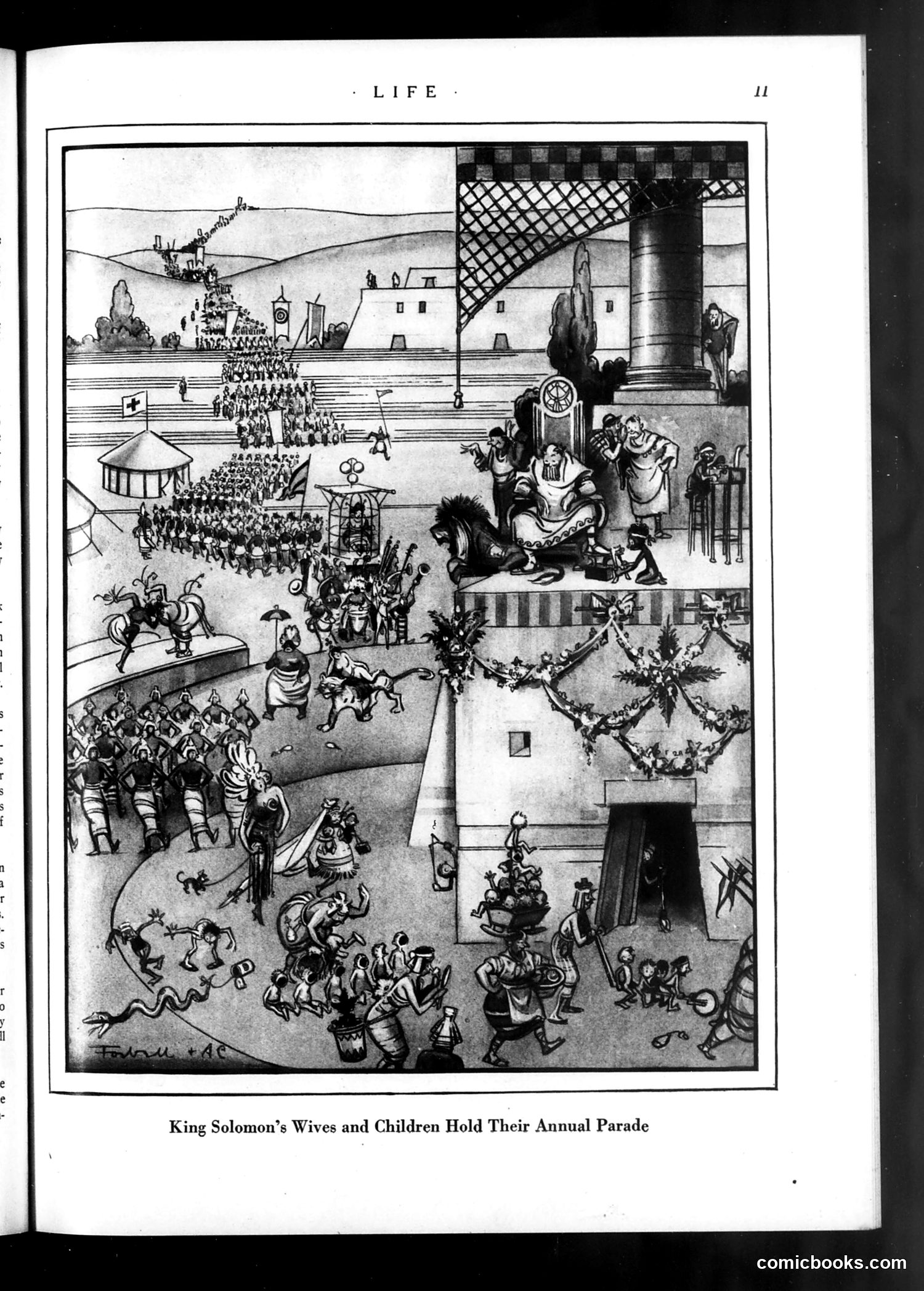
This is a satirical illustration titled "King Solomon's Wives and Children Hold Their Annual Parade," which uses biblical reference as a framework for social commentary. The image depicts a crowded, chaotic procession with numerous figures, elaborate costumes, and various activities occurring simultaneously within a fortified compound or palace setting. The satire appears to mock excessive consumption, overpopulation, or possibly critiques wealth inequality and domestic excess—the "annual parade" of Solomon's legendary 700 wives and their many children becomes a vehicle for depicting chaos and extravagance. The detailed, busy composition emphasizes absurdity through sheer visual overload. Without additional context from Life magazine's publication date, the specific contemporary target remains unclear, though the cartoon likely commented on contemporary American social conditions through historical allegory.
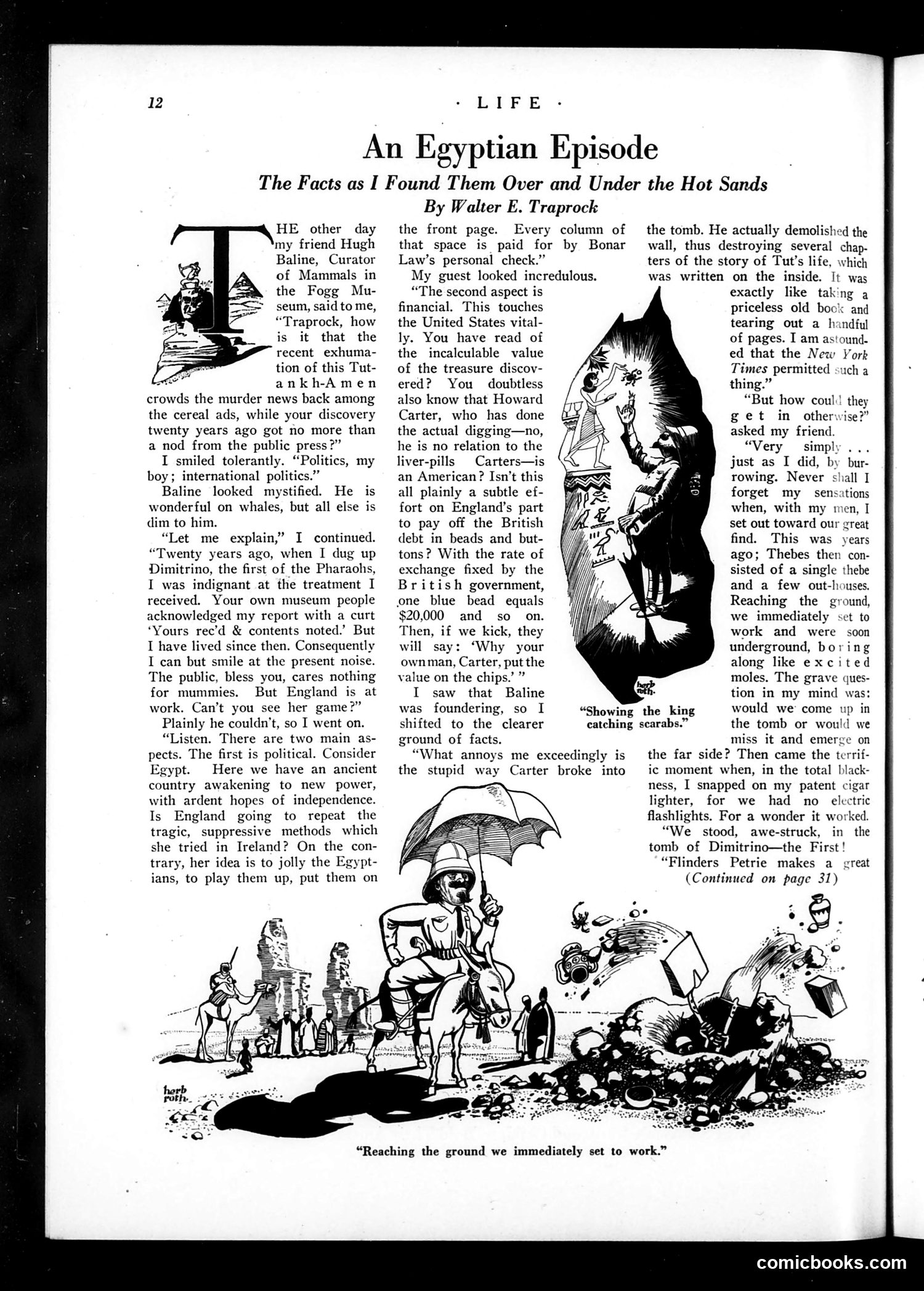
This article by Walter E. Traprock uses a humorous Egyptian archaeology frame to critique British imperial policy. The author discusses how England treats Egypt—an "ancient country awakening to new power, with ardent hopes of independence"—by playing up the Egyptians to distract them from self-governance, similar to how Britain handled Ireland. The satire compares Britain's patronizing imperial strategy to a magician's misdirection: dazzling colonized peoples with spectacle (the "treasure" of Tutankhamun's tomb, widely publicized in the 1920s) while extracting economic value and suppressing independence movements. The illustrations show Egyptians excavating treasures under British supervision, literalizing how imperial powers extract resources while controlling narratives.
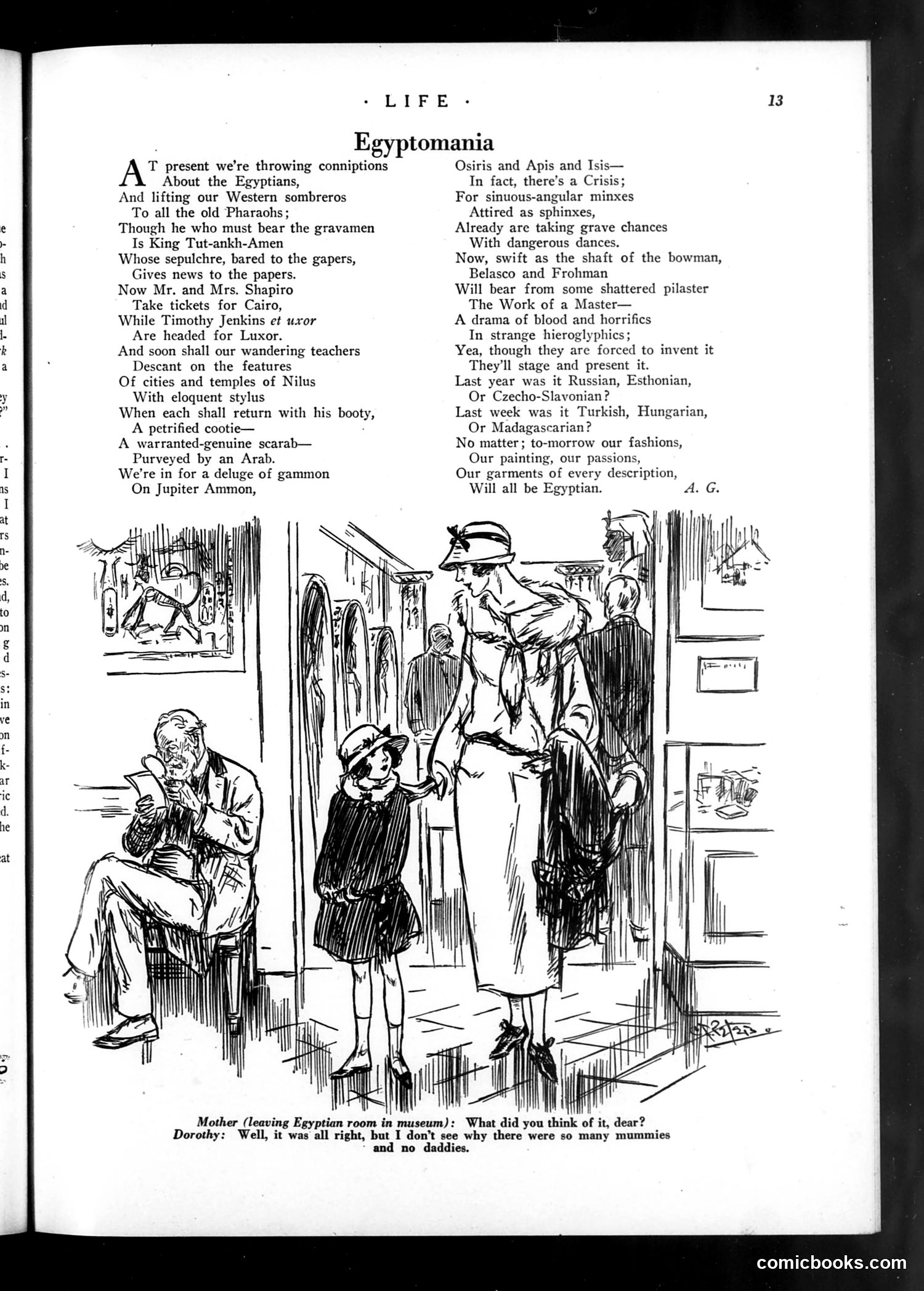
This page satirizes the American obsession with Ancient Egypt that peaked in the 1920s-30s, likely sparked by King Tutankhamun's tomb discovery (1922). The poem mocks tourists flocking to Cairo and museums to see Egyptian artifacts, mummies, and sphinxes. It ridicules how this fascination infiltrates fashion, art, and decoration—"our painting, our passions, our garments of every description, will all be Egyptian." The illustration depicts a museum scene where a mother and child view Egyptian exhibits. The caption reveals the joke: the mother complains there were too many mummies but no "daddies"—a pun suggesting absent fathers, possibly referencing wartime or social changes. The satire targets American consumer culture's superficial embrace of exotic trends.
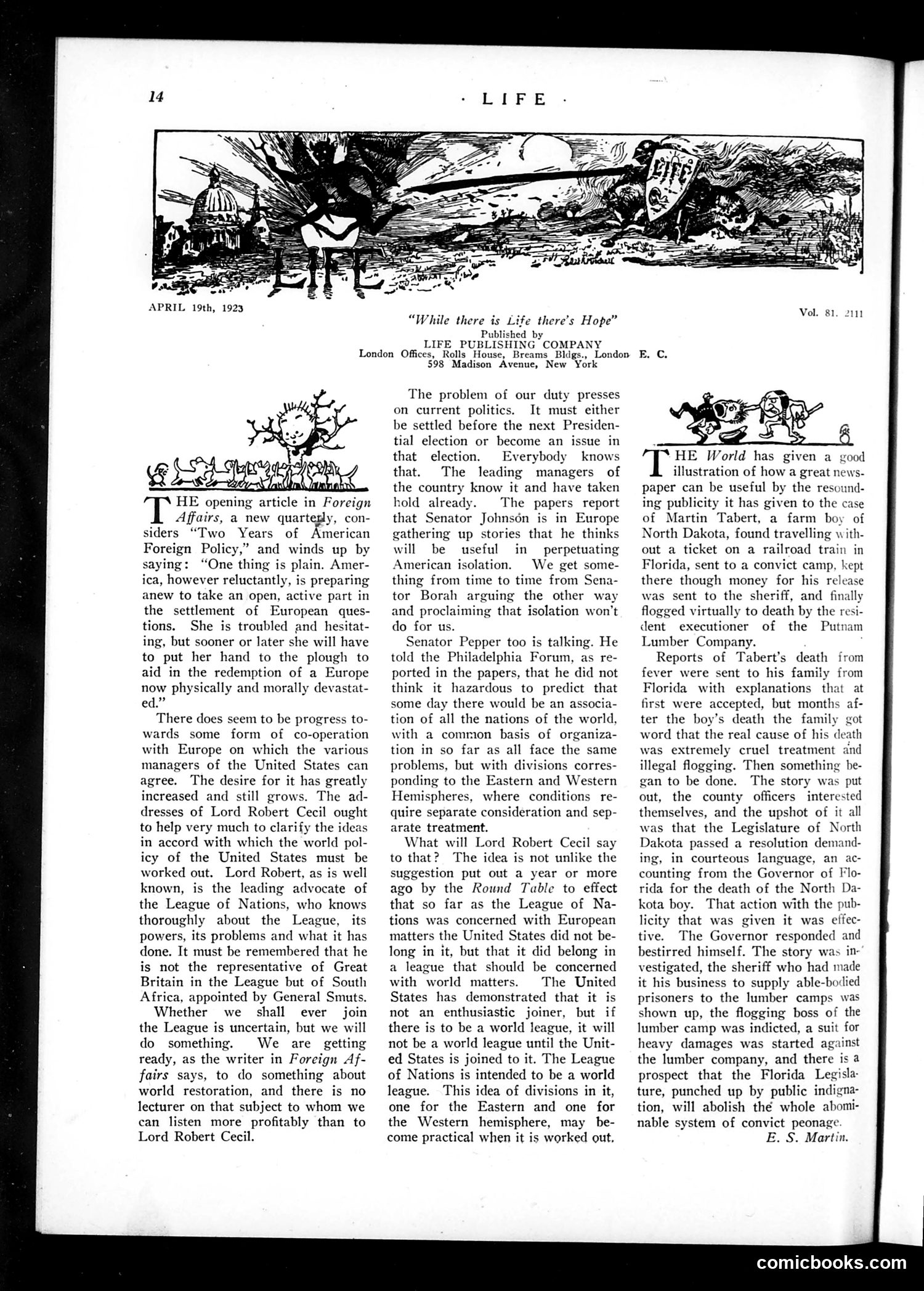
This page contains editorial commentary rather than political cartoons. The main illustrated header shows the magazine's masthead with allegorical figures. The text discusses U.S. foreign policy and European reconstruction post-WWI. It references: - **Senator Johnson** and **Senator Pepper** debating American isolationism versus international engagement - **Lord Robert Cecil**, an advocate for the League of Nations - A story about **Tabert**, a farm boy from North Dakota, who died in a Florida convict labor camp under suspicious circumstances, prompting investigation and public outrage The editors argue America must take an active role in world affairs and criticize isolationist senators. The Tabert case illustrates brutal, illegal treatment in Southern penal systems—a contemporary scandal that embarrassed Florida's government and prompted reform demands.
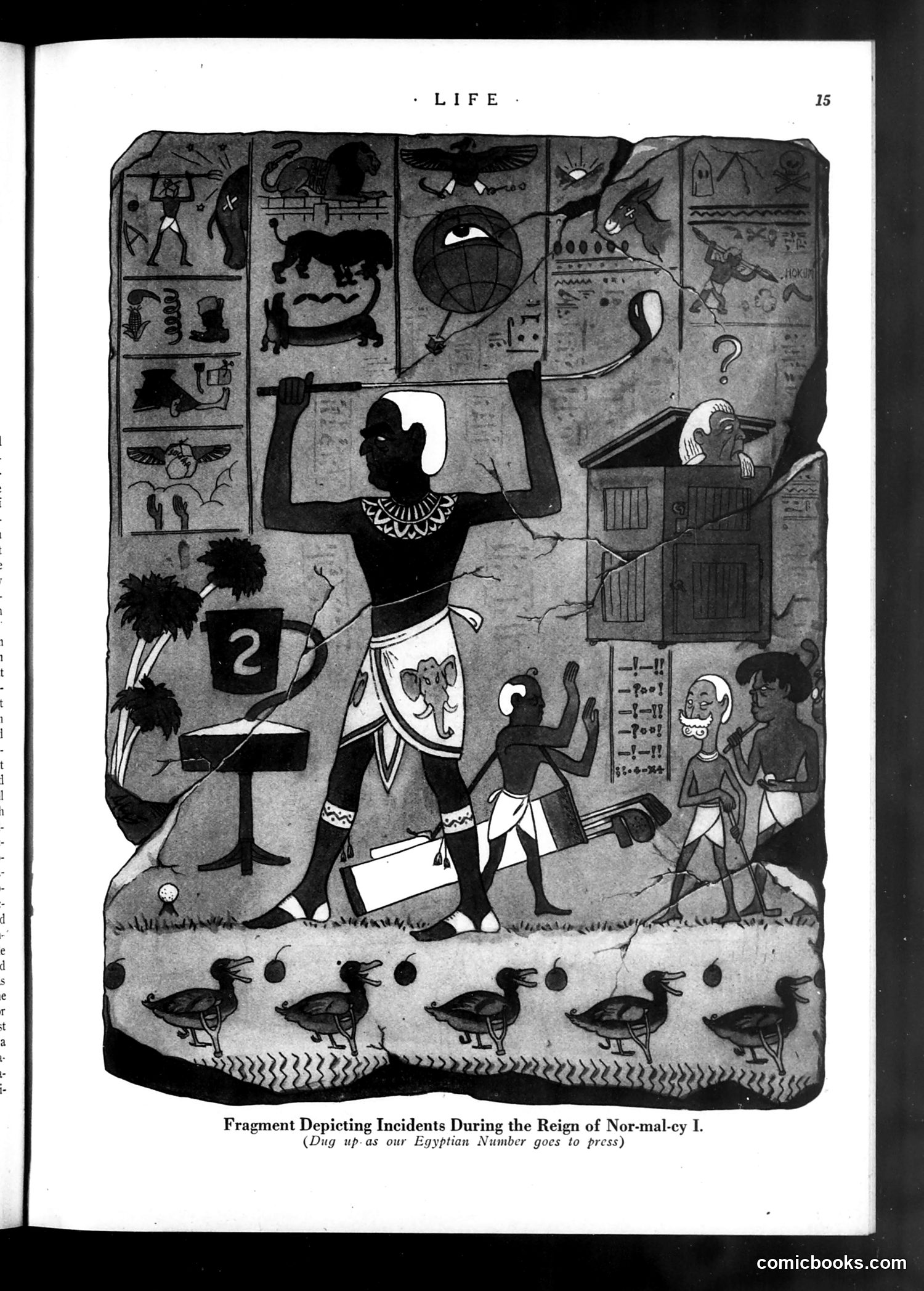
This is a satirical cartoon disguised as an ancient Egyptian artifact. The title "Nor-mal-cy I" is a pun on "Normalcy"—likely referencing President Warren G. Harding's 1920 campaign promise of a "return to normalcy" after World War I. The cartoon depicts a central figure (possibly representing Harding or his administration) juggling various concerns: hieroglyphics on the walls suggest ancient wisdom being ignored, children appear confused, birds march along the bottom, and scattered symbols reference contemporary issues. The satire works by presenting recent political events as if they were ancient history—implying Harding's policies are as outdated as Egypt. The "dug up" framing suggests these incidents are already archaeological relics, mocking both the administration's approach and the magazine's concurrent Egyptian-themed issue.
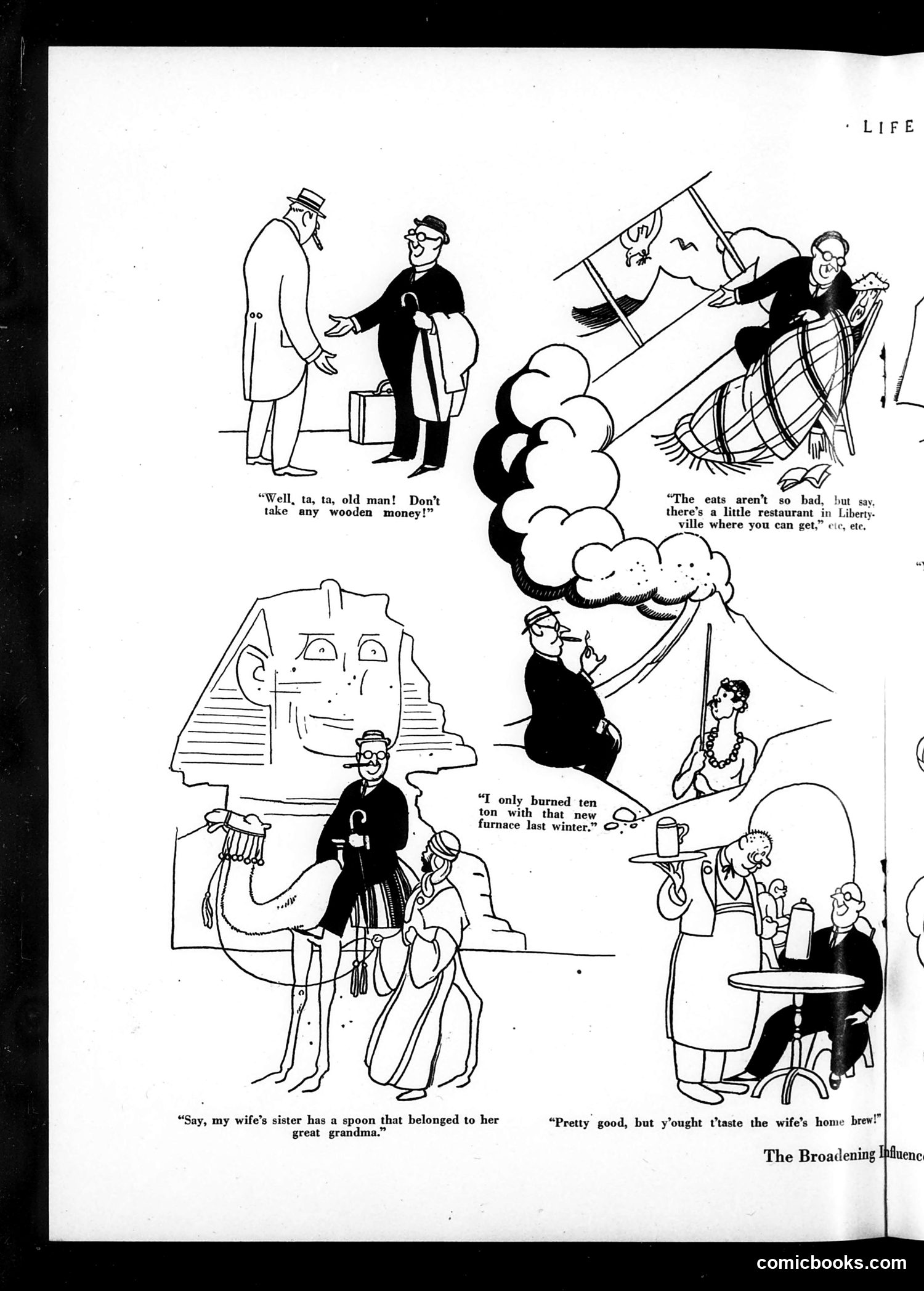
This Life magazine page satirizes Prohibition's unintended social consequences through four comic vignettes. The cartoons mock how ordinary citizens circumvent alcohol bans: men exchange dubious "wooden money," someone brags about a new furnace (likely code for illegal distilling), a tourist finds restaurants serving alcohol despite the law, and someone praises homemade beer ("home brew"). The title, "The Broadening Influence," ironically suggests Prohibition's "civilizing" effect while depicting widespread lawbreaking across all social classes. The humor targets both the futility of the ban and the casual criminality it spawned among respectable people. This reflects public skepticism about Prohibition's enforcement during the 1920s.
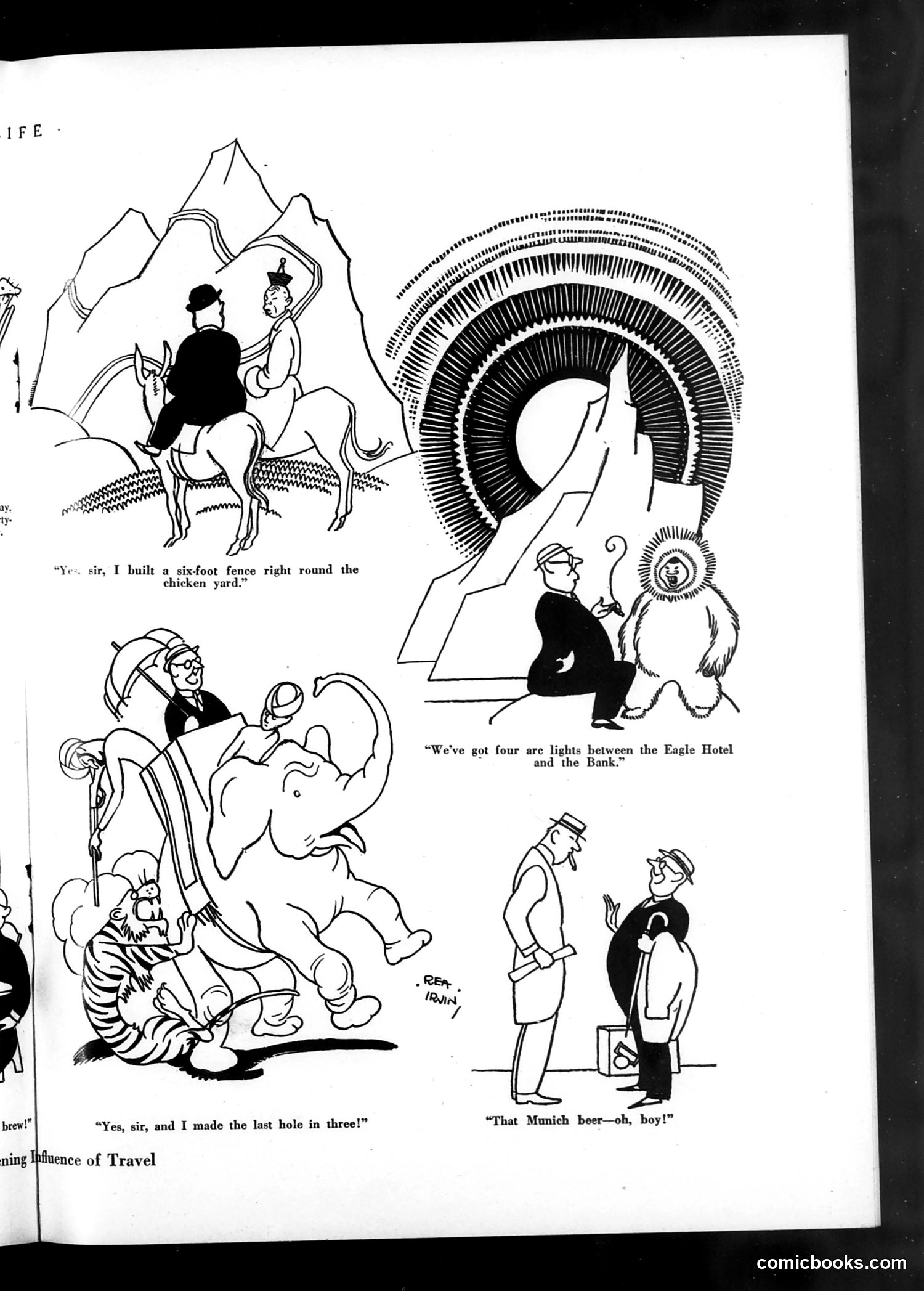
This page contains four separate cartoon jokes satirizing travelers' experiences and boasting. The top-left depicts someone on horseback describing an absurdly tall fence around chickens—exaggerating a farm accomplishment. The top-right shows a man admiring street lights in a town, suggesting he's impressed by modest infrastructure. The bottom-left features a golfer claiming to have "made the last hole in three"—either a golf boast or possible innuendo. The bottom-right references "Munich beer," likely alluding to German beer culture and tourism. The page title, "The Refining Influence of Travel," suggests these cartoons mock how travelers return home with inflated stories and newfound pretensions about what they've seen abroad. The humor lies in the contrast between mundane domestic life and travelers' tendency to exaggerate or affect sophistication from their journeys.
This page reviews two London theatrical productions. The first review critiques "If Winter Comes," adapted from a novel by A.S.M. Hutchinson. The critic argues the stage adaptation strips away the prose's beauty, becoming formulaic melodrama—the kind of sentimental Victorian play where a fallen woman arrives in the rain seeking redemption from a kind-hearted hero. The review praises the English cast (particularly Cyril Maude and Mabel Terry-Lewis) while mocking the artificial staging details, like a fence-post shadow that looks dated. The second review discusses Sir Arthur Wing Pinero's "The Enchanted Cottage," about an unattractive couple who appear beautiful only to each other through love's magic. The critic admits emotional bias from recently seeing "Mary Rose" (also by Pinero), affecting their judgment of this sentimental story involving a war-damaged man and plain woman. Both reviews employ satirical wit to critique theatrical conventions and sentimentality in English drama.
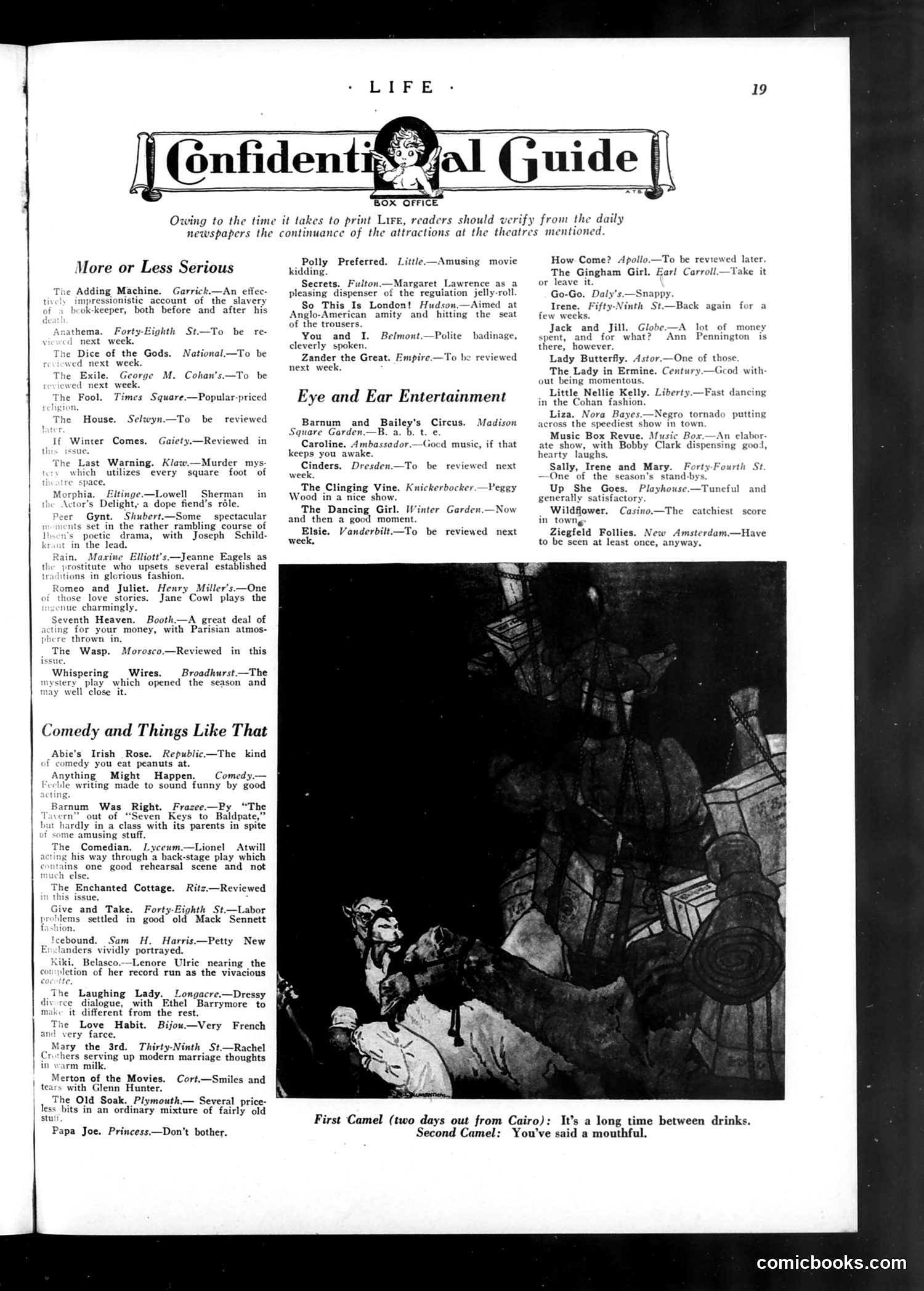
This page is a **theater review guide** for New York stage productions, not a political cartoon. It's divided into sections categorizing shows by tone: "More or Less Serious," "Comedy and Things Like That," and "Eye and Ear Entertainment." The single illustration shows two camels with a caption about Cairo and drinks—likely accompanying a review of an exotic or comedic production. This appears to be a humorous aside rather than satire. The content reflects 1920s Broadway entertainment: reviews of plays like *Abie's Irish Rose*, *Romeo and Juliet*, and *Seventh Heaven* with brief critical commentary. Notes like "The kind of comedy you eat peanuts at" and "Don't bother" offer quick judgments for readers choosing evening entertainment. This is **not satirical political content**—it's a practical entertainment guide showing what shows Life's readers could see that week in New York theaters.
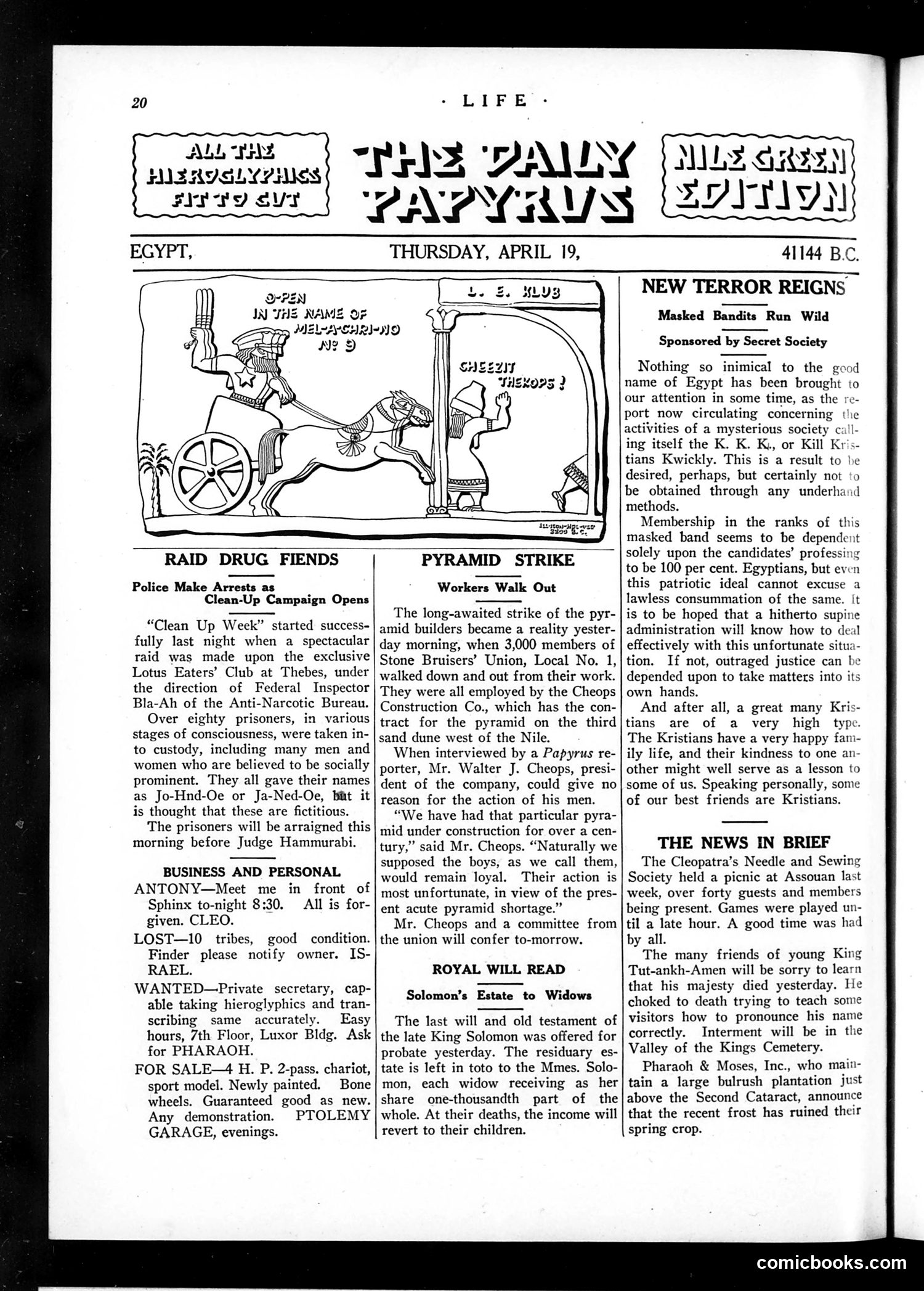
This is a satirical newspaper ("The Daily Papyrus") set in ancient Egypt (41144 B.C.), using historical figures and anachronisms as vehicles for contemporary American social commentary. **The cartoon** depicts Pharaoh in a chariot, labeled as "Melayehri-No No. 9"—likely mocking a specific contemporary political figure through Egyptian disguise. **The articles parody real 1920s American issues:** - "Raid Drug Fiends" at the "Lotus Eaters' Club" satirizes Prohibition-era drug enforcement - "Pyramid Strike" with the "Stone Bruisers' Union" mocks labor disputes and construction delays - "New Terror Reigns" explicitly references the KKK (spelled "K.K.K." for "Kill Kristians Kwickly"), satirizing the 1920s KKK resurgence by transposing it to Egypt targeting Christians—inverting the historical reality to critique American racism and religious intolerance - The personal ads (Anthony/Cleopatra, Solomon's will) use famous historical figures for comedic effect **The satire's point:** By placing contemporary American problems in ancient Egypt, Life magazine critiques 1920s society's moral failings while maintaining plausible deniability through historical costume.
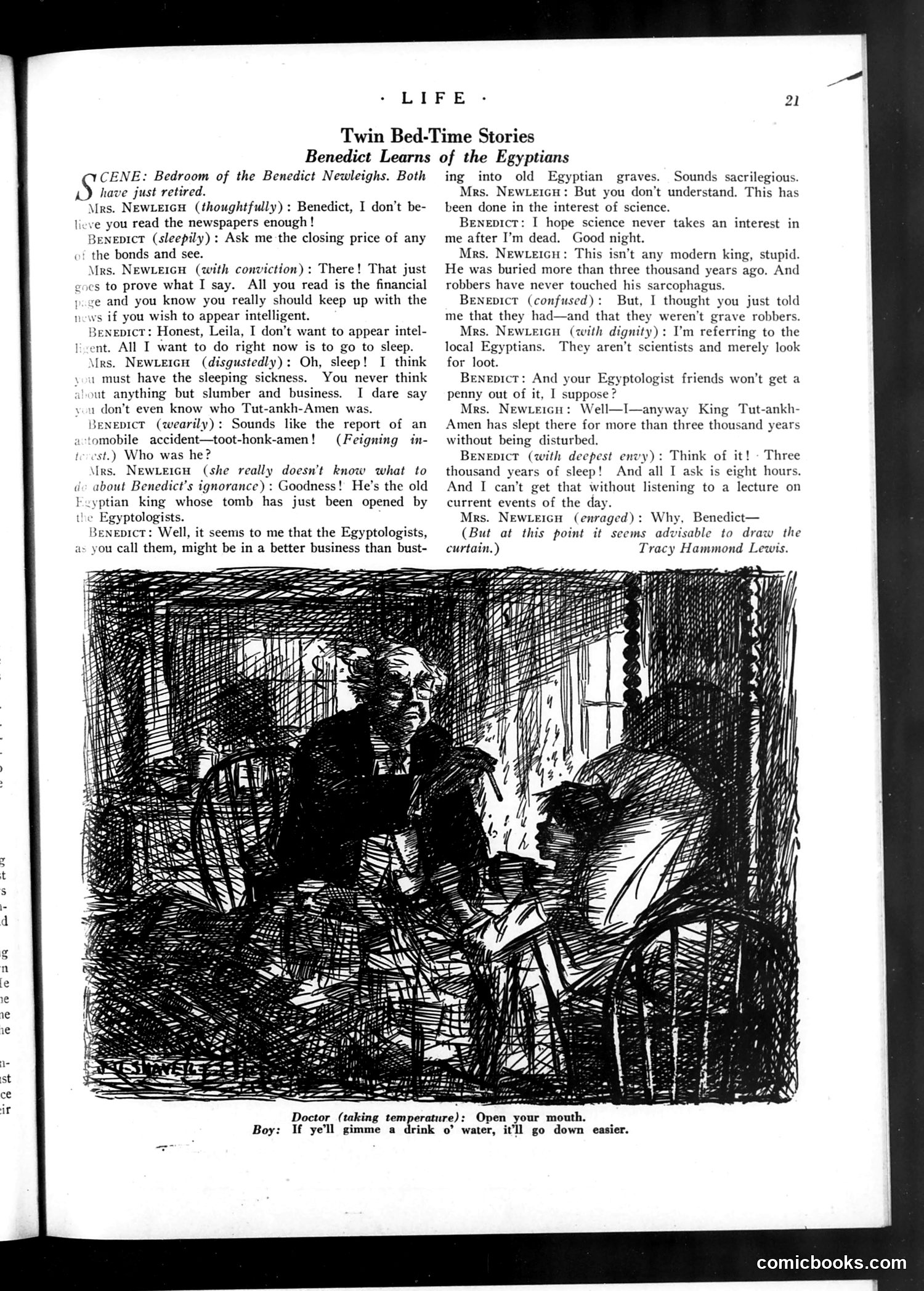
This domestic comedy satirizes both marital dynamics and the era's fascination with Egyptian archaeology—specifically King Tutankhamun's tomb, discovered in 1922. **The Setup:** Mrs. Benedict criticizes her husband for only reading financial news, not "current events." When she mentions Tut-ankh-Amen (Tutankhamun), Benedict responds with mock ignorance, confusing the name with automobile noises. **The Satire:** The humor targets two things: (1) the couple's stereotypical marriage—the nagging wife educating the indifferent husband—and (2) contemporary Egyptology mania. Mrs. Benedict's contradictory explanations about grave robbers reveal confused enthusiasm. Benedict's envious comment about the mummy sleeping 3,000 years undisturbed (while his wife lectures him nightly) is the core joke. **Context:** Tutankhamun's tomb opening caused international sensation in the 1920s, dominating newspapers. This piece gently mocks both the craze and domestic tedium, using the "current event" as a vehicle for spousal banter.
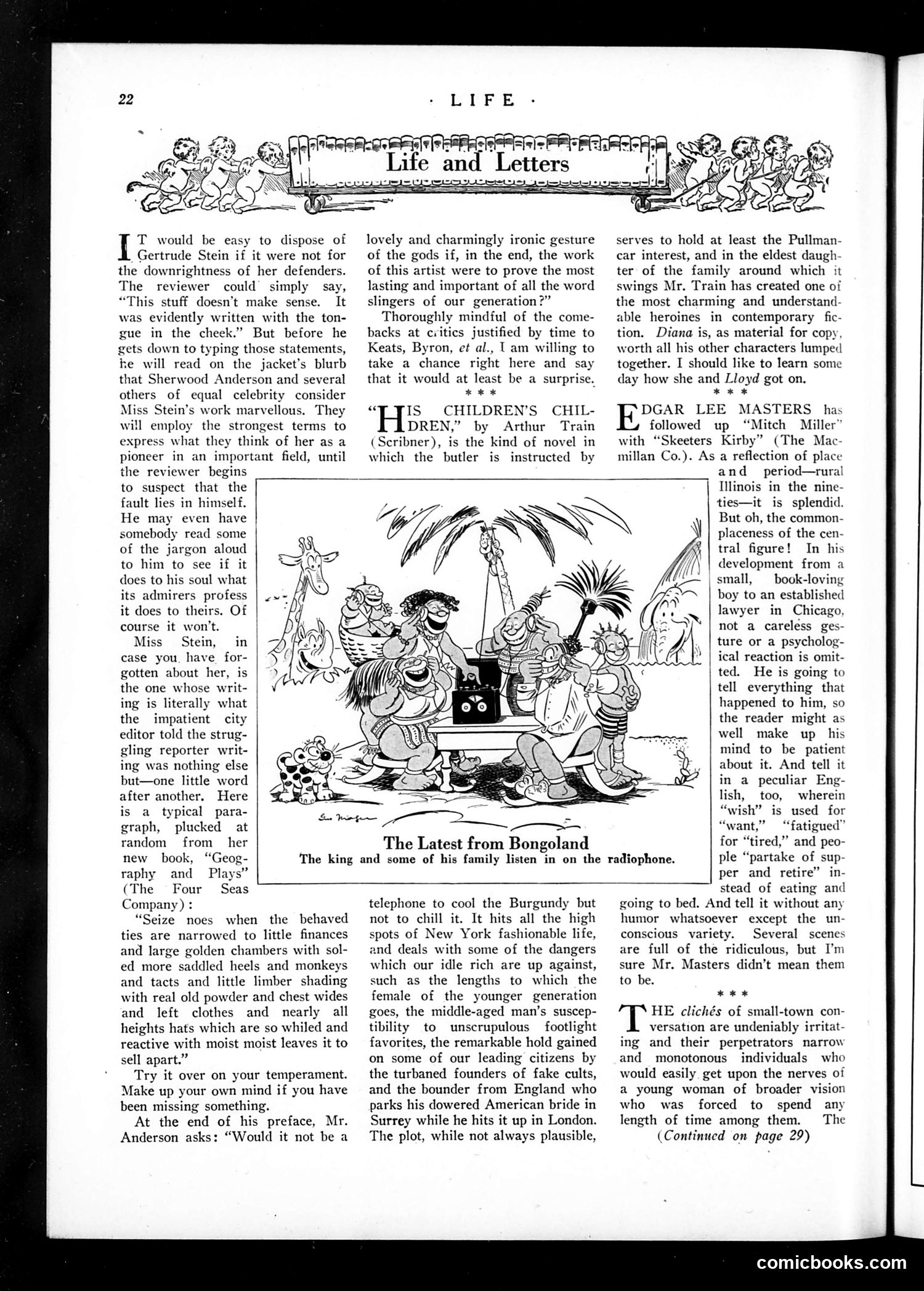
This page critiques **Gertrude Stein's experimental writing**, using satire to mock her incomprehensible prose style. The reviewer notes that while celebrity endorsers (Sherwood Anderson, et al.) praise Stein as a pioneering artist, her actual writing is nonsensical—literally "one little word after another" with no logical connection. The quoted passage exemplifies this: deliberately meaningless phrases like "saddled heels and monkeys" and "moist moist leaves." The cartoon **"The Latest from Bongaland"** depicts a colonial-era king listening to a radiophone, likely satirizing how exotic/"primitive" peoples are portrayed in media—a racist trope common to 1920s Life magazine. The page also reviews books by Arthur Train and Edgar Lee Masters, offering contrasting examples of conventional, readable fiction versus Stein's deliberate obscurity. The satire's point: Stein's defenders claim genius, but readers can judge the actual gibberish themselves.
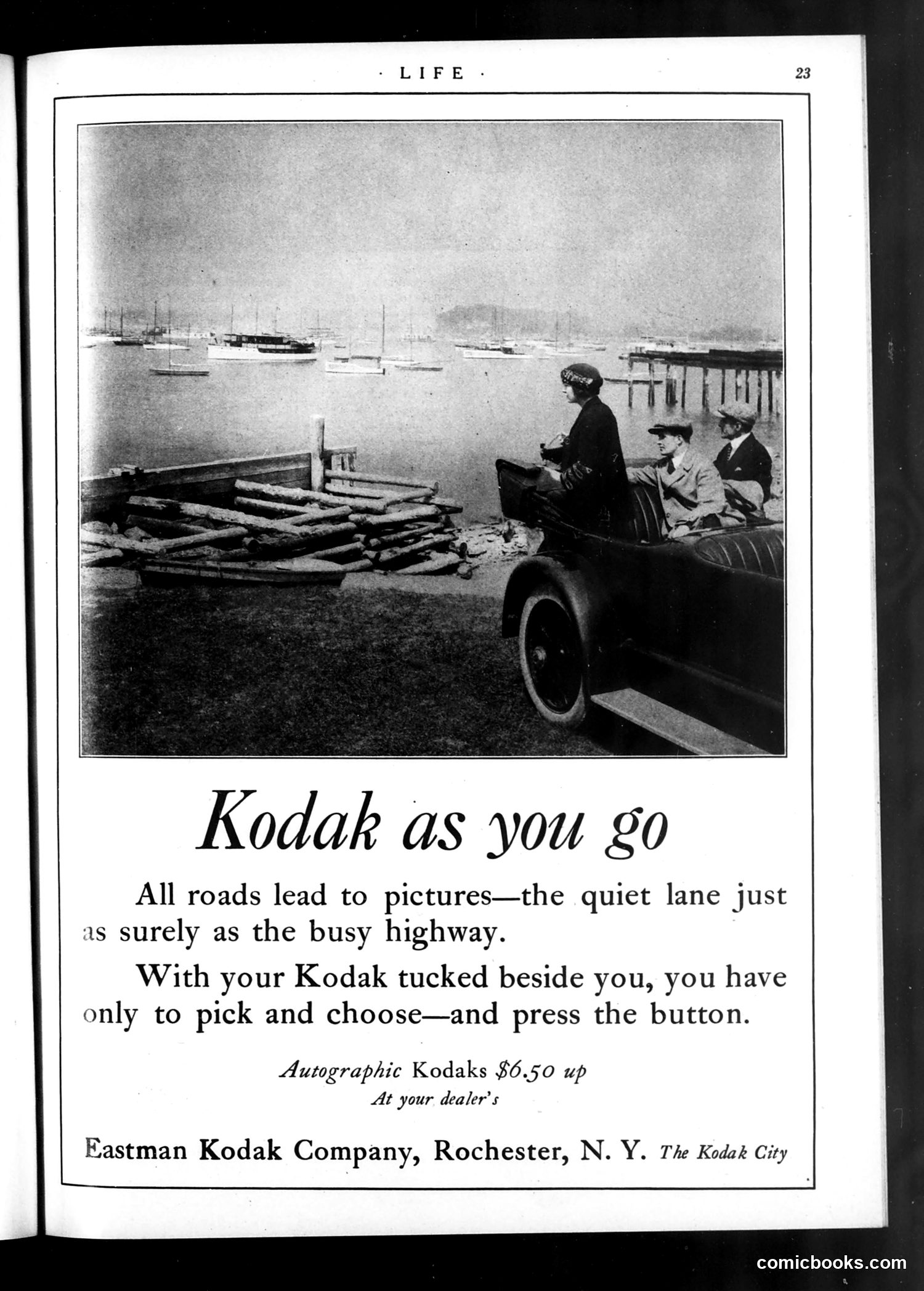
This is a Kodak advertisement, not political satire. It depicts three people in an early automobile parked near a beach or waterfront, with moored sailboats visible in the background. The ad promotes "Autographic Kodaks" starting at $6.50, emphasizing that photography is accessible to casual travelers—you simply "pick and choose—and press the button." The message appeals to the growing automobile culture and leisure travel of the era, positioning Kodak cameras as essential vacation companions. There is no cartoon or satirical commentary present; this is straightforward product advertising from Life magazine's commercial pages.
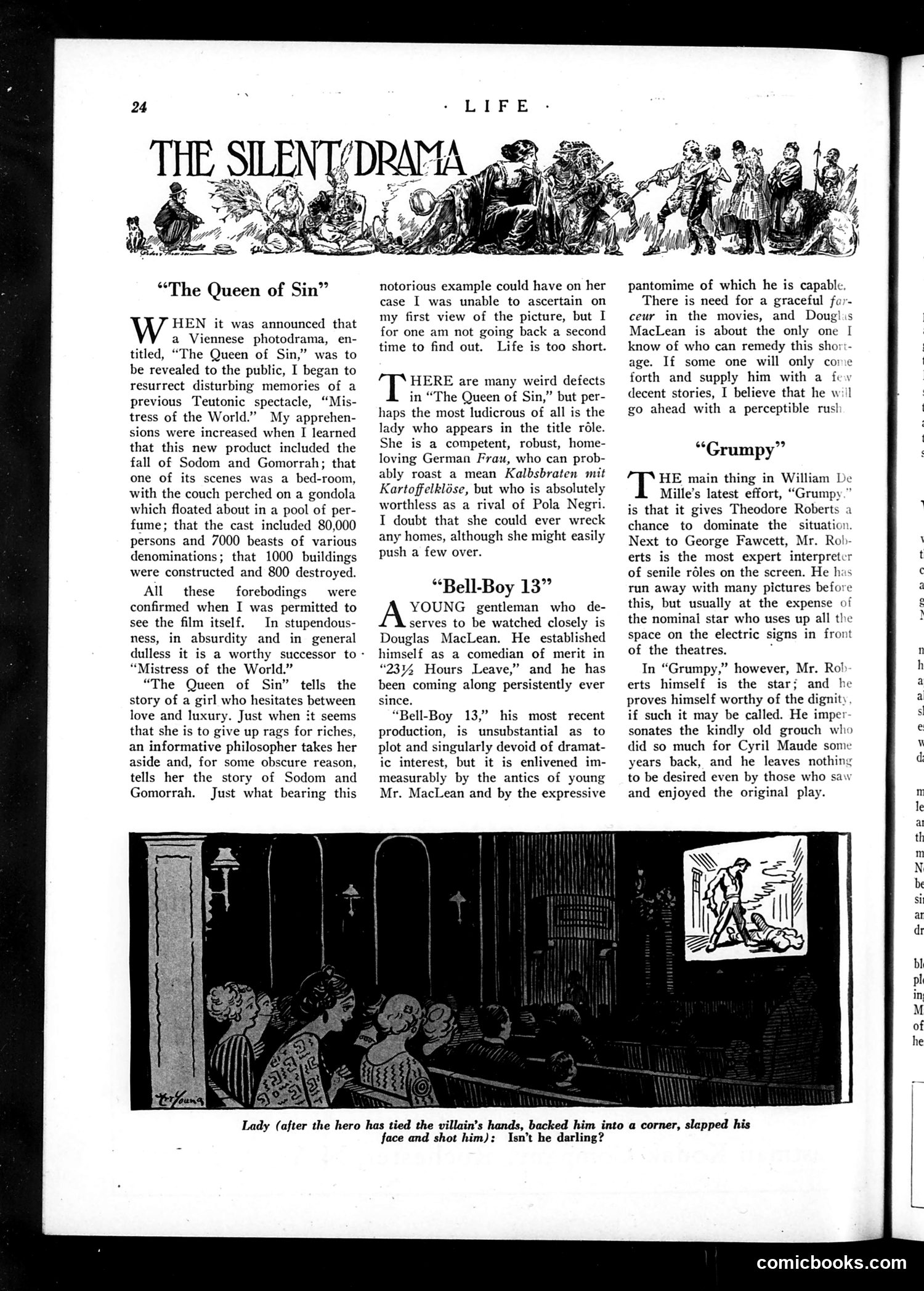
This page contains three film reviews from Life magazine's cinema criticism section. The reviews mock contemporary silent films with characteristic satire: **"The Queen of Sin"**: A scathing critique of this Viennese spectacle film. The reviewer mocks its excessive production values (80,000 extras, 7,000 animals, 1,000 buildings) and absurd plot devices (a bedroom on a floating gondola in perfume). The central joke attacks the lead actress—described as a competent German housewife unsuited to play a seductress who could "wreck homes," sarcastically suggesting she might only "push a few over." **"Bell-Boy 13"** and **"Grumpy"**: Positive reviews praising actors Douglas MacLean and Theodore Roberts respectively, noting their talent compensates for weak scripts. The **cartoon below** shows an audience watching a film; its caption satirizes melodramatic violence—a woman shoots a villain, then says "Isn't he darling?"—mocking the emotional absurdity of silent film plots and audience reactions to overwrought drama.
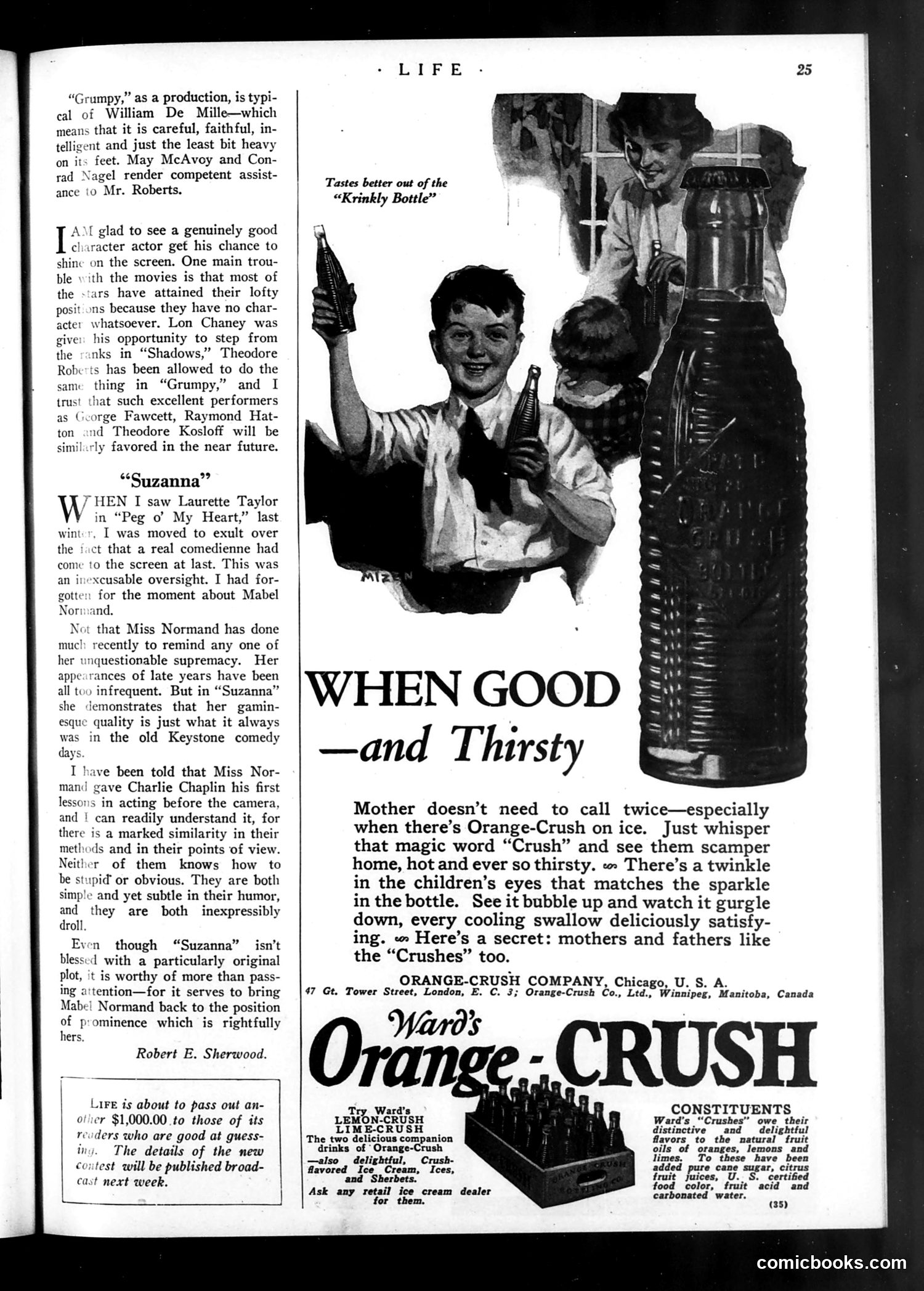
This page combines film criticism with advertising. The editorial content reviews three movies: "Grumpy" (starring May McAvoy and Conrad Nagel), and two films featuring silent-era comedians—one praising Theodore Roberts's character work, and another celebrating Mabel Normand's return to prominence in "Suzanna." The critic notes Normand had mentored Charlie Chaplin in early cinema and compares their similar acting styles: both "simple and yet subtle" without resorting to obvious comedy. The dominant content is an Orange-Crush beverage advertisement depicting a man with bottles, using the marketing angle that children eagerly respond to the product's name. The ad emphasizes the drink's natural fruit ingredients and appeals to both children and parents. A small notice at bottom announces Life magazine is giving away $1,000 to readers skilled at guessing—details to follow in future issues.
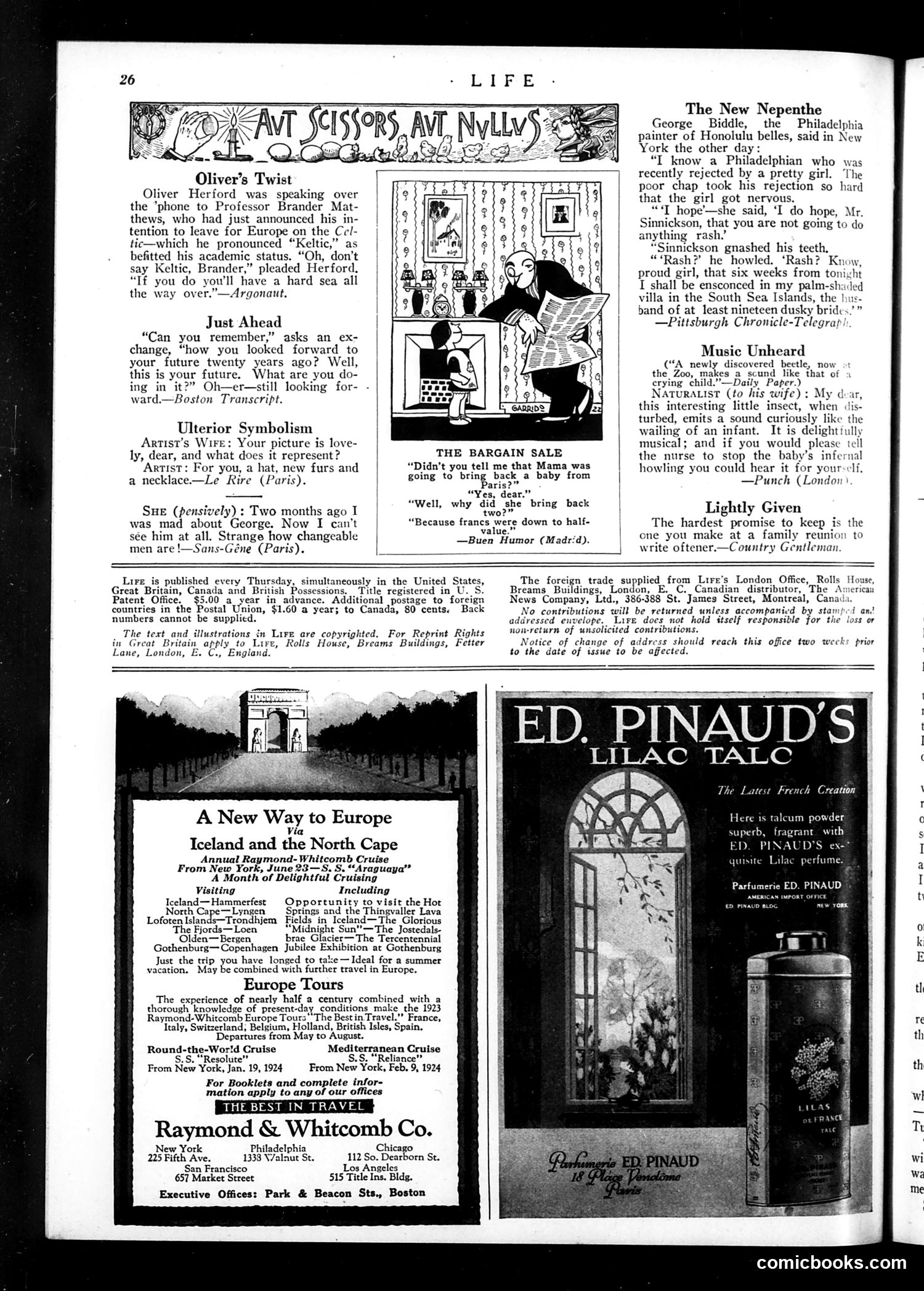
This page contains several brief satirical anecdotes and jokes typical of Life's humor format, plus advertisements. The main cartoon appears to be "The Bargain Sale," showing a woman presenting two babies to a man, illustrating a joke about currency exchange: a woman went to Paris to bring back one baby, but because "francs were down to half-value," she returned with two instead—a pun equating babies with a commodity purchased cheaper due to favorable exchange rates. The other content consists of short humorous pieces from various publications, including observations about rejected suitors, broken promises at family reunions, and a naturalist's beetle that sounds like a crying baby. These represent typical 1920s magazine humor: light, domestic, and often dependent on wordplay or ironic observations about human nature and social conventions. The advertisements promote European travel cruises and perfume, reflecting the magazine's affluent readership.
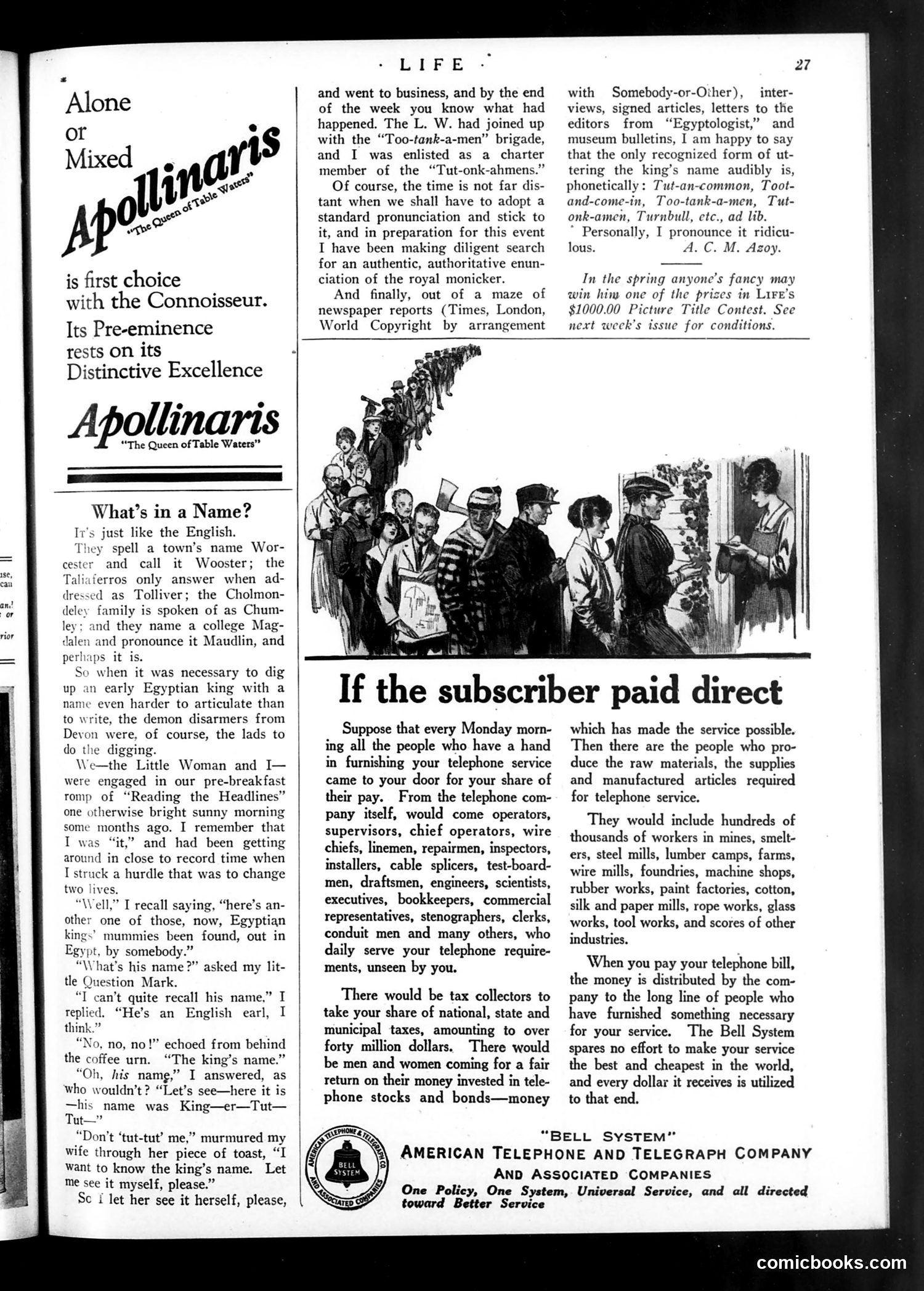
This page contains two distinct elements: a humorous essay about Egyptian King Tutankhamun's pronunciation, and a Bell Telephone advertisement. ## The Tutankhamun Essay The comic piece satirizes the difficulty English speakers had pronouncing "Tutankhamun" following the 1922 discovery of his tomb. The author describes how his family couldn't settle on the correct pronunciation, listing various competing versions ("Tut-an-common," "Too-tank-a-men," etc.). He notes that English people notoriously mispronounce their own place names and titles, making them the "lads" naturally suited to bungle an Egyptian pharaoh's name. The humor lies in the widespread confusion and the absurdity of having multiple "correct" pronunciations in newspapers and museums. ## The Bell Telephone Advertisement The ad argues for the centralized Bell System by illustrating that direct payment would require subscribers to individually pay hundreds of workers, tax collectors, and supply industries. It justifies the consolidated telephone bill as an efficient distribution system.
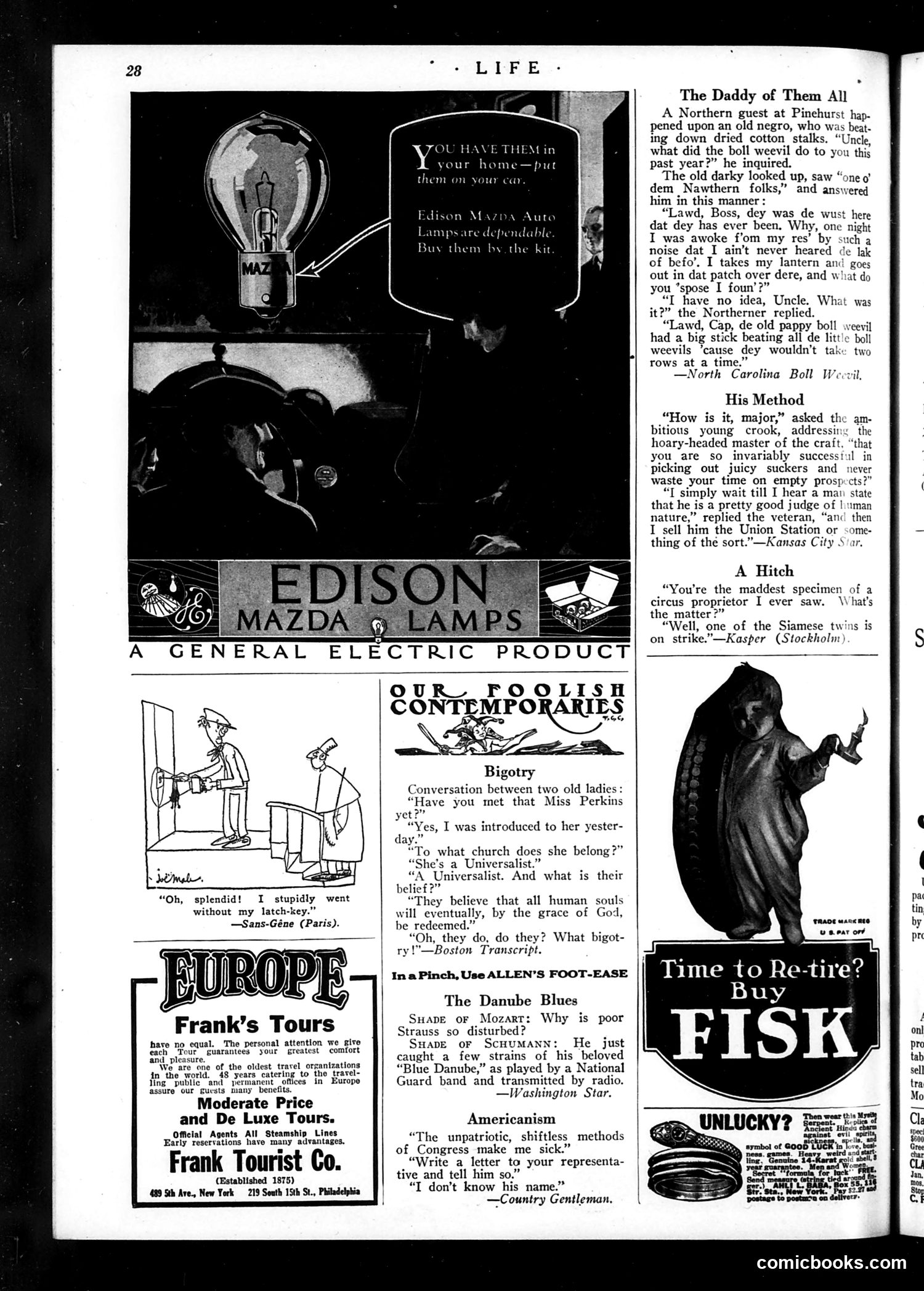
This page from *Life* magazine contains primarily **advertisements and humor columns** rather than political cartoons. The main cartoon shows a man who "stupidly went without [his] latch-key"—a joke about forgetfulness that relies on the period detail of physical door keys being essential before modern security. The "Our Foolish Contemporaries" humor section includes: - **"Bigotry"**: A satire on religious intolerance, where two ladies discuss Universalists (who believe in universal salvation). The joke is the second woman calling them bigoted—the opposite of the truth—suggesting casual prejudice masquerading as moral judgment. - **"The Danube Blues"**: A joke about radio broadcasts interrupting classical composers' rest with poor renditions of their work. - **"Americanism"**: Satirizes political apathy—a man complains about Congress but won't bother learning his representative's name. - **"The Daddy of Them All"**: A dialect-heavy joke about a Black worker describing boll weevils beating each other, playing on period racial stereotypes and rural humor. The rest is standard commercial advertising for travel agencies, auto lamps, and foot products.
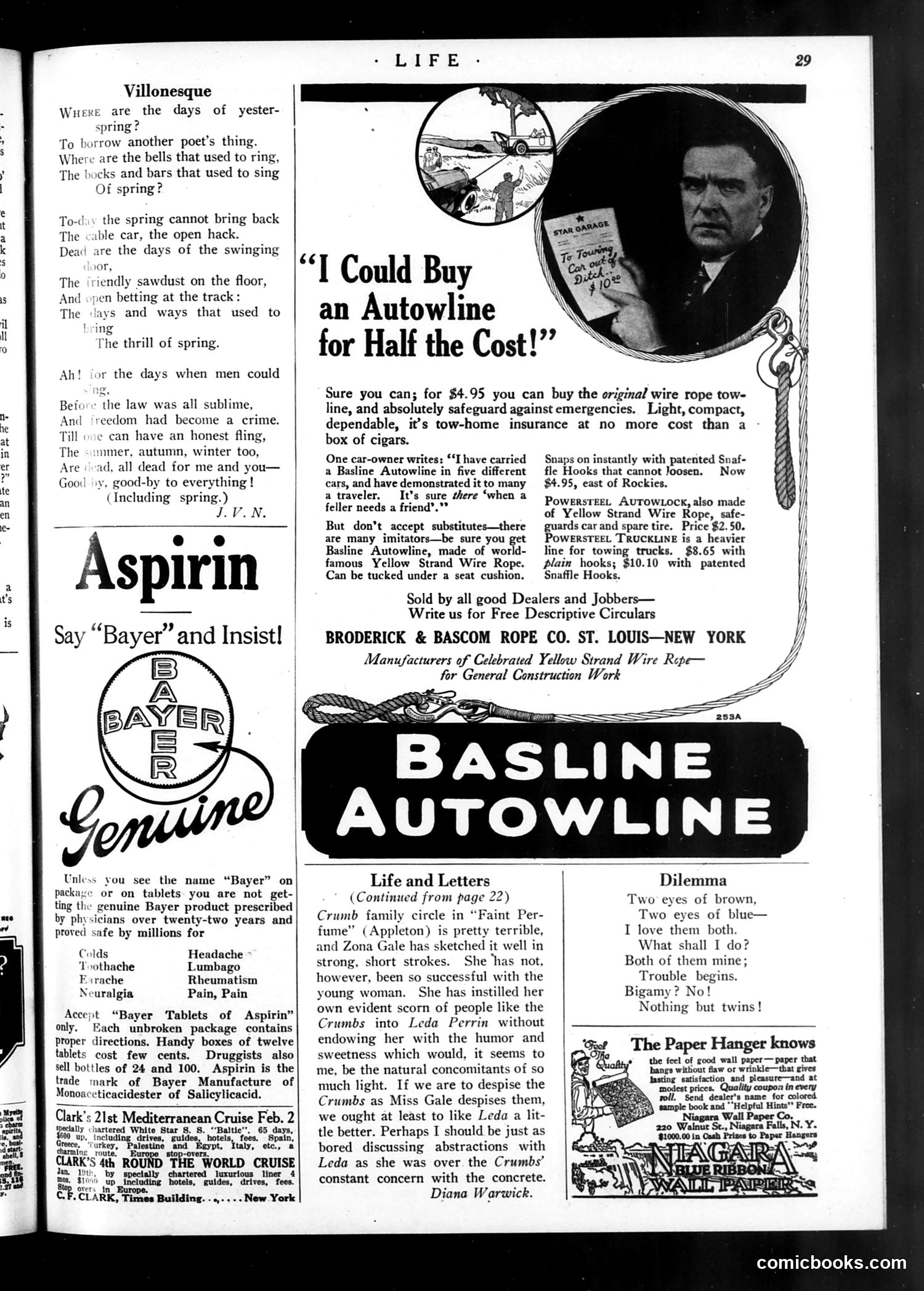
This page is primarily **advertising** with some literary content. The main features are: **Advertisements:** - **Bayer Aspirin**: A standard medical ad emphasizing the branded product's safety ("proved safe by millions") - **Basline Autowline**: A wire rope towing line pitched as cheap insurance ($4.95), with a testimonial from a satisfied user - Travel cruises by Clark **Literary Content:** - A poem titled "Villonesque" lamenting the loss of old springtime pleasures (cable cars, open carriages, betting at tracks)—nostalgic for pre-Prohibition, pre-regulatory times - "Life and Letters": Book reviews discussing character development in novels - "Dilemma": A brief humorous verse about loving two people with different eye colors **Historical Context for Modern Readers:** The nostalgic poem references Prohibition's impact (loss of "honest fling"), suggesting this is from the 1920s. The advertisements reflect consumer culture and early automotive convenience products. There is no political cartoon on this page.
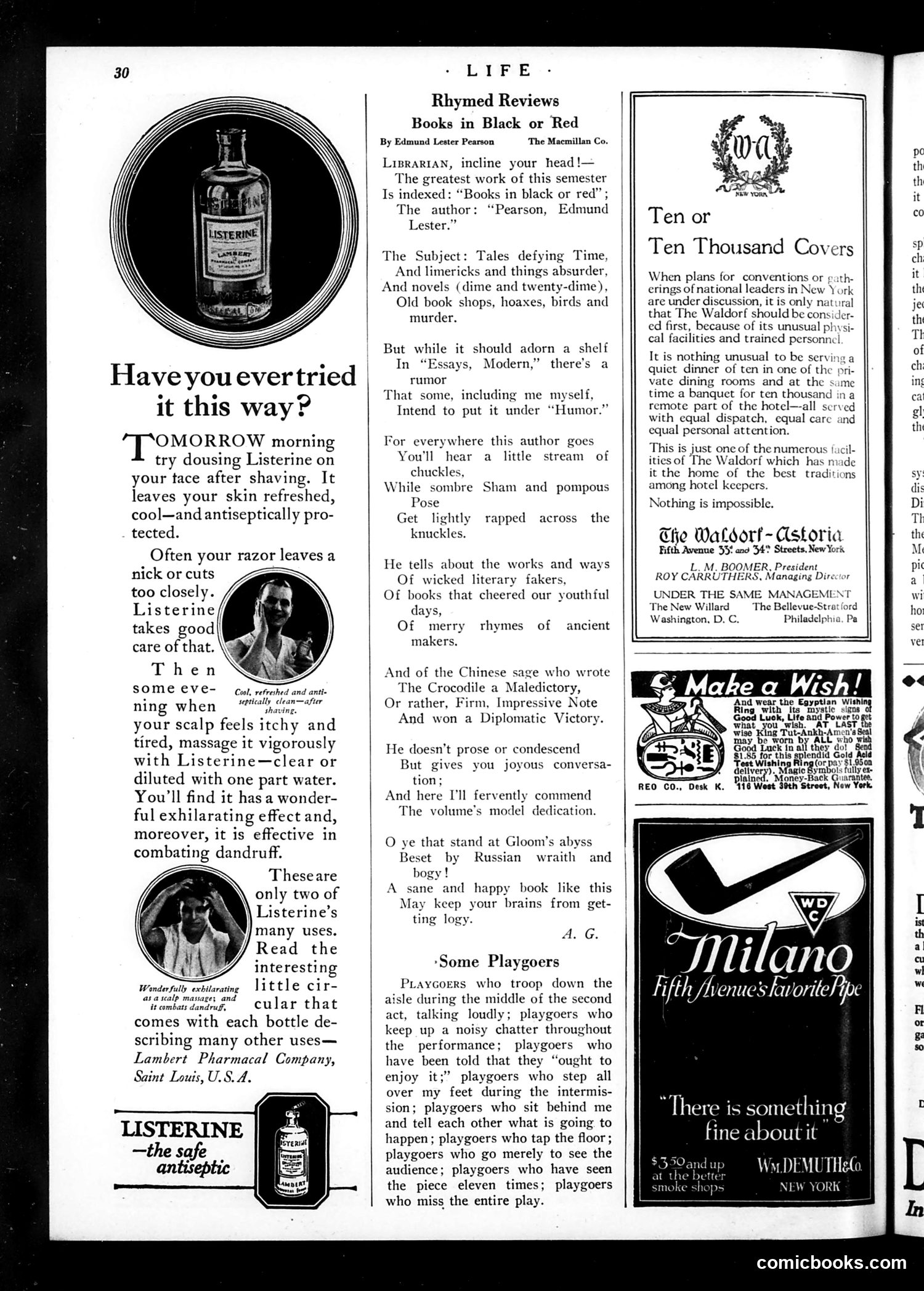
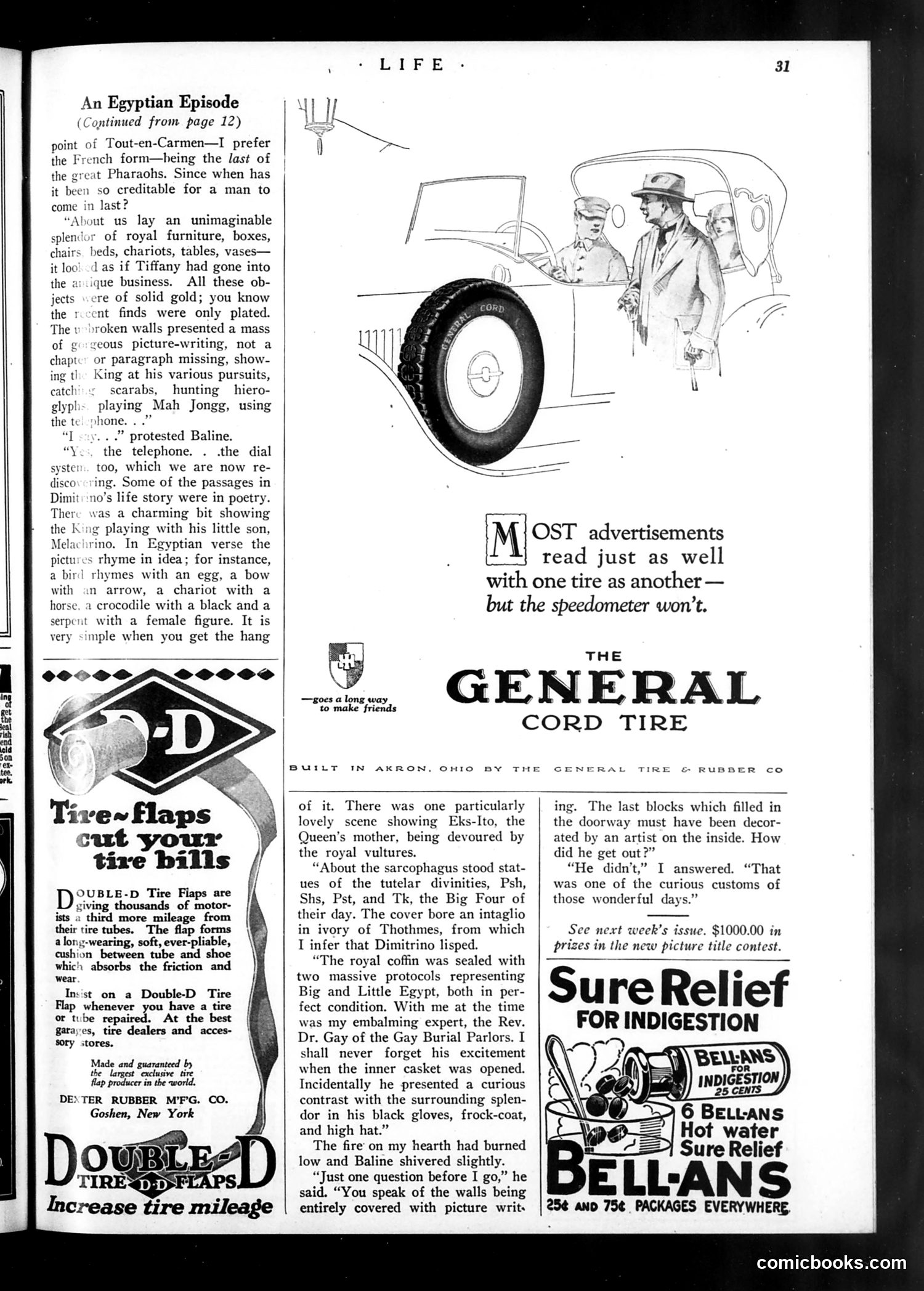
This page continues a humorous serialized story about an Egyptian archaeological discovery. The narrator describes finding Pharaoh Tout-en-Carmen's tomb filled with anachronistic luxuries—suggesting the ancient Egyptians had Tiffany furniture and used telephones and Mah Jongg. The satire mocks both Egyptian history and contemporary American obsessions with wealth and modernity. The joke peaks when Baline asks how the artist who painted the tomb's interior doorway escaped—revealing the artist was sealed inside, which the narrator matter-of-factly presents as merely "one of the curious customs of those wonderful days." The page is primarily a vehicle for period advertisements (tire flaps, General Cord Tires, Bellans indigestion remedy), typical of *Life* magazine's revenue model. The story itself satirizes both archaeological treasure-hunting fads of the era and the American tendency to project modern consumer culture onto ancient civilizations.
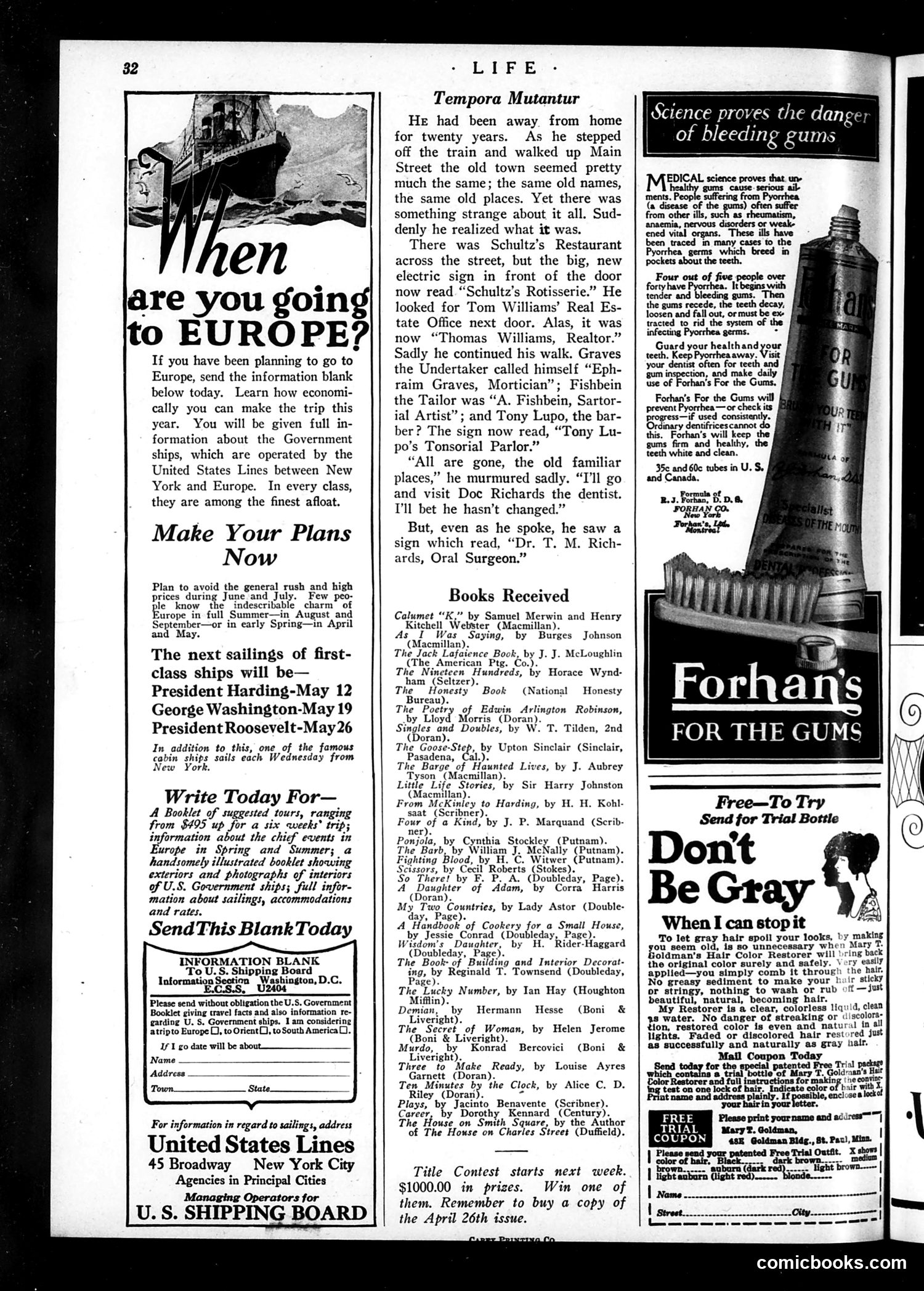
This brief story satirizes how American businesses adopted pretentious, Latinized terminology to rebrand themselves and appear more sophisticated. A man returns to his hometown after twenty years to find that familiar, plainly-named establishments have renamed themselves with inflated language: "Schultz's Restaurant" became "Schultz's Rotisserie," the barber shop is now a "Tonsorial Parlor," and the dentist practices as an "Oral Surgeon." The joke targets the era's commercial culture—likely the 1920s based on the magazine's context—where businesses believed foreign or technical terminology enhanced their status and appeal. The man's disappointment that even "Doc Richards" has succumbed to this trend underscores the satire: genuine local character has been sacrificed to fashionable jargon. The Latin title "Tempora Mutantur" ("Times Change") reinforces the irony that while everything appears different linguistically, nothing substantive has actually changed.
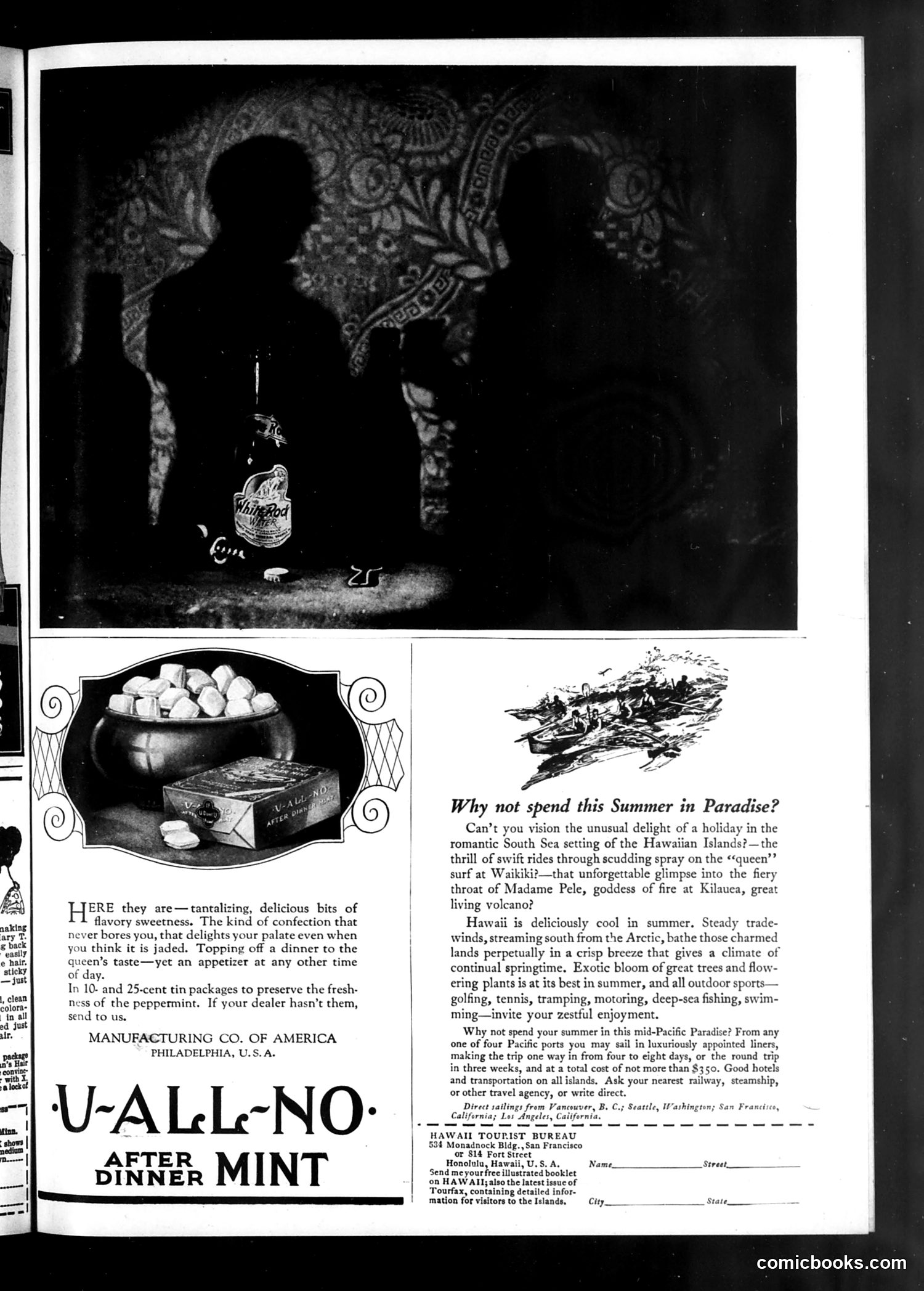
This page combines two advertisements: **U-ALL-NO After Dinner Mint** (lower left): A straightforward product ad for peppermint candies in tin packages, emphasizing their freshness and appeal as both after-dinner treats and palate cleansers. **Hawaii Tourism Advertisement** (right side and top): A travel promotion encouraging American summer vacations to Hawaii, highlighting romantic imagery (South Seas setting, Waikiki surf, volcanic sites like Madame Pele) and practical details (cost under $350 for round-trip, departure ports from West Coast cities, good hotels). **The silhouetted figures** (top image) appear to be theatrical or cinematic—likely evoking the exotic, romantic atmosphere Hawaii marketing of the era promoted to mainlanders. There is **no political satire** on this page. This is a commercial advertising spread typical of early 20th-century *Life* magazine, which balanced satirical content with paid advertisements. The messaging reflects period attitudes toward Hawaii as an exotic leisure destination for affluent Americans.
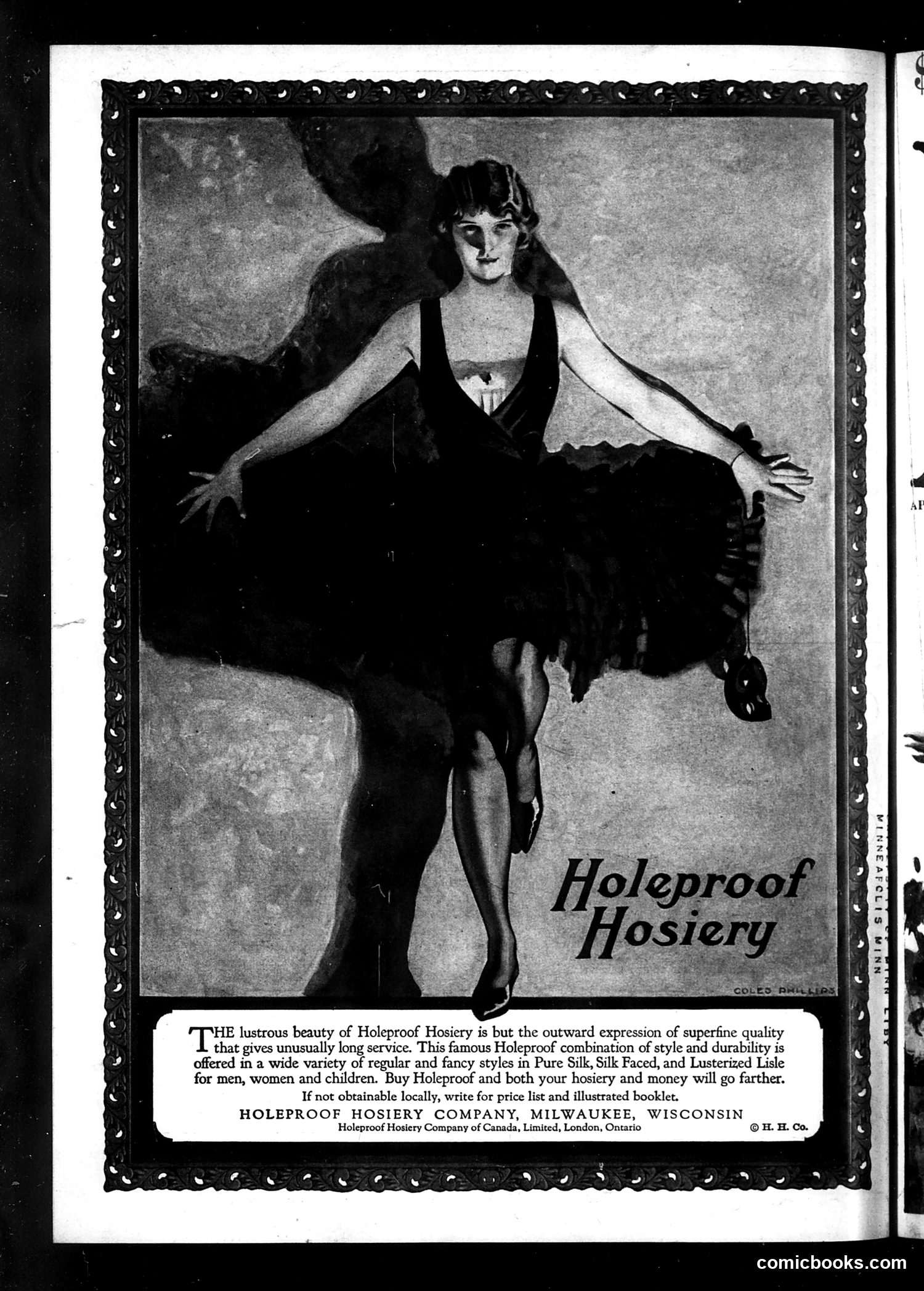
This page is **primarily an advertisement**, not political satire or editorial cartoon. It's a full-page ad for Holeproof Hosiery, a real Milwaukee-based company. The image shows a woman in 1920s attire striking a theatrical pose—legs displayed prominently, arms outstretched—to showcase the hosiery product. The styling and composition suggest elegance and durability. The ad copy emphasizes the brand's "superfine quality" and "unusually long service," positioning Holeproof as a practical yet stylish choice in "Pure Silk, Silk Faced, and Lusterized Lisle" for all family members. **Context for modern readers**: This represents typical early 20th-century advertising strategy—using glamorous female imagery to sell functional products, with emphasis on both aesthetic appeal and practical value. The woman's revealing pose was considered acceptable advertising technique of the era, though the actual product being sold (hosiery/stockings) was mundane.