
Life, 1923-04-19 · page 20 of 36
Life — April 19, 1923 — page 20: what you’re looking at
What you’re looking at
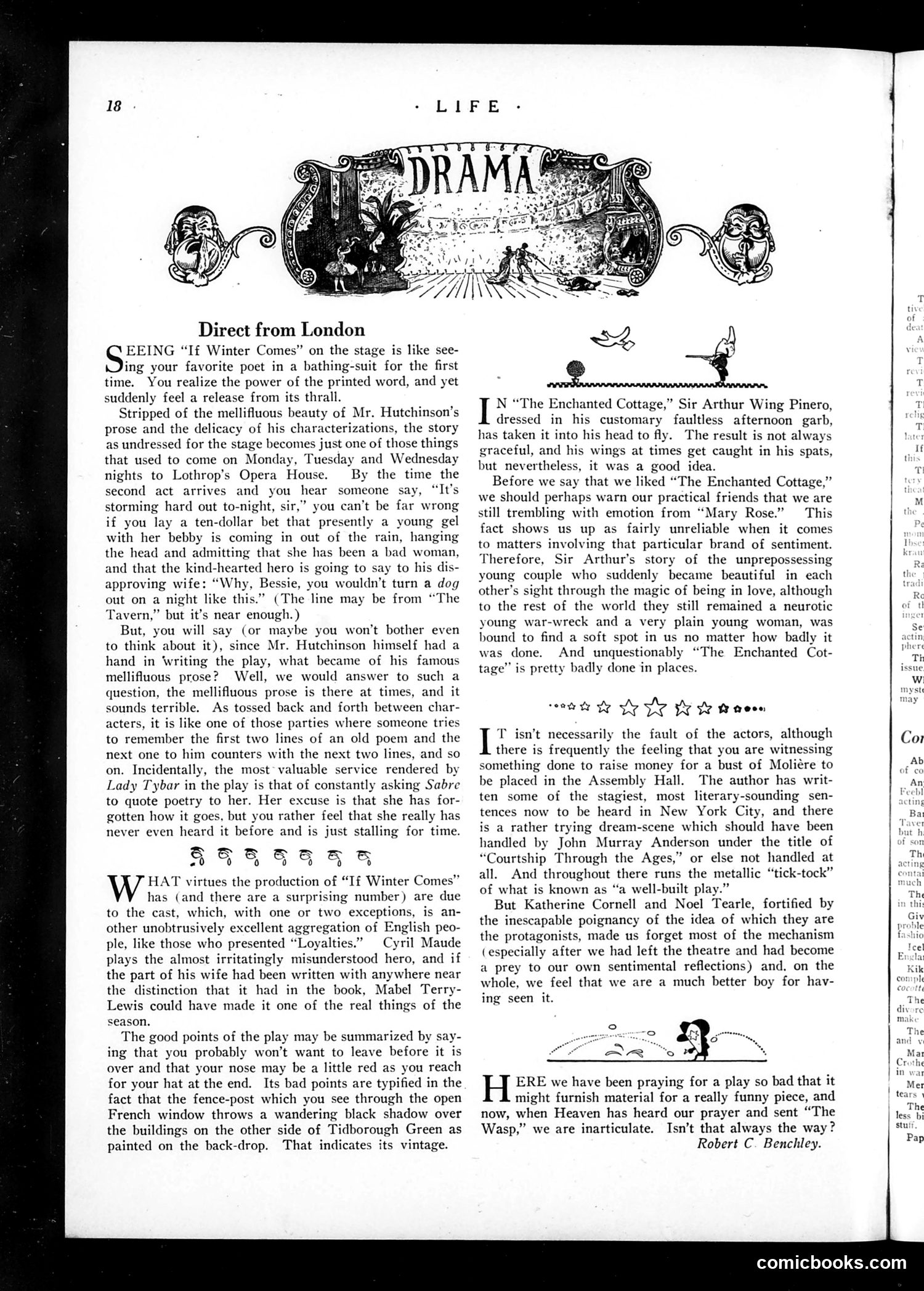
This page reviews two London theatrical productions. The first review critiques "If Winter Comes," adapted from a novel by A.S.M. Hutchinson. The critic argues the stage adaptation strips away the prose's beauty, becoming formulaic melodrama—the kind of sentimental Victorian play where a fallen woman arrives in the rain seeking redemption from a kind-hearted hero. The review praises the English cast (particularly Cyril Maude and Mabel Terry-Lewis) while mocking the artificial staging details, like a fence-post shadow that looks dated. The second review discusses Sir Arthur Wing Pinero's "The Enchanted Cottage," about an unattractive couple who appear beautiful only to each other through love's magic. The critic admits emotional bias from recently seeing "Mary Rose" (also by Pinero), affecting their judgment of this sentimental story involving a war-damaged man and plain woman. Both reviews employ satirical wit to critique theatrical conventions and sentimentality in English drama.
📄 Transcribed text from this page (OCR, searchable)
Machine-transcribed from the original scan — historical spelling and the odd misread are preserved.
ie v0) iw Direct from London EEING “If Winter Comes” on the stage is like see- ing your favorite poet in a bathing-suit for the first time. You realize the power of the printed word, and yet suddenly feel a release from its thrall. Stripped of the mellifluous beauty of Mr. Hutchinson’s prose and the delicacy of his characterizations, the story as undressed for the stage becomes just one of those things that used to come on Monday, Tuesday and Wednesday nights to Lothrop’s Opera House. By the time the second act arrives and you hear someone say, “It’s storming hard out to-night, sir,” you can’t be far wrong if you lay a ten-dollar bet that presently a young gel with her bebby is coming in out of the rain, hanging the head and admitting that she has been a bad woman, and that the kind-hearted hero is going to say to his dis- approving wife: “Why, Bessie, you wouldn’t turn a dog out on a night like this.” (The line may be from “The Tavern,” but it’s near enough.) But, you will say (or maybe you won't bother even to think about it), since Mr. Hutchinson himself had a hand in ‘writing the play, what became of his famous mellifluous prose? Well, we would answer to such a question, the mellifluous prose is there at times, and it sounds terrible. As tossed back and forth between char- acters, it is like one of those parties where someone tries to remember the first two lines of an old poem and the next one to him counters with the next two lines, and so on. Incidentally, the most~ valuable service rendered by Lady Tybar in the play is that of constantly asking Sabre to quote poetry to her. Her excuse is that she has for- gotten how it goes, but you rather feel that she really has never even heard it before and is just stalling for time. HAT virtues the production of “If Winter Comes” has (and there are a surprising number) are due to the cast, which, with one or two exceptions, is an- other unobtrusively excellent aggregation of English peo- ple, like those who presented “Loyalties.” Cyril Maude plays the almost irritatingly misunderstood hero, and if the part of his wife had been written with anywhere near the distinction that it had in the book, Mabel Terry- Lewis could have made it one of the real things of the season. The good points of the play may be summarized by say- ing that you probably won’t want to leave before it is over and that your nose may be a little red as you reach for your hat at the end. Its bad points are typified in the fact that the fence-post which you see through the open French window throws a wandering black shadow over the buildings on the other side of Tidborough Green as painted on the back-drop. That indicates its vintage. N “The Enchanted Cottage,” Sir Arthur Wing Pinero, dressed in his customary faultless afternoon garb, has taken it into his head to fly. The result is not always graceful, and his wings at times get caught in his spats, but nevertheless, it was a good idea. Before we say that we liked “The Enchanted Cottage,” we should perhaps warn our practical friends that we are still trembling with emotion from “Mary Rose.” This fact shows us up as fairly unreliable when it comes to matters involving that particular brand of sentiment. Therefore, Sir Arthur’s story of the unprepossessing young couple who suddenly became beautiful in each other’s sight through the magic of being in love, although to the rest of the world they still remained a neurotic young war-wreck and a very plain young woman, was bound to find a soft spot in us no matter how badly it was done. And unquestionably “The Enchanted Cot- tage”’ is pretty badly done in places. sow wy WLS oy ey eee T isn’t necessarily the fault of the actors, although there is frequently the feeling that you are witnessing something done to raise money for a bust of Moliére to be placed in the Assembly Hall. The author has writ- ten some of the stagiest, most literary-sounding sen- tences now to be heard in New York City, and there is a rather trying dream-scene which should have been handled by John Murray Anderson under the title of “Courtship Through the Ages,” or else not handled at all. And throughout there runs the metallic “tick-tock” of what is known as “a well-built play.” But Katherine Cornell and Noel Tearle, fortified by the inescapable poignancy of the idea of which they are the protagonists, made us forget most of the mechanism (especially after we had left the theatre and had become a prey to our own sentimental reflections) and, on the whole, we feel that we are a much better boy for hav- ing seen it. ERE we have been praying for a play so bad that it might furnish material for a really funny piece, and now, when Heaven has heard our prayer and sent “The Wasp,” we are inarticulate. Isn’t that always the way? Robert C. Benchley. comicbooks.com