
Life, 1923-04-19 · page 26 of 36
Life — April 19, 1923 — page 26: what you’re looking at
What you’re looking at
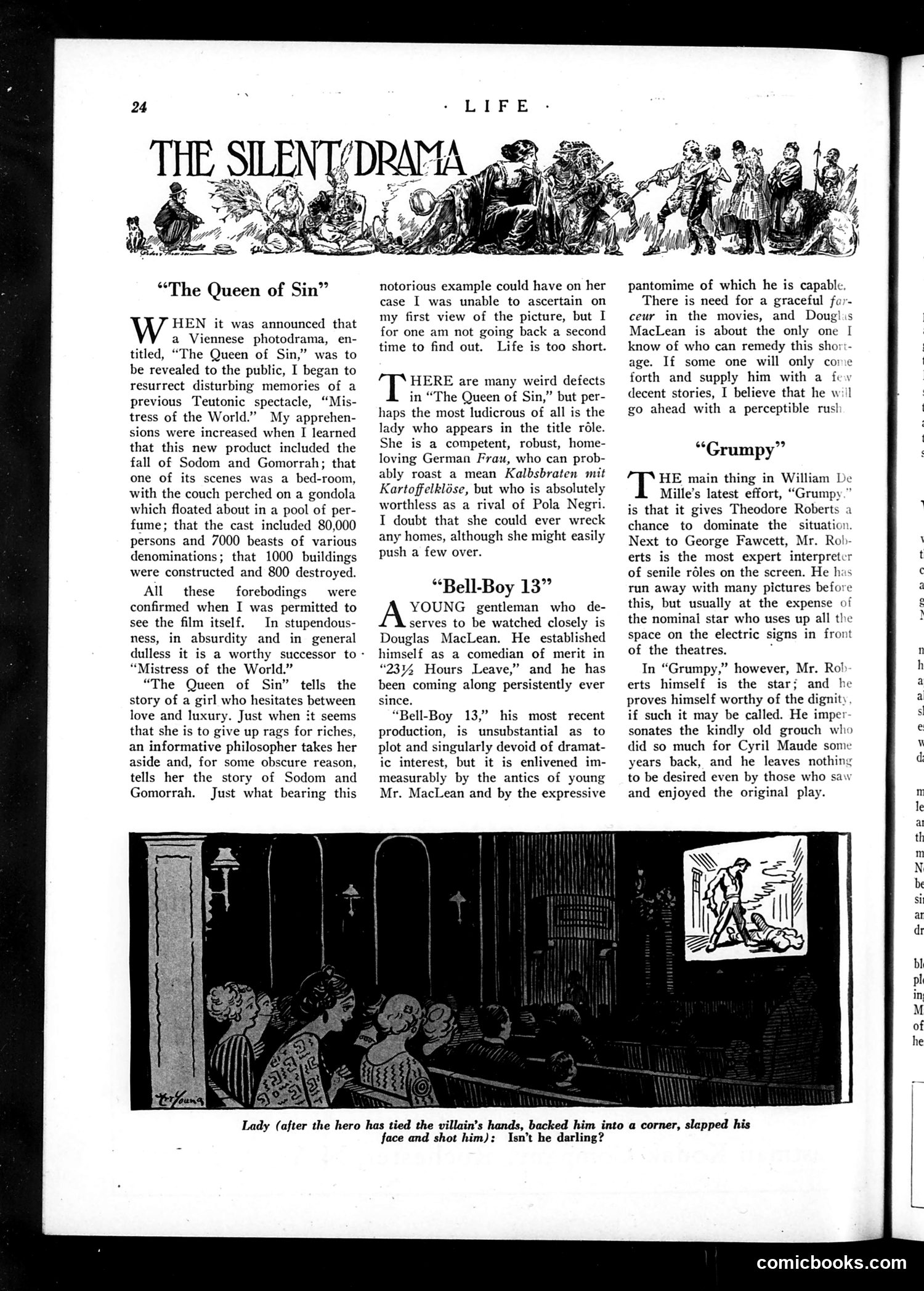
This page contains three film reviews from Life magazine's cinema criticism section. The reviews mock contemporary silent films with characteristic satire: **"The Queen of Sin"**: A scathing critique of this Viennese spectacle film. The reviewer mocks its excessive production values (80,000 extras, 7,000 animals, 1,000 buildings) and absurd plot devices (a bedroom on a floating gondola in perfume). The central joke attacks the lead actress—described as a competent German housewife unsuited to play a seductress who could "wreck homes," sarcastically suggesting she might only "push a few over." **"Bell-Boy 13"** and **"Grumpy"**: Positive reviews praising actors Douglas MacLean and Theodore Roberts respectively, noting their talent compensates for weak scripts. The **cartoon below** shows an audience watching a film; its caption satirizes melodramatic violence—a woman shoots a villain, then says "Isn't he darling?"—mocking the emotional absurdity of silent film plots and audience reactions to overwrought drama.
📄 Transcribed text from this page (OCR, searchable)
Machine-transcribed from the original scan — historical spelling and the odd misread are preserved.
“The Queen of Sin” HEN it was announced that a Viennese photodrama, en- titled, “The Queen of Sin,” was to be revealed to the public, I began to resurrect disturbing memories of a previous Teutonic spectacle, “Mis- tress of the World.” My apprehen- sions were increased when I learned that this new product included the fall of Sodom and Gomorrah; that one of its scenes was a bed-room, with the couch perched on a gondola which floated about in a pool of per- fume; that the cast included 80,000 persons and 7000 beasts of various denominations; that 1000 buildings were constructed and 800 destroyed. All these forebodings were confirmed when I was permitted to see the film itself. In stupendous- ness, in absurdity and in general dulless it is a worthy successor to - “Mistress of the World.” “The Queen of Sin” tells the story of a girl who hesitates between love and luxury. Just when it seems that she is to give up rags for riches, an informative philosopher takes her aside and, for some obscure reason, tells her the story of Sodom and Gomorrah. Just what bearing this notorious example could have on her case I was unable to ascertain on my first view of the picture, but I for one am not going back a second time to find out. Life is too short. HERE are many weird defects in “The Queen of Sin,” but per- haps the most ludicrous of all is the lady who appears in the title réle. She is a competent, robust, home- loving German Frau, who can prob- ably roast a mean Kalbsbraten mit Kartoffelklése, but who is absolutely worthless as a rival of Pola Negri. I doubt that she could ever wreck any homes, although she might easily push a few over. “Bell-Boy 13” YOUNG gentleman who de- serves to be watched closely is Douglas MacLean. He established himself as a comedian of merit in “23%4 Hours Leave,” and he has been coming along persistently ever since. “Bell-Boy 13,” his most recent production, is unsubstantial as to plot and singularly devoid of dramat- ic interest, but it is enlivened im- measurably by the antics of young Mr. MacLean and by the expressive pantomime of which he is capable. There is need for a graceful far- ceur in the movies, and Douglis MacLean is about the only one [ know of who can remedy this shori- age. If some one will only come forth and supply him with a few decent stories, I believe that he will go ahead with a perceptible rus! “Grumpy” HE main thing in William De Mille’s latest effort, “Grumpy.” is that it gives Theodore Roberts a chance to dominate the situation. Next to George Fawcett, Mr. Rob- erts is the most expert interpreter of senile roles on the screen. He has run away with many pictures before this, but usually at the expense of the nominal star who uses up all the space on the electric signs in front of the theatres. . In “Grumpy,” however, Mr. Rol erts himself is the star; and he proves himself worthy of the dignity if such it may be called. He imper- sonates the kindly old grouch who did so much for Cyril Maude some years back, and he leaves nothing to be desired even by those who saw and enjoyed the original play. Lady (after the hero has tied the villain’s hands, backed him into a corner, slapped his face and shot him): Isn’t he darling? comicbooks.com