
Life, 1923-04-19 · page 8 of 36
Life — April 19, 1923 — page 8: what you’re looking at
What you’re looking at
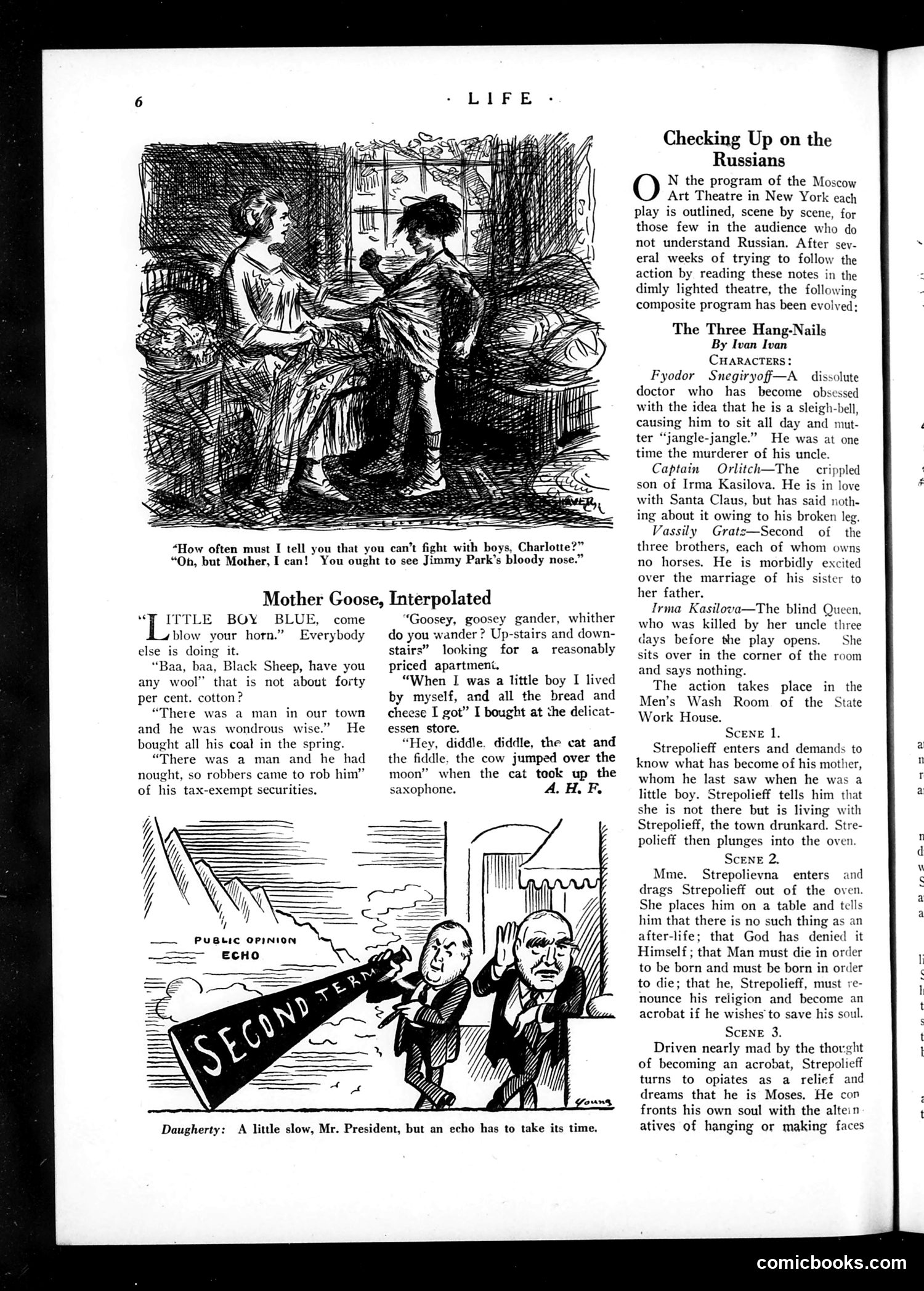
This page contains two distinct elements: **"Mother Goose, Interpolated"** is a humorous piece that inserts contemporary cynicism into the nursery rhyme "Little Boy Blue." The original's innocent lyrics are disrupted with modern observations—a man "wondrous wise" who bought stock in a spring becomes a con artist; a jumping cow becomes a saxophone-playing cat. The satire mocks both 1920s consumerism and get-rich-quick schemes. **"Public Opinion Echo"** (lower cartoon) depicts two men operating a megaphone labeled "SECOND TEAM," with the caption suggesting they're merely echoing the President's ideas slowly. This appears to satirize government spokesmen or media figures as unoriginal repeaters rather than independent voices—a critique of political messaging and institutional conformity during this era.
📄 Transcribed text from this page (OCR, searchable)
Machine-transcribed from the original scan — historical spelling and the odd misread are preserved.
“How often must I tell you that you can’t fight with boys, Charlotte?” “On, but Mother, I can! You ought to see Jimmy Park’s bloody nose.” Mother Goose, Interpolated “7 ITTLE BOY BLUE, blow your horn.” else is doing it. “Baa, baa, Black Sheep, have you any wool” that is not about forty per cent. cotton? “There was a man in our town and he was wondrous wise.” He bought all his coal in the spring. “There was a man and he had nought, so robbers came to rob him” of his tax-exempt securities. come Everybody “Goosey, goosey gander, whither do you wander? Up-stairs and down- stairs” looking for a reasonably priced apartment. “When I was a little boy I lived by myself, and all the bread and cheese I got” I bought at the delicat- essen store. “Hey, diddle. diddle, the cat and the fiddle. the cow jumped over the moon” when the cat took up the saxophone. Daugherty: A little slow, Mr. President, but an echo has to take its time. Checking Up on the Russians N the program of the Moscow Art Theatre in New York each play is outlined, scene by scene, for those few in the audience who do not understand Russian. After sey- eral weeks of trying to follow the action by reading these notes in the dimly lighted theatre, the following composite program has been evolved: The Three Hang-Nails By Ivan Ivan CHARACTERS: Fyodor Snegiryoff—A dissolute doctor who has become obsessed with the idea that he is a sleigh-bell, causing him to sit all day and mut- ter “jangle-jangle.” He was at one time the murderer of his uncle. Captain Orlitch—The crippled son of Irma Kasilova. He is in love with Santa Claus, but has said noth- ing about it owing to his broken leg. Vassily Grats—Second of the three brothers, each of whom owns no horses. He is morbidly excited over the marriage of his sister to her father. Irma Kasilova—The blind Queen, who was killed by her uncle three days before the play opens. She sits over in the corner of the room and says nothing. The action takes place in the Men’s Wash Room of the State Work House. Scene 1. Strepolieff enters and demands to know what has become of his mother, whom he last saw when he was a little boy. Strepolieff tells him that she is not there but is living with Strepolieff, the town drunkard. Stre- polieff then plunges into the oven. Scene 2. Mme. Strepolievna enters and drags Strepolieff out of the oven. She places him on a table and tells him that there is no such thing as an after-life; that God has denied it Himself ; that Man must die in order to be born and must be born in order to die; that he, Strepolieff, must re- nounce his religion and become an acrobat if he wishes to save his soul. Scene 3. Driven nearly mad by the thorght of becoming an acrobat, Strepolieff turns to opiates as a relief and dreams that he is Moses. He con fronts his own soul with the altein atives of hanging or making faces comicbooks.com