
Life, 1923-04-19 · page 16 of 36
Life — April 19, 1923 — page 16: what you’re looking at
What you’re looking at
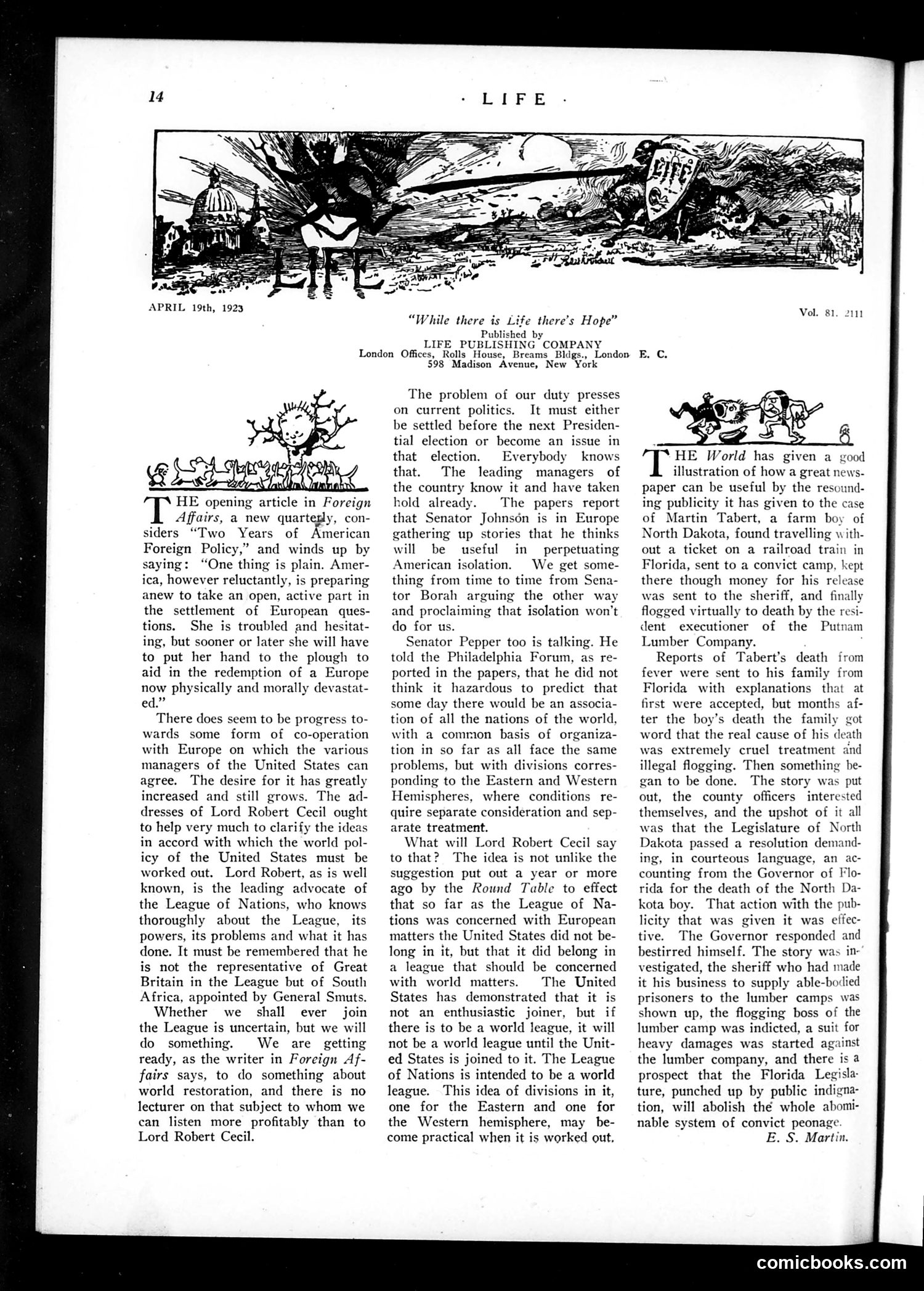
This page contains editorial commentary rather than political cartoons. The main illustrated header shows the magazine's masthead with allegorical figures. The text discusses U.S. foreign policy and European reconstruction post-WWI. It references: - **Senator Johnson** and **Senator Pepper** debating American isolationism versus international engagement - **Lord Robert Cecil**, an advocate for the League of Nations - A story about **Tabert**, a farm boy from North Dakota, who died in a Florida convict labor camp under suspicious circumstances, prompting investigation and public outrage The editors argue America must take an active role in world affairs and criticize isolationist senators. The Tabert case illustrates brutal, illegal treatment in Southern penal systems—a contemporary scandal that embarrassed Florida's government and prompted reform demands.
📄 Transcribed text from this page (OCR, searchable)
Machine-transcribed from the original scan — historical spelling and the odd misread are preserved.
APRIL 19th, 1923 “While there is Life there’s Hope” Published by LIFE PUBLISHING COMPANY Vol. 81. 2111 London Offices, Rolls House, Breams Bldgs., London E. C. HE opening article in Foreign Affairs, a new quartesly, con- siders “Two Years of American Foreign Policy,’ and winds up by saying: “One thing is plain. Amer- ica, however reluctantly, is preparing anew to take an open, active part in the settlement of European ques- tions. She is troubled and hesitat- ing, but sooner or later she will have to put her hand to the plough to aid in the redemption of a Europe now physically and morally devastat- ed.” There does seem to be progress to- wards some form of co-operation with Europe on which the various managers of the United States can agree. The desire for it has greatly increased and still grows. The ad- dresses of Lord Robert Cecil ought to help very much to clarify the ideas in accord with which the world pol- icy of the United States must be worked out. Lord Robert, as is well known, is the leading advocate of the League of Nations, who knows thoroughly about the League, its powers, its problems and what it has done. It must be remembered that he is not the representative of Great Britain in the League but of South Africa, appointed by General Smuts. Whether we shall ever join the League is uncertain, but we will do something. We are getting ready, as the writer in Foreign Af- fairs says, to do something about world restoration, and there is no lecturer on that subject to whom we can listen more profitably than to Lord Robert Cecil. 598 Madison Avenue, New York The problem of our duty presses on current politics. It must either be settled before the next Presiden- tial election or become an issue in that election. Everybody knows that. The leading managers of the country know it and have taken hold already. The papers report that Senator Johnson is in Europe gathering up stories that he thinks will be useful in perpetuating American isolation. We get some- thing from time to time from Sena- tor Borah arguing the other way and proclaiming that isolation won't do for us. Senator Pepper too is talking. He told the Philadelphia Forum, as re- ported in the papers, that he did not think it hazardous to predict that some day there would be an associa- tion of all the nations of the world, with a common basis of organiza- tion in so far as all face the same problems, but with divisions corres- ponding to the Eastern and Western Hemispheres, where conditions re- quire separate consideration and sep- arate treatment. What will Lord Robert Cecil say to that? The idea is not unlike the suggestion put out a year or more ago by the Round Table to effect that so far as the League of Na- tions was concerned with European matters the United States did not be- long in it, but that it did belong in a league that should be concerned with world matters. The United States has demonstrated that it is not an enthusiastic joiner, but if there is to be a world league, it will not be a world league until the Unit- ed States is joined to it. The League of Nations is intended to be a world league. This idea of divisions in it, one for the Eastern and one for the Western hemisphere, may be- come practical when it is worked out, HE World has given a good illustration of how a great news- paper can be useful by the resound- ing publicity it has given to the case of Martin Tabert, a farm boy of North Dakota, found travelling w ith- out a ticket on a railroad train in Florida, sent to a convict camp, kept there though money for his release was sent to the sheriff, and finally flogged virtually to death by the resi- dent executioner of the Putnam Lumber Company. Reports of Tabert’s death from fever were sent to his family from Florida with explanations that at first were accepted, but months af- ter the boy’s death the family got word that the real cause of his death was extremely cruel treatment and illegal flogging. Then something be- gan to be done. The story was put out, the county officers interested themselves, and the upshot of it all was that the Legislature of North Dakota passed a resolution demand- ing, in courteous guage, an ac- counting from the Governor of Flo- rida for the death of the North Da- kota boy. That action with the pub- licity that was given it was effec- tive. The Governor responded and bestirred himself. The story wa: vestigated, the sheriff who had made it his business to supply able-bodied prisoners to the lumber camps was shown up, the flogging boss of the lumber camp was indicted, a suit for heavy damages was started against the lumber company, and there is @ prospect that the Florida Legisla- ture, punched up by public indigna- tion, will abolish thé whole abomi- nable system of convict peonage E. S. Martin. comicbooks.com