
Life, 1923-04-19 · page 24 of 36
Life — April 19, 1923 — page 24: what you’re looking at
What you’re looking at
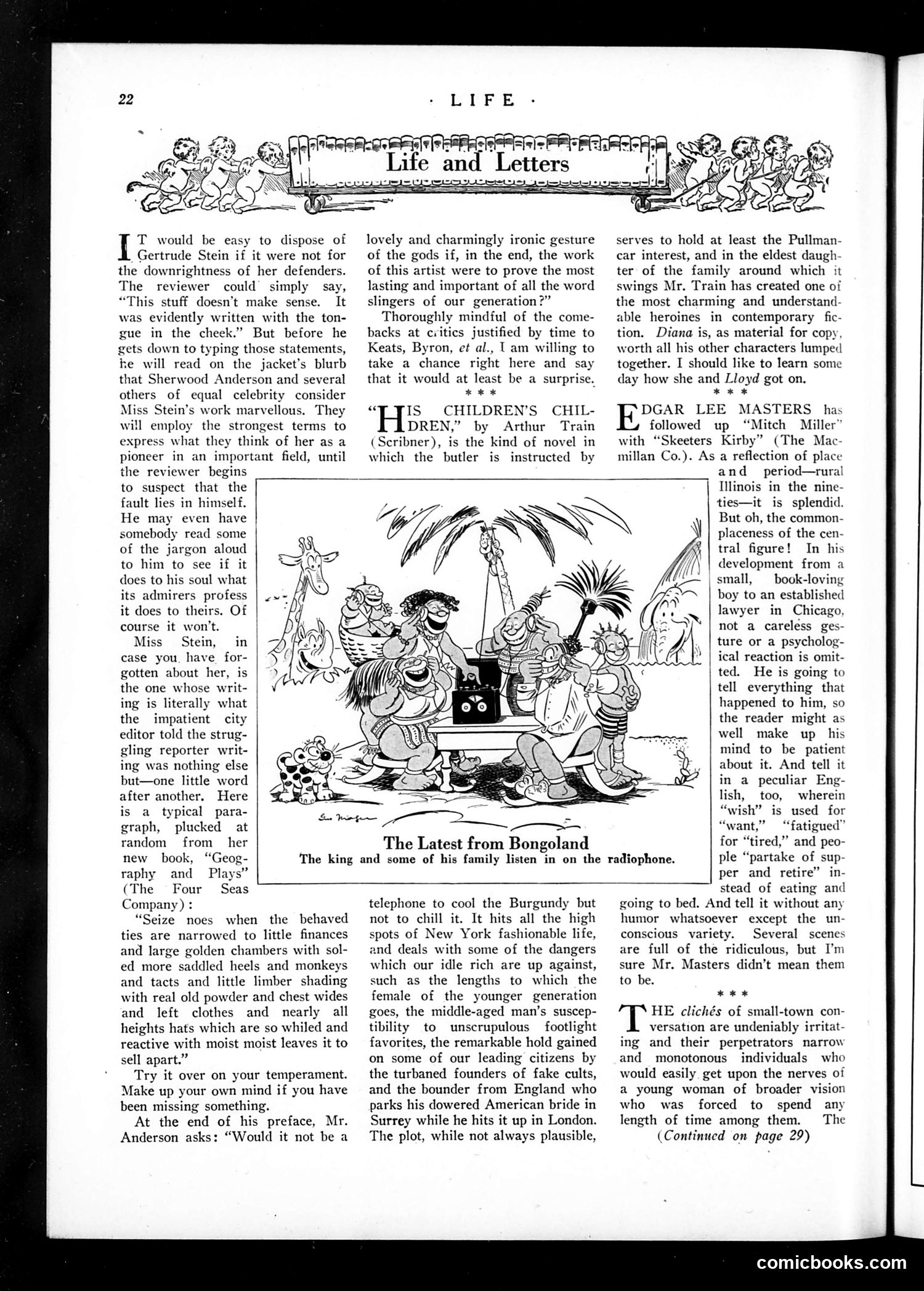
This page critiques **Gertrude Stein's experimental writing**, using satire to mock her incomprehensible prose style. The reviewer notes that while celebrity endorsers (Sherwood Anderson, et al.) praise Stein as a pioneering artist, her actual writing is nonsensical—literally "one little word after another" with no logical connection. The quoted passage exemplifies this: deliberately meaningless phrases like "saddled heels and monkeys" and "moist moist leaves." The cartoon **"The Latest from Bongaland"** depicts a colonial-era king listening to a radiophone, likely satirizing how exotic/"primitive" peoples are portrayed in media—a racist trope common to 1920s Life magazine. The page also reviews books by Arthur Train and Edgar Lee Masters, offering contrasting examples of conventional, readable fiction versus Stein's deliberate obscurity. The satire's point: Stein's defenders claim genius, but readers can judge the actual gibberish themselves.
📄 Transcribed text from this page (OCR, searchable)
Machine-transcribed from the original scan — historical spelling and the odd misread are preserved.
T would be easy to dispose of Gertrude Stein if it were not for the downrightness of her defenders. The reviewer could simply say, “This stuff doesn’t make sense. It was evidently written with the ton- gue in the cheek.” But before he gets down to typing those statements, ke will read on the jacket’s blurb that Sherwood Anderson and several others of equal celebrity consider Miss Stein’s work marvellous. They will employ the strongest terms to express what they think of her as a pioneer in an important field, until the reviewer begins LIFE e[el fe Sigasdce and Letters a lovely and charmingly ironic gesture of the gods if, in the end, the work of this artist were to prove the most lasting and important of all the word slingers of our generation?” Thoroughly mindful of the come- backs at critics justified by time to Keats, Byron, et al., | am willing to take a chance right here and say that it would at least be a surprise. * KE es IS CHILDREN’S CHIL- DREN,” by Arthur Train (Scribner), is the kind of novel in which the butler is instructed by wo serves to hold at least the Pullman- car interest, and in the eldest daugh- ter of the family around which it swings Mr. Train has created one of the most charming and understand- able heroines in contemporary fic- tion. Diana is, as material for copy, worth all his other characters lumped together. I should like to learn some day how she and Lloyd got on. xk * DGAR LEE MASTERS has followed up “Mitch Miller” with “Skeeters Kirby” (The Mac- millan Co.). As a reflection of place and __ period—rural to suspect that the fault lies in himself. He may even have somebody read some of the jargon aloud to him to see if it does to his soul what its admirers profess it does to theirs. Of course it won't. Miss Stein, in case you. have for- gotten about her, is the one whose writ- ing is literally what the impatient city | editor told the strug- gling reporter writ- ing was nothing else but—one little word after another. Here is a typical para- graph, plucked at random from her new book, “Geog- raphy and Plays” The Latest from Bongoland The king and some of his family listen in on the radiophone. Illinois in the nine- ties—it is splendid. But oh, the common- placeness of the cen- tral figure! In his development from a small, _ book-loving boy to an established lawyer in Chicago, not a careless ges- ture or a psycholog- ical reaction is omit- ted. He is going to tell everything that happened to him, so the reader might as well make up_ his mind to be patient about it. And tell it in a peculiar Eng- lish, too, wherein “wish” is used for “want,” “fatigued” for “tired,” and peo- ple “partake of sup- per and retire” in- (The Four Seas Company) : “Seize noes when the behaved ties are narrowed to little finances and large golden chambers with sol- ed more saddled heels and monkeys and tacts and little limber shading with real old powder and chest wides and left clothes and nearly all heights hats which are so whiled and reactive with moist moist leaves it to sell apart.” Try it over on your temperament. Make up your own mind if you have been missing something. At the end of his preface, Mr. Anderson asks: “Would it not be a telephone to cool the Burgundy but not to chill it. It hits all the high spots of New York fashionable life, and deals with some of the dangers which our idle rich are up against, such as the lengths to which the female of the younger generation goes, the middle-aged man’s suscep- tibility to unscrupulous footlight favorites, the remarkable hold gained on some of our leading citizens by the turbaned founders of fake cults, and the bounder from England who parks his dowered American bride in Surrey while he hits it up in London. The plot, while not always plausible, stead of eating and going to bed. And tell it without any humor whatsoever except the un- conscious variety. Several scenes are full of the ridiculous, but I’m sure Mr. Masters didn’t mean them to be. **e* HE clichés of small-town con- versation are undeniably irritat- ing and their perpetrators narrow and monotonous individuals who would easily get upon the nerves of a young woman of broader vision who was forced to spend any length of time among them. The (Continued on page 29) comicbooks.com